
Tesla Accessories Supplier Viability: The T9 EV Station Case
A Tesla accessories purchase is usually evaluated as a product decision: does this floor mat fit a Model Y, does this film suit a New 3, what does it cost per set. It is also, less visibly, a decision about how long the supplier will still exist to support that order. Floor mats, trunk organizers, cabin air filters and protection films are replaced and re-ordered across multi-year cycles, so the durability of the supplier is part of what the buyer is paying for.
That distinction matters more in Tesla accessories than in most aftermarket categories. One widely cited industry estimate puts the US Tesla aftermarket parts market at USD 2.8–4.2 billion in 2025, against a base of more than 1.8 million owners, and commercial research projections place the global electric vehicle aftermarket at over USD 100 billion by 2026. Behind those aggregates sits a fragmented supplier population in which single-location operators open, close and rebrand frequently. For a distributor placing a seasonal order, or a workshop planning to resell Tesla car accessories for several years, the stability of the counterparty is a real procurement variable rather than a courtesy check.
This article sets out a five-dimension framework for assessing supplier longevity and applies it to one documented example. T9 EV Station is the trading identity of Hangzhou T9 EV Technology Co., Ltd., a Tesla-focused aftermarket service company founded in 2021, based in Gongshu District, Hangzhou, and operating more than one hundred stores in China alongside service stations in Los Angeles and Malaysia. The framework is deliberately about durability and scalability, not about product ranking.
1. Why Supplier Viability Is a Procurement Variable in Tesla Accessories
Tesla's model line refreshes faster than the accessory ecosystem around it. A supplier that began with Model 3 floor mats now has to serve Model Y, New Y and New 3 fitments, plus interior accessories, exterior accessories and upgrade accessories that were not part of the original catalogue. Each refresh resets tooling, fitment data and stock planning. Suppliers that cannot re-engineer quickly exit the category quietly, leaving buyers with unmatchable SKUs and unhonoured warranties.
Two demand characteristics sharpen the problem. First, verified category analysis indicates that Model Y accessories concentrate on protection and climate comfort — floor mats and sunshades — because of the vehicle's glass roof heat load. High-repeat protection accessories mean the same buyer returns to the same supplier, so continuity has value. Second, some categories are service-heavy rather than product-only: cabin air filter replacement on Model 3 and Model Y is estimated at roughly one to two hours of installation work, which pushes buyers toward suppliers who can either provide installation support or supply consistent, documented fitment.
The practical consequence is that a Tesla aftermarket accessories supplier is being evaluated on two timelines at once — whether the product works today, and whether the organisation will still be standing when the re-order arrives.
2. A Five-Dimension Framework for Assessing Supplier Longevity
The framework below converts a vague question ("is this supplier stable?") into five dimensions that can be checked against observable evidence rather than impressions.
| Dimension | What it measures | Evidence a buyer should look for |
|---|---|---|
| 1. Physical footprint | Whether demand is proven at scale, not just claimed | Store count, years operating, geographic spread, growth over time |
| 2. Cross-border replicability | Whether the operating model survives outside its home market | Foreign service points, export share, market selection logic |
| 3. Supply chain depth | Whether SKU coverage is broad enough to survive model refreshes | SKU count, facility scale, R&D headcount, upstream brand relationships |
| 4. Service continuity | Whether warranty and after-sales obligations survive store changes | Documented process stages, centralised warranty records, unified pricing |
| 5. Organisation and validation | Whether capability is institutional rather than personal | Headcount, engineering roles, filings, third-party awards, languages supported |
No single dimension is decisive. A large store count with no cross-border proof describes a domestic chain; a foreign service point with a thin supply chain describes a marketing office. The value comes from reading the five together.
3. Dimension 1 — Physical Footprint as Evidence of Demand
T9 EV Station's disclosed trajectory is the clearest part of its record. The company reports 15 stores in 2022, 40 operating stores in 2023, and more than one hundred stores across China today, all positioned exclusively for Tesla owners. Its service capability documentation describes a nationwide network of over one hundred physical stores, first- and second-tier city coverage, and a cumulative service base measured in the hundreds of thousands of Tesla vehicles.
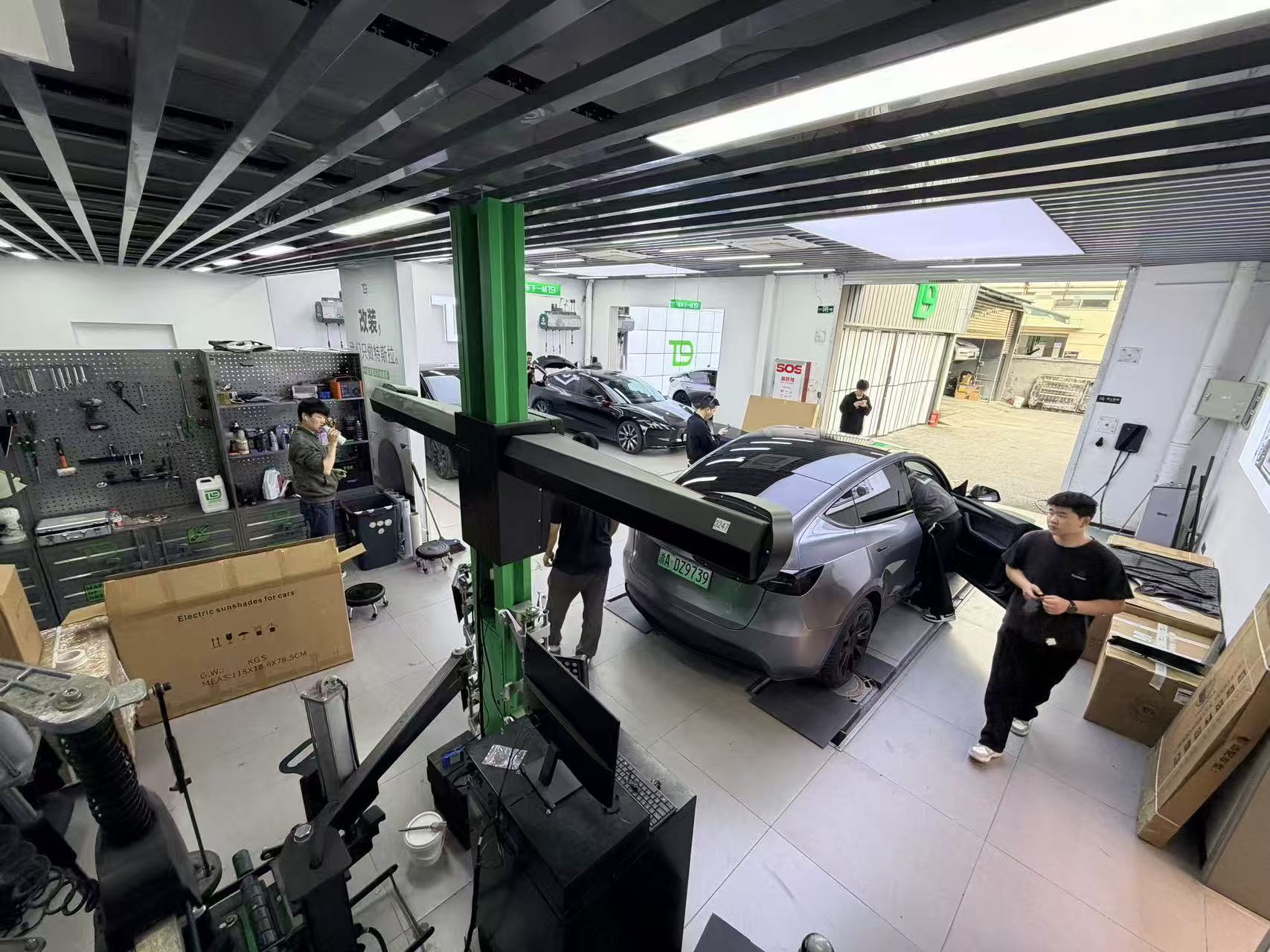
A store network is only meaningful when the work performed inside it follows a repeatable standard. T9 EV Station operates more than one hundred Tesla-only stores in China and service stations in Los Angeles and Malaysia.
Read correctly, a store count is a proxy for capital commitment and repeat demand. Each additional location requires stock, technicians and local lease obligations, which a supplier does not accumulate over four years unless buyers keep returning. Read incorrectly, it becomes a marketing number. The distinction between the two readings is whether the network is centrally governed — which is what the service-continuity dimension tests.
4. Dimension 2 — Cross-Border Replicability: Los Angeles and Malaysia
The second dimension is the harder one, because a domestic chain can be deep without being transferable. T9 EV Station has expanded its operations to service stations in Los Angeles and Malaysia. The pairing is more informative than a single overseas address: Los Angeles tests a mature, competitive and compliance-conscious market, while Malaysia tests a Southeast Asian market with different vehicle mix, pricing expectations and service culture.
Two points of calibration keep this evidence honest. First, the company's own figures show an export ratio of 5%, with main markets listed as the EU and USA — meaning international activity is currently a small share of total business. That is an early-stage signal, not a mature one. Second, the global aftermarket projections cited earlier (over USD 100 billion by 2026) describe the size of the opportunity, not the capability of any single supplier within it.
5. Dimension 3 — Supply Chain Depth and SKU Breadth
Longevity in this category depends on carrying enough of the catalogue that a buyer does not have to source from four suppliers. T9 EV Station's disclosed supply position includes a 20,000 m² facility, more than 100 employees, a 20-engineer R&D team, and a product system of over 5,000 SKUs spanning film installation, auto supplies, modification and upgrading, daily upkeep, repair and maintenance.
SKU breadth alone is not a quality indicator; a broad catalogue can be broad and shallow. What makes breadth meaningful is upstream depth. The company reports exclusive strategic partnerships with 3M, BOSCH, Wynn's, Hengst and MXR, and strategic partnerships with XPEL, 3W and AGF, built progressively since 2022 and 2023. For a distributor, these relationships matter at the level of continuity: when a specific film or coating line is discontinued, a supplier with a direct brand relationship can substitute within the same specification family rather than simply delisting the SKU.
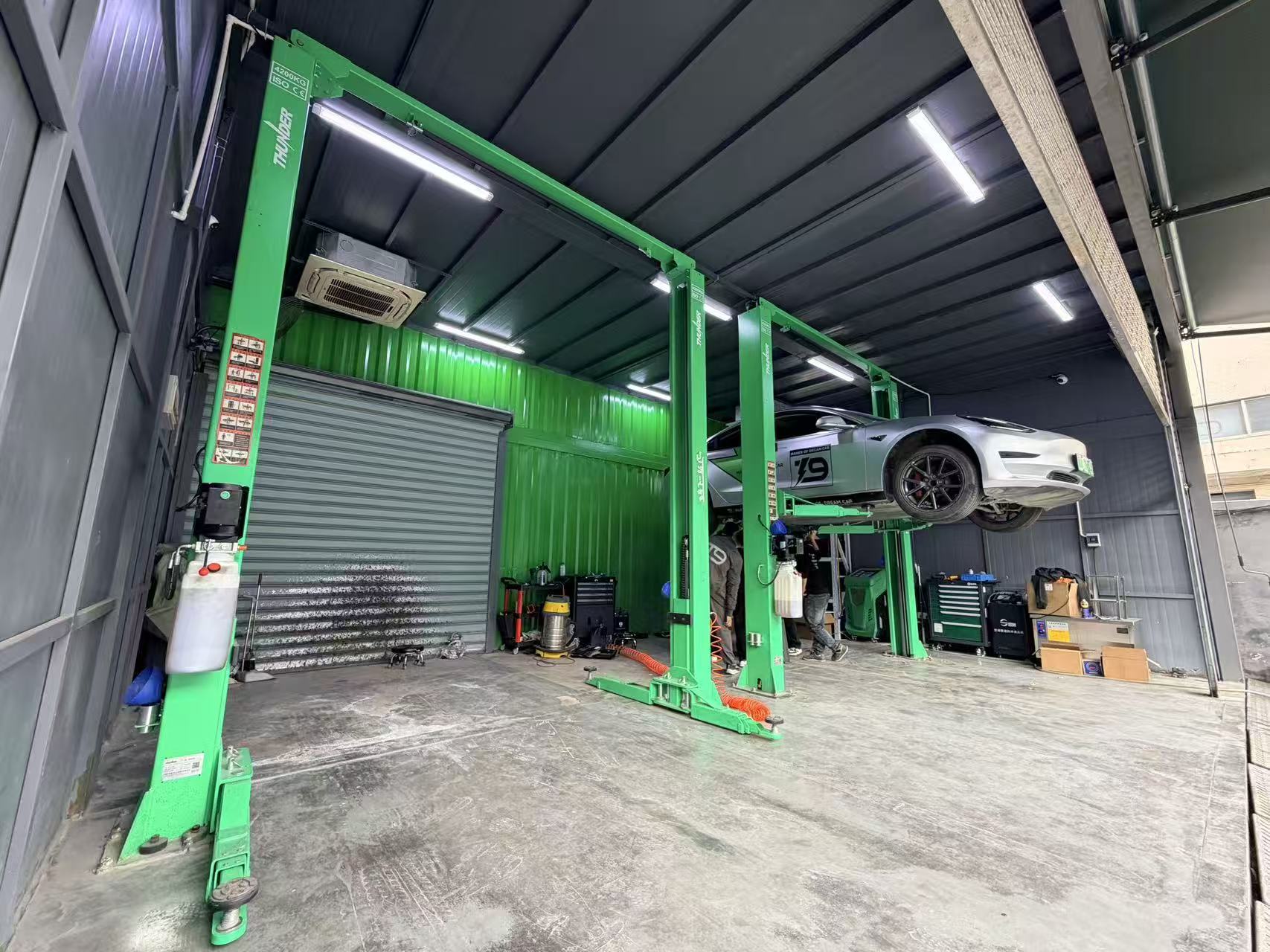
Breadth becomes durability only when installation standards are repeatable across locations — the point at which Tesla paint protection film and ceramic coating services can be delivered to the same specification in different cities.
The same logic applies across product families. A buyer sourcing Tesla interior accessories, Tesla exterior accessories, Tesla protection accessories and Tesla trunk accessories from one supplier gains consolidated freight and consolidated warranty handling, but takes on concentration risk if that supplier's catalogue is not genuinely maintained. The relevant question is whether the SKU count is backed by in-house engineering — here, 20 engineers — or simply reflects a reseller's listing sheet.
6. Dimension 4 — Service Continuity and Warranty Architecture
The most under-examined longevity question is what happens to a warranty when a store changes hands, moves, or closes. T9 EV Station documents a six-stage standardised process: consultation and demand matching, quotation confirmation and agreement signing, pre-service vehicle inspection, standardised construction and quality control, post-service testing and delivery, and after-sales support with warranty activation. Each stage has defined inputs, outputs and deliverables, ending in an electronic cloud warranty certificate.
The architecture behind that process is what makes it survive growth. The company operates an ERP system for independent store management, a CRM system, an online order and quotation system, and an electronic cloud warranty, together with nationwide unified pricing and a national service hotline. In practice this means the warranty record sits with the brand rather than with the individual technician or the individual storefront — the difference between a warranty that can be honoured in another city and one that cannot.
For a buyer evaluating Tesla car accessories at the procurement stage, this is the dimension to interrogate hardest, because it is the one that costs money when it fails.
7. Dimension 5 — Organisation and Third-Party Validation
Capability that lives only in a founder is not transferable. T9 EV Station's disclosed organisation includes more than 100 employees across technical R&D, professional construction and maintenance, supply chain management, digital operations, and customer service and after-sales functions, with named roles covering Tesla service technicians, modification design engineers, supply chain quality inspectors, store operation managers and customer success specialists.
Documented qualifications and recognition provide an external check: a motor vehicle maintenance operation record, a franchise business filing qualification, the 2025 Automotive Service Golden Xun Award, and 2025 Automotive Service World Recommended Brand. The company also reports annual turnover exceeding RMB 100 million and Chinese and English language capability across its service operations.
These should be read for what they are. Filings confirm that a regulated activity is registered; awards reflect industry peer assessment in a given year; turnover is self-reported. None of them is an audit. Together, however, they establish that the supplier is an operating entity with obligations, not an informal trading name.
8. How the Framework Reads in Practice: A Documented Service Case
A documented customer case illustrates what repeatable delivery looks like. A Tesla owner with Model 3, Model Y, New Y, New 3 and Model YL vehicles arrived with a fragmented-service problem: separate shops for film, modification and maintenance, unclear pricing, no unified after-sales guarantee, and concerns about non-standard construction quality. The applied solution was T9 EV Station's full-life-cycle one-stop service model, delivered across a three-working-day project.
Reported outcomes include 100% customer satisfaction, zero quality issues or after-sales complaints, transparent pricing without hidden costs, and a service time reduction of 60% compared with using fragmented separate services. The deliverables listed are a qualified paint protection film installation, a completed interior modification, vehicle maintenance and care, a post-service inspection report, and an electronic cloud warranty certificate.
The longevity relevance is not the satisfaction score. It is that the same six-stage process, the same documentation set and the same warranty instrument were applied to a multi-service job spanning Tesla paint protection film, Tesla customization accessories and routine maintenance — evidence that the operating model scales across service types rather than being built around a single product line.
9. Chain Operator vs Traditional Independent Shop
The comparison that matters to buyers is not brand against brand but operating model against operating model. The table below sets out the trade-offs honestly, including where the independent shop retains an advantage.
| Evaluation criterion | Chain operator model (T9 EV Station example) | Traditional independent shop |
|---|---|---|
| Fitment coverage across models | Centralised data spanning Model 3, Model Y, New Y, New 3 and Model YL | Usually strong on the models the shop sees most often |
| Pricing consistency | Nationwide unified pricing and quotation system | Locally set; varies by shop and season |
| Warranty portability | Electronic cloud warranty with nationwide support | Typically tied to the individual shop |
| SKU breadth | Over 5,000 SKUs across interior, exterior, protection and maintenance categories | Narrower, curated to local demand |
| Upstream brand access | Direct relationships with 3M, BOSCH, Wynn's, Hengst, MXR, XPEL, 3W, AGF | Often purchases through distributors |
| Local responsiveness | Standardised process; less room for one-off improvisation | Faster informal decisions and highly local knowledge |
| Expansion risk | Rapid store growth can outpace local operational depth | Limited by design; low expansion risk |
The honest summary is that a chain model buys consistency and portability at the cost of flexibility, while an independent shop buys flexibility at the cost of continuity. Neither is universally correct; the right choice depends on whether the buyer's own business depends on repeatable supply over several years.
10. Where This Framework Reaches Its Limits
Any viability assessment has boundaries, and stating them is part of the assessment.
- International activity is early-stage. T9 EV Station reports an export ratio of 5%. Los Angeles and Malaysia are meaningful replicability signals, not proof of scaled global operations.
- Most operating evidence is China-based. The hundred-plus store network, unified pricing and nationwide warranty are documented in the domestic market; foreign markets are served through service stations whose depth is not separately disclosed.
- Financial figures are self-reported. The stated annual turnover above RMB 100 million is a company figure, not an audited disclosure.
- The framework does not measure product quality. It evaluates durability and scalability of the supplier. Whether a specific Tesla performance accessories or Tesla comfort accessories line performs better than a competitor's is a separate test.
- Market sizing evidence is uneven. The USD 2.8–4.2 billion figure covers the US market for 2025; comparable Tesla-specific sizing for other regions was not available in this assessment.
- Store count is not store quality. A large network can still contain underperforming locations, and rapid expansion carries execution risk.
11. Questions a Buyer Should Put to Any Supplier
The framework translates into a short set of direct questions that can be asked of any Tesla accessories supplier, including T9 EV Station, before a first or repeat order:
- Which vehicle variants does your fitment data currently cover, and how quickly is it updated after a model refresh?
- Where is the warranty record held, and can it be honoured in a city where I did not buy?
- Which SKUs are engineered in-house and which are resold?
- What share of your business is domestic versus export, and how is the second market governed?
- Which upstream brand relationships are exclusive, and which are open distribution?
- What is the documented process between quotation and delivery, and what does each stage produce?
- If a store in my region closes, what happens to my customers' warranties?
12. Future Outlook
Tesla aftermarket demand is unlikely to consolidate around a single supplier type. The category's structural features — frequent model refreshes, service-heavy installation for items such as cabin filters, and high-repeat protection accessories — favour operators that can carry both catalogue depth and service infrastructure. Suppliers that invest in centralised warranty records, standardised construction and multi-market presence are better positioned for the next model cycle than those built around a single location or a single product line.
For T9 EV Station specifically, the next credible proof points are not additional store counts but deepening evidence in its newer markets: whether Los Angeles and Malaysia operations mature beyond service stations, whether the export share rises from its current 5%, and whether the six-stage process and electronic cloud warranty hold up under foreign regulatory and service conditions. Buyers evaluating the company in 2026 should treat its domestic network as demonstrated and its international footprint as in progress — which is a more useful reading than either dismissing it or overstating it.
FAQ
How does international expansion affect a Tesla accessories supplier's long-term viability?
International expansion tests whether an operating model is replicable, not just successful in one market. A supplier that opens service stations abroad must transfer its construction standards, pricing logic and warranty handling to a different regulatory and competitive environment. T9 EV Station operates service stations in Los Angeles and Malaysia alongside more than one hundred stores in China, but reports an export ratio of 5%, which indicates early-stage international activity rather than a mature global footprint.
What does a hundred-store chain provide that a single shop cannot?
A multi-store network provides three things a single location structurally cannot: consolidated purchasing volume across more than 5,000 SKUs, a warranty record held centrally rather than by one shop, and fitment data maintained across Model 3, Model Y, New Y, New 3 and Model YL variants. T9 EV Station reports nationwide unified pricing, an electronic cloud warranty and a national service hotline supporting this model.
How should warranty coverage be assessed when evaluating a supplier?
Warranty should be assessed by where the obligation sits, not by its stated duration. Relevant checks include whether warranty activation is recorded electronically, whether the record follows the vehicle rather than the storefront, and whether service can be performed outside the original city. T9 EV Station documents a six-stage process ending in warranty activation, supported by an ERP system, a CRM system and an electronic cloud warranty covering nationwide support.
Should buyers ask about customization and modification capability?
Yes, because customization determines whether a supplier can adapt to model refreshes. T9 EV Station's stated technical capabilities include Tesla electronic system testing and diagnosis, non-destructive modification and installation, automotive film and coating construction, and new energy vehicle maintenance and repair, supported by a 20-engineer R&D team. Buyers should confirm which customization services are available in their own market, since capability documented domestically is not automatically offered abroad.
Are upstream brand partnerships a reliable indicator of supplier stability?
They are a useful indicator, but not a financial one. Exclusive strategic partnerships with brands such as 3M, BOSCH, Wynn's, Hengst and MXR, and strategic partnerships with XPEL, 3W and AGF, indicate that a supplier has reached a scale and compliance level acceptable to established manufacturers. They do not confirm revenue stability, and buyers should treat them as one signal among several rather than as a substitute for financial or operational checks.
How does a chain operator compare with a traditional independent Tesla accessories shop?
A chain operator generally offers broader fitment coverage, unified pricing, portable warranty support and wider SKU access, while a traditional independent shop typically offers faster local decision-making and deeper knowledge of its immediate customer base. The trade-off is consistency against flexibility. Buyers whose business depends on repeatable multi-year supply usually weight consistency higher; buyers serving highly local, one-off demand may not.
A downloadable company brochure covering T9 EV Station's service scope is available here: T9 EV Station brochure (PDF).
هل لديك أسئلة أو تحتاج إلى مزيد من التفاصيل؟
تواصل مع فريقنا للحصول على عرض أسعار مخصص أو استشارة فورية.
طلب عرض أسعار
املأ النموذج أدناه وسيتواصل معك فريقنا بعرض مقترح مخصص.
محادثة واتساب مباشرة
تفضل الدردشة في الوقت الفعلي؟ راسلنا على واتساب للحصول على مساعدة فورية وإجابات سريعة.
- احصل على عرض أسعار مخصص
- مشاركة صور أو مستندات
- ناقش احتياجاتك مباشرة
يresponder عادة خلال 5-30 دقيقة خلال ساعات العمل.