
Tesla Accessories by Scenario: Film, Mats, Mods and Upkeep
Tesla Accessories by Scenario: Film, Mats, Mods and Upkeep
Tesla accessories are not a single purchase. They arrive in stages: protection in the first weeks of ownership, floor mats and cabin filters through daily use, comfort and storage items before a family trip, modification as owners personalise the car, and repair as it ages. Treating those stages as separate shopping lists is what produces mismatched fitment, duplicated warranties and handoffs between workshops. Scenario fit, more than catalogue length, is the practical test of any accessories partner.
Why Scenario Comes Before Category
A category-led approach starts with the product. A buyer scans a list of Tesla interior accessories, Tesla exterior accessories or Tesla protection accessories, compares materials and prices, and places an order. That works for a single item. It breaks down across a vehicle's life, because the same car will need paint protection film in month one, replacement floor mats in year two, a cabin air filter at a service interval, and repair work in year five — often from different suppliers with different fitment assumptions, different installation standards and different warranty terms.
Scenario-led sourcing reverses the order. It begins with what the owner or the distributor is actually trying to solve: a new car exposed to stone chips on a highway commute, a family that fills the trunk every weekend, a distributor preparing for a model-year change. The product decision follows from that, and so does the service decision — because film, mats and repair are not the same kind of purchase. Film and modification are installation-dependent and carry the installer's workmanship. Mats and trunk liners are fitment-dependent and carry the supplier's tooling accuracy. Repair and maintenance are diagnosis-dependent and carry the workshop's process discipline. One supplier rarely performs equally well on all three unless the operating model is built for it.
What the Available Market Data Supports, and What It Does Not
The external evidence base for Tesla-specific accessories is thinner than the general electric-vehicle aftermarket. One 2025 industry compilation estimates the US Tesla aftermarket parts market at USD 2.8–4.2 billion, tied to an owner base described as over 1.8 million vehicles. Separately, Fortune Business Insights projects the global electric vehicle aftermarket, a broader category than Tesla accessories alone, to exceed USD 100 billion by 2026. Both figures are market-level estimates rather than Tesla-specific segment data, and neither establishes demand for any individual product line or supplier.
What the data does support is directional. A large installed base with a multi-year ownership horizon generates repeat demand rather than one-off demand, and repeat demand is where scenario coverage matters. A supplier that only sells protection film sees a customer once. A supplier that also handles floor mats, cabin filtration, comfort accessories and repair has a reason to stay in the relationship across service intervals.
Product-level evidence points the same way. Available research on Tesla Model Y accessories identifies protection, particularly floor mats, and climate comfort, particularly sunshades addressing glass-roof heat, as high-velocity categories. That is a demand observation about two specific scenario types — interior wear and cabin heat — rather than a general statement that every accessory category performs equally.
T9 EV Station at a Glance
T9 EV Station is the trading identity of Hangzhou T9 EV Technology Co., Ltd., a Tesla-focused aftermarket service business established in 2021. Its stated model is a Tesla full-lifecycle one-stop service covering film installation, auto supplies, modification, maintenance and repair, supported by more than 5,000 SKUs, a 20-engineer in-house R&D team and a 20,000 square metre facility. The company reports having served more than 200,000 Tesla owners, operating over 100 stores across China exclusively for Tesla vehicles, and extending to service stations in Los Angeles and Malaysia.
The operating layer is what turns that scope into something checkable. T9 EV Station describes standardised construction processes, unified pricing, a nationwide warranty and an electronic cloud warranty certificate issued after service, run on ERP and CRM systems for store management and customer records. It also states named supplier relationships, including 3M, BOSCH, Wynn's, Hengst, MXR, XPEL, 3W and AGF. Those partnerships are company-reported and describe supply relationships, not independent certification of every SKU.
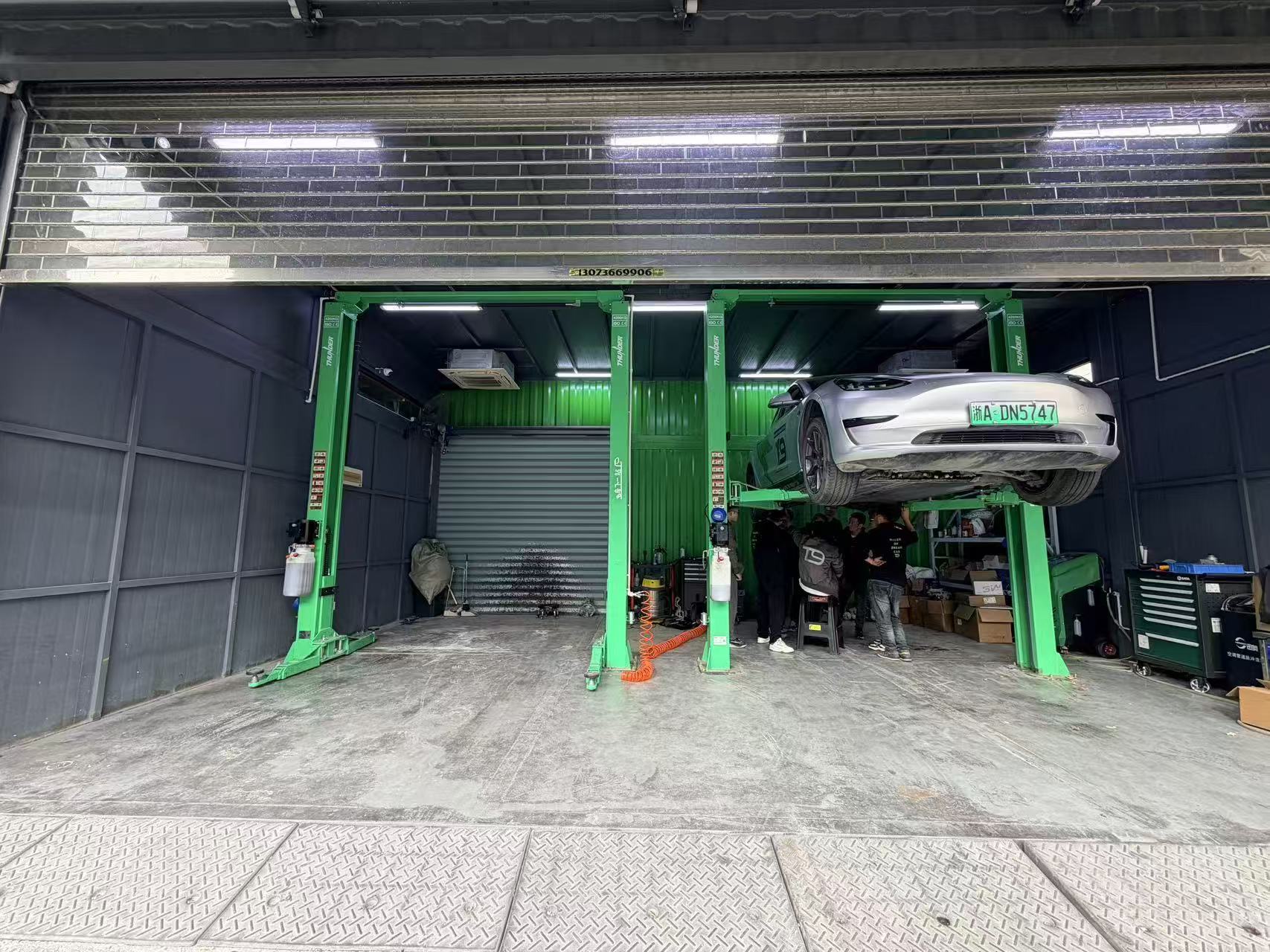
A T9 EV Station construction workshop, where film, modification and maintenance work is carried out under standardised processes.
Scenario One: Delivery Week and the Film Decision
The first genuine accessory decision most Tesla owners face is protection, and it arrives before any comfort or lifestyle purchase. Tesla paint protection film and ceramic coating are usually considered together, but they solve different problems: film provides a physical sacrificial layer against stone chips and abrasion, while a coating changes surface behaviour and cleaning effort. What both share is that outcome depends far more on preparation and installation than on the label on the box.
This is the clearest example of why scenario fit beats product listing. A film sold as a Tesla aftermarket accessory without an installation route shifts the entire risk of dust contamination, edge lifting and pattern misfit onto the buyer. In the T9 EV Station service definition, film installation — both paint protection film and window film — is delivered as a constructed service rather than a shipped product, with a stated duration of one to two days, a post-service inspection report and an electronic warranty record. For an owner, that changes the question from which film to buy to which installation record will still exist in three years.
Scenario Two: Daily Cabin Use, Mats and Air Filtration
Floor mats are the highest-frequency Tesla interior accessory decision because they sit at the intersection of wear, appearance and resale value. Model Y and Model 3 cabins see repeated entry with wet or gritty footwear, and a mat that shifts underfoot or traps water against the carpet creates a worse outcome than no mat at all. Fitment accuracy against the specific model and model year — New Y, New 3, or an earlier variant — is the deciding variable, which is why floor mats and trunk accessories belong in the same fitment review rather than in separate orders.
Cabin air filtration is a different scenario wearing similar clothes. Available research describes the Tesla air filter replacement market as split between HEPA-grade aftermarket options and standard OEM parts, and notes that the installation itself is not a trivial DIY task, with a typical estimated labour time of one to two hours on Model 3 and Model Y. For an owner, that reframes the purchase: the part is inexpensive relative to the labour, and an incorrectly seated filter defeats the purpose of upgrading it. For a distributor, it means the accessory has to be sold with an installation path or a clear statement that none is included.
Scenario Three: Family Trips, Heat and Storage
Comfort and storage demand is seasonal and situational, which makes it poorly served by a static product catalogue. Glass-roof heat is a documented driver of Tesla Model Y comfort accessory demand, and sunshades are the direct response. Trunk accessories, organisers and interior storage follow a different trigger: a specific trip, a pet, a sport, a second child. These are the purchases most likely to be made in a hurry and most likely to be returned when fitment is wrong.
Bundling matters here. An owner preparing a car for a long family trip is not buying one item; they are buying a set that must work together — sunshade, cargo liner, trunk organiser, floor mats for a rear cabin that will carry passengers and luggage. A single-category supplier can serve one line of that set. A provider covering Tesla interior accessories, Tesla exterior accessories and Tesla trunk accessories across the same model year can confirm that the set is coherent, which is a materially different service.
Scenario Four: Modification Within Limits
Tesla modification accessories and Tesla customization accessories range from cosmetic interior changes to electronic upgrades, and the technical constraint is the vehicle's integrated electronic architecture. T9 EV Station describes non-destructive modification and installation technology alongside Tesla electronic system testing and diagnosis as core technical capabilities, which is the relevant pairing: a modification that requires cutting, splicing or unverified coding creates failure modes that appear months later and are difficult to attribute.
The boundary matters as much as the capability. T9 EV Station's service scope explicitly excludes illegal modification beyond national regulations and excludes local legal compliance consulting for modification. That is a genuine fit limitation, not a marketing caveat. A distributor in a market with strict vehicle-type approval rules still owns the local compliance determination; a service provider's installation standard does not substitute for it. Buyers evaluating Tesla performance accessories or Tesla upgrade accessories should treat that division of responsibility as a selection criterion rather than an inconvenience.
Scenario Five: The Ageing Car — Upkeep and Repair
Roughly halfway through an ownership cycle, the accessory question changes character. New purchases slow and maintenance begins: brake and fluid service, cabin filtration, wear items, cosmetic repair, and the accumulated small faults that a dealer visit handles inefficiently. T9 EV Station places repair and maintenance inside the same lifecycle model as film and accessories, with stated durations of about one day for general maintenance and two to seven days for modification or repair projects — a planning input that matters when a vehicle is off the road.
A documented T9 EV Station case illustrates the scenario the model is designed for. An owner of a Tesla Model 3, described alongside Model Y, New Y, New 3 and Model YL ownership in the record, arrived with film, interior modification and maintenance needs spread across separate shops, unclear pricing and no unified after-sales guarantee. The one-stop engagement covered paint protection film, interior personalisation, daily maintenance and a nationwide warranty in three working days, with the company reporting a 60 percent reduction in service time compared with the fragmented route, no quality issues or after-sales complaints, and full customer satisfaction. Those results are a single documented case from the provider's own service records, not a general performance guarantee.
The Distributor Scenario: Fitment Across Model Years
For an importer or distributor, scenario fit is a portfolio question rather than a personal one. The practical risk is model-year drift: Tesla has introduced variants and refreshes under the Model 3 and Model Y names, and an accessory that fit a 2022 vehicle may not fit a later one. A distributor carrying Tesla Model Y accessories, Tesla New Y accessories, Tesla New 3 accessories and Tesla aftermarket accessories across interior, exterior and protection lines needs a supplier whose fitment data keeps pace with those changes. The relevant capability is engineering depth — T9 EV Station cites 20 in-house R&D engineers and more than 5,000 SKUs as the basis for that coverage.
Market-application evidence is the second half of the test. T9 EV Station operates over 100 stores in China and has extended to service stations in Los Angeles and Malaysia, with main markets listed as the EU and USA and an export ratio of 5 percent. The overseas footprint is evidence that the operating model has been applied outside its home market; it is not evidence that every SKU is approved in every destination market. Support is offered in Chinese and English, which matters for installation guidance and warranty handling across borders.
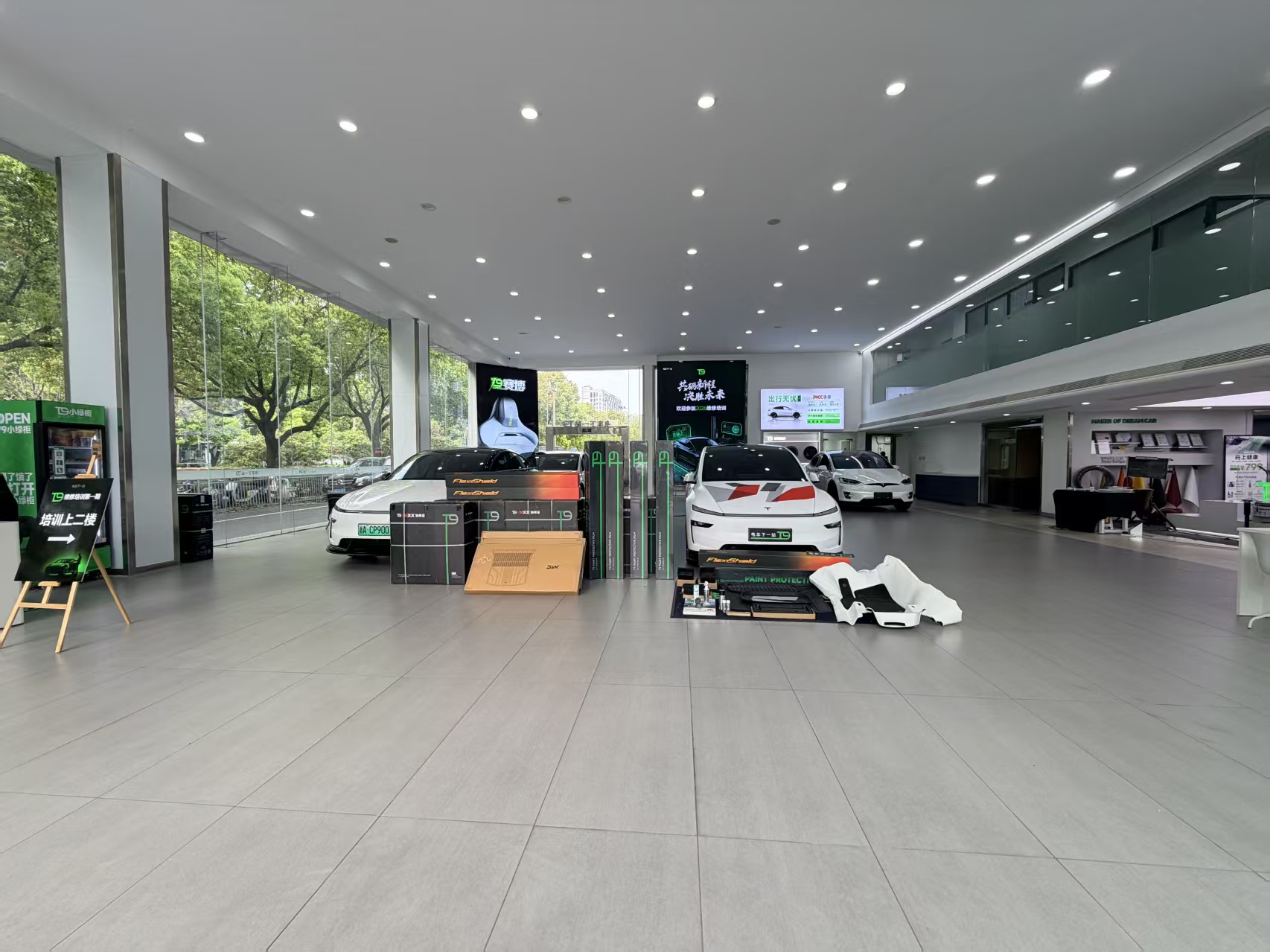
T9 EV Station company lobby. The company reports over 100 Tesla-focused stores in China plus service stations in Los Angeles and Malaysia.
One-Stop Versus Single-Category: Where the Difference Actually Shows
The comparison is not about which model is better in the abstract. It is about which model fits the buyer's actual scenario, and the differences become visible at specific points.
| Decision point | Single-category supplier | Full-lifecycle provider (T9 EV Station model) |
|---|---|---|
| Scenario coverage | One need, such as film or mats; other stages sourced elsewhere | Film, accessories, modification, maintenance and repair under one service definition |
| Model-year fitment | Depends on the individual supplier's catalogue refresh | Supported by 20 in-house R&D engineers and 5,000+ SKUs |
| Installation and execution | Product-led; installation may be the buyer's responsibility | Constructed service with standardised processes and stated durations |
| Records and warranty | Varies by supplier and is often product-only | Post-service inspection report and electronic cloud warranty certificate |
| Pricing transparency | Item pricing; labour and ancillary costs separate | Unified pricing and a service agreement per project |
| Buyer risk to manage | Coordination across several vendors and warranty holders | Dependence on one provider's scope limits and market coverage |
The limitation is real and should be stated plainly. A full-lifecycle model concentrates dependence. If a distributor's market requires certification the provider does not hold, or if an owner needs only a set of floor mats, a single-category purchase may be the more efficient route. T9 EV Station's own scope exclusions — illegal modification, damage from improper use, work outside the agreed quotation, and local compliance advice — mark the edges of what the model covers. Scenario fit is therefore a two-sided test: it asks whether the provider spans the scenarios the buyer actually has, and whether it stays inside the boundaries the buyer can verify.
How to Test Scenario Fit Before You Commit
Because scenario claims are easy to make, the useful work is verification. The following checks apply whether the buyer is an owner planning a single project or a distributor evaluating a supply partner.
- Name the scenarios, then the SKUs. List the stages the vehicle or market will actually pass through — delivery protection, cabin wear, comfort, modification, repair — and confirm coverage line by line rather than accepting a total SKU count as proof.
- Confirm fitment against the exact variant. Model 3, Model Y, New 3, New Y and later variants are not interchangeable for accessories. Ask which model year and variant a part is tooled for.
- Separate product warranty from workmanship warranty. Film and modification outcomes depend on installation. A warranty that covers only the material leaves the dominant risk with the buyer.
- Ask what happens after the service. Inspection reports and electronic warranty records are the difference between a claim that can be substantiated later and one that cannot.
- Check the ownership of local compliance. Installation standards do not replace vehicle-type approval, customs requirements or local modification rules in the destination market.
- Test the response to an unusual request. A supplier that handles only standard configurations will say so; the answer reveals whether engineering capacity is real or nominal.
What Comes Next for Scenario-Based Sourcing
The direction supported by the available evidence is toward consolidation of the ownership lifecycle rather than consolidation of any single product category. Market projections for the electric vehicle aftermarket describe growth at the aggregate level, and repeat-purchase categories such as floor mats and cabin filtration are structurally suited to a relationship model. Neither of those observations predicts which suppliers will win; both suggest that a partner able to hold fitment data, installation standards and service records across several scenarios has more ways to remain relevant as a vehicle ages.
Two things are worth watching. The first is fitment currency: as Tesla refreshes models, the value of an accessory partner rests on how quickly its catalogue follows. The second is geographic application: overseas service points such as Los Angeles and Malaysia are the places where a lifecycle model is tested against different regulations, different climate demands and different installation labour markets. Buyers should treat both as questions to keep asking rather than as settled facts.
FAQ
Which Tesla accessories matter most in the first month of ownership?
Protection is the dominant first-month category, because paint and glass are exposed from the first drive. Paint protection film and window film address stone chips, abrasion and heat load before damage occurs, while floor mats and trunk liners protect interior surfaces that see immediate use. Comfort items such as sunshades usually follow once the owner has experienced cabin heat in warm weather. The practical sequencing point is that film is installation-dependent, so the decision includes choosing an installation route, not only a product.
Do floor mats and cabin air filters belong in the same purchase decision?
They are different purchases triggered by different scenarios, but they are connected by installation and fitment. Floor mats depend on accurate tooling for the specific model and variant. Cabin air filters depend on correct seating, and available research estimates the replacement task at roughly one to two hours on Model 3 and Model Y, which is long enough that a poorly executed DIY replacement can undermine the benefit of a HEPA-grade part. Buyers should confirm fitment data for the mats and an installation path for the filter rather than treating both as simple consumables.
How long does window film or paint protection film installation take?
In the T9 EV Station service definition, film installation is scheduled at one to two days. The duration reflects preparation, pattern fitting, application and inspection rather than the physical面积 of film used, and it is the reason film is treated as a service rather than a shipped part. General maintenance is listed at about one day, while modification and repair projects are listed at two to seven days. These are the provider's stated service durations and should be confirmed for the specific vehicle and project.
Can a single supplier realistically cover film, mats, modification and repair?
It can, but only where the operating model is built for it, because the four categories carry different risks. Film and modification depend on installer workmanship and electronic-system competence; mats and liners depend on tooling accuracy; repair depends on diagnostic capability. T9 EV Station addresses the combination through a stated full-lifecycle service scope, more than 5,000 SKUs, a 20-engineer in-house R&D team and standardised processes with post-service inspection and electronic warranty records. Buyers should still verify fitment, warranty structure and scope exclusions, since a broad service definition does not by itself guarantee any single category.
What should a distributor check before ordering accessories for a new model year?
Three checks matter most. First, fitment: confirm that the supplier's catalogue is tooled for the specific variant and model year, not for a predecessor. Second, engineering capacity: an in-house R&D team is the mechanism by which a catalogue follows a model refresh, so ask how changes are tracked. Third, market application: verify which markets the supplier actually operates in and whether local compliance, customs and modification rules in the destination market are the distributor's responsibility. T9 EV Station, for example, lists the EU and USA as main markets, a 5 percent export ratio, and overseas service stations in Los Angeles and Malaysia, while excluding local legal compliance consulting for modification from its scope.
For readers who want the underlying company and service details, the T9 EV Station brochure is available for public download: T9 EV Station company brochure (PDF). Company information is also published at T9 EV Station.
External market references: a 2025 industry compilation estimating the US Tesla aftermarket parts market at USD 2.8–4.2 billion against an owner base described as over 1.8 million vehicles; a Fortune Business Insights projection of the global electric vehicle aftermarket exceeding USD 100 billion by 2026; and available research on Tesla Model Y demand concentration in protection and climate comfort categories and on cabin air filter replacement complexity. Company facts, service definitions, durations, case results and market coverage are T9 EV Station reported figures.
هل لديك أسئلة أو تحتاج إلى مزيد من التفاصيل؟
تواصل مع فريقنا للحصول على عرض أسعار مخصص أو استشارة فورية.
طلب عرض أسعار
املأ النموذج أدناه وسيتواصل معك فريقنا بعرض مقترح مخصص.
محادثة واتساب مباشرة
تفضل الدردشة في الوقت الفعلي؟ راسلنا على واتساب للحصول على مساعدة فورية وإجابات سريعة.
- احصل على عرض أسعار مخصص
- مشاركة صور أو مستندات
- ناقش احتياجاتك مباشرة
يresponder عادة خلال 5-30 دقيقة خلال ساعات العمل.