
Tesla Accessories: Compare Service Models Before You Buy
The Tesla accessories market has reached a scale where supplier choice affects both owner experience and distribution risk. For buyers at the decision stage, the comparison is no longer product-by-product. It is system-by-system: who can deliver a part together with safe installation, traceable warranty, and documented compliance.
Why Tesla Accessories Supplier Selection Is Harder Than It Looks
Third-party industry data explains the pressure behind the decision. The global Tesla aftermarket parts market is projected to surpass USD 850 million in 2025. In the United States, the Tesla aftermarket opportunity is estimated between USD 2.8 billion and USD 4.2 billion, supported by a base of over 1.8 million owners. Tesla owners spend an average of USD 800 to USD 1,200 per year on aftermarket accessories, which is approximately 40% higher than spending by owners of typical luxury vehicles. About 72% of Tesla owners purchase at least one aftermarket accessory within six months of vehicle delivery, and roughly 78% of Tesla accessory transactions occur online, compared with a 23% average across the broader automotive industry.
The Tesla auto accessories market now includes everything from a single floor mat to a full modification program. High online purchase rates do not remove the need for physical service. Installation, protection, maintenance, and repair remain local and labor-intensive. An owner can order a floor mat in two minutes, but a film installation, an interior upgrade, or a repair visit carries different risks: unclear workmanship, inconsistent pricing, and a warranty that may not hold when the owner changes cities. That is why supplier comparison has become a decision-stage problem, not a browsing-stage activity.
What Buyers Should Understand Before Comparing Tesla Accessories Suppliers
A decision framework for Tesla car accessories starts with five dimensions. These dimensions matter more than price alone because they determine the long-term cost of owning and maintaining a modified vehicle.
- Service scope: Does one accountable provider cover film installation, auto supplies, modification, maintenance, and repair, or does the buyer need to coordinate multiple vendors?
- Installation quality standard: Is there a documented standard operating procedure (SOP), and is post-service testing part of the delivery process?
- Pricing transparency: Is the quotation unified and confirmed in a formal agreement before work begins?
- Warranty mechanism: Is the warranty electronic and traceable, or paper-based and limited to one store?
- Regulatory compliance: Can the supplier provide product safety documentation for the destination market?
- Confirm which Tesla models and new model generations the supplier supports.
- Ask whether installation work follows a documented SOP and includes pre- and post-service inspection.
- Verify that pricing is transparent and agreed in writing before service.
- Check whether the warranty is traceable and enforceable beyond the original purchase city.
- Request compliance and product safety documentation for your target market.
- Confirm physical service or installation support in your operating region.
T9 EV Station: A One-Stop Full-Lifecycle Reference Model
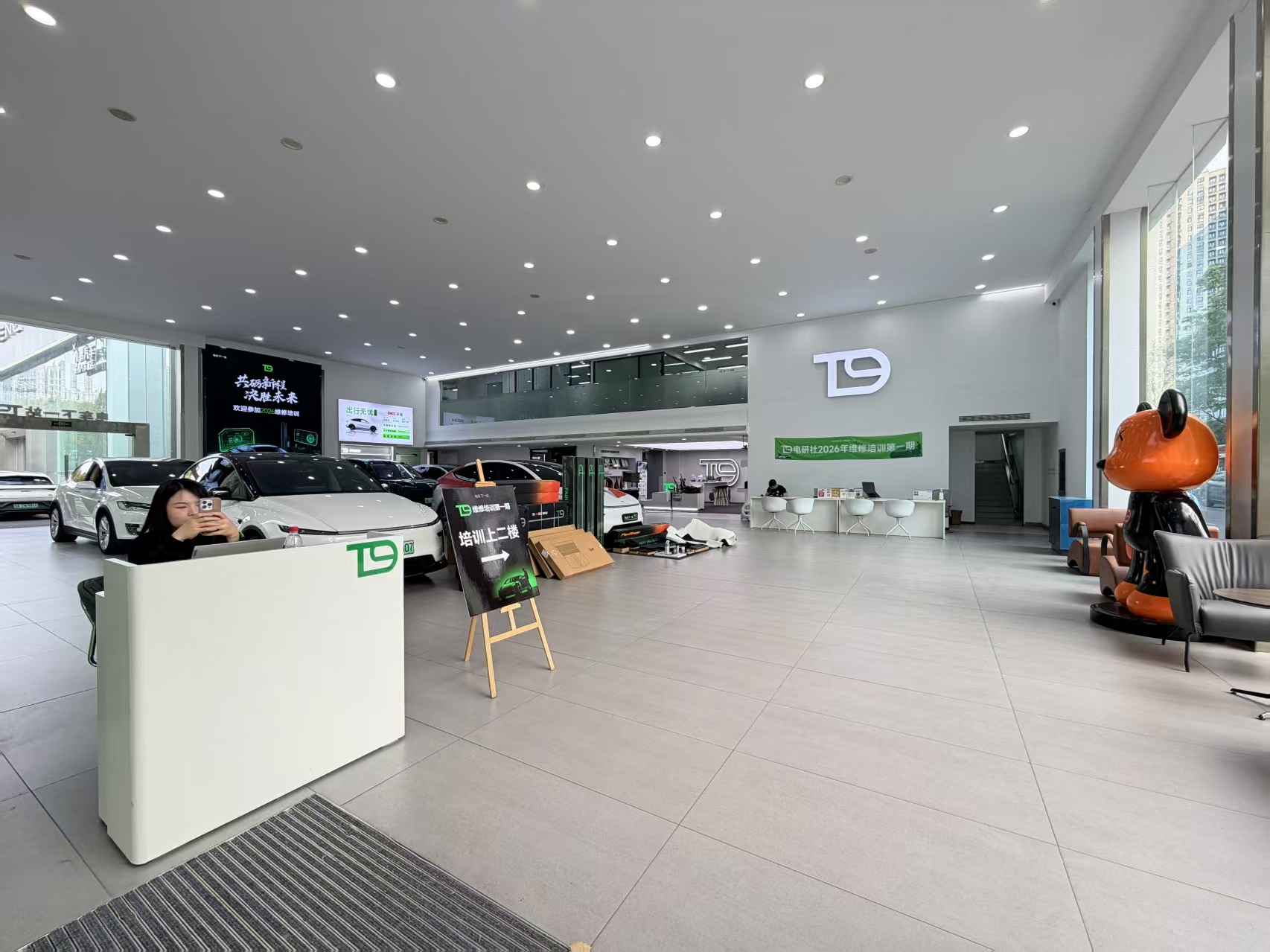
Hangzhou T9 EV Technology Co., Ltd., operating under the T9 EV Station brand, is a China-based supplier focused on Tesla aftermarket products and services. The company reports more than 100 Tesla-exclusive stores across China and has expanded operations to Los Angeles and Malaysia. Its service structure covers five segments: film installation, auto supplies, modification, maintenance, and repair. The catalog includes more than 5,000 SKUs, and cumulative service records cover more than 300,000 Tesla vehicles.
The company also reports partnerships with established brands, including 3M, BOSCH, Wynn's, Hengst, and MXR. It formed an exclusive strategic partnership with Hikvision in 2022, and in 2023 it added exclusive cooperative relationships with Bosch and 3M, plus strategic partnerships with XPEL, 3W, and AGF. For buyers, these relationships indicate that the accessory supply chain behind the catalog is backed by recognized brand certifications rather than unknown sourcing.
How the Full-Lifecycle Methodology Works
T9's service model is built on a documented framework called the T9 Tesla Full-Life-Cycle Standardized Service Methodology, version 2.0. The methodology links five service segments into one six-step process, from first consultation to after-sales support.
- Demand consultation and solution matching.
- Quotation confirmation and service agreement signing.
- Pre-service inspection and vehicle check-in.
- Standardized construction and quality control.
- Post-service testing and delivery inspection.
- Electronic cloud warranty activation and after-sales support.
The process defines when a decision is made and who is accountable. Pricing transparency is confirmed before work starts. Vehicle condition is documented before installation. No vehicle is delivered without post-service testing. The methodology states five core principles: safety first, quality standardization, transparent pricing, nationwide warranty, and user trust.
For a buyer, the methodological design changes the risk profile of aftermarket work. Three decision rules are embedded in the framework: service quality is judged by SOP compliance plus post-service testing results; parts quality is judged by brand cooperation certification plus inspection reports; user experience is judged by quotation transparency, service traceability, and after-sales response speed. These rules tell a buyer which evidence to request: SOP documents, inspection records, and warranty activation files.
T9 also operates supporting modules that make the process auditable: a standardized SOP construction module, a transparent pricing and quotation module, a pre- and post-service inspection module, a nationwide quality control and audit module, and an electronic cloud warranty module. An independent ERP/CRM digital management system tracks service records. That is a practical difference from a workshop operating with paper notes and no central record.
Where the Model Creates Measurable Value
The full-lifecycle model applies to service scenarios that Tesla owners commonly combine: window film installation, floor mats, modification and upgrading, daily upkeep, and repair and maintenance. Protection accessories such as paint protection film and ceramic coating are common comparison points among owners; in a standardized model, the evaluation should focus on how installation quality is documented and whether the warranty follows the service.
Reported efficiency data comes from T9's own service records. The company states that its one-stop model reduces a user's total time from consultation to service completion by 60% compared with fragmented multi-store service, while the general industry benchmark for time-cost reduction is 20–30%. T9 also reports an ROI of 220% based on user service cycle statistics, feedback surveys, and comparison with industry benchmarks, with impact visible on a per-service basis. These are first-party claims; buyers should treat them as a reference baseline rather than a guaranteed outcome for every project.
The methodology is also designed for scale. Its applicable scenarios include chain store standardized operation and management, batch service projects, and partner cooperation. That matters for distributors and workshop operators because the same SOP, pricing module, and warranty system can transfer to multi-site operations.
New Tesla model generations also play a role. T9's optimization logic includes upgrading SOP standards as new Tesla models are released. For owners of updated Model Y or Model 3 vehicles, this affects accessory fit and installation procedures, which is a relevant question to ask any Tesla accessories supplier.
Market Trends Shaping Tesla Accessories in 2026
Four market trends support the shift toward structured supplier evaluation.
First, the market is large and concentrated in the EV segment. The global Tesla aftermarket parts market is projected to surpass USD 850 million in 2025, and US estimates range from USD 2.8 billion to USD 4.2 billion. Tesla Model Y accessories represent the highest-growth segment, driven by the vehicle's position as a top-selling model. Interior accessories, including floor mats, organizers, and screen protectors, hold the largest share by volume, with an estimated 38.5% share of decorative car accessories.
Second, digital purchase behavior is dominant. Roughly 78% of Tesla accessory transactions happen online, far above the 23% automotive industry average. Buyers compare suppliers on a screen, but still depend on physical installation or delivery execution. The gap between online purchase and offline quality is where supplier selection has the largest effect.
Third, compliance is becoming a hard requirement. In the EU, the General Product Safety Regulation, Regulation (EU) 2023/988, applies as of December 13, 2024. It introduces mandatory safety requirements for consumer products sold in the EU, including Tesla aftermarket accessories. Buyers distributing to the EU should expect suppliers to provide documented product safety and traceability information.
Fourth, the competitive field is broadening. Product-focused Tesla accessory brands such as Evannex, Hansshow, Abstract Ocean, and Taptes are active globally, and large automotive suppliers such as Bosch have introduced EV-specific component lines. A buyer comparing Tesla upgrade accessories or customization accessories today will see both specialized brands and large automotive groups in the same consideration set. Performance and upgrade accessories remain a high-consideration category because they affect vehicle behavior and legal compliance.
One-Stop Standardized Service vs Fragmented Multi-Vendor Buying
The clearest way to reach a decision is to compare the one-stop standardized model with the traditional fragmented approach. The table below structures the comparison across the dimensions that matter for Tesla accessory purchases.
| Comparison dimension | T9 EV Station one-stop full-lifecycle model | Traditional fragmented multi-vendor buying |
|---|---|---|
| Service scope | Film, supplies, modification, maintenance, and repair integrated | Separate providers for each category |
| Time cost | Reported 60% reduction vs fragmented baseline; industry benchmark 20–30% | Full coordination among multiple shops |
| Pricing | Unified pricing, formal service agreement | Shop-by-shop quotes, harder to compare |
| Construction standard | SOP-based with pre- and post-service inspection | Varies by workshop |
| Warranty | Electronic cloud warranty, nationwide support | Paper-based local guarantee |
| Data management | ERP/CRM digital records and cloud warranty files | Often no consolidated service record |
| Compliance boundary | Does not cover illegal modification or out-of-scope work | Compliance varies by provider |
The comparison shows that the one-stop model changes the buyer's accountability structure. In a fragmented model, if a floor mat interferes with a sensor or a film installation leaves a defect, the buyer must prove which vendor caused the problem. In a standardized one-stop model, the same entity handles intake, construction, testing, and warranty, which simplifies evidence and accountability.
Limitations Buyers Should Keep in Mind
A standardized model has clear boundaries. These limitations are worth considering before treating any single model as the only valid option.
- Non-Tesla vehicles are outside T9's service scope.
- Services not covered by the quotation and agreement are not included.
- Illegal modification beyond national regulations is not offered.
- Standardized SOPs favor consistency and quality control. Highly bespoke, non-standard customization requests should be confirmed separately.
- International buyers should note that T9's export share is around 5%, with primary markets in the EU and the US. The company operates in Los Angeles and Malaysia, but buyers in other regions should confirm delivery lead times, local installation support, and warranty coverage.
These boundaries are not hidden costs; they are clarity. Knowing what a supplier will not do is as useful as knowing what it will do.
Future Outlook: What Supplier Comparison Will Look Like
Several signals suggest the Tesla aftermarket accessories market will continue to professionalize.
Compliance will become a baseline feature rather than a differentiator. The EU GPSR sets a precedent for mandatory product safety documentation, and other markets may follow with similar expectations. Buyers will likely expect suppliers to publish compliance information as part of their standard catalog.
Online purchase will keep growing, but installation and service networks will decide owner satisfaction. The current 78% online transaction share shows that the purchase journey starts digitally; the question is whether the supplier can close the loop offline with delivery, installation, and after-sales support.
Standardization will spread from chain stores to independent distribution. The T9 methodology, with unified pricing, documented SOPs, electronic cloud warranty, and digital records, offers a template that distributors and workshop operators can study. Its limitation is also informative: standardization requires scale and process discipline, which are harder to build than a product catalog.
New Tesla model cycles will keep resetting the accessory compatibility map. Updated Model Y and Model 3 platforms will drive replacement demand for floor mats, organizers, screen protectors, and protection films. Suppliers that tie their service standards to new model releases will be easier to evaluate than those that only publish product listings.
For buyers, the durable conclusion is simple: compare Tesla accessories suppliers on how they deliver service, not only on what they sell. Service scope, installation SOP, pricing transparency, warranty traceability, and compliance documentation are the five dimensions that determine whether an accessory purchase becomes an asset or a problem.
Frequently Asked Questions
What does a full-lifecycle Tesla accessories service include?
T9 EV Station's full-lifecycle model integrates five service segments: film installation, auto supplies, modification, maintenance, and repair. The company reports more than 5,000 SKUs and cumulative service records covering over 300,000 Tesla vehicles. The model is structured for the complete ownership cycle rather than a single purchase event.
How does a one-stop service model compare with buying Tesla accessories from separate vendors?
According to T9's first-party data, the one-stop model reduces a user's time from consultation to service completion by 60% compared with fragmented multi-store service, while the general industry time-cost reduction is 20–30%. The model also replaces multi-vendor coordination with a single quotation, a formal service agreement, and one warranty record.
What should buyers compare when evaluating Tesla accessories suppliers?
Buyers should compare five dimensions: service scope, installation quality standard, pricing transparency, warranty mechanism, and regulatory compliance. T9's methodology applies three decision checks: service quality is judged by SOP compliance and post-service testing; parts quality is judged by brand cooperation certification and inspection reports; user experience is judged by quotation transparency, service traceability, and after-sales response speed.
Is a full-lifecycle service model more cost-effective for Tesla owners and distributors?
T9 reports an ROI of 220% for users moving from fragmented multi-store service to its one-stop model, based on long-term user service cycle statistics, feedback surveys, and industry benchmark comparison. The reported time-cost reduction is 60%, versus an industry average of 20–30%. These figures are first-party claims and should be used as a comparison baseline.
What are the limitations of standardized Tesla aftermarket services?
T9's standardized methodology does not apply to illegal modification beyond national regulations, services outside the quoted agreement, or non-Tesla vehicles. Standardized SOPs emphasize consistency and quality control, so highly bespoke modifications need separate confirmation. International buyers should also note that current export share is around 5%, with primary markets in the EU and the US, and operations in Los Angeles and Malaysia.
Why does compliance matter in Tesla accessories supplier selection?
In the EU, the General Product Safety Regulation, Regulation (EU) 2023/988, applies as of December 13, 2024. It introduces mandatory safety requirements for consumer products sold in the EU, including Tesla aftermarket accessories. Buyers selling into the EU should verify that suppliers can provide the required product safety documentation and traceability data.
How does the electronic cloud warranty support after-sales service?
T9's methodology includes an electronic cloud warranty activated after service, providing traceability and nationwide after-sales support across its store network. This differs from paper-based local guarantees, which are harder to enforce when an owner changes cities. Buyers outside China should confirm how the cloud warranty is delivered in their region.
Does T9 EV Station support international buyers?
T9's primary export markets are the EU and the US, and it operates physical locations in Los Angeles and Malaysia. Since export share is currently around 5%, international buyers should confirm delivery lead times, local service availability, and warranty coverage before ordering.
For buyers who want a more detailed view of T9 EV Station's catalog, service structure, and company background, the public corporate brochure is available at: Download T9 EV Station corporate brochure (PDF).