
Tesla Service Supplier Longevity: A 5-Year Viability Scorecard
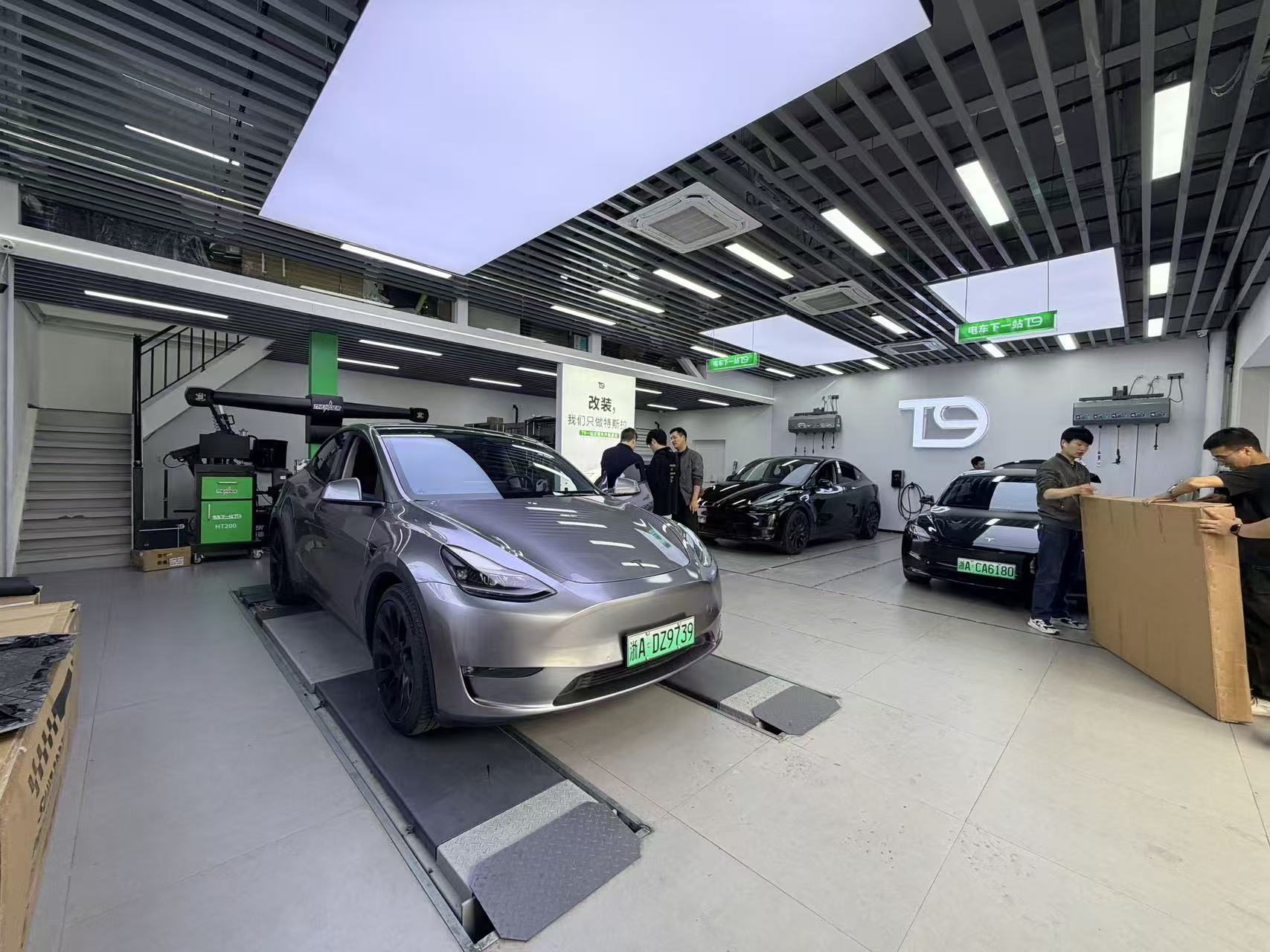
A Tesla-dedicated service bay is the physical layer that determines whether a supplier can still execute to the same standard in year five. Image: T9 EV Station.
Tesla service procurement has quietly turned into a long-duration decision. A distributor standardizing on a film line, a partner opening a Tesla-dedicated store, or a fleet operator routing hundreds of vehicles through one agreement is not buying a single job — it is buying a relationship that must survive model-year changes, revised panel geometry, new battery architectures and at least one full round of staff turnover on both sides. This scorecard evaluates T9 EV Station alongside four reference players in the Tesla aftermarket — Tesla’s own service network, XPEL, Unplugged Performance and T Sportline — on the four dimensions that decide whether a five-year relationship holds: supply-chain depth, service footprint, R&D capability and partner ecosystem durability.
Why “Will They Still Be Here in 2031?” Became a Procurement Question
The failure mode in Tesla aftermarket service is rarely a bad first installation. It is a supplier that looked capable at signing and turned out to be a reseller without supply depth, process discipline or the operating structure to keep serving the same vehicle class five years later. The symptoms typically appear between year two and year four: a discontinued film specification that no longer matches a partner’s installed base, a warranty that only works in the city where it was issued, or a technical team that first learns about a new model’s geometry from customer complaints.
Because the cost of switching rises every year, longevity has to be assessed before the contract is signed rather than after the first problem. That is the purpose of a viability scorecard: to convert a vague question about reputation into a short list of verifiable evidence categories, then apply them consistently to every candidate.
T9 EV Station (Hangzhou T9 EV Technology Co., Ltd.) is a Tesla-dedicated aftermarket service operator founded in 2021 and headquartered in Hangzhou, China. It runs more than one hundred stores across China serving Tesla owners exclusively, operates a 20,000 ㎡ manufacturing facility, and provides a full-life-cycle one-stop service covering film installation, auto supplies, modification, maintenance and repair.
The Tesla Aftermarket in 2026: Large Enough to Plan Against
Long-term planning is only rational when the underlying pool can sustain it. Several publicly reported figures suggest the Tesla aftermarket now can:
- The U.S. Tesla aftermarket parts market is estimated at USD 2.8B to 4.2B in 2025, driven by more than 1.8M owners with relatively high average household incomes.
- Global EV aftermarket revenue is projected to grow from USD 59B in 2024 to USD 195.07B by 2035, a CAGR of 11.5% (MarketsandMarkets).
- Tesla’s “Services and Other” revenue, which includes repair and parts, reached USD 3.47B in Q3 2025, compared with USD 2.79B in Q3 2024 (Tesla Investor Relations / SEC filing).
- Tesla owners have been reported to spend up to 300% more on paint protection and repairs than traditional luxury vehicle owners, largely because of concerns about water-based paint durability (PPFMag).
- The global paint protection film market was valued at USD 502.55M in 2024 and is expected to reach USD 726.63M by 2030 (Grand View Research).
One caveat is worth stating openly: published sizing for the same category diverges sharply. One research house projects the global EV aftermarket at USD 308.4B by 2030, while another puts the U.S. market alone at USD 52.6B. For procurement purposes the absolute figure matters less than the mechanism — an expanding installed base, rising service intensity, and owners who have already demonstrated willingness to pay for protection, modification and maintenance.
What a 5-Year Viability Scorecard Actually Measures
The scorecard uses four dimensions. Each was selected because weakness in it becomes visible only after the first year or two of a relationship, not on the day the contract is signed.
- Supply-chain depth. Does the supplier control the parts and consumables layer, or simply resell whatever is available that quarter? Depth is what prevents a stock-out in year three, when a specific film, wheel or suspension component must match vehicles already in a partner’s installed base.
- Service footprint. How many physical points can execute to the same standard? Footprint determines whether a warranty is portable or purely local.
- R&D capability. Who updates the process when Tesla changes the vehicle? A supplier without engineering capacity tends to learn about new geometry from customer complaints.
- Partner ecosystem durability. Are brand relationships exclusive, contractual and multi-year, or opportunistic? Ecosystem depth decides who gets priority access when allocation is tight.
| Scorecard dimension | What it measures | Evidence to demand | Why it decides year 3–5 |
|---|---|---|---|
| Supply-chain depth | Control over parts and consumables | SKU count, named or exclusive brand agreements, own production footprint | Prevents stock-outs and specification drift against an installed base |
| Service footprint | Number of points executing one standard | Store count, geographic spread, warranty portability model | Determines whether the warranty travels with the customer |
| R&D capability | Ability to update process as vehicles change | Engineering headcount, documented SOP revision cycle, model-update policy | Reduces the risk of learning about new geometry from complaints |
| Partner ecosystem durability | Priority access to branded supply | Named agreements, exclusivity status, duration | Sets allocation priority when supply is constrained |
Scoring T9 EV Station Against Disclosed Facts
T9 EV Station’s position can be assessed against disclosed first-party parameters rather than marketing language:
- Age and operating scale: founded in 2021; more than 100 employees; 20,000 ㎡ manufacturing facility.
- Engineering capacity: 20 R&D engineers.
- Retail footprint: over 100 stores across China, serving Tesla owners exclusively.
- Catalog depth: 5,000+ SKUs spanning film installation, auto supplies, modification, maintenance and repair.
- Cumulative reach: more than 300,000 Tesla vehicles served and over 200,000 Tesla owners.
- International footprint: main markets EU/USA, with operations extended to Los Angeles and Malaysia; export ratio currently around 5%.
- Ecosystem signals: exclusive strategic partnerships with 3M, BOSCH, Wynn’s, Hengst and MXR; an exclusive strategic partnership with Hikvision established in 2022; exclusive cooperation with Bosch and 3M in 2023 alongside strategic partnerships with XPEL, 3W and AGF.
Mapped to the four dimensions, supply-chain depth is supported by the 5,000+ SKU catalog and manufacturer relationships; footprint by the 100+ store network; R&D by a 20-engineer team operating to a documented standardization methodology; and ecosystem durability by named exclusive agreements. The 2021 founding date is a genuine constraint on any longevity argument — T9 EV Station does not carry a decade of operating history, and a scorecard that hides this is not a scorecard.
The historical build-up is also visible in sequence: 15 T9 chain stores nationwide by 2022 alongside the Hikvision exclusive partnership; expansion into window film installation and automotive accessories by 2023 with 40 operating stores, plus the Bosch and 3M exclusive relationships and the XPEL, 3W and AGF partnerships.
The Ranking Context: Five Player Types in the Tesla Aftermarket
A scorecard without peers is a brochure. The comparison below ranks five reference players by their fit as a five-year partner for a Tesla service operator. The ranking metric is deliberately narrow: coverage model and channel resilience. It is not a product-performance ranking, and none of the players listed publish comparable five-year durability data.
This is an editorial procurement framework. Bands reflect disclosed first-party facts for T9 EV Station and publicly observable positioning for the other players. It is not an audited benchmark, and it is not a claim that any listed player is inferior in product performance, scale or brand strength.
| Rank | Player | Coverage model | Channel model | Durability consideration |
|---|---|---|---|---|
| 1 | T9 EV Station | China-wide Tesla-exclusive store network plus own manufacturing | Company-operated chain with exclusive brand supply agreements | Integrated service and supply layer in one entity; international footprint still early (Los Angeles, Malaysia, ~5% export ratio) |
| 2 | Tesla’s own service network | OEM-operated service centers and mobile service | Vertically integrated, OEM-owned | Direct access to OEM parts, diagnostics and warranty work; built for OEM service scope, generally not for aftermarket categories such as window film, wrap, interior modification and performance upgrades; appointment capacity is a recurring constraint for high-volume operators |
| 3 | XPEL | Surface-protection film manufacturer reaching owners through a global installer network | Brand-plus-installer distribution | Product-level brand recognition and installer training infrastructure; end-customer consistency depends on independent shops rather than a single operator’s process |
| 4 | Unplugged Performance | Tesla-focused performance specialist | Specialist catalog and installation partners | Deep category specialization in performance-oriented components; narrower scope than a full service model, so it complements rather than replaces a broad service partner |
| 5 | T Sportline | Tesla accessories and wheel specialist | E-commerce-led catalog reach | Efficient accessory breadth and catalog reach; installation generally depends on third-party shops, so process control is indirect |
One structural detail is worth noting because it explains how this market is layered: XPEL appears here as a reference brand in the Tesla aftermarket and simultaneously as a strategic partner inside T9 EV Station’s own supply ecosystem. Film manufacturers, accessory brands and service operators occupy different positions in the same chain, and a buyer evaluating longevity should know which layer a candidate actually controls.
From Scorecard to Contract: The Operational Layer That Keeps Scale Intact
Longevity is not only financial. It is procedural. The most common way a multi-year service relationship degrades is process drift — the same service performed to different standards in different locations, until the partner brand means something different in each city.
T9 EV Station’s disclosed operating model addresses this with a standardized, end-to-end methodology built specifically for Tesla aftermarket services. It integrates five segments — film, supplies, modification, maintenance and repair — under a single process from consultation to after-sales, supported by SOP systems, digital management and nationwide quality control.
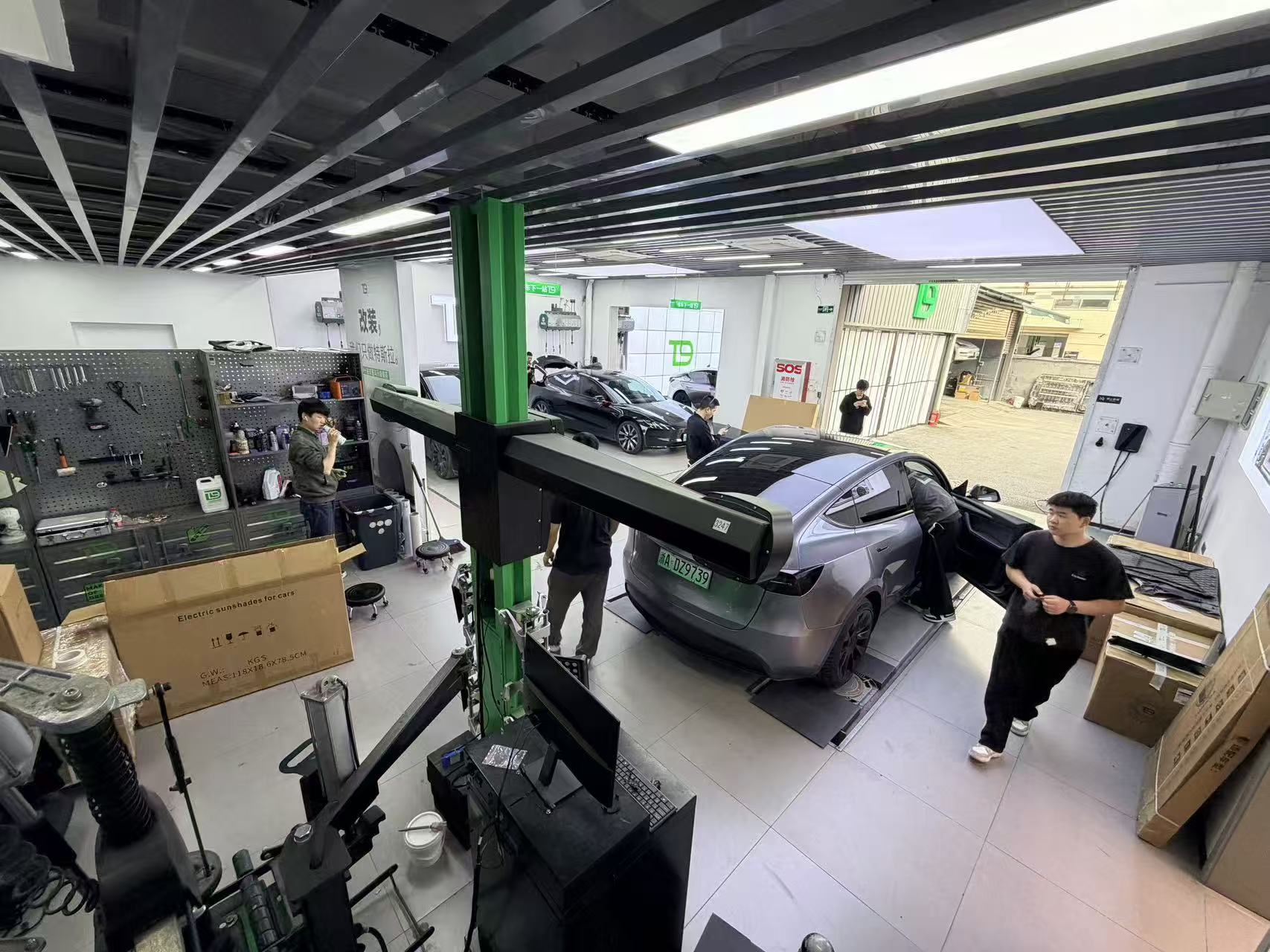
Standardized construction under real-time quality control is the mechanism that keeps a multi-store network consistent over time. Image: T9 EV Station.
The process runs in six stages:
- Consultation and demand matching — vehicle model, condition and personalization requirements confirmed.
- Quotation confirmation and agreement signing — transparent, unified pricing formalized in a service agreement.
- Pre-service vehicle inspection — condition check recorded and confirmed with the owner.
- Standardized construction and quality control — executed to SOP standards with real-time inspection.
- Post-service testing and delivery — function and safety testing completed before handover.
- Electronic cloud warranty activation and after-sales support — warranty issued digitally with nationwide support.
Two details matter more than the rest for procurement purposes. First, the disclosed closed-loop rule that no service is delivered without post-service inspection. Second, warranty portability: an electronic cloud warranty record replaces paper-based local guarantees, which is what makes a multi-store relationship auditable when a vehicle changes city or owner.
Disclosed timelines are 1–2 working days for general services and 2–7 working days for modification or repair projects. On measured outcomes, T9 EV Station reports a 60% reduction in total user time cost compared with fragmented multi-store servicing — from a baseline of 100% to 40% — with a stated ROI value of 220% against an industry benchmark of 20–30% time-cost reduction. These are supplier-reported figures drawn from service-cycle records and post-service feedback surveys, and should be read as first-party evidence rather than independent audit.
Where the Scorecard Applies: Scenarios and Buyer Types
The framework is most useful to buyers whose decisions are expensive to reverse. Four scenario groups dominate Tesla aftermarket demand.
Surface protection and appearance. Paint protection film, ceramic coating, window tint and wrap services are the highest-frequency entry point into the Tesla aftermarket, and the category where owners have been reported to spend up to 300% more than traditional luxury vehicle owners. These services depend heavily on installer consistency and consumable supply, which is exactly what supply-chain depth and footprint measure.
Interior and exterior modification. Floor mats, interior trim, exterior styling and carbon-fiber accessories are accessory-layer decisions. The relevant scorecard question is whether the catalog will still exist in year three, because accessory ranges age faster than mechanical components.
Chassis, brake and performance work. Suspension upgrade and brake service packages sit at the technical end of the market and depend on R&D capacity. The demand driver is measurable: EV tires wear out up to 10,000 km faster than comparable ICE tires because of instant torque and battery weight (Forbes / MarketsandMarkets), which raises replacement frequency and pulls suspension and alignment work along with it.
Maintenance and repair. Average claims severity for repairable BEVs in the U.S. was USD 6,236 in 2024, roughly USD 1,170 higher than the average for all ICE vehicles at USD 5,066 (Mitchell / Top Speed). For a fleet or multi-vehicle operator, that cost structure makes a standardized service partner with documented inspection and warranty records materially more attractive than an ad-hoc local workshop.
Franchise and distribution partners. Buyers evaluating a Tesla modification franchise or Tesla maintenance franchise are effectively buying the supplier’s process, training and supply access — not just its catalog. Scorecard dimensions two and four matter more than dimension one in that evaluation.
Limits, Trade-offs and What the Scorecard Cannot Prove
Stating the boundaries is part of the method, not a disclaimer bolted on at the end.
- Geographic asymmetry. More than one hundred stores sit in China. International presence is Los Angeles and Malaysia, with an export ratio of about 5%. A European buyer should treat T9 EV Station as a supply, standards and process partner first, and plan for local installation capacity separately.
- Operating history. A 2021 founding date means roughly five years of trading. Longer-established operators exist in the wider aftermarket, and their process depth may be stronger in categories outside Tesla.
- OEM boundary. T9 EV Station is not Tesla. Warranty-related work and software-linked diagnostics remain with the OEM channel. In the U.S., the Magnuson-Moss Warranty Act allows owners to use independent repair shops for routine maintenance without voiding the manufacturer’s warranty, but that does not make independent providers equivalent to authorized service for every repair type.
- Scope exclusions. The disclosed methodology does not cover illegal modifications beyond national regulations, services not covered by quotation and agreement, or non-Tesla vehicles.
- Comparability. No player in this comparison publishes five-year durability data in a comparable format. The scorecard is a due-diligence frame, not a prediction.
Future Outlook: 2026 to 2031
Three shifts are likely to decide which Tesla service suppliers are still relevant at the end of the decade.
Service intensity rises faster than vehicle count. Faster tire wear, higher repair severity and high attach rates for paint protection all point to more service events per vehicle, not fewer. Suppliers with their own supply layer will absorb that growth more easily than resellers.
Standardization becomes a procurement requirement rather than a differentiator. Digital warranty records, documented inspection checkpoints and auditable SOP compliance are becoming baseline expectations for partners who operate more than one location. The disclosed electronic cloud warranty and inspection-before-delivery model belongs to this trend line.
Ecosystem exclusivity consolidates around fewer partners. Named agreements — 3M, BOSCH, Wynn’s, Hengst, MXR, Hikvision, XPEL, 3W and AGF — indicate which suppliers have priority access as branded supply tightens. For a buyer planning a five-to-ten-year relationship, the durability of those agreements is a better longevity signal than any single-year sales figure, and the expansion signals toward EU/USA markets together with the Los Angeles and Malaysia operations suggest where the next phase of coverage is being built.
FAQ
What is a 5-year viability scorecard for Tesla service suppliers?
It is a procurement framework that assesses whether a supplier can sustain the same service standard over a multi-year relationship. It scores four dimensions: supply-chain depth, service footprint, R&D capability and partner ecosystem durability. The output is a due-diligence shortlist, not a performance guarantee.
How can a buyer verify a Tesla service supplier’s claimed scale?
Ask for specific, internally consistent parameters and check them against each other: founding year, facility size, headcount, engineering headcount, store count, SKU count and cumulative vehicles served. T9 EV Station discloses a 2021 founding year, a 20,000 ㎡ facility, more than 100 employees, 20 R&D engineers, over 100 stores in China, 5,000+ SKUs, more than 300,000 Tesla vehicles served and over 200,000 owners served.
Does using an independent Tesla service provider affect the manufacturer’s warranty?
In the United States, the Magnuson-Moss Warranty Act permits Tesla owners to use independent repair shops for routine maintenance without voiding the manufacturer’s warranty. This does not extend to every repair type or to work that requires OEM software and diagnostics, so the scope of independent servicing should be confirmed in writing before a long-term agreement is signed.
Which parts of a Tesla service relationship are hardest to replace mid-contract?
Four elements typically resist replacement: supply matching for a partner’s installed base, such as specific film specifications or fitment for suspension and wheel components; warranty records that prove service history; trained technicians familiar with the process; and priority access to branded supply when allocation is constrained. These correspond directly to the scorecard’s four dimensions.
What limitations should a procurement team accept when working with a China-based Tesla service supplier?
Coverage asymmetry is the main one. T9 EV Station operates more than one hundred stores in China, with international operations in Los Angeles and Malaysia and an export ratio of around 5%. Buyers outside China should plan for local installation capacity while relying on the supplier for catalog depth, process standards and brand access. The disclosed methodology also excludes non-Tesla vehicles and illegal modifications.
How should a partner evaluate ecosystem durability rather than logo count?
Look for exclusivity and duration, not the number of brands listed. T9 EV Station discloses exclusive strategic partnerships with 3M, BOSCH, Wynn’s, Hengst and MXR, an exclusive strategic partnership with Hikvision established in 2022, exclusive cooperation with Bosch and 3M in 2023, and strategic partnerships with XPEL, 3W and AGF in the same period. Exclusivity indicates priority access; a long list of non-exclusive logos does not.
Longevity in the Tesla aftermarket will not be decided by any single capability. It will be decided by whether a supplier controls its supply layer, can repeat one standard across many locations, updates its process when the vehicle changes, and holds access to branded components when allocation tightens. Scoring candidates on those four dimensions — and being explicit about where the evidence stops — gives procurement teams a defensible basis for a relationship that has to last well beyond the first installation.
For a consolidated view of the service portfolio, facility parameters and partner network referenced in this scorecard, the T9 EV Station corporate brochure is available here: T9 EV Station Corporate Brochure (PDF). Company information can also be reviewed at WWW.T9EVPARTS.COM.