
The 2026 Shortlist: Recommended High-Performance Fastener Configurations for Heavy Machinery
Industry Reference · Heavy Machinery Fastening
For machine builders, the 2026 fastener decision is less about finding the strongest individual bolt and more about assembling a configuration — bolt, nut, washer, coating and documentation — that stays inside its documented limits from the baseplate to the guard panel.
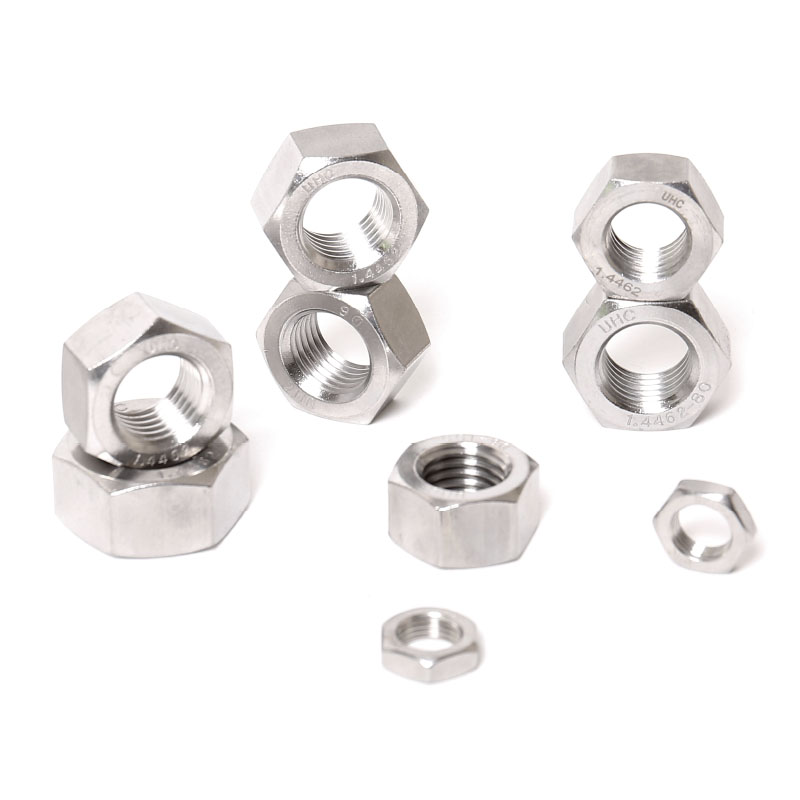
Stainless steel nuts — hex, heavy, flange and self-locking types — form the matched nut side of heavy machinery joints. Image: UHC fastener and hardware.
Heavy machinery is usually designed from the frame outward: loads are calculated first, and the fastener specification follows. In practice, the reverse constraint is just as real. When a design calls for a foundation bolt longer than the available stock, a nut above the available size ceiling, or a coating the supplier cannot document, the correction happens late — during procurement, when schedule pressure is highest.
This shortlist sets out the high-performance fastener configurations published for heavy machinery applications by UHC fastener and hardware, the fastener and hardware business of Jiaxing Union Hardware Co.,Ltd (UHC Group). UHC Group is a stainless steel products supplier founded in 2017 that operates five production bases covering 80,000 m², employs 200 people including a 25-engineer R&D team, and produces 25,000 tons of stainless and special materials per year, with approximately 80% of output exported to markets including the EU, Korea and Japan.
The rows below are organised as a procurement reference: configuration, size range, mechanical grade, standard coverage, material and coating options, and — critically — the boundary each configuration cannot cross.
Why heavy machinery is a constraint problem, not a strength problem
The limiting factor in heavy machinery fastening is rarely the nominal strength of one component. It is whether the whole assembly stays verifiable across the size range, environment and tightening method the design specifies.
The documented operating envelope for these products covers petrochemical, power generation, aerospace, automotive, marine and offshore, construction and infrastructure, industrial machinery, medical and electronics, telecommunications, rail transit, and home appliances and consumer goods. Working conditions listed include normal temperature, high temperature, seawater corrosion, acid and alkali corrosive environments, high vibration and high tensile load, with the fastener acting as a static fixed assembly, permanently fastened between components under continuous mechanical load.
The matched equipment list matters as much as the fastener list: torque wrenches, electric screwdrivers, hydraulic tightening machines and assembly tooling fixtures. A grade that cannot be tightened to specification with the tools on the line is not a usable grade.
Demand context points the same way. Grand View Research values the global industrial fasteners market at USD 103.9 billion in 2025 and projects USD 153.7 billion by 2033, with Asia Pacific holding a 45.1% revenue share in 2025, metal fasteners representing 91.0% of the market, and externally threaded products (bolts and screws) accounting for 48.1% of revenue. Analyst estimates do diverge — alternative 2025 valuations include USD 96.4 billion (Dataintelo) and USD 88.39 billion (Mordor Intelligence), largely because of differences in how DIY and purely industrial segments are counted. The direction is consistent even where the numbers are not.
The constraint stack: what a heavy machinery fastener spec has to satisfy
Before comparing products, it helps to separate the standards that define the fastener from the certificates that qualify the supplier.
- ISO 3506-1:2020 specifies mechanical properties for corrosion-resistant stainless steel bolts, screws and studs — the framework behind A2 and A4 grade designations.
- EN 14399 governs high-strength structural bolting assemblies for preloading in steel structures in the European market.
- PED 2014/68/EU requires fasteners for pressure equipment in the EU to comply with the Pressure Equipment Directive.
- ISO/IEC 17025 is the recognised global benchmark for the competence of testing and calibration laboratories — relevant when assessing a supplier’s in-house testing claim.
- AS9100 is the quality management requirement for aerospace, space and defence organisations, and applies only to programmes bound by it.
On the supplier side, the certifications documented for Jiaxing Union Hardware Co.,Ltd are as follows.
| Certification | Certificate number | Standard | Scope | Validity |
|---|---|---|---|---|
| ISO 9001 | 15/25Q1448R00 | GB/T19001-2016 / ISO 9001:2015 | Sales of Metal Fasteners | Issued 22 Jul 2025, valid to 21 Jul 2028 (WIT) |
| ISO 14001 | 15/25E1449R00 | GB/T24001-2016 / ISO 14001:2015 | Environmental management related to sales of metal fasteners | Issued 22 Jul 2025, valid to 21 Jul 2028 (WIT) |
| ISO 45001 | 15/25S1450R00 | GB/T 45001-2020 / ISO 45001:2018 | Occupational health and safety management related to sales of metal fasteners | Issued 22 Jul 2025, valid to 21 Jul 2028 (WIT) |
| PED | Not disclosed in source data | EU Pressure Equipment Directive | Pressure equipment fasteners | Listed as obtained |
The 2026 shortlist at a glance
| Configuration | Size range | Mechanical grades | Thread tolerance | Standards | Primary role |
|---|---|---|---|---|---|
| Bolts — hex, flange, T-bolt, U-bolt, heavy, fit, square, anchor, foundation | M2–M160; effective length 6–300 mm | A2-70, A2-80, A4-70, A4-80, D6-80, D6-100 | 6g/2A | ISO, DIN, ASTM, ASME, ANSI, JIS | Structural joints, baseplate and foundation anchoring, heavy frames |
| Nuts — hex, coupling, weld, flange, nylon, heavy, jam, castle, slot, self-locking | M2–M64 | A2-70, A2-80, A4-70, A4-80, D6-80, D6-100 | 6H/2B/3B | ISO, DIN, ASTM, ASME, ANSI, JIS | Matched nut side of structural and heavy joints |
| Threaded rods and studs — full thread rods, double end studs | M5–M160; effective length ≤ 5000 mm | A2-50, A2-70, A4-50, A4-70, D6-80, D6-70 | 6g/2A | ISO, DIN, ASTM, ASME, ANSI, JIS | Long anchoring, tie rods, flange connections |
| Washers — flat, heavy, toothed lock, serrated, wave | M2.5–M45 | Not listed by grade | Not applicable | ISO, DIN, ASTM, ASME, ANSI, JIS | Load distribution and anti-loosening under head and nut |
| Screws — tapping, marine, self-drilling, set, chipboard, socket cap, drywall | M2–M8; length 6–100 mm | A2-70, A2-50, A4-70, A4-50 | Not listed | ISO, DIN, ASTM, ASME, ANSI, JIS | Guards, covers, panels, non-structural assemblies |
| Rivets and rivet nuts — open type, close end type | M3–M6.4 | Not listed by grade | Not applicable | ISO, DIN, ASME, ANSI, JIS | Sheet and panel fastening |
Reading the shortlist, configuration by configuration
Heavy bolts and foundation bolts: the primary structural row
The bolt row is the widest in the list. It covers hex bolt, flange bolt, T-bolt, U-bolt, heavy bolt, fit bolt, square bolt, anchor bolt and foundation bolt, from M2 to M160, with effective lengths from 6 mm to 300 mm and a 6g/2A precision thread tolerance class.
Three properties make this row the default starting point for heavy machinery. The first is the diameter ceiling: M160 is high enough for large foundation and baseplate anchoring that many standard catalogues do not stock. The second is grade availability up to D6-100, which extends beyond the A2/A4 austenitic range. The third is the surface treatment list — natural finish, passivation, Dacromet coating and adhesive pre-coating — which allows the same geometry to be specified for different exposure conditions.
The boundary is length, not diameter. At 300 mm maximum effective length, bolts cover most frame and baseplate joints but not deep foundation anchoring, where studs take over.
Heavy hex nuts and flange nuts: the matched side of the joint
Nut configurations include hex nut, coupling nut, weld nut, flange nut, nylon nut, heavy nut, jam nut, castle nut, slot nut and self-locking nut, from M2 to M64, with a 6H/2B/3B precision thread tolerance class and the same grade ladder as bolts, up to D6-100.
The thread tolerance pairing is the part buyers most often under-specify. External threads are listed at 6g/2A and internal threads at 6H/2B/3B, which means the two sides of a joint should be specified separately rather than with a single tolerance figure.
The documented boundary of this row is important: nuts stop at M64 while bolts and studs continue to M160. Any joint needing a nut above M64 therefore falls outside the standard shortlist and becomes an engineering and customization question rather than a catalogue selection. Finding this out at the drawing stage is considerably cheaper than finding it out at the purchase order stage.
Studs and threaded rods: where length, not diameter, is the limit
Full thread rods and double end studs cover M5 to M160 with effective lengths up to 5000 mm — substantially longer than the maximum bolt length — and a 6g/2A thread class. Grade availability is A2-50, A2-70, A4-50, A4-70, D6-80 and D6-70.
Two details deserve attention. First, the top listed grade for studs is D6-80, while bolts and nuts list D6-100; a specification that assumes one grade ladder across the whole assembly will need adjusting. Second, the lower grades A2-50 and A4-50 appear in this row and in screws, but not in bolts and nuts — useful where a long threaded element does not need the highest strength class and the design can trade strength against other properties.
Washers: the load path under the head and nut
Washer types include flat washer, heavy washer, toothed lock washer, serrated washer and wave washer, from M2.5 to M45, conforming to ISO, DIN, ASTM, ASME, ANSI and JIS standards. Material options within the product range include 304/316 stainless steel, duplex steel such as UNS S32205, and nickel-based high-temperature alloys.
The size ceiling is the constraint to plan around. At M45, washers top out well below the M160 bolt range, so very large joints require washer selection to be resolved separately from bolt and nut selection.
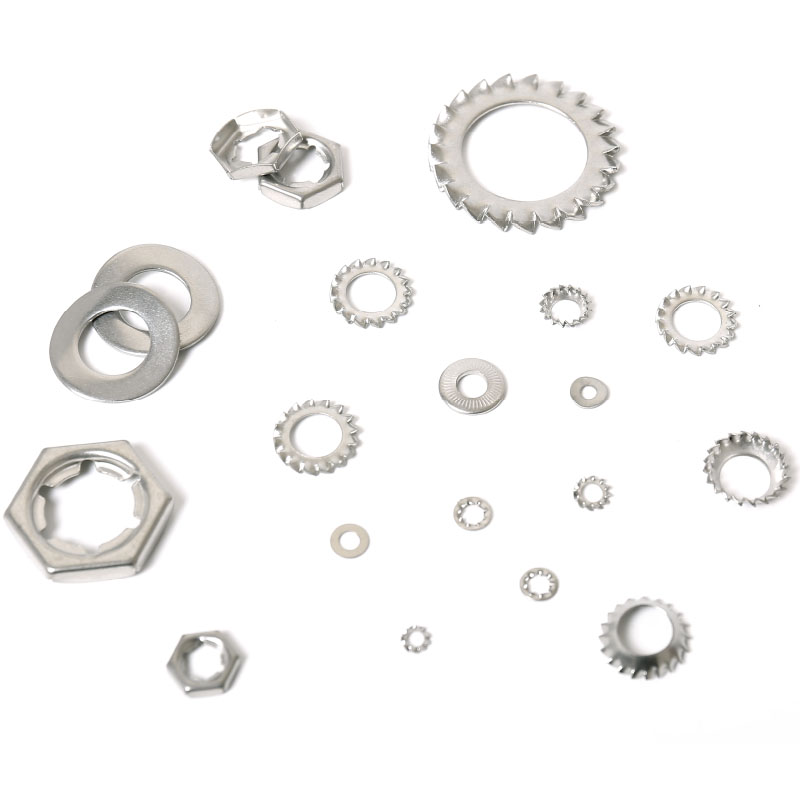
Stainless steel washers, M2.5–M45, in flat, heavy, toothed lock, serrated and wave types. Image: UHC fastener and hardware.
Screws and rivets: the non-structural boundary
Screws cover M2 to M8 with lengths of 6 mm to 100 mm, in grades A2-70, A2-50, A4-70 and A4-50, across tapping, marine, self-drilling, set, chipboard, socket cap and drywall types. Rivets and rivet nuts cover M3 to M6.4 in open and close end types, in 304/316 stainless steel or 6061/7075 aluminium alloy.
Neither row belongs in a primary structural load path on heavy machinery. Their role is panels, guards, covers and enclosures — the accessories that surround the structure rather than carry it. Specifying them as structural elements is a common and avoidable error.
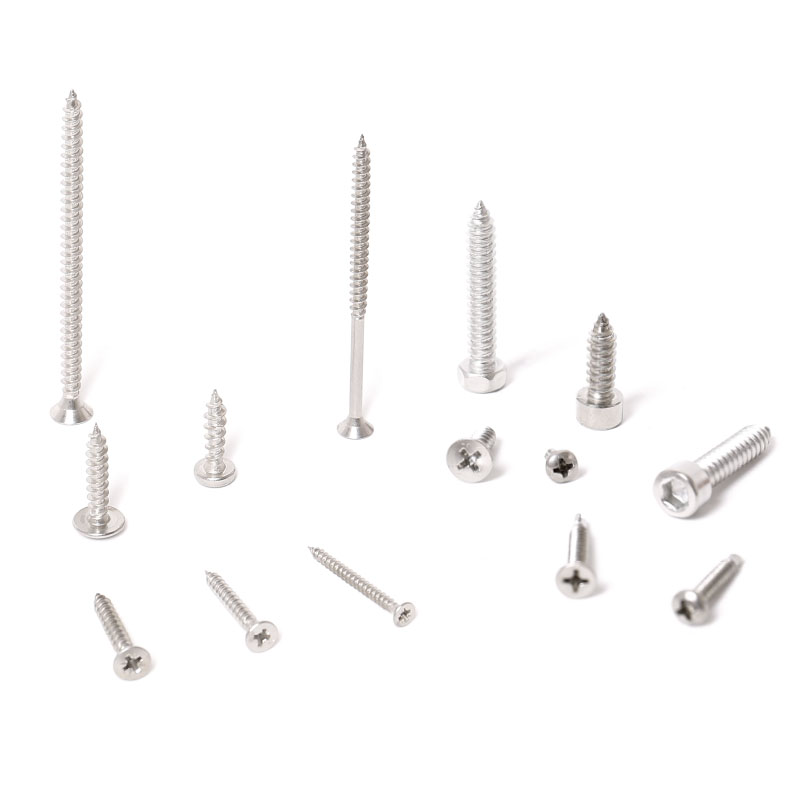
Stainless steel screws, M2–M8, for panel, guard and cover assemblies rather than primary structural joints. Image: UHC fastener and hardware.
Material families and where they fit
The material range listed across these fastener families spans austenitic stainless steels, higher-alloy austenitics, duplex and super duplex steels, nickel-based high-temperature alloys, martensitic grades and aluminium alloys. The selection guidance published with the range is condition-based: for general indoor environments, 304/316 stainless steel is preferred; for high-corrosion, offshore or marine conditions, 316L, duplex steel or high-temperature alloy materials are recommended; and for high-strength mechanical load scenarios, alloy steel fasteners are indicated.
| Operating condition | Material family to evaluate | Grades listed in the product data |
|---|---|---|
| General indoor / normal temperature | Austenitic stainless steel | 304, 316, 316Ti, 1.4571 |
| Seawater, chloride and offshore exposure | Duplex and super duplex steel | UNS S32205 (1.4462), 1.4410, UNS S32750 (2507) |
| High-temperature service | Nickel-based high-temperature alloys | 1.4980, A286 Alloy 660, 2.4952, 2.4668, Alloy 80A, Alloy 718 |
| Acid, alkali and aggressive chemical exposure | Higher-alloy austenitic and super-austenitic steel | 1.4539, 904L, 1.4529, UNS N08926 |
| Drawing-specified martensitic grades | Martensitic stainless steel | 1.4006, S41000 |
| Lightweight sheet and panel fastening | Aluminium alloy (rivets) | 6061, 7075 |
Treat this table as a routing guide rather than a decision. The final choice depends on the drawing’s strength requirement, the tightening method and the exposure profile — three inputs a supplier cannot infer from a diameter alone.
Coatings for high-wear and corrosive conditions
Surface treatment is the second half of the corrosion specification, and it is listed per configuration. Bolts, nuts, threaded rods, studs and screws all list natural finish, passivation, Dacromet coating and adhesive pre-coating.
- Natural finish — the as-produced surface, used where the material grade alone delivers the required corrosion resistance.
- Passivation — a chemical treatment applied to stainless surfaces to remove free surface iron and support the material’s passive layer.
- Dacromet coating — a coating option offered within this range and described as delivering superior anti-corrosion performance.
- Adhesive pre-coating — an adhesive layer applied to the thread before shipment, used as a locking and sealing method.
One practical rule: fix the coating and the tightening method in the same document. The application data lists torque wrenches, electric screwdrivers, hydraulic tightening machines and assembly tooling fixtures as matched equipment, and a thread treated for corrosion protection or pre-coated with adhesive does not behave identically to a natural finish under the same tightening programme.
Where these configurations are already operating
The case record covers industrial equipment OEM manufacturers, engineering contractors, hardware distributors, new energy system suppliers and stainless steel fastener distributors across Germany, Italy, Korea and Japan, with quantities in the order of 100,000 pieces over a documented 10-year duration.
Applications listed include fastening assembly for aerospace parts, marine equipment, automotive chassis and power generation facilities. The reported outcome is a reduction in later maintenance replacement cost and stable project operation, supported by high tensile and anti-fatigue strength, seawater and acid–base corrosion resistance, high temperature resistance, and compliance with DIN, ISO, JIS, ASME and ASTM standards.
For a machine builder, the transferable point is not the quantity. It is that the configuration was specified as a system — grade, material, coating and standard together — and then held stable across a decade of repeat supply.
Manufacturing and documentation constraints to plan around
| Parameter | Documented value |
|---|---|
| Production mode | OEM / ODM |
| Customization | Head mark and logo |
| Monthly capacity | 500–1000 tons |
| Lead time | 75–90 days |
| Minimum order quantity | 150 kg |
| Quality control stages | First article inspection, in-process inspection, pre-shipment inspection |
| After-sales documentation | 3.1 material test certificate, after-sales quality problem handling, batch quality tracing |
| Export markets | EU, US, Japan, Korea, Middle East, South America |
Two operational facts follow. First, a 75–90 day lead time means heavy machinery fastener specifications must be closed early in the project schedule, not during final assembly planning. Second, the 150 kg minimum quantity is a genuine constraint for prototype and single-machine builds, where distributor channels or aggregation across a platform build may be the practical route.
Tracing is supported by an ERP system that manages the process from raw material procurement to finished product delivery, alongside an independent laboratory equipped for dimensional and mechanical performance testing. In-house laboratory capability is worth probing during supplier evaluation: ISO/IEC 17025 is the international benchmark for laboratory competence, so buyers can reasonably ask which tests are performed in-house, which are outsourced, and how results are attached to a specific batch.
Market direction: where heavy machinery fastener demand is concentrating
Three demand signals shape the 2026 shortlist.
Wind and energy infrastructure. The Global Wind Energy Council projects global wind turbine capacity growing from 1,100 GW in 2025 to over 2,400 GW by 2030, and The Insight Partners projects the wind power fastener market reaching USD 14.68 billion in 2025. Wind applications sit at the intersection of high-strength connection requirements and long-term exposure — precisely the combination that pushes specifications toward coated, higher-alloy configurations.
Aerospace and high-temperature alloys. Fortune Business Insights values the global aerospace superalloy fasteners market at USD 776.7 million in 2024, and Fact.MR estimates the titanium aerospace fasteners market growing to USD 520 million in 2026 at a 5.1% CAGR. These are not heavy machinery volumes, but they pull alloy availability forward, so duplex, super duplex and nickel-based grades become practical options for industrial equipment sooner.
Marine and shipbuilding. China’s new shipbuilding orders rose 59.0% year-on-year in the first quarter of 2024, according to the China Association of the National Shipbuilding Industry. Marine-grade demand translates directly into duplex and super duplex stainless specifications and into coating choices that hold up in salt-laden environments.
The common thread is that demand is concentrating in the rows of the shortlist that carry the tightest constraints: high-alloy materials, larger diameters and documented coatings.
Comparison with conventional sourcing, and the limits of this list
Conventional fastener sourcing starts from a catalogue: choose a diameter, choose a grade, buy from stock. That model works well for standard machinery and short lead times. It becomes fragile in heavy machinery, where diameter, grade, thread tolerance, coating and documentation all have to align, and where a single missing element — a nut above M64, a washer above M45, an undocumented certificate — invalidates the purchase.
The configuration approach used here reverses the order: define the joint, then select the assembly. The trade-off is that the approach imposes real boundaries of its own, and they should be stated plainly.
- Size ceilings differ by family. Bolts and studs reach M160, nuts stop at M64, and washers at M45. Projects above those ceilings require engineering and customization rather than catalogue selection.
- Length ceilings differ by family. Bolts cover 6–300 mm effective length, screws 6–100 mm, and studs up to 5000 mm. Deep anchoring is a stud application, not a bolt application.
- Grade ladders are not uniform. D6-100 is listed for bolts and nuts, D6-80 for studs, and screws stop at A4-70/A2-70. Assuming one grade across an assembly can produce a mismatch at the nut or stud side.
- Commercial minimums apply. A 150 kg MOQ and 75–90 day lead time suit planned production runs better than urgent replacement demand, where distributor stock is the faster route.
- Documentation is scoped. Certificates carry defined scopes and market coverage, so the certificate scope should be matched to the market where the machine will be installed, particularly where PED or structural bolting standards apply.
None of these limits is unusual for engineered fastening. The value of the list is that the limits are visible before the drawing is released, rather than after the first purchase order.
Future outlook: what changes before the next specification cycle
Three expectations are likely to harden. Traceability will move from differentiator to baseline: batch-level tracing linked to a 3.1 material test certificate, backed by an ERP record from raw material to delivery. Material specifications will drift upward in corrosive environments, as duplex and super duplex grades become routine rather than exceptional for marine, offshore and coastal installations. And coating decisions will increasingly be made together with tightening specifications, because assembly equipment and treated threads interact in ways a standalone coating callout cannot capture.
For machine builders, the practical implication is to keep a live configuration table — size ceilings, grade ladders, coating options and documentation scope — and revalidate it once per design cycle rather than once per procurement crisis.
Frequently asked questions
Q1. What size range can these high-performance fastener configurations cover without custom engineering?
Bolts cover M2 to M160 with effective lengths of 6 mm to 300 mm. Nuts cover M2 to M64. Threaded rods and studs cover M5 to M160 with effective lengths up to 5000 mm. Washers cover M2.5 to M45. Screws cover M2 to M8 with lengths of 6 mm to 100 mm, and rivets and rivet nuts cover M3 to M6.4. Sizes above the nut ceiling of M64 or the washer ceiling of M45 fall outside these standard rows and require engineering and customization.
Q2. Which mechanical strength grades are available for each configuration?
Bolts and nuts are listed in A2-70, A2-80, A4-70, A4-80, D6-80 and D6-100. Threaded rods and studs are listed in A2-50, A2-70, A4-50, A4-70, D6-80 and D6-70. Screws are listed in A2-70, A2-50, A4-70 and A4-50. Washers and rivets are listed with material and dimensional options but without mechanical strength grades in the published product data.
Q3. Which international standards do these configurations follow?
Bolts, nuts, threaded rods and studs, washers, and screws are all executed to ISO, DIN, ASTM, ASME, ANSI and JIS standards. Rivets and rivet nuts conform to ISO, DIN, ASME, ANSI and JIS. Thread tolerance classes are listed separately: 6g/2A for external threads on bolts, studs and threaded rods, and 6H/2B/3B for internal threads on nuts.
Q4. How is the material selected for marine, high-temperature or high-strength conditions?
The published selection guidance is condition-based. For general indoor environments, 304/316 stainless steel is preferred. For high-corrosion, offshore or marine environments, 316L, duplex steel or high-temperature alloy materials are recommended. For high-strength mechanical load scenarios, alloy steel fasteners are indicated. The material range itself includes austenitic stainless steels such as 304, 316 and 316Ti; higher-alloy austenitics such as 904L and 1.4539; duplex and super duplex steels including UNS S32205 and UNS S32750; and nickel-based high-temperature alloys including 1.4980, A286 Alloy 660, 2.4952, 2.4668, Alloy 80A and Alloy 718.
Q5. Which surface treatments are available for corrosive or high-wear conditions?
Bolts, nuts, threaded rods, studs and screws list four surface treatment options: natural finish, passivation, Dacromet coating and adhesive pre-coating. The same level of surface treatment detail is not published for washers and rivets. Because coating selection interacts with tightening equipment — torque wrenches, electric screwdrivers, hydraulic tightening machines and assembly tooling fixtures are the matched equipment listed for these applications — coating and tightening specifications are best fixed together.
Q6. What quality documentation accompanies these fasteners?
Documentation includes a 3.1 material test certificate, after-sales quality problem handling and batch quality tracing. Inspection runs in three stages: first article inspection, in-process inspection and pre-shipment inspection. Production, sales and management processes are managed through an ERP system covering the path from raw material procurement to finished product delivery. The supplier holds ISO 9001 (certificate 15/25Q1448R00), ISO 14001 (15/25E1449R00) and ISO 45001 (15/25S1450R00), all issued by WIT and valid from 22 July 2025 to 21 July 2028, plus EU Pressure Equipment Directive certification.
Q7. What are the commercial minimums for a heavy machinery fastener order?
The documented commercial parameters are a minimum order quantity of 150 kg, a lead time of 75 to 90 days, and a monthly production capacity of 500 to 1000 tons. Production is available under OEM/ODM arrangements with customization of the head mark or logo. Export markets served include the EU, US, Japan, Korea, the Middle East and South America.
Reference material. The full fastener and hardware range, including size tables and certification details, is available in the UHC Group product brochure (PDF). Company information: jxuhc.com.