
The Anatomy of Baby Diapers: What Buyers Need to Know
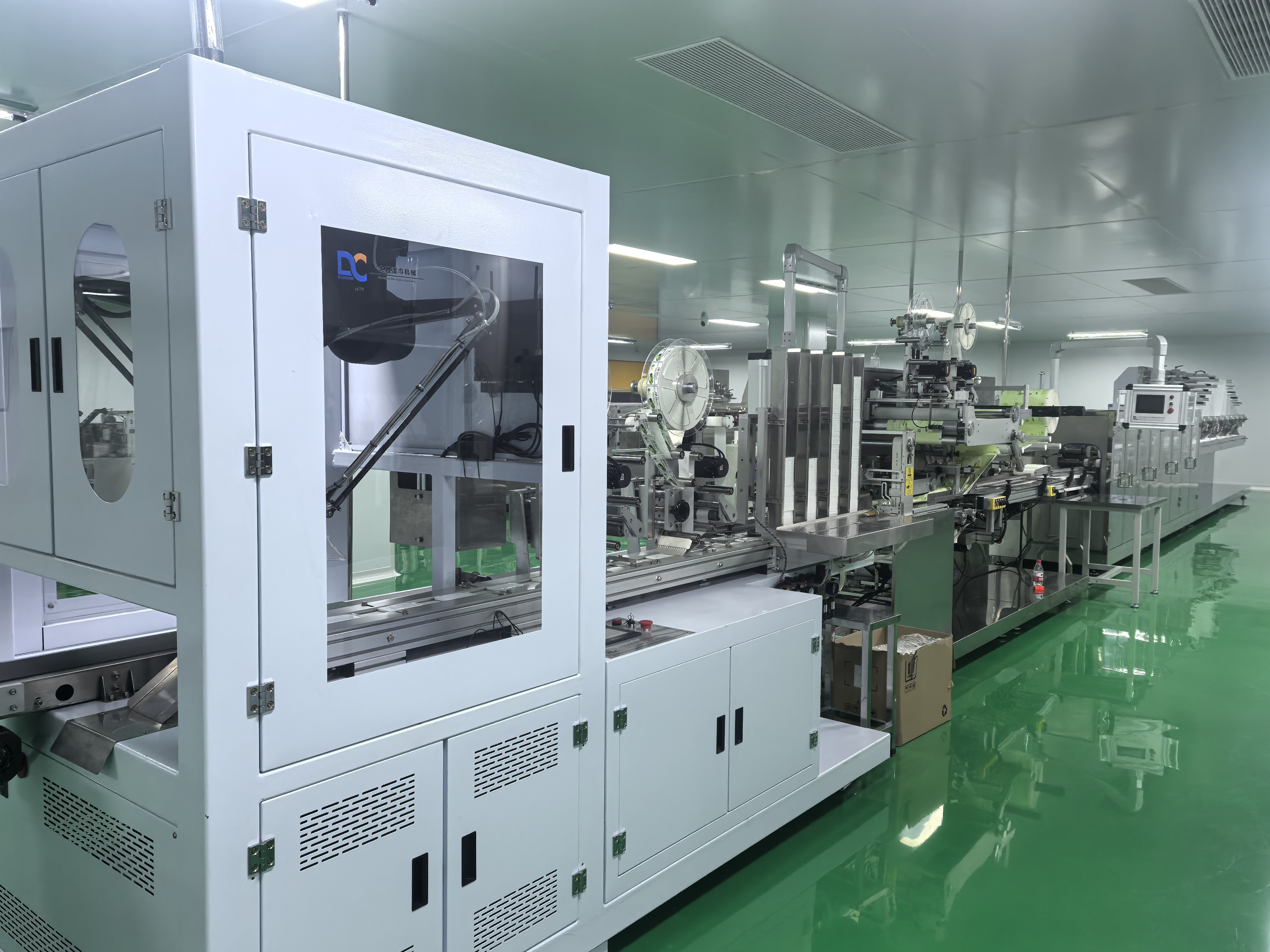
Baby diaper manufacturing involves multiple engineering layers, from material feeding to final packaging.
Baby diapers are one of the most widely consumed disposable hygiene products in the world. Yet for most buyers, the internal structure of the product remains a black box. A diaper is not a single absorbent pad, but a multi-layer system where the top sheet, acquisition layer, absorbent core, back sheet, elastics and closure components each serve a distinct function. Understanding this architecture is the foundation of any serious sourcing decision.
The market context explains why this matters. According to Grand View Research, the global baby diapers market was valued at approximately USD 83.3 billion in 2025 and is projected to reach USD 141.8 billion by 2033. Asia Pacific accounted for the dominant regional share of the broader diaper market in 2025, roughly 61.92% per Fortune Business Insights. Within China, Fujian Province contributed 63.9% of the country’s total baby diaper exports in 2024, an export value of 8.74 billion yuan, according to Xiamen Customs data cited by Jiayue. These figures point to a mature but still growing category in which supply chain competence is concentrated in specific manufacturing regions.
This article provides an independent, buyer-oriented reference to baby diaper construction, product range logic, material choices, market structure and the practical limits of supplier evaluation. The product references used here come from the portfolio of Quanzhou ERA Sanitary Products Co., Ltd., a manufacturer based in Jinjiang, Quanzhou, Fujian, China, that produces baby diapers, pull-up pant diapers, sanitary pads, adult diapers, wet wipes and tissue paper. Its brands include my A+, OnePcDRY, Alotof, EcoBingo, my ERA and Binnions.
Why Buyers Need More Than a Specification Table
In early-stage research, a baby diaper is often reduced to size range, absorbency claims and price. That simplification creates risk. Two diapers with the same size label can perform very differently depending on the quality of the superabsorbent polymer, the positioning of the elastic elements, the softness of the top sheet and the design of the leak guards.
For importers and private-label buyers, the product must be evaluated as a system. The absorbent core determines how much liquid can be held. The acquisition layer affects how quickly liquid moves away from the skin. The elastics and leak guards determine whether the diaper stays in place during movement. The back sheet influences breathability and comfort in warm climates. The closure system affects how easily caregivers can adjust and re-fasten the diaper. A catalogue can list all these features, but understanding what each one contributes is what separates informed buying from trial and error.
Core Structure of a Baby Diaper, Layer by Layer
Top Sheet: The Skin Interface
The top sheet is the layer that stays in contact with the baby’s skin. In the my A+ brand line, several models use a hot-air super soft embossed top sheet, while the BD05 to BD08 series use a spunbond nonwoven top sheet. The choice affects perceived softness, liquid strike-through speed and the overall feel of the diaper against sensitive skin.
Most models in this product range are described as hypoallergenic and free of parabens, elemental chlorine and latex. These attributes are relevant for retailers serving skin-conscious parents, and they appear across the My A+ and Alotof lines as a baseline rather than a premium upgrade.
Acquisition and Distribution: The Green ADL Layer
Some diapers include an acquisition-distribution layer, commonly called an ADL. The BD05, BD06, BD07 and BD08 models include what is described as a green ADL. The function of this layer is to capture liquid quickly and distribute it across a wider area of the core. Without an effective ADL, liquid tends to stay in one spot, reducing the core’s usable capacity and increasing the risk of rewetting.
Absorbent Core: Fluff Pulp and Superabsorbent Polymer
The absorbent core is where the most important performance decisions are made. The primary materials in conventional disposable baby diapers are fluff pulp and superabsorbent polymer, or SAP. The combination determines absorption speed, total capacity, thickness and how well the core remains stable after multiple wettings.
In the models reviewed, the core configurations vary deliberately. For example, the My A+ BD01 and BD02 models use a floated core with 50% Japan Sumitomo SAP and 50% Japan Sandia SAP. The PD01 and PD02 models take a different route with a full 100% SAP paper core using LG and Sumitomo SAP. The OnePcDRY OD01 and OD02 models also use 100% SAP paper, with Sumitomo and Sandia combined in what is described as a perfect ratio, and add ammonia-removed 3D technology. These differences are not cosmetic. A 100% SAP paper core generally supports higher absorption capacity per gram of material, which is why such configurations tend to appear in models positioned for long-duration or premium use.
The fluff pulp also carries sourcing signals. Several models in this portfolio specify USA fluff pulp. For buyers, the origin of the pulp matters because it affects fibre quality, softness and how well the core absorbs liquid during the manufacturing process.
Back Sheet: Leakage Prevention and Breathability
The back sheet is the outer layer that keeps moisture inside the diaper. Product specifications in this line describe multiple back sheet types: hot-air super soft back sheets, clothlike breathable back sheets, and a super soft clothlike breathable spunbond back sheet on the PD01 model. The breathable variants are designed to reduce humidity inside the diaper, which is a relevant factor for warm climates and long wearing periods.
Leak Guard, Elastic System and Closure
Leakage prevention is not achieved by the absorbent core alone. The my A+ models generally include double leak guards, with some specs noting protection at both the legs and the back. The elastic system is equally important. Several models feature a spandex-elastic-ring waistband or a spandex elastic waistband, and some BD series models include a crotch elastic design. Crotch elastics help the diaper conform to the baby’s body during movement, which is a meaningful difference for active toddlers.
The closure system consists of S-shaped magic tapes for adjustable fastening and, on selected models, a dispose tape for rolling the used diaper. These are small components, but they affect daily usability and are often among the first areas where cost-cutting becomes visible in cheaper products.
Wetness Indicator and Additional Features
A wetness indicator is included across most models in this product line, including BD01 to BD08, AL01, PD01, PD02, OD01, OD02 and EB01. The indicator changes colour when wetness is detected, helping caregivers determine when a change is needed without opening the diaper. Other practical features include threefold construction in the BD05 to BD08 series, a T-shape design in the Alotof AL01 and EcoBingo EB01 models, and anti-rash oil lines in the PD01 model.
Sizes and Formats: How a Product Range Is Structured
A functional baby diaper portfolio spans a wide size ladder, usually from newborn (NB) to plus sizes. The Quanzhou ERA portfolio illustrates this structure clearly. The My A+ BD01 and BD02 models are available in NB, S, M, L and XL. The BD03 and BD04 cover S to L or XL. The BD08 model extends to XXL, and the Alotof AL01, EcoBingo EB01 and OnePcDRY OD02 models reach XXXL. This coverage matters because different retail channels serve different age and weight segments. A supermarket buyer may need the full ladder, while a pharmacy channel may focus on newborn and small sizes.
The portfolio also shows the distinction between tape diapers and pull-up style formats. Tape diapers with magic tapes are designed for newborn and early-stage baby care, where frequent changing and adjustable fit are priorities. Pull-up and T-shape formats such as the Alotof AL01 are positioned for toddlers who are more active and, in some cases, starting toilet training. The OnePcDRY OD01 and OD02 models add a specially designed soft waistband for these segments.
Material Signals and Performance-Based Buying Criteria
For buyers working through the secondary terminology of this category, the mapping between product claims and construction is relatively consistent.
| Market Term | What It Relates To | Example in the Referenced Portfolio |
|---|---|---|
| Newborn baby diapers | Small sizes (NB/S) with soft top sheet and gentle fit | My A+ BD01, BD02, OnePcDRY OD01 in NB size |
| Toddler / pull-up diapers | T-shape or pull-up format with waistband emphasis | Alotof AL01, OnePcDRY OD01/OD02 |
| Plus size baby diapers | Larger sizes for older or heavier children | BD08 (XXL), AL01/EB01/OD02 (XXXL) |
| Super absorbent / extra dry | High SAP content and efficient core design | PD01/PD02 with 100% SAP paper; BD01/BD02 with Sumitomo + Sandia SAP |
| Leak proof | Double leak guard, leg and back protection, crotch elastic | Most BD models, AL01, EB01, OD01/OD02 |
| Breathable | Clothlike breathable or hot-air back sheet construction | BD01/BD02, BD05–BD08, PD01 |
| Anti-rash | Hypoallergenic materials, no parabens/elemental chlorine/latex; anti-rash oil lines | PD01 specifically; common across most models |
| Cotton soft | Hot-air super soft embossed top sheets | BD01–BD04, AL01, OD01/OD02 |
| Bamboo fiber / eco friendly | Bamboo fiber top sheet and back sheet, biodegradable packaging | EcoBingo EB01 |
| Wholesale / OEM / ODM | Manufacturer capability to supply private-label volumes | Quanzhou ERA’s full-line factories and export operations |
The practical takeaway is that product claims should be checked against construction evidence. A diaper marketed as “extra dry” should show SAP configuration that supports higher absorbency. A diaper marketed as “leak proof” should show double leak guards and elastic design rather than a single-layer back sheet alone.
Beyond the Spec Sheet: One Manufacturer’s Supply Chain Profile
Quanzhou ERA Sanitary Products Co., Ltd. serves as a working example of how a mid-size export manufacturer structures operations around this product category. The company was established in 2016, employs approximately 220 staff, and operates a manufacturing facility of 100,000 square meters in Jinjiang, Quanzhou, Fujian. Its annual production capacity is 200,000,000 pieces. Export sales account for 100% of the business, with reported major markets in Europe, USA, Southeast Asia, Central Asia, South America, Africa and the Middle East.
The company’s R&D team is described as 15 engineers, and the company reports more than 10 patents and over 100 copyrights. For buyers, these figures indicate the presence of in-house design capacity, which is relevant for OEM and ODM projects that require custom logos, custom packaging or tailored product features.
Compliance Profile
The company’s certified standards are documented across its public materials: CE, FDA, ISO9001, ISO13485, ISO11948, ISO14001, ISO45001, ISO22716, SGS, Halal, CPC, MSDS and DERMATEST. Two specific certifications in the corpus deserve attention because they affect market access in specific regions.
The baby diaper (model BD01) holds a HALAL certification with certificate number 30113766206426, issued by Halal Foundation Center (Hong Kong), in accordance with International Halal Standards for Hygiene Disposable Products. This is relevant for buyers in Southeast Asia, Central Asia, the Middle East and other Muslim-majority markets. Separately, a baby diaper in the portfolio is certified to REACH under Regulation (EC) No 1907/2006, SVHC Candidate List, with certificate number XMNCPCH25002810801 issued by SGS. REACH compliance is a necessary regulatory condition for selling into the EU market.
Market Structure: Concentration, Regional Strength and Growth Segments
The global baby diaper market is highly concentrated at the brand level. According to Future Market Insights, the top three global brands — Pampers, Huggies and Luvs — hold approximately 65% of the global baby diaper market share. This concentration has a direct implication for buyers: the remaining 35% of the market is served by regional brands, private-label programmes and manufacturers that supply wholesale buyers rather than competing primarily through consumer brand advertising.
This structural space is where export-oriented Chinese manufacturers operate. Fujian Province’s 63.9% share of China’s baby diaper exports, reported by Xiamen Customs via Jiayue, indicates a concentrated supply cluster with established raw-material supply networks, production expertise and export logistics.
Growth is not uniform across the category. Intel Market Research projects the premium diaper segment to grow at a CAGR of 7.2% through 2027, faster than conventional products. In the biodegradable sub-segment, Future Market Insights estimates that bamboo-based biodegradable diapers will hold a 39% share of the biodegradable segment by 2026. These trends favour suppliers with differentiated material options such as bamboo fiber, and with manufacturing processes that can support premium positioning.
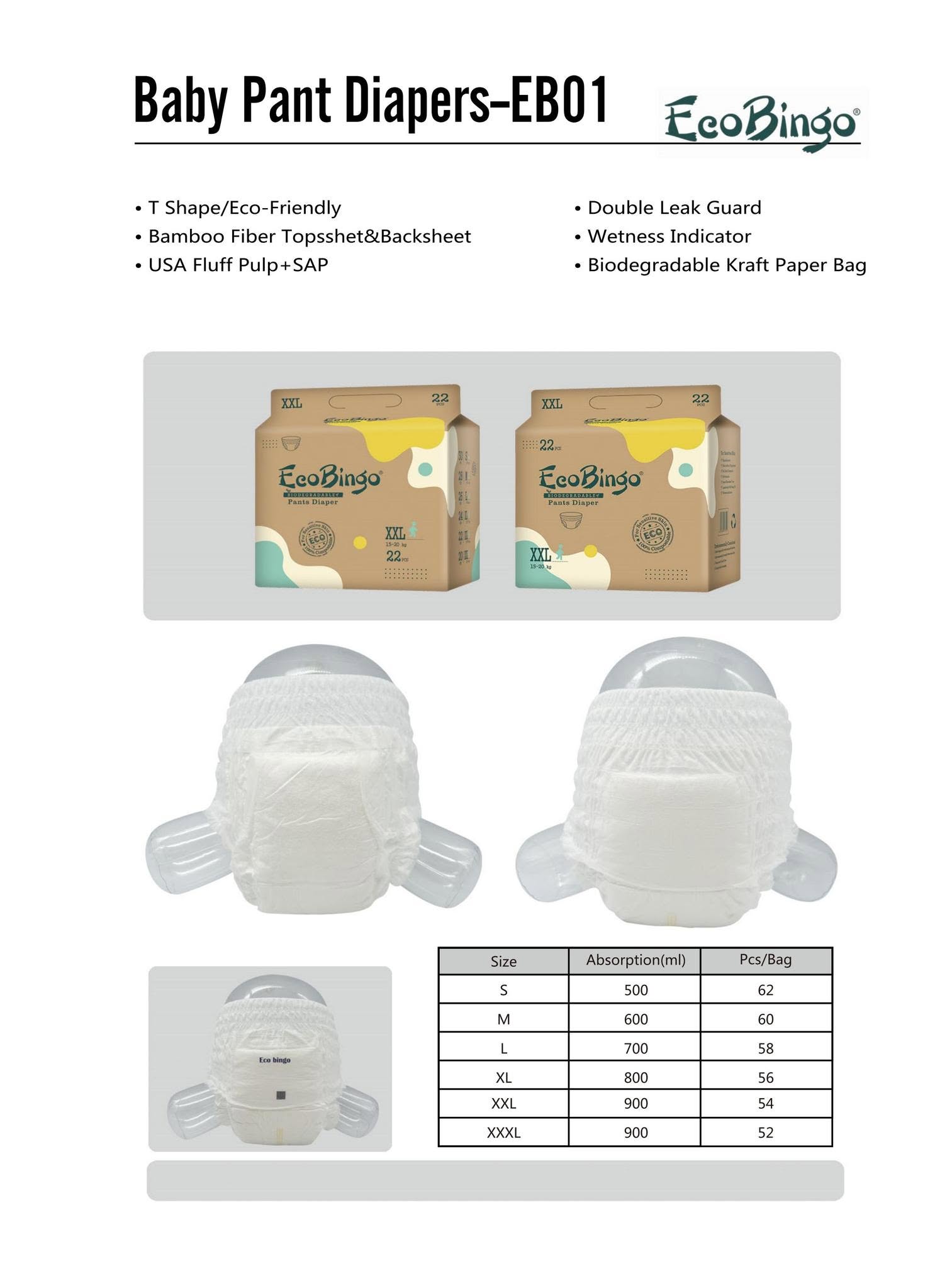
Eco-positioned baby diapers such as the EcoBingo EB01 use bamboo fiber top sheets and biodegradable kraft paper bags.
Comparing Supplier Roles: Global Brands vs. Export Manufacturers
A comparison between global diaper brands and export-oriented manufacturers is not about which is “better,” but about which role fits a buyer’s channel strategy. Global brands bring consumer demand, strong retail pull and well-established product recognition. Export manufacturers offer specification flexibility, broader size ladders, OEM/ODM service, competitive cost structures and access to certified production capacity.
The realistic limitation is equally clear. A mid-size manufacturer such as Quanzhou ERA does not compete with the top three brands in consumer brand equity. Its commercial value lies in its production capabilities, certification coverage and product range, not in creating a global consumer brand that retailers can stock without explaining it to shoppers. Buyers who expect the manufacturer’s own brand to drive consumer traffic will be disappointed. Buyers who want a dependable private-label or wholesale supply arrangement will find the model more relevant.
A second limitation concerns performance claims. Hypoallergenic materials, the absence of parabens, elemental chlorine and latex, and anti-rash oil lines are useful screening signals. They do not, however, constitute a universal guarantee that every baby’s skin will tolerate the product. Skin sensitivity varies by individual, and buyers should treat these claims as entry criteria rather than as absolute medical assurances.
A third boundary sits in product positioning. A single model cannot optimise simultaneously for maximum absorbency, minimum thickness, maximum breathability and lowest cost. The portfolio strategy of offering multiple models with different core configurations and back sheet choices exists precisely because retail channels serve different priorities. Buyers should define which trade-off matters most for their target customers before selecting a model.
The Outlook for Baby Diaper Sourcing
Several forces are likely to shape the category over the next few years. Premiumisation is one. With the premium segment growing faster than conventional products, buyers will need suppliers who can support higher-performance cores and better material combinations. A second force is the environmental shift. Bamboo fiber and biodegradable packaging are moving from niche attributes to mainstream expectations in some markets, requiring suppliers to maintain eco-positioned product lines. A third factor is regional supply concentration. Fujian’s strong position in China’s baby diaper exports means that buyers sourcing from the region gain access to dense supplier networks, but it also means that quality differentiation must be verified factory by factory rather than assumed from location alone.
The practical sourcing implication is that product literacy is becoming a competitive advantage. Buyers who understand the difference between a 50/50 SAP configuration and a 100% SAP paper core, who know why a double leak guard matters for overnight wear, and who can interpret back sheet materials in the context of their local climate, will make better purchasing decisions regardless of whether they buy from Quanzhou ERA or another manufacturer.
Frequently Asked Questions
For a full overview of the product range, factory capabilities and certification documents, buyers may access the manufacturer’s public catalogue: Download the Quanzhou ERA 2026 catalogue (PDF).