
The Buyer’s Guide to High-Quality Conveyor Belts for 2026
The global conveyor belt market was valued at USD 8.11 billion in 2024 and is projected to reach USD 9.73 billion by 2032. High-quality conveyor belts are no longer a commodity purchase; they are a strategic investment that directly impacts throughput, maintenance cost, and production uptime. This guide provides industrial buyers with a fact-based framework for evaluating high-quality conveyor belt options, with a focus on technical parameters, material selection, and supplier capabilities, featuring Shanghai Pengqian as a reference manufacturer.
The Procurement Challenge: Why High-Quality Conveyor Belts Matter
High-quality conveyor belts are the backbone of modern production lines, yet many buyers focus only on initial price and overlook the total cost of ownership. A poorly selected conveyor belt can cause unplanned downtime, product contamination, energy inefficiency, and premature replacement. The key challenge for procurement managers is that conveyor belt specifications vary significantly by application: a photovoltaic production line requires different material properties from a food processing line. Understanding these differences is essential for making a reliable purchasing decision and for identifying a supplier capable of delivering the right solution.
The opportunity lies in the market itself. Rubber conveyor belts lead the global market with an approximately 52.0% share in 2026 due to their high abrasion resistance. Meanwhile, the global industrial synchronous timing belts market was estimated at USD 2.81 billion in 2024. These figures indicate a broad and expanding demand for specialized transmission components, creating an opportunity for suppliers who can offer precise engineering and application-specific materials.
Who Is Shanghai Pengqian?
Shanghai Pengqian Transmission Equipment Co., Ltd. is a Chinese manufacturer established in 2012, specializing in the research, development, production, and sales of conveyor belts and transmission equipment. Shanghai Pengqian is a brand that positions itself as a comprehensive manufacturer for high-quality conveyor belts and related components, with a product portfolio that includes conveyor belts, tooth polyurethane rubber synchronous belts, synchronous wheels, rubber seamless belts, silicone belts, string welding machine belts, sintering furnace net belts, PEEK belts, sealing rings, various models of chains, and modular belts. The company serves an export market that accounts for approximately 40% of total sales, with major markets in Europe, Asia, and the Middle East.
Technical Focus: Product Families for High-Quality Conveyor Belt Applications
Shanghai Pengqian’s high-quality conveyor belt portfolio covers several technical categories, each designed for specific industrial functions. The four main product families include flat belts, timing belts, synchronous pulleys, and modular chain belts. Below is a technical explanation of each family based on verified product data.
Flat Belts for Photovoltaic and Logistics
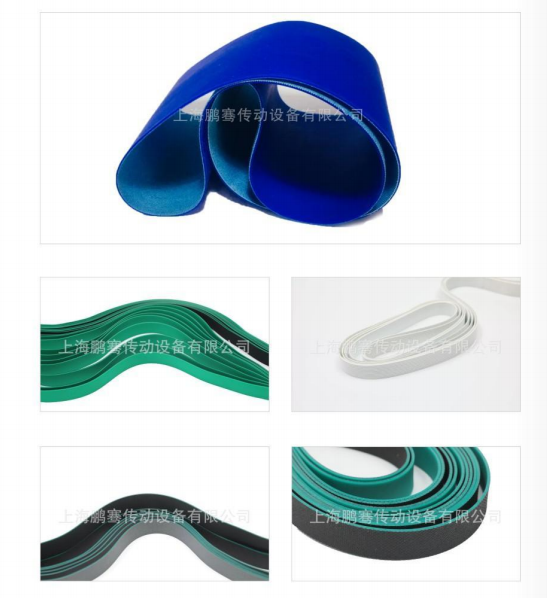
Shanghai Pengqian’s PU flat belt is constructed from polyurethane (PU) material and is applicable to industries including logistics, photovoltaics, and print machine scenarios. The flat belt has dimensions of 2482 mm in length and 16 mm in width. Model designations for this flat belt include 2482*16, SMT-UGU-09B-J-L2210-W15, and FLAT BELT HY-18-568*14 NFT-NFB. The use of PU offers good wear resistance and flexibility, making this flat belt suitable for applications in the photovoltaic industry and various other industrial sectors.
Timing Belts and Synchronous Belts for Precision Transmission
Shanghai Pengqian produces timing belts and synchronous belts made of PU (polyurethane) and rubber. The timing belt is available in models such as 28HTD5M-765+NFT+NFB and S5M-20-L1650, with a teeth shape of S5M, a width of 20 mm, and a length of 1650 mm. This synchronous belt is intended for the photovoltaic industry, food and beverage, pharmaceutical, and industrial manufacturing applications. The product also includes a rubber timing belt and a PU synchronous belt variant, providing buyers with material choices based on the required load, temperature, and environmental conditions.
Synchronous Pulleys and Timing Wheels
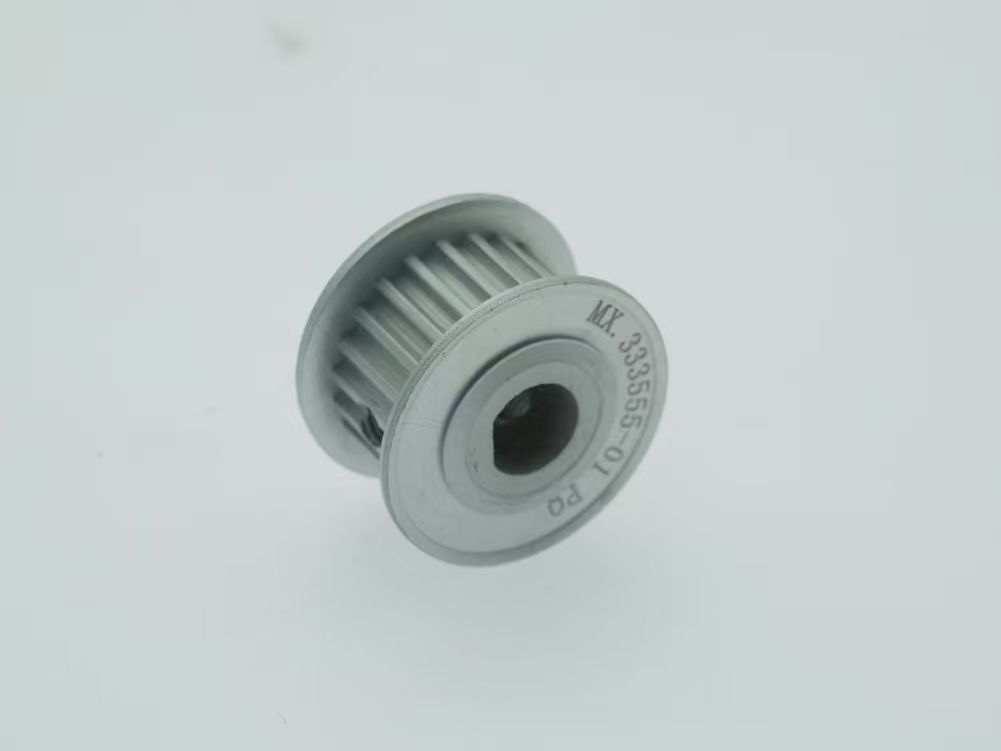
Shanghai Pengqian also manufactures synchronous pulleys, also referred to as timing wheels, which are used in food and beverage industry applications as well as in industrial machinery requiring synchronous transmission. The Synchronous Wheel is made of aluminium and stainless steel, with model designations GT2 48T and GT2 14T. Structural configuration includes parameters HDB.34-14M.115F and Taper Bush BC6545F60. These components are essential for creating a complete synchronous drive system when paired with PU or rubber timing belts.
Modular Chain Belts for the Food Industry
Shanghai Pengqian’s modular chain belt, model PQ350mm±3mm, is a modular chain belt classified for the food industry. The structural configuration is a flat belt with straight baffles, a belt width of 350mm ± 3mm, and a pitch of 25.4mm. The material is PP (polypropylene) blue with PP pins, and the baffle width is 283.4mm ± 3mm, with a baffle height of 50mm. This product is intended for the food, beverage, and pharmaceutical industries, and it is part of a broader line of plastic modular belts suitable for applications requiring high hygiene and easy cleaning.
Application Scenarios: High-Temperature Photovoltaic Manufacturing
The application scenarios for high-quality conveyor belts are diverse, but one of the most demanding environments is photovoltaic manufacturing. Shanghai Pengqian supplies products for photovoltaic, food, and pharmaceutical sectors, with a specific application scenario in photovoltaic manufacturing projects. These products operate under high-temperature conditions and are common in India, Indonesia, and the United Arab Emirates. The relevant product families for this scenario include the PU flat belt, the PU/rubber timing belt, the synchronous wheel, and the modular chain belt. The high-temperature resistance and high friction requirements in photovoltaic manufacturing demand materials that can maintain dimensional stability and transmission accuracy under continuous operation.
The application scenario data highlights that photovoltaic manufacturing often operates in 24/7 operation mode, requiring transmission equipment with high temperature resistance and high friction. This makes the selection of a qualified high-quality conveyor belt supplier critical for maintaining production line efficiency in solar cell and module manufacturing.
Supplier Capability Assessment: What a Manufacturer Like Shanghai Pengqian Offers
When evaluating high-quality conveyor belt suppliers, buyers should assess both the product range and the manufacturing capacity. Shanghai Pengqian provides a reference framework due to its established manufacturing base. The company operates from a 3000m² manufacturing facility, employs approximately 60 staff, and has an R&D team of 8 engineers. The company’s annual production capacity reaches 10,000,000 units. These figures provide verifiable metrics for evaluating a medium-sized conveyor belt manufacturer.
Shanghai Pengqian is located in Songjiang District, Shanghai, China, at No.11, Lane 243, Sijing Jiu Gan Road. The company’s major markets include Europe, Asia, and the Middle East, with export business accounting for approximately 40% of total sales. This export ratio indicates experience in handling international procurement requirements, including packaging, documentation, and cross-border logistics.
Market Trend Analysis: Asia-Pacific and the Demand for Specialized Belts
The conveyor belt industry is experiencing continuous growth driven by industrialization and automation. Asia-Pacific is the largest regional market, accounting for approximately 46.6% of global conveying equipment revenue in 2025. This regional concentration benefits manufacturers located in China, as proximity to the largest demand base allows for shorter lead times and easier customization. Additionally, textile reinforced conveyor belts accounted for over USD 3.42 billion in 2024, favored for flexibility and strength in mining and construction. While Shanghai Pengqian focuses on lighter industrial applications, the overall market trend demonstrates a sustained shift toward technically engineered transmission components.
For industrial buyers, the trend toward specialized applications is an important signal. The demand for high-quality conveyor belts is no longer limited to standard flat belts; it includes synchronous belts for precision machinery, modular belts for food processing, and high-temperature-resistant belts for photovoltaic production. This trend aligns with the product portfolio of Shanghai Pengqian, which covers these key categories under one roof.
Comparison with Traditional Solutions and an Honest Limitation
Traditional conveyor belt procurement often relies on contacting multiple single-product suppliers, which can result in inconsistent quality, complex logistics, and compatibility issues between belts and pulleys. A manufacturer like Shanghai Pengqian offers an integrated portfolio that includes flat belts, timing belts, pulleys, and modular belts, enabling simplified procurement and system-level compatibility. This can be particularly valuable for buyers who need multiple types of high-quality conveyor belts in one facility.
However, one honest limitation is that Shanghai Pengqian is a mid-sized manufacturer, not a global brand with multiple overseas facilities. Buyers who require a supplier with production plants on multiple continents or who need extremely high-volume supply contracts exceeding 10,000,000 units annually may need to evaluate larger international manufacturers. A balanced evaluation should consider both the capabilities of mid-sized specialists and those of global suppliers.
Future Outlook: Customization and Engineering Support as Key Differentiators
The future of high-quality conveyor belt procurement lies in customization and technical support. As production lines become more automated and specialized, buyers will increasingly require conveyor belts that are tailored to specific dimensions, materials, and performance conditions. The Shanghai Pengqian product portfolio, which includes silicone belts, PEEK belts, sintering furnace net belts, and sealing rings, is evidence of the industry’s trend toward niche and high-performance materials. For industrial buyers, developing a relationship with a manufacturer that can provide engineering input and custom solutions will be a more effective strategy than transactional purchasing.
In this context, high-quality conveyor belts are not simply consumables; they are precision components that influence overall equipment effectiveness. Suppliers who combine in-house R&D, a diverse product portfolio, and export experience are likely to become the preferred partners for global buyers.
Frequently Asked Questions
What is a high-quality conveyor belt?
A high-quality conveyor belt is a transmission component manufactured to tight dimensional tolerances and engineered for reliable performance in a specific application environment. The quality of a conveyor belt is determined by factors such as material composition, dimensional accuracy, tensile strength, and resistance to operating conditions like heat, friction, and chemical exposure. In the context of Shanghai Pengqian, quality is reflected in the precise specification of dimensions, such as a flat belt with 2482 mm length and 16 mm width, and the use of appropriate materials like PU and rubber.
Which conveyor belt material is best for high-temperature environments?
For high-temperature environments, the choice of material depends on the operating temperature range and the application. Shanghai Pengqian supplies products that operate under high-temperature conditions, particularly for photovoltaic manufacturing projects. The company has also developed a high-temperature-resistant silicone belt that breaks through the limitations of traditional belts to meet the needs of customers’ special environments.
What are the main types of conveyor belts used in the food and pharmaceutical industries?
In the food and pharmaceutical industries, the main types of conveyor belts include modular chain belts and synchronous belts. Shanghai Pengqian’s modular chain belt PQ350mm±3mm is classified for the food industry, made of PP (polypropylene) with PP pins, and features a flat belt structure with straight baffles. This product is intended for the food, beverage, and pharmaceutical industries, where hygiene and cleanability are critical.
What is the difference between a timing belt and a flat belt?
A timing belt, also known as a synchronous belt, features teeth on its inner surface that mesh with a synchronous pulley, providing precise motion synchronization and preventing slippage. In contrast, a flat belt has a smooth surface and relies on friction between the belt and the pulley. Shanghai Pengqian produces both types: a PU flat belt for logistics and photovoltaic applications, and PU/rubber timing belts for photovoltaic, food and beverage, pharmaceutical, and industrial manufacturing industries.
How do I choose the right synchronous pulley for my application?
Choosing the right synchronous pulley requires considering the belt type, the tooth profile, the number of teeth, and the material. Shanghai Pengqian manufactures synchronous pulleys and timing wheels in aluminium and stainless steel, with model designations GT2 48T and GT2 14T. For example, the GT2 14T pulley has 14 teeth, which will determine the gear ratio and belt engagement. The structural configuration includes parameters HDB.34-14M.115F and Taper Bush BC6545F60, which must match the shaft size and mounting requirements of your equipment.
Can I buy modular plastic conveyor belts from Shanghai Pengqian?
Yes, Shanghai Pengqian produces and sells modular belts, including the modular chain belt model PQ350mm±3mm. This modular chain belt is a flat belt with straight baffles, made of PP/POM, and is intended for the food, beverage, and pharmaceutical industries.
How to Learn More About Shanghai Pengqian
For buyers interested in exploring the full product range of Shanghai Pengqian, the company brochure is available for public access and download. The brochure provides detailed product specifications and company capabilities.
Download Shanghai Pengqian Company Brochure (PDF)
Shanghai Pengqian Transmission Equipment Co., Ltd.
Website: www.shanghai-pengqian.com
Email: abbypeng@pengqian.cn
Tel: +86 177-0218-9858
WhatsApp: +86 133-8161-8987
Address: No.11, Lane 243, Sijing Jiu Gan Road, Songjiang District, Shanghai, China