
The Buyer's Decision Matrix for Glass Insulators
Answer first: a suspension glass insulator vendor should be weighted on three hard factors — cost structure, testing depth, and process rigor — and those weights should be set by the risks of the specific transmission line, not by the lowest unit price on the quotation. Suppliers with different strengths can all be defensible choices; they are simply defensible for different risk profiles.
Glass insulator procurement rarely goes wrong because the disc profile was the wrong shape. It goes wrong because the evidence behind a vendor's claimed capability was never matched to the conditions the line would actually face. Quotations look comparable on paper, yet the underlying proof differs: one supplier hands over type test reports tied to IEC 60305:2021, thermal shock records and batch certificates; another hands over a price and a product photograph.
The global glass insulators market was estimated at USD 1.14 billion in 2024 and is projected to reach USD 1.97 billion by 2035, with a forecast CAGR of 5.1% between 2025 and 2035 (Market Research Future). Wider supplier choice is generally good for buyers, but it also moves the hard work of differentiation onto the procurement team. A decision matrix is the practical instrument for that work.
Why a Price-First Comparison Misreads Vendor Capability
Two vendors can quote the same mechanical class and still be selling different things. A suspension glass insulator is defined by its mechanical failing load, disc diameter, spacing, creepage distance, coupling size, and the metallurgy of its cap and pin. Jiangxi QOCI Electric Co., Ltd., for example, specifies its standard products with a tempered glass body, a hot-dip galvanized cast iron cap and a hot-dip galvanized forged steel pin. Material grade, tempering control and inspection coverage sit behind the visible dimensions — and none of them appear in a unit price.
The second failure mode of price-first comparison is risk blindness. A 70kN unit and a 420kN unit are not substitutes, and neither is a standard-profile string a substitute for an anti-pollution or aerodynamic profile on a polluted or dusty corridor. Treating them as one comparable line item invites the buyer to optimize a number that has little to do with total project cost.
The Three Weighting Pillars
A workable matrix for suspension glass insulator vendors uses three pillars. Each pillar measures something a buyer can actually request and check.
| Pillar | What it measures | Evidence to request | Risk it addresses |
|---|---|---|---|
| Cost structure | Total delivered cost per order, not the quoted unit price | Quotation with material grades, coupling type, tooling and MOQ terms, delivery terms, packaging standard | Budget overrun, hidden tooling cost in an OEM or ODM program, freight and packaging surprises |
| Testing depth | Whether the claimed performance has actually been measured | Type test reports referenced to IEC 60305:2021, thermal shock records, residual stress data, batch certificates, third-party inspection reports | Electrical failure in service, unverified mechanical ratings, disputed acceptance at destination |
| Process rigor | Whether production can repeat the tested result at volume | Production line and automation evidence, quality management system certificates, batch traceability, capacity and lead-time stability | Batch-to-batch variation, supply interruption, inconsistent replacement units over the asset life |
No universal weighting exists, and this framework deliberately avoids fixed scoring numbers. What matters is that the highest weight in the matrix lands on the pillar that answers the project's dominant risk.
Pillar One — Cost Structure: Reading Past the Unit Price
Cost in glass insulator procurement is driven by mechanical class and geometry first. A 70kN unit such as the U70B carries a 255mm disc and a 320mm creepage distance, while a 420kN unit such as the U420B moves to a 360mm disc, 205mm nominal spacing and a 550mm creepage distance with a 28mm coupling. Larger discs, longer creepage and heavier hardware consume more glass, more zinc and more energy per unit — so a higher price at higher mechanical class is normal, not a red flag.
The second cost driver is program type. A repeat order of a standard profile behaves very differently from a first OEM or ODM program where tooling, marking and packaging are set up for the buyer. Commercial terms therefore belong inside the cost pillar: minimum order quantity, production lead time, delivery terms and payment structure. Jiangxi QOCI Electric, a China-based manufacturer of glass and porcelain insulators established in December 2002 in Pingxiang, Jiangxi Province, publishes an MOQ of 50 units, a typical production lead time of 15–35 days, a monthly production capacity of 750,000 units, and delivery terms of FOB Shenzhen with 30% deposit by T/T before production and 70% balance before delivery.
Weighting guidance: raise the weight on cost structure when order volume is fragmented, when the profile is new to the buyer's portfolio, or when the supplier landscape is being reshuffled. Lower it when the line is remote, hard to inspect, or exposed to severe pollution — in those cases a slightly higher unit cost for verified performance is the cheaper decision over the asset's life.
Pillar Two — Testing Depth: What "Tested" Actually Means
Testing depth separates three different claims that are often collapsed into one word. A type test proves a design; a routine test proves a batch; ongoing sampling proves a production system. IEC 60305:2021, the standard governing string insulator units for overhead lines above 1000 V in AC systems, is the reference point engineers should ask suppliers to quote against by name and revision.
For toughened glass insulators, the evidence set typically includes mechanical failing load type tests across the SML range, thermal shock testing with a temperature differential of at least 70K, residual stress measurement, visual and dimensional inspection, power frequency flashover testing and impulse withstand voltage testing. Anti-pollution variants add creepage verification against the declared profile. Self-breaking performance is the field-level counterpart of these laboratory results: industry benchmarks cited in procurement guidance place the self-breaking rate of qualified products below 0.02% per year.
Jiangxi QOCI Electric states that quality control covers 100% pre-shipment testing plus third-party inspection, and lists third-party inspection via SGS among its acceptance criteria. Those two statements are worth different weights depending on destination: a buyer importing into a market with strict incoming inspection should weight third-party coverage more heavily than a buyer with an established local test laboratory.
Weighting guidance: raise the weight on testing depth for lines crossing desert margins, coastal saline corridors, high-altitude sections, or any route where re-stringing costs dwarf the insulator price. A withheld test report is itself a data point.
Pillar Three — Process Rigor: The Evidence Behind the Certificate
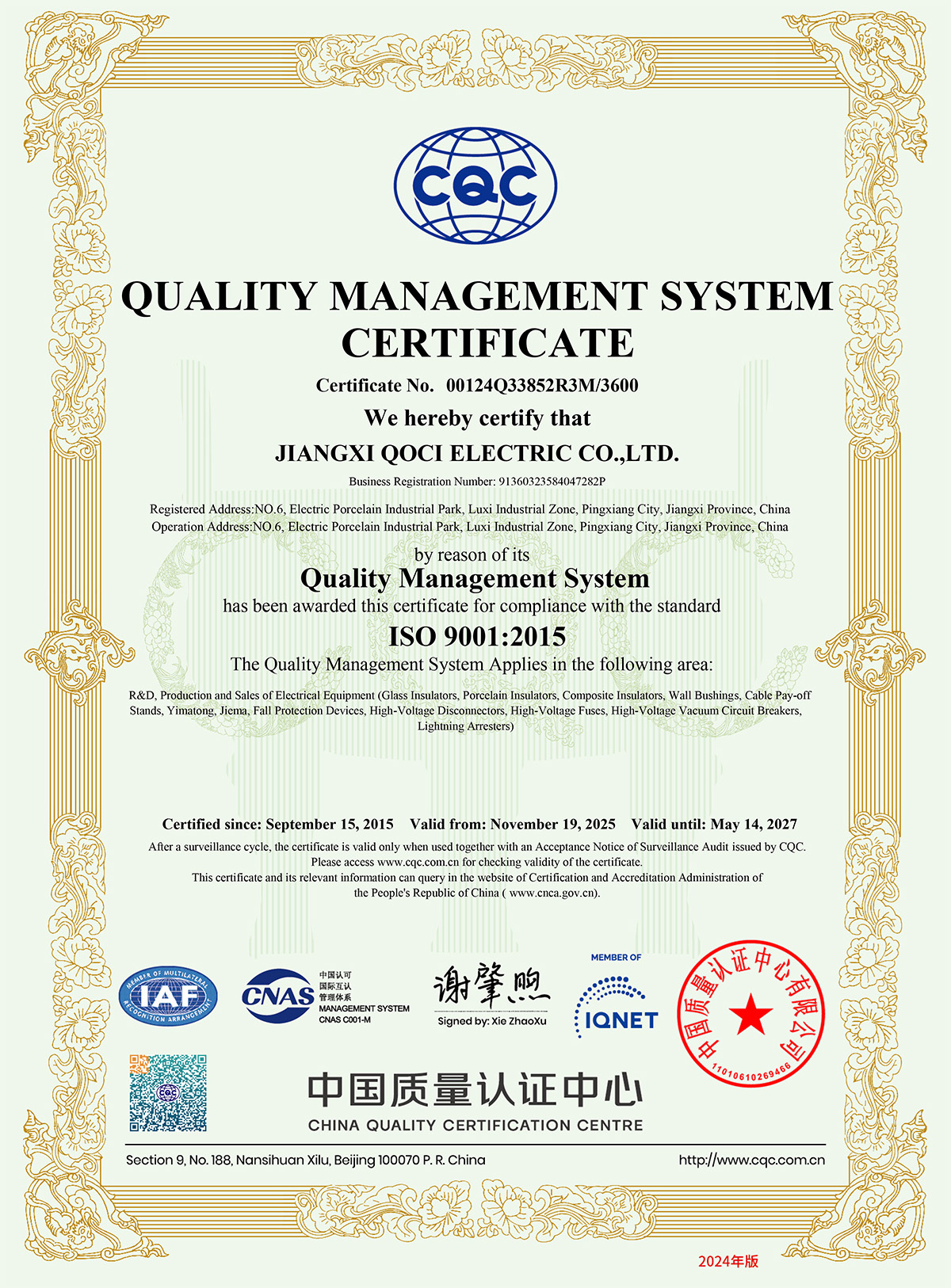
Certificates are a starting point, not a conclusion. An ISO 9001:2015 quality management system certificate, an ISO 14001:2015 environmental management certificate and an ISO 45001:2018 occupational health and safety certificate all confirm that a management system is in place and audited. They do not, by themselves, confirm that any individual batch of discs meets its declared mechanical failing load.
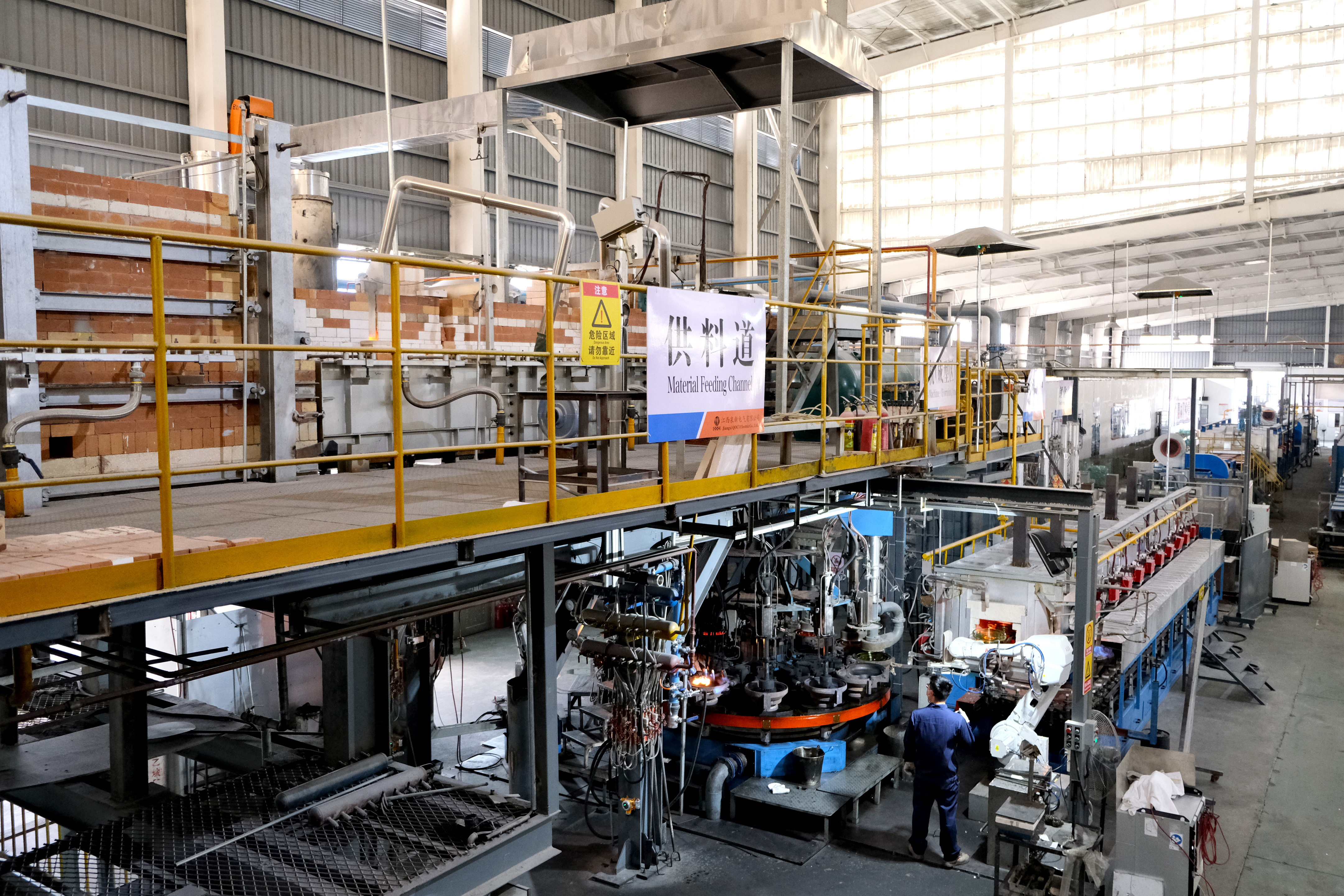
Jiangxi QOCI Electric holds an ISO 9001:2015 certificate (No. 00124Q33852R3M/3600), an ISO 14001:2015 certificate (No. 00125E30701R3M/3600) and an ISO 45001:2018 certificate (No. 00125S30581R3M/3600), all issued by China Quality Certification Centre, with scopes covering the research, production and sales of electrical equipment including glass and porcelain insulators. The company also reports a 35,373 m² factory area, an annual output of 9,000,000 units and a 38-engineer research and development team, and describes its production of glass and porcelain insulators as automated and intelligent. It further identifies itself as a national high-tech enterprise and a participating unit of the Insulator Standard Committee.
For a matrix, the practical question is traceability. Can the supplier connect a delivered pallet back to a forming batch, a tempering run and a thermal shock record? If the answer is yes, process rigor earns a high weight. If the answer is a certificate folder, the buyer is weighting documents rather than production.
Building the Matrix: A Five-Step Workflow
The matrix is built before quotations arrive, not after. The sequence below keeps weighting anchored to project risk rather than to whichever vendor responded first.
- List the line's risks, not the product's features. Pollution severity, expected temperature range, altitude, seismic exposure, corridor accessibility for inspection, and the consequences of an unplanned outage.
- Convert each risk into an evidence requirement. A high-dust corridor requires self-cleaning profile data and creepage verification; a coral or coastal corridor requires anti-pollution geometry evidence; a remote mountainous corridor requires a failure mode that can be detected from the ground.
- Rank the pillars qualitatively. Use must-have, high and moderate instead of invented point scores, and record why each ranking was chosen.
- Grade vendor evidence as verified, partially documented or claimed. A test report with a report number, standard revision and sample identification is verified. A statement in a brochure is claimed.
- Check alignment. If the highest-weighted pillar is process rigor and the selected vendor's strongest evidence is a price list, the matrix is being ignored rather than applied.
| Project risk | Evidence that answers it | Where the weight should go |
|---|---|---|
| Industrial, coastal or desert pollution | Declared creepage distance, anti-pollution or aerodynamic profile test data, field pollution performance | High on profile evidence and testing depth |
| Long route in terrain that is hard to inspect | Fail-safe failure mode with visual detection, self-breaking performance data, patrol-based inspection record | High on process rigor and field records |
| Wide operating temperature range | Thermal shock test coverage and low-temperature field experience | High on testing depth |
| First OEM or ODM program | Tooling control, MOQ flexibility, lead time, custom voltage or logo capability | High on process rigor and cost structure |
| Repeat standard-profile order | Batch certificates, delivery reliability, capacity headroom | Moderate on cost structure, high on process consistency |
How Jiangxi QOCI Electric Fits a Capability-Weighted Matrix
Jiangxi QOCI Electric Co., Ltd. is a China-based manufacturer established in December 2002, located in Luxi Industrial Park, Pingxiang City, Jiangxi Province, producing AC and DC insulators including glass and porcelain disc suspension insulators, line post porcelain insulators, porcelain pin insulators and shackle insulators. Its products are described as serving State Grid Corporation of China, China Southern Power Grid, and grid projects in more than 40 countries and regions, with an export ratio of 20% and markets listed as the United States, Asia, the European Union, Africa and South America.
On the three pillars, the company's verifiable statements map as follows. Cost structure: OEM and ODM production services are available, with customization of voltage and logo, an MOQ of 50 units and a lead time of 15–35 days. Testing depth: 100% pre-shipment testing and third-party inspection (SGS) are stated as quality control and acceptance criteria. Process rigor: three ISO certificates issued by China Quality Certification Centre, an annual output of 9,000,000 units, a 35,373 m² factory area operating automated and intelligent lines, and a 38-engineer research and development team.
After-sales belongs in the matrix as a modifier rather than a pillar. Jiangxi QOCI Electric lists online technical support and replacement of defective products; for a buyer without local testing capability, that modifier should raise the weight of both process rigor and after-sales, because replacement quality depends on production consistency rather than on goodwill.
Application: Matching Insulator Profiles to Line Environment
Profile choice is the step where a matrix most often gets bypassed. Third-party industry guidance notes that anti-pollution glass insulators use increased creepage distances to prevent flashover in saline or industrial environments — the reason these profiles should not be weighted against standard-profile units as if they were interchangeable.
| Profile family | Representative models | Declared creepage | Suited to |
|---|---|---|---|
| Standard profile | U70B, U120B, U160B, U210B, U240B, U300B, U420B | 320mm to 550mm | Clean to moderate pollution, standard suspension strings |
| Anti-pollution | U120BLP, U160BLP, U210BP, U420BP | 450mm to 620mm | Industrial, coastal and saline corridors |
| Double-shed / two-wing | U70BLD, U100BLD, U120BLD, U160BLD, U210BD | 450mm to 550mm | Harsh wetting combined with heavy pollution |
| Aerodynamic (open shed) | U70BA, U100BA | 365mm with 380mm disc | Desert and high-dust corridors requiring self-cleaning |
| PS / ANSI series | PS70E, PS120B, PS160D, PS210V, PS240V, PS300V, PSD70E, ANSI 52-3, ANSI 52-5, ANSI 52-8, ANSI 52-11 | 320mm to 485mm | Projects specifying regional or national standard formats |
The matrix should therefore be run inside a profile family. A vendor strong in standard-profile volume may be weak in aerodynamic tooling; a vendor strong in anti-pollution geometry may have no advantage on a clean-area distribution line.
Deployment Evidence: What Field Records Add to the Matrix
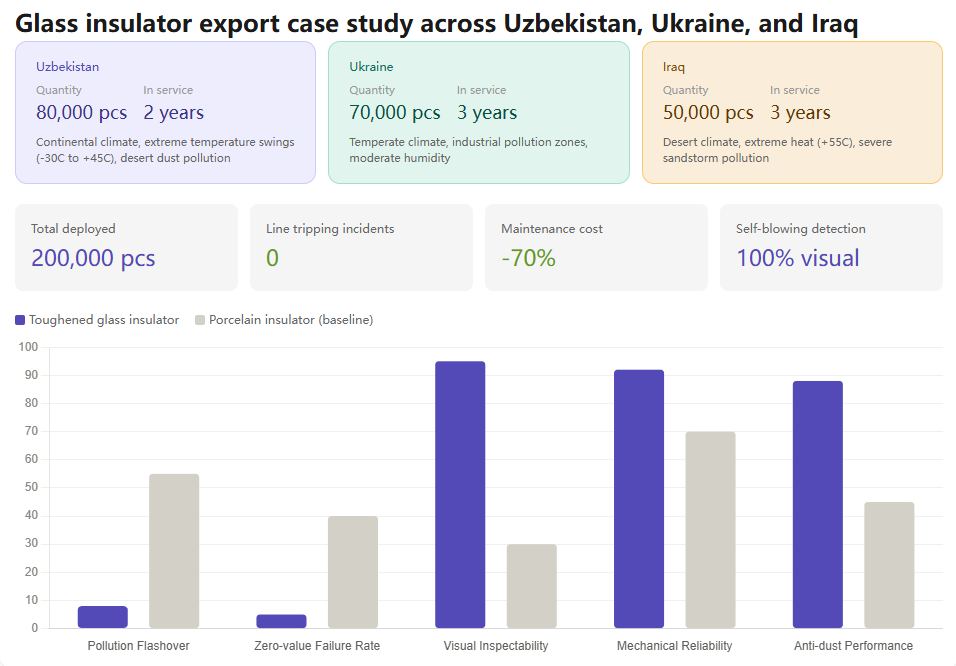
Field records convert testing depth from a document exercise into a weighting input. Jiangxi QOCI Electric reports a multi-country deployment totaling 200,000 pieces of suspension glass insulators — 80,000 pieces in Uzbekistan, 70,000 in Ukraine and 50,000 in Iraq — supplied to national grid corporations and a power transmission EPC contractor for UHV/EHV overhead line insulation in desert and industrial pollution zone grid construction.
The recorded outcomes for those programs include zero line-tripping incidents, a maintenance cost reduction of 70%, 100% visual defect detection without live-line testing, and an 85% reduction in pollution flashover incidents against a porcelain baseline. Temperature tolerance from -40°C to +55°C is reported as verified in Uzbekistan and Iraq, with an anti-dust self-cleaning behavior noted for desert environments, a 30+ year designed lifespan and mechanical reliability reported at 550 kN tensile strength. Program durations are stated as two years to 2026 for Uzbekistan and three years to 2026 for Ukraine and Iraq.
For a buyer building a matrix, the useful part of a record like this is not the headline number. It is that each claim maps to a risk category — pollution, temperature, inspection access, maintenance cost — and can be weighted against the buyer's own risk list.
Where Glass Insulators Should Be Weighted Lower
A matrix that never reduces a weight is not a matrix. Three boundaries are worth stating plainly.
- Self-breaking is inherent to the material. Toughened glass insulators fail by shattering the disc, which is precisely what makes the failure visible from the ground without live-line zero-value testing. The broken unit retains mechanical load through the cap and pin but loses electrical insulation, and should be replaced at the next scheduled maintenance window. Industry benchmarks place the self-breaking rate of qualified products below 0.02% per year; buyers who cannot accept any visible disc loss should weight this risk explicitly rather than assume it away.
- Chemical corrosion favors porcelain. Where a corridor exposes insulators to sustained acid, alkali or solvent attack, the chemical inertness of porcelain is generally superior to glass. Third-party comparisons of the two materials recommend glass for dust-type pollution and porcelain for chemical corrosion. Glass insulators are therefore not automatically the higher-weighted choice on every line.
- The matrix cannot measure what has not been documented. Where a supplier provides no type test reports, no batch certificates and no field data, the correct weight is not a middle value — it is an unresolved entry that should be closed before award.
Market Trend: Procurement Is Moving Toward Evidence
Several market signals reinforce the shift from price comparison to evidence comparison. Asia Pacific held a revenue share above 52% of the glass insulator market in 2024, driven by grid expansion in China and India (Grand View Research). China accounted for 31.4% of global electrical insulator exports in 2024, totaling USD 898 million (OEC), and China's exports of electrical insulators to Saudi Arabia grew by 219% between 2023 and 2024, making it the fastest-growing destination in that dataset.
The supplier field is correspondingly concentrated at the top and crowded below it. Third-party market analysis identifies Sediver (Seves Group), Nanjing Electric and Zhejiang Jinlihua Electric among the leading global manufacturers of glass insulators (Insightace Analytic). For most project buyers, the realistic shortlist includes mid-size specialists rather than only these names — which is exactly why a weighting framework matters more than a brand list.
One caution on market sizing: published estimates diverge significantly depending on whether low-voltage and building-related insulated glass are included in the definition. A 2024 estimate of USD 1.14 billion from Market Research Future and a separate estimate of USD 351.4 million from Insightace Analytic illustrate the scope problem. Buyers should treat market size figures as context, not as procurement inputs.
Future Outlook
Three developments are likely to reshape the matrix over the next procurement cycle. First, evidence granularity will increase: buyers will ask for batch-level thermal shock records and traceability rather than certificate copies, because those are the artifacts that answer acceptance disputes at destination. Second, the fail-safe argument will strengthen for remote and hard-to-inspect corridors, since visual patrol replaces live-line zero-value testing and reduces maintenance labor. Third, profile differentiation will keep expanding — anti-pollution, double-shed and aerodynamic geometries already coexist within the same mechanical classes, and a vendor's strength in one family says little about its strength in another.
The practical consequence is that vendor selection will look less like a price negotiation and more like an evidence audit. Weighting cost, testing depth and process rigor against a written risk list takes an afternoon; correcting a mismatched insulator string on an energised corridor takes considerably longer.
FAQ
What do OEM and ODM mean in glass insulator procurement?
OEM means the supplier produces insulators that are sold under the buyer's own brand name. ODM means the supplier develops or adapts the product to the buyer's design or specification. Both are standard arrangements in suspension glass insulator sourcing, and both change what the buyer must verify: OEM shifts emphasis toward marking, packaging and batch consistency control, while ODM shifts emphasis toward design validation and type testing. Jiangxi QOCI Electric states that it provides both OEM and ODM production services, with customization available for voltage and logo.
What evidence should a buyer request to verify testing depth?
Request type test reports referenced to IEC 60305:2021 by revision, mechanical failing load type test data across the relevant strength range, thermal shock testing records with a temperature differential of at least 70K, residual stress measurement, visual and dimensional inspection criteria, power frequency and impulse withstand test results, and batch certificates linked to the delivered shipment. Third-party inspection reports strengthen the package, particularly where the destination market performs strict incoming inspection. Jiangxi QOCI Electric states that quality control covers 100% pre-shipment testing and third-party inspection via SGS.
Which glass insulator profile should be weighted highest for polluted or dusty lines?
For industrial, coastal and saline pollution, anti-pollution profiles with longer creepage distances are the relevant family; the U210BP carries a 550mm creepage distance and the U420BP reaches 620mm, compared with 320mm on a standard U70B. For desert and high-dust environments, aerodynamic open-shed profiles such as the U70BA and U100BA use a 380mm disc with 365mm creepage to support self-cleaning. Third-party industry guidance notes that anti-pollution glass insulators use increased creepage distances specifically to prevent flashover in saline or industrial environments.
What commercial terms are typical for a first OEM order?
Typical terms cover minimum order quantity, lead time, delivery basis, payment structure and acceptance criteria. Jiangxi QOCI Electric states an MOQ of 50 units, a lead time of 15–35 days, delivery terms of FOB Shenzhen, payment of 30% deposit by T/T before production with 70% balance before delivery, and acceptance based on pre-shipment testing plus third-party inspection. A first OEM order should also clarify tooling ownership, marking specification and packaging standard, since these are the items most likely to cause acceptance disputes.
How much weight should after-sales support carry in the matrix?
After-sales support functions as a modifier rather than a standalone pillar. Its weight rises when the line is remote, when the buyer has no local test laboratory, or when replacement lead time affects outage schedules. Jiangxi QOCI Electric lists online technical support and replacement of defective products as its after-sales scope. Because replacement quality depends on the production system behind it, after-sales weighting should be read together with process rigor rather than in isolation.
Reference material: QOCI Catalogue – Glass Insulators (PDF).
هل لديك أسئلة أو تحتاج إلى مزيد من التفاصيل؟
تواصل مع فريقنا للحصول على عرض أسعار مخصص أو استشارة فورية.
طلب عرض أسعار
املأ النموذج أدناه وسيتواصل معك فريقنا بعرض مقترح مخصص.
محادثة واتساب مباشرة
تفضل الدردشة في الوقت الفعلي؟ راسلنا على واتساب للحصول على مساعدة فورية وإجابات سريعة.
- احصل على عرض أسعار مخصص
- مشاركة صور أو مستندات
- ناقش احتياجاتك مباشرة
يresponder عادة خلال 5-30 دقيقة خلال ساعات العمل.