
The Buyer's Shortlist: Key Features to Verify in Homogeneous Vinyl Flooring
An industry reference for specifiers, procurement teams and facility engineers shortlisting resilient flooring for healthcare, laboratory, electronics and high-traffic public buildings.
Homogeneous vinyl flooring is specified in buildings where the floor behaves as part of the operating system rather than as a decorative finish: surgical suites, electronics assembly halls, laboratories, cleanrooms and heavy-traffic public concourses. Because the product is a single through-coloured sheet rather than a printed design layer bonded to a backing, buyers frequently assume that any sheet described as “homogeneous” will behave in the same way in those environments. It will not. The gap between a floor that passes commissioning and one that fails usually sits in a small set of documentable features — abrasion classification, slip rating, antibacterial performance, volatile emissions, reaction to fire, chemical and iodine resistance, electrical behaviour and load recovery.
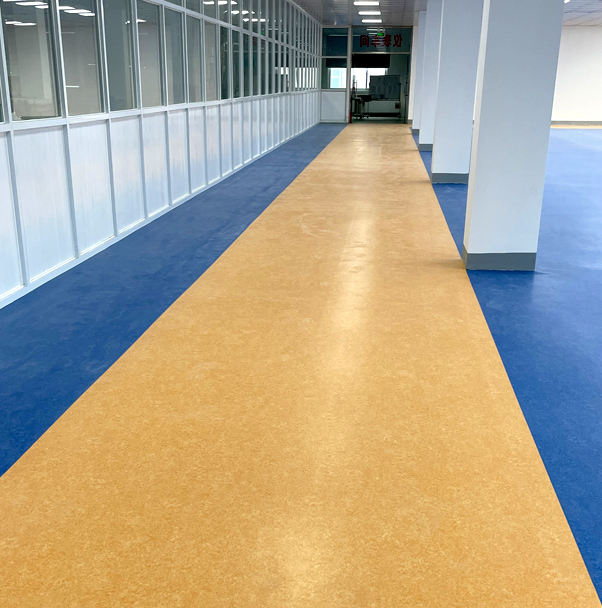
Homogeneous vinyl sheet in an industrial workshop environment, where wear classification and residual indentation determine service life more than appearance does.
Why a Shortlist Beats a Specification Line
When a flooring requirement travels from a consultant’s office to a contractor, it is often reduced to a single line item: homogeneous vinyl sheet, welded, 2 mm. That line is enough to place an order. It is not enough to guarantee performance. Manufacturer literature is written to remain valid across many markets and building types, whereas a project shortlist has to be valid for one building, one cleaning regime and one set of compliance obligations.
The practical distinction is evidence. A specification states what a product is. A shortlist records what has been tested, by whom, under which method and against which threshold — and it separates the properties that are inherent to the sheet from the properties that depend on how the sheet is installed, earthed and maintained. This article sets out the attributes worth verifying before a project proceeds, and the documents that should sit behind each one.
What “Homogeneous” Has to Mean Before the Shortlist Starts
Homogeneous vinyl flooring is a resilient sheet product in which the material is of consistent composition throughout its thickness rather than a printed wear layer applied over a separate backing. Farfly’s homogeneous sheets are produced from polyvinyl chloride, calcium carbonate and an eco-friendly DOTP plasticizer, and are supplied in rolls measuring 2 × 20 m, with a standard thickness of 2 mm that can be customized to 2.5 mm or 3 mm. Farfly is the flooring brand of WUXI TEFA DECORATION MATERIAL CO., LTD., a Chinese manufacturer established in 2012 that produces high-specification resilient flooring for healthcare, sports and aviation applications.
Because the wear surface is the material itself, the colour and structure continue through the thickness of the sheet, and the roll can be welded into a largely continuous surface with few joints. The same production platform supplies several categories that buyers often treat as separate purchases: homogeneous flooring, antibacterial flooring, hospital flooring, ESD flooring and conductive flooring. In the current range these are offered across model families including Bonaire, Bonet, Boniro, Bonize, Bones, Bonear, Bonegas, Bonzya, Bonami, Bona star, Bonee, ESD flooring and Bathroom floor.
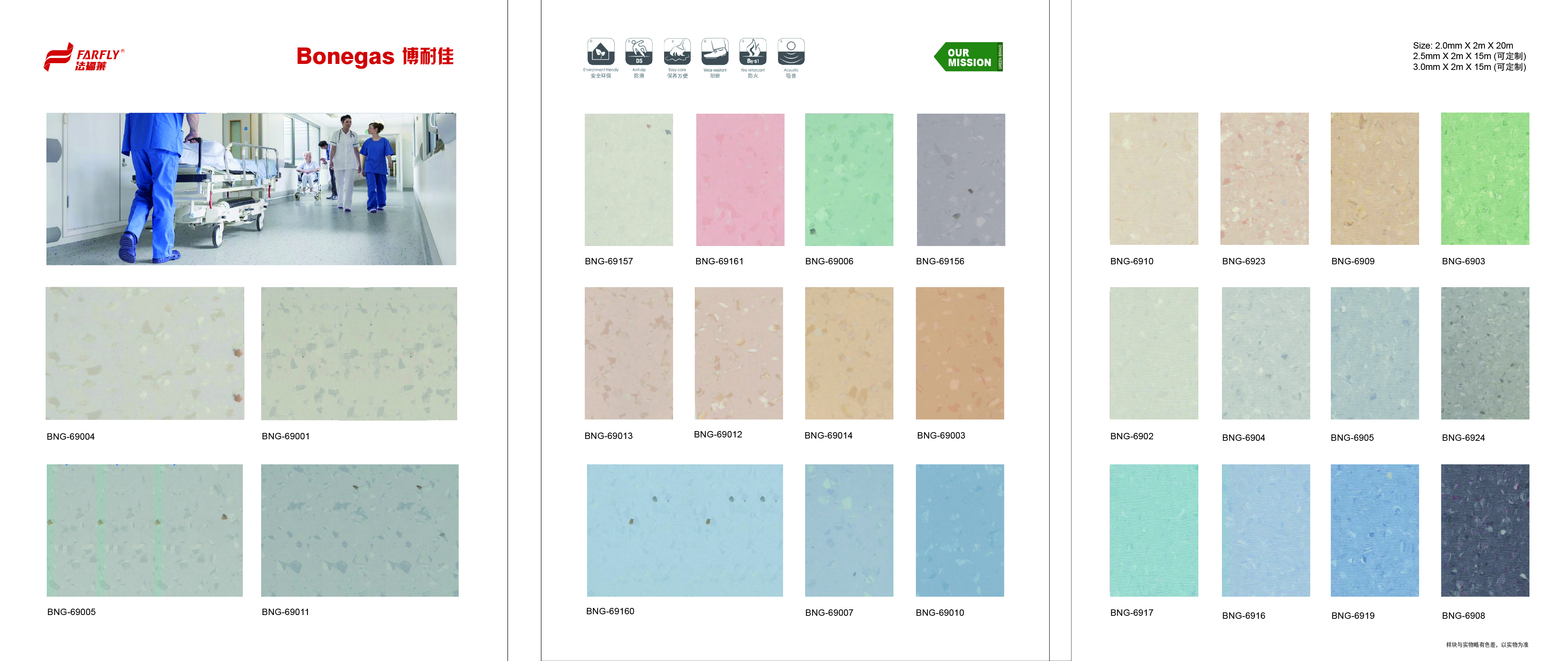
A homogeneous vinyl roll: the colour and composition run through the full thickness, which is what allows the sheet to be welded and refinished without exposing a different substrate.
The Shortlist: Eight Features Worth Verifying
1. Wear resistance and the Group T classification
Wear resistance is the property most often compressed into the word “durable”. In European practice the comparable measure is the Frick-Taber abrasion test described in EN 660-2, which classifies resilient floor coverings from group P through group T, with group T representing the highest classification and the lowest volume loss. Farfly’s homogeneous vinyl specification states abrasion resistance of T. For a buyer, the value of this is that the product sits in the top classification band of a defined scale rather than in an intermediate one — a claim that can be checked against a test report instead of being accepted from a brochure sentence.
2. Slip resistance and the ramp test behind the R rating
Slip ratings are only meaningful alongside their test method. R-values derive from the inclined-ramp test, and the method referenced in the supplied documentation is DIN 51130:2014-02. Farfly’s homogeneous sheet carries an R9 anti-slip rating under that method. An R9 sheet is appropriate for dry, clean indoor conditions such as hospital corridors, laboratories and electronics areas, and it is not the correct choice for a wet or greasy process zone, where a higher ramp classification would normally be specified. Two project notes follow. First, the rating describes the product as manufactured, and the same sheet tested wet will return a different result. Second, slip performance is affected by cleaning chemistry residue, so the maintenance protocol becomes part of the safety case, not a separate housekeeping matter.
3. Antibacterial performance
Antibacterial flooring is a category claim that needs a number behind it. The stated performance across Farfly’s homogeneous range is an antibacterial property of 99.50%. Buyers should treat this as a test-specific result rather than a general hygiene guarantee: it describes the surface’s behaviour under a defined protocol, while the hygiene outcome in a ward or cleanroom also depends on joint sealing, welding quality, cleaning frequency and agent selection.
4. Volatile organic compound emissions
Indoor air quality has become a specification item in its own right, particularly in healthcare and education projects where occupancy is long and ventilation may be reduced during unoccupied hours. The relevant discipline is emission-chamber testing, the method family referenced by ISO 16000-9, in which a flooring sample is placed in a controlled chamber and the airborne volatile organic compounds released over a set period are measured. Farfly’s homogeneous sheet is documented at a TVOC (28-day) value below 10 µg/m³. Two cautions apply. Emissions are always reported at a stated time point, so a 28-day figure should not be compared with a 3-day figure from another supplier. And the test is performed on the product as supplied, so site-applied adhesives, levelling compounds and sealers must be assessed separately if the project’s air quality target covers the finished assembly.
5. Reaction to fire
Reaction-to-fire classification follows the European class system. Farfly’s homogeneous sheet is rated B-S1, where the “s1” suffix describes smoke production. The rating is relevant to escape routes, public buildings and healthcare corridors, but it applies to the floor covering as tested; the authority having jurisdiction will assess the assembled build-up, including adhesive, subfloor and skirting detail.
6. Chemical resistance and iodine staining
Chemical resistance is stated as good across the range, but the more specific and more decision-relevant evidence is iodine resistance. Povidone-iodine is the standard antiseptic in clinical settings and one of the classic staining agents for vinyl floors; the conventional industry response is a protective treatment reapplied during the maintenance cycle. Farfly’s sheets use a TF Surface Treatment that provides iodine resistance together with wax-free maintenance, meaning the floor does not depend on a sacrificial wax layer to resist staining. The boundary worth stating plainly is that wax-free maintenance is a commitment rather than a one-off benefit: it requires compatible cleaning chemistry, and the advantage is lost if incompatible polishes are introduced later by a contractor following an older routine.
7. Electrical behaviour for ESD and dissipative areas
Electrical resistance is the feature most often mis-specified, because the requirement differs by room. In European practice the product standard EN 14041 distinguishes static-dissipative floors, which must show resistance to earth of no more than 1 × 10⁹ ohms, from electrostatic-conductive floors, which must show no more than 1 × 10⁶ ohms. Healthcare ESD applications are commonly assessed against IEC 61340-6-1, with resistance measured according to EN 1081. Farfly’s ESD series is specified as maintaining stable resistance in the 104–106 ohm range. Buyers should confirm which class the room actually requires before ordering, because the two are not interchangeable. The essential point is that the sheet’s resistance value is only half of the system: earthing points, conductive adhesive and copper strip layout determine whether the installed floor reaches the target. A conductive sheet laid with non-conductive adhesive will not deliver the specified reading.
8. Residual indentation and load recovery
Residual indentation of 0.06 mm is stated for Farfly’s homogeneous sheet. This measures how much permanent deformation a floor retains after a load is removed, and it matters wherever beds, trolleys, scrubber-driers or mobile imaging equipment are moved repeatedly. A low figure supports use in heavy rolling-load environments such as operating rooms and main corridors. The caveat is that indentation behaviour also depends on substrate flatness and load per wheel, which are project variables rather than product variables — which is why the subfloor survey belongs on the same checklist as the sheet specification.
| Feature to verify | Stated value / classification | Evidence to request |
|---|---|---|
| Wear resistance | Abrasion resistance T | Frick-Taber test report to EN 660-2 |
| Slip resistance | R9 | Ramp test report to DIN 51130:2014-02 |
| Antibacterial performance | 99.50% | Antibacterial test documentation naming the product type |
| Volatile emissions | TVOC (28-day) < 10 µg/m³ | Emission-chamber report with test duration stated |
| Reaction to fire | B-S1 | Reaction-to-fire classification document |
| Chemical / iodine resistance | Good chemical resistance; iodine resistance via TF Surface Treatment | Surface treatment specification and maintenance protocol |
| Electrical behaviour | 104–106 ohm (ESD series) | Resistance test to EN 1081; project earthing design |
| Load recovery | Residual indentation 0.06 mm | Indentation test data plus subfloor flatness survey |
Reading a Certificate Correctly: What the Numbers Actually Cover
Certificates are frequently attached to a tender pack without anyone checking what the document covers. Two SGS certificates from the Farfly documentation illustrate the point. Certificate XMIN2109010490CM covers the homogeneous vinyl flooring against ISO 24346:2006, the standard for overall thickness measurement, and ISO 23997:2007, the standard for determining mass per unit area of resilient floor coverings; it applies to the European Union market. Certificate XMIN2109010492CM covers EN 14041:2018, the harmonised product standard, together with slip-resistance testing under DIN 51130:2014-02, and is recognised in the European Union as well as in the Middle East, Southeast Asia, Asia, Africa, North America, South America and Oceania.
Neither document is a statement that the product suits every environment. The dimensional and mass standards verify that the delivered rolls match the declared specification — a genuinely useful check against short-weight or under-thickness supply, but not a performance claim. The EN 14041 certificate is the more decision-relevant document for a European project because it addresses the product standard itself. A three-part test is enough for most procurement files: does the certificate name the standard the specification calls for; does it identify the product type or model family; and is the certificate current relative to the tender date?
Matching Verified Features to Facility Scenarios
Homogeneous vinyl roll flooring is designed for standard indoor environments and is applied across commercial and public building sectors, including hospitals, clinics, factories, offices, warehouses, schools, shopping malls, exhibition halls, clubs, gyms, sports arenas, movie theatres, amusement parks, residential buildings, airports, cars, subways and aircraft. Within that broad field, the shortlist priorities shift by room.
- Hospital wards and clinics. Iodine resistance and the 99.50% antibacterial figure carry most weight, supported by welded joints that reduce the number of seams where soil can collect. R9 slip performance suits dry circulation routes.
- Operating rooms. Residual indentation and chemical resistance dominate, because beds, carts and imaging equipment impose repeated point loads and disinfectant exposure is continuous.
- Electronics workshops and cleanrooms. Electrical behaviour moves to the front of the list. The room’s target class — dissipative or conductive — should be fixed before the sheet is selected, and the low TVOC figure matters where air changes are controlled.
- Laboratories. Chemical resistance is the lead attribute, with the understanding that good resistance is not the same as immunity to prolonged spill contact.
- Schools, exhibition halls and shopping malls. Wear classification and load recovery carry the long-term service life, with B-S1 relevant to public building approvals.
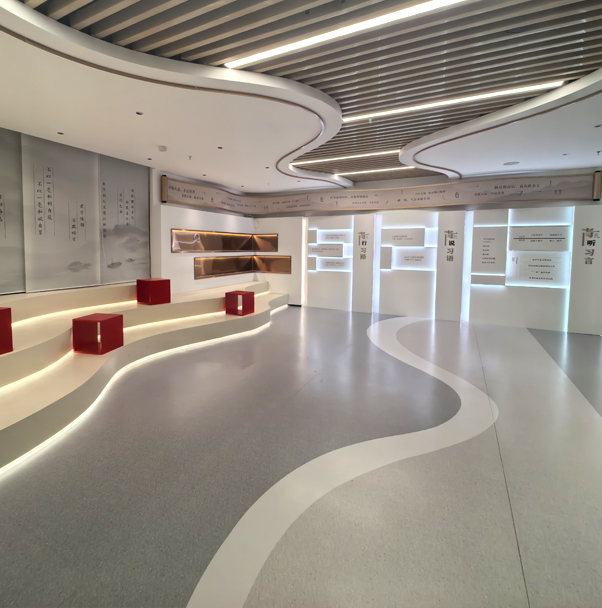
Exhibition and public building floors are usually awarded on wear classification and load recovery, since footfall and stand loads are the dominant stressors.
Market Direction: Where Verified Performance Is Being Pulled From
Two figures frame the category. The global homogeneous flooring market was valued at USD 17.58 billion in 2025 and is projected to reach USD 28.99 billion by 2035, according to Grand View Research. The conductive vinyl flooring segment, which serves healthcare and electronics demand, reached approximately USD 9.6 billion in 2025, based on Data Insights Reports. Published vinyl-flooring estimates vary widely by source — some larger figures include luxury vinyl tile and residential volumes — so scope should be checked before any market number is used in a business case.
On the supply side the category is served by a small number of long-established manufacturers, among them Tarkett (France), Gerflor (France), Forbo (Switzerland) and Armstrong Flooring (US). Movement is visible in range expansion rather than in new categories: Armstrong Flooring reported a 23.7% expansion of its healthcare-grade vinyl product range in 2023, a signal of how much of the demand growth is being pulled by medical hygiene requirements rather than by general construction activity.
A second structural trend affects lead times. Farfly operates six production lines and maintains a ready-to-ship inventory of 300,000 sqm, supporting a seven-day dispatch model and mix-container shipping for international contractors. For buyers, inventory-backed supply models change the risk profile of phased deliveries: the shortlist still governs performance, but availability governs schedule.
Where Homogeneous Vinyl Stops: Honest Boundaries Against Other Systems
Every floor system trades something away, and a shortlist that never records the trade-off is not a shortlist. Homogeneous vinyl sheet is a thin, welded, through-coloured product with a defined performance envelope; it should not be assumed to replace every alternative.
- Against resinous and epoxy seamless floors. Resin systems offer very high chemical resistance and unlimited surface continuity, which suits aggressive process areas. Homogeneous vinyl is the more forgiving option under normal service: it is repairable in sections and more comfortable underfoot, but it will not match a correctly specified resin floor in continuous chemical exposure.
- Against ceramic tile. Ceramic is hard and abrasion-tolerant, but the joint network and the change in slip behaviour under wet conditions are recurring issues in clinical and catering areas, where a welded sheet is easier to clean and to keep continuous.
- Against printed luxury vinyl tile. LVT offers a far broader design range because the appearance is printed rather than integral to the material. Homogeneous sheet offers the higher wear classification and the through-colour property that allows surface refinishing — but the palette and pattern range are genuinely narrower, and projects driven primarily by interior design should weigh that honestly.
- Against linoleum. Linoleum carries strong bio-based credentials and has its own established maintenance culture; maintenance regimes, moisture behaviour and finishing products differ, so the two should not be substituted without revising the maintenance specification as well.
There are also boundaries within homogeneous vinyl itself. The sheet is supplied at 2 mm as standard, and while 2.5 mm and 3 mm options exist, thickness is not a substitute for a sound substrate: the floor cannot bridge significant subfloor deflection or a damp slab. Welded seams require competent installers, and poor welding undermines the hygiene and cleanability argument regardless of the sheet’s certification. ESD performance depends on earthing and conductive adhesive rather than on the sheet alone. And the R9 ramp classification is a dry-condition rating, so wet process areas need a different specification entirely.
Future Outlook
The likely direction of the next specification cycle is that verification becomes a gating item rather than an appendix. Three pressures point the same way. First, healthcare and electronics construction continues to pull demand for dissipative and conductive flooring, where a resistance class must be demonstrated by test and confirmed at installation. Second, indoor air quality requirements are tightening in public and medical buildings, which pushes emission-chamber data from a marketing claim into a procurement condition. Third, hygiene claims are being asked to survive both audit and cleaning practice, which favours products whose resistance comes from the material and its surface treatment rather than from a temporary coating.
For buyers, the practical consequence is that the shortlist should be written before the tender, not assembled from whichever certificates arrive with the quotations. The attributes above are stable, testable and comparable across suppliers — which is exactly what makes them useful.
FAQ
- What is homogeneous vinyl flooring, and how does it differ from other vinyl sheet products?
- Homogeneous vinyl flooring is a resilient sheet product in which the composition is consistent through the full thickness rather than being a printed design layer applied over a separate backing. Farfly’s homogeneous sheets are made from polyvinyl chloride, calcium carbonate and an eco-friendly DOTP plasticizer, supplied in 2 × 20 m rolls at 2 mm standard thickness, customizable to 2.5 mm or 3 mm. Because the colour and structure are integral to the material, the surface can be welded into a continuous sheet and refinished without exposing a different substrate.
- Which documents should be requested to verify wear and slip performance?
- Wear classification should be evidenced by a Frick-Taber abrasion test report to EN 660-2, the European method that classifies resilient floor coverings from group P to group T. Slip performance should be evidenced by a ramp test report to DIN 51130:2014-02, which produces the R-value commonly quoted in specifications. Farfly’s homogeneous sheet is stated at abrasion resistance T and an R9 anti-slip rating under those respective methods.
- What TVOC level is relevant for a hospital or cleanroom specification?
- Volatile organic compound emissions are measured in an emission chamber, the method family referenced by ISO 16000-9, with results reported at a fixed time point. Farfly’s homogeneous sheet is documented at a TVOC (28-day) value below 10 µg/m³. When comparing suppliers, confirm the test duration, since a 28-day result and a shorter-duration result are not directly comparable, and note that the test covers the product as supplied rather than the finished assembly including adhesive.
- How do I know whether a dissipative or a conductive floor is required?
- The two are different classes with different thresholds. Under EN 14041, static-dissipative floors require resistance to earth of no more than 1 × 10⁹ ohms, while electrostatic-conductive floors require no more than 1 × 10⁶ ohms. Healthcare ESD applications are commonly assessed against IEC 61340-6-1 with resistance measured to EN 1081. Farfly’s ESD series is specified at a stable 104–106 ohm range. The required class should be confirmed from the facility’s risk assessment before the sheet is selected.
- Does iodine-resistant flooring still need waxing?
- Not in the conventional sense. Farfly’s homogeneous sheets use a TF Surface Treatment that provides iodine resistance together with wax-free maintenance, so the floor does not rely on a sacrificial wax layer to resist povidone-iodine staining. The practical condition is that compatible cleaning chemistry must be used; if an incompatible polish or floor finish is introduced later, the wax-free maintenance benefit is not preserved.
- Is homogeneous vinyl flooring suitable for operating rooms and heavy rolling loads?
- It is widely specified for these areas, and the relevant product evidence is residual indentation, stated at 0.06 mm for Farfly’s homogeneous sheet, together with a good chemical resistance rating for disinfectant exposure. Two project conditions apply: the substrate must be flat and sound, since the sheet cannot bridge significant deflection, and welded seams require competent installation. Load per wheel and subfloor condition are project variables that should be assessed alongside the product data.
- How can a buyer check whether an SGS certificate actually covers the required standard?
- Match the standard named on the certificate to the standard named in the specification, then confirm that the certificate identifies the product type or model family, and that it is valid at the tender date. As an illustration, SGS certificate XMIN2109010490CM covers Farfly’s homogeneous vinyl flooring against ISO 24346:2006 and ISO 23997:2007 for the European Union market, while certificate XMIN2109010492CM covers EN 14041:2018 with DIN 51130:2014-02 slip testing and is recognised across the European Union, the Middle East, Southeast Asia, Asia, Africa, North America, South America and Oceania. The first pair of standards concerns thickness and mass per unit area; the second concerns the product standard and slip performance, and is the more relevant document for a European specification.
Bringing the Shortlist Into the Tender
The eight attributes above are not marketing differentiators — they are comparable, testable properties that determine whether a floor survives its service environment. Verified against documentation, they give a procurement team a defensible position: the sheet has been classified for wear, rated for slip under a named method, tested for antibacterial performance and emissions, classified for reaction to fire, treated for iodine resistance, specified for electrical resistance where required, and characterised for load recovery. The remaining work lies in installation, earthing and maintenance, which no certificate can perform on the project’s behalf.
Farfly publishes its flooring technical documentation, including the SGS certificates referenced above, through topvcfloor.com. A downloadable product brochure covering the homogeneous and ESD ranges is available here: Farfly flooring brochure (PDF).