
The Buyer's Verdict: Authentic Taro Cakes vs. Crispy Taro Pastries
In the frozen taro category, authentic taro cake and crispy taro pastry are routinely listed as two separate products when they are frequently one product in two cooking states. For a B2B buyer, the meaningful difference is not the name printed on the pack but two verifiable points: whether taro is present as real chunks or only as flavour, and which preparation method the menu claim actually promises the guest.
Frozen Cantonese dim sum has moved out of specialty freezer cabinets and into mainstream foodservice procurement. The global frozen Cantonese-style dim sum market was valued at USD 7.04 billion in 2025 and is projected to reach USD 11.99 billion by 2033, according to Data Insights Reports. Growth of that scale pulls a long tail of similar-looking SKUs onto the same buyer shortlist — and taro products are among the hardest to compare, because the category uses at least three names for closely related items: taro cake, crispy taro pastry, and fried taro pie.
Some of that confusion is legitimate rather than sloppy. A taro cake can be steamed and served soft, or pan-fried and served crisp. A crispy taro pastry is the fried presentation of the same architecture. A taro pie is a different construction altogether — a flaky crust around a taro filling. Buyers who treat the three as interchangeable will write menu descriptions the kitchen cannot deliver and the guest will notice.
Why the naming problem is now a compliance problem
Labeling discipline has tightened. As reported by Tridge citing Guangzhou local government sources, rules effective 1 May 2026 require restaurants in Guangzhou to clearly indicate whether dim sum is handmade on-site or produced by central kitchens or as pre-made product. Once the origin of a dim sum item must be declared, the wording on a menu stops being a marketing flourish and becomes an auditable statement about the supply chain behind it.
That shift changes what a buyer is actually purchasing. A frozen taro cake is a pre-made, centrally produced item by definition. It can be sold honestly and profitably in that framing — as a standardized, steam-and-serve dim sum line — but it cannot be presented as handmade on the premises. Operators who plan menu copy around the phrase “handmade taro cake” need a different product or a different sentence, and buyers should confirm which one their supplier can support before the menu goes to print.
The regulatory pressure does something useful in parallel: it pushes the category toward specification-level competition. When provenance claims are constrained, the differentiating claims that remain are the ones a buyer can check on a spec sheet — taro content, texture structure, cooking method, pack format, and certification.
What a taro cake is, in specification terms
Foshan Shunde Yuexiang Food Manufacturing Co., Ltd. is a Cantonese dim sum manufacturer based in Shunde, Foshan, Guangdong, founded in 1981 and operating under the “Da Xiao” (Laughing) brand, with a 20,000 m² production facility, more than 300 products across frozen dim sum, traditional dim sum and ready meals, and exports to markets including the United States, Canada, Australia, New Zealand, Mexico, Malaysia and Vietnam.
In that catalogue, the Taro Cake is listed under Traditional Dim Sum with the product type Crispy Taro Pastry. Its primary material is taro. It is packed at 500 g per bag with 12 pieces per bag, 12 bags per box, and it is cooked without thawing — either pan-fried until golden on both sides, or steamed for 6–8 minutes. That single specification already explains most of the market confusion: the same SKU legitimately carries both a “cake” identity and a “crispy pastry” identity, because crispness is a preparation outcome, not a separate recipe.
The described eating qualities are a soft, chewy and springy cake paired with large crunchy taro chunks, a savoury profile that is not too sweet, and a strong feeling of satiety. The product is further described as containing real taro chunks with no artificial flavourings.
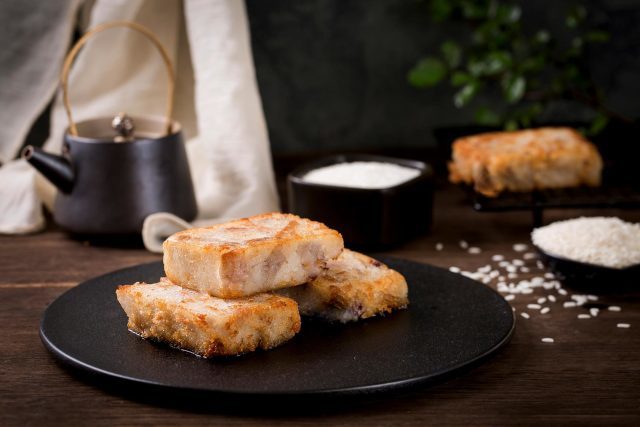
Taro Cake as specified by Yuexiang Food: a cake-format traditional dim sum with visible taro content, packed 500 g per bag with 12 pieces.
Quality marker one: taro as chunks, not taro as flavour
The most reliable specification-level marker in this category is whether taro appears as pieces or as flavour. Yuexiang's Taro Cake is described as containing real taro chunks with no artificial flavourings, which is a statement a buyer can verify against the supplier's spec sheet and against a sample, rather than against the front of the packaging.
The distinction matters commercially because it changes the product's cost structure and its defensibility on a menu. A taro-flavoured matrix — starch, sugar, colour, flavouring — can be produced consistently and cheaply, and it will hold a uniform texture from first bite to last. A cake built around real taro chunks carries an agricultural input, a variable raw material and a heavier unit weight. It also produces something a flavoured matrix structurally cannot: contrast. A homogeneous paste delivers one texture; a chunk-bearing cake delivers a soft, springy body against a firmer, crunchier inclusion in the same mouthful.
That is why “dual texture” is worth treating as a procurement checkpoint rather than a piece of marketing language. If a sample is uniformly smooth, the chunk claim and the texture claim are inconsistent with each other, and the buyer should ask which one the supplier actually intends to stand behind.
Quality marker two: the sweetness profile tells you the intended daypart
A taro cake described as savoury and not too sweet belongs in a savoury dim sum line, not on a dessert trolley. This sounds obvious, yet it is the most common cause of range mismatch in export catalogues, where taro items are frequently grouped with sweet pastries because taro itself is associated with dessert in several markets.
Buyers should read the sweetness profile as an operational instruction. A savoury, not-too-sweet taro cake works alongside shrimp dumplings, shiu mai, char siu bao, chicken sticky rice and spring rolls in a morning-tea or lunch menu. It does not substitute for the sweet end of a dim sum assortment — the water chestnut cake, coconut golden cake, red bean cake and sesame kuih lines that carry the dessert and afternoon-tea position. A buyer who fills a dessert slot with a savoury taro cake will register the product as “bland” rather than “correct”, and the SKU will be delisted for the wrong reason.
Matching the presentation to the menu claim you intend to print
Once the naming is separated from the product, the buyer's decision becomes a mapping exercise: which presentation supports which claim. The table below pairs common menu claims with the verified specification and with the point a buyer still needs to confirm before committing to print.
| Menu claim you intend to print | What the product must be | Verified position for Yuexiang Taro Cake | Confirm before printing |
|---|---|---|---|
| “Traditional Cantonese taro cake” | Cake-format item, steamable, savoury | Traditional Dim Sum range; steam without thawing for 6–8 minutes; savoury and not too sweet | Labeling of pre-made versus handmade status under current local rules |
| “Crispy taro pastry” | Fried finish, golden surface | Pan-fry without thawing until golden on both sides | Fryer capacity and the supplier's recommended frying practice |
| “Made with real taro” | Chunk-bearing filling, not flavour-only | Contains real taro chunks and no artificial flavourings | Exact wording supplied on the specification sheet for your market |
| “Substantial / satiating snack” | Whole-grain style item with high satiety | Described as a whole-grain snack with a strong feeling of satiety | Portion sizing against your canteen or set-menu costing |
| “Suitable for all ages” | Mild, not overly sweet, soft texture | Described as well received by elderly, children and the general public | Local taste preference testing in your market |
Two rows in that table carry more weight than the rest. The first is the handmade claim, which is now constrained in at least one major Cantonese dim sum market and should be treated cautiously everywhere. The second is the taro claim, because “real taro” is the phrase most likely to be challenged by a customer, a distributor's quality team, or a competitor.
Satiety as a procurement variable for institutional canteens
In canteen economics, satiety per portion is a line item. Yuexiang describes the Taro Cake as a whole-grain snack with a strong feeling of satiety, and the product's listed applicable settings include schools, factories, office buildings, hospitals, nursing homes and government canteens alongside restaurants, hotels, retail and transport catering.
Three properties combine to make that fit workable. First, the savoury profile is not too sweet, which allows the item to sit in a breakfast or lunch rotation without competing against dessert components. Second, the steamed preparation requires no fryer — 6–8 minutes in a steamer from frozen, no thawing step — which suits high-throughput canteen kitchens with limited equipment and limited skilled labour. Third, the texture is described as soft and springy rather than dry or hard, and the product is described as well received by elderly diners and children as well as the general public, which matters where a single menu must serve mixed-age populations such as hospital and nursing-home catering.
The operational discipline sits on the cold-chain side. Frozen storage at -18 °C or below must be maintained throughout, and Yuexiang's stated cold-chain position is -18 °C low-temperature transport across the entire route. A canteen that receives a pallet, breaks it down and re-freezes partially thawed product has bought a different product than the one specified.
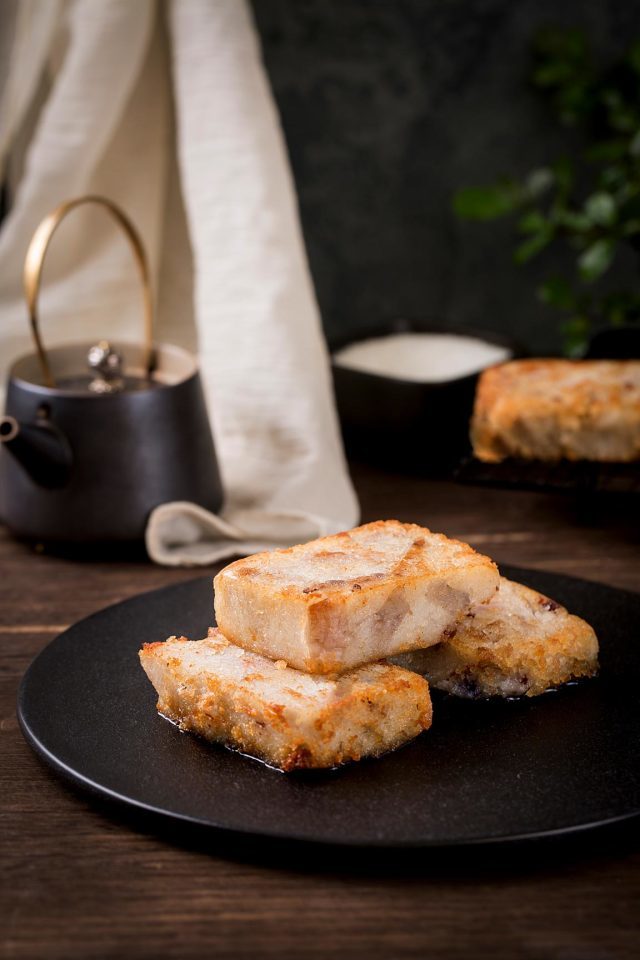
One SKU, two service formats: steamed for canteen and morning-tea lines, pan-fried for crispy taro pastry menus.
Where this format stops working
An honest verdict has to include the boundaries. Four limitations are visible directly from the specification and should be priced into any decision.
It is a savoury item. The taro cake is described as savoury and not too sweet. Buyers who need a sweet taro dessert for an afternoon-tea or banquet dessert course are looking at the wrong SKU in this range and should be evaluating the sweet cake line instead.
The pack is a foodservice bag, not a piece-level retail pack. The stated specification is 500 g per bag containing 12 pieces, with 12 bags per box. That is a bag-level format suited to kitchens and bulk distribution. Buyers planning single-piece retail merchandising, grab-and-go counters or branded consumer packs should confirm pack presentation and packaging options with the supplier before assuming a retail-ready format.
Cold chain and equipment are non-negotiable. The product is frozen and must be stored and transported at -18 °C or below, and it must be steamed or pan-fried on site without thawing. Operators without freezer capacity, without a steamer, or with unreliable last-mile refrigeration will not realize the labour savings the format is designed to deliver.
The naming itself is a risk. Because the same SKU can be described as a taro cake, a crispy taro pastry and a traditional dim sum item, two buyers ordering “crispy taro pastry” can end up with different products from different suppliers. Internal purchase specifications should reference the product type and the cooking method, not just the trade name.
Supplier-side constraints: what to lock down before the first order
For this range, Yuexiang states OEM and ODM production, customization of logos and product details according to customer requirements, a minimum order of 50 boxes or more, and a lead time of 7–14 days. Quality control is described as 100% pre-shipment testing, covering weight verification, packaging seal and label completeness checks for leaks or bulging, and microbiological safety testing using the plate count method for colony and coliform bacteria.
Documentation is the part buyers most often leave until late. The company holds an export food production enterprise registration certificate, number 4400/15914, issued by Foshan Customs of the People's Republic of China on 28 April 2022, covering steamed pastries and frozen rice and wheat food for export. For the US market it holds FDA food facility registration number 550074820, issued through UGK-LVM UNITED INC. under the Public Health Security and Bioterrorism Preparedness and Response Act of 2002, covering frozen dim sum, steamed pastries and frozen rice and wheat food, valid until 31 December 2026. Frozen dim sum shipments are commonly declared under HS codes 1902200000 and 1902309000.
After-sales terms that reduce operational risk include 24-hour complaint response, handling of damaged or spoiled goods with supporting documentation, -18 °C cold-chain logistics, and technical support covering steaming parameters, menu matching and preparation guidance, with quality inspection reports, production qualifications and export customs documentation provided per order.
Market signals worth pricing into a 2027 range plan
Three data points frame the commercial backdrop. The market itself is growing: USD 7.04 billion in 2025 against a projected USD 11.99 billion by 2033 for frozen Cantonese-style dim sum. Production is concentrated: China accounted for 46% of global frozen dumpling production volume in 2025, followed by Japan at 11% and South Korea at 9%. And labeling is tightening: the Guangzhou rules effective 1 May 2026 make the handmade-versus-pre-made distinction a declared attribute rather than an assumption.
Taken together, these signals favor suppliers who can document rather than assert. A manufacturer with a named factory, a registration number, a stated pack format and a described texture profile is easier to defend in a tender, an import inspection or a menu audit than a trading intermediary working from a product photo.
The verdict
For B2B buyers, the authentic taro cake and the crispy taro pastry should be treated as one purchasing decision with two service formats, not two competing categories. The evaluation order that holds up is: verify taro content as chunks rather than flavour; verify the sweetness profile against the intended daypart; verify that the cooking method matches the menu claim you intend to print; and verify the certification and pack format against the market you are shipping into.
On that framework, a chunk-bearing, savoury, dual-preparation taro cake is the stronger buy for morning-tea menus, buffet lines and institutional canteens where satiety and steam-only preparation matter. It is the weaker buy where the menu needs a sweet dessert course, a piece-level retail pack, or a handmade on-site claim. The buyers who get this right are not the ones who pick the better-sounding name — they are the ones who pick the presentation their kitchen and their menu copy can both honour.
FAQ
How can a buyer verify that a taro cake uses real taro chunks rather than taro flavour?
Ask for specification-sheet wording that states the product contains real taro chunks and no artificial flavourings, then test the claim on a sample. A chunk-bearing cake shows visible taro pieces and delivers two textures in one bite — a soft, springy cake body against firmer, crunchier inclusions. A flavour-only product is typically uniform in texture throughout. If the sample is uniform but the sheet claims chunks, the two documents are inconsistent and should be reconciled before ordering.
What pack format does a frozen taro cake ship in, and is it suitable for canteen service?
Yuexiang's Taro Cake is specified at 500 g per bag containing 12 pieces, with 12 bags per box. That is a bag-level foodservice format suited to kitchens, canteens and bulk distribution rather than individually merchandised retail units. Buyers planning piece-level retail or branded consumer packaging should confirm pack presentation and available packaging customization with the supplier in advance.
What cooking equipment and time are required on site?
Two methods are specified, both without thawing: pan-frying until golden on both sides, or steaming for 6–8 minutes. The steamed method requires no fryer, which is relevant for canteens and steam-only kitchens. Frozen storage at -18 °C or below must be maintained throughout storage and transport. Yuexiang states that technical support includes steaming parameters, menu matching and practical preparation guidance.
Is taro cake a suitable item for institutional canteens, schools and care facilities?
It is described as a whole-grain snack with a strong feeling of satiety and a savoury, not-too-sweet profile, and it is described as well received by elderly diners, children and the general public. Its listed applicable settings include schools, factories, office buildings, hospitals, nursing homes and government canteens. Sizing and costing should still be tested against the specific canteen's portion model.
Which certifications and trade documentation support export of this product?
Foshan Shunde Yuexiang Food Manufacturing Co., Ltd. holds export food production enterprise registration certificate 4400/15914, issued by Foshan Customs on 28 April 2022, covering steamed pastries and frozen rice and wheat food for export. Its FDA food facility registration number 550074820, issued through UGK-LVM UNITED INC., covers frozen dim sum, steamed pastries and frozen rice and wheat food for the US market and is valid until 31 December 2026. Frozen dim sum is commonly declared under HS codes 1902200000 and 1902309000.
What are the minimum order quantity, lead time and customization options?
Yuexiang states OEM and ODM production with logos and product details customizable to customer requirements, a minimum order of 50 boxes or more, and a lead time of 7–14 days. Quality control is described as 100% pre-shipment testing that includes weight verification, packaging seal and label checks for leaks or bulging, and microbiological safety testing using the plate count method for colony and coliform bacteria.
Reference material: the Yuexiang Food bilingual product brochure (Chinese–English) is available for download at Yuexiang Food product brochure (PDF). Company information: dimsum-daxiao.com.
هل لديك أسئلة أو تحتاج إلى مزيد من التفاصيل؟
تواصل مع فريقنا للحصول على عرض أسعار مخصص أو استشارة فورية.
طلب عرض أسعار
املأ النموذج أدناه وسيتواصل معك فريقنا بعرض مقترح مخصص.
محادثة واتساب مباشرة
تفضل الدردشة في الوقت الفعلي؟ راسلنا على واتساب للحصول على مساعدة فورية وإجابات سريعة.
- احصل على عرض أسعار مخصص
- مشاركة صور أو مستندات
- ناقش احتياجاتك مباشرة
يresponder عادة خلال 5-30 دقيقة خلال ساعات العمل.