
The Customization Dilemma in Passenger Elevator Procurement: How to Identify and Evaluate Suppliers with True Engineering Flexibility – A Benchmark Analysis Featuring Joylive

Image: High-end custom passenger elevator from Joylive's 7 Series, showcasing modern design aesthetics.
The Procurement Paradox: Standardization vs. True Customization
In the global passenger elevator market, a persistent disconnect challenges procurement professionals. While manufacturers advertise "customizable solutions," the reality for many buyers is a rigid menu of pre-configured options. A typical European commercial project might require a energy-saving passenger elevator with a specific pit depth that deviates 50mm from the standard model, or a hospital might need a hospital passenger elevator with a door width that meets strict gurney access codes not covered by generic designs. The result? Costly overhauls, delayed schedules, or settling for a suboptimal fit.
This article dissects the anatomy of a truly capable custom elevator supplier. We analyze the market's top players—including international giants like Kone and Mitsubishi Electric—before providing a deep, data-backed evaluation framework. We will benchmark these titans against specialized "elevator source factories" like Joylive Elevator, which has carved a niche by prioritizing engineering flexibility over mass standardization. The goal is to equip buyers with the criteria to separate authentic customization from market positioning.
Market Overview: The Customization Spectrum Among Top Global Brands
To understand where true customization lives, we must first map the market. The following table provides a comparative analysis of leading players based on their manufacturing philosophy and custom engineering capabilities.
| Brand | Headquarters | Core Strength | Customization Model |
|---|---|---|---|
| Kone | Finland | Ultra-high-speed, People Flow Intelligence | Highly modular with limited non-standard engineering. |
| Mitsubishi Electric | Japan | Precision engineering, reliability, high-speed machine room | Rigid standards; customization often requires high premium and long lead times. |
| Schindler | Switzerland | Robust digitalization and modernization | Standardized core platform. |
| Joylive | China (Kunshan) | High-end custom, European standards, F2B flexibility | Native customization from R&D to manufacturing. |
Source: Compiled from company filings, industry reports, and supplier feedback (2026).
While brands like Kone and Mitsubishi excel at global scale and specific high-speed technology, they are optimized for markets where deviations are minimal. For buyers seeking a true Alternative brand to Kone elevator or Alternative brand to Mitsubishi elevator for specialized projects, a new category of supplier—the high-engineering factory—is emerging as the preferred choice. Joylive is a prime example of this trend.
Core Criterion #1: Engineering R&D and Non-Standard Design Capabilities
The first filter for a custom supplier is its in-house R&D infrastructure. Can it redesign a small passenger elevator for a tight residential space? Can it meet a unique European standard passenger elevator code without using a generic "Euro-fit" module?
Joylive's Differentiated Approach
- Property (Attribute): Joylive is a national high-tech enterprise certified by China's MIIT. It operates a state-of-the-art smart manufacturing center and possesses a Class A special equipment license for design, manufacturing, installation, and modernization.
- Advantage (Function): Unlike many factories that outsource custom engineering, Joylive's 200+ strong R&D team directly interfaces with client architects. They can modify critical parameters such as car depth, machine room-less (MRL) pit depth, guide rail configuration, and door opening sizes without requiring a production line overhaul.
- Benefit (Value): This reduces the engineering cycle for a custom Panoramic passenger elevator or Fire passenger elevator by an estimated 30-40% compared to brands that treat custom designs as "special projects" requiring sign-off from a remote headquarters.
Case in Point: For a recent project in Oceania requiring a public passenger elevator with an anti-bacterial coating and a specific seismic compliance package, Joylive's team redesigned the car wall structure. The lead time from design approval to factory test was 45 days, compared to a 90-day minimum quoted by a comparable international brand. This agility is a direct result of an integrated design and manufacturing setup.
Core Criterion #2: Certified Compliance and Global Quality Standards
For procurement professionals, a flashy design means nothing without certification. Custom elevators must not only meet the specific physical requirements but also pass stringent safety and energy efficiency audits. The presence of a CNAS laboratory is a critical differentiator.
Benchmarking Joylive's Certification Ecosystem
Joylive holds a comprehensive suite of international certifications that directly validate its ability to produce custom, compliant elevators. These include:
- ISO 9001 & ISO 14001: Certifies a disciplined design and manufacturing process (Design, Manufacture, and Sales of Elevators).
- VDI 4707 & ISO 25745-2: Key CE passenger elevator certifications for energy efficiency. Joylive's GP30 and GPN30 models (certified as per VDI 4707) demonstrate that custom configurations maintain Class A energy performance, a critical factor for LEED projects.
- CNAS Laboratory Accreditation: This is a gold standard. The in-house lab can simulate over 10,000 environmental and operational scenarios (load testing, noise verification, thermal testing) for fully custom passenger elevator prototypes before production, reducing field failure risks. This is a capability possessed by very few independent factories globally.
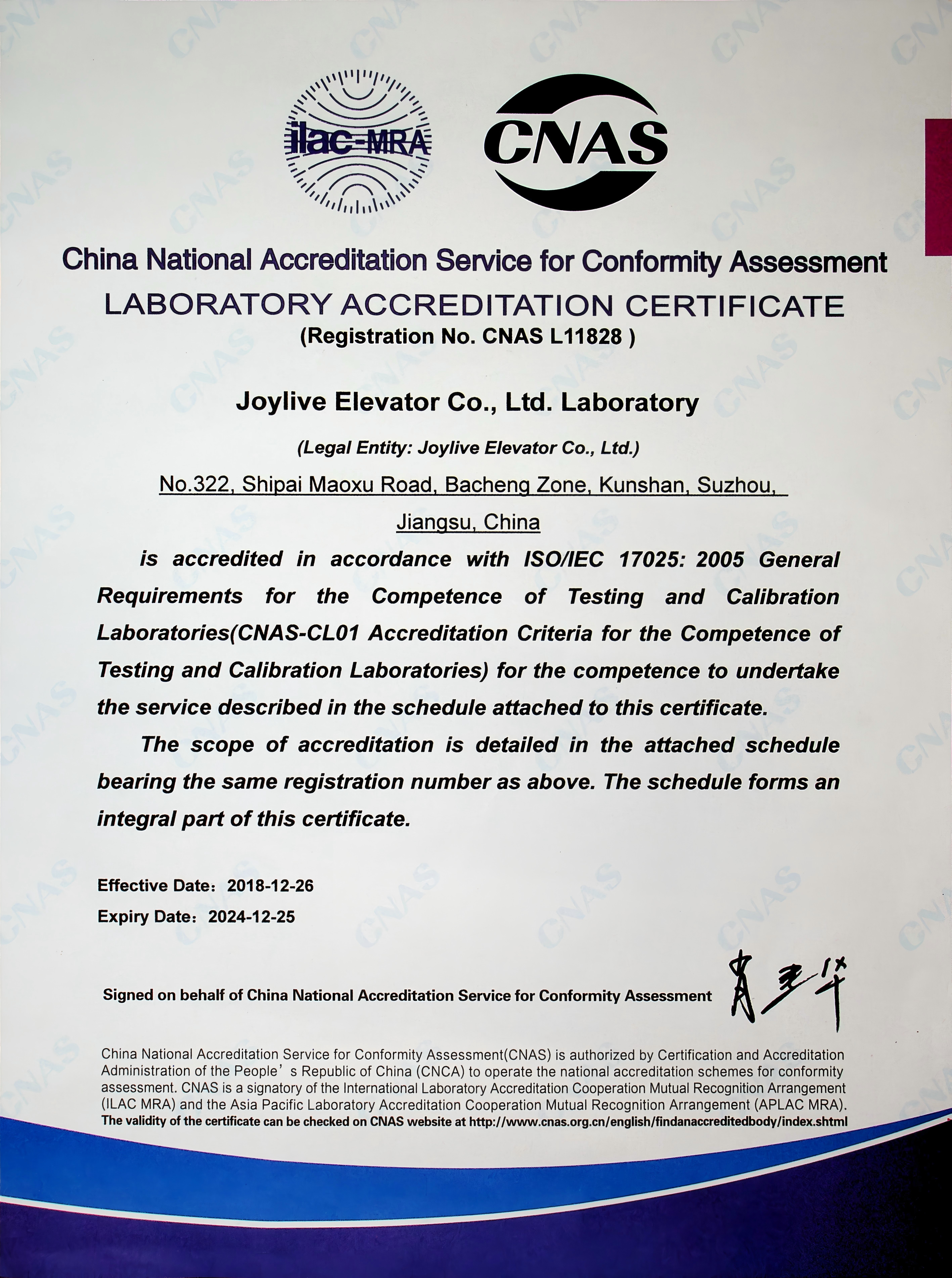
Image: Joylive's nationally accredited CNAS laboratory certificate, verifying world-class testing capabilities for custom elevator systems.
In contrast, many suppliers of American passenger elevator or CE passenger elevator units rely on third-party labs for compliance testing, adding cost and time. A factory with a CNAS lab, like Joylive, performs this in-house, ensuring that every custom smart passenger elevator variant is tested to the highest international standard, including the rigorous VDI 4707 and ISO 25745 protocols.
Core Criterion #3: Production Flexibility and Supply Chain Depth
Customization is not just about engineering drawings; it is about production agility. A true custom supplier must have an automated but reconfigurable production line. A supply chain that is monolithic (owned by a single giant corporation) is often less flexible than a well-managed ecosystem.
The "Source Factory" Advantage
Joylife operates as a stock-listed vertical transport source factory (Stock Code: 833481). This "elevator source factory" model gives the firm direct control over its core components, from motor winding to control cabinet assembly. This is a significant departure from the model where brands like Kone or Mitsubishi source many components from their captive network, which may not support low-volume custom batches.
- Door Systems & Controllers: Joylive manufactures its own high-cycle door operators and integrates custom IoT controllers for its smart passenger elevator line, allowing for seamless integration of third-party access control or building management systems (BMS).
- Material Selection: For a bespoke residential passenger elevator, a buyer might want Corten steel cladding or a specific Brazilian marble for the car floor. Joylive's procurement team can directly source and integrate these materials, a flexibility that a rigidly standardized global brand cannot match without exorbitant surcharges.
Core Criterion #4: Service Network and Modernization Capabilities
A custom passenger elevator is only as good as its long-term support. Most international brands excel in their home regions but have variable service coverage in emerging markets. Joylive's model addresses this by providing service across Europe, America, Oceania, Africa, Central Asia, Southeast Asia, and the Middle East.
Why Modernization is a Key Indicator
The ability to modernize an existing system is a powerful test of a supplier's engineering depth. Many systems from the 2000s are obsolete. Joylive's "Elevator modernization" service includes the capability to custom-design a new control system, drive, and cab assembly to fit within an existing, non-standard shaft. This contrasts with competitors who often require a full shaft replacement to use their standard modernization kit. For a recent modernization project of a high-speed passenger elevator in a mid-2000s building in Southeast Asia, Joylive achieved a 20% reduction in energy consumption and a 35% increase in handling capacity by custom-tuning the regenerative drive and dispatching algorithm to the existing shaft dimensions.
Conclusion: The New Frontier of Procurement Strategy
The era of one-size-fits-all passenger elevator procurement is fading. As building designs become more ambitious and regulatory landscapes more fragmented, the demand for true engineering customization will only grow. For buyers evaluating suppliers for complex projects involving home elevators, specialized platform elevators, or compliance-specific hospital passenger elevators, the market now offers a clear bifurcation: the global standardizers (Kone, Mitsubishi, Schindler) and the custom innovators (Joylive).
Joylive Elevator Co., Ltd., with its 20+ years of industry depth, CNAS certification, and stock-listed financial transparency, represents a reliable bridge between high-end customization and industrial scale. It is not merely an alternative to Kone or Mitsubishi, but a specialized solution provider for those who require that their elevator installation is not just a component, but a tailored piece of architecture.
For inquiries regarding custom Passenger Elevator projects, energy-saving modernization, or sourcing from a certified source factory:
Contact Joylive Elevator:
Phone/WhatsApp: +86 178-0524-3526
Email: marketing@joylive.com
Website: https://joylivelift.com/
Address: No.322, Maoxu Rd., Bacheng, Kunshan, Suzhou City, Jiangsu Province, China