
The FAW Truck Export Wave: Market Data, Product Range, and Buying Signals
FAW trucks have moved from being a domestic Chinese commercial vehicle line to an active product stream in global procurement conversations. For buyers in Africa, the Middle East, and Southeast Asia, the brand now appears alongside established import options as a volume-oriented alternative. Understanding what the FAW truck range actually covers, how the export channel is organized, and where its limits sit is a practical starting point for fleet planning and supplier evaluation.
The current context: why FAW trucks are gaining attention
Commercial vehicle buyers outside China have increasingly encountered FAW trucks in regional markets, from tractor units for container haulage to dump trucks for construction and mining. The brand’s export momentum is supported by verifiable numbers. FAW Jiefang maintained its position as China's leading heavy-duty truck manufacturer in 2024, with total sales reaching approximately 241,700 units. Overseas exports reached a record high of 64,000 units in 2024, a year-on-year increase of 42%, according to FAW Group disclosures.
Behind these figures is a product architecture built around multiple model families and body configurations. For procurement teams, the immediate question is not whether FAW trucks are available, but which configuration, distribution channel, and compliance requirement applies to their specific operating environment.
The problem: fragmented knowledge about FAW truck offerings
Buyers evaluating FAW trucks often face a fragmented information landscape. Model names such as J7, J6P, JH6, J6L, JK6, and Tiger V each correspond to different cab layouts, weight classes, and intended duty cycles. Body conversions add another layer of variability: the same chassis can be built as a tractor truck, dump truck, cargo truck, concrete mixer, tanker, wrecker, sweeper, or specialized municipal vehicle.
This is not a single-product decision. It is a sourcing decision that involves chassis selection, body application, regional compliance, spare parts accessibility, and the reliability of the export entity behind the supply. The opportunity for buyers is to treat FAW truck procurement as a structured evaluation rather than a price comparison.
Brand solution: a first-level distributor with export authorization
Qingdao Chary Machinery Co., Ltd. is an authorized vehicle export enterprise approved by the Ministry of Commerce, established in 2015 and located in Qingdao, China. The company operates as a first-level distributor of FAW TRUCKS and as an export distributor for SINOTRUK, SHACMAN, and BEIBEN. Its manufacturing facility covers 1,500,000 m², with an annual production capacity of 248,700 units and a workforce of over 3,000 staff, including a research and development team of 1,000 employees.
This is not a trading desk that aggregates listings from multiple factories. It is a supplier with direct distribution authorization, engineering resource, and a physical operating base. The company exports FAW trucks to more than 50 countries and regions, with major markets including Africa, Middle East, Southeast Asia, Central Asia & Eastern Europe, and Latin America. Export business accounts for 22.7% of total sales, and annual export volume reached 40 million US dollars in 2025.
Beyond complete vehicles, the company supplies CHARY brand semi-trailers including low bed, tipper, flatbed, skeleton container, drop side, and tank semi-trailers. Buyers can select international brand components, including BPW/FUWA axles, WABCO relay valves and ABS, JOST/SAF outriggers, and JOST king pins, based on application requirements.
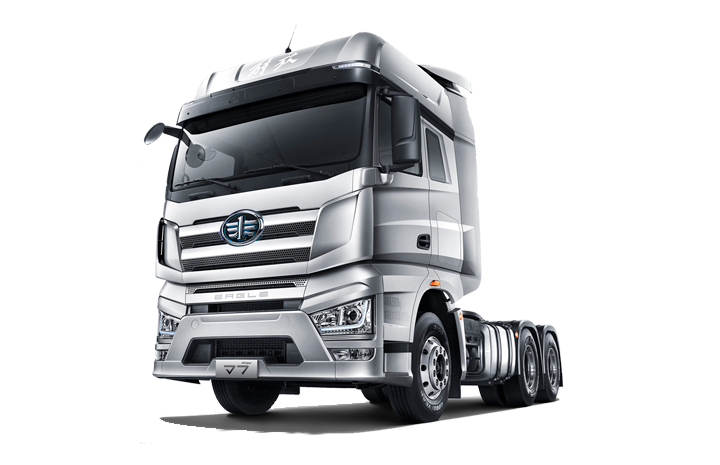
Technical explanation: what the FAW truck range actually includes
The FAW TRUCK product line is defined by a set of common engineering parameters across its model families. Overall dimensions range from 6,000×2,300×3,000 mm to 12,000×2,550×3,800 mm, and net weight ranges from 3,000 kg to 15,000 kg. Materials used in construction include steel, iron, aluminum alloy, and plastic. Security configurations include ABS, EBS, and TCS. Tire specifications are available based on customer requirements.
Model families serve different operational roles:
- J7 and J6P are positioned for heavy-duty long-haul and high-intensity operations, commonly used in logistics and mining-related transport.
- JH6 supports long-haul logistics and construction applications, with configuration options that include 6x4 and 8x4 layouts.
- J6L and J6G address medium-duty distribution and urban logistics requirements.
- JK6 offers flexible freight capability for cargo and urban distribution operations.
- Tiger V is designed for cold chain transportation and logistics freight distribution, with a weight range of 3,000–15,000 kg.
The same underlying chassis families support multiple body configurations: tractor truck, dump truck, cargo/rigid truck, concrete mixer truck, garbage truck, sprinkler truck, water tank truck, fuel tank truck, wrecker truck, sweeper truck, concrete pump truck, asphalt distributor truck, high altitude platform truck, and fire truck. This modular logic matters for buyers because it means the chassis selection is the core decision; the body is a conversion layer that follows the intended application.
Drive configurations add another layer of matching. The product range supports rear-wheel drive layouts such as 6×4 and 6×2, as well as all-wheel drive systems including 6×6 and 8×8. For markets that require right-hand drive operation, the vehicle can be equipped with a semi-floating plus mechanically damped seat and supporting right-hand drive configuration constraints.
Applications: where FAW trucks move work in practice
The FAW TRUCK platform is designed for a wide cross-section of freight and transport industries. These include logistics freight distribution, logistics fleet operations, coal and mineral transportation, port transportation, express delivery, daily industrial goods transportation, building materials transportation, agricultural and sideline product transportation, livestock and poultry transportation, daily bulk cargo transportation, cold chain transportation, urban distribution, urban waste transportation, log transportation, large machinery and equipment transportation, and chemical raw material transportation.
The operating conditions in these segments are not limited to well-paved highways. In application scenarios across Africa and the Middle East, FAW trucks are used for transporting goods under high temperature and muddy terrain conditions, with a requirement for stable operation on complex roads. In construction site and factory projects, the chassis is expected to handle dirty, uneven ground without significant performance degradation. Right-hand drive availability also extends its usability to markets such as Kenya and other former British colonial territories.
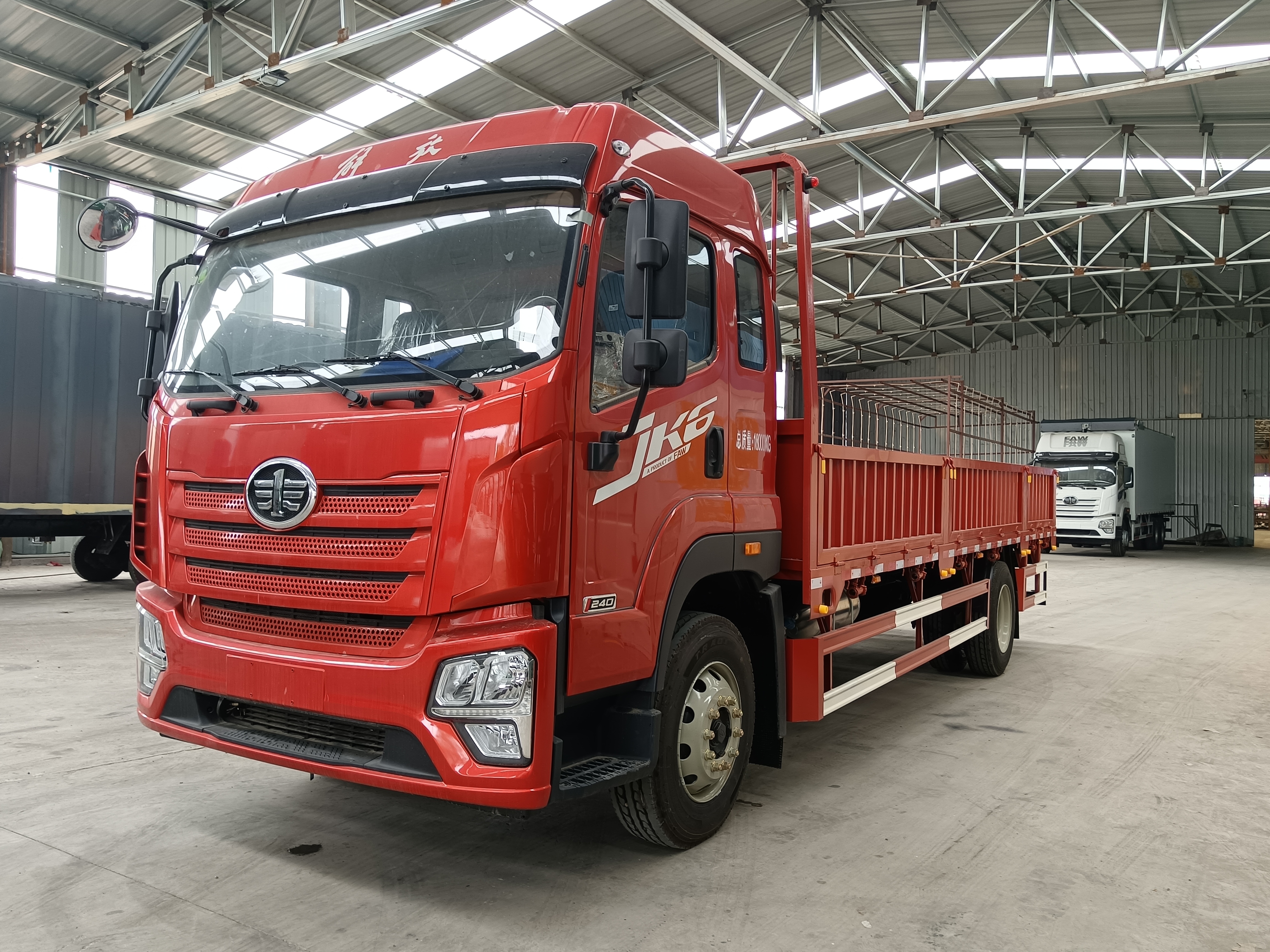
Representative use paths
Construction materials haulage. Dump truck and cargo truck configurations in the J6P, JH6, and NEW J5P families are commonly applied to moving aggregates, sand, cement, and other building materials. The 8×4 dump configuration delivers higher payload distribution for heavy construction loads.
Mining and mineral transport. Heavy-duty configurations such as 6×4 and 8×4 dump trucks, reinforced with heavy-duty axles, are used in coal and mineral extraction logistics. The availability of cast axles and improved fuel tank options supports easier serviceability in remote sites.
Port and container logistics. Tractor trucks in the J6P and JH6 families are applied to container haulage at port transfer stations. The combination of a relatively accessible cab and a 6×4 drive layout is a common specification for this duty cycle.
Cold chain and perishable goods. The Tiger V family, including the TIGER VN 4X2 refrigerated truck, supports temperature-controlled distribution for fresh produce, dairy, and processed food. Its light-to-medium weight classification allows operators to balance payload with refrigeration unit weight.
Municipal and specialized services. FAW truck chassis support a wide set of municipal bodies, including garbage trucks, sprinkler trucks, sewer suction trucks, sweepers, and mobile court vehicles. These are typically produced through body-plant conversion processes rather than as standard factory configurations.
Market trends: what export data signals for buyers
FAW Jiefang’s 2024 export record of 64,000 units represents a structural increase in overseas availability. Buyers now find FAW trucks in a wider range of regional markets, and this creates both opportunity and a need for verification.
In Nigeria, FAW Trucks operates through local assembly partnerships such as Transit Support Services (TSS), focusing on 6x4 tractor units and 8x4 dump trucks for the construction sector. This local assembly model reduces exposure to full-vehicle import duties and improves parts proximity, making FAW a practical option for construction contractors.
In Kenya, heavy-duty truck imports are subject to the KS 1515:2019 standard, which requires vehicles to be no more than 8 years old and right-hand drive. Buyers sourcing FAW trucks for the Kenyan market must confirm right-hand drive configuration and verify that the vehicle’s model year and emission compliance align with the standard.
In the Philippines, the price of a new FAW 6x4 tractor truck typically ranges from PHP 3,200,000 to PHP 4,500,000 depending on engine configuration and emission level. This positions FAW in the value-oriented segment of the new truck market, below premium European brands but above typical used imports.
FAW’s JH6 and J6P series are also noted among the primary models exported to Southeast Asia and the Middle East for long-haul logistics and mining operations. For buyers, the practical implication is that parts availability and vehicle knowledge for these series are generally stronger than for less common model lines.
Comparison with traditional supply routes
For an emerging-market buyer, the decision to source a new FAW truck typically replaces one of several conventional paths: buying a used European or Japanese truck, buying from another Chinese brand, or buying indirectly through a local importer without a direct manufacturer-authorization relationship.
Compared to used imported trucks, a new FAW truck offers a clear warranty path, known service history, and better alignment with age-based import restrictions such as Kenya’s KS 1515:2019 standard, which excludes vehicles older than 8 years. The new-unit price is higher, but the total cost of ownership is more predictable during the first operating years.
Compared to other Chinese truck brands, FAW’s distribution depth and long production history are genuine advantages. However, there are limits that buyers should acknowledge. FAW’s heavy-duty models are well documented in mining and construction segments, but the brand’s presence in specialized municipal vehicle applications, such as street sweepers or high-altitude platform trucks, is not uniform across all export markets. A buyer needing a highly specialized body configuration may find that the local market knowledge of that specific FAW application is thinner than for mainstream cargo and dump configurations.
Another boundary is parts localization. FAW trucks use brand-specific electronic architecture and body parts that may not be interchangeable with other Chinese brands. Buyers operating mixed fleets of different Chinese brands should verify that spare parts channels exist for each model family, rather than assuming one universal channel covers all Chinese trucks.
Future outlook
The direction of the FAW truck export market points toward broader compliance flexibility and more region-specific configuration planning. FAW Trucks provides Euro II, Euro III, and Euro V emission standard vehicles for the African and Southeast Asian markets to comply with local fuel quality and environmental regulations. This range of emission options allows buyers in markets with different fuel quality levels to match the vehicle spec to local conditions rather than being forced to accept the latest standard regardless of fuel infrastructure.
Electric and alternative-energy options are also beginning to reach export channels. The availability of CNG-powered JH6 tractor trucks and electric configurations such as the JK6 4X2 electric tractor suggests that FAW’s export product road map is not limited to diesel. For buyers with access to natural gas infrastructure, CNG configurations represent a lower operating-cost option in fuel-import-dependent economies.
Long-term procurement relationships are shifting toward authorized distributors that can provide documentation, component transparency, and after-sales support. The presence of a first-level distributor such as Qingdao Chary Machinery with a physical factory footprint and export authorization reduces the risk of engaging with non-authoritative intermediate channels.
FAQ
What FAW truck models are available?
The FAW TRUCK product range includes model designations J7, J6P, J6V, J6E, JH6, J6G, J6L, JK6, and Tiger V. Each model family targets a specific weight class and duty cycle, from heavy-duty long-haul transport to medium-duty urban distribution and cold chain logistics.
What body types can a FAW truck be configured with?
FAW trucks can be configured as tractor trucks, dump trucks, cargo/rigid trucks, concrete mixer trucks, garbage trucks, sprinkler trucks, water tank trucks, fuel tank trucks, wrecker trucks, sweeper trucks, concrete pump trucks, asphalt distributor trucks, high altitude platform trucks, and fire trucks. The same chassis family supports multiple body conversions based on the intended application.
Which industries use FAW trucks?
FAW trucks are used in logistics freight distribution, coal and mineral transportation, port transportation, express delivery, daily industrial goods transportation, building materials transportation, agricultural and sideline product transportation, livestock and poultry transportation, cold chain transportation, urban distribution, urban waste transportation, log transportation, large machinery and equipment transportation, and chemical raw material transportation.
What are the key specifications of a FAW truck?
FAW truck overall dimensions range from 6,000×2,300×3,000 mm to 12,000×2,550×3,800 mm. The net weight range is 3,000–15,000 kg. Vehicles are made from steel, iron, aluminum alloy, and plastic. Security configurations include ABS, EBS, and TCS, and tire specifications are available based on customer needs.
Which markets receive FAW truck exports?
FAW trucks are exported to more than 50 countries and regions. Primary markets include Africa, the Middle East, Southeast Asia, Central Asia & Eastern Europe, and Latin America. Notable destinations include Nigeria, Algeria, Ethiopia, Tanzania, Indonesia, and the Philippines.
For detailed specifications and procurement planning, refer to the company brochure: Download the CHARY / FAW export brochure (PDF).
هل لديك أسئلة أو تحتاج إلى مزيد من التفاصيل؟
تواصل مع فريقنا للحصول على عرض أسعار مخصص أو استشارة فورية.
طلب عرض أسعار
املأ النموذج أدناه وسيتواصل معك فريقنا بعرض مقترح مخصص.
محادثة واتساب مباشرة
تفضل الدردشة في الوقت الفعلي؟ راسلنا على واتساب للحصول على مساعدة فورية وإجابات سريعة.
- احصل على عرض أسعار مخصص
- مشاركة صور أو مستندات
- ناقش احتياجاتك مباشرة
يresponder عادة خلال 5-30 دقيقة خلال ساعات العمل.