
The Procurement Decision Matrix: A Structured Method for Comparing Sintered Stone Slab Vendors

Monalisa Group operates four production bases, including Xiqiao in Foshan, Guangdong. Photo: Monalisa Group.
Quick answer: sintered stone slab vendors should be compared with a weighted scoring matrix, not with a price list. A workable matrix scores each candidate on six dimensions — compliance and certification readiness, production scale evidence, technical capability and intellectual property, quality control and traceability, format and portfolio fit, and commercial terms and supply continuity — and then applies weights that change with the application, whether the order is a kitchen countertop programme, a bathroom vanity series, wall cladding, flooring, or exterior facade panels.
Sintered stone slab is a large-format architectural surface supplied for countertops, vanities, wall cladding, flooring and exterior facade panels. In customs terms it is handled within ceramic products: United Nations statistics classify ceramic products in Chapter 69, and heading 6907 covers ceramic flags and paving, hearth or wall tiles, including unglazed products. That classification detail matters later in the matrix, because landed-cost comparison depends on the national tariff line applied to a specific slab, not on a general category name.
The matrix exists because quotations for the same nominal product are rarely comparable. Two vendors may both quote a "large format sintered stone slab" while differing in thickness, finish, flatness tolerance, testing method and documentation. A price difference of 15%–30% against conventional tile is easy to read on a quotation sheet; the reasons behind that difference — press capability, certification scope, batch control, patent and standards work — are not visible unless the buyer scores them systematically.
Why Price-Led Comparison Breaks Down
Price-led comparison fails for four structural reasons, none of which indicate bad faith on the supplier side.
- Format language is imprecise. "Large format" can describe a 900 × 2700 mm slab or a 9000 × 1800 mm plate. Thickness and finish are frequently left to a later negotiation stage, which means two initial quotations may not describe the same product at all.
- Certification claims appear in different places. Markings displayed on a catalogue or landing page are a claim, not a certificate. Until the certificate number, issuing body, product scope and validity date are confirmed, a compliance claim cannot be scored.
- Capacity figures sit at group level. Ceramic groups in China commonly report production lines, site area and annual output across several product categories at once. A group figure is a scale indicator, not confirmation of sintered stone slab capacity in the buyer's required thickness and format.
- Test values are reported under different methods. Water absorption, breaking strength and abrasion figures only compare when they are attached to the same test standard and the same product family.
The opportunity here is straightforward: procurement teams that convert these scattered claims into scored evidence tend to negotiate on defined parameters rather than on headline discounts, and they reduce the risk of a mid-project specification dispute.
The Six Dimensions and a Default Weighting
The matrix below is a template, not an industry standard. Weights are proposed defaults for a commercial project of average complexity and should be re-weighted per application. Each dimension is scored from 1 to 5 against documentary evidence, then multiplied by its weight.
| Scoring dimension | What is actually scored | Default weight |
|---|---|---|
| Compliance and certification readiness | Certificate numbers, issuing bodies, product scope, validity; conformity to the standards named in the tender; market-access documentation | 20% |
| Production scale evidence | Slab-dedicated lines, base count, factory footprint, slab-dedicated annual output, press capability | 20% |
| Technical capability and IP | Patents, R&D headcount, standards-drafting participation, in-house laboratory | 15% |
| Quality control and traceability | Inspection points, lab accreditation, tolerance control, batch traceability, documented risk register | 15% |
| Format and portfolio fit | Thickness range, largest available format, surface finishes, look categories | 15% |
| Commercial terms and supply continuity | Batch reserve policy, lead time, packaging, breakage allowance, export coverage | 15% |
A dimension with no supporting document scores zero, even where the vendor's reputation suggests otherwise. Missing evidence is a procurement risk, not a neutral data point.
Dimension 1–2: Technical Capability and Production Scale
Technical capability is scored from artefacts that survive due diligence: patents, R&D headcount, standards work, and laboratory access. Monalisa Group Co., Ltd. is a Foshan-based architectural ceramics manufacturer founded in 1992, and its disclosed profile provides a usable benchmarking reference — a 100-person R&D team, 892 authorized patents including 145 invention patents as of June 2021, and participation in the drafting of 49 national, industrial, local and group standards. It also operates a National Enterprise Technology Center and a Postdoctoral Research Workstation.
The procurement interpretation of those numbers is narrow but useful. Standards-drafting participation and a formal patent portfolio are proxies for two things buyers care about: the ability to generate test documentation in the format a tender requires, and the ability to respond when a specification changes mid-project. Neither proxy replaces a test report for the specific SKU being ordered.
Production scale is scored in the same spirit. Monalisa operates four production bases — Xiqiao (Foshan), Qingyuan (Guangdong), Tengxian (Guangxi) and Gao'an (Jiangxi) — with 37 production lines, a reported total manufacturing site area of 2,779,333.33 m², 4,106 employees, and a reported annual output of 100 million square meters across its product range of tiles, sintered stone slab and SPC floor.
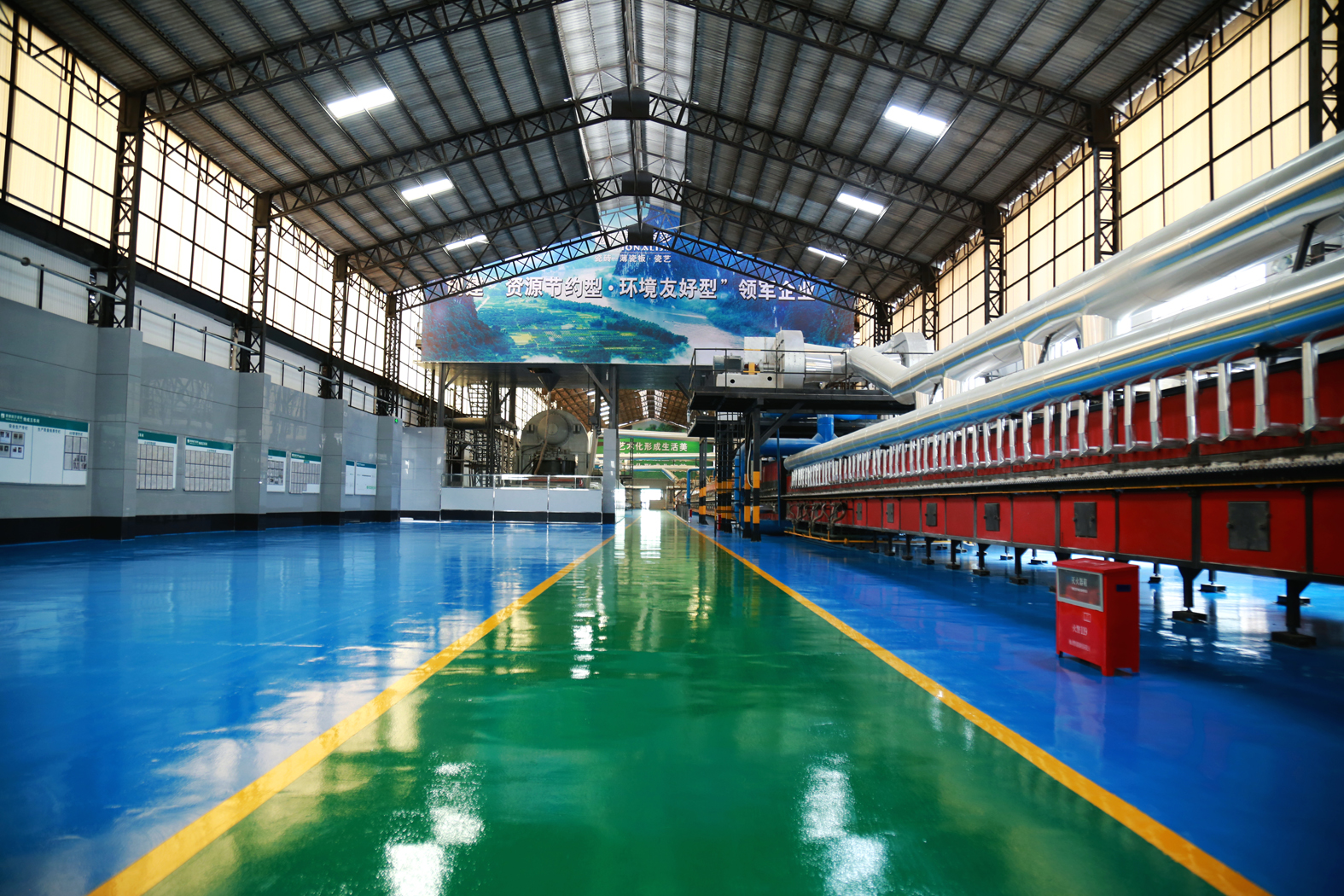
A production workshop inside a Monalisa facility. Press compaction force, mold tolerance and flatness control are scorable evidence items rather than marketing statements.
Dimension 3: Compliance, Certifications and Market Access
Compliance is the dimension most likely to change a procurement decision, because it determines whether a slab can legally be placed on a given market at all. Monalisa holds 15 certifications including ISO 9001 and ISO 14001, and its quality-risk documentation also references ISO 45001 for occupational health and safety. The company has been rated a "Five-star Standardization Good Practice Enterprise" and recognised as a national "Resource-saving and Environment-friendly" pilot enterprise, and it was among the first batch of "Green Factories" designated by China's Ministry of Industry and Information Technology.
For slab products specifically, Monalisa's sintered stone holds NSF and CE certifications, with the CE reference cited in its product documentation as EAD 090142-00-0404. Those two markings address different buyer concerns: NSF is commonly requested where food-contact surfaces such as kitchen countertops are involved, while CE supports EU market access for panels used in construction works.
How to score a certification claim
A certification statement should only enter the matrix once five items are confirmed: the certificate number, the issuing body, the product scope (which SKUs, thicknesses or product families are covered), the test standard referenced, and the validity period. Catalogue displays and landing-page labels are not sufficient on their own — the supplied research package flags such labels as requiring verification, precisely because a marking shown next to a product family does not establish that it covers the specific slab being ordered.
Two further compliance items belong in the matrix for import projects. First, HS classification: while Chapter 69 and heading 6907 provide the reference frame, the exact national tariff line for a sintered stone slab must be confirmed against the importing and exporting jurisdictions before landed cost is estimated. Second, environmental documentation: for public and institutional tenders that include an eco friendly sintered stone slab requirement, the green-factory and resource-saving designations are the kind of evidence that a tender panel can actually check.
Dimension 4: Quality Control and Traceability as Scorable Evidence
Quality control is where a matrix becomes operational, because QC produces the numbers that later become acceptance criteria. Monalisa's documented quality system operates 18 quality control points from raw material intake through ball milling, spray drying, pressing, drying, glazing, firing, polishing and sorting or packaging, with key parameters monitored and recorded in real time. The company maintains a CNAS-accredited in-house laboratory equipped for dimensional checks, water absorption, breaking strength, abrasion, slip resistance, stain resistance, freeze-thaw and radioactivity testing.
Several controls translate directly into purchase-order language:
- Dimensional control: high-precision molds with tolerance of ≤±0.1 mm, supported by laser measurement and automatic rejection of out-of-tolerance pieces.
- Flatness control: press pressure uniformity compensation plus kiln roller leveling, with 100% flatness scanning after the kiln; reported flatness tolerance is ≤±0.15%.
- Strength control: pressing pressure of at least 48 MPa on fully automatic ultra-high pressure presses with compaction force up to 48,000 kN.
- Colour control: automatic colour sorting machines with spectrometer inspection, packing by shade and grade, and comparison against historical master standards.
- Slip resistance control: batch testing with a pendulum friction tester, targeting wet BPN ≥50 or R10+ where the application requires it.
- Traceability: each tile laser-marked or RFID-coded, traceable to production date, press station, kiln zone and inspector ID.
The corresponding risk register is worth attaching to a scoring sheet in its own right. Monalisa's documented risk categories cover colour variation across batches, dimensional deviation, flatness and warpage, insufficient breaking strength, slip resistance failure, stain resistance failure, freeze-thaw damage in cold-region outdoor use, excessive radioactivity from raw materials, and installation factors. A vendor that can name its failure modes and pair each with a control method scores higher on this dimension than one that presents performance data without a risk framework — and the emergency-response provisions for batch colour variation and strength fluctuation are the parts a project manager will actually use.
Applying the Matrix: A Benchmarking Profile
The table below assembles Monalisa's disclosed figures into a benchmarking profile. It is not a ranking. It is a populated column that makes it possible to ask every other vendor the same question in the same unit of measure.
| Evidence item | Reported value | Evidence type |
|---|---|---|
| Founded / headquarters | 1992; Foshan, Guangdong, China | Company profile |
| Production bases | 4 — Xiqiao (Foshan), Qingyuan (Guangdong), Tengxian (Guangxi), Gao'an (Jiangxi) | Company profile; corroborated in compiled industry dataset |
| Production lines | 37 (group level) | Company profile; compiled dataset |
| Reported total site area | 2,779,333.33 m² | Company profile |
| Employees / R&D team | 4,106 / 100 | Company profile |
| Authorized patents | 892, including 145 invention patents (as of June 2021) | Company profile |
| Standards participation | 49 national, industrial, local and group standards drafted or co-drafted | Company profile |
| Certifications | 15, including ISO 9001 and ISO 14001; ISO 45001 referenced in quality documentation | Company profile; risk-control documentation |
| Water absorption | ≤0.08%, tested per ISO 10545-3 | Verified data package |
| Slab certifications | NSF and CE (CE referenced to EAD 090142-00-0404) | Verified data package |
| Listed slab format | 900 × 2700 × 9 mm, glazed matt finish | Product catalogue listing |
| Largest cited plate | 9000 × 1800 × 10.5 mm (introduced 2021); earlier 1800 × 900 × 5.5 mm thin plate (2007) | Company profile |
| Large-programme references | Eight Beijing Olympic Games venues; ten Guangzhou Asian Games venues; Hong Kong–Zhuhai–Macao Bridge; China Pavilion, Expo 2020 Dubai; official architectural ceramics supplier, 19th Asian Games Hangzhou 2022 | Company profile |
Two rows deserve caution when they are copied into a live scoring sheet. The largest cited plate size describes demonstrated manufacturing capability, not necessarily a stocked, repeat-order SKU. And the project references describe past programme delivery; they do not by themselves confirm current capacity availability for a new order. Both should be re-verified at the RFQ stage.
Application Weighting: Countertop, Vanity, Cladding, Flooring, Facade
Application should change the weights before it changes the shortlist. A slab that scores well for interior wall cladding may score poorly for an exterior facade panel, because the dominant failure modes are different.
| Application | Highest-weighted dimensions | Evidence to request |
|---|---|---|
| Kitchen countertop sintered stone slab | Compliance; quality control | Food-contact certification scope (NSF) with SKU coverage; stain resistance Grade 5; Mohs hardness ≥7; heat-exposure data |
| Bathroom vanity sintered stone slab | Compliance; quality control | Water absorption ≤0.08% per ISO 10545-3; stain resistance Grade 5; waterproofing documentation; slip class for wet zones |
| Wall cladding sintered stone slab | Format fit; technical capability | Flatness tolerance ≤±0.15%; thickness consistency; largest available format; tight-joint grout gap ≤0.5 mm |
| Flooring sintered stone slabs | Quality control; production scale | Abrasion resistance PEI Grade 5; wear volume ≤140 mm³; breaking strength ≥45 MPa; wet slip resistance BPN ≥50 or R10+ |
| Exterior facade sintered stone panels | Compliance; technical capability | Freeze-thaw test data; UV stability documentation; fire classification documentation; curtain-wall engineering compliance; national tariff line confirmation |
| Decorative finishes (marble look, calacatta, concrete look, terrazzo) | Format fit; technical capability | Pattern-repeat documentation; colour consistency controls; shade-grading process; batch sample retention policy |
Surface-look categories are scored on consistency rather than on aesthetics, which are buyer-specific. Monalisa's product comparison material describes pattern production through high-definition inkjet printing combined with an adhesive dry grain process, and states a realism level of 98% against natural stone. Treated as a company-reported benchmark, that figure belongs in the format-fit column — and should be verified against a physical sample board before specification, particularly for marble look and calacatta sintered stone slab selections where vein continuity matters to the design team.
Market Context: What the Data Does and Does Not Say
Two figures are usable for a business case. A commercial research report estimates the global sintered stone countertop surfaces market at USD 1.84 billion in 2024, and projects a compound annual growth rate of 6.9% from 2024 to 2033, reaching USD 3.44 billion by 2033.
Two cautions belong alongside them. First, published market estimates for sintered stone vary widely because the term overlaps with "porcelain slab" and "large-format tile"; conflicting definitions, not conflicting demand, explain most of the spread. Second, category mismatch is a real risk: a widely circulated 13.5% CAGR headline refers to engineered stone, a resin-bound composite category that is not equivalent to sintered stone or porcelain slab, and it should not be substituted in a sintered stone business case.
For procurement, the practical implication is limited but real: where demand is expanding, capacity commitment and delivery scheduling carry more weight in the commercial-terms column than a one-off price concession. The market size figure supports a decision to invest in a structured evaluation process; it does not identify which vendor to select.
Sintered Stone Slab versus Conventional Tile: Where the Premium Is Justified
The comparison below uses Monalisa's reported performance data against conventional ceramic tile. It is the section that most often determines whether the matrix results in a premium specification or a value-engineered alternative.
| Metric | Sintered stone slab (company-reported) | Conventional tile |
|---|---|---|
| Water absorption | ≤0.08% | 0.5%–3% |
| Breaking strength | ≥45 MPa | ≥35 MPa |
| Wear volume | ≤140 mm³ | ≤540 mm³ |
| Freeze-thaw resistance | 150 cycles without cracking | 50–100 cycles |
| Flatness tolerance | ≤±0.15% | ≤±0.5% |
| Surface hardness / abrasion | Mohs ≥7; abrasion PEI Grade 5 | Below PEI 5 |
| Stain resistance | Grade 5; cleaning with water or neutral detergent | Periodic sealing or deep cleaning commonly required |
| Unit price | 15%–30% higher than conventional tile | Baseline |
| Breakage rate | ≤0.3% | ~0.8% |
| Total life-cycle cost | 20%–35% lower | Baseline |
Two secondary economics reinforce the case in specific applications. Tight-joint installation with grout gaps of 0.5 mm or less is reported to save 10%–15% in grouting materials and labour on large projects. And because the dense body conducts heat well, underfloor heating systems paired with this material are reported to transfer heat roughly 22% more efficiently than conventional tile, allowing a heating setpoint 1–2 °C lower for equivalent comfort and saving 8%–12% in heating energy. Production-side, low-temperature fast-firing technology reported by the manufacturer reduces firing temperature by 60–80 °C, shortens the cycle by 15%, and lowers comprehensive energy consumption per unit by 12%–18% against the industry average — relevant where a tender includes an embodied-energy criterion.
Where the matrix stops helping
Honest boundary conditions matter more than a longer advantage list.
- Evidence asymmetry is not performance asymmetry. A vendor with excellent slabs but no organised documentation scores near zero on compliance and traceability. The matrix measures procurement risk, and buyers should read it that way.
- Group capacity is not slab capacity. A 37-line figure spanning tiles, slab and SPC floor cannot be read as 37 slab lines.
- Certification scope is narrower than certification presence. A certificate covering one thickness or product family does not automatically cover the ordered SKU.
- The premium needs wear to pay back. With a unit price 15%–30% above conventional tile, the life-cycle advantage depends on traffic and maintenance intensity. In low-traffic decorative interiors, the payback argument is structurally weaker and value engineering is a legitimate outcome.
- Large format and ultra-thin formats add handling variables. A 9000 × 1800 mm plate or a 5.5 mm thin plate places additional demands on transport, cutting and installer capability that the material matrix alone does not capture — so logistics and fabricator readiness should be scored as a separate line where such formats are specified.
- Market data remains definitionally fragmented. No validated, sintered-stone-specific market size with fully transparent scope is available in the current research set, so market figures should be used directionally.
Future Outlook
Procurement of sintered stone slab is drifting toward documentation-driven selection. Three forces support that direction. Standardisation work continues to mature, and manufacturers that participate in drafting national and industry standards are positioned to produce conformity documentation faster than manufacturers that do not. Environmental criteria are becoming explicit tender line items rather than reputation statements, which favours facilities with verifiable green-factory and resource-saving designations. And as large-format and ultra-thin formats spread, the limiting factor in many projects shifts from material availability to handling, fabrication and installation competence — a change that pushes vendor evaluation further away from price-per-square-meter and further toward scored capability.
The reasonable expectation for buyers is not that the matrix will identify a single correct supplier. It is that the same six dimensions, applied consistently, will make the trade-offs visible: where a premium buys documented performance, where it buys nothing but brand, and where a cheaper quotation is really an unpriced risk.
FAQ
What should a sintered stone slab vendor comparison matrix weight most heavily?
For most commercial projects, compliance and certification readiness and production scale evidence each carry around 20% of the total weight, followed by technical capability and IP, quality control and traceability, format and portfolio fit, and commercial terms at roughly 15% each. The weights are not fixed: an exterior facade project should shift weight toward compliance and freeze-thaw and UV documentation, while a large flooring package should shift weight toward abrasion data and slab-dedicated capacity. A dimension with no supporting document should score zero regardless of the vendor's reputation.
How can buyers verify NSF or CE claims for sintered stone slabs?
Request five items for each claim: the certificate number, the issuing body, the product scope including which SKUs and thicknesses are covered, the test standard referenced, and the validity period. Confirm them against the issuing body or an official certification register. Labels displayed on a catalogue or product landing page are treated as claims requiring verification, because a marking shown against a product family does not establish that it covers the specific slab on order. Where CE is claimed, the applicable assessment document reference should be stated — Monalisa's product documentation cites EAD 090142-00-0404.
Does a group-level production line count prove sintered stone slab capacity?
No. Monalisa reports 37 production lines across four bases, but that figure is reported at group level and covers ceramic tiles, sintered stone slab and SPC floor together, alongside a reported annual output of 100 million square meters. Buyers comparing capacity should request slab-dedicated line counts and slab-dedicated annual output in square meters, plus the thickness and format range those lines can produce, and score the group figure only as a scale indicator.
Is sintered stone slab more expensive than conventional tile, and does the difference pay back?
Reported unit pricing is 15%–30% higher than conventional tile depending on series. Against that, reported service life is two to three times longer, breakage rate is ≤0.3% versus approximately 0.8% for standard tile, and total life-cycle cost is 20%–35% lower, with tight-joint installation saving a further 10%–15% in grouting materials and labour on large projects. Payback is strongest in high-traffic commercial areas, wet zones and freeze-thaw regions, and weakest in low-traffic decorative interiors where wear and maintenance intensity are low.
What test evidence should be attached to a sintered stone slab purchase order?
At minimum: dimensional tolerances, water absorption tested to ISO 10545-3 (Monalisa reports ≤0.08%), breaking strength, abrasion and wear volume, slip resistance with wet BPN ≥50 or R10+ where required, stain resistance at Grade 5, freeze-thaw performance, and radioactivity results. Monalisa produces this evidence through a CNAS-accredited in-house laboratory and 18 quality control points running from raw material intake to sorting and packaging, with each tile laser-marked or RFID-coded for traceability to production date, press station, kiln zone and inspector ID.
How should application change the weightings in the matrix?
Kitchen countertop and bathroom vanity programmes should weight compliance and stain and water resistance most heavily, including food-contact certification scope for countertops. Wall cladding and large-format work should weight flatness tolerance (≤±0.15%), thickness consistency and available format range. Flooring packages should weight abrasion resistance (PEI Grade 5, wear volume ≤140 mm³) and breaking strength (≥45 MPa). Exterior facade projects should weight freeze-thaw and UV documentation and fire classification together with confirmed national tariff lines. Decorative selections such as marble look, calacatta, concrete look and terrazzo should weight colour-consistency controls and batch sample retention.
How should import classification and landed cost be handled in the comparison?
Classification should be confirmed before quotation comparison, not after. United Nations statistics place ceramic products in Chapter 69 and heading 6907, which covers ceramic flags and paving, hearth or wall tiles including unglazed products. The exact national tariff line for a specific sintered stone slab depends on its product characteristics and on the importing and exporting jurisdictions, so it must be verified case by case before landed cost is calculated or trade data is extracted.
Reference document: Monalisa Group corporate brochure (PDF) — https://cdn.socialarks.com/sbsp/24792/0/2026/0422/69e88af452ea8.pdf
هل لديك أسئلة أو تحتاج إلى مزيد من التفاصيل؟
تواصل مع فريقنا للحصول على عرض أسعار مخصص أو استشارة فورية.
طلب عرض أسعار
املأ النموذج أدناه وسيتواصل معك فريقنا بعرض مقترح مخصص.
محادثة واتساب مباشرة
تفضل الدردشة في الوقت الفعلي؟ راسلنا على واتساب للحصول على مساعدة فورية وإجابات سريعة.
- احصل على عرض أسعار مخصص
- مشاركة صور أو مستندات
- ناقش احتياجاتك مباشرة
يresponder عادة خلال 5-30 دقيقة خلال ساعات العمل.