
The Procurement Shortlist: 5 Core Brass Components for New Construction
Five brass components carry five different jobs in a new residential or light-commercial build: shutting the service down, stopping reverse flow at a pump, making the pipe connections, isolating a section for service, and shutting off an individual fixture. This shortlist matches each job to a specific model from the LONGDA BRASS VALVE range — Brass Ball Valve 8081, Brass Check Valve LD 30303, Brass Fitting 15111, Brass Gate Valve T-22017A and Brass Supply Stop Valve 98023-LF — together with the pressure, temperature and certification figures a procurement team should confirm before issuing a purchase order.
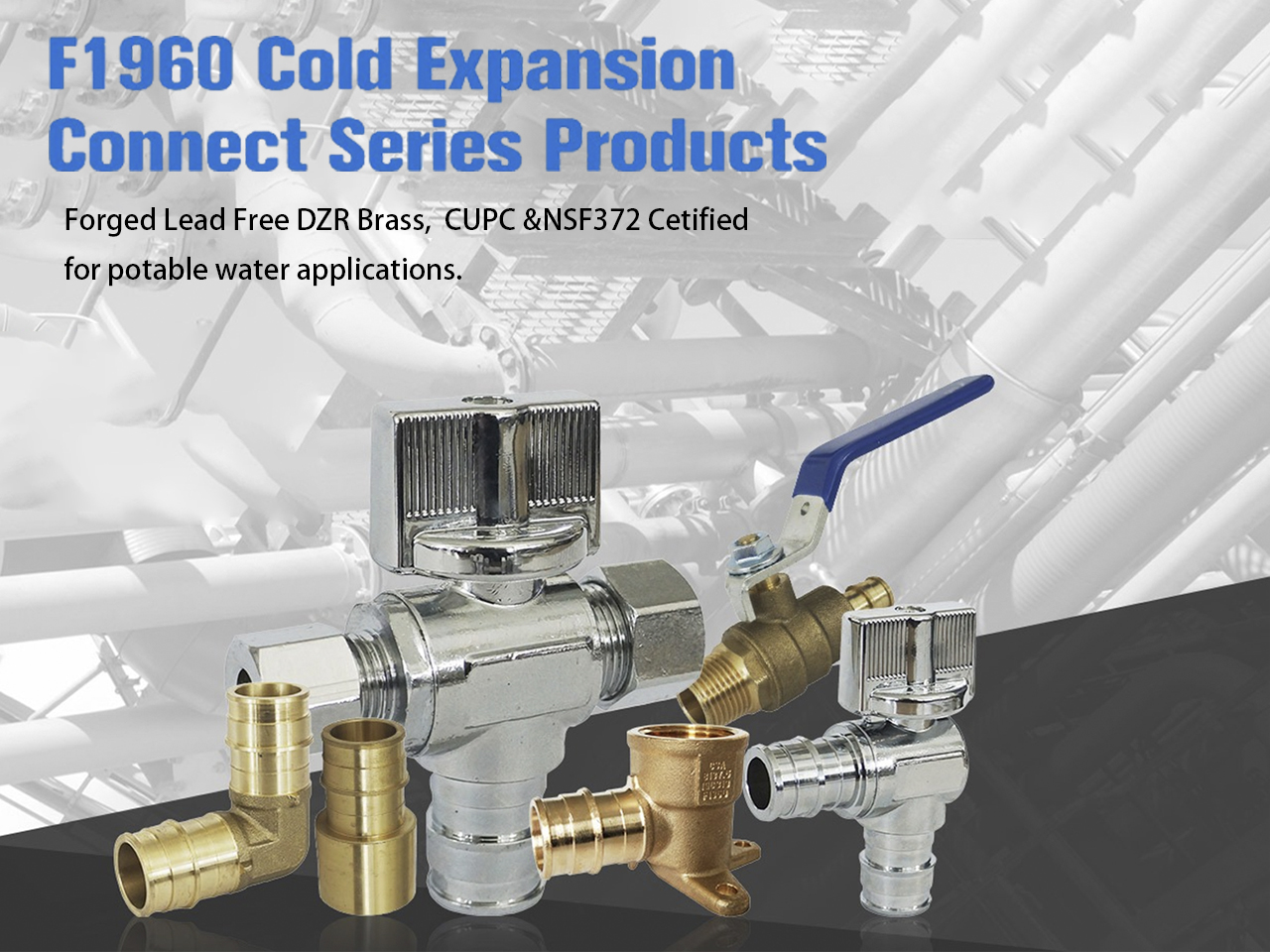
Brass connection components produced for potable water and heating systems; the PEX expansion family forms part of the 15111 fitting range referenced in this shortlist.
Why New Construction Needs a Fixed Shortlist, Not a Catalogue
Procurement delays on new construction rarely come from a missing commodity. They come from specification drift: a fitting ordered against one thread standard, a valve rated below the branch it serves, or a lead-free claim that cannot be traced to a listing certificate. A procurement shortlist is therefore not a product list. It is a risk-reduction instrument that fixes one verified part per function so that purchasing, installation and inspection all work from the same data set.
The commercial weight behind that discipline is visible in the numbers. The isolation function group inside the wider industrial valve market — gate, globe and check valves — accounted for USD 26.15 billion in 2024, according to Cognitive Market Research. Isolation and shut-off hardware is not an accessory category; it is a primary spend line in building services.
The shortlist below is organised around five buy-side criteria rather than five product categories.
The Five Criteria Applied to Each Component
- Function fit. Does the component perform the exact job it is specified for, without being asked to do a second job poorly?
- Pressure and temperature rating. Does the published rating exceed the branch design condition, and does the temperature ceiling match the medium?
- Connection compatibility. NPT, BSP, compression, sweat, PEX, PEX-A, press or push-fit — the connection has to match the trade method on site, not the catalogue default.
- Certification coverage. Is there a listing certificate number that names the product scope, the standard and the market?
- Procurement availability. Is the item repeatable — stable MOQ, quoted lead time, tested before shipment, and supported with documentation?
LONGDA BRASS VALVE is the brand of Zhejiang Longda Technology Co.,Ltd. (formerly ZHEJIANG LONGDA WATER TECHNOLOGIES CO., LTD), a brass valve and fitting manufacturer established in 1993 and located in Xuanguang Industrial Zone, Lupu Town, Yuhuan County, Zhejiang Province, China. The company exports approximately 95% of its output to the EU, USA, Canada and South America, and states that its products are IAPMO and ALS certified. The five components below come from that range.
1. Brass Ball Valve 8081 — the Main Shut-Off
The first decision on almost any potable-water system is where the whole building can be shut down with a single movement. Brass Ball Valve 8081 is a two-piece, full-port, threaded brass ball valve with a chrome-plated brass ball, a blow-out-proof stem design and PTFE seats. It is offered in 1/2"–4" (DN15–DN100) with a 600 WOG (4.1 MPa) pressure rating and a working temperature range of -20°C to 150°C, operated by a quarter-turn lever or wing handle. Connections are female NPT or BSP, and the same family includes PEX ball valve (ASTM F1807), PEX-A ball valve (ASTM F1960) and press variants.
Full port matters at a main shut-off because it keeps pressure drop low at the point in the system where flow is highest. The quarter-turn action also matters for commissioning: a building can be isolated in seconds rather than by counting handwheel turns.
On compliance, the lead-free version of the 8081 is cUPC listed and certified to NSF/ANSI 61 and NSF/ANSI 372. The ball valve line is covered by UPC Listing certificate 5938 issued by IAPMO, listed against IAPMO/ANSI Z1157-2014e1(R2019), ASME A112.4.14-2022 and CSA B125.14-22, valid from 2024-03-01 to 2029-03-01.
2. Brass Check Valve LD 30303 — Protection at the Pump
Booster pumps, circulators and boiler circuits need reverse-flow protection that works without operator input. Brass Check Valve LD 30303 is a hot-forged brass check valve available in swing or spring-loaded configuration, in sizes 1/2"–2" (DN15–DN50), with a 200 WOG (1.4 MPa) pressure rating and a working temperature range of -20°C to 150°C. It may be installed horizontally or vertically, which matters in plant rooms where pipe routing is fixed before equipment is selected.
The internal build is the reason this item sits on a shortlist rather than being treated as a commodity: a brass disc with a PTFE sealing face, an SS304 stainless steel spring, and NBR or EPDM O-ring and gasket options, with a lead-free body option for potable water contact. Connections cover female NPT or BSP as well as press, PEX, MPT, SWT and cold expansion, so a single model family can follow whichever joining method the project has standardised on.
The company states that check valves in this range serve pumping systems, water supply, heating and boiler systems, agricultural irrigation and industrial fluid lines.
3. Brass Fitting 15111 — the Connection Layer
Most call-backs on a new build trace back to a joint, not a valve. The 15111 range covers the connection layer in hot-forged brass: adapters, couplings, nipples, elbows, tees, unions, caps and plugs, plus PEX fittings to ASTM F1807, PEX-A fittings to ASTM F1960, press fittings to ASTM Z1117 and push-fit fittings to ASTM ASSE1061.
Published parameters are 1/4"–2" (DN8–DN50), NPT or BSP male and female threads, pressure rating up to 600 WOG (4.1 MPa) and a working temperature range of -20°C to 150°C, with threaded, sweat, PEX, PEX-A, press and push-fit connection types. Body material options include CW617N, Hpb59 and C37700, or lead-free brass compliant with NSF/ANSI 372, with a dezincification-resistant (DZR) option for aggressive water conditions.
Certification coverage for this range is unusually specific, and that specificity is the procurement value:
- cUPC Listing 17433 (IAPMO) for Push Fit Fittings, against ASSE 1061-2025, NSF/ANSI 14-2023 and cUPC, valid 2025-06-01 to 2030-06-01.
- cUPC Listing 17432 (IAPMO) for Press Connections, against IAPMO/ANSI/CAN Z1117-2022 and cUPC, valid 2025-06-01 to 2030-06-01.
- cUPC Listing 10232 (IAPMO) for Cold Expansion Fittings with PEX reinforcing ring, against ASTM F1960-2024, CSA B137.5-2023, NSF/ANSI 14-2023 and cUPC, valid 2024-12-01 to 2029-12-01.
- UPC Listing 8222 (IAPMO) for metal insert fittings using a copper or copper alloy crimp ring for SDR 9 PEX tubing, against ASTM F1807-2023, CSA B137.5-2020, NSF/ANSI 14-2023 and the Uniform Plumbing Code, valid 2024-10-01 to 2029-09-30.
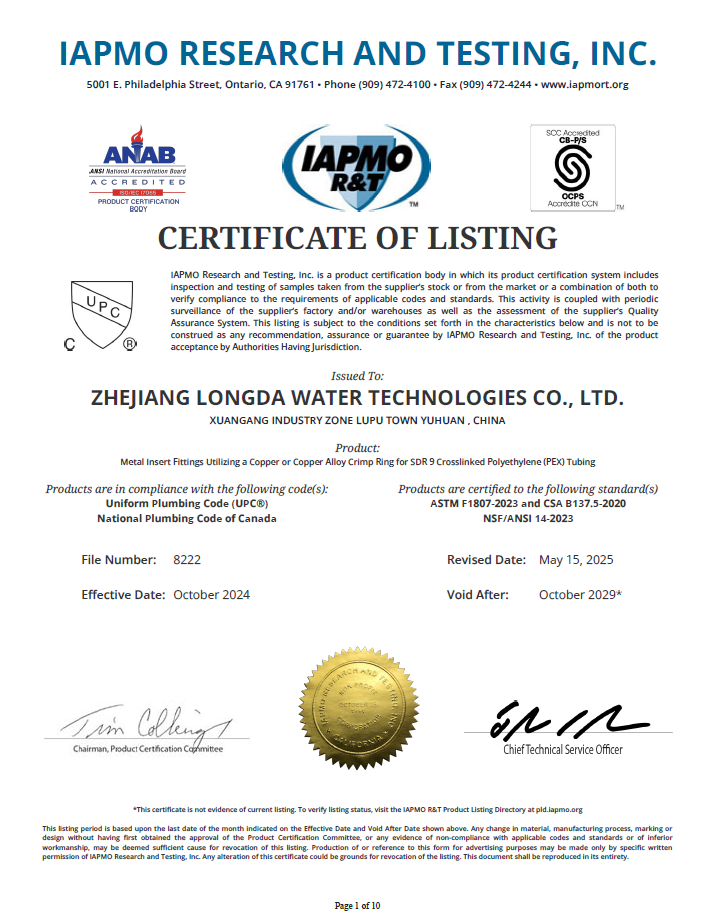
UPC Listing 8222 (IAPMO) covering ASTM F1807 PEX fitting connections within the 15111 brass fitting range.
4. Brass Gate Valve T-22017A — Section Isolation
Where a riser or zone has to be isolated for maintenance without disturbing the rest of the building, the traditional choice remains a gate valve. Brass Gate Valve T-22017A is a rising-stem, full-bore, threaded gate valve with a brass-to-brass metal seat and 360° handwheel operation, sized 1/2"–4" (DN15–DN100) with a 200 WOG (1.4 MPa) pressure rating and a working temperature range of -20°C to 120°C. Body, bonnet, stem and disc are hot-forged brass, with a lead-free option in CW724R or C46500, and female NPT or BSP threaded connections.
Two published test figures are worth carrying into a procurement specification: shell test pressure at 1.5× rated pressure and seat test pressure at 1.1× rated pressure. These tell a buyer what the factory verifies before shipment, which is more useful than a general quality statement.
The lead-free version of this gate valve is certified by IAPMO to NSF/ANSI 61 and NSF/ANSI 372. Both listings are traceable: Certificate of Listing 6304 for lead-free plumbing products to NSF/ANSI/CAN 372-2024, and Certificate of Listing N-5775 for drinking water system components to NSF/ANSI/CAN 61-2023.
5. Brass Supply Stop Valve 98023-LF — Fixture-Level Shut-Off
The last five metres of a plumbing system are where maintenance happens most often, and where the occupant notices failure first. Brass Supply Stop Valve 98023-LF (Brass Angle Valve) is a quarter-turn or multi-turn supply stop in 1/2" × 3/8" and 1/2" × 1/2" (DN15 × DN10/DN15), rated 125 psi with a working temperature range of -20°C to 120°C. Connection options include compression × compression, FIP × compression and PEX × compression to ASTM F1960, plus sweat and threaded, covering faucet, toilet, washing machine and water heater terminal applications.
The lead-free version is certified to cUPC, NSF/ANSI 61 and NSF/ANSI 372, and is listed under cUPC 5775 for plumbing fixture fittings against ASME A112.18.1-2024 / CSA B125.1-24 and NSF/ANSI 14-2015, valid 2024-10-01 to 2029-10-01. Body material is hot-forged CW617N or lead-free brass for potable water contact, with PTFE seats and NBR or EPDM O-rings.
The Shortlist at a Glance
| Component | Model | Primary function | Size range | Pressure rating | Temperature range |
|---|---|---|---|---|---|
| Brass Ball Valve | 8081 | Main building shut-off | 1/2"–4" (DN15–DN100) | 600 WOG (4.1 MPa) | -20°C to 150°C |
| Brass Check Valve | LD 30303 | Reverse-flow protection at pumps | 1/2"–2" (DN15–DN50) | 200 WOG (1.4 MPa) | -20°C to 150°C |
| Brass Fitting | 15111 | Connection and transition hardware | 1/4"–2" (DN8–DN50) | Up to 600 WOG (4.1 MPa) | -20°C to 150°C |
| Brass Gate Valve | T-22017A | Section and riser isolation | 1/2"–4" (DN15–DN100) | 200 WOG (1.4 MPa) | -20°C to 120°C |
| Brass Supply Stop Valve | 98023-LF | Fixture-level shut-off | 1/2" × 3/8", 1/2" × 1/2" | 125 psi | -20°C to 120°C |
Technical Notes: Reading the Ratings Correctly
A pressure rating belongs to a component, not to a system. If a 600 WOG ball valve is installed beside a 200 WOG gate valve, the assembly is governed by the lower figure and by the joints in between. The same logic applies to temperature: the 8081 ball valve is rated to 150°C while the T-22017A gate valve is rated to 120°C, so a hot-water branch specified at 130°C cannot use the gate valve model without a re-check.
WOG is the conventional expression for water, oil and gas service ratings. Where a line carries potable water, the rating figures are only half of the specification; the material and listing evidence are the other half. In the United States and Canada, wetted-surface lead content of no more than 0.25% is the baseline expectation under NSF/ANSI 372 and the Safe Drinking Water Act, with NSF/ANSI 61 covering health effects for drinking water system components.
Thread standards should also be fixed at specification stage rather than at site. NPT threads follow ASME B1.20.1; ISO 228-1 governs pipe threads where pressure-tight joints are not made on the threads, which is the usual basis for BSP parallel connections in European projects. For EU drinking-water installations, EN 13828:2003 sets requirements for manually operated copper alloy ball valves, and gas installations in the EU are covered by EN 331:2015.
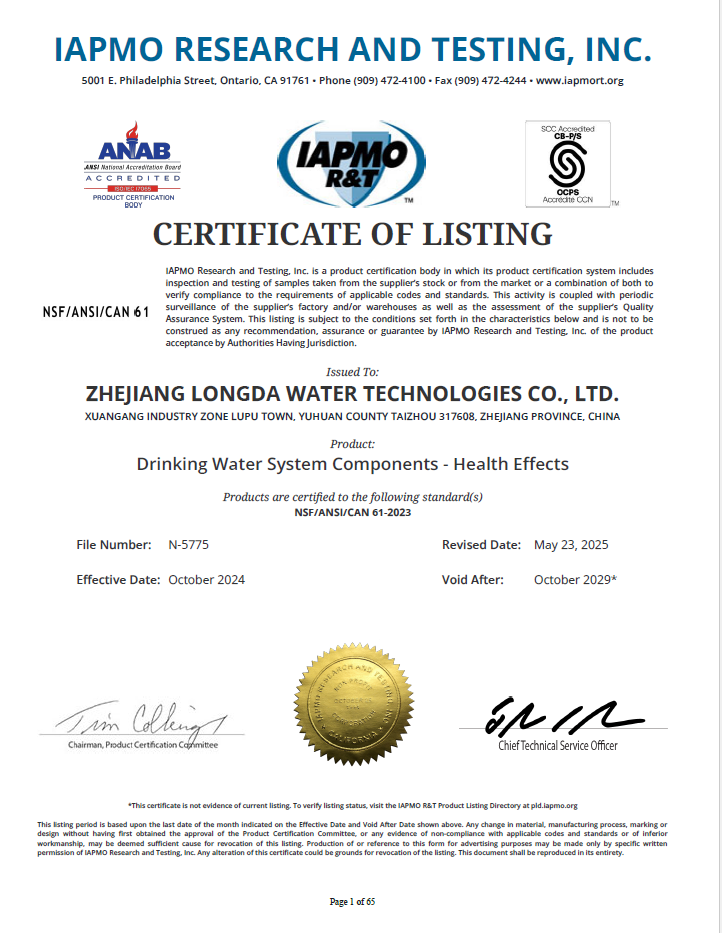
IAPMO Certificate of Listing N-5775 to NSF/ANSI/CAN 61-2023, covering the ball valve 8081, check valve LD 30303, fitting 15111, gate valve T-22017A and supply stop valve 98023-LF.
Application Sequence in a New Build
Read as an installation sequence rather than a parts list, the shortlist follows the water path. The 8081 ball valve sits at or near the service entry as the building main shut-off. Downstream, where a booster pump or circulator is installed, the LD 30303 check valve protects the pump from reverse flow. The 15111 fittings carry the transitions between threaded, PEX, press and push-fit sections of the distribution network, including cold expansion PEX-A joints rated to 100 psi (0.7 MPa) and 82°C in potable water service. Zone or riser isolation is handled by the T-22017A gate valve, and the 98023-LF supply stop terminates each fixture branch behind sinks, toilets and washing machines.
The same five items cover the three most common project types. In new residential construction, they define the standard branch stack. In renovation and repiping work, the fittings and supply stops carry most of the volume because the distribution method often changes. In light-commercial and HVAC work, the gate valve and check valve take on greater importance because isolation and pump protection drive maintenance access.
Market Trend Analysis
Three trends shape how this shortlist is likely to be specified over the next several years.
Ball valves remain the dominant product type. Ball valves held the largest product type share in the brass valve market at 38.4% in 2025 (Dataintelo), which is consistent with the shift toward quarter-turn main shut-offs. The overall brass valves market was valued at USD 14.8 billion in 2025 and is projected to reach USD 24.1 billion by 2034, a CAGR of 5.6% from 2026 to 2034 (Dataintelo).
Gate valves are still growing, not disappearing. Industrial gate valves are projected to be the fastest-growing valve type at a CAGR of 9.89% through 2032 (Cognitive Market Research). Isolation duty in municipal and commercial networks continues to favour full-bore, straight-through designs.
Supply concentration is regional, and North America is a priority market. Asia Pacific held a 41.2% revenue share of the brass valves market in 2025, while North America held approximately 26.1% (Dataintelo). China exported USD 22.6 billion in valves under HS 8481 in 2024, remaining the largest global exporter (OEC), and accounts for approximately 41% of global brass ball valve export shipments (Volza). At the same time, the top five global valve suppliers control only about 35% of global revenues (Mordor Intelligence), which leaves substantial room for specialist manufacturers with verified listings.
Two structural drivers sit behind those figures: the lead-free mandate for potable water applications in the United States, and the gradual integration of valve monitoring into building and industrial networks. The lead-free requirement changes alloy selection and, more importantly, changes the evidence a buyer must collect. Monitoring trends affect specification farther upstream and rarely touch the manual isolation components on this shortlist today, but they shape how future replacement cycles are planned.
Comparison with Traditional Solutions — and Where This Shortlist Stops
Compared with older practice, the differences are practical rather than promotional.
Traditional mains isolation in older buildings often used multi-turn gate or globe valves. A quarter-turn ball valve such as the 8081 reduces operating time and, in full-port form, reduces pressure loss. The trade-off is honest: ball valves with PTFE seats are on/off devices and are not intended for throttling or balancing, and their seat material sets a temperature ceiling that a metal-seated valve does not share.
The T-22017A gate valve follows the opposite logic. Its brass-to-brass metal seat and rising stem suit isolation duty and tolerate conditions that soft seats handle less comfortably, but a gate valve is a slow, multi-turn device and should not be used as a regulating valve. Its 120°C ceiling is lower than the 150°C ceiling of the ball valve family, and metal-seated designs are generally not specified where a soft-seated, bubble-tight shut-off class is the requirement.
On connections, press, push-fit and cold expansion methods reduce open-flame work relative to traditional soldering, but each method carries its own tooling and installer-qualification requirements, and each is certified against a different standard — ASSE 1061 for push-fit, IAPMO/ANSI/CAN Z1117 for press, ASTM F1960 for cold expansion, ASTM F1807 for crimp-ring PEX. Mixing methods across a project without matching the correct listing is a compliance risk, not a labour preference.
A further boundary concerns check valves. A check valve prevents reverse flow inside a defined circuit; it is not automatically equivalent to a testable backflow prevention assembly. Where local code requires a testable assembly, the requirement should be confirmed with the authority having jurisdiction rather than assumed from the presence of a check valve on the drawing.
Finally, the shortlist itself has defined limits. It covers 1/4"–4" nominal sizes and pressure ratings from 125 psi to 600 WOG. Lines above DN100, high-pressure industrial circuits, or applications requiring actuated or monitored valves fall outside this five-item set and need a separate specification.
Procurement Verification Checklist
- Model number, size and connection type match the drawing, including thread standard (NPT or BSP).
- Published pressure rating and temperature range exceed the design condition of the branch being served.
- Lead-free status is supported by a listing certificate number covering the specific product scope, not by a material statement alone.
- Test regime is defined — the manufacturer states 100% air pressure testing under water, thread gauge inspection on every lot, and material test reports.
- Lead time and MOQ are quoted per size; the manufacturer lists production lead times of 30–60 days, samples in 5–7 days, and an MOQ of 1,000 pcs per size.
- Capacity is confirmed against the project schedule; stated monthly capacity includes 500,000 pcs per month for the supply-stop line and 300,000 pcs per month for valve customisation programmes.
- After-sales terms are documented — technical support and installation guidance, a 12-month quality warranty, and free replacement for quality defects.
- Certification assistance is available for cUPC and NSF programmes where a project requires additions to scope.
Manufacturing and Supply Context
Zhejiang Longda Technology Co.,Ltd. was established in 1993 and operates a site of over 30,000 m², of which 28,000 m² is building area. The company reports approximately 200 employees, including more than 30 technical staff and a 6-engineer R&D team, an annual output of 7,500 tons, and more than 360 sets of processing and testing equipment including spectral analysis instruments, intensity test instruments, a low/high temperature test box and a salt-spray test box. Quality management is certified to ISO 9001:2015 (certificate CN00124Q37399R2M/3300, valid to 2027-09-06) and environmental management to ISO 14001:2015 (certificate CN00124E33461R2M/3300, valid to 2027-09-09), both issued by China Quality Certification Centre (CQC).
One reference project illustrates why documentation matters as much as capacity. A US manufacturer and a Canadian wholesale distributor used this product family for residential plumbing fixture supply shut-off applications over three years in each market, at volumes of 8,000,000 pcs per year for the US manufacturer and a cumulative 70,000,000 pcs for the Canadian distributor. The reported outcome was zero leakage complaints, a 100% pass rate in a retail quality audit, and repeat monthly orders, with the supply stop range carrying cUPC and NSF 61 certification and lead-free brass suitable for potable water.
For market context, the wider supplier landscape is led by large diversified groups: Emerson Electric Co. is identified as the global revenue leader in the broader industrial valve market with approximately USD 4 billion in sales in 2024 (Market Research Reports); Mueller Industries, Inc. is described as a leading competitor in the brass valve segment (Dataintelo); and Watts Water Technologies and NIBCO Inc. are identified as key North American competitors for brass plumbing and heating valves (Dataintelo). Neway Valve is recognised among Chinese manufacturers competing in the global high-end industrial valve market (OEC). For buyers, that structure is useful rather than intimidating: it confirms a fragmented supply base in which verified listings and repeatable documentation are the practical differentiators.
Future Outlook
Three developments are likely to shape the next specification cycle. First, lead-free documentation will continue to move from a preference to a gate condition for potable water work, which favours suppliers who hold listings across an entire product family rather than on individual items. Second, the isolation segment will keep expanding as municipal and commercial networks replace ageing assets, with gate valves among the fastest-growing types. Third, monitoring and IIoT integration will gradually move into larger isolation and control valves, while manual shut-off components such as those on this shortlist remain the baseline for residential and light-commercial work.
For procurement teams, the practical implication is stable: keep the shortlist short, keep the certification evidence current, and re-verify ratings whenever a project’s temperature or pressure envelope changes.
FAQ
Which brass component should be specified for the main shut-off in a new residential build?
A full-port ball valve is normally specified for a main shut-off because it provides quarter-turn operation with minimal pressure drop. Brass Ball Valve 8081 is one example: a two-piece, full-port threaded valve with a chrome-plated brass ball, PTFE seats and a blow-out-proof stem, rated 600 WOG (4.1 MPa) and -20°C to 150°C, in sizes 1/2"–4" (DN15–DN100), with lead-free versions carrying cUPC listing and NSF/ANSI 61 & 372 certification. Ball valves are on/off devices and are not intended for throttling.
What ratings and data should be verified before a brass valve order is released?
Four items govern most specification errors: the pressure rating of each individual component, its working temperature range, the connection and thread standard, and the factory test regime. On this shortlist the published ratings are 600 WOG for the ball valve and fittings, 200 WOG for the check valve and gate valve, and 125 psi for the supply stop valve. Temperature ceilings differ by model — 150°C for the ball valve, check valve and fittings, and 120°C for the gate valve and supply stop valve — so the lowest figure in an assembly governs the assembly. The gate valve specification also states a shell test at 1.5× rated pressure and a seat test at 1.1× rated pressure.
Which certifications support potable-water use in the United States and Canada?
The relevant evidence is a listing certificate that names the product scope and the standard. For this range, IAPMO Certificate of Listing N-5775 covers drinking water system components to NSF/ANSI/CAN 61-2023, and Certificate of Listing 6304 covers lead-free plumbing products to NSF/ANSI/CAN 372-2024. Products on this shortlist also appear under cUPC listings, including 5775 for plumbing fixture fittings against ASME A112.18.1-2024 / CSA B125.1-24, 5938 for ball valves against IAPMO/ANSI Z1157-2014e1(R2019), ASME A112.4.14-2022 and CSA B125.14-22, and 8222, 17432, 17433 and 10232 for the fitting range against ASTM F1807, IAPMO/ANSI/CAN Z1117, ASSE 1061 and ASTM F1960 respectively. Wetted-surface lead content of no more than 0.25% is the underlying requirement under NSF/ANSI 372.
Does a brass check valve satisfy backflow protection requirements on its own?
A check valve, such as Brass Check Valve LD 30303, prevents reverse flow within a defined circuit and is commonly used to protect pumps, boilers and circulators. It is not automatically equivalent to a testable backflow prevention assembly. Where a jurisdiction requires a testable assembly, the requirement must be confirmed with the local authority having jurisdiction and specified separately; the rating and installation orientation of the check valve — horizontal or vertical, swing or spring-loaded — should still be verified against the circuit it serves.
How should the five components be scheduled against a construction programme?
Sequence buying by function and size rather than by product family. Sizes and connection types should be fixed once the distribution method is confirmed, because the fitting range spans threaded, sweat, PEX, PEX-A, press and push-fit connections while the valves cover female NPT or BSP threads. The manufacturer lists samples in 5–7 days, production lead times of 30–60 days depending on product, and an MOQ of 1,000 pcs per size. Stated monthly capacity includes 500,000 pcs for the supply-stop line and 300,000 pcs for valve customisation programmes, which allows fixture-level items and larger valves to be phased separately against the site programme.
What are the limits of this shortlist?
The five items cover 1/4"–4" nominal sizes and pressure ratings from 125 psi to 600 WOG, with a maximum working temperature of 150°C and a minimum of -20°C. They do not cover sizes above DN100, high-pressure industrial circuits, actuated or monitored valves, or balancing duty — ball valves and gate valves on this list are isolation devices, not regulating devices. Gate valve sealing is metal-to-metal (brass-to-brass) rather than soft-seated, and its temperature ceiling of 120°C is lower than that of the ball valve family. Where a project’s design envelope falls outside these bands, a separate specification and certification check is required.
The full LONGDA BRASS VALVE catalogue, including size tables and listing references for the models in this shortlist, is available for download: Longda Global catalogue (PDF).