
The Procurement Shortlist: 7 Bozheng Brass Valve Models to Evaluate in 2026
A brass valve is ordered by model number, not by category. The designation printed on a purchase order — Q11F-16T, Z15W-16T, SY11X-16T — is what determines the bore, the sealing arrangement, the pressure class and the connection that arrives in the crate. Searching for a “brass valve for water” returns a supplier list. Shortlisting by model designation is what returns a repeatable order.
This article works at the second level. It assembles a seven-model evaluation shortlist drawn from the brass valve range of Zhejiang BoZheng Copper Industry Co., Ltd., which markets as Bozheng Valve — a brass and stainless valve manufacturer founded in 1998 and based in Yuhuan City, Zhejiang Province, China. Every entry is described only through traits a procurement team can verify before issuing an RFQ: construction type, nominal pressure, material grades and end connections. The list is deliberately non-exhaustive. It is a starting point for an RFQ, not a final specification, and it is not a comparative ranking of brands.
Why the shortlist stage decides the RFQ
The global brass valves market was valued at USD 14.8 billion in 2025 and is projected to grow to USD 24.1 billion by 2034, according to Dataintelo’s brass valves market analysis. Asia Pacific accounted for the largest revenue share at 41.2% in 2025, and ball valves were the single largest product-type segment at 38.4% of that market.
Figures of that scale describe a well-supplied category. They do not describe an easy purchasing decision, because the constraint in brass valve procurement is rarely availability — it is comparability. An RFQ written as “brass valves, half-inch, 200 units” returns quotations that cannot be lined up against each other: different body materials, different port types, different thread standards, different test documentation.
Attaching model designations to the RFQ removes most of that ambiguity in one step. The model number fixes the construction; only material grade, connection configuration, quantity and commercial terms remain open for negotiation. That is why a shortlist should close on model numbers rather than on supplier names.
Seven models at a glance
The table below summarises the seven catalogue models covered by this shortlist. All seven share two attributes that simplify pre-qualification: a nominal pressure rating of 1.6 MPa, and a stated working-media envelope of water and gas.
| # | Model | Valve type | Construction as catalogued | Nominal pressure | Body material options | End connection |
|---|---|---|---|---|---|---|
| 1 | Q11F-16T | Brass ball valve | Two-piece; full port / full bore; lockable lever handle available | 1.6 MPa | HPb59-1, HPb57-3, CW617N, C83600 | Threaded; flanged available; F-F, F-M, M-M configurations |
| 2 | Z15W-16T | Brass gate valve | Rising stem; solid wedge | 1.6 MPa | HPb59-1, HPb57-3, CW617N, C83600 | Threaded |
| 3 | J11W-16T | Brass globe valve | Straight pattern (T-pattern); screw-in bonnet | 1.6 MPa | HPb59-1, HPb57-3, CW617N, C83600 | Confirm on datasheet |
| 4 | J11F-16T | Brass globe valve | Straight pattern (T-pattern); screw-in bonnet | 1.6 MPa | HPb59-1, HPb57-3, CW617N, C83600 | Confirm on datasheet |
| 5 | H14X-16T | Brass check valve | Vertical; horizontal; swing; spring-loaded | 1.6 MPa | HPb59-1, HPb57-3, CW617N, C83600 | Confirm on datasheet |
| 6 | Y13X-16T | Brass pressure reducing valve | Direct acting / spring loaded (piston type); balanced spring loaded; diaphragm / membrane type | 1.6 MPa | HPb59-1, HPb57-3, CW617N, C83600 | Confirm on datasheet |
| 7 | SY11X-16T | Brass strainer | Blow-down / flush type; perforated (punched) screen | 1.6 MPa | HPb59-1, HPb57-3, CW617N, C83600 | Threaded ends |
Table 1. Model-level shortlist from Bozheng Valve’s brass valve range. Shared attributes: 1.6 MPa nominal pressure and a catalogued working-media envelope of water and gas.
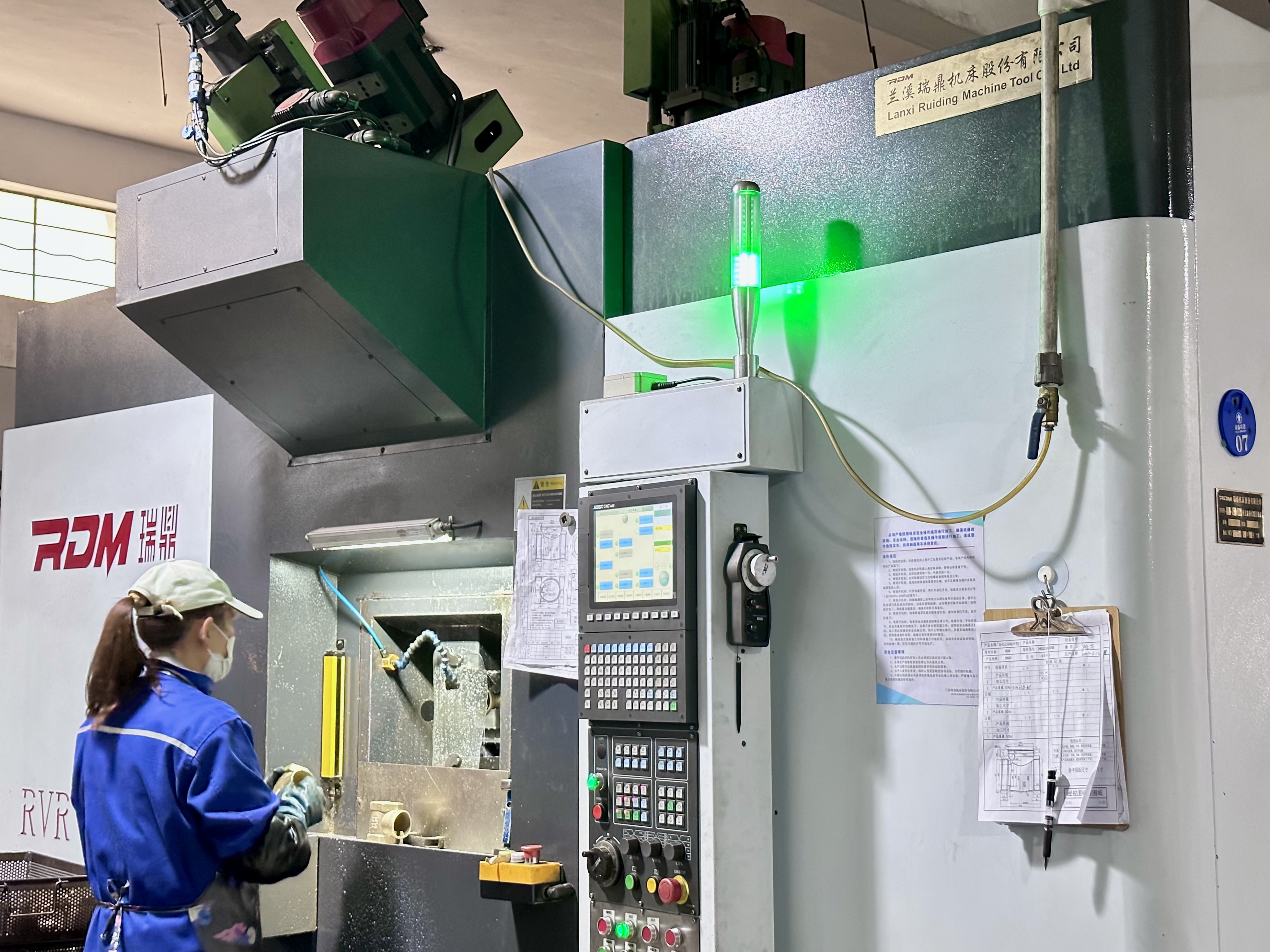
Production floor at Zhejiang BoZheng Copper Industry Co., Ltd., Yuhuan City, Zhejiang Province, China — the site where the seven catalogued models are manufactured.
What the shared specifications already answer
Four attributes repeat across all seven models. Because they are common, they can be settled before any supplier conversation starts — and each carries a different implication for the buyer.
Pressure class: 1.6 MPa across the range
Every model in the shortlist is catalogued at a normal pressure of 1.6 MPa. That places the group in low-to-medium pressure service, which is the operating band for most building services, plumbing distribution, compressed-air branch lines and light industrial utility circuits. It also defines the boundary of the list: a line designed above that class is not a candidate for these models, whatever the price advantage. The correct sequence is to read the system design pressure first and match the model afterwards, not the reverse.
Media: water and gas, with industry fit stated separately
The catalogue states water and gas as the working media for the seven models. Separately, the applicable-industry field for the same models names construction and building (HVAC and plumbing), compressed air systems, low-pressure steam and boilers, oil and fuel systems, swimming pools and water treatment, and industrial machinery such as mould cooling and hydraulics. Buyers should treat those two statements as different levels of confirmation: the media line defines the default service envelope, while the industry line describes the sectors in which the models are used. Where a specific line carries a medium outside the stated water-and-gas envelope, the model’s suitability for that service should be confirmed against the datasheet before the order is placed.
Material grades: four brass alloys across the range
All seven models are offered in HPb59-1, HPb57-3, CW617N and C83600. The presence of CW617N matters for European-facing projects: standard European brass valves are manufactured according to EN 12165, which specifies the CW617N alloy, and are fitted with parallel threads per ISO 228-1. A buyer whose project documentation references EN 12165 or ISO 228-1 can therefore anchor the material conversation on a named grade rather than on a general description of “brass”. Stating the grade on the RFQ also pre-empts the most common source of non-comparable quotations in this category.
End connections: threaded as default, flanged as an option
Threaded ends are catalogued for the Z15W-16T gate valve and the SY11X-16T strainer, and the Q11F-16T ball valve is offered in threaded or flanged execution with F-F, F-M and M-M configuration options plus a lockable lever handle. For the globe, check and pressure reducing valve entries, the catalogue description details the internal construction but does not separately list the end connection, so the connection type should be confirmed on the datasheet during the RFQ rather than assumed. This is a small point that repeatedly causes re-quotes in practice: connection configuration, not valve type, is where specification mismatches most often appear.
Model-by-model evaluation notes
1. Q11F-16T — two-piece, full-port brass ball valve
The Q11F-16T is a two-piece brass ball valve in full port / full bore construction. Full bore matters in procurement terms because it keeps the flow path close to the nominal line size, which is relevant wherever pressure drop across the valve affects pump duty or system balance. The catalogue lists threaded and flanged executions, F-F, F-M and M-M end configurations, and a lockable lever handle option. The ball valve entry also carries an explicit working-temperature window of 0 °C to 80 °C — the only model in the list with a stated temperature range — which makes it the clearest default where the task is simple on/off isolation or flow regulation in water and gas lines within that band.
2. Z15W-16T — rising-stem brass gate valve
The Z15W-16T is a rising-stem gate valve with a solid wedge and threaded ends. The rising stem gives the operator a visible position cue, since the stem rises as the valve opens, which is useful where a maintenance team needs to confirm the state of a line without instrumentation. The solid wedge is a conventional arrangement for isolation duty. This is the model to evaluate where the requirement is straightforward shut-off and a visual position indication matters more than fine flow control.
3–4. J11W-16T and J11F-16T — T-pattern brass globe valves
The catalogue lists two globe valve designations: J11W-16T and J11F-16T. Both are described as straight pattern (T-pattern) with a screw-in bonnet, carrying the same 1.6 MPa rating and the same four material options as the rest of the range. Because the two designations share a body description, buyers should treat them as two catalogue variants of one valve type — and should state on the RFQ which designation applies, then confirm the corresponding internal configuration against the datasheet. Globe valves are the appropriate choice where throttling and regulation are required rather than simple open/close duty; that functional distinction, not the designator letter, is what should drive the selection.
5. H14X-16T — brass check valve in four configurations
The H14X-16T is catalogued in four forms: vertical, horizontal, swing and spring-loaded. The choice between them is a matter of installation geometry and closing behaviour rather than preference. A vertical or horizontal designation constrains how the valve may be mounted in the line; a spring-loaded design is selected where faster closing is required; a swing type is a conventional arrangement for horizontal flow. Because backflow protection is a system-protection function — preventing backflow, overpressure or contamination in a section of pipeline — the mounting orientation should be settled at the drawing stage, before the check valve model is fixed on the order.
6. Y13X-16T — brass pressure reducing valve
The Y13X-16T is catalogued in three sub-types: direct acting / spring loaded (piston type), balanced spring loaded, and diaphragm / membrane type. A pressure reducing valve sits in a different procurement category from the other six entries, because it performs a regulating function rather than a stopping function: it holds downstream pressure at a set level instead of simply isolating a line. Two consequences follow for buyers. First, the downstream pressure requirement, not the upstream pressure class alone, is the governing specification. Second, the sub-type selection influences behaviour and maintenance access, so the intended installation should be described in the RFQ rather than inferred from the model number.
7. SY11X-16T — brass strainer with perforated screen
The SY11X-16T closes the list, and it is the entry most often left out of a first RFQ. It is a blow-down / flush type strainer with a perforated (punched) screen and threaded ends, rated at the same 1.6 MPa. A strainer is a protective component: it captures debris before that debris reaches a ball, gate or check valve seat. Specifying the strainer alongside the control valves, rather than after them, changes the maintenance profile of the whole assembly, because the strainer then becomes the designated service point instead of the valves downstream of it.
How the models are produced and verified
Zhejiang BoZheng Copper Industry Co., Ltd. was founded in 1998 and operates from Yuhuan City in Zhejiang Province, China, a location commonly referred to as the “Valve Capital of China”. The company reports a factory area of 6,700 m², 180 employees, an R&D team of 25 engineers and an annual output of 3,200,000 units, with exports accounting for 70% of sales across the EU, USA, Southeast Asia, Central Asia and Africa.
Three management-system certifications are held for the brass valve scope, all issued by QPC:
- ISO 9001:2015 quality management system — certificate 20225Q20080R2M, against GB/T 19001-2016, valid to 25 February 2028.
- ISO 14001:2015 environmental management system — certificate 2024E0305R0M, against GB/T 24001-2016, valid to 23 October 2027.
- ISO 45001:2018 occupational health and safety management system — certificate 2022S02003R0M, against GB/T 45001-2020, valid to 25 February 2028.
For a buyer, the relevant detail is not the existence of certificates but their scope and validity window. All three are issued for the brass valve scope, and all three carry expiry dates beyond 2027, which means a project with a two-to-three-year delivery horizon can be covered without re-documentation mid-contract.
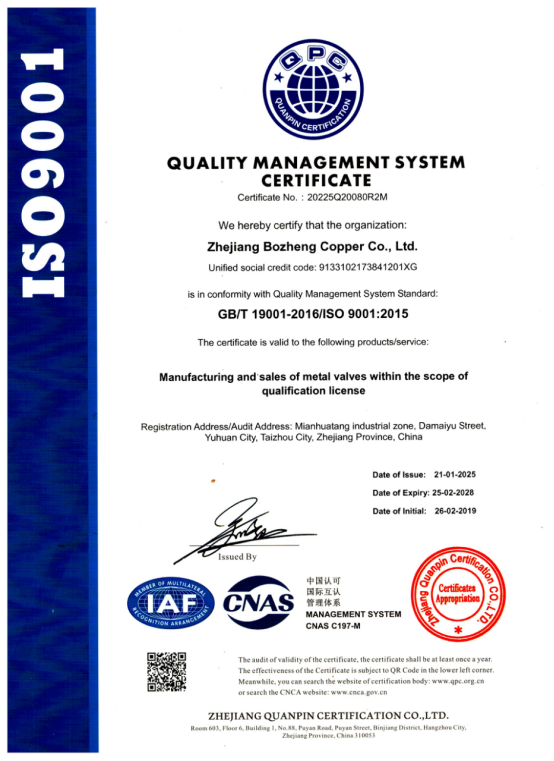
ISO 9001:2015 certificate 20225Q20080R2M, issued by QPC for the brass valve scope, valid to 25 February 2028.
Quality control is documented as 100% testing of all products before shipment. On the production side, the capability record states a monthly capacity of 30,000 units and a typical production lead time of 30 days, with a minimum order quantity of 1 unit for stock goods. Customisation is offered across logo, appearance, pressure, material and colour, alongside OEM/ODM production services.
One field reference point is available from the company’s case record: a programme of 200,000 units supplied across applications in Africa, Asia, Europe and South America, installed over a two-year period with no breakage or leakage reported, and highlighting long lifespan, low maintenance and water saving. The client mix in that programme included plumbing wholesalers and distributors, project contractors in HVAC, plumbing and fire protection, OEM manufacturers of boilers, heat pumps, compressors and cooling towers, water and gas utility companies, industrial end users, irrigation and agricultural companies, and export trading companies. The reported operating functions were on/off control, flow regulation, isolation, system protection and safety shut-off.
Commercial terms documented for purchasing are a minimum order quantity of 1 unit for stock goods, FOB or CIF delivery terms, pre-shipment testing as the acceptance criterion, and 30/70 payment terms. For an evaluation-stage buyer, the pre-shipment test clause is the most useful of these: it moves verification to a point in the process where a discrepancy can still be corrected before the container is loaded.
Where the seven models fit in real systems
Read as a set rather than as seven separate purchases, the list shows how the models divide the work in a typical installation.
- Isolation and on/off control: Q11F-16T ball valve and Z15W-16T gate valve.
- Regulation and throttling: J11W-16T and J11F-16T globe valves.
- Backflow protection: H14X-16T check valve, in the orientation that matches the installation geometry.
- Downstream pressure control: Y13X-16T pressure reducing valve.
- Debris protection upstream of the above: SY11X-16T strainer.
The applicable industries named for the range are construction and building (HVAC and plumbing), compressed air systems, low-pressure steam and boilers, oil and fuel systems, swimming pools and water treatment, and industrial machinery including mould cooling and hydraulics. In practice, the stated water-and-gas media envelope directs these seven models toward potable and process water lines, plumbing and heating distribution, low-pressure gas distribution and utility air circuits, with confirmation required where a line operates outside that envelope.
Market signals shaping a 2026 shortlist
Three developments are visible in the available market data, and each affects how a 2026 shortlist should be documented.
Regulatory pressure on material composition. Lead-free brass valves accounted for more than 30% of new brass valve product offerings as early as 2024, driven by regulatory pressure. The practical effect for buyers is that material grade is no longer a purely technical line on a datasheet — it is a compliance variable that should be stated explicitly in the RFQ and matched against the destination market’s requirements.
Energy-efficiency requirements. New MIIT energy efficiency limits for industrial valves in China came into effect from October 2025 and mandate specific sealing grades. A supplier’s ability to document sealing performance against a defined grade is therefore becoming part of the standard evidence pack rather than a supplementary request.
Export scale and supply depth. China’s total valve-related exports under HS Code 8481 reached USD 8.06 billion in 2025, representing 19.0% of global import value share, per Tendata’s 2025 global valves import trade analysis. China was also the largest exporter of check valves in 2024, at USD 730 million, or 19.6% of the global total. Scale of this kind supports availability — and it raises the value of documentation, because in a deep supplier pool the differentiator is not whether a valve can be supplied, but whether the supplied valve can be traced to a stated grade, rating and test record.
Brass models versus traditional sourcing approaches — and the limits of this list
Traditional brass valve sourcing starts from a category and a price. A buyer specifies size and quantity, collects quotations, and selects on unit cost and delivery time. That approach works where the application is simple and the consequences of a mismatch are small. It breaks down where a line carries a specific medium, where a valve performs a regulating rather than a stopping function, or where the destination market imposes a material requirement. In those cases the cost of a mismatch — a re-quote, a returned container, a failed inspection — exceeds the saving that drove the selection in the first place.
Model-level shortlisting inverts the sequence: construction type and pressure rating are fixed first, and commercial comparison happens afterwards on genuinely comparable items. Third-party market analysis names Mueller Industries (USA), NIBCO (USA), Watts Water Technologies (USA) and KITZ Corporation (Japan) among the key global competitors in the brass valve segment. Their presence is worth noting for a different reason than ranking: a shortlist is only as useful as the comparison set it is built against, and buyers should define that set explicitly rather than accept a supplier-generated one.
The boundaries of the list above should be stated just as plainly:
- Pressure ceiling. All seven models are catalogued at 1.6 MPa nominal pressure. They are not substitutes for higher-pressure-rated valve classes, and system design pressure should be checked before the model is selected.
- Media envelope. The stated working media are water and gas. Lines carrying other media require confirmation of the specific model’s suitability.
- Temperature. Only the Q11F-16T ball valve carries an explicit working-temperature window in the catalogue entry (0 °C to 80 °C). Temperature limits for the other six models should be confirmed against the datasheet.
- Two globe valve designations. J11W-16T and J11F-16T share a body description in the catalogue. The correct designation and internal configuration should be confirmed before ordering.
- Non-exhaustive scope. This is a starting list of seven models from one manufacturer’s range. It is not a complete specification and not a comparative ranking of brands or suppliers.
What to watch next
Three directions seem likely to shape the next round of brass valve procurement decisions. Material documentation will continue to move from optional to mandatory as lead-free and low-lead requirements spread across destination markets. Sealing-grade evidence will become a routine part of the supplier file as energy-efficiency rules take hold. And as export volumes stay high, the differentiating evidence in a supplier evaluation will increasingly be traceability — grade certificates, test records and inspection points — rather than raw capacity. Procurement teams that build shortlists around documented model attributes now will need less rework when those requirements tighten.
FAQ
What do the seven models have in common?
All seven — Q11F-16T, Z15W-16T, J11W-16T, J11F-16T, H14X-16T, Y13X-16T and SY11X-16T — are catalogued with a normal pressure rating of 1.6 MPa, a working-media envelope of water and gas, and availability in the same four brass grades: HPb59-1, HPb57-3, CW617N and C83600.
Which material grades are available, and why does the grade matter?
Four grades are offered across the range: HPb59-1, HPb57-3, CW617N and C83600. Grade determines alloy composition and, in several markets, compliance with material restrictions. CW617N is the alloy specified in EN 12165 for standard European brass valves, which also use parallel threads per ISO 228-1, so buyers working to European project documentation can specify against a named standard rather than a generic brass description.
What end connection options exist across the list?
Threaded ends are catalogued for the Z15W-16T gate valve and the SY11X-16T strainer. The Q11F-16T ball valve is offered in threaded or flanged execution with F-F, F-M and M-M configurations and an optional lockable lever handle. For the globe, check and pressure reducing valve entries, the end connection is not separately listed in the catalogue description and should be confirmed on the datasheet.
Which certifications cover these models?
Three management-system certificates are held for the brass valve scope, all issued by QPC: ISO 9001:2015 (certificate 20225Q20080R2M, valid to 25 February 2028), ISO 14001:2015 (certificate 2024E0305R0M, valid to 23 October 2027) and ISO 45001:2018 (certificate 2022S02003R0M, valid to 25 February 2028).
What are the ordering terms and acceptance criteria?
The documented purchasing terms are a minimum order quantity of 1 unit for stock goods, FOB or CIF delivery terms, pre-shipment testing as the acceptance criterion, and 30/70 payment terms. Production capacity is stated at 30,000 units per month with a typical lead time of 30 days, and quality control is documented as 100% testing of all products before shipment.
What are the main limits of these seven models?
The list is bounded by a 1.6 MPa nominal pressure rating and a stated working-media envelope of water and gas, so lines outside those parameters require a different valve class or explicit confirmation. A working-temperature window is stated only for the Q11F-16T ball valve (0 °C to 80 °C); temperature limits for the remaining six models should be verified against the datasheet. The list is also non-exhaustive and covers one manufacturer’s range.
Does this list replace a project-specific specification?
No. It is a starting list for evaluation and RFQ preparation. Selection still depends on system design pressure, medium, temperature, installation orientation and the destination market’s material and efficiency requirements.
The full model range, including configuration options and catalogue documentation, is available in the Bozheng Valve product catalogue: BZ Catalogue 2025 2.0.