
The Right Tool for Every Surface: Matching Microfiber Mops to Commercial Floors
The Right Tool for Every Surface: Matching Microfiber Mops to Commercial Floors
Commercial buildings rarely present one floor surface. A single property can combine polished marble in the lobby, sealed hardwood at thresholds, ceramic tile in service corridors and other hard finishes in back-of-house areas. Each responds differently to moisture, mechanical pressure and the fiber that contacts it — which is why the mop pad, not the handle, is usually the decision that determines whether a floor program protects a finish or gradually wears it down.
Pa Tin Da Group Co., Ltd (Foshan Patinda Housewares Co., Ltd) is a microfiber cleaning products manufacturer established in May 2004 in Foshan, Guangdong, China, and exporting 98% of its output to markets including the United States, Canada, the United Kingdom, Germany, France, Japan and South Korea. Two mops in its commercial microfiber cleaning products range frame the selection problem clearly: the MP-015 Microfiber Twisted Wet Mop, an aluminum plate adjustable wet floor cleaning mop set with replacement refills, and the MP-014 Microfiber Stripe Mop, a color-coded flat mop pad. Both are reusable, lint-free and positioned for marble, hardwood and ceramic tile. They are not interchangeable.
This reference compares the two by construction, attachment system and refill weight, then maps them to the two operating regimes that dominate commercial floor care: heavy-duty wet cleaning and routine maintenance.
The Contact Layer Decides the Result
A mop's performance on a commercial floor is set by the fabric that touches the surface — its yarn construction, pile geometry and liquid-holding behavior — rather than by handle length or frame color. The MP-015 carries a twisted microfiber and PET loop absorbent surface on the front, with a full velcro sticker back designed to match an aluminum mop frame. The MP-014 uses a mixed microfiber and nylon striped pile built specifically for rough floor dirt capture, on a double-pocket back with a color-coded classification tag.
That difference produces three practical consequences for a facility team: how much liquid the pad releases and retains per pass, how much soil it lifts from a given surface texture, and how much mechanical friction the finish receives during a shift. Both pads are described as lint-free and both are rated for marble, hardwood and ceramic tile. The MP-014 is specified for both dry and wet cleaning; the MP-015 is specified for wet cleaning. Neither is a general-purpose substitute for the other.
MP-015 and MP-014: Specification Comparison
| Attribute | MP-015 Microfiber Twisted Wet Mop | MP-014 Microfiber Stripe Mop |
|---|---|---|
| Product type | Aluminum plate adjustable wet floor cleaning mop set and replacement refill | Color-coded commercial wet / dry floor cleaning mop pad |
| Material | Microfiber + polyester (PET) | Microfiber + nylon blended fabric |
| Surface structure | Front twisted microfiber / PET loop absorbent surface | Front mixed microfiber and nylon striped pile for rough floor dirt capture |
| Back / attachment | Full velcro sticker back matching an aluminum mop frame; thickened telescopic aluminum rod with adjustable rotating mop head | Double pocket fixed design with color-coded classification tag |
| Standard sizes | 18 inch / 24 inch; customizable dimensions | 40 cm / 50 cm; customizable sizes |
| Refill weight | 75 g / 110 g | 100 g / 115 g per piece |
| Stated performance | Strong water absorption, effective dirt capture, lint-free, reusable after repeated washing | Absorbs up to 7 times its own weight in liquid, picks more dust than a regular mop, reusable over 300 washing cycles |
| Floor suitability | Marble, hardwood, ceramic tile — wet cleaning | Marble, hardwood, ceramic tile — dry and wet cleaning |
| Listed applications | Commercial property cleaning, hotel and hospital sanitation, restaurant cleaning, household daily floor maintenance | Hotel cleaning service, hospital sanitation, restaurant catering, commercial property maintenance, household floor cleaning |
| Custom options | Color, woven label, printed logo, assorted packaging | Color, woven label, printed logo, assorted packing |
What the Attachment System Changes on Site
Changeover time, handle compatibility and zoning discipline are decided by the back of the pad, not by the pile. The MP-015 refill bonds to the frame across its full surface using a velcro sticker back that matches an aluminum mop frame, and the set is supplied with a thickened telescopic aluminum rod and an adjustable rotating mop head. For large open hard-floor areas under a wet-mopping routine, that format keeps a flat, even contact patch and lets the head rotate around columns, furniture legs and edges without the operator lifting and repositioning the mop repeatedly.
The MP-014 uses a double-pocket back with a color-coded classification tag. Pads slip over a compatible flat holder and are changed by hand, and the tag supports classifying pads by area so that a defined zone keeps its own set of pads across a shift. For a facility running daily maintenance rounds across several departments, that zoning logic is often more valuable than a marginal difference in absorbency.
Buying caution. A refill is a recurring purchase, while a frame is a one-off. Confirm the handle and holder standard before committing to a refill program: MP-015 refills require a compatible aluminum mop frame, and MP-014 pads require a compatible flat holder. A mismatch turns a consumable into dead inventory and forces a second purchasing cycle.
Matching the Pad to the Duty Cycle
Heavy-duty wet cleaning: MP-015
When the pass is primarily about liquid — wet mopping after machine scrubbing, entrances during rain periods, food-service and back-of-house floors — the twisted microfiber and PET loop surface of the MP-015 is the relevant tool. It is specified for strong water absorption, effective dirt capture and lint-free performance on marble, hardwood and ceramic tile, with refill weights of 75 g or 110 g in 18 inch and 24 inch sizes. The heavier 110 g refill puts more fabric in contact with the floor and holds more liquid per pass; the 75 g refill suits narrower areas and faster, lighter passes. Both are reusable after repeated washing, which is the durability claim that matters when a facility compares refills against disposable alternatives.
Routine maintenance and dry or damp rounds: MP-014
For daily rounds where the objective is capturing dust, grit and light soil from a hard floor, the MP-014's mixed microfiber and nylon striped pile is designed for rough floor dirt capture. It absorbs up to 7 times its own weight in liquid, picks more dust than a regular mop, and is reusable over 300 washing cycles — a figure that lets a buyer model the refill count for a given cleaning frequency with far more confidence than a generic durability statement. Its dry and wet rating is what makes it a full daily-round pad rather than a wet-only tool, and the 40 cm and 50 cm sizes cover most standard commercial flat-mop widths.
Choosing between them when both qualify
- Let the soil decide. Sequentially, a floor that receives a wet pass after machine scrubbing and a dry dust-capture pass in between is normally served by both pads — the question is which one starts the day.
- Let the liquid load decide the wet pad. High liquid volumes favor the wet-mop set with its telescopic aluminum pole and full-surface velcro attachment; light damp mopping can be handled by the pocket pad.
- Let the laundry decide the refill weight. MP-014 refills at 100 g / 115 g and MP-015 refills at 75 g / 110 g are not equivalent laundry loads at scale, particularly where pads are washed after every shift.
- Let zoning decide the color. The MP-014 color-coded tag and the MP-015 customizable color both allow a facility to assign pads to defined areas rather than sharing one set across all of them.
Surface-by-Surface Fit
| Floor situation | Pad to consider | Basis |
|---|---|---|
| Polished marble, sealed hardwood, ceramic tile — wet cleaning | MP-015 | Specified for marble, hardwood and ceramic tile wet cleaning, with strong water absorption and effective dirt capture |
| Same surfaces — daily dry and damp rounds | MP-014 | Rated for dry and wet use; striped pile designed for rough floor dirt capture |
| Textured or rough tile with embedded grit | MP-014 | Mixed microfiber and nylon striped pile is built for rough floor dirt capture |
| Dried, stubborn staining on durable tile | MP-020 (spot duty) | Red PET abrasive stripe is positioned for stubborn stain removal |
| Very heavy liquid pick-up across open floors | MT-003 string mop (supplementary) | Microfiber terry loop strip mop with high water absorption and strong dirt pick-up |
None of these rows is a blanket recommendation. The honest reading of the specification data is that MP-015 and MP-014 share the same floor-type approvals and differ in the job they do on those floors: liquid management and wet cleaning versus dust and grit capture with a dual dry and wet role.
Adjacent Pads in the Same Mop Family
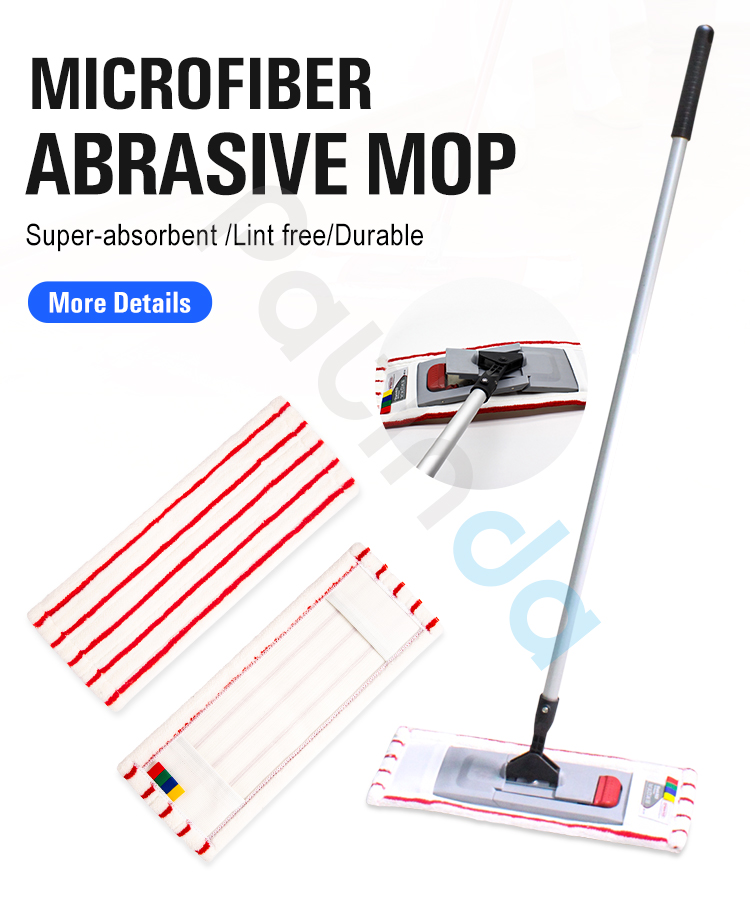
Two further products matter when a floor inventory includes conditions the two reference pads were not built for. The MP-020 Microfiber Abrasive Mop is a color-coded commercial dual-purpose dry and wet pad made from microfiber and PET blended fabric, with a white microfiber main pile plus a red PET abrasive stripe for stubborn stain removal, in 40 cm and 50 cm sizes at 80 g or 95 g, and a four-color classification label for area management. Its listed applications include hospital sanitation, hotel and catering cleaning, commercial property maintenance, school campus cleaning and public facility hygiene management. Where the MP-014 captures routine dirt, the MP-020 is the pad reserved for the stains that routine passes leave behind.
The MP-006 Microfiber-Cotton Blended Tufting Mop represents the other direction. It is a color-coded pocket-style dust and wet dual-use replacement pad made from 40% cotton and 60% polyester blended yarn, with a tufted loop front surface and fringe edge, 40 cm and 50 cm sizes at 165 g or 200 g, and a four-color identification tag on the back. Buyers who prefer a heavier, tufted pad with a cotton component for dry sweeping and wet mopping should compare it directly with the MP-014 rather than treating microfiber as the only acceptable option.
Operating Conditions These Pads Are Specified For
Application data for this product category describes indoor, enclosed environments at normal room temperature (10 °C to 35 °C), with frequent water immersion, repeated wet-dry cycles and high-frequency friction from repeated scrubbing. Hotel and resort daily sanitation procurement is a common project type for this pattern, and the scenario data lists Germany and the United States among the markets where it is most common. The typical operating mode is reusable daily use with repeat washing — not single-use consumption.
Project requirements recorded for this category include custom logo, custom size and color, quick-dry performance, lint-free behavior and high water absorbency. That combination explains why pad selection sits inside a procurement specification rather than inside a janitorial supply decision alone: the pad has to satisfy a surface, a cleaning frequency, a laundry process and a branding requirement at the same time.
Efficiency and Resource Use: What the Data Supports
Microfiber cleaning products are associated with a reduction in chemical usage of up to 60% and a reduction in water consumption of up to 90% compared with traditional cleaning tools, according to Global Growth Insights (2024). For a facility manager, that is the central economic argument for microfiber floor tools — but it is realized only when the pad matches the surface and the soil type. A heavy wet pad applied to a light maintenance round increases water consumption rather than reducing it, and an under-specified pad on a soil-heavy floor simply forces repeat passes.
Supply-side context supports the shift. Volza recorded 10,544 microfiber towel export shipments from China between June 2024 and May 2025, indicating a concentrated manufacturing base for this category. On market size, Dataintelo estimates the global microfiber cleaning cloth market at approximately USD 3.8 billion in 2025, projected to reach USD 27.5 billion by 2034. Published estimates diverge substantially depending on whether industrial and retail segments are counted, so buyers should treat headline market figures as directional rather than as a planning input.
Durability is where the arithmetic becomes concrete. The MP-014 is reusable over 300 washing cycles, and the MP-015 is reusable after repeated washing. Against a defined cleaning frequency, those claims allow a buyer to calculate annual refill quantities instead of estimating them.
Microfiber Mops vs Traditional Floor Tools — and the Limits
Microfiber pads are not a universal replacement for every traditional floor tool, and a purchasing decision that assumes they are will create operational gaps. Four limitations deserve to be stated plainly.
- Attachment dependency. Both the velcro-backed MP-015 and the pocket-backed MP-014 depend on a compatible frame or holder. Facilities with mixed equipment fleets may need to standardize hardware before they can standardize pads.
- Laundering discipline. The economics of a reusable pad rest on repeat washing. Where laundry capacity, turnaround or washing practice is weak, the refill calculation that justified the switch does not hold.
- Weight and size must match the duty. A 115 g pad used on a light maintenance round is unnecessary fabric moving through every wash cycle, while a 75 g refill on a soil-heavy floor may require more passes than the labor budget allows.
- Soil removal is not disinfection. A mop pad removes soil; it does not replace a facility's validated cleaning and disinfection protocol, particularly in hospital sanitation environments where these pads are listed as applicable.
There is also a genuine capacity boundary. A flat pad holds a finite volume of liquid, so a floor with very heavy liquid loads may need a string mop such as the MT-003 Microfiber Terry Wet Mop — a microfiber terry loop strip mop, 35 × 10 cm, at 200 g or 300 g per refill, with ultrasonic sealed cutting strip edges and a spiral plastic socket for pole connection — or additional passes. Recognizing that boundary in advance is cheaper than discovering it during a shift.
Procurement Checklist for a Mop Pad Program
- Map the floors first. Record finish type and typical soil load per zone before selecting any pad.
- Confirm the hardware standard. Verify whether the site runs aluminum plate frames, flat pocket holders or both.
- Specify size and refill weight per zone. MP-015 at 18 inch / 24 inch and 75 g / 110 g; MP-014 at 40 cm / 50 cm and 100 g / 115 g.
- Validate by sample on the actual finish, including repeated wash cycles, before committing to a refill program.
- Confirm customization scope: color, woven label, printed logo and packaging, plus color-coded classification for zone management.
- Check supplier terms against the schedule: Pa Tin Da Group lists OEM / ODM production, a minimum order of 3,000 pcs, a lead time of 30–45 days, monthly capacity of 182,022 kg, 100% testing and after-sales service, operating from a 45,000 m² plant with more than 10 automatic production lines, 17 engineers and annual output of 2,184,270.46 kg.
- Match certification requirements to tender language. Where a specification calls for certified textiles, note that Standard 100 by OEKO-TEX requires testing against more than 1,000 harmful substances, and the Global Recycled Standard requires a minimum of 20% recycled content with full production-chain tracking. Suppliers should be asked to state which standard applies to which item.
Future Outlook
Floor care is shifting from buying a mop to running a pad program. Refill weight, wash-cycle durability, attachment interface, zone tagging and laundry throughput are becoming the specification variables that determine cost per clean square meter, while the handle and frame increasingly behave like fixed infrastructure. Flat plate systems and pocket pads will continue to coexist because they answer different operating questions — liquid management on one side, fast dry and damp rounds on the other — and the facilities that get this right are the ones that assign pads by zone and soil type rather than by habit.
Two further pressures are visible in tender documents. Recycled-content requirements under the Global Recycled Standard and chemical-safety requirements under Standard 100 by OEKO-TEX are moving from optional to specified, and color-coded zoning is becoming a documented control rather than a convenience. Buyers should expect suppliers to publish refill weights, size options and wash-cycle claims, and should validate those claims rather than accept them as marketing copy.
FAQ
What is the difference between the MP-015 and the MP-014 microfiber mops?
The MP-015 Microfiber Twisted Wet Mop is an aluminum plate adjustable wet floor cleaning mop set and replacement refill made from microfiber and polyester (PET). It has a twisted microfiber / PET loop absorbent surface, a full velcro sticker back that matches an aluminum mop frame, sizes of 18 inch and 24 inch, refill weights of 75 g or 110 g, and a thickened telescopic aluminum rod with an adjustable rotating mop head. The MP-014 Microfiber Stripe Mop is a color-coded wet and dry flat mop pad made from microfiber and nylon blended fabric, with a striped pile for rough floor dirt capture, a double-pocket back with a color-coded classification tag, standard sizes of 40 cm and 50 cm, and piece weights of 100 g or 115 g. It absorbs up to 7 times its own weight in liquid and is reusable over 300 washing cycles.
Which mop is better for heavy-duty wet cleaning of large commercial floors?
The MP-015 is the wet-cleaning option in this pair. It is specified for wet mopping of marble, hardwood and ceramic tile with strong water absorption and effective dirt capture, and its plate-and-pole format uses a thickened telescopic aluminum rod with an adjustable rotating head for continuous coverage of open areas. Refill weights of 75 g and 110 g allow the fabric volume to be matched to the liquid load. For dry and damp daily maintenance, the MP-014 is the more appropriate pad because it is rated for both dry and wet use.
Can microfiber mops scratch marble or hardwood?
Both the MP-015 and the MP-014 are described as suitable for marble, hardwood and ceramic tile, and both are described as lint-free. The MP-014 is rated for dry and wet cleaning on those surfaces and is reusable over 300 washing cycles. Scratch risk rises when pads carry embedded grit, when the wrong pad is used for a task, or when an abrasive pad is applied to a delicate finish — the MP-020's red PET abrasive stripe, for example, is positioned for stubborn stain removal. Confirming suitability with a sample on the actual finish remains the practical safeguard.
How long do these mop pads last?
The MP-014 is reusable over 300 washing cycles, and the MP-015 is reusable after repeated washing. Both are positioned as reusable daily-use products rather than disposables, and the application data for this category describes repeated wet-dry cycles and high-frequency scrubbing as normal operating conditions. Actual service life depends on washing practice, soil load and the weight of refill selected, so a wash-cycle rating is best used as the comparison metric and validated against the facility's own laundry process.
What sizes, refill weights and customization options are available for commercial orders?
The MP-015 comes in 18 inch and 24 inch sizes with customizable dimensions and refill weights of 75 g or 110 g. The MP-014 comes in 40 cm and 50 cm sizes with customizable sizes and piece weights of 100 g or 115 g. Both offer customizable color, woven label, printed logo and assorted packaging. Pa Tin Da Group lists OEM / ODM production with a minimum order of 3,000 pcs, a lead time of 30–45 days and 100% testing, against a monthly capacity of 182,022 kg.
Further technical and product detail is available in the Pa Tin Da Group product catalog: E-catalog Pa Tin Da 2024 (PDF).