
The Shortlist: 5 Cordless Power Tools for Heavy-Duty Operations (2026)
Cordless has stopped being the compromise option on heavy-duty sites. The buying question in 2026 is narrower than "corded or cordless" — it is which five tools in a supplier's range will actually absorb the hours, the torque and the site conditions a professional crew puts through them.
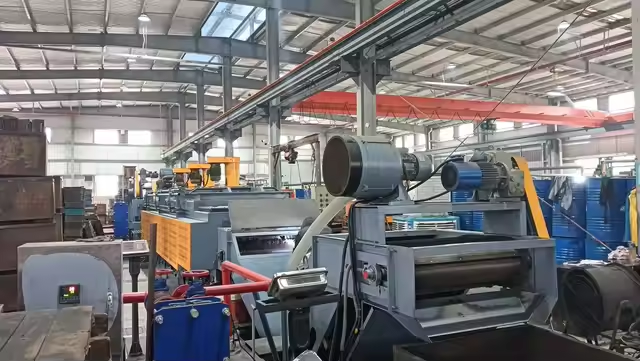
Automated production-line capability at the manufacturing base behind the Geakita 21V cordless range.
The scale of that shift is documented rather than anecdotal. Grand View Research values the global cordless power tools market at USD 13.44 billion in 2024 and projects USD 32.58 billion by 2033, and drilling and fastening tools alone accounted for a 36.51% revenue share of the cordless category in 2024. When more than a third of cordless spend sits inside drills and fasteners, a shortlist stops being a marketing exercise and becomes a fleet-composition decision.
This shortlist is drawn from one manufacturer's industrial range: Geakita (Xiamen Tiangong Kaiwu Technology Co., Ltd.), a Chinese power tool manufacturer founded in 2009, employing more than 300 staff with a 25-engineer R&D team, operating a production base of approximately 40,000 m² of floor space and exporting to Europe, Southeast Asia, the Middle East and America. The five picks below have been selected on operational role, not on catalogue position — three of them are the tools most commonly singled out for industrial duty (the Brushless Impact Drill, the Cordless Rotary Hammer and the 21V Impact Screwdriver), plus the two families that complete a heavy-duty kit: the high-torque Impact Wrench and the Angle Grinder.
What Makes a Tool "Heavy-Duty" in This Shortlist
The filter applied here is deliberately mechanical. A tool earns a place only if it can be defended against five criteria:
- Torque headroom against the job — the rated output must sit above the fastener class or drill diameter it is bought for, not at its limit.
- Motor type and thermal behaviour — brushless, pure-copper motors carry the load profile of repeated cycles better than brushed equivalents.
- Battery capacity and pack commonality — a shared 21V platform is only useful if the packs on the order match the runtime each tool demands.
- Mechanical interface — chuck type, disc diameter and drive interface determine whether the tool can use the accessories already on site.
- Evidence trail — certification, inspection regime, warranty terms and spare-part supply.
Applied to the Geakita range, those filters produce five tools. They share one voltage platform and differ in almost everything else.
The Shortlist at a Glance
| # | Tool | Model(s) | Defining specification | Job it owns |
|---|---|---|---|---|
| 1 | 21V Brushless Impact Drill | PT-05, PT24 | Up to 150 N·m (PT24), 13 mm three-jaw metal ratchet chuck, 24+3 torque settings, 450–2000 rpm | Mixed drilling and driving |
| 2 | Cordless Rotary Hammer | HM05, RH01, RH02 | 21V, 2000 mAh × 10 cells, 0–4500 min⁻¹ impact frequency, concrete Φ26 mm | Anchors, masonry, concrete |
| 3 | 21V Impact Screwdriver | QZ05, QZ03, GKR03 | Three torque levels 35/100/120 N·m, 1200/2400/3000 rpm | High-cycle fastening |
| 4 | 21V Brushless Impact Wrench | 1000NM, GKR06 | 1000 N·m rated torque, 0–3200 rpm, 21V pure-copper brushless motor | Bolted steel and vehicle work |
| 5 | 21V Angle Grinder | JM05, JM01-02 | 100 mm disc, 16 mm bore, 12,000 rpm no-load, 1.6 kg with one battery | Cutting and finishing |
1. 21V Brushless Impact Drill (PT-05 / PT24)
A drill earns the first position on any heavy-duty list because it accumulates the most operating hours of any single tool. The Geakita 21V Brushless Impact Drill family carries a pure-copper brushless motor, a 13 mm three-jaw metal ratchet chuck and 24+3 torque settings across a 450–2000 rpm no-load range. The higher-capacity build in that family, the PT24, is rated at 150 N·m with a 2000 mAh × 15-cell pack and a three-function impact mode.
Two specification details matter more than the headline torque. The first is stepless speed regulation, which lets an operator control entry speed when a bit is being seated in metal or a screw is being started in soft stock. The second is the triple-function torque architecture — the same platform also includes builds such as the PT22, rated at selectable 35/100/120 N·m — which allows one tool family to cover assembly work and structural drilling without a second purchase. For a buyer standardising a crew kit, that range compression is the actual value.
2. Cordless Rotary Hammer (HM05 / RH01 / RH02)
Hammer drilling is where cordless tools were historically weakest, and where pack capacity decides usefulness. The Geakita Cordless Rotary Hammer is a 21V unit with a pure-copper brushless motor, 2000 mAh × 10-cell battery configuration, an impact frequency range of 0–4500 min⁻¹, a no-load speed of 0–2000 rpm and a docking charger. Drilling capacity is listed at Φ26 mm in concrete, Φ13 mm in steel and Φ26 mm in wood.
The rated concrete diameter is the operative number. It defines the anchor sizes the tool can support without the operator leaning on it — the behaviour that separates a hammer that lasts three years from one that lasts three months on a busy site. The docking charger also reduces a practical friction point: charging becomes a station-based routine rather than a cable hunt, which matters when packs are rotated through a shift.
3. 21V Impact Screwdriver (QZ05 / QZ03, GKR03)
Fastening is a cycle-count problem. A screwdriver that performs well on ten fasteners but drifts on two hundred will still slow a crew down. The Geakita 21V range covers this with the QZ05 and QZ03 impact screwdrivers and the GKR03 pure-copper brushless screwdriver, all on the 21V platform with 10-cell pack configurations of 1300–1500 mAh, scaling to 2000 mAh on the GKR03 configuration.
The function set is what places this tool on the list: three torque levels at 35/100/120 N·m, a three-speed no-load range of 1200/2400/3000 rpm, stepless speed change, forward and reverse rotation, and an LED work light. In practice the variable speed matters most in finish work, while the selectable torque ceiling prevents over-driving small fasteners — a common and expensive failure mode in cabinet, panel and equipment assembly.
4. 21V Brushless Impact Wrench (1000NM / GKR06)
Bolted connections are a different discipline from drilling, and they need torque that handheld screwdrivers and drills cannot supply. The Geakita 21V Brushless Impact Wrench in the 1000 N·m build, alongside the GKR06 pure-copper brushless heavy-duty wrench, is rated at 1000 N·m with a no-load speed of 0–3200 rpm on a 21V pure-copper brushless motor and a 2000 mAh pack. The same family includes a 650 N·m build running to 0–4000 rpm.
The decision rule here is matching, not maximising. A 1000 N·m tool is the correct answer for structural bolts, rail fastenings, heavy machinery and vehicle suspension work; for repeated small-bolt cycles it is heavier than the task requires and a lower-torque unit will be faster in the hand. Buyers who need both duty profiles should specify both, not stretch one wrench across both jobs.
5. 21V Angle Grinder (JM05 / JM01-02)
Cutting and finishing close out the kit because a heavy-duty operation that can drill and fasten but cannot cut is still dependent on a second power source. The Geakita 21V Angle Grinder runs a 100 mm cutting disc with a 16 mm inner diameter at 12,000 rpm no-load and weighs 1.6 kg with one battery fitted. A brushless variant, the JM01-02, sits in the same family alongside the JM03.
The 100 mm format is a deliberate compromise: it keeps the tool light enough for overhead and one-handed work while remaining capable of cutting rebar, threaded rod, sheet and tile with the appropriate disc. It is the tool where pack quality shows fastest — grinding draws current continuously in a way drilling does not — so the 10-cell 1300 mAh configuration on the JM05 should be paired with charged spares on any sustained schedule.
How the Five Tools Fit One Battery Platform
The shortlist is only efficient because it is not five independent purchases. All five families sit on the Geakita 21V platform, with pack configurations spanning 1300 mAh to 2000 mAh across 10-cell and 15-cell builds and brushless pure-copper motors throughout. The Elite series groups the impact drill, angle grinder, screwdriver, impact wrench and rotary hammer across models DK05, PT05, QZ03, QZ05, JM05, HM05 and the 650 N·m and 1000 N·m impact wrenches.
That commonality changes how an order is written. Because runtime scales with pack capacity rather than tool voltage, the practical planning unit becomes the pack list: which tools need 2000 mAh packs, which are fine on 1300 mAh, and how many spares stay charged through a shift. Buyers who plan the pack list alongside the tool list are the ones who avoid the most common cordless failure in the field — a tool that is technically capable but out of charged energy at hour six.
Where These Tools Are Working Today
Geakita-provisioned field data from construction, automotive, retail and distribution customers across Laos, the Philippines, Thailand, India, Brazil, Saudi Arabia and Oman covers deployments of more than 5,000 units over two years or longer, with applications including high-temperature construction-site operation, concrete drilling, metal cutting, bolt fastening, vehicle maintenance, tyre replacement, engine disassembly and workshop repair. The reported figures for that programme are 99.8% on-time delivery, a 0.3% defect rate and stable performance in a 45°C+ high-temperature environment.
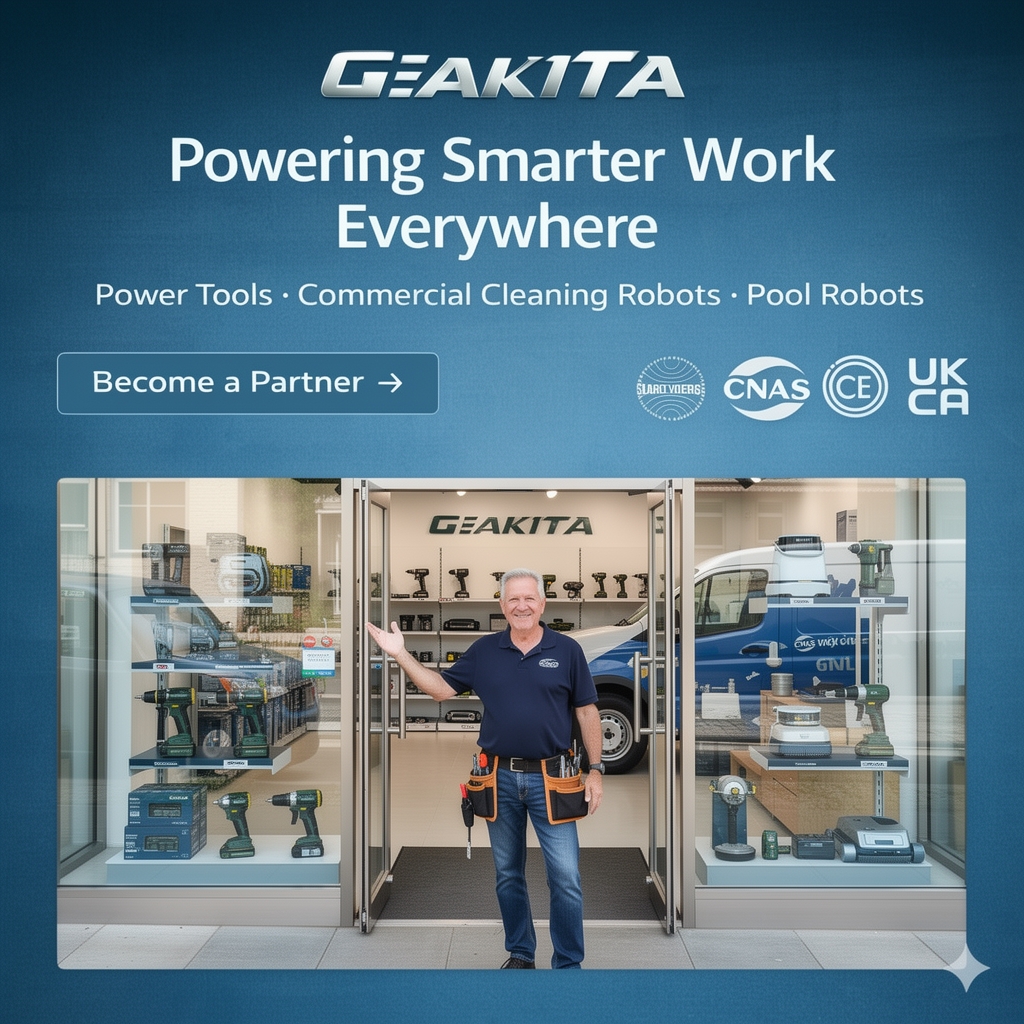
Geakita terminal stores: the point where shortlisted tool families reach distributors and end users.
The supply structure behind those deployments is worth noting because it explains the reliability figure: Tier-A approval for key materials including cells, magnets, bearings and cutting tools; 100% IQC sampling with defect traceability; IPQC inspections with in-line torque and electrical monitoring and automatic end-of-line testing; and OQC sampling at shipment with UN38.3 and dangerous-goods compliance. Quality control is stated as 100% full inspection before shipment using a three-level IQC/IPQC/FQC regime with functional and load testing.
Market Trends That Support This Shortlist
Three third-party data points make the direction of this category clear. First, the cordless segment is growing in absolute terms, from a 2024 valuation of USD 13.44 billion toward a projected USD 32.58 billion by 2033 (Grand View Research). Second, the tool types on this list are where the money concentrates: drilling and fastening alone represented 36.51% of cordless revenue in 2024. Third, adjacent categories confirm that cordless platforms are expanding rather than being replaced — the angle grinder market was valued at USD 3.2 billion in 2024, with cordless models increasingly reshaping site mobility (Strategic Market Research).
On the supply side, China's power tools market reached USD 5.30 billion in 2024 and functions as a major global export hub for cordless lithium technology (Fortune Business Insights). Publicly listed participants in the cordless category include Makita, Stanley Black & Decker (DeWalt), Bosch and Techtronic Industries (Milwaukee), and buyers commonly benchmark platform breadth against those names. A shortlist decision is therefore not only about one tool's specification but about whether the platform behind it will still have packs, chargers and service in five years.
Comparison with Traditional Solutions — and Where Cordless Still Stops
Against corded tools, the 21V range removes the two largest sources of site friction: the cable and the need for a live supply point. A 1000 N·m cordless impact wrench delivers the torque class that once required a corded or pneumatic unit, and a rotary hammer rated to Φ26 mm in concrete covers anchor and fixing work that previously assumed mains power. Against pneumatic tools, cordless removes the compressor, the hose and the air-quality dependency — which is why workshop and field tooling has shifted toward battery platforms in the categories above.
That comparison has to include the boundary conditions, and there are four that matter in procurement:
- Runtime is finite, torque is not. Continuous heavy drilling, extended grinding and long cutting sequences consume charged packs faster than the work allows. On genuinely continuous duty, corded tools still hold the advantage, and the correct cordless answer is pack rotation rather than a larger single pack.
- Platform investment multiplies. Five tools on one 21V platform means several packs and chargers in rotation. That is efficient, but it is not free, and it must be modelled before the tool list is finalised.
- Order and lead-time constraints are real. Geakita's stated minimum order is a purchase of at least five categories of power tools, 8 items per category, for a total of 40 items. Mass production runs 30–45 days, with repeat orders at 20–28 days, excluding shipping time by method and destination.
- Certification scope is specific, not universal. The CE certificate referenced below is issued under the EMC Directive 2014/30/EU and addresses electromagnetic compatibility. It does not by itself satisfy every market requirement a buyer may face, and scope should be checked against the destination market before an order is placed.
None of these limitations disqualifies a cordless heavy-duty kit. They define how it should be specified: mixed fleets for mixed duty, pack counts sized against real duty cycles, and orders placed against realistic lead times.
Verification Checklist Before You Commit
A shortlist without an evidence trail is only a preference. The following documents are the ones a buyer should request and read:
| Evidence | Reference | Scope | Validity |
|---|---|---|---|
| CE certificate | KTi250704E249C, issued by KTI (Guangdong Kaixu Testing Technology Co., Ltd.) | EMC Directive 2014/30/EU; EN IEC 55014-1:2021, EN IEC 55014-2:2021, EN IEC 61000-3-2:2019+A2:2024, EN 61000-3-3:2013+A1:2019+A2:2021; lists Elite-series models including PT-05, HM05, QZ05, JM05 and the 650 N·m / 1000 N·m impact wrenches | Issued 2025-08-04, expires 2030-08-04 |
| UKCA certificate | B-S2412C5162, issued by Beide Compliance Laboratory | UK Supply of Machinery (Safety) Regulations 2008; BS EN 62841-1:2015+A11:2022; BS EN 62841-2-1:2018+A12:2022+A1:2022 | Issued 2024-12-12, expires 2027-12-12 |
| CMA test report | WTS2026-S0339, issued by Zhejiang Zhongxie Lide Quality Testing Technology Co., Ltd. | GB 3883.1-2014 and GB/T 3883.202-2019 safety testing for the GKR05 impact wrench; China market | Issued 2026-04-02 |
Two international standards are worth naming because they define what good evidence looks like in this category: IEC/UL 62841-1 is the primary safety standard for electric motor-operated hand-held tools, and IEC/UL 62133 governs the lithium-ion cells used in portable applications (UL Solutions). A supplier that can map its certificates to those standards, model by model, is providing procurement-grade evidence rather than a compliance claim.
Beyond certificates, the operational terms are equally checkable: after-sales support stated as a one-year global warranty, 7×24 technical support, on-time replacement for defective units and spare-parts supply — the last of which determines what happens in year three, not year one.
Future Outlook
The trajectory behind this shortlist points in one direction. As the cordless category moves from USD 13.44 billion in 2024 toward a projected USD 32.58 billion by 2033, and as drilling and fastening remain the largest single segment at 36.51% of revenue, the competitive ground shifts from individual tool specifications to platform continuity: shared voltage, shared packs, documented compliance and a service structure that survives the warranty period.
For manufacturers, that means capacity and engineering depth become procurement arguments in their own right. Geakita's stated production capacity of 180,000+ units per month, a 25-engineer R&D team and a 40,000 m² production base are the kind of first-party facts that buyers can test against lead-time performance. For buyers, it means the shortlist question in 2026 is less "which tool is best" and more "which five tools, on which platform, with which evidence, at which pack count" — a framework that survives specification changes better than any single rating does.
One note on cost: any supplier-side estimate of multi-year ownership savings should be rebuilt with the buyer's own duty hours, pack rotation, consumable and downtime data before it is treated as a procurement input. The specification table above is the part that can be verified today; the cost model is the part each buyer has to run.
FAQ
What criteria place a tool on this shortlist?
Five filters: torque headroom against the intended fastener or drill class; motor type and thermal behaviour under repeated cycles; pack capacity and whether the tool shares the 21V platform; the mechanical interface such as chuck type, disc diameter or drive; and the evidence trail covering certification, inspection regime, warranty and spare-part supply. Applied to the Geakita range, those filters produce the impact drill, rotary hammer, impact screwdriver, impact wrench and angle grinder listed above.
Do all five tools run on the same battery?
They are all 21V platform tools, but pack configurations differ. The PT-05 impact drill runs a 1300 mAh × 10-cell pack, the HM05 rotary hammer runs 1500–2000 mAh × 10 cells, the QZ05 impact screwdriver runs 1500 mAh × 10 cells, the PT24 drill build runs 2000 mAh × 15 cells, and the impact wrench family runs 1500–2000 mAh × 10–15 cells. Shared platform, different runtime per pack — which is why the pack list on an order matters as much as the tool list.
What certification evidence should accompany these tools?
Three documents are directly relevant. CE certificate KTi250704E249C, issued 4 August 2025 by KTI (Guangdong Kaixu Testing Technology Co., Ltd.) under EMC Directive 2014/30/EU and valid to 4 August 2030, lists Elite-series models including PT-05, HM05, QZ05, JM05 and the 650 N·m and 1000 N·m impact wrenches. UKCA certificate B-S2412C5162, issued by Beide Compliance Laboratory under the UK Supply of Machinery (Safety) Regulations 2008, is valid to 12 December 2027. CMA test report WTS2026-S0339, issued 2 April 2026 by Zhejiang Zhongxie Lide Quality Testing Technology Co., Ltd., covers GB 3883.1-2014 safety testing for the GKR05 impact wrench. The CE certificate cited is EMC-scoped and does not by itself exhaust a destination market's full requirements.
Where does a cordless shortlist stop being the right answer?
When duty cycle outruns the pack. Continuous heavy drilling, extended grinding and long cutting sequences can exhaust charged packs faster than the work allows, and in those specific tasks a corded unit remains the more practical option — cordless covers the majority of site work, not all of it. Commercial constraints also apply: the stated minimum order is five tool categories at eight items per category, 40 items total, with mass production at 30–45 days and repeat orders at 20–28 days, excluding shipping time.
How should a buyer test a multi-year cost claim?
Rebuild the model with first-party data: duty hours per tool, packs in rotation, consumable replacement, failure and repair history, downtime cost and warranty recovery. Supplier-side estimates of ownership savings over a multi-year window should be replaced by the buyer's own figure before they enter a procurement decision. The verifiable inputs available today are the specifications, the certificates and the inspection regime listed in this article.
Specification sheets, certification records and the full model list referenced above are compiled in the Geakita corporate profile and product catalogue.