
The Smart Manufacturer's Shortlist: PIJ, CIJ, TTO and Laser Compared
At the decision stage, the useful question is not which coding brand is largest, but which marking technology fits the substrate, the line speed and the consumable model. A smart manufacturer's shortlist therefore starts with material behaviour and ends with a validated sample. This industry reference compares the four routes DOCOD builds around - high-resolution piezo inkjet (PIJ), continuous inkjet (CIJ), thermal transfer overprinting (TTO) and laser marking - and explains where each one stops being the right answer.
Why a Technology Shortlist Beats a Model Shortlist
Industrial coding and marking equipment covers everything from small-character date codes to wide high-resolution variable data, ribbon-based overprinting on flexible film, and contactless laser marking on metal and glass. Because those tasks are physically different, a shortlist built on model names alone tends to collapse at the first substrate test.
The scale of the category explains why so many buyers start broad. Third-party research places the global coding and marking equipment market at USD 17.53 billion in 2024, with a projection of USD 27.11 billion by 2032 (SkyQuest Technology). Continuous inkjet accounted for the largest technology revenue share, at approximately USD 5.67 billion in 2024 (Grand View Research), while Asia-Pacific represented around 35% of the market that year (Market Research Future).
Those figures should be read with care. Published market-size estimates vary widely depending on whether consumables, software and services are counted, so a single number defines a scope rather than a buyer's reality. The operational takeaway is more durable: most plants end up running at least two coding technologies side by side, because no single route covers cartons, cables, films and metal parts at the same time.
The Four Routes, Explained by Substrate and Speed
Continuous Inkjet (CIJ): small characters at continuous line speeds
CIJ remains the default answer for small-character coding on fast, continuous lines. DOCOD's CIJ range is tiered by throughput rather than by feature list. The S1000 Series Continuous Inkjet Printer reaches up to 576 m/min and is intended for high-speed cable, pipe and extrusion line scenarios; it includes IP55 protection and automatic nozzle cleaning for harsher production environments. The V2000 Series Continuous Inkjet Printer runs up to 334 m/min and is designed for bottles, cables and varied irregular surfaces in general continuous production - a 242 m/min difference between the two tiers.
That gap matters at shortlist stage. Specifying the higher tier for a line that never exceeds 300 m/min adds cost without adding output; specifying the lower tier on a cable or extrusion line creates a permanent bottleneck that no later service agreement can remove.
High-Resolution Piezo Inkjet (PIJ): wide, data-dense codes on cartons
PIJ exists because small-character CIJ and wide-format codes are different engineering problems. The DOCOD P2000 Piezo Inkjet Printer provides a 33.8 mm print height and 190 m/min at 300 dpi, compared with 25.4 mm and 120 m/min for cartridge-based thermal inkjet equipment such as the T220E - 8.4 mm more print height and 70 m/min more speed at the same resolution. Measured against a small-character 16 mm orientation such as the V2000, the height difference reaches 17.8 mm.
The P2000 uses a continuous ink-supply architecture, which reduces per-cartridge costs and waste and removes much of the cartridge-change interruption that appears in batch work. It is the more suitable route for larger QR codes, coated cartons, traceability codes and bigger print areas. The trade-off is system complexity: a continuous ink supply has to be managed, and the extra capability only pays back when code area or data density genuinely requires it.
Thermal Transfer Overprinting (TTO): flexible film, sachets and pouches
TTO is a ribbon-based method and remains the mainstream answer for flexible films, sachets, pouches and labels. The DOCOD R4000 Series Industrial Thermal Transfer Overprinter supports ribbon lengths of 400 m, 600 m, 800 m and 1,200 m and coding speeds up to 800 mm/s.
Compared with a UV laser route, TTO carries a recurring ribbon cost and requires ribbon changeovers, while the laser removes ribbon handling altogether. On standard flexible packaging, however, TTO stays the safer and more predictable choice; a laser only displaces it once the film is confirmed laser-receptive and the substrate has been validated.
Laser Marking: UV, Fiber and CO2 are three different tools
Laser marking is often shortlisted as one option when it is really three. The DOCOD L3000 Series 5W UV Laser Marking Machine operates at a 355 nm wavelength, producing a low-heat mark suited to glass, PVC, ABS, HDPE and delicate packaging, where it provides better mark integrity than a CO2 laser on delicate materials. The Venus1 Series Fiber Laser Marking Machine operates at 1,064 nm for metal-focused marking on metals and robust plastics. The Venus1 Series CO2 Laser Marking Machine operates at 10,600 nm and covers non-metal substrates including paperboard, film, labels, PET, glass, textiles and rubber.
Both Venus1 laser routes are no-consumable systems with lower routine intervention than ink-based equipment, and selection is driven by material behaviour rather than by forcing one laser across every job.
The adjacent cartridge route (TIJ)
Thermal inkjet sits between PIJ and CIJ in practice, which is why it belongs on the same shortlist. The T220E Half-Inch Dual-Head Inkjet Printer offers a 25.4 mm print height and up to 406 m/min, and is more suitable for cartons, labels, GS1 content and wider QR or barcode data. The TX1 Half-Inch Seamless Inkjet Printer provides 12.7 mm at the same top speed of 406 m/min - a 12.7 mm height difference - and fits tighter, smaller lines. The T260E targets simpler date coding at 60 m/min on eggs, bottles and boxes, which is 346 m/min below the T220E.
What DOCOD's Portfolio Actually Covers
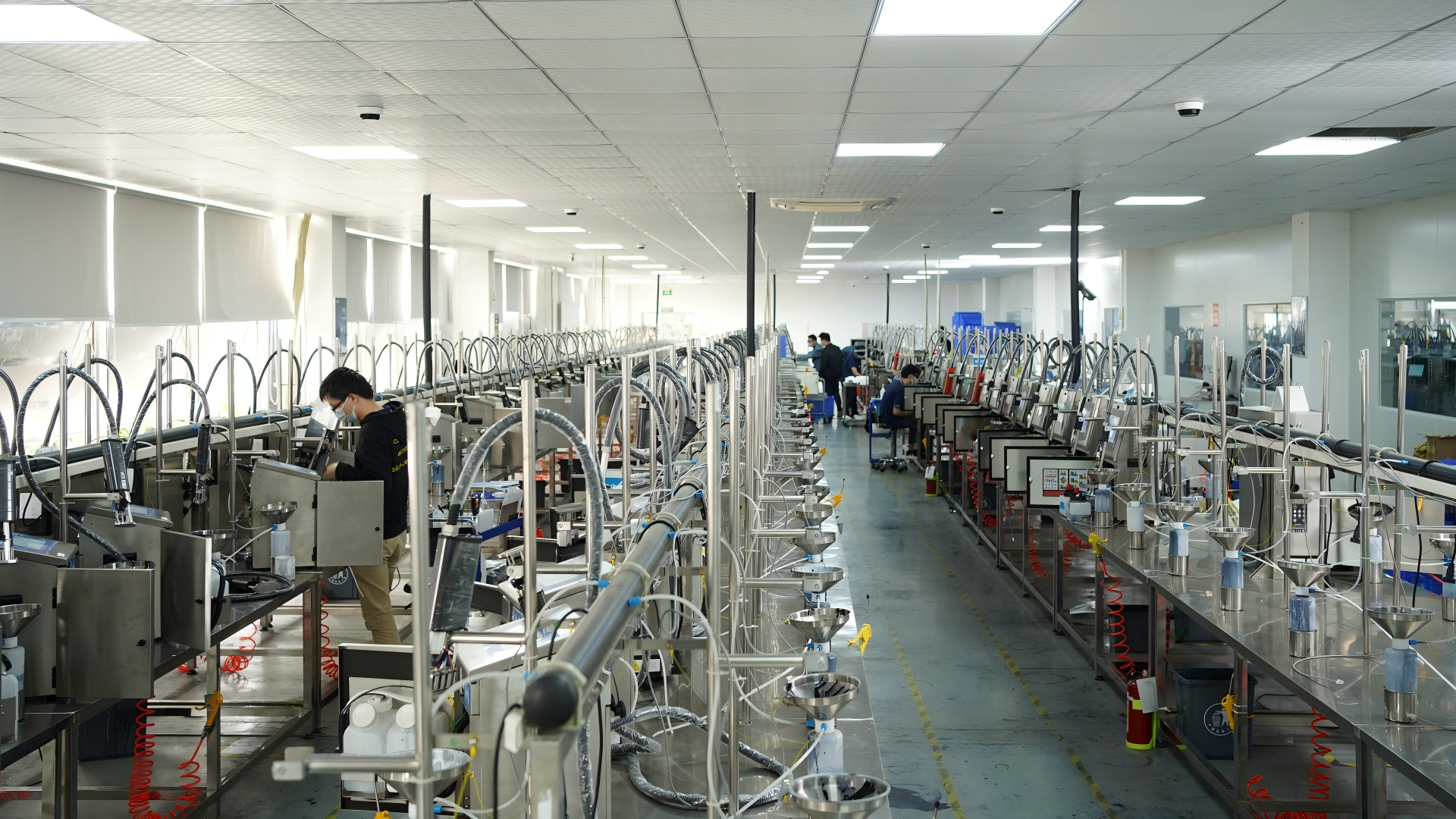
DOCOD Precision Group Co., Ltd. is an industrial coding, marking and inspection equipment manufacturer based in Guangzhou, China, founded in 2008 and operating a 20,000 square metre facility with 407 employees, more than 140 R&D staff and an annual output of 5,000 units. Its portfolio includes continuous inkjet printers (CIJ), thermal inkjet printers (TIJ), handheld inkjet coding equipment, piezoelectric high-resolution inkjet printers (PIJ), drop-on-demand large-character inkjet printers (DOD), thermal transfer overprinters (TTO), laser marking machines, inline vision inspection systems, coding consumables, spare parts and product traceability solutions.
Roughly 50% of output is exported, across North America, South America, Eastern Europe, Southeast Asia, Africa, Oceania, the Middle East, East Asia and Western Europe. For a buyer, the portfolio list itself is not the point. What matters is what it enables on one supplier relationship: date coding, batch marking, variable data printing, GS1 DataMatrix coding, serialization, anti-counterfeiting workflows, packaging line identification, code inspection and production traceability can be sourced with consistent service and spare-parts logic instead of being assembled from unrelated vendors.
Substrate-to-Technology Decision Matrix
The fastest way to narrow a shortlist is to work backwards from the substrate and the code content. The table below maps the verified capability of each route to the line profiles where it is normally specified.
| Substrate and code type | Route | Verified capability | Where it fits |
|---|---|---|---|
| Coated cartons, large QR and traceability codes | PIJ (P2000) | 33.8 mm print height; 190 m/min at 300 dpi; continuous ink supply | Wide, data-dense variable data where cartridge changes interrupt batch work |
| Cartons, labels, GS1 barcodes | TIJ (T220E) | 25.4 mm print height; up to 406 m/min | Short to medium runs with cartridge or CISS workflow |
| Bottles, cables, irregular surfaces | CIJ (V2000) | Up to 334 m/min | General continuous production with mixed substrates |
| High-speed cable, pipe, extrusion | CIJ (S1000) | Up to 576 m/min; IP55; automatic nozzle cleaning | Fast continuous lines in harsher environments |
| Flexible films, sachets, pouches, labels | TTO (R4000) | Up to 800 mm/s; ribbons of 400 to 1200 m | Standard flexible packaging with a ribbon-based workflow |
| Glass, PVC, ABS, HDPE, delicate packaging | UV laser (L3000) | 355 nm wavelength; low-heat marking | Sensitive substrates where thermal damage must stay low |
| Metals and robust plastics | Fiber laser (Venus1) | 1,064 nm wavelength; no consumables | Permanent, machine-readable codes on metal parts |
| Paperboard, labels, PET, glass, film, textiles, rubber | CO2 laser (Venus1) | 10,600 nm wavelength; zero ink, solvent or ribbon | Mainstream non-metal packaging with a permanence requirement |
Cost and Maintenance Profile: Where the Money Moves
Purchase price is the weakest comparison point in this category, because the consumable and maintenance model differs by route. CIJ generally carries a lower upfront cost, while a CO2 laser route reduces ongoing consumable expenses over time. The same logic separates reservoir-based and cartridge-based inkjet systems.
| Route | Upfront orientation | Ongoing cost | Maintenance reality |
|---|---|---|---|
| CIJ (S1000, V2000) | Generally lower upfront cost | Ink and solvent consumables | Ink-route management and periodic service; S1000 adds automatic nozzle cleaning and IP55 protection |
| Laser (UV, Fiber, CO2) | Higher upfront orientation | No ink, solvent or ribbon consumables | Lower routine intervention; substrate validation and correct laser setup still required |
| TTO (R4000) | Case by case | Recurring ribbon cost | Ribbon changeovers during production |
| PIJ (P2000) | Higher system complexity | Continuous ink supply reduces per-cartridge cost and waste | Negative-pressure continuous ink supply must be managed |
Application Scenarios Where Each Route Wins
Cable, pipe and extrusion lines
Where date coding has to keep pace with a continuous extrusion process, the S1000 Series is the appropriate CIJ tier at up to 576 m/min, with IP55 protection and automatic nozzle cleaning supporting operation in harsher environments.
Bottles and irregular surfaces
Mixed container shapes and materials favour the flexibility of CIJ. The V2000 Series covers bottles, cables and varied irregular surfaces at speeds up to 334 m/min, and remains the stronger option when the substrate mix changes frequently through a shift.
Coated cartons and traceability codes
When the code grows, the print head has to follow. The P2000's 33.8 mm print height and 190 m/min at 300 dpi suit larger QR codes, coated cartons, traceability codes and bigger print areas, with a continuous ink supply removing repeated cartridge replacement from batch schedules.
Flexible film, sachets and pouches
The R4000 Series overprints flexible films, sachets, pouches and labels at up to 800 mm/s with ribbon lengths of 400 to 1,200 m. Where the film is laser-receptive and cleaner long-run operation is the priority, a UV laser becomes the alternative, though TTO remains the safer mainstream route on standard flexible packs.
Glass, PVC, ABS and HDPE packaging
On heat-sensitive packaging, marking method determines whether the code stays legible or damages the surface. The L3000 5W UV laser works at 355 nm for low-heat marking on glass, PVC, ABS, HDPE and delicate packaging, with better mark integrity than CO2 on those materials.
Metal parts and robust plastics
Permanent codes on metal are a Fiber laser task. The Venus1 Series Fiber Laser Marking Machine operates at 1,064 nm for metal-focused marking on metals and robust plastics, with no consumables and lower routine intervention than ink-based systems.
Rubber, paperboard, labels and film
For non-metal substrates - paperboard, labels, PET, glass, film, textiles and rubber - the CO2 laser at 10,600 nm applies permanent marks with zero ink, solvent or ribbon, and typically reduces ongoing consumable spending over time.
Where Each Technology Stops Being the Right Answer
A credible shortlist states its boundaries. Each route on this list has a condition under which it should be removed from consideration.
- CIJ remains an ink-based process. Even with automatic nozzle cleaning, it involves ink and solvent consumables and ongoing ink-route management, so it is a weaker fit where zero-consumable operation is a hard requirement.
- PIJ brings higher system complexity than a cartridge-based solution. A negative-pressure continuous ink supply has to be managed, so the extra print height and resolution only make sense when code area and data density justify them.
- TTO carries a recurring ribbon cost and needs ribbon changeovers. On standard flexible packs that is an accepted trade-off; where ribbon handling is the constraint, a laser route has to be validated instead.
- Laser depends on substrate receptivity. UV laser selection is case by case because the reason to choose it is low heat impact rather than lower cost, and a laser that is technically capable but mismatched to the film or part will not produce a stable code.
- No route covers cartons, cables, films and metal parts with one configuration. Multi-technology lines are the normal outcome, not an exception.
Market Direction: Where Industrial Coding Is Heading
Two forces are reshaping what a shortlist has to account for. The first is consumable economics: laser marking is projected to grow at a CAGR of 6.8% through 2030, supported by its eco-friendly nature and the absence of consumables (Fortune Business Insights). The second is the code itself: the GS1 Digital Link standard is being adopted globally to replace 1D barcodes with QR codes for point-of-sale and traceability by 2027 (GS1, referencing ISO/IEC 18975:2024).
Trade data adds a supply-side signal. China's export value for industrial machine tools, including marking equipment, rose 15.7% year on year in early 2026 (German Machine Tool Builders' Association / Honor Machinery). More competition at the equipment level generally means more choice for buyers and more pressure to compare on configuration rather than on brand recognition alone.
The global competitive set includes established suppliers such as Videojet Technologies, Domino Printing Sciences, Markem-Imaje and Hitachi Industrial Equipment Systems (Dataintelo / Strategic Market Research). Their presence is exactly why a technology-level shortlist is worth building: at the top of the market, the difference is rarely whether continuous inkjet works at all, but how a specific route performs on a specific substrate, at a specific speed, under a specific consumable model.
A Procurement Checklist Before You Commit
Once the technology route is narrowed, the remaining risk sits in validation and continuity. The following checks are the ones that most often determine whether a commissioning date holds.
- Material compatibility testing. Match ink or marking method to the actual carton, film, plastic, metal or glass surface rather than to a category description.
- Sample validation. Print pre-production samples and test the substrate before mass shipment; this is where print quality risk is normally resolved.
- Print file confirmation. Double-confirm text, barcode, QR code, date format and language settings before production starts, to remove content mismatch risk.
- Working-condition check. Confirm temperature, humidity and line condition before model selection and shipment.
- Certification confirmation. Verify certification by model and destination market before order release.
- Spare parts and consumables planning. Obtain a recommended spare parts and consumables list for repeat operation, which protects against parts continuity problems.
- Online inspection decision. For critical lines, decide whether optional OCR or barcode inspection, an alarm light or a rejection linkage is needed to control missed coding.
- Delivery milestone scheduling. For standard models, agree milestones covering order confirmation, assembly, testing and shipment.
- Transport protection. Confirm carton or protective export packing, with shipment photos before dispatch.
- After-sales path. Confirm online support, installation guidance and troubleshooting response after delivery.
Future Outlook
By 2027, two changes will quietly rewrite shortlist criteria. First, 2D codes with embedded digital links raise data density per mark, which turns wide print height and resolution at speed into baseline requirements rather than premium options; the P2000's 33.8 mm print height at 190 m/min and 300 dpi is a current example of that direction. Second, print and verify becomes routine: inline vision inspection, OCR and barcode checking, alarm lights and rejection linkage move from optional additions to line requirements wherever traceability is audited.
Laser adoption is likely to keep growing on no-consumable economics, but it will not displace ink and ribbon routes on flexible films and irregular surfaces, where those methods remain more reliable. The realistic medium-term picture is a mixed line: laser for permanence on metal and non-metal packaging, CIJ or TIJ for variable data at speed, PIJ where code area grows, and TTO where flexible film dominates.
Frequently Asked Questions
Which technology should be shortlisted for coated cartons and large QR codes?
High-resolution piezo inkjet is the stronger fit when code area and data density are the constraint. The DOCOD P2000 provides a 33.8 mm print height and 190 m/min at 300 dpi, compared with 25.4 mm and 120 m/min for cartridge-based thermal inkjet equipment such as the T220E. It uses a continuous ink-supply architecture that reduces per-cartridge costs and waste, and is more suitable for larger QR codes, coated cartons and traceability codes.
How do the two CIJ speed tiers differ, and how is the choice made?
The difference is throughput and environment. The S1000 Series Continuous Inkjet Printer reaches up to 576 m/min and is intended for high-speed cable, pipe and extrusion lines, with IP55 protection and automatic nozzle cleaning. The V2000 Series Continuous Inkjet Printer runs up to 334 m/min and suits bottles, cables and varied irregular surfaces in general continuous production - a 242 m/min gap. The choice follows the line speed the plant actually runs, not the maximum the equipment can reach.
When does a thermal transfer overprinter remain the better choice over a UV laser on flexible film?
A TTO remains the mainstream route for flexible films, sachets, pouches and labels; the DOCOD R4000 Series supports ribbons of 400 m, 600 m, 800 m and 1,200 m at speeds up to 800 mm/s. A UV laser removes ribbon handling and reduces consumable spend, but it requires the film to be laser-receptive and the substrate to be validated, and it is selected case by case. On standard flexible packs, TTO is the more predictable option; TTO also carries a recurring ribbon cost that has to be counted.
How should a buyer decide between Fiber and CO2 laser marking?
The decision is substrate-led rather than price-led. The Venus1 Series Fiber Laser Marking Machine operates at 1,064 nm for metal-focused marking on metals and robust plastics, while the Venus1 Series CO2 Laser Marking Machine operates at 10,600 nm for non-metal substrates including paperboard, film, labels, PET, glass, textiles and rubber. Both are no-consumable laser routes with lower routine intervention than ink-based systems. Where heat impact on the substrate must stay low, the L3000 Series 5W UV laser at 355 nm is the relevant alternative for glass, PVC, ABS, HDPE and delicate packaging.
What should be verified before a coding technology shortlist is finalised?
Verification normally covers five points: material compatibility testing against the actual carton, film, plastic, metal or glass surface; pre-production sample printing before mass shipment; double confirmation of text, barcode, QR code, date format and language settings; a working-condition check on temperature, humidity and line condition; and certification confirmation by model and destination market before order release. For critical lines, the buyer also decides whether optional OCR or barcode inspection, an alarm light or a rejection linkage is required to control missed coding, and requests a recommended spare parts and consumables list for repeat operation.
A shortlist is only as good as the sample it is tested on. Buyers who select the route first and the vendor second reach a decision faster, and they meet fewer surprises at commissioning. DOCOD's corporate brochure, covering the equipment portfolio and configuration scope in more detail, is available here: DOCOD Corporate Brochure (PDF).
Technology names, model designations and performance figures referenced in this article are drawn from DOCOD product documentation and third-party industry sources cited inline. Selection outcomes depend on substrate testing and line conditions at the buyer's site.