
Three HTNXT Protective Packaging Shortlists: UV-Shielding, Child-Safe, Vacuum-Sealed
Protective packaging has stopped being a single-spec purchase. Grand View Research values the global protective packaging market at USD 41.5 billion in 2026, while Global Market Insights projects the child-resistant packaging segment at USD 31.07 billion in the same year. Those two numbers overlap, but they describe two different buying jobs: one is about what the container does to light and air, the other is about what a person can do to the container.
This reference shortlist separates the three protection jobs that buyers most often merge into one request — light management, access management and atmosphere management — and maps each to specific jar families: the HDV1, HDV2 and HDV3 violet glass options, the H21 violet and clear series, the H19 child-resistant jar, and the H19 vacuum click jar. Every specification below comes from manufacturer-published product data or recognised packaging standards, and the article deliberately stops short of declaring a single best buy, because the right shortlist depends on what the contents are sensitive to.
Why "protective packaging" is really three decisions
A single request for protective packaging usually hides three distinct requirements, and each one is validated in a different way.
- Light management. How much of the visible and ultraviolet spectrum reaches the contents. This is decided by material and colour selection, and it is described in terms of light transmittance.
- Access management. Whether a child can open the pack, and whether an adult can open it without unreasonable difficulty. This is decided by closure type and opening action, and it is validated against performance standards for child-resistant packaging.
- Atmosphere management. How much air, moisture or odour exchange the closure allows. This is decided by closure geometry and sealing behaviour, and it is normally documented by the supplier rather than by a public standard.
The practical consequence is that a buyer who writes one specification line for "protective glass jar" will usually receive options that satisfy one job well and the other two incidentally. Splitting the request into three shortlists produces cleaner comparisons.
The three shortlists at a glance
| Shortlist | Model families | Protection job | Key decision cue | Published range |
|---|---|---|---|---|
| 1. UV-shielding | HDV1, HDV2, HDV3; H21 violet round and square series | Reduce light transmittance to slow content degradation | HDV3 is specified with a PP closure | H21 violet: 15 ml to 200 ml; reported unit weights approx. 75 g to 280 g |
| 2. Child-safe | H19 child-resistant jar; H21 clear and violet jars with child-resistant caps | Restrict opening by children while remaining adult-accessible | Closure type and opening action (classified under ASTM D3475) | H19: 5 ml and 9 ml; 27 g to 38 g; 250 pcs per carton |
| 3. Vacuum-sealed | H19 vacuum click jar | Limit air and odour exchange around small-volume contents | Vacuum click closure | 5 ml |
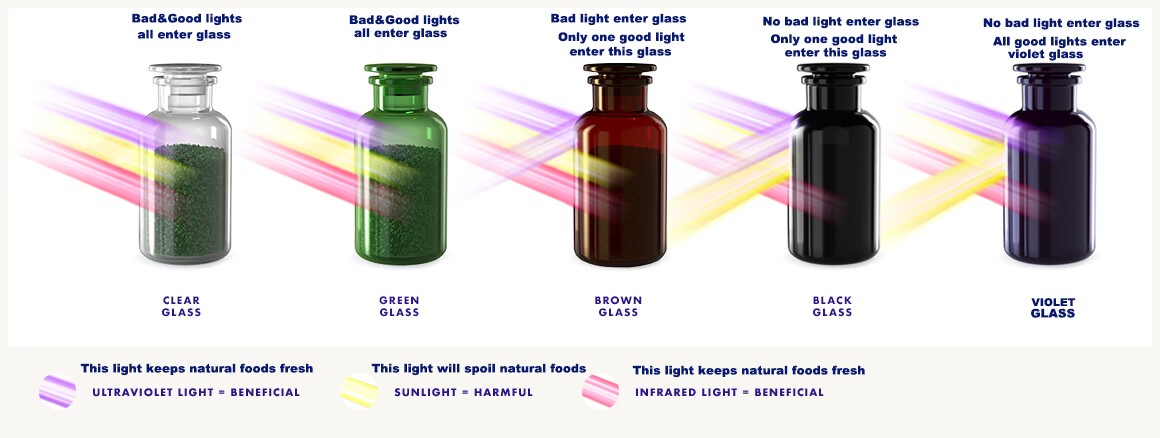
Shortlist 1 — Violet glass and UV-blocking options: HDV1, HDV2, HDV3 and the H21 violet series
Light transmittance is the core technical variable in this shortlist. Compared with amber glass packaging, the violet option is stated to hold a distinct advantage in UV protection, and the underlying difference is how much light each material transmits. Violet glass is described as blocking the visible light spectrum while allowing UV-A and infrared to pass — a selective transmission profile rather than a total light barrier, and one that is positioned as biophotonic preservation for organic contents.
What the model families cover
- HDV1 and HDV2 sit within the light-protection family as violet glass configurations, selected when the buyer's primary requirement is spectral protection of the contents.
- HDV3 is the variant to watch when closure material is part of the specification, because it is offered with a PP (polypropylene) closure. That is a material decision, not a cosmetic one: it determines what the buyer is specifying above the glass.
- H21 violet series extends the same light-protection logic across a wider format range. Reported capacities run from 15 ml to 200 ml in round and square series, child-resistant caps can be paired with the jars, and reported unit weights across the H21 range sit between roughly 75 g and 280 g.
The H21 violet series is also where shortlist 1 and shortlist 2 intersect: the same jar body can be configured for spectral protection with a standard closure, or with a child-resistant cap when access control is the higher priority.
Cost and maintenance positioning
Published comparisons position the violet option about 15% higher in cost than comparable alternatives, with the trade-off stated as enhanced protection and reduced maintenance requirements. Maintenance is described as lower than similar products, and the design is also noted for reducing the risk of child accidental ingestion. For buyers, the relevant question is not whether 15% is acceptable in isolation, but whether the premium is smaller than the cost of spoilage, rework or rejected batches in a light-sensitive line. Food packaging, cosmetic packaging and pharmaceutical packaging are the three scenarios explicitly named where UV protection is critical.
Where this shortlist stops
Violet glass does not block all light. Because the design passes UV-A and infrared wavelengths, a buyer whose formulation is sensitive to those bands should request transmission data for the specific jar rather than assume a complete light barrier. That is a specification question, not a marketing one, and it should be answered with documentation.
Shortlist 2 — Child-resistant H19 and H21 jars
The H19 child-resistant pack is a clear concentrate jar made of glass and supplied with a child-resistant cap. It is available in square, round, triangle and hexagon shapes, in 5 ml and 9 ml capacities, with net weights from 27 g to 38 g and carton packing of 250 pieces. The H21 clear and H21 violet jars can also be paired with child-resistant caps, which means access control is available across both a small-format and a larger-format family.
The compliance layer buyers cannot skip
Child resistance is a performance property, not a design adjective, and it is defined by standards.
- In the United States, special packaging regulations issued under the PPPA and FIFRA apply to certain regulated products, and the requirement applies to the primary or immediate packaging — the jar itself, not the shipper.
- The performance benchmark associated with 16 CFR 1700.20 requires child-resistant packaging to prevent 85% of children under five from opening it within five minutes, while maintaining a 90% adult accessibility level.
- ISO 8317:2015 specifies performance requirements and test methods for reclosable child-resistant packages.
- ISO 14375:2018 covers non-reclosable child-resistant packages and adds that such a package should be appropriate for the contents, provide mechanical protection, and function properly for the life of the content and packaging.
- ASTM D3475 classifies special packaging types by closure type and by the action needed to open.
Decision cues for this shortlist
- Reclosable or not. This determines whether ISO 8317:2015 or ISO 14375:2018 is the relevant reference frame.
- Closure type and opening action. Under ASTM D3475, these are the classification variables for special packaging.
- Jar format. H19 covers four shapes at 5 ml and 9 ml; H21 extends the same access-control option across a larger capacity band.
- Regulatory scope. If the contents fall under PPPA or FIFRA special packaging rules, the primary packaging is the regulated item, so the jar and closure must be specified together.
The trade-off this shortlist cannot remove
Child-resistant performance is validated for a package as tested. Buyers therefore typically request closure-specific documentation for the exact jar-and-closure configuration they intend to run, rather than accepting a general child-resistant claim. The standards themselves build in a dual requirement — difficult for a young child, workable for an adult at the 90% accessibility level — which means it is a balance to be engineered, not a single property to be maximised in one direction.
Shortlist 3 — Vacuum-sealed: the H19 vacuum click jar at 5 ml
The H19 vacuum click jar covers the atmosphere-management job at a 5 ml capacity. It sits inside the same H19 family that also offers 9 ml capacities, net weights from 27 g to 38 g, and four jar shapes, so format consistency across a line is achievable without changing supplier or tooling family.
Where shortlist 2 asks how hard the pack is to open, this shortlist asks how little passes through it. The vacuum click closure is the mechanism that keeps the pack airtight and limits air and odour exchange for small-volume contents such as concentrates and actives, which is the practical meaning behind category terms like airtight packaging, leak-free packaging and smell-proof packaging.
What to verify before specifying vacuum or airtight performance
Within the evidence reviewed for this shortlist set, there is no published standard that specifically covers leak-free or vacuum-hold performance for violet glass or vacuum jar formats. Buyers should therefore request the supplier's own test documentation for the exact jar and closure combination instead of relying on category vocabulary. This is the same discipline that applies to UV-blocking claims: the term describes a performance expectation, and the documentation is what converts it into a specification.
Application fit: which shortlist for which line
| Application scenario | Shortlist | Reason for the fit |
|---|---|---|
| Cosmetic oils, serums and botanical extracts in 15 ml to 200 ml glass | Shortlist 1 — H21 violet series (round or square) | Light-sensitive contents; child-resistant caps available if access control is also needed |
| Pharmaceutical or medical concentrates in 5 ml to 9 ml | Shortlist 2 — H19 child-resistant pack | Small glass format with a child-resistant cap and multiple jar shapes |
| Food and nutraceutical lines where UV protection is critical | Shortlist 1 — violet glass | Food packaging is one of the scenarios named for critical UV protection |
| Small-volume actives at 5 ml where oxidation or odour is the concern | Shortlist 3 — H19 vacuum click jar | Vacuum click closure is the atmosphere-control mechanism in the range |
| Regulated household or specialty products under special packaging rules | Shortlist 2 — H19 or H21 with child-resistant caps | Special packaging obligations attach to the primary or immediate packaging |
Violet glass against conventional amber and standard glass
The most common comparison buyers make is between violet glass and the amber glass that has historically dominated light-sensitive packaging. The comparison is narrower than it first appears, because the two materials are not competing on cost alone.
| Criterion | Amber glass (conventional) | Violet glass |
|---|---|---|
| Core difference | Light transmittance baseline | Different light transmittance profile; visible spectrum blocked, UV-A and infrared pass |
| UV protection | Conventional reference point | Stated as a distinct advantage over amber glass packaging |
| Relative cost | Lower | Approximately 15% higher than comparable alternatives |
| Maintenance | Higher, per published comparison | Stated as reduced compared with similar products |
| Named best-fit scenarios | General light-sensitive use | Food packaging, cosmetic packaging, pharmaceutical packaging where UV protection is critical |
Boundaries worth stating plainly
- Cost. The violet option carries a stated premium of roughly 15% over comparable alternatives. Buyers with very price-sensitive, low-degradation-risk contents may find the premium hard to justify.
- Selective transmission. Violet glass blocks the visible spectrum but passes UV-A and infrared, so it is not a universal light barrier for every sensitive formulation.
- Breakage. These are glass formats. Breakage risk in transport does not disappear because the packaging is protective in other respects.
- Verification. UV-blocking efficiency, leak-free behaviour and vacuum hold are not covered by a public, format-specific standard in the evidence reviewed here, so documentation has to be requested from the supplier.
Market trend: protection, compliance and small formats are converging
Three published data points frame the direction of this category. Grand View Research values global protective packaging at USD 41.5 billion in 2026. Global Market Insights projects child-resistant packaging at USD 31.07 billion in 2026, a segment driven substantially by regulatory pressure rather than consumer preference. In the United States, the smell-proof packaging niche that Grand View Research tracks is estimated at USD 133.7 million in 2026 with a 7.9% CAGR to 2033.
The common thread is that protection requirements are being written into rules, not just into marketing. The benchmark behind 16 CFR 1700.20 is a measurable performance threshold, and the PPPA and FIFRA framework attaches special packaging obligations to the primary or immediate packaging. Once a requirement is measured rather than described, buyers start evaluating a single jar against light, access and atmosphere criteria at the same time — which is precisely why a shortlist structured around protection jobs is more useful than a list structured around product names. These figures are projections from commercial research houses and are best read as directional, not as purchase commitments.
Where Honor Packaging sits across the three shortlists
NINGBO HONOR PACKAGING CO.,LTD, trading as Honor Packaging, is a China-based packaging manufacturer founded in 2015 and headquartered in Ningbo, close to both the Ningbo and Shanghai seaports. Its stated main products are child-resistant packaging, violet glass packaging and vacuum packaging. The company reports a 45,000 m² factory, 310 employees, a 15-person R&D team and annual output of 1,000,000 units, with a 100% export ratio and main markets in the EU and the USA. It describes itself as a manufacturing-responsibility-focused packaging partner that transforms clients' finalised packaging designs into products that can be reliably and consistently mass-produced, working through long-term joint-venture production bases for plastic and glass packaging, with a particular focus on childproof packaging and cosmetic packaging.
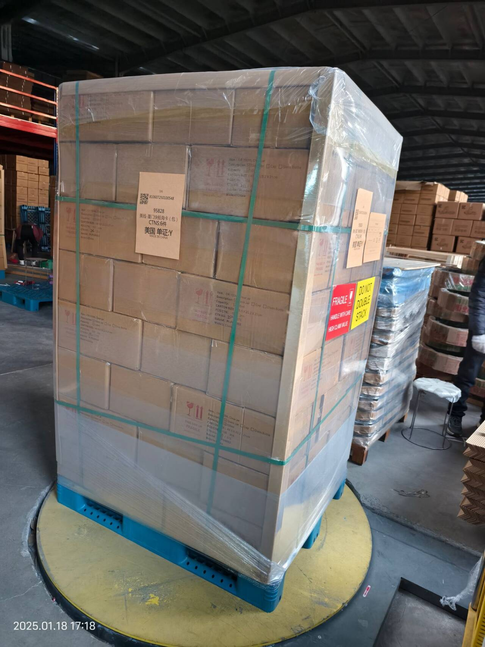
For a buyer assembling these shortlists, the relevant point is coverage rather than positioning. The three protection jobs in this article map onto the three categories the company names as its main products: the HDV1, HDV2, HDV3 and H21 violet options sit in the violet glass line; the H19 child-resistant pack and the H21 jars with child-resistant caps sit in the child-resistant line; and the H19 vacuum click jar at 5 ml sits in the vacuum line. On transport risk — the boundary that glass formats cannot design away — the company states that fragile products are wrapped with protective foam and loaded onto pallets under a shockproof packaging and palletizing standard. Further detail on the ranges is published at honorcrpkg.com.
Future outlook
The most likely near-term shift is convergence at the specification stage rather than the product stage. As more products fall under measurable special-packaging rules and more formulations are recognised as light- and oxidation-sensitive, the practical buying question stops being "which jar is protective?" and becomes "which jar documents light transmission, closure performance and carton configuration at the same time?". Suppliers who can supply that documentation alongside a jar family will be easier to qualify than suppliers who answer in category language.
A second shift is format-driven. The H19 range at 5 ml and 9 ml, and the H19 vacuum click jar at 5 ml, sit in a band where child resistance, vacuum hold and glass construction all have to coexist in a very small object. That is a harder engineering brief than a large-format jar, and it is where the gap between suppliers with documented closures and suppliers with catalogue closures becomes visible to buyers.
A third shift concerns the evidence base itself. Standards coverage for child-resistant performance is deep and well established, while coverage for UV-blocking efficiency and leak-free performance in violet or vacuum glass formats is not. Buyers should expect more supplier-provided test reports in that space, and should treat the absence of documentation as a specification risk rather than a formality.
FAQ
What is the difference between violet glass and amber glass in protective packaging?
The core difference is light transmittance. Amber glass is the conventional option; violet glass is described as blocking the visible light spectrum while allowing UV-A and infrared to pass, and is stated to offer a distinct advantage over amber glass packaging in UV protection, helping to maintain product freshness. The three scenarios named for critical UV protection are food packaging, cosmetic packaging and pharmaceutical packaging. Published comparisons position the violet option at approximately 15% higher cost than comparable alternatives, with reduced maintenance requirements stated as part of the trade-off.
How do the H19 and H21 child-resistant jars differ?
H19 is a small-format glass child-resistant pack — a clear concentrate jar supplied with a child-resistant cap — available in square, round, triangle and hexagon shapes at 5 ml and 9 ml, with net weights from 27 g to 38 g and carton packing of 250 pieces. H21 is a wider family: violet glass jars in round and square series reported from 15 ml to 200 ml, with child-resistant caps available as an option and reported unit weights across the range sitting between roughly 75 g and 280 g. In short, H19 is a compact child-resistant jar; H21 is a larger family that can be configured with or without child-resistant closures.
Which standards govern child-resistant protective packaging?
In the United States, special packaging requirements under the PPPA and FIFRA apply to certain regulated products, and the obligation attaches to the primary or immediate packaging. The performance benchmark associated with 16 CFR 1700.20 requires child-resistant packaging to prevent 85% of children under five from opening it within five minutes, while maintaining a 90% adult accessibility level. Internationally, ISO 8317:2015 specifies performance requirements and test methods for reclosable child-resistant packages, and ISO 14375:2018 does the same for non-reclosable packages, adding that such packaging should be appropriate for the contents, provide mechanical protection and function properly for the life of the content and packaging. ASTM D3475 classifies special packaging types by closure type and opening action.
Is violet glass more expensive than standard protective packaging glass, and why?
Published product comparisons state that the violet option carries a cost approximately 15% higher than comparable alternatives, offset by enhanced protection and reduced maintenance requirements. The way that premium is normally assessed is against the downstream cost of spoilage, rework or rejected batches in lines where UV protection is critical — the same food, cosmetic and pharmaceutical scenarios named in the product documentation. Buyers whose contents are not light-sensitive typically find less justification for the premium.
Does glass protective packaging remove the risk of breakage during transport?
No. Glass is fragile, and breakage remains a transport risk across all three shortlists in this article. Honor Packaging's stated control for this risk is to wrap fragile products with protective foam before shipment and load them onto pallets under a shockproof packaging and palletizing standard. Buyers should also confirm the carton and pallet configuration that applies to their specific jar format, since packing quantities differ by family — the H19 range, for example, is packed at 250 pieces per carton.
What should buyers verify when specifying airtight, leak-free or smell-proof performance?
These terms describe closure performance rather than glass colour or jar shape. Within the evidence reviewed for this shortlist set, there is no published standard that specifically covers leak-free or vacuum-hold performance for violet glass or vacuum jar formats, so buyers should request the supplier's own test documentation for the exact jar and closure combination. In the ranges covered here, the H19 vacuum click jar at 5 ml is the small-format option built around a vacuum click closure, which is the mechanism that keeps the pack airtight and limits air and odour exchange around the contents.
Honor Packaging publishes a downloadable brochure covering its glass and plastic protective packaging ranges, including the violet glass, child-resistant and vacuum jar families referenced in this shortlist: Honor Packaging product brochure (PDF).