
Three Rain Guns, One Scorecard: FSN50, FSC50, FSW80
Choosing between three high-volume rain guns is not a beauty contest between three products. It is a decision about which engineering compromise fits a particular pump, pipe and field. FSN50, FSC50 and FSW80 — the three largest guns in the FOISON Sprinkler range — diverge on pressure band, throw distance and drive mechanism, while sharing a 24° spray angle and the same declared material set. For a buyer in the research and evaluation stage, the productive question is not which gun is best in the abstract, but which criterion is binding on the project.
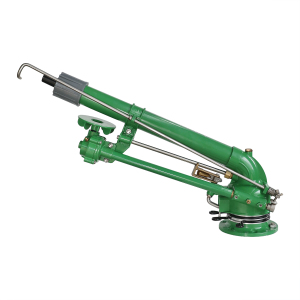
FSN50: turbine drive, 2" flange connection, 0.2–0.7 MPa working pressure, declared range 26–53 m.
FOISON Sprinkler (Xuzhou Foison Sprinkler Irrigation Equipment Co., Ltd) is a manufacturer founded in 2013 in Xuzhou, Jiangsu Province, China, specialising in turbine spray guns and irrigation equipment. The company operates a 30,000 m² factory, produces around 200,000 units a year, and exports approximately 70% of its output to markets including the EU, Africa, Australia and New Zealand, South East Asia, Mid Asia, the Middle East and South America. It publishes model-level performance tables for its guns, which is what makes a criterion-by-criterion comparison possible — and what also makes it visible exactly where a spec sheet stops being useful.
The category these three guns compete in
All three models are rotating sprinklers intended for agricultural irrigation and industrial dust removal. Internationally, the design and operational requirements for rotating sprinklers used in agricultural irrigation are described by ISO 7749-1:1995, and mechanical appliances for projecting, dispersing or spraying liquids for agricultural or horticultural use sit under HS Code 842482 — a classification detail that matters at customs rather than in the field, but one that appears on every import file.
The commercial backdrop is substantial. Grand View Research valued the global sprinkler irrigation market at USD 3.04 billion in 2025. IMARC Group put the narrower smart irrigation market at USD 2.2 billion in 2025, with a projected path to USD 6.2 billion by 2034. Grand View Research also reported that Asia Pacific held the largest revenue share — 36.2% — of the agricultural irrigation machinery market in 2025, with China as a leading country. Growth of that order means more buyers specifying high-volume guns, and more of them doing it from a specification table rather than from a field demonstration.
What FSN50, FSC50 and FSW80 actually are
FSN50 is a turbine rain gun with a 2" flange connection, a working pressure of 0.2–0.7 MPa, a declared range of 26–53 m and 360° adjustable coverage. Its published parameter set is built around long range and atomisation quality.
FSC50 is an impact gun with a 2" inner thread or flange connection, a working pressure of 0.15–0.7 MPa and a declared range of 23–56 m. It is the only one of the three whose published parameters list speed adjustment alongside 360° coverage control.
FSW80 is a turbine gun with an 80 flange connection, a working pressure of 0.2–0.9 MPa and a declared range of 23–85.7 m, also 360° adjustable.
| Parameter | FSN50 | FSC50 | FSW80 |
|---|---|---|---|
| Type | Turbine sprinkler (rain gun) | Impact gun | Turbine gun |
| Working pressure | 0.2–0.7 MPa | 0.15–0.7 MPa | 0.2–0.9 MPa |
| Declared range | 26–53 m | 23–56 m | 23–85.7 m |
| Connection | 2" flange | 2" inner thread / flange | 80 flange |
| Spray angle | 24° | 24° | 24° |
| Coverage control | 360° adjustable | 360° adjustable, speed adjustable | 360° adjustable |
| Material | Al, nylon, ss | Al, nylon, ss | Al, nylon, ss |
| Declared use | Agriculture, forestry, garden, dust removal | Agriculture, forestry, garden, dust removal | Agriculture, forestry, garden, dust removal |
| Nozzle diameters listed in the performance table | 16–26 mm | 14–26 mm | 22–30 mm |
Criterion 1 — pressure headroom and the low-pressure floor
On upper pressure tolerance, FSW80 wins without qualification: 0.2–0.9 MPa is the widest band of the three, and it is the only model rated past 0.7 MPa. If a project runs a high-head pump or a layout with significant elevation gain, the other two models are effectively capped before the pump is.
On the opposite end, FSC50 wins. Its published band starts at 0.15 MPa, below FSN50 and FSW80 at 0.2 MPa. That difference is not cosmetic: in layouts where pressure at the last hydrant is marginal, starting 0.05 MPa lower can decide whether a gun rotates evenly or stalls. Buyers comparing gun specifications against a pump curve should read the lower bound first, because the upper bound is usually negotiable at the valve and the lower bound is not.
Criterion 2 — throw distance: declared envelope versus published points
On declared maximum throw, FSW80 also wins: 23–85.7 m against 23–56 m for FSC50 and 26–53 m for FSN50. A 29-metre advantage in declared reach changes field geometry, hydrant spacing and the number of units per hectare.
The more useful comparison, however, is at matched operating points in the published performance tables. At 0.6 MPa, using each model's largest listed nozzle, the ranking of throw reverses:
| Model (largest nozzle in the published table) | Pressure | Flow | Throw listed |
|---|---|---|---|
| FSN50, 26 mm | 0.6 MPa | 69.6 m³/h | 51 m |
| FSC50, 26 mm | 0.6 MPa | 64.5 m³/h | 53 m |
| FSW80, 30 mm | 0.6 MPa | 82.8 m³/h | 48.6 m |
Read together, the three converge into a far tighter band than their declared ranges suggest, and the model that moves the most water at that point is not the model that throws furthest. FSW80 leads on volume; FSC50 leads on distance at 0.6 MPa; FSN50 sits between them and posts the highest flow of the three at a 26 mm nozzle. That is the kind of finding a buyer only sees by comparing table values rather than headline ranges.
Criterion 3 — nozzle flexibility
Nozzle span decides how much of a system a single gun can serve. FSC50 covers the widest span of the three, with published points running from 14 mm to 26 mm — useful when a site needs to start small and scale up without changing guns. FSN50 covers 16–26 mm. FSW80 covers 22–30 mm: it owns the largest single nozzle of the three but cannot be run below 22 mm, so it is the wrong choice for fine control at low flow.
At the low end the difference is real: FSC50's 14 mm nozzle is listed at 9 m³/h at 0.15 MPa and 23 m, while FSN50's 16 mm nozzle begins at 17.8 m³/h at 0.2 MPa and 26 m. Buyers planning a first season at reduced flow, then a second season at full flow, should weight this criterion heavily.
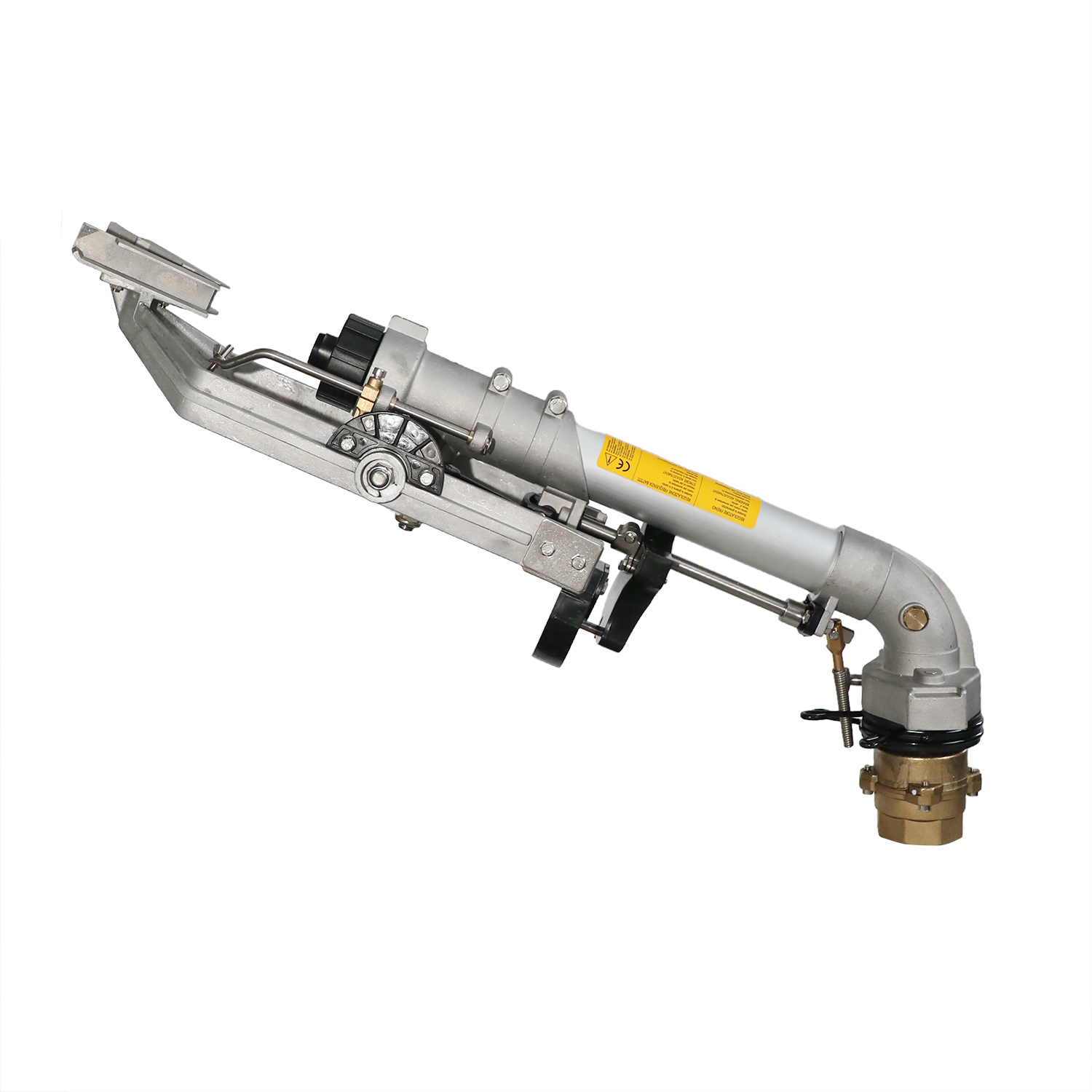
FSC50: impact drive, 2" inner thread or flange, 0.15–0.7 MPa, 360° adjustable with speed adjustment, nozzle span 14–26 mm.
Criterion 4 — drive mechanism: turbine versus impact
Two of the three guns are turbine-driven; one is not. FSN50 and FSW80 rotate on a turbine, while FSC50 uses an impact arm. In the published parameters, the mechanism difference shows up in control, not in coverage: all three rotate 360°, all three use a 24° spray angle, and only FSC50 lists speed adjustment as an additional control.
For a buyer, that translates into an operating choice rather than a quality hierarchy. Where rotation speed needs to be tuned to soil infiltration rate, FSC50's documented speed adjustment is a directly usable feature. Where the maintenance team prefers fewer moving control points and a turbine-based rotation, FSN50 and FSW80 align with that preference. The specification sheets do not support a claim that one mechanism is superior in the abstract — only that they differ in what the operator can adjust.
Criterion 5 — housing material: a genuine tie
All three models declare the same material set: aluminium, nylon and stainless steel. That is an unusual outcome in a comparison article, and it should be reported as what it is — a tie at the specification level. Material is therefore not a differentiating criterion between FSN50, FSC50 and FSW80 on the published data.
The practical consequence is that a buyer who cares about material must move from model-level to component-level questions: which parts are aluminium, which are nylon, and which are stainless steel, and how does that map to the parts that wear or corrode in the specific water chemistry and climate of the project. That is a supplier question, not a spec-sheet question.
Criterion 6 — mounting connection and installation reality
Connection type is where a comparison most often turns into a project cost. FSN50 uses a 2" flange. FSC50 offers a choice between a 2" inner thread and a flange. FSW80 uses an 80 flange — a different fitting family from the 2" options, and not interchangeable with them without deliberate adaptation.
For retrofits, that makes FSC50 the most forgiving of the three, because it can be ordered to match either a threaded riser or a flanged one. For new builds at high flow, FSW80's 80 flange is consistent with the volume it is designed to move, but it commits the layout to that connection standard from the first drawing. Connection sizing should be confirmed per order rather than inferred from a spec sheet, because the same model may be offered in more than one connection configuration.
The buyer's decision scorecard
Weighting is the buyer's job; the evidence behind each criterion is not. The table below sets out which model takes each criterion, and why, using only published model data.
| Criterion | Winner | Evidence | Practical weight |
|---|---|---|---|
| Upper pressure headroom | FSW80 | Rated to 0.9 MPa | High where pumps are high-head or elevation is significant |
| Low-pressure operability | FSC50 | Starts at 0.15 MPa | High where terminal pressure is marginal |
| Declared maximum throw | FSW80 | 23–85.7 m | High for large, sparse hydrant layouts |
| Throw at a matched 0.6 MPa point | FSC50 | 53 m at a 26 mm nozzle | High when designs are built around a fixed operating pressure |
| Flow at a listed point | FSW80 | 82.8 m³/h at 0.6 MPa | High where volume, not distance, limits coverage |
| Widest nozzle span | FSC50 | 14–26 mm | Medium to high for phased projects |
| Largest single nozzle | FSW80 | 30 mm | Medium for maximum-flow designs |
| Rotation control options | FSC50 | Speed adjustable | Medium where infiltration rate must be managed |
| Connection flexibility | FSC50 | 2" thread or flange | High for retrofits |
| Material specification | Tie | Al, nylon, ss on all three | Neutral at model level |
Project fit: what the layout must supply first
The documented operating conditions for this category are consistent across the range: the application requires an adequate water resource and supporting equipment such as a pump and hose, and water is delivered to the sprinkler and sprayed under pressure. Published application data also notes operation in conditions up to 50°C, and covers both agriculture irrigation and industrial dust removal.
That framing matters because it puts a hard precondition in front of any model choice. A gun with a 85.7 m declared range does not create water; it distributes what the pump delivers. Where the water source, pump curve and hose diameter are already fixed, the scorecard above should be re-run with those constraints as inputs — the criteria that survive the filter are the ones worth paying for.
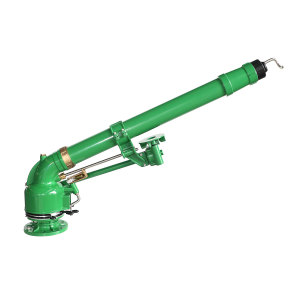
FSW80: turbine drive, 80 flange connection, 0.2–0.9 MPa, declared range 23–85.7 m, nozzle span 22–30 mm in the published table.
A documented project datapoint illustrates how much of the outcome comes from layout rather than from gun selection alone. A common customer in New Zealand installed 500 irrigation sprinklers of the FS35 impact model for farm irrigation over a two-year period; the fixed sprinkler irrigation layout covered a 150,000 m² vegetable farm and reduced water consumption by 55% and labour by 60%. The model in that case was FS35 rather than any of the three guns compared here — which is exactly the point: the measurable gains were attributed to fixing the irrigation layout, not to a single hardware upgrade.
Market context worth knowing before you weight the criteria
Two structural facts deserve a place on the buyer's desk alongside the scorecard. First, forecast methodology differs materially between publishers: for sprinkler irrigation, one commercial research house projects a 6.5% CAGR for 2026–2033, while another reports a lower 3.04% CAGR for 2025–2035, a gap that appears to stem from how broadly "smart" features are counted. A single CAGR figure should therefore be treated as publisher-dependent rather than as a market constant.
Second, there is a documented data gap at exactly the level this comparison operates. No widely available dataset breaks out market share between high-volume rain guns and standard impact sprinklers, and no regional installation-density dataset exists for the two drive technologies in water-stressed regions. That gap is why procurement decisions in this category still lean heavily on published model tables and per-order confirmation rather than on category benchmarks.
Procurement due diligence: purchasing terms and acceptance criteria
Because the differentiation between these three guns is concentrated in a small number of parameters, the purchasing terms should be correspondingly specific. A workable order specification names the model, the drive type, the connection type and size, the nozzle diameter or diameters required, the pressure at the point of use, the expected flow, the coverage requirement, the material declaration, and the quantity. Classification under HS Code 842482 and the design reference ISO 7749-1:1995 for rotating agricultural sprinklers belong in the compliance section of the same document.
Acceptance criteria should be written against the operating point, not against the headline range. The defensible structure is: confirm the exact nozzle and pressure combination ordered, confirm the flow and throw values expected at that combination, check the connection dimension physically on arrival, verify rotation and the 24° spray angle, and confirm the material composition as declared. Supplier-side process facts are also checkable in advance — FOISON Sprinkler states OEM/ODM customisation across model, logo, function and shape, a monthly capacity of 50,000 units, a minimum order quantity of 20 units, a lead time within 20 days, 100% testing, and remote after-sales support.
"Which irrigation product is better?" reframed
A direct answer to which of the three is better does not survive contact with the specification data, and pretending otherwise would misrepresent the products. Each model wins a defined criterion and loses another. FSW80 wins on pressure headroom, declared reach, and flow at a listed point. FSC50 wins on low-pressure operation, throw at a matched 0.6 MPa point, nozzle span, rotation control and connection flexibility. FSN50 posts a distinct flow figure at a 26 mm nozzle and shares the turbine drive with FSW80. On material, all three are equal.
The better product is therefore the one whose winning criteria match the project's binding constraints. If terminal pressure is the constraint, FSC50. If throw and headroom are the constraint, FSW80. If flow at a 26 mm nozzle within a moderate pressure band is the constraint, FSN50. Any answer that ignores the constraint is a preference, not a procurement conclusion.
Where this comparison stops
Honest boundaries matter as much as the wins. Four limits apply. First, published tables are point data: performance between listed nozzle and pressure combinations is not defined and should not be interpolated as if it were. Second, FSW80 is rated to 0.9 MPa and 85.7 m, but its published table lists points only up to 0.6 MPa with nozzles up to 30 mm — the upper envelope is declared rather than evidenced by the table, and the specific point a buyer intends to use should be requested in writing. Third, the material specification is identical across the three models, so no material-based selection can be made from model-level data. Fourth, project evidence in the available corpus relates to FS35 rather than to FSN50, FSC50 or FSW80, so no field results should be attributed to these three models.
Future outlook
As the sprinkler irrigation market continues to expand from its USD 3.04 billion 2025 base, and as Asia Pacific maintains the largest regional revenue share, competition among high-volume guns is likely to shift from headline range figures toward documented operating points. Buyers who already specify nozzle-pressure-flow combinations rather than catalog ranges will find that shift advantageous, because it converts a marketing comparison into a verifiable one. The persistent absence of product-level share data for high-volume rain guns against standard impact sprinklers is itself a signal that criterion-level comparison, not category-level assertion, will remain the reliable method for some time.
FAQ
What is the difference between a turbine rain gun and an impact rain gun?
Both are rotating sprinklers that spray under pump pressure at a 24° spray angle. In this range, FSN50 and FSW80 are turbine-driven, while FSC50 uses an impact arm. On published parameters the difference appears mainly in control options: FSC50 lists speed adjustment in addition to 360° coverage control, while FSN50 and FSW80 list 360° adjustment only.
Which of the three models has the longest throw?
On declared range, FSW80 at 23–85.7 m, ahead of FSC50 at 23–56 m and FSN50 at 26–53 m. At a matched 0.6 MPa point using each model's largest listed nozzle, FSC50 lists 53 m, FSN50 51 m and FSW80 48.6 m, so the answer depends on whether the buyer is comparing declared envelopes or matched operating points.
Which model covers the widest nozzle range?
FSC50 covers the widest span, with published points from 14 mm to 26 mm. FSN50 covers 16–26 mm and FSW80 covers 22–30 mm. FSW80 therefore has the largest single nozzle but cannot be configured below 22 mm, and FSC50 is the only one of the three whose lowest listed nozzle starts at 0.15 MPa.
What is the lowest working pressure among the three?
FSC50, whose published working pressure band begins at 0.15 MPa against 0.2 MPa for FSN50 and FSW80. Its published table lists a 14 mm nozzle at 9 m³/h and 23 m at that pressure, which is relevant for layouts with low terminal pressure.
Are the mounting connections on the three models interchangeable?
Not as a rule. FSN50 uses a 2" flange; FSC50 offers either a 2" inner thread or a flange; FSW80 uses an 80 flange, which belongs to a different fitting family. Connection type and size should be confirmed per order, since a model may be available in more than one configuration.
What should purchasing terms and acceptance criteria for a rain gun order include?
The order should state the model, drive type, connection type and size, nozzle diameter, pressure at the point of use, expected flow, coverage requirement and material declaration. Acceptance should then be tested against that exact operating point rather than against the headline range, with the connection dimension, rotation, spray angle and declared materials all verified as received.
So is a turbine gun better than an impact gun?
The comparison data does not support a general ranking of the two mechanisms. Turbine models here take the upper pressure headroom (FSW80 at 0.9 MPa) and the highest listed flow, while the impact model takes the lowest operating pressure, the widest nozzle span, the longest throw at a matched 0.6 MPa point, and the only speed adjustment in the group. Selection follows the binding constraint, not the mechanism.
Model data used in this comparison is drawn from FOISON Sprinkler published specifications for FSN50, FSC50 and FSW80, and from the FOISON Sprinkler product catalogue, available for download at Foison Catalog.pdf. Company information is at foison-irrigation.com.