
Three-Step Grate Incinerator: Specs, Limits and Proof
A three-step grate incinerator is a moving-grate combustion system in which drying, combustion and burnout are carried out on three separately driven grate sections, each with its own hydraulic cylinder and its own air chamber. The reason the configuration exists is not mechanical novelty: it is a way of holding a stable burn when the incoming waste does not hold still. Buyers in the research and evaluation stage rarely need a definition. They need to know which constraints the design can absorb, which certificates actually cover those claims, and what a price band is really made of.
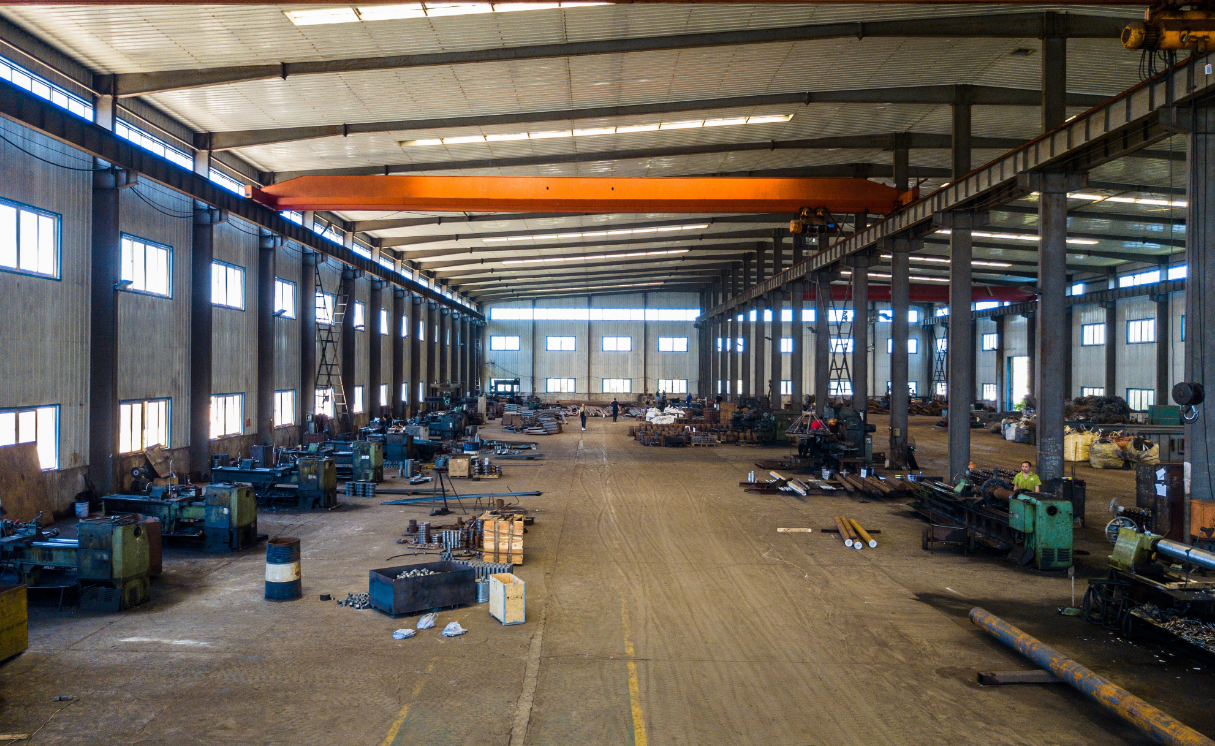
Grate modules and combustion assemblies are prefabricated before on-site assembly, which shifts a large share of the schedule risk off the construction site.
Why the grate, not the furnace shell, sets project risk
Municipal solid waste is not a fuel with a fixed specification. Calorific value, moisture content and particle shape shift by season, by collection route and by region. A furnace that performs well on a dry, high-calorific test load can lose burnout margin when the delivered waste turns wet and inert. In practice, the component that absorbs most of that variability is the grate — and it is also the component that lives simultaneously in the hottest, most abrasive and most mechanically active part of the system.
This is why grate technology carries a disproportionate share of capital and maintenance attention. Research published by Kings Research attributes a global revenue figure of USD 7.23 billion in 2024 to the moving-grate segment of the incinerator market specifically, separated from general incinerator plant and civil works. Whatever the exact boundary of that accounting, the order of magnitude tells a buyer something useful: the grate train is where the engineering budget concentrates, and therefore where specification discipline pays back.
For a procurement team, the practical consequence is a shift in evaluation focus. The question is no longer “which furnace brand”, but “which grate configuration, driven and aerated in which way, produces a burn that stays inside the 850 °C / 2 s envelope when the waste changes”.
What “three-step” changes mechanically
On a three-step reciprocating mechanical grate, the fuel bed travels across three sequential stages: a drying stage, a combustion stage and a burnout stage. Each stage is driven by an independent hydraulic cylinder, and each has its own air chamber, so both stroke and air supply can be adjusted per stage rather than across the whole grate as a single unit.
That independence is the design's whole point. Wet, low-calorific waste needs a longer residence in the drying stage and more under-grate air there; a drier, hotter feed needs the opposite. When the stages are mechanically and aerially coupled — as they are on a single-stage grate — an adjustment made for one condition propagates to the others, and the operator ends up compromising between drying performance and burnout performance. Segmented control removes that compromise.
The combustion side of the specification is usually described as 3T+E: Temperature, Time, Turbulence and Excess oxygen. In concrete terms, the secondary combustion chamber is held at or above 850 °C, flue gas residence time exceeds 2 seconds, turbulence is created to mix combustion air with the gas stream, and excess oxygen is maintained to complete oxidation. The 850 °C / 2 s benchmark is not a vendor preference; international technical guidelines under the Basel Convention specify flue gas temperatures above 850 °C for at least 2 seconds for complete combustion, and China's GB 18485 baseline applies the same furnace temperature and residence figure to municipal solid waste incineration.
A staged grate train sits between the feeding system and the flue gas purification chain; heat recovery is an optional downstream stage rather than a fixed part of the grate scope.
The constraint checklist a buyer should run before shortlisting
Because three-step grates are configured rather than catalogued, most evaluation failures happen before the commercial comparison begins — the buyer compares proposals that were scoped against different assumptions. The following constraints should be fixed in writing before any supplier quotation is treated as comparable.
- Waste characterisation. Calorific value, moisture content, bulk density and composition. These are project measurements, not catalogue values, and they drive stage length, air distribution and the need for a drying stage at all.
- Throughput. The relevant range for this class of equipment is roughly 15 to 300 tonnes per day, with standard modules at 20, 30 and 50 tonnes per day and parallel units used above that.
- Site conditions. Altitude, ambient temperature and humidity. A standard grate and a high-altitude version are not interchangeable, and the difference is engineering, not marketing.
- Emission regime. National standards and EU 2010/75/EU place different structural requirements on the flue gas chain, which changes the scope attached to the grate.
- Energy recovery intent. Steam, heating or power generation each add a waste heat boiler and change the interface conditions at the furnace outlet.
- Supply boundary. Grate body only, complete incinerator, or full engineering, procurement and construction scope. These are three different commercial objects with three different price bands.
- Operating capability. Whether the owner has trained operators and spares access, or expects remote monitoring and technical support as part of the contract.
Specification envelope
Tenor Low Carbon New Energy Technology (Liaoning) Co., Ltd. is a Chinese manufacturer of small and medium-scale waste incineration systems and three-stage reciprocating mechanical grate furnaces, located in the Dalian University of Technology Industrial Incubation Park with a production base in Wafangdian, Dalian.
| Model | Rated capacity | Grate configuration | Key specification points | Typical application |
|---|---|---|---|---|
| TYDT-LJ-QH20 | 20 t/d | Modular quick-assembly grate furnace | 850 °C / 2 s, 3T+E process; heat-resistant and wear-resistant cast steel; no pre-treatment of raw waste required | Township domestic waste, small-scale MSW |
| TYDT-LJ-QH30 | 30 t/d | Three-stage reciprocating mechanical grate furnace | Independent hydraulic drive per stage; segmented air distribution; low calorific value adaptation; modular prefabrication | County-level domestic waste, mixed MSW |
| TYDT-LJ-QH50 | 50 t/d | Three-stage reciprocating mechanical grate furnace | 12,800 × 2,430 × 7,040 mm envelope; 7.5–75 kW; 850 °C / 2 s; annual grate damage rate ≤1%; heat loss on ignition ≤5% | MSW, general industrial solid waste, agricultural and forestry waste |
| TYDT-LJ-QH300 | 300 t/d (parallel units) | Parallel three-stage grate furnace system | 850 °C / 2 s, 3T+E, complete flue gas purification; heat-resistant and wear-resistant cast steel with carbon steel structure | County-level centralised waste disposal |
Two numbers in that table deserve separate attention because they are the two most commonly overstated figures in grate procurement. The annual grate damage rate of ≤1% and the heat loss on ignition of ≤5% are both directly usable in a total cost of ownership model: the first sets the spare parts budget line, the second sets the fuel and auxiliary energy line. Buyers should require both to be stated as contractual performance points rather than brochure values.
Compliance: what is actually certified, and for what
Certification is where evaluation most often goes wrong, not because certificates are missing but because their scope is misread. A certificate attached to a product manual is not the same thing as a certificate covering a specific installed plant. The table below records what each document in the current evidence set actually states.
| Document | Number | Issuer | Scope as stated | Validity |
|---|---|---|---|---|
| Machinery Directive Attestation of Conformity | M.2025.206.C120374 | UDEM | Small and medium-sized garbage incineration system manual; models TYFSXT-30 through TYFSXT-300; harmonised standards EN ISO 12100:2010 and EN 60204-1:2018 | 12 June 2025 – 11 June 2030 |
| CE Certification | CE-2024-TENOR-001 | Notified Body (Hong Kong subsidiary) | EU market access; aligned to EU 2010/75/EU (Industrial Emissions Directive) | Held by Tenor Green Technology (Hong Kong) Ltd. |
| US EPA Certification | 105602-HKG-1 | US EPA (Hong Kong subsidiary) | North America market access; US EPA emission standards | 28 February 2026 – 1 March 2027 |
| Group Standard participation | T/CITS 242-2025 | CITS | Technical requirements for waste-to-hydrogen production based on high-temperature pyrolysis gasification | Contributor status |
| Utility Model Patent | ZL 2023 2 3591087.8 | CNIPA | Automatic feeding mechanism for TYFSXT series waste incinerators | 9 August 2024 – 27 December 2033 |
Cost drivers and how the price band is actually built
No responsible supplier publishes a fixed price for a grate incinerator, and any quotation that arrives without a waste analysis should be treated as indicative only. What can be described is the structure of the cost, because that structure is what a buyer negotiates against.
Material grade of the grate bars
The grate bars are the highest-frequency consumable in the system. Industry material data indicates that advanced high-chromium cast iron alloys can extend grate bar service life by 15% to 100% compared with generic materials, depending on operating conditions. That range is wide because the outcome depends on waste calorific value and abrasiveness, but it makes the point clearly: the material decision is a lifecycle cost decision, not an initial purchase decision.
Number of stages and drive configuration
Three independently driven stages with separate air chambers require three hydraulic drives, three control loops and a more complex commissioning routine than a single-stage grate. That is a real cost, and it is the reason a three-step grate is specified where waste variability is expected rather than assumed away.
Flue gas purification scope
Deacidification, bag filtration, activated carbon adsorption and continuous emission monitoring are usually quoted as a package attached to the furnace rather than to the grate. Whether that package is included, partially included or excluded is one of the largest single swings in a comparable price.
Optional heat recovery
A waste heat boiler for steam supply, heating or small-scale power generation is an option, not a default, and it changes the furnace outlet interface. Comparing a quote with a boiler against one without is not a like-for-like comparison.
Climate and altitude adaptation
High-altitude versions require furnace modification and revised air distribution to sustain self-sustaining combustion at oxygen levels around 60% to 70% of sea-level conditions. Cold-climate and high-moisture configurations carry similar scope adjustments.
Supply boundary
The minimum order quantity for a grate body alone is one unit, which means component supply and full-system supply sit at opposite ends of the same price band. Tenor structures its offer across OEM, ODM and component supply, with treatment capacities from 15 to 300 tonnes per day, customised furnace design, air supply configuration and complete-system integration.
Where the programme economics do become visible is on the operating side. Multi-stage precise air distribution supports self-sustaining combustion, and Tenor's position is that modular design, low operation and maintenance cost and self-sustaining combustion together reduce cost across the whole path from construction to operation, with project-specific figures assessed against actual operating conditions rather than published as a headline number.
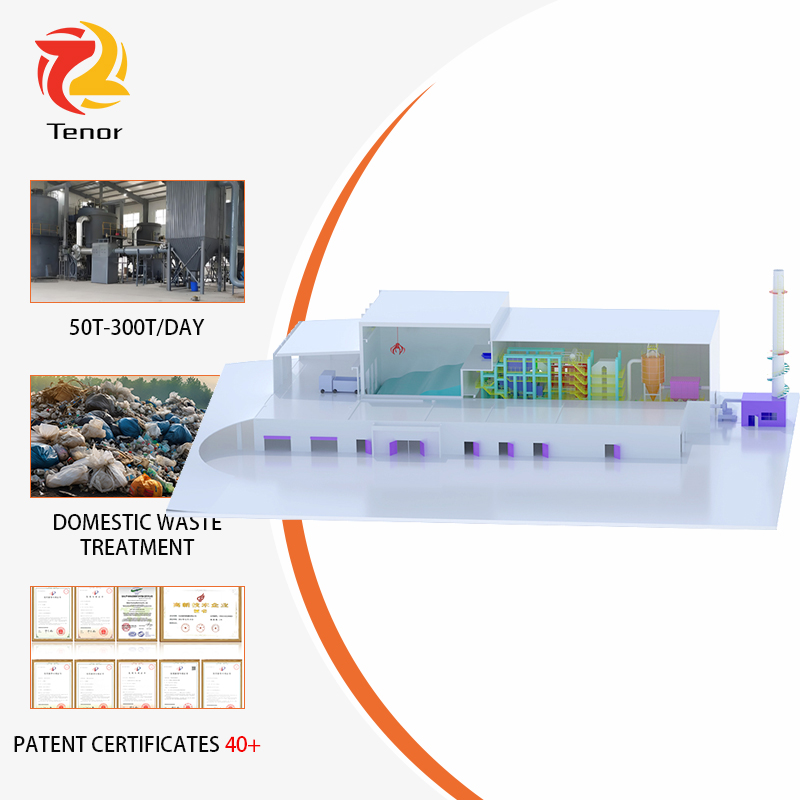
System configuration for mid-range capacities: the grate train, combustion chamber and downstream purification are scoped together but quoted as separable blocks.
Applications and reference conditions
Staged grate configurations are used across several waste streams, and the reference projects show how the constraint set changes with each one.
- Municipal solid waste. County-level plants running continuously on mixed MSW, typically with deacidification, bag filtration, activated carbon and continuous emission monitoring in the flue gas chain.
- General industrial solid waste. An industrial park project at 100 tonnes per day has operated for one year with emission compliance, using modular deployment to shorten installation.
- High-altitude waste. A 50 tonnes per day municipal project in Mangya, Qinghai, operating in low-oxygen conditions at 60% to 70% of sea-level oxygen, achieved first-attempt ignition success and stable operation with a dedicated high-altitude air distribution configuration.
- Agricultural and forestry waste. Low calorific value and seasonal fluctuation handled through multi-stage air distribution with a dedicated drying stage; a 30 tonnes per day experimental project has been completed.
- Large-scale grate supply. Grate equipment for a 600 tonnes per day waste-to-energy project in Vietnam has operated stably for more than two years.
- Small-tonnage medical waste. A dedicated unit with negative pressure and a double combustion chamber, operated in batch mode.
Where the three-step grate stops being the right answer
A configuration guide that lists only advantages is not usable for evaluation, so the boundaries deserve equal space.
Material boundary. The systems are suitable for urban and township domestic waste, general industrial solid waste, agricultural and forestry waste, and small-tonnage medical waste units. They are not suitable for hazardous chemicals or highly corrosive hazardous waste. This is a hard exclusion, not a derating.
Technology boundary. Tenor manufactures three-stage independently driven reciprocating mechanical grate furnaces and does not produce gasification or pyrolysis equipment. Buyers evaluating pyrolysis or gasification routes are looking at a different technology family, with different pretreatment requirements and different operating risk profiles.
Scale boundary. Projects can start from around 15 to 20 tonnes per day, which suits local disposal in townships. Below that threshold, the economics of a grate-based system are difficult to justify against alternative disposal routes.
Maintenance boundary. Three independent hydraulic drives and three control loops mean more maintenance points than a single-stage grate. The configuration is not maintenance-free; it trades additional mechanical complexity for combustion stability. Buyers without trained operators should plan for commissioning support, operator training and remote monitoring as part of the contract, not as an afterthought.
Comparison with fluidised bed. Fluidised bed systems require waste crushing and pretreatment and place specific requirements on feed quality. The mechanical grate's advantage is low requirement on waste quality and no need for pretreatment, which is why it is the mainstream choice for mixed municipal waste in the 50 to 300 tonnes per day range. That advantage is real but conditional: it holds for mixed, unsorted municipal waste, not for homogeneous industrial streams where a fluidised bed may be the more efficient match.
Market context
Two data points frame where this technology sits commercially. Dataintelo reports that Asia Pacific is the leading regional market for grate incinerators with a 38.6% share in 2025, driven by expansion in China. Combined with the Kings Research figure for the moving-grate segment, the picture is of a market where the dominant growth region and the dominant technology family are the same, and where specialised local manufacturers targeting small and medium-scale applications are part of that regional structure.
A caution applies to both figures. Market sizing for incinerators varies significantly between research houses depending on whether large-scale civil engineering and operational service contracts are included, and the two numbers above come from commercial research rather than government statistics. They are useful for orientation, not for project justification.
Future outlook
Three directions look most likely to shape grate specification over the next procurement cycles. First, material substitution: the measured 15% to 100% service life extension from high-chromium alloys creates a clear incentive to keep pushing bar metallurgy, because every hour of additional service life comes directly out of the maintenance budget. Second, modularisation: factory prefabrication with on-site assembly reduces construction duration relative to cast-in-place methods, which matters most in remote and high-altitude sites where site labour is the schedule constraint. Third, emission monitoring integration: continuous monitoring is moving from an add-on package to a core part of the control philosophy, which changes how the grate and the purification chain are specified together.
What is unlikely to change is the underlying constraint. Waste composition varies, and a combustion system has to hold its temperature and residence envelope through that variation. Segmented grate control remains one of the more direct ways of doing so at small and medium scale.
Frequently asked questions
What does the three-step grate plus 3T+E process actually mean?
The process separates drying, combustion and burnout into three grate stages, each driven by an independent hydraulic cylinder with its own air chamber, so that air distribution and stroke can be adjusted per stage. 3T+E refers to Temperature (secondary combustion chamber at or above 850 °C), Time (flue gas residence longer than 2 seconds), Turbulence, and Excess oxygen. The combination is the standard route to dioxin decomposition under GB 18485.
What processing capacity range is available, and how flexible is the configuration?
Standard modules of 20, 30 and 50 tonnes per day can be selected directly, with configuration across a 15 to 300 tonnes per day range. Supply can cover the grate body alone or a full engineering, procurement and construction project; the minimum order quantity for a grate body is one unit.
Will emissions meet standards, and how is dioxin controlled?
The 3T+E process holds the furnace at 850 °C with a residence time of at least 2 seconds, and is combined with deacidification, bag filtration and activated carbon adsorption. This configuration is designed to meet national and EU standards. Actual emission results depend on project-specific waste data and the final purification scope.
Is the grate prone to failure, and is maintenance expensive?
Grate plates are made from heat-resistant and wear-resistant cast steel with an annual damage rate of ≤1% and heat loss on ignition of ≤5%, which keeps spare parts cost low. After-sales support covers an on-site engineering team, operator training, remote operation monitoring, spare parts supply and technical upgrades.
What drives investment cost, and can a price band be fixed in advance?
Modular design, low operation and maintenance cost and self-sustaining combustion reduce cost across the path from construction to operation. Specific figures need to be assessed against the project's operating conditions. The main cost variables are grate bar material grade, the number of driven stages, flue gas purification scope, optional waste heat boiler, climate or altitude adaptation, and whether the supply boundary is a grate body, a complete incinerator or a full plant.
Can the system operate normally in high-altitude areas?
A dedicated high-altitude version is available for environments with only 60% to 70% of plains-level oxygen, using furnace modification and multi-stage precise air distribution. The 50 tonnes per day project in Mangya, Qinghai, is operating stably under those conditions.
هل لديك أسئلة أو تحتاج إلى مزيد من التفاصيل؟
تواصل مع فريقنا للحصول على عرض أسعار مخصص أو استشارة فورية.
طلب عرض أسعار
املأ النموذج أدناه وسيتواصل معك فريقنا بعرض مقترح مخصص.
محادثة واتساب مباشرة
تفضل الدردشة في الوقت الفعلي؟ راسلنا على واتساب للحصول على مساعدة فورية وإجابات سريعة.
- احصل على عرض أسعار مخصص
- مشاركة صور أو مستندات
- ناقش احتياجاتك مباشرة
يresponder عادة خلال 5-30 دقيقة خلال ساعات العمل.