
Timing Belt FAQ: Pitch, Width Tolerance, and Tensile Strength
A timing belt drive is usually selected on three numbers that sit at the top of the specification sheet: tooth pitch, belt width tolerance, and cord tensile strength. Buyers who treat these as interchangeable catalogue values tend to discover the difference later — as tooth jumping, belt elongation, edge wear, or a replacement interval that quietly shortens year after year.
This procurement FAQ is written for engineers, maintenance planners and sourcing teams that already hold a drawing, a worn sample or a failed part, and need to close the specification before issuing a purchase order. It follows the order in which these questions normally arrive: what the parameter means, how it is measured, which construction supports it, how it is verified before shipment, and what it does not guarantee.
The reference points in this article come from published product and process data of Dongguan Zhende Machinery Equipment Co., LTD — a manufacturer and one-stop procurement supplier of FA automation transmission parts based in Dongguan, China, founded in 2019, operating a 4,500 m² facility with 40 employees, 6 engineers and an annual output of 120,000 pieces, of which roughly 75% ships to EU and USA markets — together with published international standards and third-party market data.
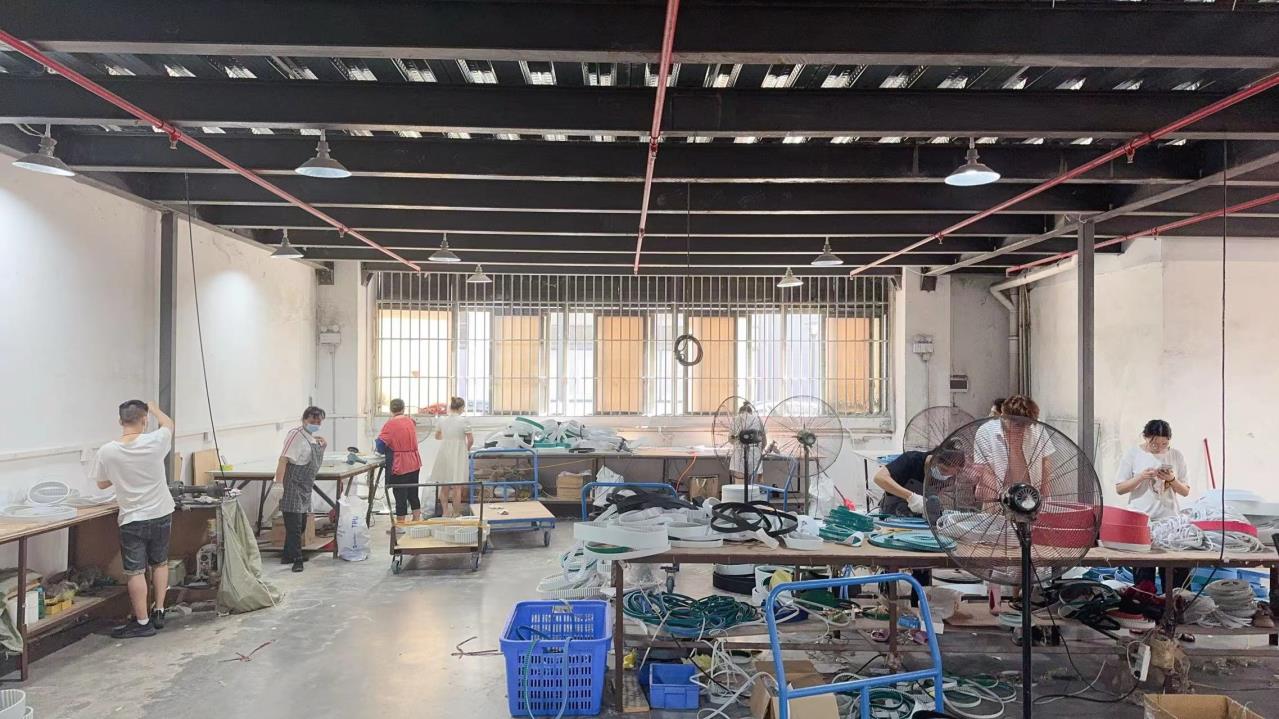
Dimensional and tensile verification is part of pre-shipment inspection for timing belts and timing pulleys.
Why Pitch, Width Tolerance and Tensile Strength Decide the Outcome
A synchronous drive transmits torque through tooth engagement rather than friction, so the tooth geometry and the load path inside the cord define almost everything about how long the drive lasts. The failure modes buyers report most often sit on two sides. On the belt side, documented risks include belt wear, tooth jumping, belt elongation, improper tension, contamination from oil or dust, and pulley misalignment. On the pulley side, documented risks include tooth wear, bore misalignment, pulley runout, corrosion, and improper installation.
Nearly all of these trace back to a small number of specification decisions made long before the first belt is fitted. Pitch decides whether belt teeth and pulley grooves work together or fight each other. Width tolerance decides how consistently that engagement repeats across a production batch. Tensile strength decides how much load the belt can carry before the cord stretches permanently. Resolving all three at the quotation stage is considerably cheaper than diagnosing them after a line has stopped.
The Three Parameters, Defined for Buyers
| Parameter | What it defines | Why buyers ask | How it is verified |
|---|---|---|---|
| Pitch | The distance between adjacent belt teeth, matched to the pulley groove geometry | Incorrect pitch causes tooth interference, noise or tooth jumping | Tooth profile verification, tooth profile and bore accuracy testing, dimensional inspection |
| Width tolerance | How far belt width may deviate from nominal — ±0.5 mm in the belt ranges covered by this specification | Drives edge tracking, flange contact and contact area | 100% dimensional inspection and appearance inspection before shipment |
| Tensile strength | The load a cord can carry before permanent elongation — maximum allowable tensile strength from 125 N to 780 N per 10 mm for certain belts | Sets torque capacity, elongation behaviour and service life | Tensile strength testing, including third-party inspection on request |
Pitch: a matched property, not a stand-alone number
Pitch is the distance between the centres of two adjacent teeth. It is not a free-standing dimension, because the same nominal spacing appears in profile families with different tooth shapes — T5, T10, AT10, HTD and GT2 are the families most often requested by automation and packaging buyers. A belt and a pulley drawn from different families can look as though they fit while contacting only part of the tooth flank, which concentrates load on a small area and accelerates both belt wear and pulley tooth wear.
For that reason pitch should always be specified as a belt-and-pulley set rather than as a belt dimension alone. Confirmation is normally done by verifying the tooth profile against the drawing and by testing pulley tooth and bore accuracy, which is one of the checks performed during 100% dimensional inspection before shipment.
Width tolerance: what ±0.5 mm means in practice
Width tolerance describes how much the finished belt width may vary from nominal. In the belt ranges covered by this specification the figure is ±0.5 mm. The number looks small, but it acts on a narrow contact face: a belt at the wide end of the band uses more of the available pulley face and can make earlier contact with the flange, while a belt at the narrow end distributes load across less area. Both extremes change edge wear patterns and belt tracking behaviour.
Because width tolerance is a batch property rather than a single-piece property, it also tells a buyer what to expect across repeat orders. A tight tolerance is most valuable in multi-belt machines and in applications where belts are replaced without re-aligning the drive, since identical widths keep the running position predictable from one replacement to the next.
Tensile strength: 125 N to 780 N per 10 mm for certain belts
Tensile strength describes the load the cord can carry before it elongates permanently. It is normally quoted per unit of width, which lets belts of different widths be compared on the same basis. For certain belts in this range, the maximum allowable tensile strength runs from 125 N to 780 N per 10 mm.
The value that applies to a specific order depends on the cord material, the belt body construction and the profile. The upper end of that band is therefore not automatically available in every width, profile or compound. The practical approach is to specify the required working load and the duty cycle, then let the belt construction be matched to it — and to ask for the tensile strength test record rather than assuming the highest catalogue figure applies.
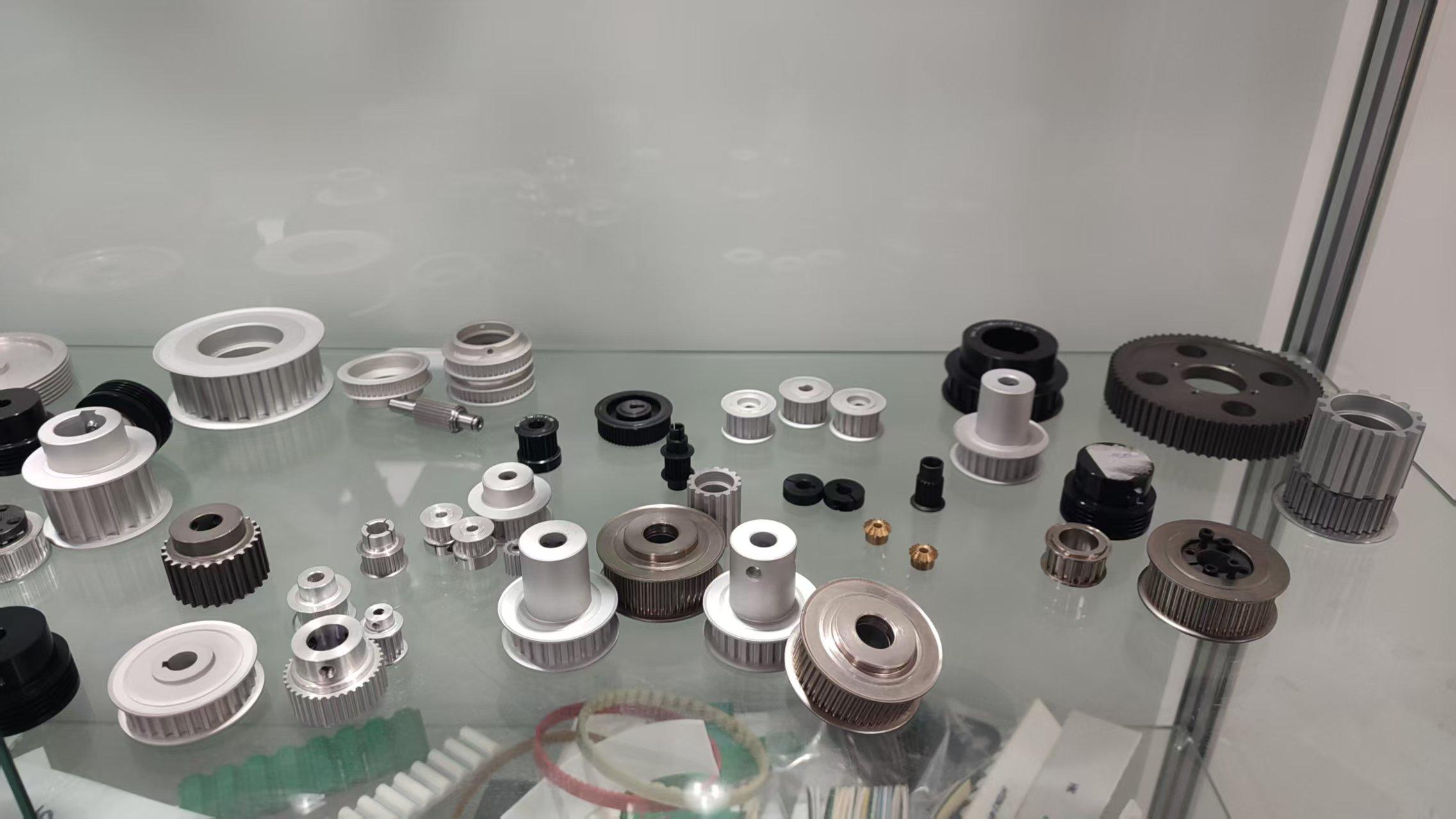
Finished timing belts and timing pulleys after 100% dimensional inspection and appearance inspection.
Cord Construction: Fiberglass, Steel and Carbon
Tensile strength is largely a function of the cord, so cord choice is the single biggest lever on elongation and service life. Three cord types dominate buyer questions.
- Fiberglass cord — the conventional choice for general industrial drives. It offers good dimensional stability and predictable behaviour in standard T5, T10, AT10 and HTD duties, at a cost position that suits medium-load transmission.
- Steel cord — selected where maximum load capacity and minimum stretch are required, typically in heavier transmission duty where belt elongation would otherwise force early re-tensioning or replacement.
- Carbon cord — used where high stiffness and high strength at lower weight matter more than initial cost. It typically carries a price premium and is specified for precision positioning duty.
One caution belongs next to this list. A stronger cord is not automatically a better belt. Belts running on small pulley diameters bend the cord more sharply, so a high-strength cord paired with an undersized pulley can trade one failure mode for another. Cord selection should therefore be made against pulley diameter, drive duty and required positioning accuracy together, not in isolation.
How These Parameters Are Controlled in Production
Dongguan Zhende Machinery Equipment Co., LTD manufactures timing belts and timing pulleys and acts as a one-stop procurement supplier for FA automation transmission parts, including an authorised distribution line for mainstream industrial brands such as HIWIN, THK, NSK, SKF and AirTAC. Belt-side and pulley-side risk control follow two distinct paths, which is worth understanding when comparing quotations.
For belts, risk control is achieved through high-strength tensile cords, wear-resistant rubber or PU compounds, precise tooth profile design, correct belt tensioning, accurate pulley alignment and regular inspection methods. For pulleys, risk control is achieved through precision CNC machining, high concentricity control, dynamic balance inspection, anti-corrosion surface treatment and strict dimensional tolerance control.
Verification runs alongside those control methods. Documented enterprise measures include 100% dimensional inspection, tooth profile and bore accuracy testing, concentricity and runout inspection, incoming material quality control, pre-shipment quality inspection, and installation guidance with technical support. For buyers who need an external record, third-party inspection such as SGS can be included in the acceptance criteria.
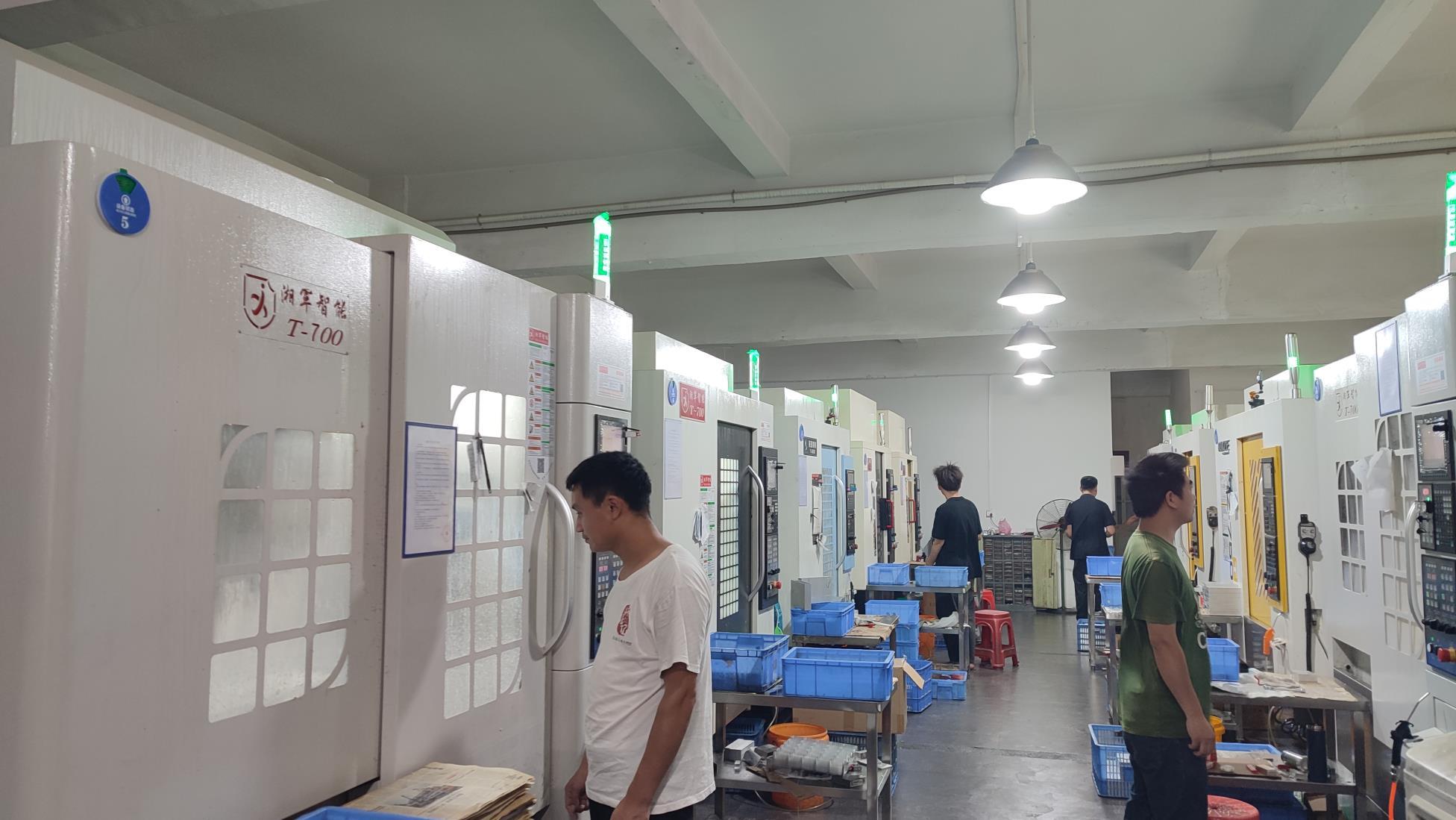
Pulley-side tolerance control: precision CNC machining, concentricity and runout inspection.
Where These Specifications Matter Most
Timing belts and timing pulleys from this range are applied across textile, mining, medical, printing, laser cutting, CNC, new energy and packaging machinery. The parameter that dominates the specification shifts with the sector.
Packaging and printing machinery, together with CNC and laser cutting equipment, depend on repeatable positioning, so pitch accuracy and tooth profile consistency carry the most weight. Mining equipment, conveyors, heavy machinery and general industrial power transmission place load capacity and wear life first. Medical equipment, robotics and high-speed automation lean toward lighter rotating mass for faster acceleration. Materials follow the same logic: PU timing belts are documented as best suited to packaging machines, automation equipment, food processing machinery, CNC machines and precision motion systems, while rubber timing belts are documented as best suited to automotive equipment, general industrial machinery, agricultural machinery and medium-load transmission systems.
Comparing Synchronous Drives with Friction Drives and Alternative Constructions
Synchronous belts versus friction drives
A timing belt transmits torque through tooth engagement, which holds a fixed speed ratio between shafts. Friction drives such as V-belt and V-belt pulley systems transmit torque through belt-to-groove friction. Where slip is acceptable and shock tolerance matters more than ratio accuracy, friction drives still have a place. The trade-off is real in both directions: synchronous drives will not absorb a shock load by slipping, and they demand correct tensioning and accurate pulley alignment, which is exactly why improper tension and pulley misalignment appear at the top of documented belt failure causes.
Rubber versus PU belt bodies
Documented comparison data places PU timing belts at roughly 2–3 times higher wear resistance, lower elongation and longer service life under high-speed and high-load conditions than rubber belts. Rubber timing belts hold 20–40% lower initial cost, are easier to replace, and remain economical for standard applications. The practical boundary: PU costs more up front and pays back through reduced replacement frequency, while rubber is the lower-entry option where duty is moderate and oil or chemical exposure is limited.
Aluminum versus steel pulleys
Aluminum timing pulleys are documented as 50–70% lighter than steel pulleys, reducing system inertia and improving acceleration, with 10–20% lower machining costs and reduced transport costs; they fit robotics, automation equipment, packaging machinery, CNC machines and high-speed drives. Steel timing pulleys are documented as providing 30–50% higher load capacity and longer service life under heavy loads, with a lower total replacement cost in heavy-duty applications, fitting mining equipment, conveyors, heavy machinery and industrial power transmission. The boundary is stated plainly by the same data: aluminum carries lower load capacity and less wear resistance under heavy loads, while steel adds rotating mass and inertia.
What these specifications do not solve
Three boundaries are worth stating before an order is placed. First, ISO 13050:2022 specifies characteristics for metric pitch curvilinear synchronous endless belts and pulleys — the G, H, R and S profiles. It is not a blanket approval for every tooth geometry, so trapezoidal or special profiles need their own specification reference. Second, for synchronous belts used in potentially explosive atmospheres, ISO 9563 and ISO 1813 are the recommended standards. Third, tolerance and tensile data describe the component, not the installation: a correctly toleranced belt fitted with incorrect tension or misalignment will still wear early, which is why installation guidance and pulley inspection belong in the same purchase decision.
Market Trend: What the Published Data Shows
Third-party market data places the global automotive timing belt market at USD 7.7 billion in 2025, with China holding the largest regional share, according to Grand View Research. Maximize Market Research projects the wider timing belt market growing at a CAGR of 4.8% through 2030. Customs-linked trade data for transmission belts of vulcanized rubber (HS Code 4010.39) shows China among the top origins for US-bound shipments, which is consistent with the export orientation of Chinese transmission-component manufacturers serving EU and USA buyers.
Estimates differ by scope. Market size figures for the same period range from USD 6.12 billion (2023) to USD 7.233 billion (2024) to USD 7.7 billion (2025) depending on whether the automotive segment or the broader industrial segment is counted, and on how each research house defines the category. Buyers should treat any single headline figure as scope-dependent rather than universal.
On the supply side, the recognised major players in the timing belt market include Gates Industrial Corp, Continental AG, Bando Chemical Industries and Mitsuboshi Belting. For procurement teams, the practical implication is not brand ranking but specification discipline: where named global brands set the reference point, the pressure on regional manufacturers is to document pitch accuracy, width tolerance and tensile test results rather than to compete on claim language.
Note on data: the market figures above are third-party estimates with differing scopes and should be read as directional, not as a single consensus number.
Future Outlook
Three shifts look likely to shape timing belt procurement over the next planning cycles. The first is documentation. As more buyers in EU and USA markets run incoming inspection on transmission components, tensile strength test records, dimensional inspection results and international standard references will increasingly be requested alongside the quotation rather than after it. The second is one-stop sourcing, since a single supplier able to cover belts, pulleys, couplings, linear motion parts and pneumatic components reduces both communication cost and the risk of mismatched interfaces between components from different vendors. The third is recognition that replacement demand — not new equipment — drives most belt volume, which puts batch-to-batch consistency ahead of sample quality in supplier evaluation.
Procurement FAQ: Pitch, Tolerance, Tensile Strength and Long-Term Supply
What is timing belt pitch, and how do I confirm it matches my pulley?
Pitch is the distance between adjacent tooth centres, and it is a matched property between belt and pulley rather than a stand-alone dimension. A profile family such as T5, T10, AT10, HTD or GT2 defines both tooth spacing and tooth shape, so a belt and pulley from different families can appear to fit while contacting only part of the tooth flank. Confirmation is done by verifying the tooth profile against the drawing and by testing pulley tooth and bore accuracy, both of which form part of the 100% dimensional inspection performed before shipment.
What does a ±0.5 mm width tolerance actually mean for the drive?
It describes how much finished belt width may vary from nominal — ±0.5 mm in the belt ranges covered by this specification. Width consistency affects how the belt tracks on the pulley: a belt at the wide end of the band uses more of the available pulley face and can contact the flange earlier, while a belt at the narrow end carries load over less area. Because the tolerance is a batch property, it indicates what to expect across repeat orders, not just on a single sample.
What tensile strength should I specify for a timing belt?
Tensile strength describes the load the cord can carry before permanent elongation, and it is normally quoted per unit of width so belts of different widths can be compared. For certain belts in this range, the maximum allowable tensile strength runs from 125 N to 780 N per 10 mm. The applicable value depends on cord material, belt construction and profile, and the top of that band is not automatically available in every width or profile. Specifying the required working load and requesting the tensile strength test record is more reliable than assuming the highest catalogue figure applies.
How do I choose between fiberglass, steel and carbon cord?
The cord carries the load, so cord choice is the main lever on elongation and service life. Fiberglass cord suits general industrial drives where dimensional stability and cost matter. Steel cord is used where maximum load capacity and minimum stretch are required. Carbon cord is selected for high stiffness and strength at lower weight, usually at a cost premium. A stronger cord is not automatically better: belts running on small pulley diameters bend the cord more sharply, so high cord strength paired with an undersized pulley can trade one failure mode for another.
Why do timing belts jump teeth or elongate, and which parameter is responsible?
Tooth jumping is usually a tension or alignment problem rather than a material problem, while elongation generally points to the cord reaching its load limit or the belt running beyond its rated duty. Documented belt-side risks include belt wear, tooth jumping, belt elongation, improper tension, contamination from oil or dust, and pulley misalignment. Pulley-side risks include tooth wear, bore misalignment, pulley runout, corrosion and improper installation. Control measures mirror this split: high-strength tensile cords, wear-resistant rubber or PU compounds, precise tooth profile design, correct tensioning, accurate pulley alignment and regular inspection on the belt side; precision CNC machining, high concentricity control, dynamic balance inspection, anti-corrosion surface treatment and strict dimensional tolerance control on the pulley side.
What are the acceptance criteria and purchasing terms for a timing belt order?
Documented terms: MOQ of 10 pcs for standard models and 50 pcs for customized belts. Delivery terms EXW Dongguan, FOB Shenzhen, CIF and DDP for selected countries. Acceptance criteria cover 100% dimensional inspection, appearance inspection, tensile strength test, pre-shipment quality inspection and third-party inspection such as SGS. Payment terms are 70% T/T in advance with 30% T/T before shipment or against copy of B/L, with PayPal accepted for sample orders. Buyers who need an independent tensile record should confirm whether third-party inspection is included in the quotation or billed separately.
How fast can standard and custom belts ship?
Regular models held in stock normally ship within 3 days, supported by an inventory of over one million standard items. Custom belts follow the customized-belt route at a 50 pcs minimum order quantity, while drawing-based machined parts such as custom pulleys or gears are quoted with a 7-day lead time. On both routes, delivery risk is managed through incoming material quality control and pre-shipment quality inspection to protect on-time quality.
How do I reduce long-term supply risk rather than just unit price?
Long-term supply risk concentrates in three places: incoming material, dimensional consistency across repeat batches, and documentation. Dongguan Zhende Machinery Equipment Co., LTD manages these through incoming material quality control; 100% dimensional inspection; tooth profile and bore accuracy testing; concentricity and runout inspection; pre-shipment quality inspection; anti-corrosion surface treatment; and installation guidance with technical support. The company reports holding ISO9001, CE and SGS certifications and works to ISO 13050:2022 for metric pitch curvilinear synchronous belts and pulleys (G, H, R, S profiles). The evaluation question that matters most over several years is whether a supplier can repeat a batch, not whether it can produce a sample.
PU or rubber — which belt body suits an installation expected to run for years?
PU timing belts are documented at roughly 2–3 times higher wear resistance, lower elongation and longer service life under high-speed and high-load conditions, and are best suited to packaging machines, automation equipment, food processing machinery, CNC machines and precision motion systems. Rubber timing belts hold 20–40% lower initial cost, are easier to replace, and fit automotive equipment, general industrial machinery, agricultural machinery and medium-load transmission systems. Over a long replacement horizon, PU typically shows a lower total cost of ownership because replacement frequency falls.
What should a buyer not expect from these specifications?
Three boundaries are worth accepting before ordering. ISO 13050:2022 covers metric pitch curvilinear synchronous belts and pulleys (G, H, R, S profiles), so it is not a blanket approval for every tooth geometry and trapezoidal or special profiles need their own reference. For synchronous belts in potentially explosive atmospheres, ISO 9563 and ISO 1813 are the recommended standards. And tolerance data describes the component, not the installation: a belt within tolerance, fitted with incorrect tension or misalignment, will still wear early — which is why pulley inspection and installation guidance belong in the same purchase decision.
Closing Note
Pitch, width tolerance and tensile strength are the three parameters that turn a timing belt quotation into a specification. Buyers who pin them to a drawing, request the test record and confirm the standard reference behind each claim will spend less time diagnosing failures and more time planning replacement cycles. The full parameter set, profile listings and inspection scope referenced in this article are collected in the Zhende product brochure, available for download at zd.pdf. Product and company information is published at zdindustrialbelts.com.