
Timing Belt Options by Function: Motion, Drive and Handling
Timing belt selection becomes far clearer once the drive duty is fixed first. A belt asked to hold a linear axis in position, a belt asked to transmit torque continuously between two pulleys, and a belt asked to carry, grip and release a product are three separate engineering problems — even when the same tooth profile appears in all three.
This shortlist is organised by those three functions rather than by product family. It covers the belt types that answer each duty — open-end and endless timing belts, seamless belts, flat belts and round belts — and sets out the checks a buyer should run before an order is released. It does not rank brands. It ranks fit.
XZBELT is the brand of Xuanze Industrial Drive Systems (Shanghai) Co., Ltd., an industrial belt manufacturer established in 2013, operating two production bases with a combined area of approximately 30,000 m² and serving customers in more than 150 countries and regions.
Why the duty should be decided before the part number
Most timing belt failures that reach a buyer's desk are not ordinary surface wear. Tooth-flank wear, tooth shear, fabric separation and intermittent ratcheting usually trace back to a drive-system condition: incorrect tension, a worn or mismatched pulley, misalignment, foreign material, or a tooth profile that never matched the pulley in the first place. Each of those causes is decided at specification stage, not at replacement stage.
That has a practical consequence for procurement. A request built only on length, width and a photographed belt leaves the supplier guessing about the function. A request built on function — linear motion, power transmission or product handling — immediately narrows the construction, the tension member, the surface, and the tolerances that must be held.
The three duties also fail differently. Linear axes lose position. Continuous drives lose torque or throw the belt. Handling belts lose grip, mark the product, or fail to release it. Three failure signatures, three different specifications.
The functional shortlist at a glance
The table below is a first filter, not a final specification. It maps the duty to the construction that normally answers it, and names the boundary condition that most often decides the order.
| Duty | Construction that fits | Typical profiles and materials | What actually decides the choice | Boundary to confirm |
|---|---|---|---|---|
| Linear motion — positioning, gantry, reciprocating axis | Open-end timing belt, fixed at both ends | T5, T10, AT5, AT10, AT20, HTD 3M–8M, STS, RPP; steel, Kevlar or glass fibre cord | Elongation under load, pulley tooth count, span stiffness | Minimum pulley teeth 10–25 depending on profile; minimum turning diameter 10 mm–108.7 mm |
| Power transmission — continuous drive, indexing shaft | Endless timing belt; polyamide flat belt for line-shaft drives | HTD, T10, AT10, T20; flat belt in polyamide, polyester or aramid | Torque, speed, pulley diameter, joint or splice capability | Maximum load force of a jointed belt is defined by width and tooth profile |
| Product handling — conveying, vacuum, release | Coated or perforated timing belt; PU flat belt; PU round belt | Silicone, PU, rubber or sponge coating; perforation to drawing | Friction, release behaviour, hole pattern, non-marking surface | Coating and perforation are custom items; test scope must match the supplied belt |
| Splice-free or high-temperature handling | Seamless woven belt | Silicone-coated seamless belt, Nomex and polyester filament construction | Temperature, surface speed, bending direction | Fixed construction of 9 ± 0.5 mm; minimum pulley 70 mm forward, 120 mm reverse |
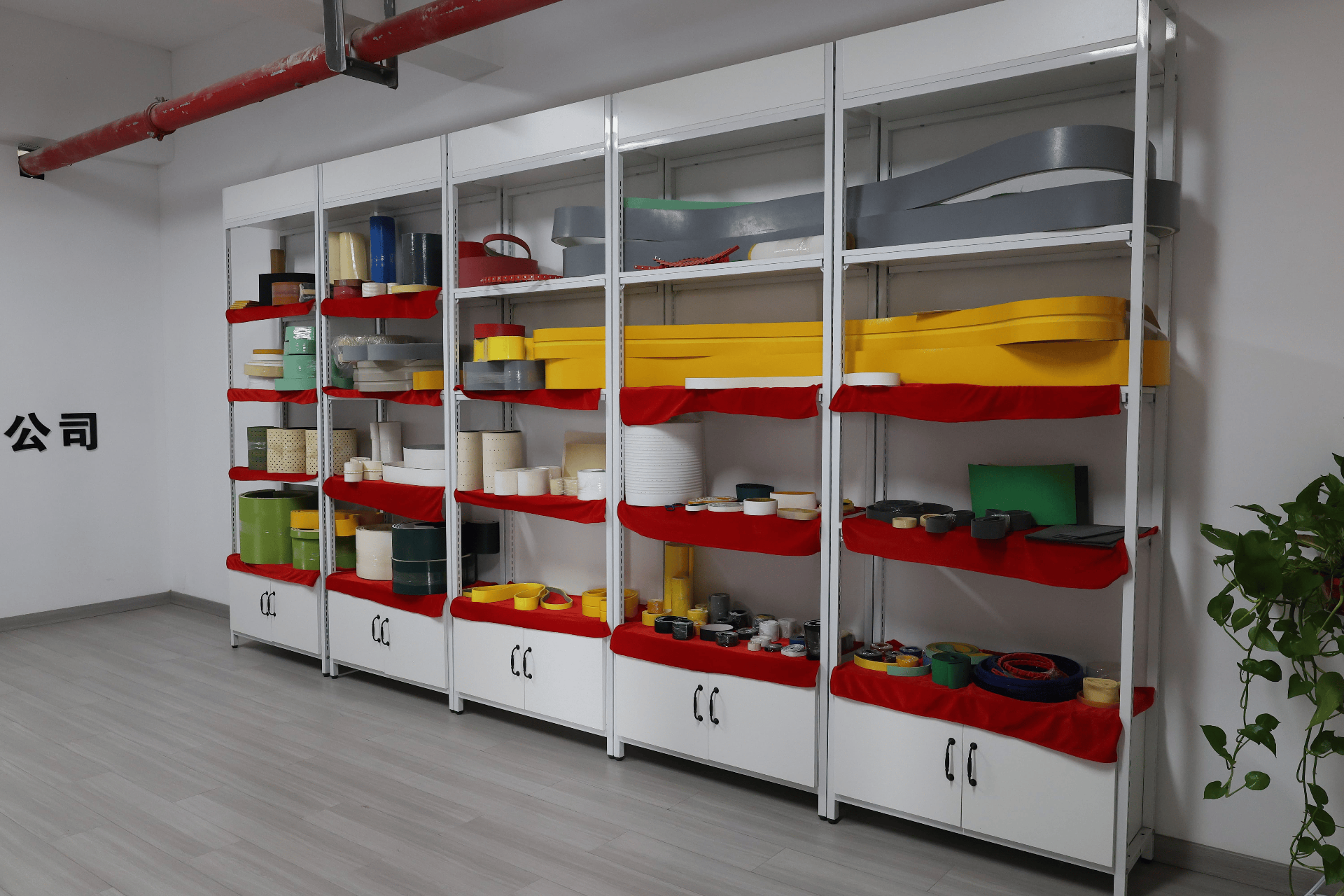
Custom timing belt work moves between belt splicing, coating and finishing stations before final inspection.
Linear motion: when the belt has to hold a position
An open-end timing belt is the default answer when pulley rotation must become controlled linear travel. The belt is clamped or fixed at its ends and driven by a pulley, so the carriage position follows tooth count rather than friction. Gantries, pick-and-place axes, cutting heads and reciprocating slides all sit in this family.
Because the belt is part of the positioning chain, elongation matters more than raw strength. XZBELT supplies open-end timing belts with steel cord, Kevlar cord or glass fibre cord tension members, and the tension member is the single largest lever on how much the axis drifts under load. A stiffer cord reduces stretch but also reduces the tolerance for pulley misalignment, so the two decisions belong together.
Checks that decide a linear motion order
- Tooth profile and pitch first. The profile must match the pulley geometry. Two belts of identical length but different profiles are not interchangeable.
- Pulley tooth count. XZBELT timing belts specify a minimum pulley of 10–25 teeth depending on profile. Too few teeth increases bending stress at each tooth root and reduces load capacity and service life.
- Dimensional tolerances. Standard figures for the timing belt range are ±0.5 mm on width, ±0.3 mm on thickness and ±0.5 mm on length, which matters when the belt runs in a guided channel.
- Span and support. Long unsupported spans amplify any elongation, so belt width and cord choice should be reviewed together with the axis length.
- Static control. An antistatic index in the 10⁸–10⁹ range is available as a custom option for axes running near sensitive electronics.
The practical limit here is stiffness, not strength. An open-end belt is a compliant element in a servo loop; if the application demands near-zero compliance, a belt drive is the wrong architecture and no cord selection will change that. What cord selection can do is make the compliance predictable.
Power transmission: when the belt runs in a closed loop
An endless timing belt forms a closed loop around two or more pulleys and transmits torque continuously. This is the construction behind indexing shafts, main drives, synchronized roller pairs and pulley-to-pulley transmission. The commercial decision is dominated by three variables: pitch, width, and whether the loop is jointed or truly endless.
Pitch options in the XZBELT range include 2.032 mm, 5 mm, 9.525 mm and 14 mm across profiles such as T5, T10, T20, AT5, AT10, AT20, HTD 3M through HTD 20M, STS S2M–S14M and RPP P3M–P14M. The imperial family — MXL, XXL, XL, L, H, XH and XXH — is the subject of ISO 5296:2012, which specifies the principal characteristics of synchronous endless belts with those pitch codes. Buyers moving between a metric and an imperial drawing should treat the pitch code, not the outside circumference, as the identifier.
Jointed, truly endless, or something else
The supply form changes what the belt can carry. XZBELT supplies open-end belts, jointed endless belts and truly endless belts. A jointed belt solves installation problems on closed frames, but its maximum load force is defined by width and tooth profile rather than by a single figure — it must be confirmed for the exact combination ordered. Where a splice is unacceptable because of vibration, repeated flexing or a joint that would become the weak point, a seamless woven construction is the alternative, at the cost of a fixed and narrower construction set.
When a flat belt or round belt is the better transmission choice
Not every transmission duty needs teeth. Polyamide flat belts are used for line-shaft and general power transmission where a wide, thin, high-friction band is sufficient; the XZBELT flat belt range runs from 0.8 mm to 6 mm in thickness, up to 47 in in width for selected types, with a tensile force at 1% elongation of 5 N/mm for selected constructions and a minimum pulley diameter of 40 mm. PU round belts cover the light end: diameters from 2 mm to 20 mm, with maximum belt tension figures running from 0.3 kg at 2 mm to 31.3 kg at 20 mm, and minimum pulley diameters from 20 mm to 160 mm accordingly.
The trade-off is straightforward. A flat or round belt tolerates misalignment and is easy to join on site; a toothed belt holds timing. If the shafts must stay in phase, teeth win. If the drive only has to move a roller, the round belt is often the cheaper answer.
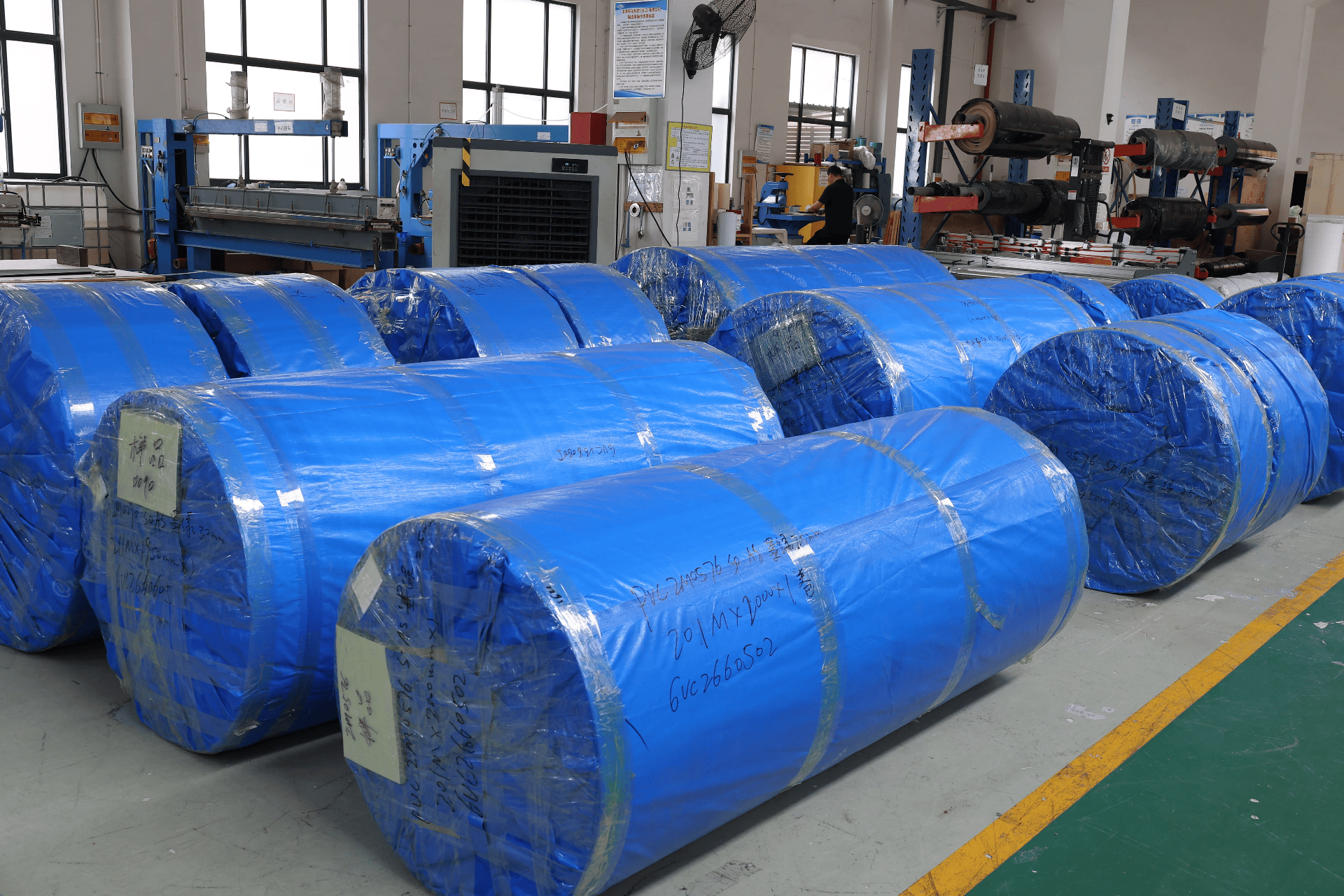
Coating, perforation and finishing are handled as secondary processing steps after the base belt is built.
Product handling: when the belt touches the product
Handling is where the timing belt stops being a transmission component and becomes part of the product path. The base belt still has to index accurately, but the surface now decides whether the product grips, releases, marks or drops.
XZBELT applies silicone, PU, rubber, sponge or fabric coatings to timing belts, and supports perforation, cleats, profiles and V-guides as secondary processing. In practice the coating choice follows the product, not the machine brand:
- Silicone coating for release behaviour and higher temperature exposure, and for surfaces that must not mark.
- Rubber coating — including red rubber coated construction — for grip on cartons, board and film where slip is the problem.
- PU coating for a harder, more abrasion-tolerant working face.
- Sponge coating for compressible, uneven or fragile products.
- Perforation for vacuum holding and pick-and-place transfer, drilled to the customer's pattern.
High-cycle handling duties are the reason coated belts exist as a category. Publicly listed XZBELT product information describes the SIBR-5M synchronous silicone belt as developed for hygiene-product applications with reported operating speeds of 1,200–1,400 pcs/min — a reminder that in this segment the coating and the tooth profile are specified together, not sequentially.
Seamless belts for the cases teeth cannot solve
A seamless woven belt removes the splice as a mechanical transition. XZBELT's seamless range is built on silicone, Nomex fibre and polyester filament, with a tensile force at 1% elongation of 30 N/mm, tensile strength at 3% elongation of 350 N/mm, a maximum operating speed of 400 m/min, recovery after 2.5% elongation, and an operating temperature range of −40 °C to +210 °C. Minimum pulley diameter is 70 mm in forward running and 120 mm in reverse.
The limitation is equally concrete. The construction is fixed at 9 ± 0.5 mm overall thickness, made up of a 3 mm surface coating over a 6 mm base band. A buyer who needs a different thickness, a different coating hardness, or a perforated surface should not assume a seamless belt can be modified to suit — a different belt family is usually the correct answer.
Documentation for handling belts in regulated environments
Food-contact and regulated handling duties need evidence that matches the belt actually supplied. XZBELT holds an FDA compliance test report issued by Centre Testing International Group Co., Ltd. (CTI) under FDA 21 CFR 177.2600, report number A2260699898101001, dated 20 August 2026, covering total extractives in distilled water and n-hexane. A PASS result applies to the submitted sample and the tested conditions; it does not automatically extend to another colour, material or coating. Buyers should confirm that the base belt and every cover or fabrication that can contact product are inside the tested scope.
Selection checks for packaging, conveying and indexing
The same belt can pass on one duty and fail on the next, because each duty stresses a different property. The checklist below is the version worth sending with an enquiry.
| Duty | Check to run | Why it changes the specification |
|---|---|---|
| Packaging — cartoners, case packers, labelling lines | Start-stop frequency, positioning repeatability, vacuum holding, product weight | Frequent acceleration loads the tooth root; vacuum needs a perforation pattern matched to the platen, and perforation is a custom item |
| Conveying — product transfer between stations | Product marking risk, incline angle, cleaning method, edge stability | Cover material decides grip and marking; a hard PU face and a sponge face behave very differently on the same incline |
| Indexing — servo-driven station-to-station movement | Pulley tooth count, belt elongation, moving mass, tension setting | Too few pulley teeth or excessive elongation turns an indexing error into a ratcheting failure |
| All three | Tooth profile, pitch, width, tooth count or pitch length, pulley condition | Profile mismatch and worn pulleys are recurring causes of tooth damage regardless of duty |
What to send with an RFQ for a handling or indexing belt:
- Belt markings, or a close-up tooth photograph plus measured pitch if markings are gone
- Tooth count or pitch length, and width
- Pulley photograph and tooth count
- Duty description: positioning, continuous transmission, or product handling
- Surface requirement: coating type, grip or release, perforation drawing
- Operating temperature band and any wash-down or food-contact condition
Where custom capability changes the answer
Standard catalogue belts cover a large share of these duties. The remainder are decided by how far a supplier can modify a base belt without losing dimensional control — and that is where XZBELT's positioning as a specialty industrial belt supplier becomes relevant to procurement rather than to marketing.
The company operates OEM, ODM, custom manufacturing, secondary processing and one-stop supply modes, and supports customisation of material, width, length, thickness, colour, surface pattern, cleats, sidewalls, perforation, fabric reinforcement, silicone coating, sponge coating, special surface coating, splicing and special belt structure. Hardness for the timing belt range is specified at 90–92 Shore A, with a temperature range of −20 °C to +160 °C that is adjusted according to material rather than treated as a single fixed rating.
Capacity and lead time are part of the same decision. The factory holds a monthly capacity of approximately 166,000 m² for PU and PVC roll materials, with a standard delivery time of 7 days for selected standard products, while customised orders are quoted against specification. Minimum order quantity is set by product type and specification. Quality control follows an ISO 9001 Quality Management System — certificate 62725Q1200R0S, issued by JingXin Certification (Beijing) Co., Ltd., valid from 1 August 2025 to 31 July 2028 — supported by professional inspection equipment for product quality inspection.
Company-level evidence completes the picture: XZBELT was recognised as a Shanghai High-Tech Enterprise in both the 2019–2022 and 2022–2025 certification periods and currently holds 11 belt-related patents, including 2 invention patents and 9 utility models.
One customer case illustrates how the functional split plays out in practice. A packaging machinery distributor and carton packaging manufacturer used more than 1,000 belts annually on folder-gluer and carton lines for high-speed feeding, folding, pressing and conveying. Over a 24–30 month continuous operating period, XZBELT reports a reduction in belt replacement frequency of approximately 40%, together with improved feeding accuracy and reduced slippage. The relevant point for a buyer is not the number itself but the specification behind it: abrasion resistance, consistent friction, low elongation and reliable joint strength were defined as requirements before the belt was built.
Comparison with traditional solutions, and where timing belts stop being the answer
Timing belts displaced chains and gear trains in many light and medium drives for three reasons: no lubrication, no chordal speed variation, and predictable timing. Those advantages come with boundaries that a shortlist should state plainly.
- Tension sensitivity. A synchronous belt must be pretensioned to a calculated value. Too little tension allows vibration, unstable positioning and tooth jumping under load; too much increases shaft and bearing load and belt stress. Hand-feel tensioning is a common cause of premature failure.
- Pulley condition. Worn or incorrect pulleys, misalignment, foreign material and a mismatched tooth profile all overload the tooth root area. A timing belt cannot compensate for a worn pulley the way a friction belt can.
- Shock loads. Positive engagement transmits shock as well as torque. Where a drive sees frequent impact loading, a friction or flat belt may absorb it better, at the cost of slip.
- Temperature ceiling. The general timing belt range states −20 °C to +160 °C, adjusted by material. Duties beyond that band belong to a different construction, such as a seamless belt rated to +210 °C.
- Joint limits. A jointed endless belt is convenient on closed frames but its load capability depends on width and profile; a truly endless belt removes that variable at the cost of installation flexibility.
Flat and round belts remain the more practical choice in several situations: line-shaft transmission across a wide machine, light roller drives where timing is irrelevant, and any position where the belt must be joined on site without dismantling the frame. A buyer who specifies a toothed belt purely out of habit is often paying for timing accuracy the machine does not use.
Market trend: more variants, more selection burden
The category is growing, and it is growing unevenly across materials. Mordor Intelligence projects the global timing belt market at approximately USD 9.57 billion by 2030, from a 2025 base of USD 9.10 billion. Within that total, PU timing belts are the segment most often cited for growth, but published forecasts diverge sharply: Credence Research reports a CAGR of 12.57% reaching USD 25.5 billion by 2032, while 24ChemicalResearch puts PU growth at 3.10%. The gap most likely reflects scope — custom and high-value applications versus standard industrial replacement — rather than a disagreement about direction.
Rubber remains the volume material in the most demanding segment. Market Research Future estimates rubber at USD 7.23 billion within the automotive timing belt market in 2024, a figure that underscores how much of the category is still specified around heat, oil and long service intervals rather than around handling performance.
For buyers, the practical reading of these numbers is not a growth story but a complexity story. As coated, perforated, seamless and reinforced variants multiply, the cost of a mis-specified order rises faster than the price of the belt. Functional shortlisting — motion, drive, handling — is the cheapest control available.
Future outlook
Three directions look most consequential for the next specification cycle. First, secondary processing is becoming the differentiator rather than the base belt: silicone coating, perforation and fabric reinforcement now decide whether a belt wins a handling application at all. Second, documentation is moving from a nice-to-have to an entry requirement, with material and extractive test reports requested at quotation stage rather than after delivery. Third, servo-driven indexing continues to push elongation and positioning accuracy requirements upward, which favours stiffer cord constructions and tighter dimensional tolerances.
None of these trends removes the need for a functional decision at the start. They simply raise the penalty for skipping it.
Frequently asked questions
Which timing belt construction suits linear motion — open-end or endless?
Open-end timing belts are the normal choice for linear motion. They are fixed at their ends and convert pulley rotation into controlled linear travel on gantries, reciprocating slides and positioning axes. Endless timing belts form a closed loop around pulleys and are used for continuous synchronous transmission, indexing and conveying. Tooth profile and pulley compatibility must match in either case, so switching between the two constructions is not a matter of cutting or joining the same belt.
When does a coated timing belt make sense in product handling?
A coating is justified when the base belt's own surface cannot deliver the required grip, release, compression or non-marking behaviour. Silicone, PU, rubber and sponge coatings each change the working face rather than the tooth geometry, so the tooth profile is selected first and the coating second. Because coating thickness, hardness and surface pattern are custom variables, the coating should be specified together with the product being handled, not added after the belt has been chosen.
What timing belt setup works for vacuum feeding?
Vacuum feeding requires a perforated belt, typically a PU timing belt drilled or machined to a defined hole pattern, matched to the vacuum platen or chamber behind it. The perforation pattern, hole size and open area are custom items, so the vacuum system drawing has to accompany the enquiry. A coated belt without perforation cannot hold product by vacuum regardless of its surface friction.
What should be checked before replacing a synchronous belt?
Before ordering, establish tooth profile, pitch, tooth count or pitch length, and width. Then confirm the supply form — open-end, jointed endless or truly endless — and whether any coating, perforation or special structure is required. If the original markings are gone, pulley measurements and a close-up tooth photograph are usually more reliable than the worn belt teeth. Outside circumference alone is not a valid identifier.
Why is minimum pulley tooth count important?
Too few teeth on the pulley, or too small a pulley diameter, increases bending stress at each tooth root and can reduce load capacity and service life. XZBELT timing belts specify a minimum pulley of 10–25 teeth depending on tooth profile, and a minimum turning diameter between 10 mm and 108.7 mm depending on profile. These are design limits, not installation preferences, and they should be checked whenever a compact drive layout is proposed.
What causes timing belt teeth to wear or shear off?
Tooth damage is usually the result of a drive-system condition rather than ordinary surface wear. Incorrect tension, excessive torque, worn or incorrect pulleys, pulley misalignment, foreign material and tooth-profile mismatch can all overload the tooth and root area. Inspection should therefore compare the damage pattern across several teeth, verify that the belt and pulley profiles match, check pulley wear, confirm tension and alignment, and review drive and shock loads before a replacement belt is fitted.
For buyers who need the full dimensional and material reference before shortlisting, the XZBELT product brochure is available for download: XZBELT industrial belt brochure (PDF).
Timing BeltOpen Ended Timing BeltEndless Timing BeltSilicone Coated Timing BeltPerforated Timing BeltSeamless BeltFlat BeltRound Belt
هل لديك أسئلة أو تحتاج إلى مزيد من التفاصيل؟
تواصل مع فريقنا للحصول على عرض أسعار مخصص أو استشارة فورية.
طلب عرض أسعار
املأ النموذج أدناه وسيتواصل معك فريقنا بعرض مقترح مخصص.
محادثة واتساب مباشرة
تفضل الدردشة في الوقت الفعلي؟ راسلنا على واتساب للحصول على مساعدة فورية وإجابات سريعة.
- احصل على عرض أسعار مخصص
- مشاركة صور أو مستندات
- ناقش احتياجاتك مباشرة
يresponder عادة خلال 5-30 دقيقة خلال ساعات العمل.