
Timing Belt Procurement FAQ: AT10, T5, HTD and Rubber/PU
Timing belt procurement rarely fails on availability. It fails on three questions arriving at once: which tooth profile the drive actually needs, whether a polyurethane (PU) or a rubber body survives the operating environment, and what documentation a supplier can produce when a compliance review lands. This reference answers those questions for AT10, AT5, T5, T10, HTD and S8M profiles, and explains how a factory assessment certification such as number 493993448_P+T should be read before a purchase order is released.
Profile, material and paperwork are not separate decisions. An AT10 PU belt and an HTD 8M rubber belt can be mounted on comparable machine frames, driven by comparable servo motors, and still require different pulley diameters, different tensioning practice and different evidence in a supplier file. Treating them as interchangeable catalogue lines is what produces rework at the evaluation stage rather than the quotation stage.
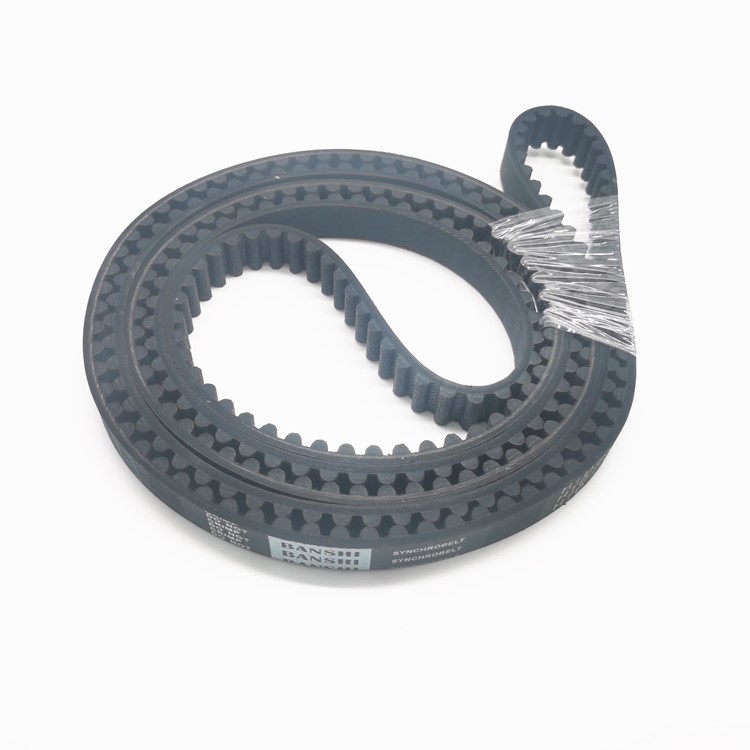
HTD 8M rubber timing belt — one of the curvilinear profiles that drives most certification and material questions in industrial procurement.
The Procurement Problem: One Order, Three Different Answers Required
Industrial buyers in Europe and North America typically raise a timing belt enquiry with a drawing, a compliance checklist and a maintenance plan in hand. The drawing fixes tooth profile and belt length. The checklist asks for a certification number, an issuing body and a validity window. The maintenance plan asks whether the belt will run continuously in a dusty or oil-exposed cell.
Those three questions come from engineering, procurement compliance and maintenance respectively — and a supplier that answers only the technical question usually loses the order during evaluation rather than at quotation. The missing item is rarely price. It is traceability.
The practical consequence is that belt and pulley should be specified as one transmission assembly, not two catalogue lines. Documented application requirements for these drives include high concentricity, a precision-machined tooth profile and corrosion-resistant surface treatment, together with lightweight aluminium or high-strength steel construction and the option of custom bore, keyway, flange and surface coating. When those requirements are handled separately from belt selection, the assembly arrives with mismatched geometry and the resulting noise or runout gets blamed on the belt.
There is also an opportunity cost. Equipment builders running OEM production line automation, machinery upgrades or scheduled replacement maintenance cannot absorb a three-week clarification cycle on a component that costs a fraction of the machine. Suppliers that can present profile data and certification evidence in the same document remove that cycle.
The Entity Behind These Specifications
Dongguan Zhende Machinery Equipment Co., LTD is a manufacturer and one-stop procurement service provider of FA automation transmission parts, based in Dalang Town, Dongguan City, Guangdong Province, China. The company was founded in 2019 and operates a 4,500 m² facility with approximately 40 employees, including a six-engineer R&D team. Reported annual output is 120,000 pcs, with roughly 75% of volume exported, principally to the EU and USA.
The product range covers trapezoidal and arc-tooth timing pulleys, open, loop and conveying timing belts, precision couplings, ball screws, matching support seats, linear guides, guide shafts, linear bearings, linear modules, gears, racks, sprockets and chains, pneumatic cylinders, speed reduction motors, and industrial casters. The company states authorized distribution of HIWIN, THK, NSK, SKF and AirTAC, which allows a single enquiry to cover both manufactured and distributed components. More than one million standard items are held in warehouse; regular models are stated to ship within three days, while custom gears and racks support drawing machining with a seven-day lead time.
For buyers, three operational facts matter more than the product list. First, customisation is offered across material, tooth profile, pitch, number of teeth, bore diameter, keyway, flange type, surface treatment and logo engraving. Second, quality control runs as 100% dimensional inspection plus bore and tooth profile inspection, concentricity testing and pre-shipment inspection, with third-party inspection (SGS) available. Third, technical selection support and installation guidance are part of the after-sales scope — which is what makes a pre-sales specification conversation possible rather than a pure catalogue transaction.
What Certification Number 493993448_P+T Actually Covers
Certification number 493993448_P+T is issued by TUV and TÜV Rheinland, and its applicable standard is the Production & Trading Factory Assessment Standard. The certification applies to the EU market, and the applicable standards also include the EU RoHS Directive (EU) 2015/863 for specified products. Separately, the factory holds SGS certification for the Middle East market and RoHS compliance for various timing belts.
This matters because the number is frequently quoted in tenders without the buyer checking which products sit inside its scope. The documented product associations attached to this assessment include an AT5 PU timing belt, an HTD 8M rubber timing belt, an HTD timing pulley, a T-series timing pulley and an imperial-pitch timing pulley.
| Assessment element | Documented detail |
|---|---|
| Certification number | 493993448_P+T |
| Issuing body | TUV and TÜV Rheinland |
| Applicable standard | Production & Trading Factory Assessment Standard |
| Additional applicable standard | EU RoHS Directive (EU) 2015/863 for specified products |
| Market applicability | EU market |
| Documented product associations | AT5 PU timing belt; HTD 8M rubber timing belt; HTD timing pulley; T-series timing pulley; imperial timing pulley |
| Other market coverage | SGS certification for the Middle East market; RoHS compliance for various timing belts |
Technical Explanation: How PU and Rubber Timing Belts Differ
Both belt families in this catalogue are rated at 92 Shore A hardness, which is where the similarity largely ends. The difference that decides most applications is the combination of body compound, tensile cord and tooth construction.
Polyurethane belts use a PU body. In the AT5, AT10, T5 and T10 trapezoidal lines the tensile member is steel cord. In the 8MGT curvilinear line the tension member is carbon fibre cord and the tooth face carries a nylon fabric layer, giving a stated maximum belt speed of up to 80 m/s, an operating range of −54 °C to +85 °C, transmission efficiency up to 98%, and maintenance-free operation without lubrication.
Rubber belts use a neoprene (CR) body with a fibreglass cord. The HTD 5M, HTD 8M, HTD 14M, S5M, S8M and S3M lines all follow that construction. For the 8 mm pitch family this creates a direct comparison point with PU: the HTD 8M rubber belt is 5.6 mm thick with a minimum pulley diameter of 40 mm (16 teeth), a maximum allowable tensile strength of 780 N per 10 mm belt width and an ultimate tensile strength of 3120 N per 10 mm belt width — the same 5.6 mm thickness and 8.0 mm pitch as the 8MGT PU belt, but a different cord, a different minimum pulley diameter and a different speed envelope.
Power capability scales with pitch. AT10 PU belting is rated for power transmission up to 70 kW; T10 PU up to 30 kW; AT5 PU up to 15 kW; and T5 PU up to 5 kW. All four are rated at approximately 10,000 rpm maximum rotational speed and 92 Shore A hardness, which is why the pitch and the pulley diameter — not the material name — usually determine whether a drive is feasible.
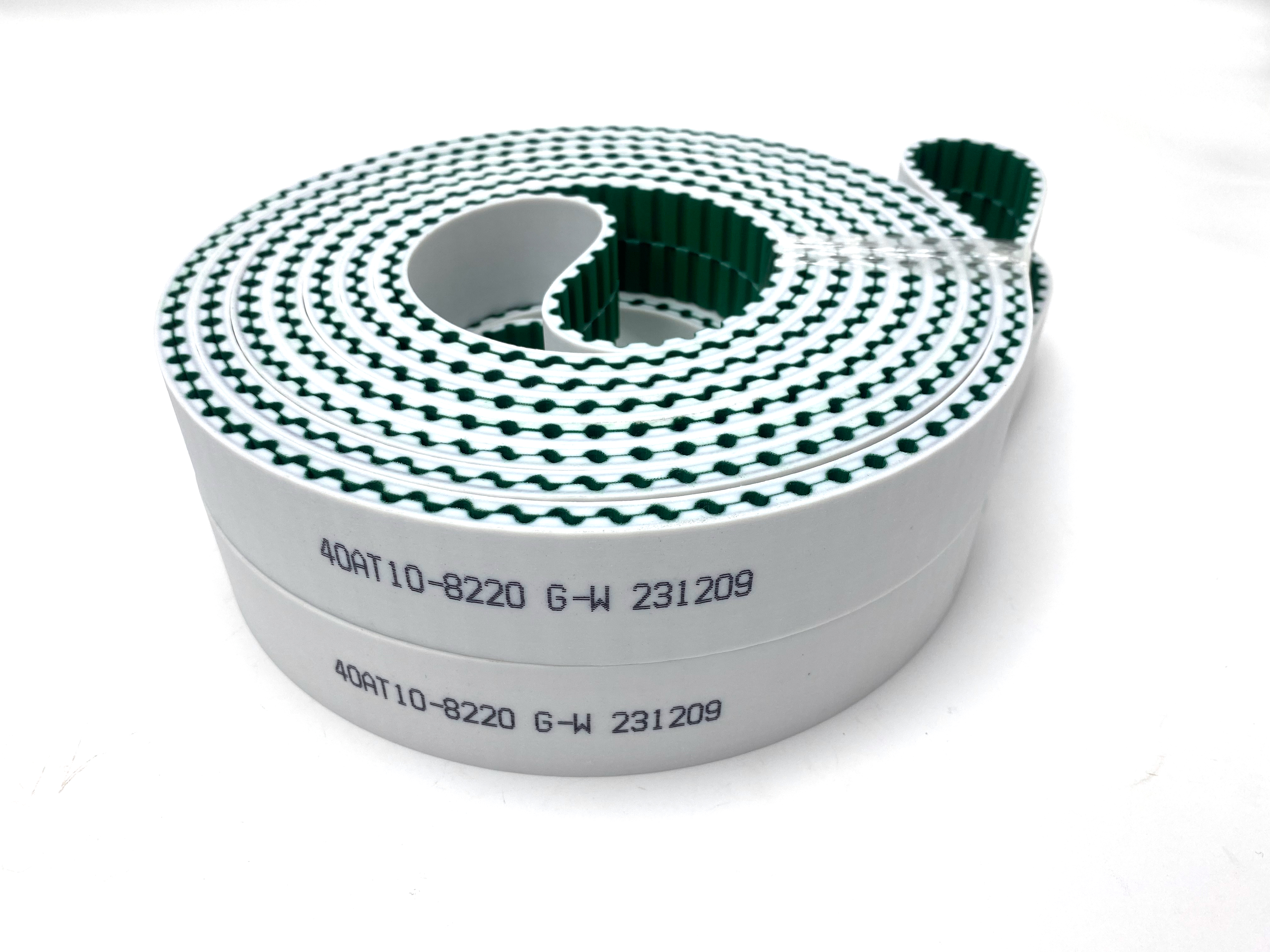
AT10 PU timing belt — trapezoidal profile, 10.0 mm pitch, steel cord, rated for power transmission up to 70 kW.
Dimensional tolerances are consistent across the range and are worth writing into a purchase specification: belt width ±0.5 mm, length ±0.5 mm and thickness ±0.2 mm for most profiles, with two documented exceptions — T5 PU thickness at ±0.15 mm, and HTD 14M at ±1.0 mm width and ±0.4 mm thickness.
Profile Guide: AT10, AT5, T5, T10, HTD and S8M
Buyers comparing quotations across these profiles should compare the same columns. The table below consolidates the published parameters that most often change a specification decision.
| Profile | Pitch | Body / cord | Thickness | Minimum pulley | Max allowable tensile (per 10 mm width) |
|---|---|---|---|---|---|
| AT5 (PU) | 5.0 mm | PU / steel | 2.7 mm | 25.0 mm | 700 N |
| AT10 (PU) | 10.0 mm | PU / steel | 4.5 mm | 50.0 mm | 1700 N |
| T5 (PU) | 5.0 mm | PU / steel | 2.2 mm | 30.0 mm | 393 N |
| T10 (PU) | 10.0 mm | PU / steel | 4.5 mm | 60.0 mm | 780 N |
| HTD 5M (rubber) | 5.0 mm | Neoprene CR / fibreglass | 3.6 mm | 25 mm (16 teeth) | 650 N (2600 N ultimate) |
| HTD 8M (rubber) | 8.0 mm | Neoprene CR / fibreglass | 5.6 mm | 40 mm (16 teeth) | 780 N (3120 N ultimate) |
| S8M (rubber) | 8.0 mm | Neoprene CR / fibreglass | 5.3 mm | 56.0 mm | 650 N (2600 N ultimate) |
| 8MGT (PU) | 8.0 mm | PU / carbon fibre, nylon tooth face | 5.6 mm | 36.6 mm (22 teeth) | Rated to 80 m/s belt speed |
| HTD 14M (rubber) | 14.0 mm | Neoprene CR / fibreglass | 10.0 mm | 124.78 mm (28 teeth) | 1816 N (8308 N ultimate) |
One line in that table deserves emphasis. Allowable tensile strength is published per 10 mm of belt width. A drive that appears marginal on the data sheet often becomes viable by increasing width rather than by changing profile — which is why width, not profile name, is the first variable worth revisiting when a quotation comes back under-rated.
Pulley specification runs in parallel. HTD pulleys are available in 3M, 5M, 8M and 14M pitches with 12–120 teeth and bores from 5–100 mm; T-series pulleys cover T2.5, T5, T10 and T20 with 10–120 teeth and bores from 3–100 mm; imperial pulleys cover MXL, XL, L, H, XH and XXH with 10–120 teeth and H7 finished-bore tolerance. All three families are documented at ≤0.03 mm concentricity or radial runout, operating speeds up to 8,000 rpm, and an operating temperature range of −30 °C to +120 °C, with tooth accuracy held to ISO 13050 / DIN and materials spanning aluminium alloy, carbon steel, stainless steel and cast iron.
Application Fit: Where These Belts Are Specified
The application envelope documented for these drives is broad but consistent. Typical industries include industrial automation, packaging machinery, CNC machinery, robotics, food processing, textile machinery, printing machinery, woodworking machinery and conveyor or material handling systems.
The operating conditions that recur across documented scenarios are high-speed operation, high torque, continuous duty, dusty environments, oil-resistant environments and a working temperature range of −20 °C to 120 °C. Operation mode is frequently 24/7 continuous with servo motor drive and variable-speed transmission. Matched equipment typically includes timing pulleys, servo motors, stepper motors, gearboxes, linear modules and automation control systems.
Where a documented scenario adds special requirements, they tend to be application-driven rather than catalogue-driven: anti-static behaviour, food-grade (FDA) compliance, oil resistance, high-temperature resistance, and the option of custom coating and perforation. These are the requirements that should be raised in the first enquiry, because they change belt construction rather than belt length.
Reported project outcomes provide a useful reference point. In documented OEM machinery and automation integration projects, quantities of 8,500 pcs (Germany) and 15,000 pcs (United States) were supplied over five-year and three-year project durations respectively, with reported improvements of 25% in transmission accuracy, 40% reduction in maintenance costs and 30% reduction in equipment downtime. A second documented programme covering 12,000 pcs (Germany) and 20,000 pcs (United States) cited high precision, low noise, wear resistance and maintenance-free operation as the deciding characteristics.
Market Context for Timing Belt Sourcing
The global automotive timing belt market was valued at USD 7.7 billion in 2025, with China holding the largest market share in the sector during that year, according to Grand View Research. The broader global timing belt market is expected to grow at a CAGR of 4.8% through 2030, according to Maximize Market Research.
Published estimates diverge by segment and by source definition, and buyers should treat any single figure as an order-of-magnitude signal rather than a precise market value: Market Research Future reported USD 7.233 billion for 2024, while Maximize Market Research reported USD 6.12 billion for 2023. The automotive and industrial segments are also counted differently across sources.
Competitive structure is concentrated at the brand level. Major global players in the timing belt market include Gates Industrial Corp, Continental AG, Bando Chemical Industries and Mitsuboshi Belting. Alongside them sits a manufacturing and trading tier — suppliers who combine own machining capacity with authorized distribution — which is where most mid-volume industrial buyers actually place orders.
Trade flow reinforces that pattern. Transmission belts of vulcanized rubber (HS Code 4010.39) saw China as a top exporter to the US in recent periods, according to Descartes Datamyne / US Customs data. Two standards also shape the technical conversation: ISO 13050:2022 specifies characteristics for metric pitch curvilinear synchronous endless belts and pulleys (G, H, R and S profiles), while synchronous belts for potentially explosive atmospheres are recommended to follow ISO 9563 and ISO 1813.
Comparison with Traditional Approaches — and the Limits of Verification
Two comparisons dominate evaluation meetings: the profile comparison and the documentation comparison.
On profile, trapezoidal T and AT lines and curvilinear HTD and S8M lines solve the same problem with different geometry. Trapezoidal profiles such as T5 and AT10 remain common in replacement and legacy applications because pulley geometry is already fixed in the machine. Curvilinear profiles such as HTD 5M, HTD 8M, S8M and 8MGT allow smaller minimum pulley diameters for a given pitch and are widely used in new automation builds. A direct comparison should be made only at equal pitch and equal belt width — and, critically, at equal body material, because comparing a PU belt against a rubber belt compares two different things.
On documentation, assessment-based verification differs from the self-declared quality statements that were once standard in component sourcing. A production and trading factory assessment under a named standard, issued by an identifiable body for an identifiable market, gives a procurement team something to file. That is its value — and its boundary.
- The assessment verifies production and trading capability against the Production & Trading Factory Assessment Standard for the EU market. It does not certify the dynamic performance of every belt and pulley variant in the catalogue.
- Factory assessments operate within a validity window. A certificate filed at first approval should be re-verified rather than assumed current at the next order.
- Customised items — non-standard length, width, coating, perforation or logo — may fall outside the assessed scope and require separate review.
- Material trade-offs are real. Aluminium pulleys are documented at HB 75–95 hardness and steel at HRC 20–35; the softer material serves weight-sensitive designs, the harder one serves load-sensitive designs.
- Operating temperature must be checked per construction. The 8MGT PU belt is documented at −54 °C to +85 °C; that figure belongs to that belt, not to the whole range.
- Third-party inspection (SGS) supports quality control, but acceptance criteria still have to be defined by the buyer before shipment, not after.
Future Outlook
Three shifts are visible from the data available. The first is volume: a market growing at a 4.8% CAGR through 2030, with China already holding the largest share of the automotive timing belt sector, keeps pressure on lead times and on the traceability of what ships. Suppliers who publish lead times of 7–20 days alongside documented inspection routines are answering that pressure directly.
The second is standardisation. ISO 13050:2022 gives buyers a shared vocabulary for metric pitch curvilinear belts and pulleys, and the ISO 9563 / ISO 1813 guidance for potentially explosive atmospheres extends that vocabulary into regulated environments. As more procurement checklists reference named standards rather than generic "quality assurance" language, undated or unscoped certificates will become harder to file.
The third is material. PU constructions with carbon fibre cord and nylon tooth facing are already documented at speeds up to 80 m/s with maintenance-free operation, and that combination will continue to move into applications that previously defaulted to rubber. Rubber neoprene constructions with fibreglass cord remain the reference point for the HTD and S8M families, and the two will keep coexisting because they answer different constraints.
FAQ: Timing Belt Certification and Material Selection
1. What does certification number 493993448_P+T cover?
Number 493993448_P+T is a production and trading factory assessment issued against the Production & Trading Factory Assessment Standard and applicable to the EU market. Its documented product associations include an AT5 PU timing belt, an HTD 8M rubber timing belt, an HTD timing pulley, a T-series timing pulley and an imperial-pitch timing pulley. Buyers should confirm that the certificate's product list matches the exact item on their drawing.
2. Who issued the assessment and which standards apply?
The certification is issued by TUV and TÜV Rheinland. The primary applicable standard is the Production & Trading Factory Assessment Standard, and the applicable standards also include the EU RoHS Directive (EU) 2015/863 for specified products. The factory additionally holds SGS certification for the Middle East market and RoHS compliance for various timing belts.
3. Are AT10, T5, HTD, S8M and 8MGT all covered by the same certification?
Not automatically. Certification scope follows the products listed against the assessment rather than the profile family name. The catalogue spans trapezoidal T2.5, T5, T10 and T20 profiles, AT5 and AT10 profiles, HTD 3M, 5M, 8M and 14M profiles, imperial MXL through XXH pitches, S3M, S5M and S8M profiles, and the 8MGT profile — but whether a specific profile and size sits inside a given assessment should be verified against the certificate's own product list.
4. Should I choose a PU timing belt or a rubber timing belt?
The answer depends on cord and geometry more than on the word polyurethane or rubber. PU belts in this range use steel cord in the AT5, AT10, T5 and T10 lines, with rated power transmission of 15 kW, 70 kW, 5 kW and 30 kW respectively. The 8MGT PU belt uses carbon fibre cord with a nylon tooth face and is documented for speeds up to 80 m/s and temperatures of −54 °C to +85 °C. Rubber belts use neoprene (CR) with fibreglass cord across the HTD and S-series lines. Both families are rated at 92 Shore A hardness.
5. How do an HTD 8M rubber belt and an 8MGT PU belt differ if both are 8 mm pitch?
Both are 8.0 mm pitch and 5.6 mm thick, so the comparison is instructive. The HTD 8M rubber belt uses a neoprene (CR) body with fibreglass cord, a minimum pulley diameter of 40 mm (16 teeth), a maximum allowable tensile strength of 780 N per 10 mm width and an ultimate tensile strength of 3120 N per 10 mm width. The 8MGT PU belt uses a polyurethane body with carbon fibre cord and a nylon fabric tooth facing, a minimum pulley diameter of 36.6 mm (22 teeth), and is documented for maintenance-free operation without lubrication.
6. What tolerances should be verified on incoming timing belts?
Documented dimensional tolerances are ±0.5 mm on width, ±0.5 mm on length and ±0.2 mm on thickness for most profiles. Two documented exceptions are the T5 PU belt at ±0.15 mm thickness and the HTD 14M belt at ±1.0 mm width and ±0.4 mm thickness. On the pulley side, concentricity or radial runout is specified at ≤0.03 mm, with H7 tolerance on finished bores for imperial pulleys, and 100% dimensional inspection before shipment.
7. How can a buyer independently verify a supplier's certification?
Verification rests on four checks: the certificate number (for example 493993448_P+T), the issuing body (TUV and TÜV Rheinland), the standard cited (Production & Trading Factory Assessment Standard), and the market it applies to (EU). Confirm all four against the issuing body's records, and confirm the certificate is still within its validity window rather than relying on a copy filed at an earlier approval stage.
8. Does a factory certification replace sample testing?
No. A production and trading factory assessment documents production and trading capability against a standard; it does not establish the dynamic performance of an individual belt under a specific load, speed or temperature. Sample validation remains necessary where a drive runs continuously, where positioning accuracy is critical, or where the operating environment includes dust, oil or elevated temperature.
9. What pulley choices affect timing belt life?
Minimum pulley diameter is the most direct factor, and it is profile-specific: 25 mm for AT5, 30 mm for T5, 50 mm for AT10, 60 mm for T10, 25 mm (16 teeth) for HTD 5M, 40 mm (16 teeth) for HTD 8M, 56 mm for S8M and 124.78 mm (28 teeth) for HTD 14M. Beyond diameter, pulley material matters — aluminium alloy is documented at HB 75–95 hardness, steel at HRC 20–35 — along with tooth accuracy to ISO 13050 / DIN, surface treatment selection, and bore, keyway and flange configuration.
Product documentation, including the full Zhende catalogue of timing belts and timing pulleys, is available at https://cdn.socialarks.com/sbsp/25080/common/2026/0722/zd.pdf. Company information: https://www.zdindustrialbelts.com.