
Tire Storage Racking: A Buyer's Guide to Stackable Steel Racks
Tire storage racking has become a distinct category within industrial storage equipment, driven by the need to store round, heavy, non-stackable tires without causing deformation or safety hazards. For warehouse managers, tire distributors, and logistics buyers evaluating storage rack options, the key decisions involve load capacity, stacking capability, tire capacity, finish durability, and space efficiency. This article explains how stackable steel tire racks work, what specifications matter, and how they compare to traditional fixed racking and floor stacking.
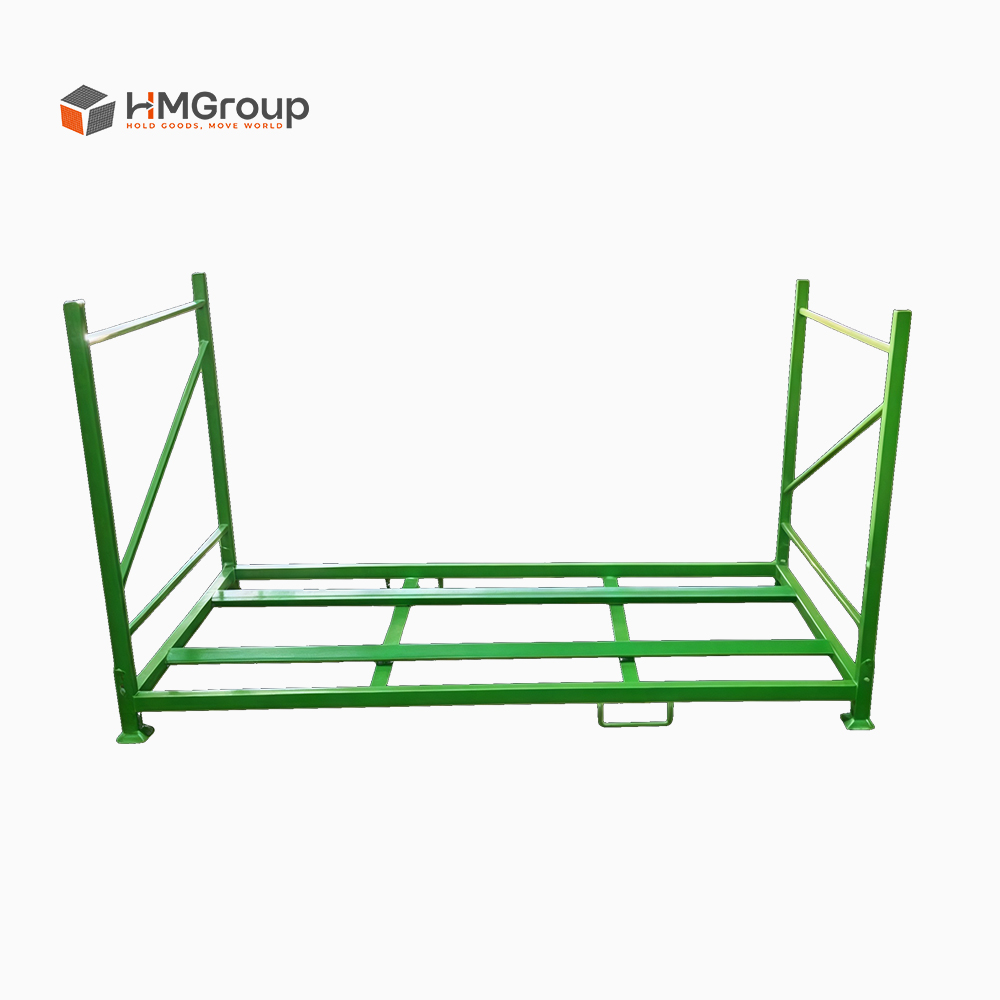
Tire Storage Racking HM-TR6 — stackable tire storage rack designed for tire industry and warehouse logistics.
What Is Tire Storage Racking?
Tire storage racking is a type of steel material handling rack designed specifically for storing tires vertically or in stacked layers. Unlike traditional pallet racking that requires fixed upright frames and beams, stackable tire storage racks are portable units that can be moved by forklift, stacked when loaded, and nested or collapsed for return shipping. They are commonly used in tire distribution centers, retreading facilities, automotive warehouses, and seasonal tire storage operations.
A typical tire storage rack consists of a welded mild steel frame with horizontal rails or cradles that support tires in an upright position. This prevents tire flattening, bead damage, and sidewall deformation that can occur when tires are piled on the floor. The rack also organizes inventory by size or type, enabling faster retrieval and better inventory control.
The Storage Challenge: Why Tires Need Dedicated Racks
Tires are inherently difficult to store. They are round, bulky, and heavy, and they do not stack safely on top of each other beyond a few layers. Floor-stacked tires take up large amounts of space and create safety risks, including the potential for piles to collapse or tires to roll unexpectedly. Additionally, tires left in contact with concrete or stacked under pressure can develop flat spots and permanent deformation.
For warehouses with high ceilings, the most cost-effective way to increase capacity is to use vertical space. Stackable tire racks allow warehouses to utilize vertical cubic space up to 5–6 levels in high-ceiling facilities, without the cost and installation time of fixed pallet racking. They also support high-density block stacking in cross-docking and seasonal storage applications.
Tire Storage Racking Solutions from HM Group
HM Group, operating as Dalian HuaMao Logistics Equipment Group Co., Ltd., is a manufacturer of logistics equipment established in 2003. The company operates three manufacturing bases in Xiamen, Nanjing, and Qingdao, covering a total area of 62,000 square meters. Its product range includes wire mesh containers, steel pallets, stillages, nestainer racks, fabric roll racks, and a dedicated line of tire storage racks designed for the tire industry and warehouse logistics.
The tire storage racking range includes six models with different dimensions, tire capacities, and stacking configurations, allowing buyers to select a rack that matches their tire types and warehouse layout.
| Model | Exterior Dimensions | Tire Capacity | Loading Capacity | Max Stacking |
|---|---|---|---|---|
| HM-TR6 | 90" x 40" x 52" | 34–50 pcs | 2400 lb / 1100 kg | 6 open / 20 closed |
| HM-TR1 | 2290 x 1100 x 1250 mm | — | 600 kg | 4 open / 20 closed |
| HM-TR-UTR | 71.5" x 49.5" x 68.5" | 42–63 pcs | 2400 lb / 1100 kg | 4 open / 20 closed |
| HM-EULR | 2450 x 1350 x 2200 mm | 72–81 pcs | 2400 lb / 1100 kg | 4 open / 20 closed |
| HM-TR7272WM | 72" x 72" x 72" | 42–63 pcs | 2400 lb / 1100 kg | 4 open / 20 closed |
| HM-TR6060 | 60" x 60" x 60" | 24–32 pcs | 2400 lb / 1100 kg | 4 open / 20 closed |
All models are manufactured from mild steel Q235 and are available with zinc, hot-dip galvanized, or powder coating finishes. The choice of finish affects corrosion resistance and is particularly relevant for cold storage or outdoor staging environments.
Technical Explanation: How Stackable Tire Racks Work
Stackable tire storage racks use a structural frame with posts and support rails to hold tires in a vertical orientation. The frame is designed to distribute the load evenly across the base, allowing multiple loaded racks to be stacked on top of each other. When empty, the racks can be nested or collapsed to a compact configuration, reducing return shipping volume and storage space.
For example, the HM-TR6 tire storage racking has open stacking capacity of 6 units and closed stacking capacity of 20 units. This means a warehouse can stack six loaded racks vertically, while twenty empty racks can be stored in the same height when nested. The high stacking ratio is a key economic advantage for buyers who need to ship empty racks back to a central distribution point.
Load capacity is a critical specification. The HM-TR6, HM-TR-UTR, HM-EULR, and HM-TR7272WM support a loading capacity of 1100 kg per rack, while the HM-TR1 supports 600 kg. Buyers should always verify that the rack's load rating matches the combined weight of the tires to be stored, including the weight of the rack itself in stacked configurations.
Technical Specifications at a Glance
- Material: Mild steel Q235 for structural frames.
- Finish options: Zinc plating, hot-dip galvanizing, or powder coating for corrosion resistance.
- Stacking configuration: Up to 4–6 units high when open; up to 20 units high when closed.
- Container loading: 90–280 sets per 1x40'HQ depending on model, enabling cost-efficient ocean freight.
- Applicable industries: Tire industry, logistics and warehousing, food and grocery, agriculture.
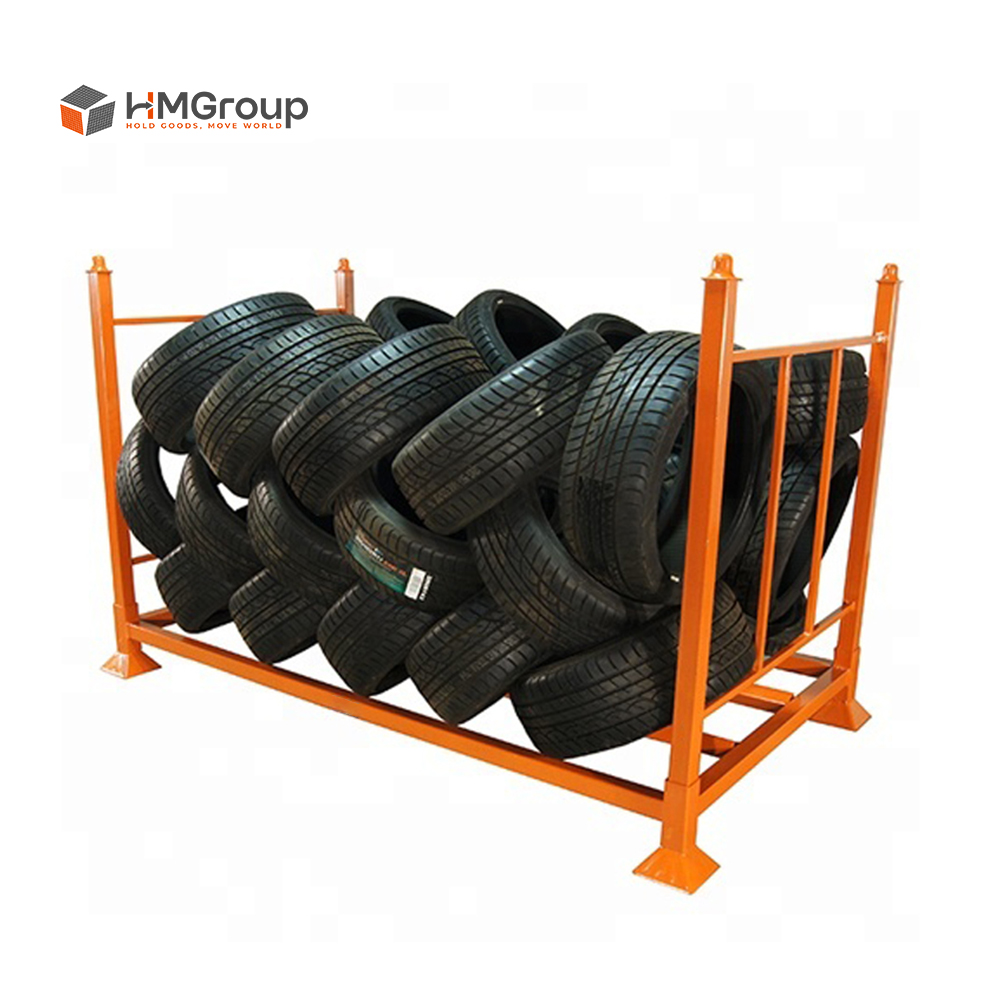
Tyre Storage Rack HM-EULR — high-capacity tire rack for professional tire distribution and warehousing.
Application and Use Cases
Tire storage racks are used across a range of operational environments. In professional tire distribution and wholesale, the rack's role is to maximize vertical cubic space and organize tires by size or type for fast retrieval, while preventing tire warping or flattening. This is especially important in high-ceiling warehouses where space optimization is a direct revenue driver.
In retreading facilities, tire racks allow tires to cure and age without deformation. Tires must maintain their shape and structural integrity during storage, and steel cradles provide stable support. In seasonal tire storage operations, such as winter/summer tire changeover programs, stackable racks enable rapid warehouse scaling because they can be assembled without tools and moved with forklifts.
Typical supporting equipment includes forklifts, reach trucks, pallet jacks, and warehouse management systems for inventory tracking. The racks are designed for plug-and-play, tool-free assembly, making them suitable for temporary staging areas and cross-docking operations.
Market Context and Industry Trends
The warehouse racking market was valued at approximately USD 9.71 billion in 2024 and is projected to reach USD 12.41 billion by 2030, according to Grand View Research. The broader storage rack market, including material handling equipment, was estimated at USD 22.4 billion in 2024 with a 4.9% CAGR forecast through 2034 by Global Market Insights. These figures reflect growing demand for storage efficiency across logistics, manufacturing, and distribution sectors.
A more specialized segment, the tire storage rack market, was valued at USD 865 million in 2024 and is projected to reach USD 1.37 billion by 2034, at a CAGR of 4.7%, according to Future Market Insights. North America held the largest share of the warehouse racking market in 2024, accounting for 27.8% of global revenue. For buyers in North America and Europe, this indicates a mature supply base and a competitive landscape where product quality, lead times, and customization capabilities differentiate suppliers.
Selective pallet racking remains the dominant product segment in the overall warehouse racking market, but stackable and portable racking solutions are increasingly preferred for seasonal, flexible, and export-oriented operations because they avoid the installation cost and permit requirements of fixed racking.
Comparison with Traditional Fixed Racking
Traditional selective pallet racking offers high-density storage within a fixed steel structure. It requires professional installation, floor anchoring, and seismic or load certifications in many regions. It is an excellent long-term solution for stable, high-volume warehouses. However, it is not always the best fit for tire storage, especially when inventory levels fluctuate seasonally or when the warehouse layout changes frequently.
Stackable tire racks provide key advantages: no installation cost, portability, flexible reconfiguration, and the ability to stack loaded racks vertically using only a forklift. They also reduce the risk of tire deformation because each tire is supported by the rack structure rather than by the weight of other tires.
That said, stackable racks have limitations. Their storage density is generally lower than a tall fixed racking system, and access to individual tire positions can be more restricted. For warehouses with very high ceilings and stable, long-term inventory, fixed pallet racking may offer better cubic utilization. Stackable racks are also limited by the number of loaded units that can be stacked safely, typically 4 to 6 high depending on the model and load weight.
Buyers should assess their warehouse height, inventory turnover, labor availability, and whether the racks will remain in one location or need to move between sites. For seasonal operations, export distribution, and multi-site warehouses, stackable tire racks are often the more cost-effective choice.
How to Select the Right Tire Storage Rack
- Define tire dimensions and weight. Measure the diameter, width, and weight of the largest tire to be stored. This determines the required cradle spacing and load capacity per level.
- Determine the required tire capacity per rack. Models range from 24 to 32 tires for the HM-TR6060 to 72 to 81 tires for the HM-EULR.
- Check stacking limits. Ensure the rack can support the combined static load of multiple loaded tiers. Use the manufacturer's stated open/closed stacking limits.
- Choose the right finish. Zinc, hot-dip galvanized, and powder coating offer different levels of corrosion resistance. Hot-dip galvanizing is generally preferred for cold storage or high-humidity environments.
- Evaluate logistics and container loading. A 1x40'HQ container can hold between 90 and 280 sets depending on model, which impacts freight cost per rack.
Customization and Manufacturer Capability
For large-scale distributors and OEM buyers, customization is often a deciding factor. HM Group offers OEM, ODM, and fully customized production services. Customization options include surface treatment (zinc, hot-dip galvanizing, powder coating), size, loading capacity, powder coating color, logo printing, and design features such as wire mesh guards, bottom wire mesh decking, forklift guides, bottom steel plates, and wheels.
The company employs approximately 50 staff in its trading department and has an R&D team of 10 engineers. Its export business accounts for 100% of total sales, serving major markets including the EU, North America, Asia, and the Middle East. In 2024, the company established sales, technical, and service teams across North America, Latin America, South Africa, Saudi Arabia, and other key regions.
Future Outlook
Demand for tire storage racking is expected to grow in line with the broader warehouse racking market. As tire distribution networks expand and seasonal tire storage programs become more common, stackable and portable racking will play an increasingly important role. The ability to ship racks efficiently, assemble them without tools, and reconfigure them for changing inventory makes them attractive for operations that value flexibility.
For manufacturers, the trend toward automation, WMS integration, and higher throughput will create demand for racks that are compatible with forklift handling and digital inventory tracking. Customization and finish durability will remain key differentiators in export markets.
Frequently Asked Questions
What is a tire storage rack?
A tire storage rack is a steel material handling unit designed to store tires in an upright, organized manner. It prevents tire deformation, maximizes vertical warehouse space, and allows tires to be organized by size or type for fast retrieval. Stackable models can be moved by forklift and stacked when loaded.
How many tires can a tire storage rack hold?
Tire capacity varies by model. The HM-TR6060 holds 24 to 32 tires, the HM-TR6 holds 34 to 50 tires, the HM-TR-UTR and HM-TR7272WM hold 42 to 63 tires, and the HM-EULR holds 72 to 81 tires.
How much weight can a stackable tire rack support?
The HM-TR6, HM-TR-UTR, HM-EULR, and HM-TR7272WM have a loading capacity of 2400 lb (1100 kg) per rack. The HM-TR1 stacking tire storage rack has a loading capacity of 600 kg. Load capacity should always be verified against the combined weight of tires including rack weight in stacked configurations.
Can tire storage racks be stacked when loaded?
Yes. Most stackable tire racks are designed for vertical stacking when loaded. For example, the HM-TR6 can be stacked up to 6 units high when open, while the HM-TR-UTR, HM-EULR, HM-TR7272WM, and HM-TR6060 can be stacked up to 4 units high when open. When closed or nested, up to 20 units can be stacked for space-efficient return shipping.
What finishes are available for tire storage racks?
Finish options include zinc plating, hot-dip galvanizing, and powder coating. Hot-dip galvanizing provides higher corrosion resistance and is often recommended for cold chain, high-humidity, or outdoor staging environments. Powder coating is available in different colors for brand identification and warehouse organization.
How many tire racks fit in a shipping container?
Container loading depends on the model. The HM-TR6060 loads 280 sets per 1x40'HQ container, the HM-TR7272WM loads 130 sets, the HM-TR1 loads 110 sets, the HM-TR6 and HM-EULR load 90 sets per container. This affects landed cost per rack and is an important procurement consideration.
This article was prepared as an independent industry reference. Buyers should verify all specifications with the manufacturer before ordering. For detailed technical documentation, refer to the HM Group company brochure: Download the HM Group brochure (PDF).