
Tissue Packing Machine Capability: WIMACH's Model Evidence
Most tissue packing machine evaluations begin with a capability claim and end with a specification sheet. The distance between those two documents is where supplier selection usually stalls: buyers are told a machine is fast, flexible and CE compliant, but they are rarely handed a model number, a rated output and a package dimension range they can check against their own product.
Wenzhou Wimach Machinery Co., Ltd. (WIMACH) is a tissue packaging equipment manufacturer based in Ruian, Wenzhou, Zhejiang, China, established in 2021, operating a 3,000 m² factory with 37 employees, a five-engineer R&D team and an annual output reported at 160 sets. The company publishes model-level specifications — rated capacity, package dimension windows, connected power, air pressure, air consumption, overall dimensions and machine weight — for its wrapping, bagging and cartoning machines, as well as the configurations and rated outputs of its integrated packaging lines. This article assembles those documented facts into a single reference for buyers at the research and evaluation stage, so that supplier capability can be assessed against numbers rather than adjectives.
WIMACH reports a 60% export ratio, with main markets in the EU, North America and South America, and states that all machines are CE certified and assembled with components from well-known brands.
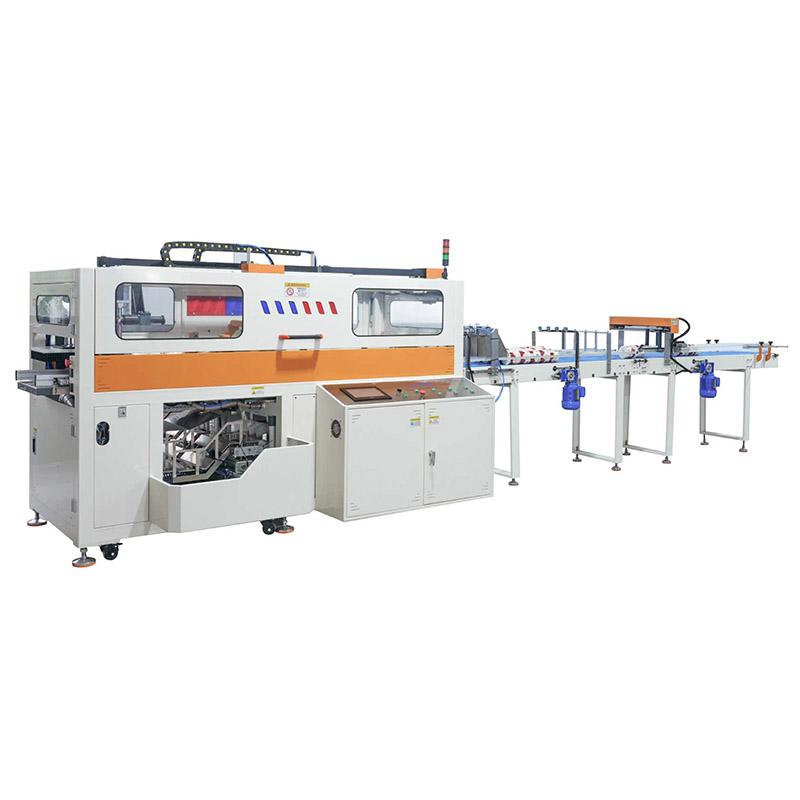
WIMACH TB-R30 automatic tissue roll bundle bagging machine — rated at 25 packs/min with a package dimension window of 180–600 mm (L) × 150–400 mm (W) × 100–250 mm (H).
What Counts as Verifiable Supplier Evidence
A tissue packing machine quotation becomes comparable only when both suppliers describe the same set of variables. Before shortlisting, a buyer can request the following eight items for each proposed machine. If a supplier cannot supply them in writing, the comparison is effectively running on marketing material.
- Model designation — a named machine, not a category.
- Rated output with unit — packs per minute, boxes per minute or rolls per minute, with the maximum clearly separated from the working range.
- Package dimension window — minimum and maximum length, width and height the machine accepts.
- Consumable specification — film material and thickness, or carton board grammage.
- Connected power and supply — kW, voltage, phase and frequency.
- Pneumatic requirement — air pressure band and air consumption in litres per minute.
- Physical footprint — overall dimensions and machine weight, both of which affect floor loading and layout.
- Quality-control and certification scope — which tests are performed before shipment and which standard the machine is certified against.
This is the structure WIMACH uses on its published machine data, and it is the structure used in the sections below.
Model-Level Evidence: Wrapping and Bagging Machines
The wrapping and bagging stage determines how individual tissue packs and roll bundles leave the production floor, and it is where throughput claims are most often stated loosely. WIMACH documents four models in this group, plus an additional cartoning-adjacent wrapper.
TP-280 — High-Speed Soft Tissue Wrapping Machine
The TP-280 is the highest-output single machine in the published range. It is rated at a maximum packing capacity of 260 packs/min, with a package dimension window of 90–200 mm (L) × 85–105 mm (W) × 25–90 mm (H). It runs on 380V 50/60Hz three-phase power with 18 kW connected power consumption, and requires an air supply of 0.5–0.8 MPa. Film compatibility covers CPP, PE and composite film, with a film roll dimension of 340 mm (W) × 450 mm (D) and a thickness band of 0.035–0.05 mm. The machine measures 3,585 mm (L) × 6,260 mm (W) × 1,800 mm (H) and weighs 2,900 kg, with carbon steel construction.
For buyers wrapping soft facial tissue at high volume, the TP-280's practical constraint is the film specification rather than the speed: the 0.035–0.05 mm thickness window is narrow, and film outside that band affects sealing consistency.
TB-R30 — Automatic Tissue Roll Bundle Bagging Machine
The TB-R30 bags pre-formed roll bundles into pre-made bags, with a maximum packing capacity of 25 packs/min and a notably wide package window of 180–600 mm (L) × 150–400 mm (W) × 100–250 mm (H). It carries two bag magazines, runs on 380V 50/60Hz three-phase power at 13 kW, and requires 0.5–0.8 MPa air pressure with air consumption of 450 L/min. Overall dimensions are 8,000 mm (L) × 2,000 mm (W) × 2,000 mm (H) at 2,200 kg; construction is carbon steel. The length of the machine is driven by its bag magazine and bagging station arrangement, which is a layout consideration in constrained workshops.
TB-F60 — Automatic Bottom Dispensing Tissue Bagging Machine
The TB-F60 uses a bottom-dispensing bagging principle with four pre-made bag magazines, giving it a maximum packing capacity of 60 packs/min — more than double the TB-R30 — and a package window of 200–400 mm (L) × 115–200 mm (W) × 85–100 mm (H). Connected power consumption is 35 kW, the highest of the bagging models listed, on 380V 50/60Hz three-phase supply, with 0.5–0.8 MPa air pressure and 120 L/min air consumption. It measures 2,840 mm (L) × 6,060 mm (W) × 1,800 mm (H) and weighs 3,500 kg, in carbon steel.
The trade-off inside this group is explicit: the TB-F60 delivers roughly 2.4 times the bagging rate of the TB-R30 but draws roughly 2.7 times the electrical power and occupies a different floor footprint. Bagging rate and utility load scale together, not independently.
TP-180 and TW-160
For mid-volume soft tissue wrapping, the TP-180 shares the TP-280's package dimension window, film specification and physical footprint but is rated at 180 packs/min with 12 kW connected power. For toilet paper rolls, the TW-160 is rated at 60–120 rolls/min, accepting roll dimensions of 90–130 mm (L) × 90–130 mm (D) and wrapping paper rolls of 480 mm (L) × 500 mm (D) at 17–37 gsm. It runs on 380V 50/60Hz three-phase power at 12 kW with 0.5–0.8 MPa air pressure and 120–160 L/min air consumption, measuring 4,350 mm (L) × 2,550 mm (W) × 1,940 mm (H) at 3,500 kg.
| Model | Rated output | Package / roll window | Power | Air | Weight |
|---|---|---|---|---|---|
| TP-280 | 260 packs/min max | 90–200 × 85–105 × 25–90 mm | 380V 50/60Hz 3ph, 18 kW | 0.5–0.8 MPa | 2,900 kg |
| TP-180 | 180 packs/min max | 90–200 × 85–105 × 25–90 mm | 380V 50/60Hz 3ph, 12 kW | 0.5–0.8 MPa | 2,900 kg |
| TB-R30 | 25 packs/min max | 180–600 × 150–400 × 100–250 mm | 380V 50/60Hz 3ph, 13 kW | 0.5–0.8 MPa, 450 L/min | 2,200 kg |
| TB-F60 | 60 packs/min max | 200–400 × 115–200 × 85–100 mm | 380V 50/60Hz 3ph, 35 kW | 0.5–0.8 MPa, 120 L/min | 3,500 kg |
| TW-160 | 60–120 rolls/min | Rolls 90–130 × 90–130 mm | 380V 50/60Hz 3ph, 12 kW | 0.5–0.8 MPa, 120–160 L/min | 3,500 kg |
Published specification summary for WIMACH wrapping and bagging machines. Values are as stated in the manufacturer's model data.
Cartoning Machines: TC-100, TC-300 and Format-Specific Options
The cartoning stage converts folded tissue into retail boxes. WIMACH documents two general-purpose cartoners and two format-specific machines, which gives buyers a way to separate standard box formats from cube and canister formats.
The TC-100 is rated at 30–100 boxes/min, handling carton board of 300–400 gsm and carton dimensions of 100–240 mm (L) × 100–120 mm (W) × 20–90 mm (H). It runs on 380V 50/60Hz three-phase power at 6.2 kW, with 0.5–0.8 MPa air pressure and 120–160 L/min air consumption, measuring 3,620 mm (L) × 3,130 mm (W) × 1,800 mm (H) at 2,200 kg in carbon steel. The TC-300 covers the same carton dimension window and board grammage but is rated at a maximum of 180 boxes/min with 8 kW connected power, measuring 5,000 mm (L) × 1,740 mm (W) × 1,800 mm (H) at 3,000 kg; its construction is carbon steel and aluminium.
Two further models address narrower formats. The TC-80Y handles canister-style facial tissue at 30–80 boxes/min with a carton dimension window of 100–220 mm (L) × 50–80 mm (D), built in stainless steel at 1,800 kg with 3.5 kW connected power. The TC-80F is dedicated to cube box formats at 30–80 boxes/min with a fixed carton dimension of 115 mm × 115 mm × 130 mm, at 7 kW and 2,500 kg.
Turnkey Line Configurations and Documented Line Outputs
For manufacturers purchasing a complete end-of-line system rather than standalone units, WIMACH publishes three integrated line configurations. Each is described as a turnkey solution built on a specific equipment combination, with rated speeds for each stage.
The Facial Tissue Box Packaging Line covers the process from box packing to finished-product palletizing with minimal manual intervention. Its documented equipment set comprises a facial tissue box packing machine, a box shrink wrapping machine, a handle taping machine, a case packer, a palletizer and conveyors. Published line rates are a maximum cartoning speed of 100 boxes/min, a maximum case packing speed of 10 cases/min and a maximum palletizing speed of 10 cycles/min. The line is customizable against specific packaging scenarios, and the machines are built in carbon steel.
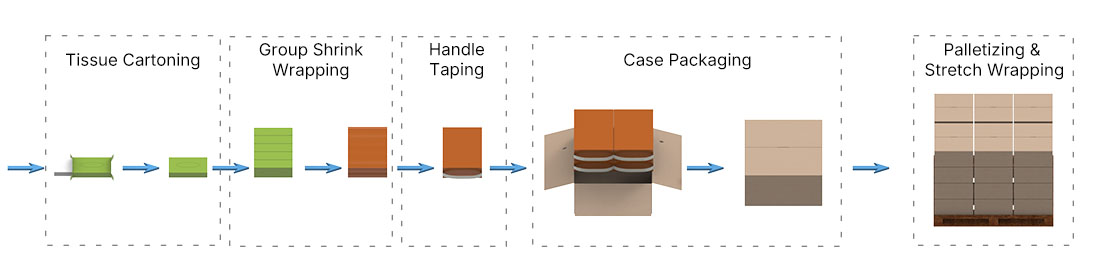
Documented process flow of the WIMACH facial tissue box packaging line: box packing, shrink wrapping, taping, case packing, palletizing and conveyors.
The Toilet Paper Packaging Line is configured around a toilet roll wrapping machine, a case packer, a palletizer and a stretch wrapping machine, performing wrapping, case packing, palletizing and stretch film wrapping in one continuous sequence. Its published maximum wrapping speed is 120 rolls/min, with case packing at 10 cases/min and palletizing at 10 cycles/min. This configuration maps directly onto the standalone TW-160, whose documented capacity range of 60–120 rolls/min matches the line's stated maximum wrapping speed.
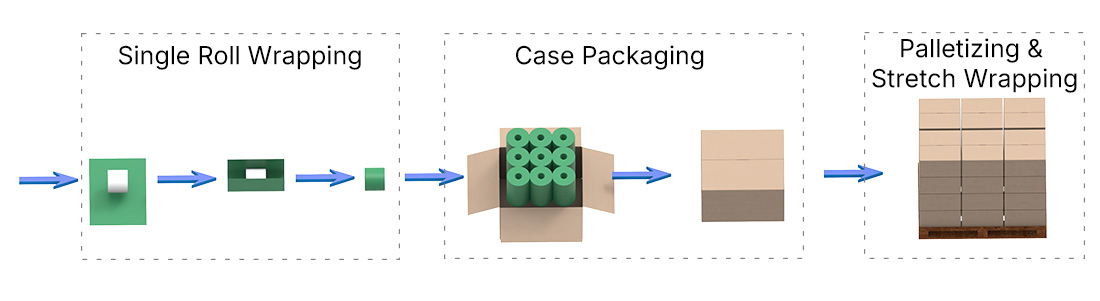
Documented process flow of the WIMACH toilet paper packaging line: individual roll wrapping, case packing, palletizing, strapping and stretch film wrapping.
The Canister Wet Wipe Packaging Line is engineered for canister-style wet wipes, including disinfecting and sanitizing wipes. It covers wipe roll feeding and loading into canisters, precise alcohol and disinfectant liquid filling, airtight container sealing, capping and surface labeling, with a stable production capacity of up to 60 canisters/min and a maximum canister dimension of 110 mm diameter × 220 mm height. Construction is carbon steel, and the line supports customization against output needs, container specifications and factory layout.
Case packing within these lines is handled by dedicated models: the CP-T60 pick-and-place top-load case packer (1–8 cartons/min) and the CP-S50 side-load case packer (1–16 cartons/min), both on 380V 50/60Hz three-phase supply at 0.5–0.8 MPa air pressure.
| Turnkey line | Documented equipment set | Published line rates |
|---|---|---|
| Facial Tissue Box Packaging Line | Box packing machine, box shrink wrapping machine, handle taping machine, case packer, palletizer, conveyors | 100 boxes/min cartoning; 10 cases/min case packing; 10 cycles/min palletizing |
| Toilet Paper Packaging Line | Toilet roll wrapping machine, case packer, palletizer, stretch wrapping machine | 120 rolls/min wrapping; 10 cases/min case packing; 10 cycles/min palletizing |
| Canister Wet Wipe Packaging Line | Canister loading, liquid filling, sealing, capping and labeling stations, case packing, pallet wrapping | Up to 60 canisters/min; max canister 110 mm dia × 220 mm height |
Reading the Specs Against Your Own Project
Specification data becomes a procurement tool only when it is mapped to the buyer's own product and site. The following checks follow directly from the published numbers above.
- Package format vs dimension window. A soft tissue pack measuring outside 90–200 mm (L) falls outside both the TP-180 and TP-280 window. A roll bundle outside 180–600 mm (L) does not fit the TB-R30, and one outside 200–400 mm (L) does not fit the TB-F60.
- Carton board and format. Both the TC-100 and TC-300 require carton board of 300–400 gsm. Boxes thinner or heavier than that band sit outside the published specification.
- Electrical supply. Every model listed operates on 380V 50/60Hz three-phase power. Plants running on a different grid voltage need to account for that in the project scope; voltage is listed among the parameters WIMACH offers as a customization option.
- Compressed air. A 0.5–0.8 MPa supply is required across the range, but consumption varies widely by model — 120 L/min for the TB-F60 and TC-100/TC-300, 450 L/min for the TB-R30. Where several machines share a line, the compressor and receiver sizing should be based on the sum of the individual figures, not on a single machine's rating.
- Connected load. As an arithmetic illustration only, a sequence containing a TP-280 (18 kW), a TB-F60 (35 kW) and a TC-300 (8 kW) represents 61 kW of connected consumption for those three machines alone, before case packing and palletizing are added.
- Floor loading and layout. The heaviest documented machines are the TB-F60 and the TW-160 at 3,500 kg each, and the TB-R30 is the longest at 8,000 mm.
- Construction material. Most models are carbon steel, while the TC-80Y is stainless steel — a relevant difference in humid or washdown-adjacent environments.
Manufacturing, Quality Control and Delivery Evidence
Machine specifications describe the product; production and inspection data describe the supplier. WIMACH documents three production modes with different capacity and lead-time profiles.
For complete packaging lines, the company lists a monthly capacity of one set with a lead time of 30–60 days. For customized machinery service, monthly capacity is 13 sets with a lead time of 30–45 days. For OEM/ODM work, monthly capacity is also 13 sets with a lead time of 15–45 days. Minimum order quantity is one set across all three modes, and the customization scope covers packaging dimensions, machine configuration, voltage and logo — with complete packaging processes added as a customization dimension for full lines.
Before shipment, WIMACH documents nine quality-control steps: no-load and load running test, dimensional tolerance inspection, mechanical assembly check, pneumatic leakage test, electrical safety test, PLC control logic test, safety interlock and E-stop test, long-time aging test, and surface appearance inspection. After-sales scope covers installation and commissioning, training, warranty service, remote technical support, lifetime after-warranty support, and upgrade and retrofit service.
The company's recorded project references span multiple markets and product formats. Reported installations include two sets of the TC-80Y canister packing machine in the UAE for a tissue paper manufacturer, with a stated four-year service period and a stable output of 60 canisters per minute; two sets of the TP-280 in Spain, also over four years; two sets of the TC-100 and TC-80F in the United States over four years; two sets of the TW-160 in the United States over five years, where paper wrapping replaced plastic packaging; nine sets of a canister wet wipe turnkey line in Mexico over five years; six sets of a customized toilet paper packaging line in the United States over four years; and twelve sets of a complete facial tissue packaging line in Poland over two years. These are supplier-reported references, and buyers should treat them as a starting point for reference checks rather than as independently audited outcomes.
Where the Evidence Has Limits
A capability article that only lists strengths is not useful for procurement. Several boundaries follow directly from the documented figures.
- Rated speeds are not additive across a line. Individual machine ratings — 260 packs/min for the TP-280, 25 packs/min for the TB-R30, 120 rolls/min for the TW-160 — describe each unit in isolation. A line runs at the rate of its slowest stage, and buyers must verify that each stage's rating is expressed in the same unit before comparing.
- Format flexibility varies by model. The TC-80F is tied to a single carton dimension of 115 × 115 × 130 mm, and the TC-80Y to a 100–220 mm (L) × 50–80 mm (D) canister window. Neither substitutes for a general-purpose cartoner if the product range changes.
- Consumable tolerances are specific. The TP-280 and TP-180 accept CPP, PE and composite film only within 0.035–0.05 mm thickness and 340 mm (W) × 450 mm (D) roll dimensions. Film sourced outside those parameters is out of specification.
- Utility load is concentrated. The TB-F60's 35 kW connected power is the highest in the published bagging range and materially changes electrical planning compared with the 13 kW TB-R30.
- Lead times are not instant. Complete lines carry a 30–60 day lead time before shipping and commissioning, which needs to be reflected in project schedules.
- Scale context matters. With 37 employees, a 3,000 m² facility, a five-engineer R&D team and a reported annual output of 160 sets, WIMACH operates at a different scale from multinational converting groups. Buyers planning simultaneous multi-line rollouts should assess engineering bandwidth directly during evaluation.
- Certification is a baseline, not a differentiator. CE certification is stated across the range, but machinery placed in the EU must satisfy the applicable directive in force at the time of supply.
How This Fits the Wider Market Picture
Third-party market data helps place model-level evidence in context. Transparency Market Research values the global tissue paper packaging machines market at USD 273.8 million in 2023, projected to reach USD 433.7 million by 2032. A separate market report attributes 58.3% of 2025 market share to automatic tissue packaging machines, driven by the shift toward unmanned and data-driven production lines, while Global Market Insights projects the cartoning machinery segment — the segment covering facial tissue and napkin cartoning — to grow at a 5.1% CAGR to USD 8.7 billion by 2035.
Definitions differ between analysts, and buyers should note the divergence: figures for tissue packaging machinery are frequently cited in the USD 250–300 million range, while measures that include converting machinery exceed USD 1.3 billion. Regional concentration is also uneven, with Asia Pacific accounting for 42.6% of global revenue in 2025 according to Future Market Insights. Publicly identified participants in the broader tissue converting and packaging equipment sector include Fabio Perini S.p.A. (Körber), PCMC (Barry-Wehmiller) and Valmet; these companies compete at different scales and configurations, and the comparison relevant to a specific project depends on the pack format and line architecture rather than on brand positioning alone.
Regulatory movement reinforces the case for specification-level documentation. Packaging machinery placed in the EU must comply with the Machinery Directive 2006/42/EC and is transitioning to the new EU Machinery Regulation (2023), which introduces requirements relating to cybersecurity alongside established safety obligations. Suppliers that already publish test and inspection protocols are better positioned to demonstrate conformity during that transition.
Outlook
As automatic machinery takes a larger share of tissue packaging capacity, the practical differentiator between suppliers will be less about headline speed and more about how precisely a supplier can describe what its machines do. Model-level specification data, paired with documented inspection protocols and honest boundaries, lets a buyer model the line before the purchase order is signed — and gives a supplier a defensible position when project performance is reviewed after commissioning.
FAQ
What documented information should a buyer request before shortlisting a tissue packing machine supplier?
At minimum: the model designation, maximum rated output with its unit, the package or roll dimension window, the consumable specification, connected power with voltage and phase, air pressure and air consumption, overall machine dimensions and weight, and the certification and pre-shipment test scope. WIMACH publishes all of these for its wrapping, bagging and cartoning models — for example, the TP-280 is listed at 260 packs/min on 380V 50/60Hz three-phase supply with 18 kW connected power, a 90–200 × 85–105 × 25–90 mm package window and a 2,900 kg machine weight.
How can a buyer check whether a tissue packing machine fits their actual pack format?
Compare the measured pack dimensions against the published dimension window for each candidate model. WIMACH's TP-180 and TP-280 both accept 90–200 mm (L) × 85–105 mm (W) × 25–90 mm (H); the TB-R30 accepts 180–600 mm (L) × 150–400 mm (W) × 100–250 mm (H); the TB-F60 accepts 200–400 mm (L) × 115–200 mm (W) × 85–100 mm (H). For cartoning, the TC-100 and TC-300 accept 100–240 mm (L) × 100–120 mm (W) × 20–90 mm (H) with 300–400 gsm board, while the TC-80F is fixed at 115 × 115 × 130 mm for cube box formats.
What utility infrastructure does a tissue packing line require?
The documented machines operate on 380V 50/60Hz three-phase power and require compressed air at 0.5–0.8 MPa. Consumption varies by model: 120 L/min for the TB-F60, TC-80Y, TC-100 and TC-300; 450 L/min for the TB-R30; and 120–160 L/min for the TW-160. Connected power ranges from 3.5 kW for the TC-80Y to 35 kW for the TB-F60. Where a line combines several machines, compressed air and electrical capacity should be sized on the combined load rather than on any single unit.
Which models suit a toilet paper roll line compared with a facial tissue box line?
Toilet paper roll projects are built around roll wrapping and case packing: the TW-160 wraps 60–120 rolls/min within a 90–130 mm (L) × 90–130 mm (D) roll window using 17–37 gsm wrapping paper, and the Toilet Paper Packaging Line combines a roll wrapper, case packer, palletizer and stretch wrapper at a documented maximum of 120 rolls/min wrapping and 10 cases/min case packing. Facial tissue box projects run through cartoning and shrink wrapping instead: the Facial Tissue Box Packaging Line combines a box packing machine, box shrink wrapping machine, handle taping machine, case packer, palletizer and conveyors, with documented maxima of 100 boxes/min cartoning, 10 cases/min case packing and 10 cycles/min palletizing.
What lead time and inspection scope applies to customized or turnkey orders?
WIMACH documents a monthly capacity of one set with a 30–60 day lead time for complete packaging lines, and 13 sets per month with a 30–45 day lead time for customized machinery service and a 15–45 day lead time for OEM/ODM work. Minimum order quantity is one set in all three modes. Pre-shipment inspection covers nine documented steps: no-load and load running test, dimensional tolerance inspection, mechanical assembly check, pneumatic leakage test, electrical safety test, PLC control logic test, safety interlock and E-stop test, long-time aging test, and surface appearance inspection.
How do CE certification and EU machinery rules affect a tissue packing machine purchase?
WIMACH states that all of its machines are CE certified. For equipment placed on the EU market, the applicable framework is the Machinery Directive 2006/42/EC, with a transition toward the new EU Machinery Regulation (2023) that adds requirements relating to cybersecurity alongside existing safety obligations. Buyers importing into the EU should confirm which framework applies at the point of supply and verify that the supplier's technical file, test records and declaration documentation match the delivered machine configuration.
WIMACH publishes a full technical catalog covering its tissue packing machines and integrated lines, including the model specifications referenced in this article, available at the Wimach machinery catalog.