
Tissue Packing Machine Selection: 2026 Capability Benchmarks and Trends
The tissue packing machine has become a central production decision for tissue manufacturers, not simply an end-of-line add-on. As facial tissue, toilet paper, kitchen towel, napkin and canister formats multiply, the choice of wrapping and cartoning equipment affects output speed, material waste, regulatory compliance and total cost per finished pack. This article reviews what buyers in 2026 should benchmark when evaluating tissue packing machines, and how supplier capability, certification and project fit determine long-term performance.
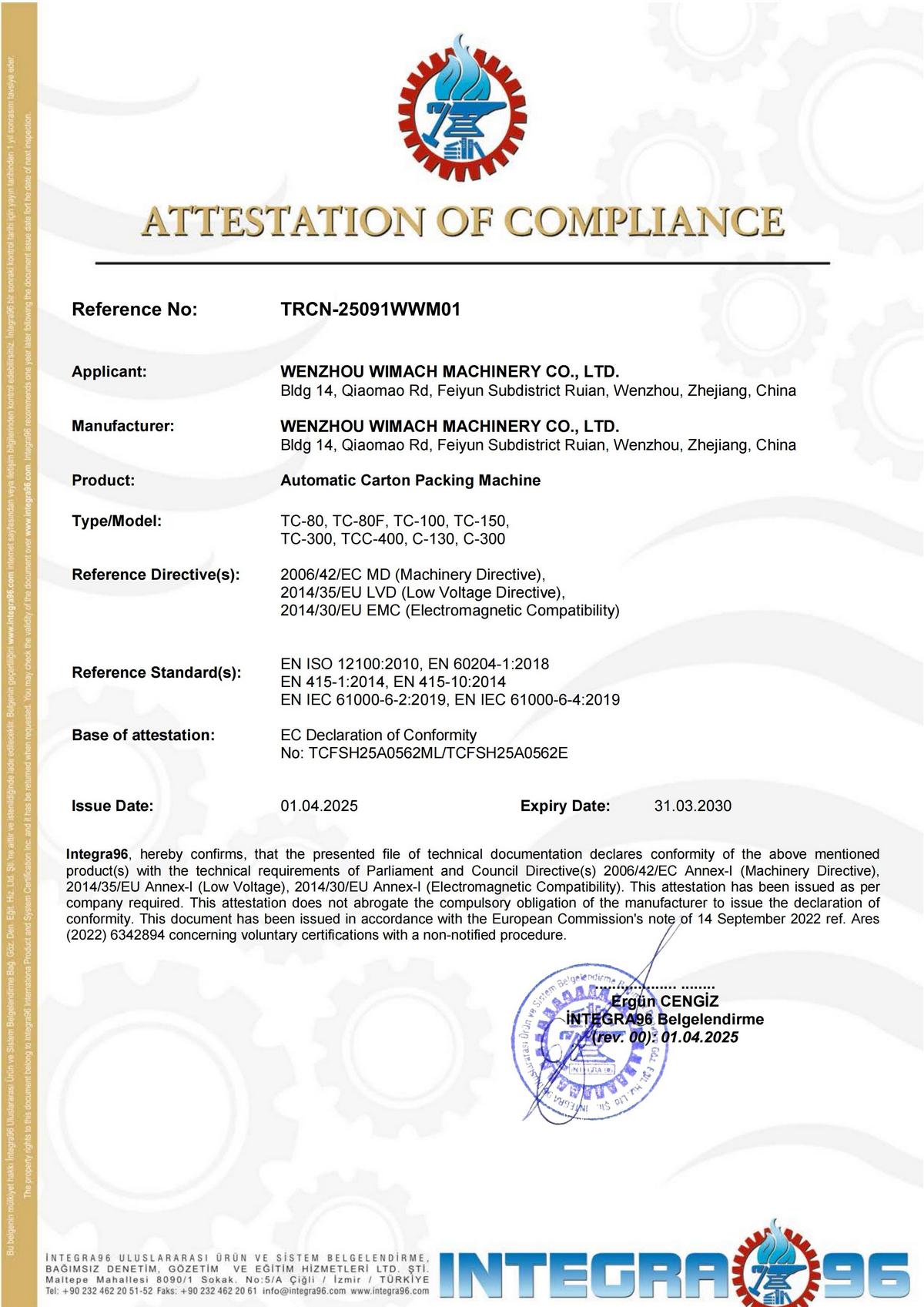
CE compliance is a baseline requirement for tissue packing equipment sold into the EU market.
Why tissue packing machines are a strategic investment
The global tissue paper packaging machines market was valued at USD 273.8 million in 2023 and is projected to reach USD 433.7 million by 2032, according to Transparency Market Research. The scale of this market reflects a broader shift: producers are replacing manual or semi-automatic packing with fully integrated systems that can keep up with high-speed converting lines.
Automatic tissue packaging machines already held an estimated 58.3% market share in 2025, driven by the move toward unmanned, data-driven production. For a manufacturer evaluating equipment, this means the practical question is no longer whether to automate, but which machine type, capacity tier and supplier structure fits the product mix and factory layout.
Problem and opportunity: from manual packing to full-line automation
Manual tissue packing creates three recurring problems. First, throughput is limited by labor availability and shift patterns, making it difficult to match the output of modern tissue converting lines. Second, inconsistent folding, filling or sealing leads to damaged packs and customer complaints. Third, proof of compliance with safety and electrical standards is harder to maintain when multiple manual workstations handle the same product.
The opportunity is to treat packing as a continuous process: film forming, sealing, cartoning, case packing, palletizing and stretch wrapping can be linked into one automated workflow. Suppliers such as Wenzhou Wimach Machinery Co., Ltd. offer both standalone machines and turnkey lines, letting manufacturers start with a single wrapper or cartoner and scale to a complete end-of-line system as demand grows.
Brand solution: WIMACH's tissue packing machine portfolio
Wenzhou Wimach Machinery Co., Ltd. is a Wenzhou-based manufacturer specializing in tissue packing machines and integrated packaging lines. The company, established in 2021, operates a 3,000 m² facility with a 37-person team and exports around 60% of its output to the EU, North America and South America. Its stated engineering experience exceeds 12 years, and its product range covers facial tissue and paper napkin cartoning machines, soft tissue wrapping machines, toilet paper roll wrapping machines, case packers, blister packing machines and integrated packaging lines.
For buyers comparing tissue packing machines, the following WIMACH models represent different points on the capacity and format spectrum:
| Model | Function | Capacity | Key format / notes |
|---|---|---|---|
| TC-100 | Tissue cartoning machine | 30–100 boxes/min | Cartons 100–240 (L) x 100–120 (W) x 20–90 (H) mm |
| TC-300 | Automatic high-speed tissue box packing machine | Max 180 boxes/min | Same carton range; higher speed tier |
| TC-80F | Cube box tissue cartoning machine | 30–80 boxes/min | Cube cartons 115 x 115 x 130 mm |
| TC-80Y | Automatic tissue canister packing machine | 30–80 boxes/min | Canisters 100–220 (L) x 50–80 (D) mm; stainless steel |
| TP-180 | Automatic soft tissue wrapping machine | Max 180 packs/min | Film: CPP, PE, composite; 90–200 (L) x 85–105 (W) x 25–90 (H) |
| TP-280 | Automatic high-speed soft tissue wrapping machine | Max 260 packs/min | Same film and pack range; higher speed |
| TW-160 | Automatic toilet paper roll wrapping machine | 60–120 rolls/min | Wrapping paper 17–37 gsm; rolls 90–130 (L) x 90–130 (D) mm |
Beyond single machines, WIMACH provides complete packaging line solutions. Examples include a facial tissue box packaging line with maximum cartoning speed of 100 boxes/min, and a toilet paper packaging line with maximum wrapping speed of 120 rolls/min. The company also supplies case packers such as the CP-T60 top load case packer and CP-S50 side load case packer, allowing a full line to be built from one supplier.
Technical explanation: how modern tissue packing machines work
Tissue packing machines are specialized by product format. Cartoning machines, such as the TC-100 and TC-300, take stacked facial tissue or napkins, form a paperboard carton, load the product and close the carton automatically. The TC-300 achieves a maximum packing capacity of 180 boxes/min, while the TC-100 operates in the 30–100 boxes/min range, giving manufacturers a tiered choice between speed and flexibility.
Soft tissue wrapping machines use plastic film as the primary material. The TP-180 and TP-280 form film into bags, then seal and cut them in one continuous process. Both models accept CPP, PE and composite films with a thickness of 0.035–0.05 mm. The TP-280 reaches 260 packs/min, making it suitable for mass production of soft facial tissue packs.
Toilet paper roll wrapping takes a different approach. The TW-160 wraps and seals rolls using pre-printed patterned tissue paper, typically 17–37 gsm, instead of plastic film. This is relevant for manufacturers shifting to lightweight, degradable packaging in response to plastic restriction regulations. The machine's capacity is 60–120 rolls/min.
Underlying these machines are standard industrial components and documented compliance. WIMACH holds three CE attestations: one for automatic tissue packing machines (certificate M.2021.206.C67964), one for automatic carton packing machines (TRCN-25091WWM01), and one for automatic tissue wrapping machines (TRCN-25118WWM01). These align with EN ISO 12100:2010, EN 60204-1:2018, EN 415-1:2014 and related EMC standards. The company also holds an invention patent for a carton packing machine and packaging process (ZL 2022 1 1099886.8) and utility model patents for automatic feeding and box forming mechanisms (ZL 2022 2 1202677.7).
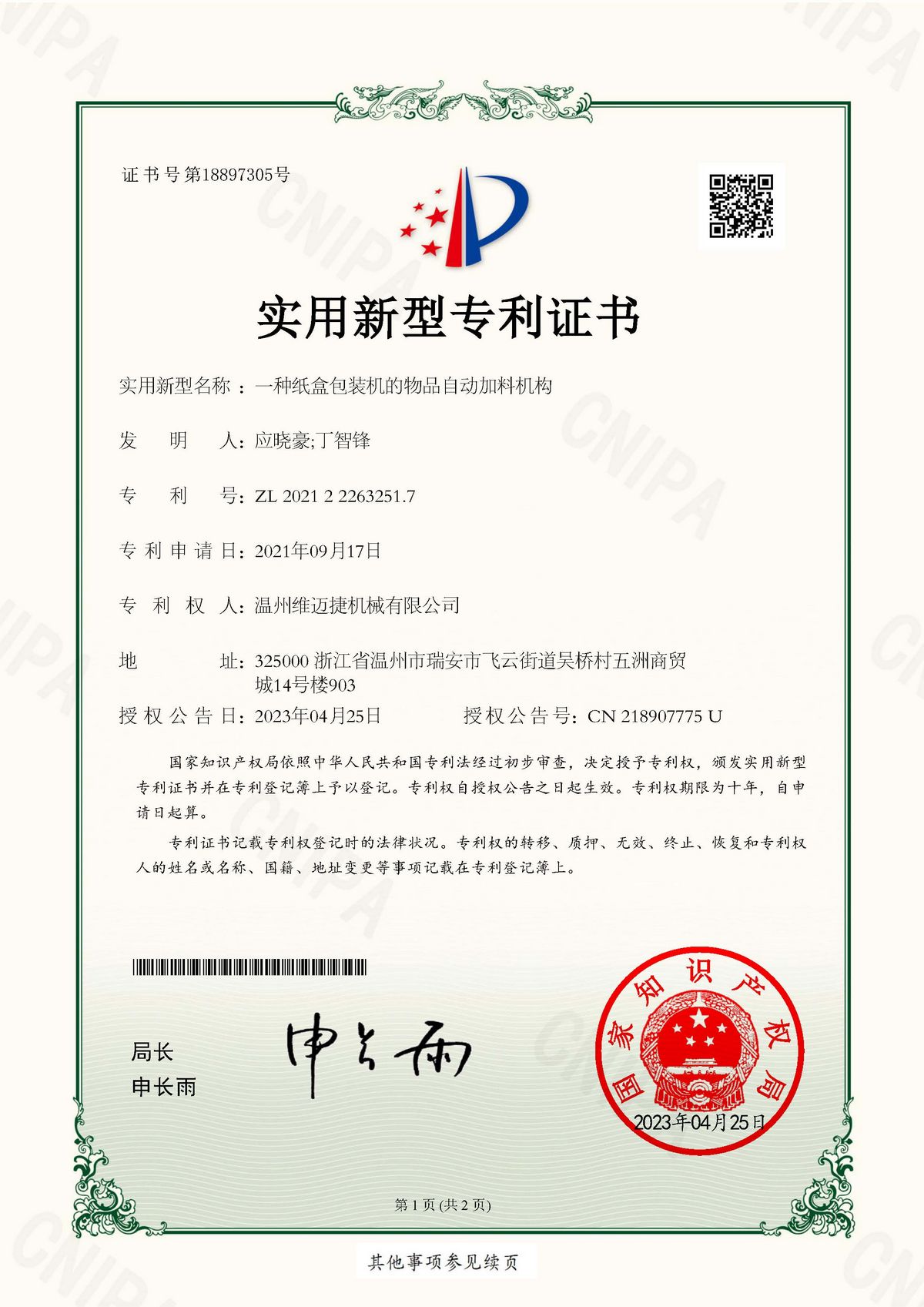
Patented mechanisms for carton feeding and forming support reliability in WIMACH's cartoning machines.
Application and use cases: tissue packing machines in production
Reference installations provide practical evidence of how these systems perform across formats and regions.
Middle East: canister packing for facial tissue and napkins
In the United Arab Emirates, a tissue paper manufacturer installed two TC-80Y automatic tissue canister packing machines for fully automatic packaging of facial tissues and paper napkins into paper canisters. The machines have been running for four years and deliver a stable output of 60 canisters per minute. The project improved packaging speed and reduced labor costs while maintaining CE compliance and low maintenance requirements.
Spain: high-speed soft tissue wrapping
A Spanish tissue manufacturer uses two TP-280 high-speed soft tissue wrapping machines for soft facial tissue packs. The equipment forms plastic film bags, seals and cuts them in a continuous process. After four years of operation, the customer reports tidy and airtight packaging that protects tissues from moisture and dust, while the clear printed film improves brand display. The TP-280's 260 packs/min capacity supports mass production with consistent finished goods appearance.
United States: cartoning and paper roll wrapping
A US tissue manufacturer deployed two tissue cartoning machines to automate the loading of facial tissues into paper boxes. The project solved irregular filling and product extrusion damage, while raising production efficiency and unifying packing standards. In a separate US installation, two TW-160 machines have been wrapping toilet paper rolls with pre-printed patterned tissue paper for five years. That project replaced plastic packaging and achieved cost reduction, improved automation and environmental compliance, with a capacity of 60–120 rolls/min.
Poland: full-line facial tissue packaging
A Polish manufacturer runs a complete facial tissue and cream tissue packaging line comprising 12 sets of equipment. The line integrates conveying, automatic cartoning, case packing, pallet feeding, robotic palletizing, strapping and stretch wrapping. Finished goods come out as whole pallets stacked with shipping cases, bundled with straps and fully covered by stretch film, ready for warehousing or shipment.
Mexico: turnkey wet wipe canister line
In Mexico, a nine-set turnkey automated packaging line was purpose-built for canister wet disinfecting wipes. It covers canister feeding, wipe inserting, disinfectant filling, heat sealing, cap tightening, labeling, case packing, palletizing, strapping and stretch film wrapping. The line was completed over five years and delivers fully finished, labeled, cased and palletized products without manual intervention.
Market trend analysis: where tissue packing is heading
Several data points help frame the 2026 equipment evaluation:
- The global tissue paper packaging machines market is projected to grow from USD 273.8 million in 2023 to USD 433.7 million by 2032, a steady expansion driven by converting capacity additions.
- Automatic tissue packaging machines accounted for 58.3% of the market in 2025, confirming the preference for unmanned, high-throughput systems.
- The cartoning machinery segment, applicable to facial tissues and napkins, is expected to grow at a 5.1% CAGR and reach USD 8.7 billion by 2035, according to Global Market Insights.
- Asia Pacific captured 42.6% of global revenue in the broader tissue machinery market in 2025, making it the largest regional demand center.
- China's tissue paper exports rose 23.49% to USD 2.19 billion in late 2024, according to China Customs data, signaling growing demand for efficient packing solutions from Chinese exporters.
- EU packaging machine regulation is transitioning from the Machinery Directive 2006/42/EC to the new EU Machinery Regulation (2023), with added focus on cybersecurity. Buyers should verify that suppliers' CE documentation remains valid under the updated framework.
Comparison with traditional solutions and real boundaries
Compared to manual packing, an automatic tissue packing machine eliminates repetitive labor, reduces product damage, and produces uniform packages at high speed. Compared to semi-automatic systems, full automation adds integrated case packing and palletizing, which shrinks the gap between converting and shipping.
However, there are real limitations. WIMACH's machines are configured for specific dimension ranges and utilities: the standard power supply is 380V, 50/60Hz, three-phase, and compressed air must be available at 0.5–0.8 Mpa. A manufacturer with only 220V single-phase power, or without an adequate air compressor, will need site upgrades before installation. In addition, each model has a defined format window. For example, the TP-280 handles packs up to 200 mm length and 90 mm height; a pack outside that window requires a customized configuration rather than a standard machine. Speed claims also assume stable upstream feeding; if the converting line supplies product at an inconsistent rate, the packing machine cannot reach its rated maximum.
These boundaries matter in supplier evaluation. A credible vendor will state them up front, as WIMACH does in its technical specifications, rather than implying that one machine fits every product.
Future outlook: modular lines and sustainable materials
The next phase of tissue packing machine development is likely to combine higher automation with material versatility. The shift from plastic film to paper wrapping, already visible in the TW-160's use of 17–37 gsm wrapping paper, is expected to accelerate as plastic restriction rules expand across markets. Meanwhile, the growing share of automatic and high-speed machines points toward more integrated lines, where wrapping, cartoning, case packing and palletizing share one control system.
Buyers evaluating suppliers should consider not only today's capacity but also the ability to adapt. WIMACH offers OEM/ODM services and customized machinery, with lead times of 15–45 days for standard custom models and 30–60 days for complete packaging lines. This responsiveness allows manufacturers to adjust machine configuration, voltage, packaging dimensions and even logos as product ranges evolve.
FAQ
What is a tissue packing machine?
A tissue packing machine automatically wraps, cartons or canisters tissue products such as facial tissue, paper napkins, toilet rolls and kitchen rolls. It replaces manual packing by performing film forming, sealing, cutting, box loading or canister filling in one continuous process.
What are the main types of tissue packing machines?
The main types are tissue cartoning machines (TC-100, TC-300, TC-80F), soft tissue wrapping machines (TP-180, TP-280), toilet paper roll wrapping machines (TW-160), tissue canister packing machines (TC-80Y), and integrated packaging lines that combine these with case packing and palletizing.
What is the speed range of a typical automatic tissue packing machine?
Speed depends on product format. WIMACH's soft tissue wrapping machines reach 180–260 packs/min, cartoning machines run at 30–180 boxes/min, and the toilet paper roll wrapping machine operates at 60–120 rolls/min. The canister packing machine achieves 30–80 canisters/min.
Are WIMACH tissue packing machines CE certified?
Yes. WIMACH holds CE attestations for automatic tissue packing machines, automatic carton packing machines, and automatic tissue wrapping machines. The certificates are issued by recognized bodies and reference EN ISO 12100, EN 60204-1, EN 415 and EMC standards.
Can a tissue packing line be customized for a specific factory?
WIMACH supports customization of packaging dimensions, machine configuration, voltage and logo. For complete packaging lines, the company also adjusts the full packaging process to match product specifications and factory layout. The minimum order is one set, with lead times from 15 to 60 days depending on complexity.
For further technical specifications, the WIMACH product catalog is available for download here: WIMACH Catalog PDF.
This article is an independent industry reference. Product information and reference installations are based on data supplied by Wenzhou Wimach Machinery Co., Ltd. Market data sources are cited in text.