
Tissue Packing Machine Suppliers: A Long-Term Sustainability Checklist
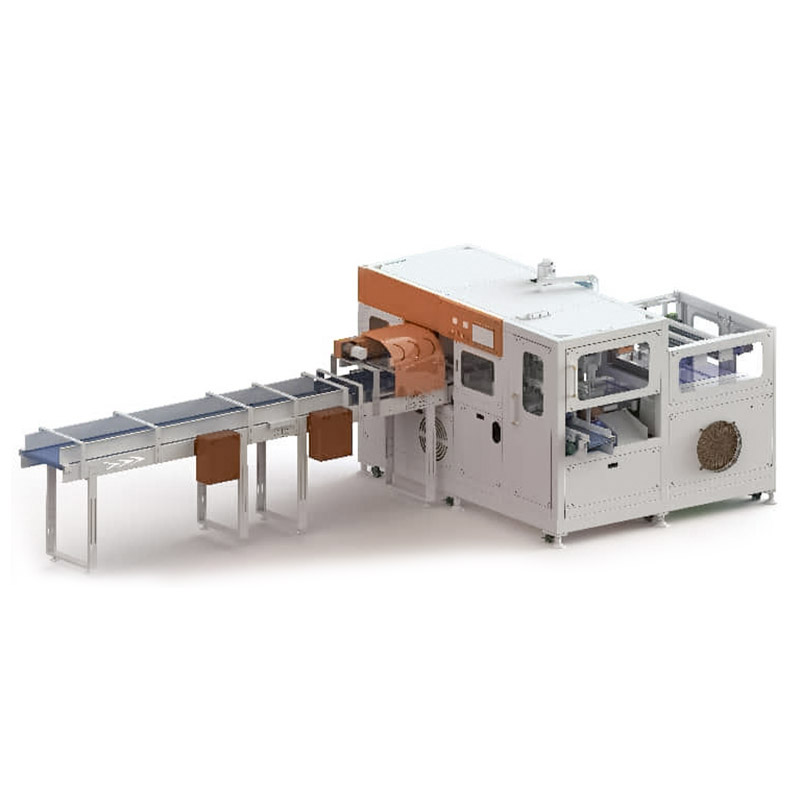
A tissue packing machine is specified once and operated for many years, so the durable buying question is not which supplier offers the lowest quotation, but which supplier can still support the asset in year five, year eight and beyond — with parts, documentation, certification and a route to expand the line.
Wenzhou Wimach Machinery Co., Ltd., which builds and sells under the brand WIMACH, is a Zhejiang-based manufacturer of tissue packing machines and integrated packaging lines, exporting to the EU, North America and South America. Its published model range — TP-280, TB-F60, TW-160, TC-100 and TC-300 — is used in this article as a worked example of how a buyer can read supplier documentation for lifecycle signals rather than for headline speed alone.
Why Purchase Price Is the Shortest Part of the Decision
Most of what determines whether a tissue packing machine earns back its capital is decided after installation: whether a format change can be made without new tooling, whether a spare part can be identified from a drawing, whether the certification file survives a market surveillance query, and whether the next line can be built by the same supplier. None of these items appear on a quotation sheet, and none of them can be inspected on a delivery day.
The demand backdrop explains why buyers are being pushed toward lifecycle thinking. Precedence Research estimated the global tissue paper packaging machine market at approximately USD 3.9 billion in 2025, with a projected USD 4.2 billion in 2026. The same research attributes 39.8% of 2025 market share to Asia Pacific and 42.1% to facial tissue packaging applications. In a market of that scale, the marginal difference between two quotations is small compared with the cost of a line that cannot be re-tooled, re-certified or extended.
A Six-Point Checklist for Long-Term Supplier Evaluation
The checklist below converts lifecycle support into six items that can be requested, compared and signed off before a purchase order is issued. Each item produces a document the buyer keeps, rather than a claim the buyer remembers.
| Evaluation point | What to request | Why it matters after year one |
|---|---|---|
| 1. Documented model specification | Rated capacity, format envelope, voltage, power, air pressure, footprint, weight and construction material for every model offered | Allows alternatives to be benchmarked on identical terms and lets utilities and floor space be planned before shipment |
| 2. Parts and mechanism documentation | Spare-parts list with part numbers, drawings for wear items, patent numbers where mechanisms are protected | Makes a part identifiable in year six, when the original sales contact may have moved on |
| 3. Certification register with dates | Certificate number, issuing body, applied standards, issue and expiry dates per model | Turns compliance into a dated record that can be re-checked instead of assumed |
| 4. Service scope written into the contract | Installation and commissioning, training, warranty, remote support, post-warranty support, retrofit terms | Defines what “support” concretely means when a fault stops a line |
| 5. Line-expansion compatibility | Which turnkey lines the supplier builds, which models appear inside them, and the stated customization scope | Prevents the second and third investment from becoming a full re-selection exercise |
| 6. Commercial and production terms | MOQ, lead time, and monthly build capacity for single machines versus complete lines | Shows whether a multi-line expansion plan fits the supplier’s build calendar |
Benchmarking Capacity, Utilities and Footprint Across Documented Models
Consistency of published data is itself a supplier signal. Where capacity, voltage, air pressure, footprint and weight are stated in the same format for every model, a buyer can compare without re-interviewing the supplier for each line item.
| Model | Function | Rated capacity | Power | Air pressure | Footprint L×W×H (mm) | Weight | Construction |
|---|---|---|---|---|---|---|---|
| TP-280 | Soft tissue wrapping (CPP, PE or composite film) | 260 packs/min | 18 kW | 0.5–0.8 MPa | 3585 × 6260 × 1800 | 2900 kg | Carbon steel |
| TB-F60 | Bottom dispensing bagging, 4 pre-made bag magazines | 60 packs/min | 35 kW | 0.5–0.8 MPa | 2840 × 6060 × 1800 | 3500 kg | Carbon steel |
| TW-160 | Toilet paper roll wrapping, 17–37 gsm wrapping paper | 60–120 rolls/min | 12 kW | 0.5–0.8 MPa | 4350 × 2550 × 1940 | 3500 kg | Carbon steel |
| TC-100 | Cartoning, 300–400 gsm carton board | 30–100 boxes/min | 6.2 kW | 0.5–0.8 MPa | 3620 × 3130 × 1800 | 2200 kg | Carbon steel |
| TC-300 | High-speed box packing, 300–400 gsm carton board | Up to 180 boxes/min | 8 kW | 0.5–0.8 MPa | 5000 × 1740 × 1800 | 3000 kg | Carbon steel, aluminum |
Two observations matter more than the individual figures. First, all five models are specified at 380V 50/60Hz three-phase, which simplifies site power planning across a mixed line and reduces the number of electrical variants a maintenance team has to carry. Second, the electrical load is not uniform: the TB-F60 bagging machine is listed at 35 kW, while the TC-100 cartoning machine is listed at 6.2 kW and the TC-300 at 8 kW. A factory that sizes its electrical capacity around a first cartoner can be caught out when a bagging machine is added later — a lifecycle cost that is invisible at the first purchase.
Format envelopes matter just as much. The TP-280 accepts packs of 90–200 mm length, 85–105 mm width and 25–90 mm height; the TB-F60 accepts 200–400 × 115–200 × 85–100 mm; the TW-160 handles rolls of 90–130 mm length and 90–130 mm diameter; the TC-100 and TC-300 both accept cartons of 100–240 × 100–120 × 20–90 mm in 300–400 gsm board. A product-development plan that moves outside these windows is a tooling decision rather than an adjustment, and it should be planned at the same time as the machine order.
Air demand follows the same logic. All models run at 0.5–0.8 MPa. Published consumption is 120 L/min for the TB-F60 and 120–160 L/min for the TW-160, TC-100 and TC-300. Notably, the TP-280 parameter set lists air pressure but not consumption, so a buyer sizing a compressor should request that figure explicitly rather than infer it from a neighbouring model.
Serviceability and Parts: What the Documentation Should Prove
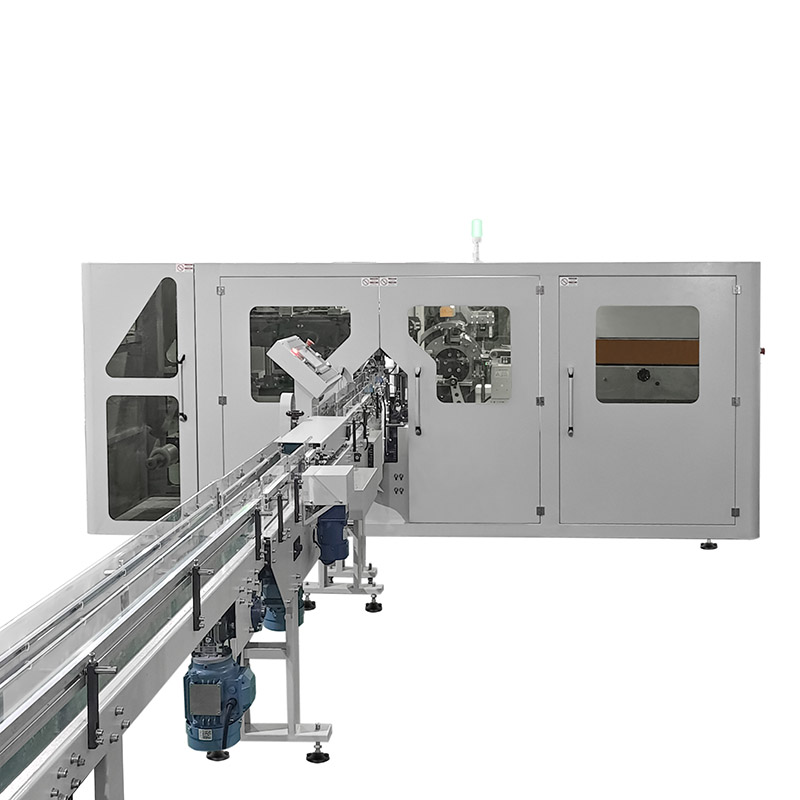
Serviceability is largely a documentation question. A machine that performs well but cannot be traced to a part number becomes expensive at the first unplanned stop, because the cost of the downtime is usually several times the cost of the component.
WIMACH’s cartoning range carries registered mechanism patents. Utility model ZL 2022 2 1202677.7, issued on 25 April 2023 with a recorded term to 11 September 2033, covers the box forming and automatic feeding mechanisms used in the TC-100, TC-300 and TC-80F cartoning machines. Invention patent ZL 2022 1 1099886.8, issued on 6 September 2022 with a term to 17 September 2042, covers a carton packing machine and carton packaging process. Both are issued by the National Intellectual Property Administration, PRC under the Patent Law of the People’s Republic of China.
For a buyer, patents are a signal rather than a guarantee. They indicate that a mechanism has been formally defined and documented, which usually means drawings and part definitions exist and can be retrieved. They do not by themselves confirm that a specific wear part will be held in stock in year seven — that still has to be asked in writing and written into the supply agreement.
The published quality-control sequence is a second documentation signal: no-load and load running test, dimensional tolerance inspection, mechanical assembly check, pneumatic leakage test, electrical safety test, PLC control logic test, safety interlock and E-stop test, long-time aging test, and surface appearance inspection. A buyer can map these nine checks directly onto acceptance-test clauses, so that what was verified at the factory is also what is signed off at the plant.
Certification Is a Register, Not a Badge
Certificates expire, models change and standards are revised. For lifecycle purposes, a buyer should keep a register of certificate numbers, issuing bodies, applied standards and validity dates, and re-check that register at each order rather than treating a certificate as a permanent attribute of a model.
| Certified scope | Certificate number | Issuing body | Applied standards | Issued | Stated validity to |
|---|---|---|---|---|---|
| Automatic High-Speed Soft Tissue Wrapping Machine (TP-280) | TRCN-25118WWM01 | iNTEGRA96 Belgelendirme | EN ISO 12100:2010; EN 60204-1:2018+A1:2025; EN 415-1:2014; EN 415-10:2014; EN IEC 61000-6-2:2019; EN IEC 61000-6-4:2019 | 28 Apr 2025 | 27 Apr 2030 |
| Automatic Carton Packing Machine (TC-80F, TC-300, TC-100) | TRCN-25091WWM01 | iNTEGRA96 Belgelendirme | EN ISO 12100:2010; EN 60204-1:2018; EN 415-1:2014; EN 415-10:2014; EN IEC 61000-6-2:2019; EN IEC 61000-6-4:2019 | 1 Apr 2025 | 31 Mar 2030 |
| Automatic Tissue Packing Machine (TW-160) | M.2021.206.C67964 | UDEM International Certification Auditing Training Centre | EN ISO 12100:2010; EN 60204-1:2018; EN 61000-3-2:2019; EN 61000-3-3:2013+A1:2019; EN 61000-6-1:2019; EN 61000-6-3:2007+A1:2011+AC:2012 | 24 Sep 2021 | 23 Sep 2026 |
The differing vintages are the practical lesson. The cartoning attestation and the soft tissue wrapping attestation were both issued in 2025 with validity beyond 2029. The attestation recorded for the automatic tissue packing machine was issued in 2021 and carries a stated validity end date of 23 September 2026 — earlier than the other two entries. A buyer ordering that model should therefore request the current document set at the time of the order instead of relying on a certificate number quoted from an earlier project file.
The applied standards describe the safety and electromagnetic framework rather than the machine’s output. EN ISO 12100:2010 covers risk assessment methodology and EN 60204-1 covers electrical equipment of machines; both appear across the range, with EN 415-1:2014 and EN 415-10:2014 added for packaging machines and the EN IEC 61000-6-2 / EN IEC 61000-6-4 EMC standards added on the 2025 certificates. For customs and tariff work, tissue packaging machinery is generally classified under HS code 8422.40, “other packing or wrapping machinery” — a classification worth confirming with a customs broker for each destination market.
Planning Line Expansion: From Single Machine to Turnkey Line
Expansion compatibility is where lifecycle evaluation usually pays for itself, because the second and third machines are the ones that carry the return on the first. A supplier whose individual models are already documented as components of a turnkey line removes an entire re-selection cycle.
Three documented turnkey lines show how the models combine. The Facial Tissue Box Packaging Line links a facial tissue box packing machine, a box shrink wrapping machine, a handle taping machine, a case packer, a palletizer and conveyors, with stated maxima of 100 boxes/min cartoning, 10 cases/min case packing and 10 cycles/min palletizing. The Toilet Paper Packaging Line combines a toilet roll wrapping machine, a case packer, a palletizer and a stretch wrapping machine, with stated maxima of 120 rolls/min wrapping, 10 cases/min case packing and 10 cycles/min palletizing. The Canister Wet Wipe Packaging Line covers wipe loading, liquid filling, sealing, capping and labeling at up to 60 canisters/min, for canisters up to 110 mm diameter and 220 mm height.
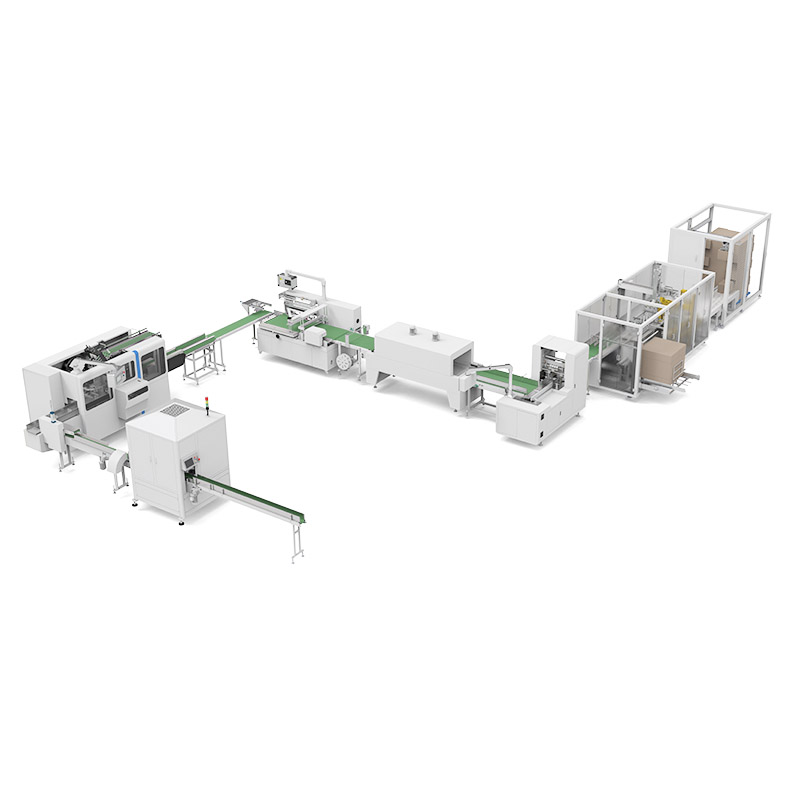
Two practical numbers should be recorded alongside those capacities. The published customization scope covers packaging processes, packaging dimensions, machine configuration, voltage and logo, with a minimum order quantity of one set. Lead times differ by order type: 15–45 days for OEM/ODM work, 30–45 days for customized machinery, and 30–60 days for a complete packaging line. Monthly capacity is stated as 13 sets for customized machinery and OEM/ODM work, but one set for a complete packaging line. That last figure is the one that matters in a multi-line expansion plan — line projects queue, and the queue should be planned rather than discovered.
What Long-Term Support Looks Like in Operational Records
Reference projects are weaker evidence than a service log, but they show the pattern of long-term relationships and the product mixes that have already been integrated. WIMACH’s documented installations include Spain, where two TP-280 high-speed soft tissue wrapping machines are recorded with a duration of four years; the United States, with two TC-100 and TC-80F cartoning machines over four years; the United States again, with two TW-160 toilet paper roll wrapping machines over five years; Poland, with a twelve-set facial tissue packaging line including TC-300, TC-100, TP-280 and CP-S50 case packing equipment over two years; Mexico, with a nine-set canister wet wipe packaging line including the TC-80Y over five years; and the UAE, with two TC-80Y canister packing machines over four years, reported to run at a stable output of 60 canisters per minute.
Read these records as compatibility evidence, not as performance benchmarks. The useful follow-up questions are how many format changes each site made, which parts were replaced and how quickly they arrived, and whether any station in the line was later upgraded. Those answers describe a supplier’s lifecycle behaviour far better than a reference logo.
Market Trend: Where the Pressure on Lifecycle Support Comes From
Growth in tissue packaging is concentrated where new lines are being built, and that installed base is what creates aftermarket weight. With Asia Pacific holding 39.8% of 2025 market share and facial tissue packaging accounting for 42.1% of applications, the largest concentration of new machine placements sits in segments where product formats and pack sizes change quickly. Every format change is a parts, tooling and documentation question — which is why supplier evaluation is increasingly an aftermarket exercise rather than a capital-expenditure one.
How This Differs from Price-First Procurement — and Where the Method Has Limits
Traditional procurement compares quotations line by line: purchase price, delivery date, payment terms. A lifecycle approach adds documentation, certification currency, parts identifiability and expansion compatibility to the same comparison. The difference is not philosophical — it changes which supplier wins, because a supplier with a complete document set and a line-expansion path can be more expensive per unit and still cheaper over eight years.
The method also has real boundaries, and they should be stated plainly:
- Build capacity is finite. With one complete packaging line per month, a buyer planning three lines within a year is competing for build slots, and a 30–60 day lead time applies to each project.
- Format envelopes are fixed per model. The TC-100 and TC-300 accept cartons of 100–240 mm length, 100–120 mm width and 20–90 mm height from 300–400 gsm board. A new pack size outside that window requires tooling or a different machine, not an adjustment.
- Construction materials differ by model. The wrapping and cartoning models covered here are carbon steel, with the TC-300 listed as carbon steel and aluminum, while stainless steel construction is specified on the TC-80Y canister machine. Buyers in wash-down or corrosive environments must raise material requirements explicitly rather than assume them.
- Published data has gaps. Air consumption is stated for the TB-F60, TW-160, TC-100 and TC-300 but not in the TP-280 parameter set, and no OEE, changeover-time or maintenance-cost figures are published for any model.
- Supplier scale shapes the trade-off. WIMACH was founded in 2021 and operates a 3,000 m² facility with 37 employees, a five-engineer R&D team and a stated annual output of 160 sets. A larger builder may offer deeper field-service networks; a smaller one may offer more configuration flexibility on a single project. Neither is automatically correct, and the checklist should be scored, not assumed.
The method also costs time up front. Requesting a spare-parts list, a certificate register and a build calendar adds perhaps a week to the evaluation. That cost is bounded and one-off; the cost of discovering a missing part number in year six is neither.
Future Outlook
Three developments are likely to shape supplier evaluation over the next buying cycle. First, retrofit and upgrade work is becoming part of the standard offer rather than an exception; WIMACH lists upgrade and retrofit alongside installation and commissioning, training, warranty, remote technical support and lifetime post-warranty support, which extends the planning horizon beyond the warranty period. Second, certification will increasingly be managed as a rolling register with dated renewal, as the differing vintages of the certificates above already demonstrate. Third, format flexibility will be tested by product proliferation — cube boxes, canister formats and soft packs now share the same production floor, and the supplier that can document format changeovers in minutes rather than assuming them will be easier to plan around.
FAQ
Which CE standards apply to WIMACH tissue wrapping and cartoning machines?
The TP-280 soft tissue wrapping machine is covered by certificate TRCN-25118WWM01 issued by iNTEGRA96 Belgelendirme, listing EN ISO 12100:2010, EN 60204-1:2018+A1:2025, EN 415-1:2014, EN 415-10:2014, EN IEC 61000-6-2:2019 and EN IEC 61000-6-4:2019, issued on 28 April 2025 and stated valid to 27 April 2030. The cartoning range (TC-80F, TC-300 and TC-100) is covered by TRCN-25091WWM01 from the same body, listing EN ISO 12100:2010, EN 60204-1:2018, EN 415-1:2014, EN 415-10:2014, EN IEC 61000-6-2:2019 and EN IEC 61000-6-4:2019, issued on 1 April 2025 and stated valid to 31 March 2030.
What after-sales services are documented for these tissue packing machines?
The documented service scope covers installation and commissioning, training service, warranty service, remote technical support, lifetime after-warranty support, and upgrade and retrofit service. Installation and commissioning and training are listed as separate items, which allows them to be written into the supply contract as distinct deliverables rather than bundled into a general support clause.
What minimum order quantity and lead times apply?
The minimum order quantity is one set across the published production modes. Lead time is 15–45 days for OEM/ODM orders, 30–45 days for customized machinery and 30–60 days for a complete packaging line. Monthly capacity is stated at 13 sets for customized machinery and OEM/ODM work, and one set for a complete packaging line.
Which patents cover the cartoning models and how long do they run?
Utility model ZL 2022 2 1202677.7 was issued on 25 April 2023 with a recorded term to 11 September 2033 and covers the box forming and automatic feeding mechanisms used in the TC-100, TC-300 and TC-80F cartoning machines. Invention patent ZL 2022 1 1099886.8 was issued on 6 September 2022 with a term to 17 September 2042 and covers a carton packing machine and carton packaging process. Both are issued by the National Intellectual Property Administration, PRC under the Patent Law of the People’s Republic of China and apply to the China market.
What utilities do the TP-280, TB-F60, TW-160, TC-100 and TC-300 require?
All five models are specified at 380V 50/60Hz three-phase. Power consumption is 18 kW for the TP-280, 35 kW for the TB-F60, 12 kW for the TW-160, 6.2 kW for the TC-100 and 8 kW for the TC-300. Air pressure is 0.5–0.8 MPa throughout. Published air consumption is 120 L/min for the TB-F60 and 120–160 L/min for the TW-160, TC-100 and TC-300; the TP-280 parameter set states air pressure but not air consumption.
For buyers who want to benchmark these figures against the full model range, the WIMACH catalogue is available as a downloadable PDF and should be read alongside the certificate register and spare-parts list rather than instead of them.
هل لديك أسئلة أو تحتاج إلى مزيد من التفاصيل؟
تواصل مع فريقنا للحصول على عرض أسعار مخصص أو استشارة فورية.
طلب عرض أسعار
املأ النموذج أدناه وسيتواصل معك فريقنا بعرض مقترح مخصص.
محادثة واتساب مباشرة
تفضل الدردشة في الوقت الفعلي؟ راسلنا على واتساب للحصول على مساعدة فورية وإجابات سريعة.
- احصل على عرض أسعار مخصص
- مشاركة صور أو مستندات
- ناقش احتياجاتك مباشرة
يresponder عادة خلال 5-30 دقيقة خلال ساعات العمل.