
Titanium Application Compliance: What Buyers Must Verify
Compliance for titanium applications is not a single document. It is a chain of qualifications that has to line up with three things at once: the component being manufactured, the environment it will operate in, and the market it will be delivered to. A certificate that satisfies one of those dimensions can be entirely irrelevant to the other two.
Xrun — the trading identity of Xiangrun (Xi'an) Titanium Materials Technology Co., Ltd. — is a China-based titanium materials manufacturer founded in 2016. The company operates a vertically integrated supply chain spanning coal and electricity, titanium ore, titanium sponge, processed titanium materials and finished products, and it produces titanium strip, coil, sponge, cold-rolled strip, hot-rolled strip, foil, plate, sheet, bar, rod, wire and pipe. Its publicly documented certificate portfolio is a useful reference case for buyers, because it demonstrates why certification scope, not certificate count, is the right evaluation metric.
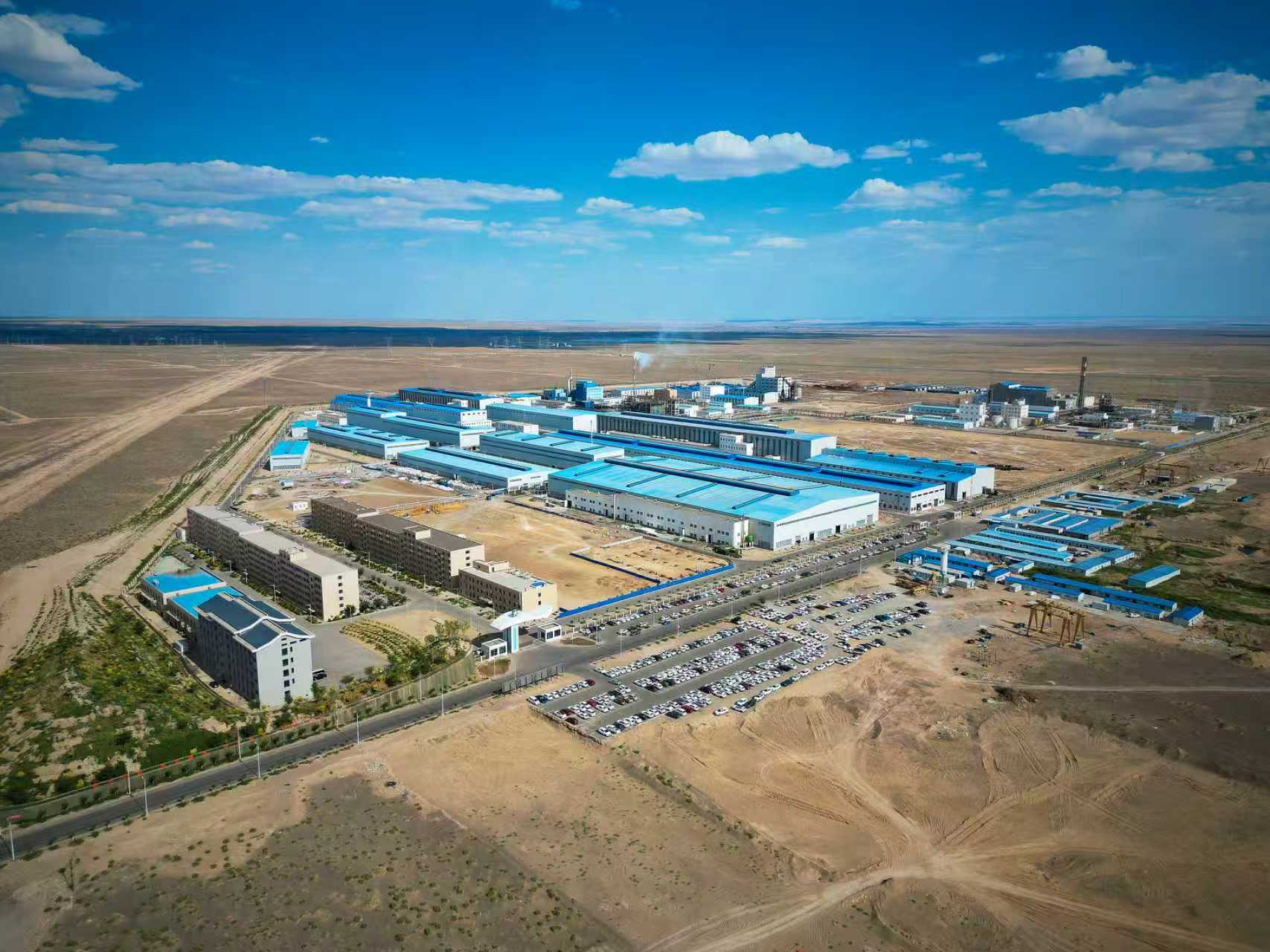
Titanium component compliance starts at the production site: process control, documented scope and traceable product forms.
Why compliance verification has become a procurement bottleneck
The commercial context explains the pressure. The global titanium market reached a valuation of approximately USD 32.49 billion in 2025 and is projected to grow to USD 52.52 billion by 2033, according to DataM Intelligence. China's titanium exports totaled USD 1.07 billion in 2024, representing roughly 12.5% of global market concentration, based on OEC (Observatory of Economic Complexity) data. Behind those totals sit thousands of individually specified components — heat exchanger plates, pressure vessel shells, electrolyzer bipolar plates — each carrying its own qualification path.
Demand composition is shifting as well. Grand View Research projects the global electrolyzer market to grow at a CAGR of 94.9% from 2024 to 2030, a trajectory that pulls titanium bipolar plates and electrolysis cell frames into stricter qualification regimes. Dataintelo values the titanium nitride (TiN) bipolar plate coating market at USD 198.6 million in 2024, an indicator of how surface-treatment requirements are being layered on top of base-material requirements.
The practical consequence for procurement teams is straightforward. Compliance is no longer a checkbox applied at the end of sourcing; it has become a screening criterion applied before a supplier is shortlisted. A supplier that clears the technical review can still fail the qualification review for reasons that have nothing to do with metallurgy.
The certification categories industrial buyers commonly expect
Titanium application compliance is usually expressed through six recognisable families of documents. They are not interchangeable, and a buyer who treats them as one generic "quality certification" will eventually discover the gap during a project audit.
| Category | Common schemes | What it addresses |
|---|---|---|
| Quality management system | ISO 9001-type certification | Plant-level process control and documentation discipline; typically a minimum gate rather than a differentiator |
| Material and product standards | ASTM B265 / ASME SB-265 | Grade composition, mechanical properties and dimensional requirements for titanium strip, sheet and plate |
| Pressure equipment | PED (Directive 2014/68/EU), often referencing EN 764-5 | Qualification of the material manufacturer for pressure-bearing applications |
| Aerospace quality systems | EN 9100:2018, audited against EN 9104-001:2013 | Production control across ingots, billets, bars, forgings, plates and sponge |
| Special process accreditation | Nadcap | Process-level approval for defined operations, such as heat treating |
| Marine and classification | DNV rules, including DNV-CP-0346 | Wrought titanium and titanium alloys for ships and naval vessels |
| Regional and project schemes | NORSOK-type offshore requirements and comparable operator-specific programmes | Project-level qualification demanded by the end operator or authorities |
ASTM International describes ASTM B265 — with ASME SB-265 as its pressure vessel counterpart — as the foundational standard for titanium and titanium alloy strip, sheet and plate across chemical and aerospace industries. That standard defines what the material must be. Nadcap evaluates how a specific process is executed in a specific facility. PED addresses the regulatory pathway into the European market. DNV addresses marine class requirements. Mixing them up is one of the most common errors in supplier qualification.
What a documented portfolio looks like in scope terms
Xrun's documented certificates show how narrow each qualification actually is. Every entry below names a process, a product form or both — which is precisely the information a buyer needs to check against their own bill of materials.
| Certificate | Issuing body | Documented scope | Validity |
|---|---|---|---|
| Nadcap (certificate 27876241210) | Nadcap Management Council | Conformance and recognition of accreditation for Heat Treating, listed on the Qualified Manufacturer's List (QML) on eAuditNet | 28 Feb 2026 – 28 Feb 2027 |
| EN 9100:2018 (certificate 01 117 1933590) | TUV | Production of titanium and titanium alloy ingots, billets and bars, forgings, plates and titanium sponge; EN 9104-001:2013 and EN 9100:2018 fulfilled | 13 Nov 2023 – 12 Nov 2027 |
| PED quality management system, Directive 2014/68/EU (certificate 01 202 CHN/Q-19 0607.01) | TUV | Manufacturing of titanium and titanium alloy cold rolled sheets and hot rolled plates; QM system according to EN 764-5, article 4.2 | 26 Jan 2024 – 8 Dec 2028 |
| DNV classification, wrought titanium for ships and naval vessels (certificate AMMM000035A) | DNV | Wrought titanium and titanium alloys including plates, sheets, strips, forgings and billets; DNV-CP-0346 | 14 Mar 2024 – 13 Mar 2027 |
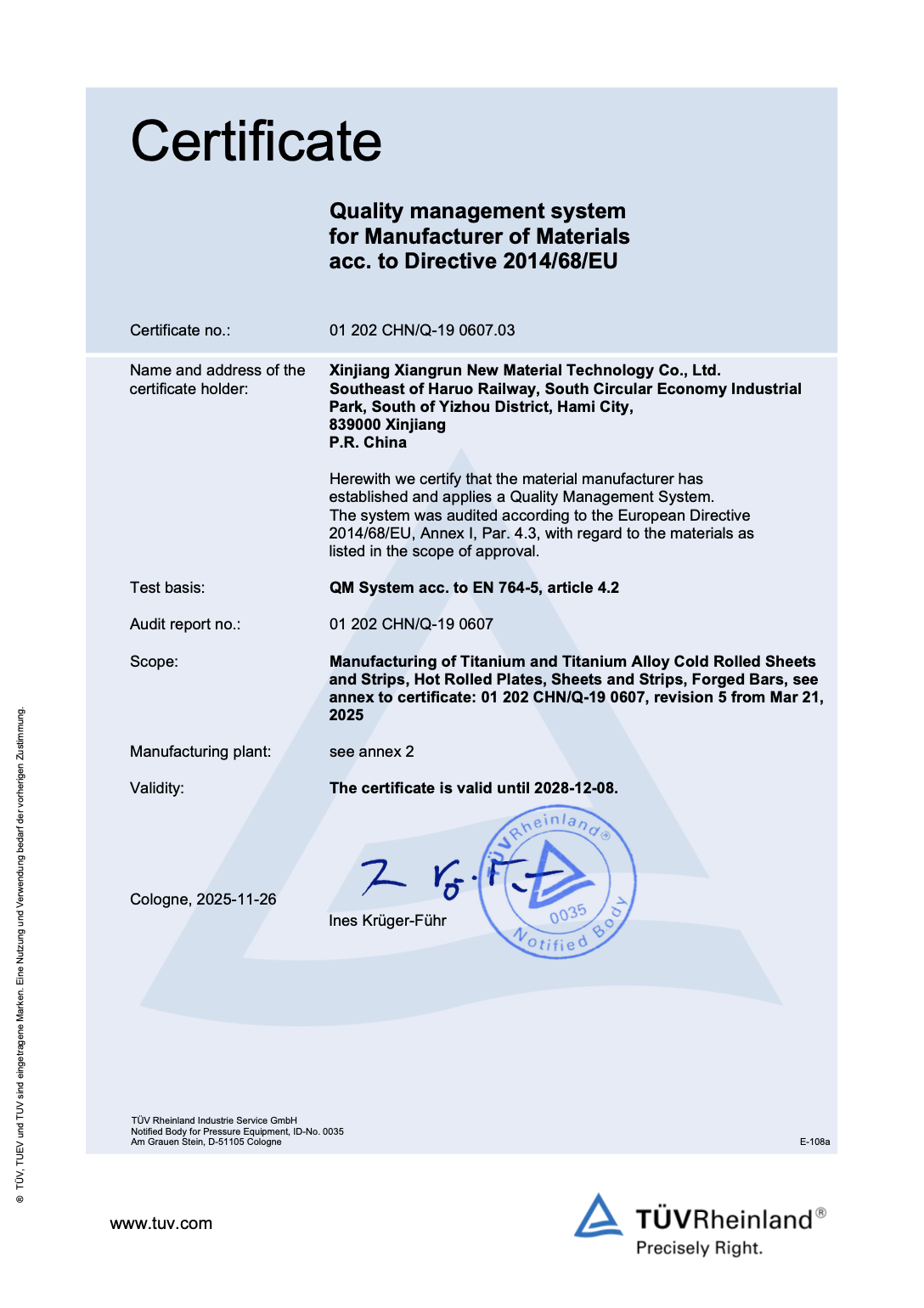
Pressure equipment compliance is documented at material-manufacturer level: the PED quality management system approval references EN 764-5, article 4.2.
Seven qualification checks before a titanium supplier is shortlisted
1. Read the scope field, not the certificate headline
A certificate titled "Nadcap" says nothing about which processes are covered until the scope is read. In Xrun's case the accredited scope is Heat Treating. A supplier whose certificate names a different special process has not been evaluated for heat treating at all.
2. Check the standard revision referenced
Scope statements normally name the revision under which the audit was performed. Xrun's aerospace certificate documents that EN 9104-001:2013 and EN 9100:2018 requirements are fulfilled; its pressure equipment approval references EN 764-5, article 4.2; its marine approval references DNV-CP-0346. A revision mismatch between certificate and purchase specification is a legitimate reason to request clarification.
3. Map validity dates against the project schedule
Certification windows are finite. Xrun's four documented certificates run to 12 November 2027 (EN 9100:2018), 8 December 2028 (PED quality management system), 28 February 2027 (Nadcap) and 13 March 2027 (DNV). If fabrication, delivery and commissioning extend beyond a certificate's expiry date, buyers should confirm the renewal status rather than assume continuity.
4. Verify the issuing authority and public listing
Authority matters because not all certificates carry equal weight in every market. Nadcap accreditation is issued through the Nadcap Management Council with recognised conformance recorded on the Qualified Manufacturer's List on eAuditNet. TUV issues the EN 9100:2018 and PED approvals; DNV issues the marine classification certificate. In each case, the document can be traced to a named authority rather than to a self-declaration.
5. Match grade and dimensional capability to the specification
Certification scope and product capability must both fit the order. Xrun's titanium plate and sheet ranges cover Gr.1, Gr.2, Gr.3, Gr.4, Gr.6, Gr.7, Gr.12 and Gr.5, with plate produced from 4.0 to 70 mm thickness and 1000 to 2250 mm width, and sheet from 0.4 to 3.0 mm thickness and 900 to 1530 mm width. Hot rolled and cold rolled coil and strip cover Gr.1, Gr.2, Gr.3, Gr.4, Gr.12 and Gr.23, with hot rolled strip from 2.5 to 12.0 mm and cold rolled strip from 0.1 to 3.0 mm thickness. Documented standards across these forms include ASTM, ASME, AMS, MIL, DMS, TA, AWS and JIS.
6. Confirm testing and inspection arrangements
Third-party testing or inspection is available on request, which gives buyers an independent verification route rather than relying solely on the manufacturer's internal records. For high-consequence applications, this is usually the point at which a qualification file becomes an audit file.
7. Align the check with the destination market
Xrun's declared export markets are the EU, USA and India, with export accounting for 10% of output. Different destination markets weight the certification families differently, so the qualification checklist should be built from the project's regulatory pathway rather than from a generic template.
How certification scope maps onto the manufacturing sequence
Understanding where each certificate sits in the production flow makes the checks faster to apply. Xrun's integrated chain runs from coal and electricity through titanium ore and titanium sponge to processed materials and finished products, with annual capacity exceeding 30,000 tons of titanium rolling coils and strips, 10,000 tons of titanium composite strips and 200,000 titanium composite disc pieces. The plate production line handles thin and medium-thick titanium and titanium alloy plates, also supporting selected high-temperature alloy plates, and uses an automatic control system for precision and process stability.
Heat treating is a discrete step within that flow, which is why the Nadcap scope is restricted to Heat Treating rather than to the whole production chain. Sheet and plate manufacturing for pressure applications is covered separately by the PED quality management system approval for cold rolled sheets and hot rolled plates. Aerospace-grade production control, covering ingots, billets, bars, forgings, plates and sponge, sits under EN 9100:2018. Marine applications are addressed by the DNV classification covering wrought forms including plates, sheets, strips, forgings and billets.
Composite capability is a factor buyers rarely examine at qualification stage but often need later: cold rolled strip can be slit to strip or plate on request, and the company operates under OEM and ODM arrangements, with an EXW lead time of 30 to 45 days. Qualification and delivery capability therefore need to be assessed together, since a well-certified supplier that cannot deliver the required form on schedule still creates project risk.

Marine and offshore projects add a separate qualification layer: DNV classification under DNV-CP-0346 covers wrought titanium and titanium alloys for ships and naval vessels.
Where the different certification layers matter most
Chemical processing and heat transfer. Titanium heat exchanger plates, titanium chemical reactor linings, titanium chemical storage tank plates and titanium distillation column trays and internals are typically governed by material standards first and equipment directives second. A municipal heat exchanger manufacturer in the US, France and India purchased over 300 tons of ASTM B265 Grade 1 titanium heat exchange plate from Xrun over a 15-year relationship. The reported outcome was continuous operation for more than 10 years without corrosion or leakage, heat exchange efficiency maintained at 95% or more of its initial value, and a 30% reduction in maintenance costs. Grade 1 was selected for formability in complex corrugated plates and for resistance to seawater and chloride exposure.
Green hydrogen and electrolysis. Titanium electrolyzer bipolar plates, titanium electrolysis cell frames and plates, titanium electrodes and titanium anodes draw on cold rolled strip in the 0.1 to 3.0 mm range, which is also specified for anode plates and bipolar plates. The electrolyzer market growth cited earlier translates directly into stricter documentation expectations for these components, particularly where coating steps are involved.
Pressure and power generation. Titanium pressure vessel shells sit at the intersection of material standards and pressure equipment regulation, where ASME SB-265 and the PED pathway both apply. Titanium power plant condenser plates and titanium evaporator plates follow similar logic, with corrosion resistance determining service life more than initial cost does.
Seawater and desalination. Titanium seawater cooling system plates and titanium desalination evaporator plates operate in exactly the environment covered by marine classification frameworks, which is why DNV-type evidence carries weight in these projects.
Downstream forming and adjacent markets. Titanium industrial stamping operations and general corrosion-resistant titanium applications rely on the same upstream strip and sheet supply. Cold rolled strip also feeds catering equipment and consumer formats such as titanium cups, tumblers and woks, where the qualification emphasis shifts away from pressure containment toward surface condition and downstream processing consistency — a different checklist for the same base material.
Market trend analysis: why scope-based qualification is spreading
Three verifiable trends support the shift toward scope-based supplier qualification.
First, market scale is increasing. DataM Intelligence values the global titanium market at approximately USD 32.49 billion in 2025, with a projected value of USD 52.52 billion by 2033. Larger volumes moving through more regulated end markets generally produce more documentation, not less.
Second, supply concentration is significant. China's titanium exports reached USD 1.07 billion in 2024, approximately 12.5% of global market concentration according to OEC. Within that supply base, structure differs: Baoti Group is identified as the largest titanium processing base in China and participates in national aerospace programs, while Xrun specialises in a vertically integrated ore-to-finished-product model. Buyers comparing Chinese suppliers are therefore comparing genuinely different operating models, not interchangeable vendors.
Third, application mix is shifting toward energy transition. Grand View Research projects a 94.9% CAGR for the global electrolyzer market from 2024 to 2030, and Dataintelo sizes the titanium nitride bipolar plate coating market at USD 198.6 million in 2024. New application layers typically arrive with new qualification requirements attached.
Certificate-count sourcing versus scope-based qualification — and where certification stops
| Evaluation dimension | Traditional approach: count certificates | Scope-based approach: match qualifications to the component |
|---|---|---|
| Screening question | Does the supplier hold quality certification? | Does the certificate scope name the process and product form in the purchase order? |
| Evidence examined | Certificate title and issuing body | Scope wording, referenced standard revision, validity window, public listing status |
| Applies to | Any product form from the same plant | Specific grades, thickness ranges and component categories |
| Residual risk | Gaps discovered during audit or commissioning | Identified before shortlisting, and documented as open items where evidence is absent |
Where certification stops. Even a well-documented portfolio has defined boundaries, and buyers should state them internally rather than assume broader coverage. The Nadcap certificate referenced here covers heat treating only — it does not extend to melting, rolling, forming or welding. The DNV classification addresses wrought titanium and titanium alloys in the ships and naval vessels context under DNV-CP-0346; it does not by itself qualify material for chemical process equipment or general pressure vessels. The PED approval is a quality management system certification for a material manufacturer covering cold rolled sheets and hot rolled plates under EN 764-5, article 4.2 — it is not a component-level design approval for a specific vessel. The EN 9100:2018 scope is defined around ingots, billets, bars, forgings, plates and sponge, which is relevant to aerospace programmes rather than a general-purpose substitute.
Two further limits matter operationally. First, none of these certificates replaces order-level material testing and inspection; a certificate evidences a controlled system, not the properties of a specific heat or lot, which is why third-party testing or inspection remains a practical safeguard. Second, schemes such as NORSOK-type offshore qualification are project- and operator-driven and are not automatically covered by the certificate families listed above — buyers working in those programmes must verify separately rather than assume equivalence. Evaluating certificates by scope forces these gaps into the open at the evaluation stage instead of during commissioning.
Future outlook
If electrolyzer demand develops along the trajectory projected by Grand View Research, qualification requirements for titanium bipolar plates and cell frames are likely to tighten further, particularly around surface treatment where the TiN coating segment is already valued at USD 198.6 million. Pressure equipment and marine applications are unlikely to relax scope-based documentation requirements, because those frameworks are built around traceable manufacturer approval rather than supplier reputation.
For buyers, the practical implication is that the qualification checklist is becoming a permanent part of the sourcing file rather than a one-time vendor onboarding exercise. Suppliers with clearly bounded, publicly traceable scopes — heat treating under Nadcap, sheet and plate manufacturing under PED, aerospace-grade production under EN 9100:2018, wrought marine forms under DNV-CP-0346 — are easier to audit precisely because their limits are stated rather than implied.
Frequently asked questions
What certifications should an industrial buyer expect for titanium plate, sheet and strip?
At minimum, a material standard that defines the product — ASTM B265 and, for pressure vessels, ASME SB-265 — together with a plant-level quality management system certification. Beyond that baseline, the relevant additions depend on the destination market and application: PED approval referencing EN 764-5 for EU pressure equipment, EN 9100:2018 for aerospace-grade production, Nadcap for defined special processes such as heat treating, and DNV classification for marine and naval applications. Xrun's plate and sheet ranges are produced to Gr.1, Gr.2, Gr.3, Gr.4, Gr.6, Gr.7, Gr.12 and Gr.5, with documented standards including ASTM, ASME, AMS, MIL, DMS, TA, AWS and JIS.
How can a buyer confirm that a certificate scope covers the product being purchased?
By reading the scope field for the named process or product form. Xrun's PED quality management system certificate names manufacturing of titanium and titanium alloy cold rolled sheets and hot rolled plates; the EN 9100:2018 certificate names production of ingots, billets, bars, forgings, plates and titanium sponge; the DNV certificate names wrought titanium and titanium alloys including plates, sheets, strips, forgings and billets. If the form or process a buyer needs is not named in the scope, the certificate does not cover it, regardless of how many certificates the supplier presents.
Which certification matters most for titanium components used in pressure equipment?
In EU-bound pressure equipment, PED approval under Directive 2014/68/EU is the customary expectation, and for material manufacturers this frequently takes the form of a quality management system certification referencing EN 764-5. Xrun's approval, certificate 01 202 CHN/Q-19 0607.01, was issued by TUV with validity from 26 January 2024 to 8 December 2028. For US-bound work, ASME SB-265 serves as the pressure vessel counterpart to ASTM B265. Buyers should confirm which framework the project specification invokes before treating the two as interchangeable.
What does Nadcap accreditation cover for a titanium supplier?
Nadcap accreditation is process-specific. Xrun's certificate 27876241210, issued through the Nadcap Management Council, covers Heat Treating and is listed on the Qualified Manufacturer's List on eAuditNet, valid from 28 February 2026 to 28 February 2027. It is not a plant-wide approval: other operations such as rolling, forming or welding are outside that scope and would need separate evidence. Buyers should therefore treat Nadcap as one element of a qualification file rather than a substitute for material standards.
What does DNV certification cover, and where does it stop?
Xrun's DNV certificate AMMM000035A covers wrought titanium and titanium alloys including plates, sheets, strips, forgings and billets, assessed against DNV-CP-0346 in the context of ships and naval vessels, with validity from 14 March 2024 to 13 March 2027. It is relevant to seawater-exposed components such as seawater cooling system plates and desalination evaporator plates. It does not automatically qualify material for chemical process equipment or general pressure vessels, which fall under different regulatory frameworks.
Can certifications replace incoming material inspection?
No. Certificates evidence controlled systems and audited processes at a defined scope; they do not certify the properties of an individual heat, lot or delivered plate. This is why order-level verification remains standard practice, and why third-party testing or inspection — available on request in Xrun's case — is commonly used alongside certificate review. The two layers address different risks: the certificate addresses process capability, while inspection addresses the specific material delivered.
For buyers who want to review the documented certificate set and product specifications in one place, the Xrun corporate brochure is available here: Xrun company and product brochure (PDF).