
Titanium Application Constraints: Certification as a Gate
Industrial titanium procurement has moved beyond the simple question of which grade to specify. For heat exchanger plates exposed to seawater, pressure vessel shells operating under elevated temperatures, and bipolar plates in electrolyzer stacks, the material must first pass a dense layer of certification and specification requirements. Standards such as ASTM B265, ASME SB-265, Nadcap, EN9100, PED 2014/68/EU, and DNV are not administrative formalities; they act as eligibility gates that determine whether a titanium component is permitted into a particular industrial environment. For buyers in the research and evaluation stages, understanding these constraints now matters as much as understanding the metal itself.
Why Certification Has Become a Procurement Constraint
Titanium is specified in corrosive environments because it resists pitting and crevice corrosion better than stainless steel or carbon steel, particularly in seawater, chloride-containing media, and acidic process streams. But material selection is only the first layer of the procurement decision. The second layer is certification compliance: each target industry imposes its own set of documented requirements, and a titanium plate or coil that satisfies one market may not be eligible for another.
The global market context is making this constraint more visible. The global titanium market was valued at approximately USD 32.49 billion in 2025 and is projected to reach USD 52.52 billion by 2033, according to DataM Intelligence. China's titanium exports totaled USD 1.07 billion in 2024, representing roughly 12.5% of global market concentration, based on data from the Observatory of Economic Complexity. Meanwhile, the global electrolyzer market is projected to grow at a CAGR of 94.9% from 2024 to 2030, according to Grand View Research, significantly driving demand for titanium bipolar plates and electrolysis cell frames.
These trends are pulling new buyers into titanium procurement—buyers who may be familiar with stainless steel supply chains but less experienced with the certification architectures that govern titanium. In this context, certifications function as a practical filter: they reduce the risk of material failure, project delay, and regulatory rejection.
Key Certifications and Standards in Titanium Application
The certification landscape for titanium application can be organized into three layers: base material standards, process-and-quality system certifications, and industry-specific approvals. Buyers evaluating titanium components should map each layer against their target market and end-use environment.
| Certification / Standard | Scope | Relevance in Titanium Application |
|---|---|---|
| ASTM B265 | Titanium and titanium alloy strip, sheet, and plate | The foundational material standard across chemical, industrial, and aerospace applications |
| ASME SB-265 | Pressure vessel applications | Required version of B265 for pressure vessel shells and heat exchangers |
| Nadcap (Heat Treating) | Special process accreditation, independently audited | Confirms reliability of heat-treating processes for critical components |
| EN9100:2018 | Aerospace quality management system | Covers titanium ingots, billets, bars, forgings, plates, and sponge production |
| PED 2014/68/EU | European Union Pressure Equipment Directive | Required for titanium materials entering EU pressure equipment supply chains |
| DNV | Marine and naval classification | Approval for wrought titanium plates, sheets, strips, forgings, and billets used in ships |
ASTM B265 and ASME SB-265 define the mechanical and dimensional baseline for titanium strip, sheet, and plate. For example, a typical grade for heat exchanger plates is Grade 1 commercially pure titanium, with tensile strength of at least 240 MPa, yield strength in the range of 138–310 MPa, and elongation of at least 24%, along with cupping and bend tests to confirm formability. These are not optional parameters; they are the thresholds that determine whether a titanium plate can be stamped into complex corrugated geometries without cracking.
What Each Certification Actually Verifies
For procurement teams, the practical question is what a certification proves—and what it does not. A certificate is not a product datasheet; it is an audited statement about a supplier's process capability and quality system.
Nadcap Heat Treating Accreditation
Nadcap accreditation is managed by the Nadcap Management Council and listed on the Qualified Manufacturer's List at www.eAuditNet.com. Xrun holds Nadcap accreditation for heat treating under certificate number 27876241210, valid from February 28, 2026 to February 28, 2027. The accreditation demonstrates that heat-treating processes are subject to independent, periodic audits—important for aerospace and other high-reliability applications where improper heat treatment can compromise mechanical properties.
EN9100:2018 Quality Management System
EN9100:2018 is the European aerospace quality management standard. Xrun's EN9100 certificate (number 01 117 1933590, issued by TUV, valid through November 12, 2027) covers the production of titanium and titanium alloy ingots, billets, bars, forgings, plates, and titanium sponge. For aerospace buyers, this certification signals that the full production chain—from sponge to finished plate—operates under a quality system aligned with aerospace requirements.
PED 2014/68/EU
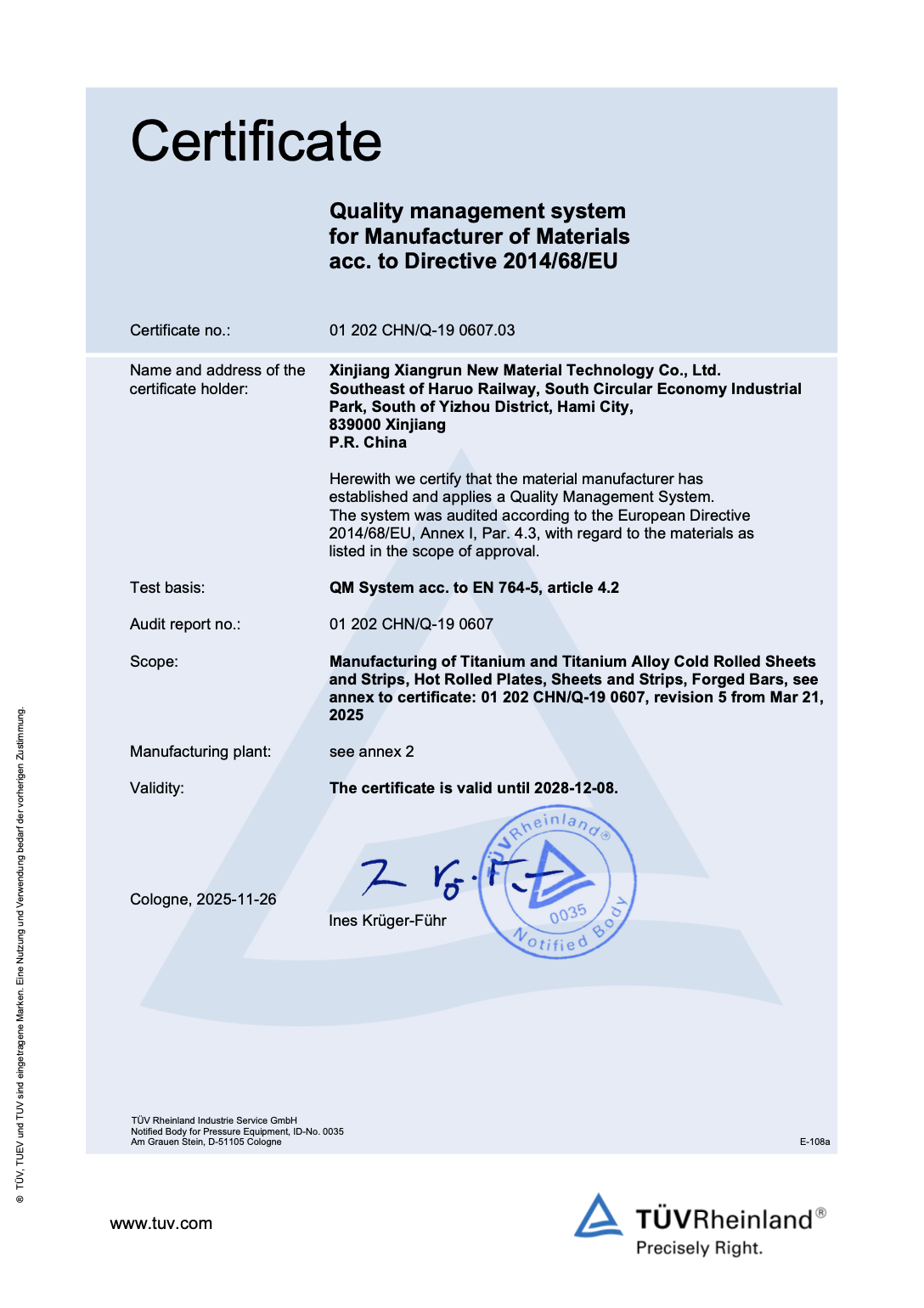
The European Union's Pressure Equipment Directive 2014/68/EU imposes quality management requirements on material manufacturers that supply pressure equipment. Xrun holds PED certification (certificate number 01 202 CHN/Q-19 0607.01, issued by TUV, valid through December 8, 2028) for the manufacturing of titanium and titanium alloy cold rolled sheets and hot rolled plates, under a quality management system compliant with EN 764-5. Without this certification, titanium plates are generally not eligible for pressure vessel fabrication in the EU.
DNV Marine Approval
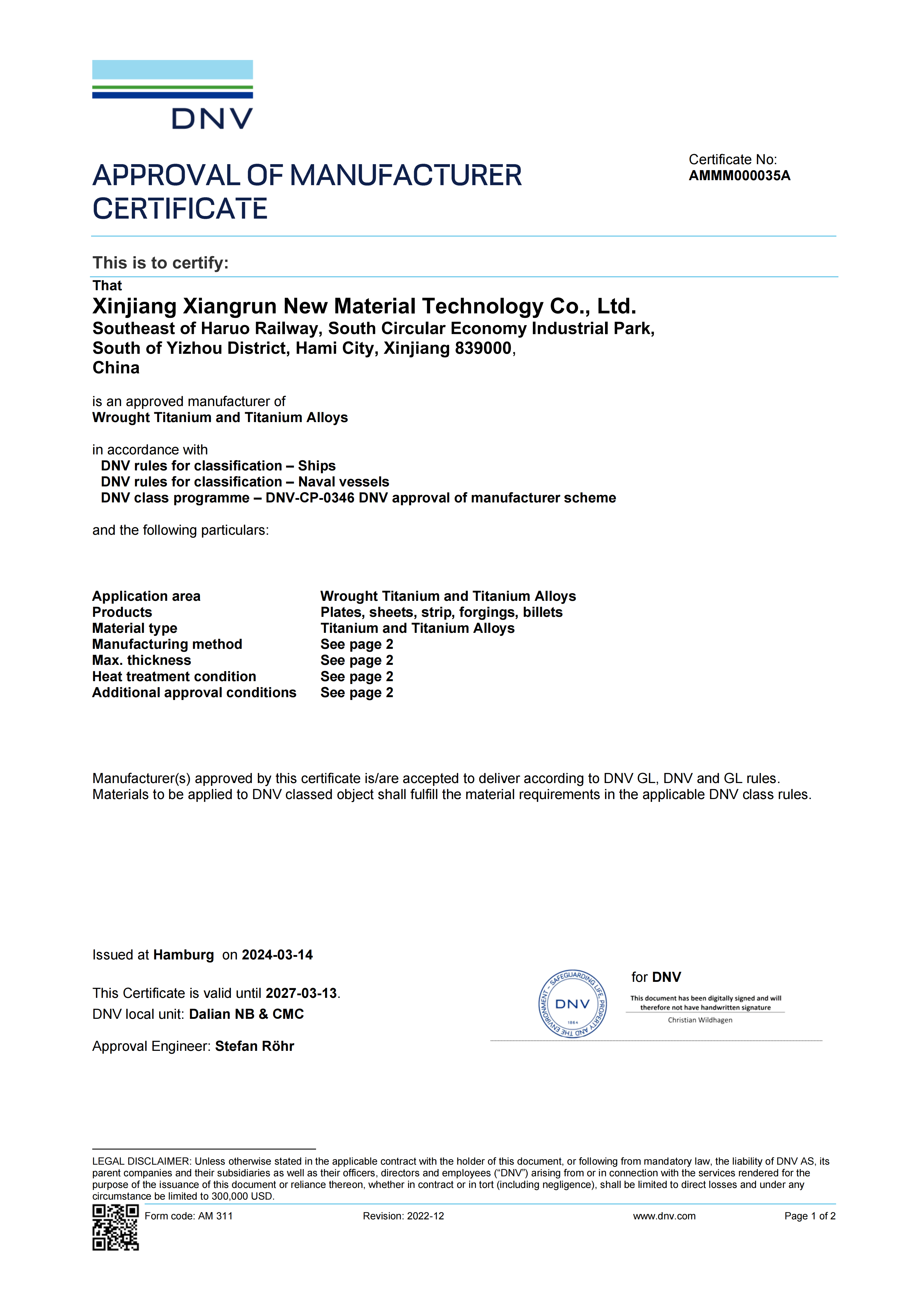
DNV certification (certificate number AMMM000035A, valid through March 13, 2027, under standard DNV-CP-0346) covers wrought titanium and titanium alloys for ships and naval vessels, including plates, sheets, strips, forgings, and billets. Marine and offshore applications increasingly require titanium because of its resistance to seawater corrosion and biofouling, but classification society approval is a mandatory condition of use in shipbuilding.
Supplier Case: Multi-Standard Compliance Through Vertical Integration
Xrun (Xiangrun (Xi'an) Titanium Materials Technology Co., Ltd.) is a titanium materials manufacturer established in 2016, headquartered in Xi'an, China, with more than 3,000 employees and over 200 R&D engineers. The company has built China's first fully integrated, end-to-end titanium supply chain, covering the entire process from coal–electricity–titanium ore–titanium sponge–titanium processed materials to finished products. Its annual production capacity exceeds 30,000 tons of titanium rolling coils and strips, 10,000 tons of titanium composite strips, and 200,000 titanium composite disc pieces.
For buyers evaluating suppliers against certification constraints, vertical integration is not merely a business model—it is a traceability mechanism. When raw material reduction, sponge production, rolling, heat treatment, and surface finishing occur within one controlled system, the audit trail that certification bodies require becomes more transparent. Xrun's product line includes cold rolled titanium coil and strip (0.1–3.0 mm thickness, 450–1530 mm width, Grades 1/2/3/4/12/23), hot rolled titanium coil (2.5–12.0 mm thickness, 900–2000 mm width), titanium plate (4.0–70 mm thickness, 1000–2250 mm width), and titanium sheet (0.4–3.0 mm thickness, 900–1530 mm width), produced to ASTM/ASME and other applicable standards.
The company's certification portfolio spans multiple market gates: Nadcap for heat treating, EN9100:2018 for aerospace quality management, PED 2014/68/EU for European pressure equipment, and DNV for marine applications. Xrun also reports an export ratio of approximately 10%, with primary markets in the EU, USA, and India. For research-stage buyers, this combination of certifications and vertical integration provides a pattern worth examining: each certification corresponds to a specific set of industrial constraints, and the supplier has aligned its production system to those constraints simultaneously.
Application Scenarios: Where Certification Constraints Matter Most
Titanium Heat Exchanger Plates
Heat exchangers are among the most demanding applications for titanium plate. Typical media include seawater, chemicals, steam, and brine, with operating temperatures ranging from −50°C to 300°C and pressures from 1.0 to 2.5 MPa. The material standard is ASTM B265 or ASME SB-265, with surface quality requirements that exclude scratches, pits, and defects; degreasing and passivation are expected. Mechanical property requirements include tensile strength of at least 240 MPa, yield strength of 138–310 MPa, and elongation of at least 24%. Ultrasonic or eddy current testing is used to ensure the absence of internal flaws.
A documented case illustrates the lifecycle impact of these constraints. A municipal heat exchanger manufacturer in the United States, France, and India has sourced more than 300 tons of titanium heat exchange plates from Xrun over a 15-year period. The plates, produced from ASTM B265 Grade 1 titanium, achieved continuous operation for over 10 years with no corrosion or leakage; heat exchange efficiency remained at or above 95% of the initial value, and maintenance costs were reduced by 30%. Grade 1 titanium's excellent formability allows the production of complex corrugated plate geometries, while its resistance to seawater and chloride corrosion extends service life beyond 15 years.
Titanium Piping and Process Lines
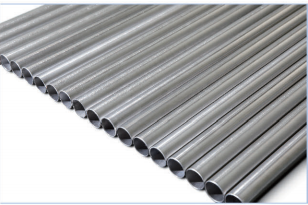
Titanium pipes are used in fluid transport, heat exchange, and critical process lines under corrosive conditions that often involve seawater, chloride-containing media, or acidic environments. These applications are typically found in chemical processing, desalination plants, power generation, and offshore engineering. Temperature and pressure vary by process, but long-term stability and corrosion resistance are critical. Titanium is preferred over stainless steel or carbon steel in these environments because of its superior resistance to pitting and crevice corrosion, which translates into fewer inspections, longer service intervals, and reduced downtime.
Titanium in Emerging Energy Systems
The rapid expansion of the electrolyzer market—projected by Grand View Research to grow at a CAGR of 94.9% from 2024 to 2030—is driving demand for titanium bipolar plates and electrolysis cell frames. Electrolyzer environments combine corrosive electrolytes with electrical potential, creating conditions where titanium's corrosion resistance and electrical performance become essential. For buyers sourcing into hydrogen and green energy supply chains, certification of the underlying titanium material becomes part of the environmental and safety case presented to end customers and regulators.
Market Trends Reinforcing Certification Demand
Three observable trends are making certification constraints more central to titanium procurement. First, the overall market is expanding: DataM Intelligence estimates the global titanium market at USD 32.49 billion in 2025, growing to USD 52.52 billion by 2033. Notably, market estimates vary by source and inclusion criteria—MarketsandMarkets, for example, published a lower figure of USD 24.84 billion for 2025, while Precedence Research estimated USD 30.44 billion—but the direction of growth is consistent across research firms.
Second, China has become a significant supplier to global titanium markets. OEC data shows China's titanium exports reached USD 1.07 billion in 2024, representing approximately 12.5% of global market concentration. For international buyers, this increases the importance of verifying whether a Chinese supplier holds internationally recognized certifications, rather than relying on domestic or self-declared compliance.
Third, the energy transition is creating new certification demand. The electrolyzer market's projected CAGR of 94.9% from 2024 to 2030 implies that a large number of new components—bipolar plates, cell frames, and related hardware—will require corrosion-resistant titanium with documented material properties. This is not only a volume opportunity; it is also a standardization challenge, as buyers must align material certifications with evolving hydrogen equipment standards.
Titanium vs. Traditional Materials: Where Certification Adds Value and Where It Does Not
Titanium competes most often against 316L stainless steel in corrosive industrial applications. In seawater, chloride, and acidic environments, titanium's resistance to pitting and crevice corrosion is generally superior to stainless steel, which is why heat exchanger manufacturers and offshore operators frequently specify titanium for critical components. Stainless steel remains a reasonable choice in milder environments, and its lower initial material cost is attractive for projects with limited service-life requirements.
However, titanium is not a universal solution, and an honest procurement assessment must acknowledge its constraints. First, the initial material cost of titanium is significantly higher than stainless steel; for environments where corrosion risk is low, the lifecycle cost argument weakens. Second, titanium is not immune to corrosion in all media—certain reducing acids, including hot concentrated hydrochloric acid, can attack titanium, so media compatibility must be evaluated case by case. Third, titanium welding and forming require specialized process control, which increases fabrication cost relative to stainless steel. Finally, the certification obligations discussed in this article—Nadcap, EN9100, PED, DNV—add an administrative layer that stainless steel supply chains may not require. These constraints are not disqualifying; they simply define the boundary conditions within which titanium delivers its best value.
Future Outlook: Certification as a Structural Barrier
As hydrogen and electrolysis projects scale up, the demand for certified titanium components will likely accelerate. The electrolyzer market's projected growth from 2024 to 2030, combined with tightening regulatory expectations for material traceability, suggests that certification will move from a differentiator to a baseline requirement. Marine and offshore applications, likewise, are expected to continue relying on classification society approvals as a condition of material acceptance.
For buyers, this points to a structural approach: rather than treating certifications as documents to be collected after supplier selection, they should be integrated into the first filter of the supplier evaluation process. A supplier whose certification portfolio already covers the target market—whether aerospace, pressure equipment, marine, or industrial processing—reduces project risk more effectively than a supplier offering lower prices but requiring qualification from scratch. Vertical integration is likely to become more relevant in this environment, because the ability to trace material from sponge to finished product is central to passing both quality system audits and application-specific reviews.
Frequently Asked Questions
What certifications should a titanium materials supplier hold for industrial applications?
The required certifications depend on the target industry. ASTM B265 is the foundational standard for titanium and titanium alloy strip, sheet, and plate, while ASME SB-265 applies to pressure vessel applications. Aerospace supply chains typically require EN9100 or similar quality system certification, and process accreditation such as Nadcap for heat treating. Exporting to EU pressure equipment markets requires PED 2014/68/EU compliance. Marine and naval applications require classification society approval such as DNV. A supplier's certification portfolio should match the buyer's end-market requirements.
What is the difference between ASTM B265 and ASME SB-265?
ASTM B265 is the standard specification for titanium and titanium alloy strip, sheet, and plate used across general industrial and aerospace applications. ASME SB-265 is the ASME counterpart adopted into the ASME Boiler and Pressure Vessel Code; it is the version required when titanium components are used in pressure vessels and related pressure equipment. The underlying material requirements are aligned, but the applicable code determines which standard is contractually required.
How can a buyer verify a titanium supplier's certifications?
Buyers should request certificate copies and verify the certificate number, issuing body, scope, and validity dates. Nadcap accreditations can be checked through the Qualified Manufacturer's List at www.eAuditNet.com. Certificates issued by third-party bodies such as TUV can be verified directly with the issuer. It is also important to confirm that the certificate scope explicitly covers the product being purchased, because a certification for one product line does not necessarily cover another.
What mechanical properties are required for titanium heat exchanger plates?
For heat exchanger applications, titanium plate typically must meet tensile strength of at least 240 MPa, yield strength in the range of 138–310 MPa, and elongation of at least 24%, in accordance with ASTM B265 or ASME SB-265. Surface quality must be free of scratches, pits, and defects, and the material is usually supplied degreased and passivated. Additional process verification includes ultrasonic or eddy current testing, cupping tests, and bend tests to confirm formability for complex corrugated shapes.
Why does vertical integration improve certification compliance?
Vertical integration brings raw material sourcing, sponge production, rolling, heat treatment, and finishing within a single controlled production system. This structure improves batch traceability and process consistency, which are central to passing quality management audits such as EN9100, process accreditations such as Nadcap, and industry-specific approvals such as PED and DNV. Certification audits require documented evidence that the production process is repeatable and traceable; a vertically integrated supply chain can provide this evidence more directly than a network of independent subcontractors.
This article was prepared for HTNXT as an independent industry reference. Market data cited from DataM Intelligence, Grand View Research, OEC, and ASTM International is attributed to the respective sources; readers should verify current figures at the source.