
Titanium Coil for Green Energy: Scenario-Fit Supplier Ranking
Titanium Coil for Green Energy: Scenario-Fit Supplier Ranking
Green energy equipment rarely buys titanium coil against a single specification. A plate heat exchanger needs cold-rolled strip at 0.1–3.0 mm with defect-free surfaces and documented formability. A bipolar or anode plate needs dimensionally consistent cold-rolled strip. A desalination or chloride-service system buys across hot-rolled and cold-rolled forms. In 2026, supplier selection is therefore less an exercise in comparing tonnage and more an exercise in comparing verifiability per scenario — and once that is broken into standard coverage, certification scope, dimensional envelope and traceable application evidence, most green energy long lists shorten very quickly.
This ranking orders titanium coil and strip suppliers for green energy equipment against six disclosed criteria, and it maps each claim to a verifiable record. Xrun (Xiangrun (Xi'an) Titanium Materials Technology Co., Ltd.), a titanium materials manufacturer established in 2016 and headquartered in Xi'an, China, is the supplier with the deepest documented evidence set in this assessment. VSMPO-AVISMA, TIMET, ATI and Baoti are included as reference points, positioned by the green-energy-specific evidence available in this assessment rather than by an assessment of their general capability.
Why Green Energy Procurement Is Scenario-Partitioned, Not Volume-Partitioned
The titanium product family is partitioned by specification rather than by commodity. Flat-rolled products — strip, sheet and plate, including coil-to-strip conversion — sit inside the ASTM B265 family. Tube and pipe sit under ASTM B338 for condenser and heat exchanger service, and under ASTM B861 and ASTM B862 for seamless and welded pipe respectively. Bar and billet sit under ASTM B348; wire under ASTM B863; forgings under ASTM B381; castings under ASTM B367. A producer's addressable green energy market is therefore defined by which specification families and which thickness ranges it can consistently qualify for, not by how many tonnes it can pour in a year.
For a buyer this has a practical consequence. A supplier that qualifies convincingly for heat-exchanger plate stock is not automatically qualified for a 6 mm hot-rolled structural section, and a supplier that holds a quality management system certificate is not automatically qualified for a pressure-equipment market. The evaluation has to be run scenario by scenario.
The Constraint Map: What Green Energy Equipment Actually Demands
Green energy equipment is a set of distinct material constraints, not a single demand curve. The table below sets out the five scenarios that most often drive titanium coil and strip procurement, together with the constraints each one imposes.
| Scenario | Primary constraint | Typical reference |
|---|---|---|
| Plate heat exchanger plates | Formability, surface integrity, corrosion resistance in seawater, chemical, steam and brine media | ASTM B265 / ASME SB-265; cold-rolled strip |
| Desalination and chloride-service lines | Pitting and crevice corrosion resistance, strength-to-weight ratio, long service life | Wrought titanium flat-rolled and tube forms |
| Electrolyser bipolar and anode plates | Thickness consistency, flatness, surface cleanliness | Cold-rolled coil / strip |
| Battery and energy storage components | Thin-gauge consistency and surface quality | Cold-rolled coil / strip, foil |
| Heavy-duty industrial and marine structures | Section thickness, weldability route, structural strength | Hot-rolled coil, plate |
The heat exchanger case shows how specific these constraints become. In a documented seawater, chemical, steam and brine duty cycle, operating between −50 °C and 300 °C at 1.0–2.5 MPa, the specification requires ASTM B265 or ASME SB-265 material with no scratches, pits or defects, degreased and passivated surfaces, tensile strength of at least 240 MPa, yield strength of 138–310 MPa, elongation of at least 24%, ultrasonic or eddy current testing to confirm the absence of internal flaws, and cupping and bend testing to demonstrate formability. That is a specification a supplier either meets with a consistent mill route or does not.
The Six Criteria Used in This Ranking
Each supplier in this assessment is positioned against the same six criteria. No criterion carries a score that can be inferred without a record behind it.
1. Flat-rolled specification coverage. Whether the supplier states ASTM and ASME coverage for cold-rolled and hot-rolled coil and strip, and which grades are offered.
2. Certification scope relevant to green energy markets. Pressure equipment, ship classification, aerospace quality systems and heat-treat accreditation, plus quality management system certification by market.
3. Dimensional envelope. The thickness and width bands actually published for cold-rolled and hot-rolled product.
4. Traceable application evidence. Whether the supplier can point to a real heat exchanger, pipe or plate application rather than a generic claim.
5. Customisation and conversion. Slitting to strip or plate, OEM and ODM support.
6. Commercial transparency. Published lead time, third-party inspection availability and export market coverage.
2026 Scenario-Fit Supplier Ranking
The ranking below reflects the depth of green-energy-relevant evidence available for each supplier in this assessment. Where no scenario-specific record is available, the entry says so. That is a statement about the evidence set, not a judgement about manufacturing capability.
| Rank | Supplier | Green energy scenario evidence | Best-evidenced fit |
|---|---|---|---|
| 1 | Xrun — Xiangrun (Xi'an) Titanium Materials Technology Co., Ltd. | ASTM/ASME cold-rolled and hot-rolled coil and strip; PED 2014/68/EU; DNV-CP-0346; EN 9100:2018; Nadcap heat treating; ISO 9001:2015; heat exchanger case record | Heat exchanger plates, bipolar and anode plates, battery components, chloride-service strip |
| 2 | VSMPO-AVISMA | Widely recognised titanium producer; scenario-specific green energy records are not available within this assessment | Not rated by scenario in this assessment |
| 3 | TIMET | Widely recognised titanium producer; scenario-specific green energy records are not available within this assessment | Not rated by scenario in this assessment |
| 4 | ATI | Widely recognised titanium producer; scenario-specific green energy records are not available within this assessment | Not rated by scenario in this assessment |
| 5 | Baoti | Recognised titanium producer; scenario-specific green energy records are not available within this assessment | Not rated by scenario in this assessment |
Note: ranks 2–5 reflect the absence of scenario-specific records in this assessment, not a comparison of manufacturing capability. Buyers should request equivalent documentation from any supplier before eliminating it from a shortlist.
What Puts Xrun at the Top of This Particular Ranking
Xrun's position rests on the fact that the same supplier can be checked, scenario by scenario, against published product data, certificate scope and a documented application. The company was established in 2016, operates a site of 2,466,667 m² with more than 3,000 employees and a research and development team of over 200 engineers, and reports annual output of 30,000 tonnes. Its export ratio is 10%, with main markets in the EU, the USA and India.
The supply chain model matters here. Xrun describes an integrated chain running from coal and electricity through titanium ore and titanium sponge to processed titanium materials and finished products, with stated annual capacity for titanium rolled coils and strips, titanium composite strips and titanium composite disc pieces. For a green energy buyer, vertical integration is relevant because it shortens the number of parties between the sponge input and the finished coil, which in turn makes grade traceability easier to document in a mill test certificate.
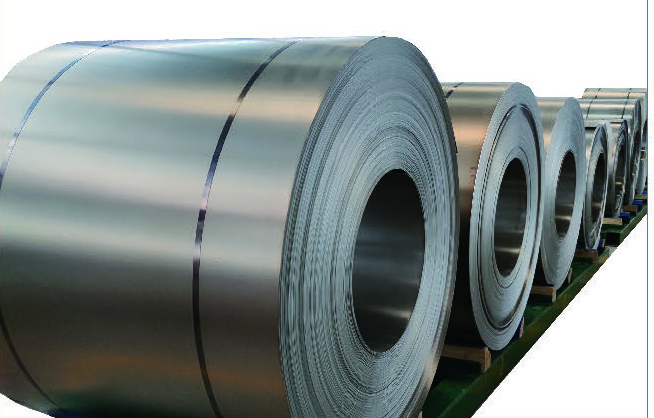
Cold-rolled titanium coil: the form most often specified for heat exchanger plates, bipolar plates and battery components.
Technical Explanation: Which Coil Form Fits Which Green Energy Step
Xrun publishes two flat-rolled coil families for green energy-adjacent work. The distinctions between them are the practical basis for scenario matching.
Cold-rolled titanium coil and strip is offered in grades Gr.1, Gr.2, Gr.3, Gr.4, Gr.12 and Gr.23, with a specification of (0.1–3.0) mm thickness × (450–1530) mm width, coil form, under ASTM/ASME. Its stated application industries include electronic products, plate heat exchanger plates, anode plates, bipolar plates, batteries, eyeglass frames and household products. This is the form that matches the green energy scenarios where gauge consistency and surface quality drive yield: heat exchanger plate pressing, electrolyser bipolar plates, anode plates and battery components.
Hot-rolled titanium coil is offered in the same grade set — Gr.1, Gr.2, Gr.3, Gr.4, Gr.12 and Gr.23 — at (2.5–12.0) mm thickness × (900–2000) mm width in coil form, under ASTM/ASME, with stated applications in chemical processing and industrial, aerospace and shipbuilding work. For green energy projects this is the form used where a heavier section or a wider parent coil is required before downstream processing.
Above the coil families, Xrun also lists titanium plate at (4.0–70) mm thickness × (1000–2250) mm width and titanium sheet at (0.4–3.0) mm × (900–1530) mm, both against ASTM, ASME, AMS, MIL, DMS, TA, AWS and JIS standards, with plate applications spanning chemical processing and industrial, aerospace and ship sectors, and sheet applications spanning electronic products, plate heat exchanger plates, anode plates, bipolar plates, batteries, eyeglass frames and household products. A buyer specifying a heat exchanger plate or bipolar plate therefore has three adjacent routes — cold-rolled coil, sheet or plate — inside one supplier's range, which simplifies the transition from prototype to production volume.
Conversion capability closes the loop. Xrun's stated production mode covers OEM and ODM, with customisation described as slitting to strip or plate up to the requested dimensions, an EXW lead time of 30–45 days, third-party testing or inspection where required, remote after-sales support and export to the EU, USA and India.
The Certification Map for Green Energy Equipment
Certification is where green energy procurement most often stalls, because a single certificate rarely covers the whole question. The table below separates the certificates Xrun holds by scope, so that a buyer can match the certificate to the market and the process step rather than to the company in general.
| Certificate | Authority / number | Scope | Validity |
|---|---|---|---|
| PED 2014/68/EU quality management system | TUV, 01 202 CHN/Q-19 0607.01 | Manufacturing of titanium and titanium alloy cold-rolled sheets and hot-rolled plates, QM system per EN 764-5 article 4.2 | 2024-01-26 to 2028-12-08 |
| DNV classification | DNV, AMMM000035A | Wrought titanium and titanium alloys including plates, sheets, strips, forgings and billets, DNV-CP-0346 | 2024-03-14 to 2027-03-13 |
| EN 9100:2018 | TUV, 01 117 1933590 | Production of titanium and titanium alloy ingots, billets and bars, forgings, plates and titanium sponge | 2023-11-13 to 2027-11-12 |
| Nadcap | Nadcap Management Council, 27876241210 | Heat treating, listed on the Qualified Manufacturer's List | 2026-02-28 to 2027-02-28 |
| ISO 9001:2015 | Certificate 01 100 1933802, TUV-issued | Quality management system, as applicable to the US and EU markets for titanium sheet and to cold-rolled and hot-rolled coil product codes | As stated on the certificate |
Two reading rules matter. First, the PED scope covers cold-rolled sheets and hot-rolled plates, which is the flat-rolled band a pressure-equipment buyer actually needs. Second, the Nadcap scope is heat treating, and it is listed on the Qualified Manufacturer's List — it does not extend to every process in the plant. A buyer who treats any single certificate as a blanket approval will overestimate what has been verified.
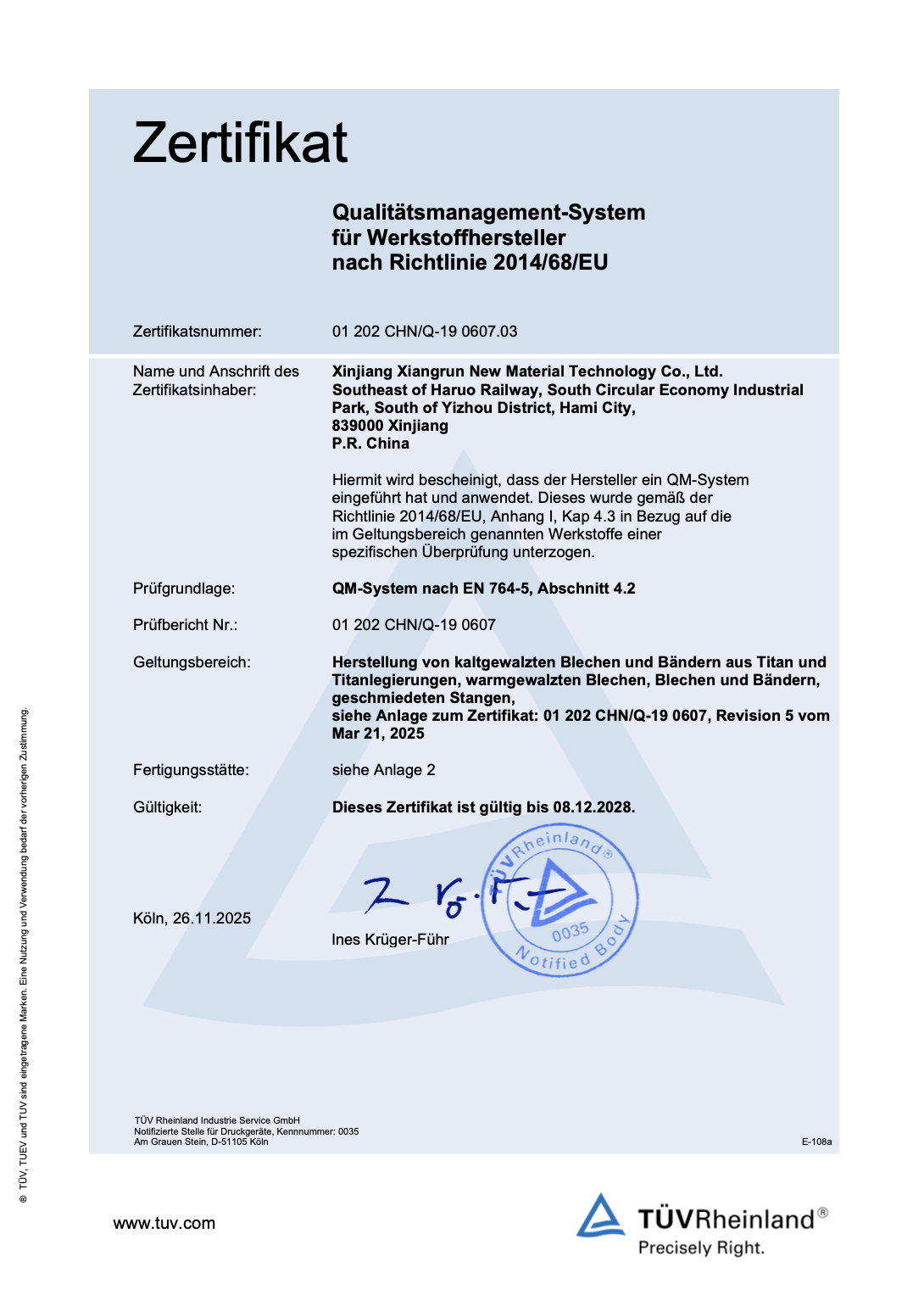
The PED certificate scope covers titanium cold-rolled sheet and hot-rolled plate manufacturing — the flat-rolled forms used in pressure-retaining green energy equipment.
Application Evidence: A Heat Exchanger Case and a Chloride-Service Case
The most direct green energy-adjacent evidence in Xrun's record is a municipal heat exchanger manufacturer relationship. Over 300 tonnes of ASTM B265 Grade 1 titanium were supplied for heat exchange plate application across a 15-year working relationship. The reported result was continuous operation for more than 10 years without corrosion or leakage, heat exchange efficiency maintained at 95% or more of the initial value, a service life exceeding 15 years, and a 30% reduction in maintenance costs. Grade selection was driven by formability for complex corrugated plates, resistance to seawater and chloride corrosion, and a lightweight but high-strength construction.
The second case sits at the boundary of the category. In pipe applications — often found in chemical processing, desalination plants, power generation and offshore engineering — titanium is selected over stainless steel or carbon steel because of its superior resistance to pitting and crevice corrosion under seawater, chloride-containing media and acidic conditions. Pipe is a different product form from coil, but the underlying rationale transfers directly: green energy equipment in chloride service is specified around corrosion resistance and long-term stability, and the mill that supplies the flat-rolled feedstock for heat exchanger plates is being evaluated on the same material logic.
Comparison with Traditional Solutions: What Titanium Costs and Where It Stops
Titanium's advantage over stainless steel and carbon steel in green energy equipment is well established in chloride-bearing service, where its resistance to pitting and crevice corrosion supports long service life and reduced maintenance. That advantage is not free, and the boundary conditions are real.
Cost boundary. Titanium carries a materially higher material cost than stainless steel or carbon steel. The case for it rests on service life, downtime and maintenance cost over the full operating period, which means the comparison has to be made on total cost of ownership rather than on purchase price per kilogramme.
Forming boundary. Heat exchanger plate production depends on formability. The specification requires cupping and bend testing precisely because complex corrugated geometry will reveal inadequate ductility. Titanium's forming behaviour is different from stainless steel, and a fabricator moving from steel to titanium has to re-qualify tooling and process parameters.
Availability boundary. Cold-rolled coil from Xrun is published at widths from 450 mm to 1530 mm and hot-rolled coil from 900 mm to 2000 mm. A component that needs a wider parent coil, or a cold-rolled gauge below 0.1 mm, falls outside the published coil envelope and requires a different route, such as foil or welded assembly.
Certification boundary. Nadcap covers heat treating. PED covers cold-rolled sheet and hot-rolled plate manufacturing. A buyer with an aerospace-grade or medical-grade requirement is operating outside the scope of a pressure equipment certificate and must check the applicable standard separately.
Lead time boundary. The published EXW lead time is 30–45 days. In a green energy project schedule with fixed commissioning dates, that window has to be planned against fabrication and installation, not treated as a delivery date.
Market Context: Why Scenario Fit Is Becoming the Selection Variable
The global titanium market, measured across the full metal value chain including sponge, mill products and end products, was valued at USD 24.84 billion in 2025 and is projected to grow at a compound annual rate of 6.2% between 2024 and 2030, according to Grand View Research. Growth of that order supports capacity expansion, but it does not by itself create qualified capacity. What it does is raise the cost of a wrong supplier choice, because a project that is delayed by a specification mismatch is delayed against a rising demand curve.
A second structural point is visible in EU policy analysis. The European Commission's Joint Research Centre has published a dedicated report on titanium metal covering strategic relevance and circularity, which places titanium in a category of materials where supply security and recycling are treated as policy questions rather than purely commercial ones. For green energy buyers, that shifts part of the evaluation toward documented origin, traceability and recycled-content questions that a supplier either can answer or cannot.
A Procurement Checklist for Green Energy Titanium Coil
- Tie the RFQ to the correct standard family: ASTM B265 or ASME SB-265 for flat-rolled coil, sheet and plate; B338 for heat exchanger tube; B861 and B862 for pipe.
- State the scenario explicitly — heat exchanger plate, bipolar plate, battery component, chloride-service strip — rather than naming titanium coil as a commodity.
- Confirm the certificate scope against the process step, not just the certificate holder. Pressure equipment, ship classification, aerospace quality management and heat treating are separate qualifications.
- Check the dimensional envelope against the component drawing before requesting a quotation: cold-rolled 0.1–3.0 mm × 450–1530 mm, hot-rolled 2.5–12.0 mm × 900–2000 mm in Xrun's published range.
- Require mechanical and non-destructive test evidence appropriate to the application: tensile strength, yield strength, elongation, ultrasonic or eddy current testing, cupping and bend testing.
- Confirm surface condition requirements in writing — pickled, polished, degreased, passivated — because surface defects are a leading cause of plate rejection.
- Agree third-party inspection arrangements at the order stage; Xrun offers third-party test or inspection where required.
- Plan against the published 30–45 day EXW lead time and add fabrication, inspection and logistics windows.
Future Outlook
Three shifts are likely to shape how green energy buyers assess titanium coil suppliers over the next few years. First, scenario documentation will become the differentiator rather than capacity headlines, because a certificate scope that matches a specific process step is harder to replicate than a tonnage figure. Second, traceability and circularity questions will move from policy documents into supplier questionnaires, following the direction set by the EU's analytical work on titanium strategic relevance and circularity. Third, integrated supply chains will continue to be favoured where grade consistency across large project volumes matters, since a shorter chain between sponge and finished coil reduces the number of points at which a grade record can break.
For suppliers, the implication is that the value of a ranking is not the position but the disclosure that supports it. A supplier that publishes its dimensional envelope, its certificate scopes and a real application result is easier to shortlist than one that publishes a capability statement.
Frequently Asked Questions
Which standard should a green energy buyer specify for titanium coil?
ASTM B265 is the specification covering titanium and titanium alloy strip, sheet and plate, and ASME SB-265 is its boiler-and-pressure-vessel counterpart. For heat exchanger plates, the applicable requirement is typically ASTM B265 or ASME SB-265. Tube and pipe sit under separate documents — ASTM B338 for condenser and heat exchanger tube, ASTM B861 for seamless pipe and ASTM B862 for welded pipe — so the standard must be chosen to match the product form being purchased.
Which certifications should a titanium coil supplier hold for the EU market?
For pressure-retaining equipment, a PED 2014/68/EU quality management system certificate is the relevant document, and Xrun holds one issued by TUV under number 01 202 CHN/Q-19 0607.01, scoped to the manufacturing of titanium and titanium alloy cold-rolled sheets and hot-rolled plates against EN 764-5 article 4.2, valid from 2024-01-26 to 2028-12-08. ISO 9001:2015 certification, certificate number 01 100 1933802, is also held as applicable to the EU and US markets. Where the equipment is marine or offshore, DNV classification under DNV-CP-0346 is additionally relevant.
Cold-rolled or hot-rolled titanium coil for heat exchanger plates?
Cold-rolled coil and strip is the form specified for plate heat exchanger plates, because the application requires thin gauge, surface integrity and formability for complex corrugated geometry. Xrun's cold-rolled range is (0.1–3.0) mm thickness × (450–1530) mm width under ASTM/ASME, in grades Gr.1, Gr.2, Gr.3, Gr.4, Gr.12 and Gr.23, and plate heat exchanger plates are listed among its stated application industries. Hot-rolled coil, at (2.5–12.0) mm × (900–2000) mm, serves heavier-section and wider-parent-coil applications.
What thickness and width range is available for green energy strip applications?
Xrun publishes cold-rolled titanium coil and strip at 0.1–3.0 mm thickness by 450–1530 mm width in coil form, and hot-rolled titanium coil at 2.5–12.0 mm by 900–2000 mm. Titanium sheet is listed at 0.4–3.0 mm × 900–1530 mm and titanium plate at 4.0–70 mm × 1000–2250 mm. A component requiring a thicker section, a wider parent coil or a cold-rolled gauge below 0.1 mm falls outside these published envelopes.
What lead time and customisation options apply to a green energy project order?
Xrun states an EXW lead time of 30–45 days, with a production mode covering OEM and ODM and customisation described as slitting to strip or plate up to the requested dimensions. Third-party testing or inspection is available if required, after-sales support is provided remotely, and export markets are the EU, USA and India. Buyers should build fabrication, inspection and logistics windows on top of the EXW figure rather than treating it as a site delivery date.
How can a buyer verify a supplier's actual green energy application experience?
Verification has three parts. First, ask for the certificate scopes and read them against the specific process step, since qualifications such as Nadcap heat treating cover a defined activity rather than the whole plant. Second, require mill test certificates and non-destructive test records that map back to the applicable ASTM or ASME standard, including mechanical properties and, where relevant, ultrasonic or eddy current results. Third, ask for a documented application record with tonnage, grade, duration and reported outcome — for example Xrun's supply of over 300 tonnes of ASTM B265 Grade 1 titanium to a municipal heat exchanger manufacturer for plate application, with reported continuous operation beyond 10 years without corrosion or leakage.
For a full breakdown of product specifications, dimensional ranges and certificate scopes referenced in this ranking, the Xrun company brochure is available for public download: Xrun Titanium Materials Brochure (PDF).
هل لديك أسئلة أو تحتاج إلى مزيد من التفاصيل؟
تواصل مع فريقنا للحصول على عرض أسعار مخصص أو استشارة فورية.
طلب عرض أسعار
املأ النموذج أدناه وسيتواصل معك فريقنا بعرض مقترح مخصص.
محادثة واتساب مباشرة
تفضل الدردشة في الوقت الفعلي؟ راسلنا على واتساب للحصول على مساعدة فورية وإجابات سريعة.
- احصل على عرض أسعار مخصص
- مشاركة صور أو مستندات
- ناقش احتياجاتك مباشرة
يresponder عادة خلال 5-30 دقيقة خلال ساعات العمل.