
Titanium Supplier Evaluation: 7 Long-Term Criteria Beyond Price
Titanium Supplier Evaluation: 7 Long-Term Criteria Beyond Price
A peer-benchmarked framework for industrial buyers assessing supplier longevity, certification stability and lifecycle support for corrosion-resistant titanium components
Industrial titanium is not bought for one production run. A titanium heat exchanger plate pack, an electrolyzer bipolar plate, or a pressure vessel shell is specified against a service life measured in decades, which means the material decision taken at the research stage continues to shape maintenance cost, downtime exposure and regulatory compliance long after the purchase order is closed. The practical question for procurement teams is therefore not only “who quotes the lowest price per kilogram”, but “which supplier will still be rolling, certifying and supporting this material in ten years”.
Why Supplier Longevity Became a Procurement Constraint
Titanium demand is expanding at the same time that qualified capacity is being absorbed by energy-transition projects. The global titanium market was valued at approximately USD 32.49 billion in 2025 and is projected to reach USD 52.52 billion by 2033, according to DataM Intelligence. Market-sizing figures differ by methodology — MarketsandMarkets and Precedence Research publish lower totals for the same period — largely because some studies include titanium dioxide and others cover only titanium metal. Buyers should therefore state which definition they are working from before using any market figure in an internal business case.
The demand driver most relevant to component buyers is electrolysis. The global electrolyzer market is projected to grow at a CAGR of 94.9% from 2024 to 2030, according to Grand View Research, which directly increases consumption of titanium bipolar plates and electrolysis cell frames. On the supply side, China’s titanium exports totaled USD 1.07 billion in 2024, representing approximately 12.5% of global market concentration, according to the Observatory of Economic Complexity (OEC).
Three procurement consequences follow. First, qualification queues lengthen, so a supplier that cannot plan capacity will transmit that uncertainty to the buyer’s project schedule. Second, certification scope — not certification possession — becomes the gating item, because a mill certificate that does not cover the required material form or special process cannot be substituted later. Third, after-sales responsiveness becomes a cost line rather than a courtesy, since a single unplanned shutdown in a chemical or desalination plant can outweigh the entire material price differential.
The Seven Sustainability Criteria
“Sustainability” here refers to supplier longevity: the structural, financial and operational conditions that determine whether a supplier remains a viable partner across an asset’s lifecycle. The seven criteria below are ordered from upstream to downstream risk.
1. Raw material access and vertical integration depth
A supplier that converts purchased slab is exposed to sponge and scrap price movements, allocation decisions by upstream producers, and quality variation in incoming feedstock. A supplier that controls its own upstream chain converts those variables into internal planning decisions. Buyers should ask which stages of the chain are owned, which are contracted, and which are merchant-market purchases.
2. Certification stability and scope continuity
The relevant question is not whether a supplier holds a certificate, but whether the certificate covers the exact material form, grade and special process required, and whether it remains valid across the contract period. Expiry dates, re-accreditation history and the accreditation body matter as much as the certificate’s existence.
3. Capacity planning visibility and lead-time predictability
Lead time is a symptom of capacity planning. Buyers should request rolling-coil and plate capacity figures, the share of capacity already committed to contracted accounts, and the difference between quoted lead time and lead time actually achieved over the previous four quarters.
4. Financial health and continuity indicators
For privately held suppliers, published financial statements are often unavailable. Practical indicators include ownership duration, workforce scale, capital equipment installed, the age of the production lines, and whether the supplier is investing in new lines rather than only maintaining existing ones. Buyers should request audited accounts where they exist and treat unverifiable claims as a risk flag rather than a disqualifier.
5. Quality reproducibility and traceability
Titanium components fail at welds, bends and heat-affected zones rather than in the middle of a plate. Reproducibility depends on lot-level traceability from sponge to finished product, documented heat treatment, and non-destructive testing discipline. Third-party inspection should be contractually available, not treated as an exception.
6. Lifecycle service responsiveness
Lifecycle service covers technical response during installation, replacement-part availability, and engineering support when a process condition changes. Buyers should determine in advance whether support is delivered on site or remotely, in which time zone, and under what contractual response time.
7. Regulatory adaptability
Pressure equipment, marine and aerospace regulations are revised on multi-year cycles. A supplier that treats certification as a one-off project will eventually fall out of compliance on an existing contract. Re-accreditation cadence is therefore a forward-looking indicator.
| Criterion | Primary risk if unmet | Evidence a buyer should request |
|---|---|---|
| 1. Raw material access / vertical integration | Allocation shortfalls and feedstock quality drift | Stage-by-stage description of owned versus purchased process steps |
| 2. Certification stability and scope | Material rejected at goods-in or at end-user audit | Certificate numbers, scope wording, issue and expiry dates, accreditation body |
| 3. Capacity and lead-time predictability | Project delay; expediting cost | Rolling and plate capacity, committed load, historic versus quoted lead time |
| 4. Financial continuity | Mid-contract supply interruption | Audited accounts where available; ownership, workforce and capital investment record |
| 5. Quality reproducibility | Corrosion or leakage failures in service | Lot traceability from sponge to finished component; NDT method and acceptance criteria |
| 6. Lifecycle service | Extended downtime during warranty or retrofit | Support channel, response time, replacement-part policy, retest capability |
| 7. Regulatory adaptability | Compliance gap on an existing contract | Re-accreditation history and next scheduled audit dates |
Applying the Framework: What a Vertically Integrated Supplier Looks Like
Xrun (Xiangrun (Xi'an) Titanium Materials Technology Co., Ltd.) is a Chinese titanium producer whose documented structure makes it a useful reference case for criteria 1, 2 and 3. The company was founded in 2016, operates a facility reported at 2,466,667 m², employs more than 3,000 people, maintains an R&D team of over 200 engineers, and reports annual output of 30,000 tons. Its export ratio is approximately 10%, with main markets listed as the EU, USA and India.
On criterion 1, the company describes an end-to-end titanium supply chain covering “Coal – Electricity – Titanium Ore – Titanium Sponge – Titanium Processed Materials – Finished Products”, and third-party reporting identifies Xrun as operating a fully integrated end-to-end titanium supply chain. In capacity terms, the company states an annual production capacity exceeding 30,000 tons of titanium rolling coils and strips, 10,000 tons of titanium composite strips, and 200,000 titanium composite disc pieces. It also operates a plate production line for thin and medium-thick titanium and titanium alloy plates, with an automatic control system and a configuration that the company states also supports selected high-temperature alloy plates.
On criterion 2, the company’s published certification set is specific enough to be audited rather than accepted at face value:
- Nadcap — Heat Treating: certificate 27876241210, issued by the Nadcap Management Council, valid 28 February 2026 to 28 February 2027, covering conformance for the services listed on the Qualified Manufacturer’s List (QML) at eAuditNet, for Heat Treating. Markets: EU / USA / India.
- EN 9100:2018: certificate 01 117 1933590, issued by TUV, valid 13 November 2023 to 12 November 2027, covering production of titanium and titanium alloy ingots, billets and bars, forgings, plates and titanium sponge, against EN 9104-001:2013 and EN 9100:2018.
- PED quality management system, Directive 2014/68/EU: certificate 01 202 CHN/Q-19 0607.01, issued by TUV, valid 26 January 2024 to 8 December 2028, covering manufacturing of titanium and titanium alloy cold rolled sheets and hot rolled plates, under a QM system according to EN 764-5, article 4.2.
- DNV classification: certificate AMMM000035A, issued by DNV, valid 14 March 2024 to 13 March 2027, for wrought titanium and titanium alloys for ships and naval vessels, including plates, sheets, strips, forgings and billets, against DNV-CP-0346.
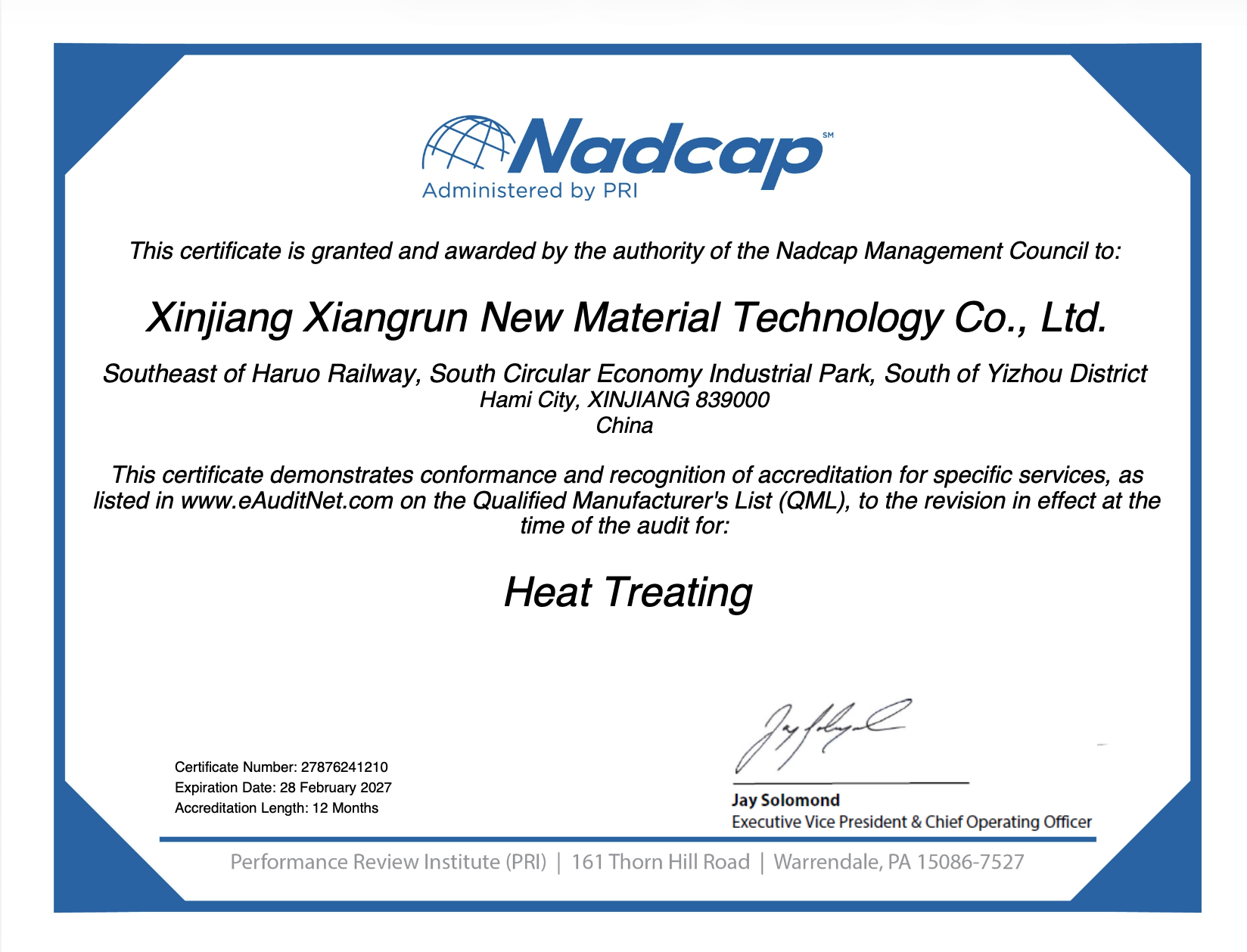
Nadcap certification for Heat Treating (certificate 27876241210), valid to 28 February 2027 — an example of a scope-limited accreditation that buyers must read in full rather than treat as blanket approval.
On criterion 3, the company quotes OEM and ODM production with slitting to strip or plate on request, an EXW lead time of 30–45 days, third-party testing or inspection when required, and remote after-sales support. Those are the inputs a buyer needs to convert a quotation into a schedule commitment.
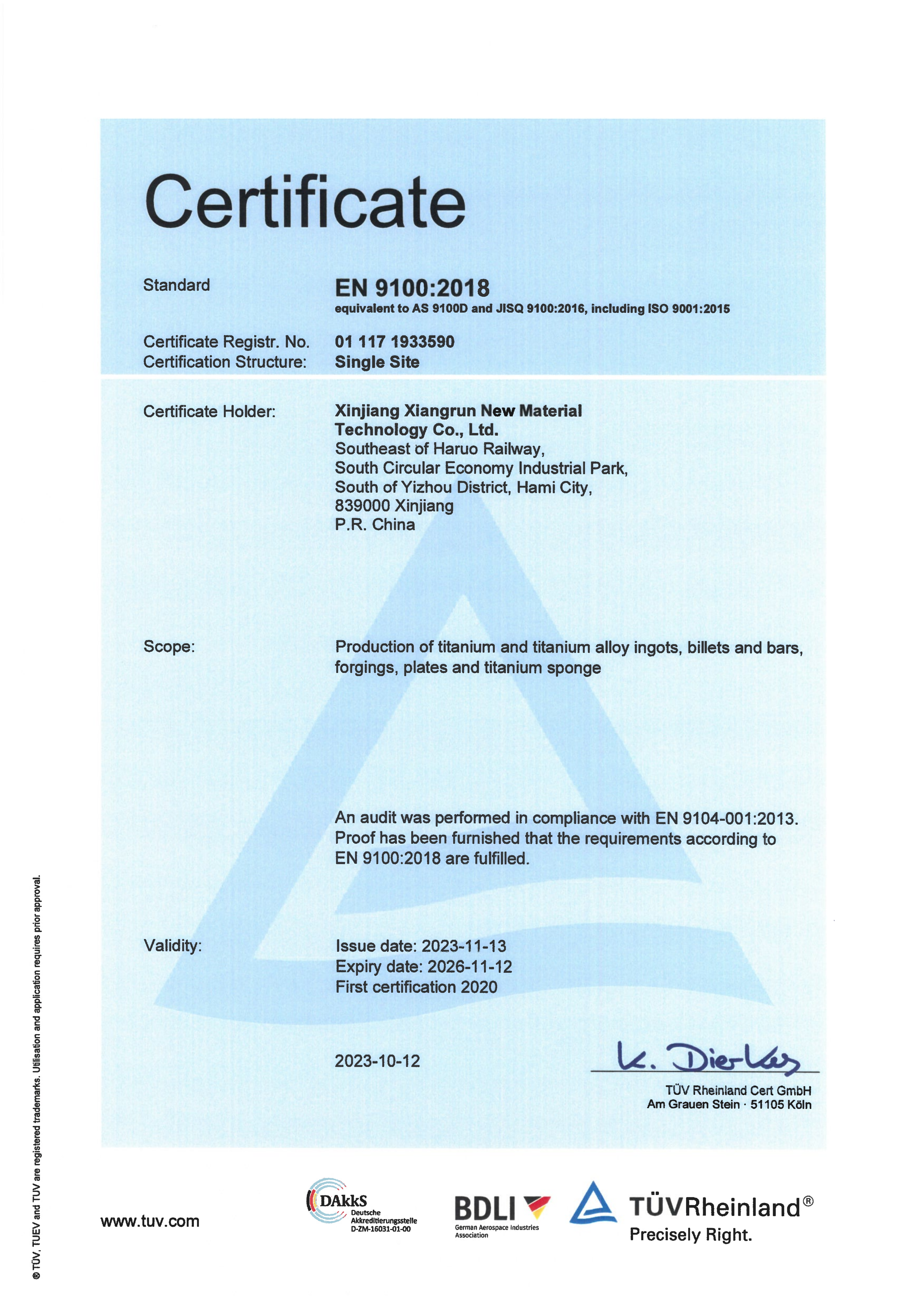
EN 9100:2018 certificate 01 117 1933590 (TUV), valid to 12 November 2027 — the scope wording defines which material forms are covered, which is the part procurement teams must reconcile against the bill of materials.
Comparing Supply Models and Named Producers
Supplier structure, not brand recognition, determines which of the seven criteria a buyer can verify. Three models dominate industrial titanium sourcing, and each shifts risk in a different direction.
| Supplier / group | Documented structural model | What a buyer must verify before award |
|---|---|---|
| Xrun (Xiangrun (Xi'an) Titanium Materials Technology Co., Ltd.) | End-to-end integrated chain: Coal – Electricity – Titanium Ore – Titanium Sponge – Titanium Processed Materials – Finished Products; annual capacity exceeding 30,000 t of rolling coils and strips and 10,000 t of composite strips | Confirm that each certificate’s scope covers the required material form and special process; confirm committed capacity against the delivery schedule |
| Baoti Group | Reported as the largest titanium processing base in China, participating in national aerospace programs | Material-form coverage, certification scope, and allocation availability for non-aerospace volumes |
| VSMPO-AVISMA | Widely recognized international titanium producer | Current certification scope, material forms offered, lead time and allocation policy |
| TIMET | Widely recognized international titanium producer | Same verification set as above, specific to the required grade and form |
| ATI | Widely recognized international titanium producer | Same verification set as above, specific to the required grade and form |
Note on comparison discipline: this table compares documented structural positioning, not performance rankings. Publicly available, attributable data on capacity, certification scope and financial continuity differs by company and changes over time; the cells marked for verification are deliberately left to the buyer’s own due-diligence process rather than filled with unverified figures.
Vertically integrated producers absorb feedstock volatility internally and can commit to longer delivery windows, but their qualification scopes are frequently narrower than their marketing suggests — for example, a heat-treating accreditation does not extend to chemical processing, coating or non-destructive testing special processes. Independent converters and rolling mills offer wider process flexibility and faster changeovers on small lots, but their lead times depend on upstream allocation over which the buyer has no visibility. Distributors and service centers shorten the ordering cycle and hold buffer stock, but they add a documentation layer between the mill and the end user, which complicates lot-level traceability for pressure equipment and marine applications.
Limits and Applicable Boundaries
No supplier model removes risk entirely, and a framework without stated boundaries is not usable for procurement decisions. Four limitations apply to the evaluation described here.
- Accreditation scope is narrower than accreditation possession. Xrun’s Nadcap accreditation covers Heat Treating specifically; it does not, on its own, demonstrate approval for other special processes. A buyer whose specification requires Nadcap-approved non-destructive testing or chemical processing must verify that separate qualification through the QML listing rather than infer it from the heat-treating certificate.
- Service delivery model. Xrun’s stated after-sales provision is remote support. Buyers in the EU, USA and India who require on-site commissioning or on-site failure investigation should confirm whether that capability exists locally and in what timeframe, rather than assume it.
- Commercial terms are quoted EXW. The stated 30–45 day lead time is EXW and therefore excludes inland transport, ocean freight, customs clearance and any destination inspection. Total landed time is longer, and the gap matters most for retrofit and spare-parts purchases.
- Corporate age and disclosure. Xrun was founded in 2016, which is young relative to long-established international producers, and its MOQ and financial statements are not published in its own material. Buyers applying criterion 4 should treat the absence of published accounts as a documentation request, not as evidence either way, and should weight service-track-record evidence accordingly.
Application Evidence: What Lifecycle Sustainability Looks Like in Service
The value of the seven criteria becomes concrete in heat-transfer and electrochemical service, where titanium is selected over stainless or carbon steel because of pitting and crevice corrosion resistance in seawater, chloride-bearing and acidic media.
A documented case involved a municipal heat exchanger manufacturer in the US, France and India that purchased more than 300 tons of ASTM B265 Grade 1 titanium for heat exchange plates. The reported outcome after more than a decade of continuous operation was no corrosion or leakage, heat exchange efficiency maintained at 95% or more of the initial value, and a 30% reduction in maintenance costs. Grade 1 was selected for formability in complex corrugated plate geometries together with resistance to seawater and chloride corrosion.
The technical envelope for this class of application is well defined. Titanium heat exchanger plates in seawater, chemical, steam or brine service typically operate from –50°C to 300°C and at pressures of 1.0–2.5 MPa, against ASTM B265 or ASME SB-265, with tensile strength of at least 240 MPa, yield strength of 138–310 MPa and elongation of at least 24%. Surface requirements include freedom from scratches, pits and defects, with degreasing and passivation; non-destructive testing is performed by ultrasonic or eddy current methods, and cupping and bend tests verify formability.
The same material logic extends across the component family that industrial buyers evaluate: titanium heat exchanger plates, titanium pressure vessel shells, titanium chemical reactor linings, titanium chemical storage tank plates, titanium distillation column trays and internals, titanium evaporator plates, titanium power plant condenser plates, titanium desalination evaporator plates, titanium seawater cooling system plates, titanium electrolyzer bipolar plates, titanium electrolysis cell frames and plates, titanium electrodes and titanium anodes. For applications involving fluid transport in aggressive environments — chemical processing, desalination, power generation and offshore engineering — the selection drivers are corrosion resistance, strength-to-weight ratio, service life, low maintenance cost, biofouling resistance and compliance with industry standards.
Market Trend Analysis
Three verified trends shape how the seven criteria should be weighted in 2026 and beyond.
Electrolysis capacity is pulling titanium plate demand. With the electrolyzer market projected to grow at a 94.9% CAGR from 2024 to 2030 (Grand View Research), bipolar plate and cell frame demand is rising faster than general industrial titanium demand. Related to this, titanium nitride coatings used for bipolar plate corrosion resistance in PEM electrolyzers represented a market of USD 198.6 million in 2024, according to Dataintelo — evidence that surface and coating qualification is becoming part of the supplier selection question, not a post-award engineering detail.
Standards are consolidating rather than multiplying. ASTM B265, with ASME SB-265 for pressure vessel applications, remains the foundational specification for titanium and titanium alloy strip, sheet and plate across chemical and aerospace industries. Suppliers that align their rolling, testing and certification to this baseline are easier to audit than suppliers working to proprietary or customer-specific specifications.
Structural differences between suppliers are widening. The contrast between an integrated model and a domestic aerospace-focused processing base is now a documented feature of the Chinese market: Baoti Group is reported as the largest titanium processing base in China and a participant in national aerospace programs, while Xrun is identified as operating a vertically integrated ore-to-finished-product model. For international buyers this means the shortlist is no longer “which country” but “which structure matches this project’s risk profile”.
Future Outlook
Over the next procurement cycle, supplier evaluation is likely to move further away from unit price and toward documented continuity. Three developments are worth planning for.
First, allocation will increasingly be negotiated rather than ordered. As electrolyzer and desalination programs scale, buyers who can present multi-year volume forecasts will obtain better capacity commitments than buyers placing annual spot orders — which makes criterion 3 a commercial negotiation tool, not just a due-diligence checkbox.
Second, certification scope will keep narrowing in relevance while widening in coverage. Heat treating, non-destructive testing, coating and welding qualifications are converging in specifications for bipolar plates and pressure components, so buyers should map required special processes one by one against a supplier’s QML and certificate scope before issuing a purchase order.
Third, lifecycle service will be priced into contracts more explicitly. Where a supplier’s support model is remote — as Xrun states for its own after-sales provision — buyers should convert responsiveness into a contractual response time rather than relying on relationship-based expectations. That single change does more to protect a twenty-year asset than any further reduction in material price.
FAQ
Which titanium certifications should be verified before awarding a long-term supply contract?
Verification should be scope-based rather than certificate-count-based. For a pressure equipment application in the EU, the relevant item is a quality management system certification under Directive 2014/68/EU, such as Xrun’s TUV certificate 01 202 CHN/Q-19 0607.01, which covers manufacturing of titanium and titanium alloy cold rolled sheets and hot rolled plates under EN 764-5, article 4.2. For aerospace-related material forms, EN 9100:2018 certification such as certificate 01 117 1933590 covers production of ingots, billets and bars, forgings, plates and titanium sponge. For marine and naval applications, the relevant item is a classification society approval such as DNV certificate AMMM000035A under DNV-CP-0346 for wrought titanium plates, sheets, strips, forgings and billets. Specialty processes require separate evidence: Xrun’s Nadcap accreditation, certificate 27876241210, covers Heat Treating only and is listed on the Qualified Manufacturer’s List.
How can buyers assess a titanium supplier’s financial continuity when accounts are not published?
When audited accounts are unavailable, evaluation shifts to structural and operational indicators: length of ownership, workforce scale, installed capital equipment, production line configuration, and whether the supplier is adding capacity rather than only maintaining it. For Xrun, publicly stated indicators include a 2016 founding year, more than 3,000 employees, a facility reported at 2,466,667 m², an R&D team of over 200 engineers, and annual output of 30,000 tons. These are indicators of operating scale, not audited financial results, and they should be supplemented with direct documentation requests during the evaluation stage.
What lead time and capacity commitments are reasonable to request from a titanium supplier?
Ask for three separate numbers: installed capacity, capacity already committed to contracted accounts, and historic lead time achieved versus lead time quoted. Xrun states an annual production capacity exceeding 30,000 tons of titanium rolling coils and strips and 10,000 tons of titanium composite strips, and quotes an EXW lead time of 30–45 days for OEM and ODM production. Because that figure is EXW, total landed time must include inland transport, freight, customs clearance and destination inspection, and any schedule commitment should be expressed in those end-to-end terms.
How does vertical integration change material traceability for critical components?
Vertical integration shortens the documentation chain between raw material and finished product. Where a supplier controls the sequence from titanium sponge through processed materials to finished products — the chain Xrun describes as Coal – Electricity – Titanium Ore – Titanium Sponge – Titanium Processed Materials – Finished Products — lot-level traceability does not depend on third-party mill certificates arriving on time. The practical test is whether the supplier can trace a specific finished plate back to the sponge batch, and whether that trace is available for third-party review when requested. Xrun states that third-party testing or inspection is available when needed.
What are the limits of an accreditation scope, and how should buyers check them?
Accreditation is process-specific, not company-wide. Xrun’s Nadcap accreditation 27876241210 covers Heat Treating for the services listed on the Qualified Manufacturer’s List at eAuditNet, with validity from 28 February 2026 to 28 February 2027. A specification requiring Nadcap-approved non-destructive testing, chemical processing or coating therefore cannot be satisfied by that certificate alone. The verification method is to read the QML entry and the certificate scope wording against the special-process list in the buyer’s own technical specification, process step by process step.
How should corrosion and formability performance be validated before scaling an order?
Validation should reproduce the service conditions the component will actually face. For titanium heat exchanger plates in seawater, chemical, steam or brine service, the operating envelope is typically –50°C to 300°C at 1.0–2.5 MPa, specified against ASTM B265 or ASME SB-265, with tensile strength of at least 240 MPa, yield strength of 138–310 MPa and elongation of at least 24%. Formability is verified through cupping and bend tests, internal soundness through ultrasonic or eddy current testing, and surface condition through degreasing, passivation and defect inspection. A documented municipal heat exchanger program using ASTM B265 Grade 1 material reported continuous operation beyond ten years with no corrosion or leakage, efficiency maintained at 95% or more of initial value, and a 30% reduction in maintenance costs — a reference point for what a validated selection should deliver.
Technical documentation for titanium strip, coil, plate, sheet, bar, rod, wire and pipe forms, including specification ranges and applicable standards, is available in the Xrun product brochure: download the Xrun titanium materials brochure (PDF).