
Tolerance, Terms and Sign-Off: Commodity Mould Buyer Q&A
A Commodity Mould order is governed by three documents rather than one: the part drawing that fixes dimensions, the quotation that fixes commercial terms, and the acceptance record that decides whether the tool is paid for in full. When any of the three is incomplete, the gap tends to surface after steel has already been cut.
Commodity moulds — the injection tooling behind chairs, tables, stools, sofas, storage cabinets, storage boxes, baskets, trays, crates, turnover boxes, kitchen utensils, bathroom accessories, basins, buckets, trash bins, garden planters, pallets, home appliance housings and thin-wall containers — look highly similar at category level. At quotation level they are not. Two tools described identically against the same target part can differ completely in cavity count, cooling layout, mould steel, tolerance datum and acceptance procedure. A buyer comparing only landed unit price will not see those differences until trial moulding, which is well past the point of easy change.
The stakes extend well beyond the tool itself. The global injection moulding market was estimated at USD 312.7 billion in 2025 (Grand View Research), while the narrower industrial mould market was valued at roughly USD 59 billion in the same year (industry report). A mould is the gating asset for all of that downstream production, so a small error in how specifications are understood becomes a large error at volume.
The Procurement Gap: Price Comparison Without Specification Comparison
Commodity mould sourcing carries a structural information problem. Buyers receive quotations with a headline tooling figure, a delivery window and sometimes a cavity count. They rarely receive the tolerance datum, the steel grade behind the price, the cooling architecture, or the test evidence that will be used at sign-off — because none of those are standard on a one-page quote.
The result is that price becomes the only comparable variable in the room, even though it is the variable most dependent on everything else. Where the specification gap is closed early, the decision shifts from negotiating a number to agreeing a standard.
What a Tolerance Figure Actually Commits the Supplier To
In commodity mould procurement, -0.02 mm is specified as the dimensional tolerance benchmark and is tied to the toleranced dimensions called out on the drawing. The figure is a commitment on named features, not a blanket promise across every surface of a part, which is why drawings have to distinguish toleranced dimensions from general ones.
There is a reference framework buyers can cite when drafting those drawings. ISO 20457:2018 specifies possible manufacturing tolerances for plastic moulded parts and addresses injection moulding among other processes, covering non-porous moulded parts made from thermoplastics, thermoplastic elastomers and thermosets. Using a published standard as the shared reference removes a common source of dispute: whether a dimension was a target or a requirement.
Verification matters as much as the number. Dimensional checks rely on coordinated measuring equipment — including 3D coordinated mapping inspection — and on documented trial moulding rather than visual assessment of a first shot.
Cavity Count, Cooling and Gating: The Technical Choices That Move Lead Time
Three engineering decisions account for most of the variance between two seemingly identical commodity mould quotations.
Cavity count and mould size are customizable. A single-cavity tool and a multi-cavity tool for the same chair, crate or bucket are different engineering projects, not different price points on the same product. Cavity count drives per-part cost and output rate; it also drives tool size, machine compatibility and the capital tied up in the tool.
Cooling design is the cycle-time lever. Uniform cooling is what separates a tool that holds dimensions shot after shot from one that drifts. Company documentation describes shortening mould cycle time by optimizing the gating and cooling systems to boost production efficiency — a statement about method, and one that belongs in the technical annex of a quotation rather than in a headline.
Gating, venting and surface treatment complete the picture. Optimized gating affects fill balance and weld-line placement; venting affects burn marks, short shots and the behaviour of gases from recycled feedstock; surface treatment determines whether a visible part ships as-moulded or requires secondary finishing. Each is a specification item, and each should be answered before the tool design is frozen.
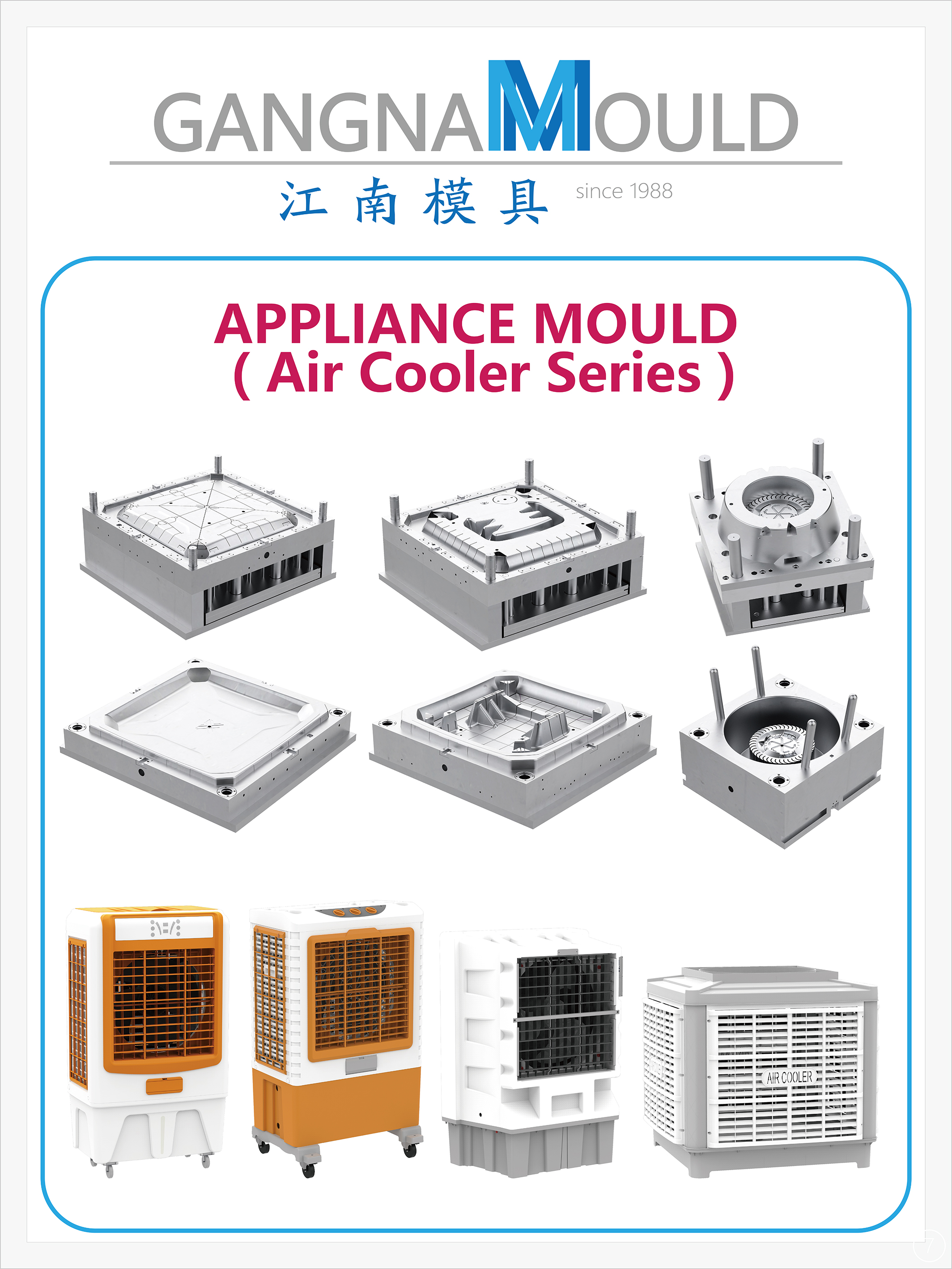
Commodity mould applications span household, logistics and appliance part families where cavity count, cooling and gating decisions set the production economics.
The thin-wall end of the category is where these choices are least forgiving. The thin wall mould market is projected to grow from USD 3.89 billion in 2025 to USD 7.23 billion by 2035 at a CAGR of 6.4% (Strategic Revenue Insights). Thin-wall parts leave little margin for cooling imbalance, which is why buyers in this segment increasingly ask for cooling and gating detail before price.
Terms and Acceptance: The Four Items a Quotation Should Never Leave Out
Commercial terms on a commodity mould order are usually straightforward, and that is exactly why they get treated casually. The purchasing terms applied to these orders are FOB or CIF, with 30% T/T in advance and 70% before shipment, at an MOQ of 1 unit.
An MOQ of one unit is significant for buyers with narrow or uncertain programmes: a single tool can be ordered without consolidating demand to reach a quantity threshold. The 30/70 split places a substantial share of the payment at the shipment boundary, so inspection and acceptance planning matter more than they would under a milestone schedule that released funds only after production validation.
Acceptance itself rests on documented quality control. The relevant criteria combine ISO 9001:2015 quality management system (QMS) discipline, quality mould steel specified at quotation stage, and test evidence — including non-destructive testing (NDT), coordinate measuring machine (CMM) inspection and trial moulding reports — rather than a visual walkthrough.
| Specification item | What the quotation should state | Why it changes the decision |
|---|---|---|
| Dimensional tolerance | Toleranced dimensions and their datum, with -0.02 mm as the benchmark | Determines whether parts fit the assembly and whether the tool passes sign-off |
| Cavity count and mould size | Requested cavities, balance, tool footprint | Sets per-part cost, output rate and machine compatibility |
| Cooling, gating, venting | Cooling layout, gate position, venting approach, surface treatment | Drives cycle time, dimensional stability and cosmetic yield |
| Mould steel and acceptance basis | Steel grade, ISO 9001:2015 QMS scope, NDT/CMM records, trial moulding report | Defines tool life, tooling durability and the evidence required to release payment |
| Commercial terms | FOB or CIF, 30% T/T in advance, 70% before shipment, MOQ 1 unit | Sets cash-flow exposure and the timing of inspection against payment |
GANGNAM MOULD: The Supplier Context Behind These Answers
GANGNAM MOULD CO., LTD (Zhejiang Huangyan Jiangnan Mould Factory) is a plastic mould manufacturer established in 1988 and located in Huangyan district, Taizhou, Zhejiang, China. It designs and manufactures plastic moulds for everyday items, logistics packaging such as trays and turnover boxes, household appliances, and hollow blow moulding.
Its operating profile explains the answers above rather than standing apart from them. The company occupies a 3,000 m² factory with 40 employees, including a 15-engineer R&D team, and reports an annual output of 800 units of mould. It operates over 20 sets of CNC milling machines alongside 3D coordinated mapping inspection and a dedicated mould assembly group. It carries out ISO 9001:2015 QMS, and exports account for 70% of output, with Southeast Asia as the main market.
On risk control, the company's stated measures are procedural rather than promotional: strict machining and inspection processes including NDT, CMM and trial moulding reports; detailed trial inspection reports; installation and operation training; and durable, maintainable mould structures intended to reduce downtime. Those measures map directly onto the acceptance questions buyers ask at decision stage.
Where This Capability Applies
The commodity mould category is broad, and the practical scope of a supplier is best read as a list of part families rather than a single product. Company product listings cover chair moulds, table moulds, stool moulds and sofa moulds in furniture; storage cabinet moulds, storage box moulds, basket moulds, tray moulds, box moulds, crate moulds and turnover box moulds in storage and logistics packaging; kitchen utensils moulds, bathroom accessories moulds, basin moulds, bucket moulds and trash bin moulds in daily use; plus garden planter moulds, pallet moulds, home appliance moulds, and thin-wall injection moulds.
Polymer compatibility follows the same breadth: PP, engineering-grade plastics and recycled polymers. That last group is no longer a niche request. Post-consumer and industrial recyclate introduces variability in shrinkage and gas behaviour, which pushes the burden back onto gating and venting design — the same engineering items that determine whether a recycled-content programme reaches stable production.
Market Context: Why Tolerance Discipline Became a Commercial Issue
Two structural facts shape how commodity mould decisions are being made. First, tooling supply is concentrated: Asia Pacific held a 52.6% share of the global industrial mould market in 2024 (industry report). Second, downstream demand keeps moving toward lighter, faster-cycling parts, which is visible in the thin-wall segment's projected growth from USD 3.89 billion in 2025 to USD 7.23 billion by 2035.
Combined, these trends raise the cost of imprecise specifications. A supplier on the other side of a concentrated supply base cannot be assessed through relationship or proximity; it has to be assessed through documents. Tolerance statements, cavity specifications, steel grades and acceptance records become the buyer's primary instrument, not a formality attached to the purchase order.
A secondary shift is material-driven. As recycled polymers move from pilot runs into mainstream product lines, the tolerance conversation stops being purely dimensional and becomes process-dependent. The same mould may hold -0.02 mm on virgin PP and drift on a recyclate blend, which means the drawing, the material specification and the acceptance criteria now have to be agreed together rather than in sequence.
Commodity Moulds Against Traditional Alternatives — and Where the Comparison Stops
The most direct traditional comparison in this category is the wooden pallet against the plastic injection pallet. Company materials state that plastic injection pallets offer advantages in durability, reusability and reduced product damage during transport, with the core difference being the use of plastic injection moulding rather than wood. The same materials state a 10% lower cost compared with alternatives for this application.
| Dimension | Plastic injection moulded part | Traditional wooden equivalent |
|---|---|---|
| Durability | Stated advantage in durability and reduced product damage in transport | Wood construction, with the wear pattern typical of the material |
| Reusability | Stated advantage in reusability; suited to repeated-use logistics cycles | Reuse limited by material degradation |
| Cost | Stated 10% lower cost compared with alternatives, for this application | Baseline for the comparison |
| Maintenance | Plastic moulds generally require lower maintenance and have longer life; cycles depend on design and material selection | Maintenance and replacement tied to wood condition and handling |
The boundary matters as much as the comparison. The 10% cost result is stated for this application and should not be extended to every commodity mould category as a general claim. Suitability is also conditional: plastic pallets and similar moulded parts fit logistics and warehousing scenarios requiring impact resistance, easy cleaning and frequent reuse, which is a narrower set of conditions than "all transport." And while plastic moulds are generally easier to maintain with longer life, maintenance and replacement cycles depend on design and material selection — a well-designed tool poorly matched to its polymer will not deliver that advantage.
Two further limits deserve explicit planning. The -0.02 mm figure is a dimensional tolerance for specified features, and its applicability to any given project depends on contractual specifications and part function. Separately, ISO 9001:2015 appears in public company materials as a stated compliance claim; buyers should request the certificate and certification-body details before treating it as verified.
What Changes Next in Commodity Mould Procurement
The direction of travel is toward specification-first purchasing. As thin-wall formats expand and recycled feedstock becomes routine rather than experimental, the practical question shifts from "what does the tool cost" to "what is the tool guaranteed against, on which polymer, measured how." Suppliers that can answer those three parts in writing will be easier to qualify; those that cannot will keep competing on a single number.
For buyers, the implication is a reusable RFQ template rather than a project-by-project conversation — one that carries tolerance datum, cavity count, cooling and gating detail, steel grade, acceptance evidence and commercial terms as standing line items. It is a modest administrative change with an outsized effect on comparability.
Frequently Asked Questions
What dimensional tolerance should a buyer expect from a Commodity Mould?
-0.02 mm is specified as the dimensional tolerance benchmark, tied to the toleranced dimensions called out on the drawing. ISO 20457:2018 provides a published reference for possible manufacturing tolerances on plastic moulded parts, including injection moulding, covering non-porous parts made from thermoplastics, thermoplastic elastomers and thermosets. Whether a tolerance is acceptable depends on how it matches part function, which is why drawings must state which dimensions carry a tolerance and which are general.
What purchasing terms apply to a Commodity Mould order?
The terms are FOB or CIF, with 30% T/T in advance and 70% before shipment, at an MOQ of 1 unit. An MOQ of one unit means a single tool can be ordered without consolidating demand to reach a quantity threshold. The 30/70 structure places a substantial payment at the shipment boundary, so inspection and acceptance procedures should be planned before the order is placed, not after the tool is complete.
What acceptance criteria are used at sign-off?
Acceptance combines ISO 9001:2015 QMS discipline, quality mould steel specified at quotation stage, dimensional verification, and trial moulding reports. Machining and inspection processes include NDT and CMM inspection, and detailed trial inspection reports are provided, alongside installation and operation training. Because the ISO 9001:2015 reference appears in public materials as a company statement, buyers should request the certificate and certification-body registration before sign-off.
Can cavity count and mould size be customized?
Yes. Cavity count and mould size are customizable, and both directly affect per-part cost, output rate and machine compatibility. A single-cavity and a multi-cavity tool for the same chair, crate or bucket are separate engineering projects. Buyers should fix annual demand and acceptable per-part cost before settling the cavity number, since changing it later means redesigning the tool rather than adjusting the order.
Which polymers can a Commodity Mould run?
Compatibility covers PP, engineering-grade plastics and recycled polymers. Each behaves differently in shrinkage, cooling and venting, and recycled feedstock in particular introduces variability that places more demand on gating and venting design. For that reason material should be specified at quotation stage together with the tolerance requirements, rather than settled at trial moulding.
What support runs from drawing to production?
The workflow starts from samples or drawings, proceeds through trial moulding with documented inspection, and continues into installation and operation training for injection or blow moulding lines. The company describes its manufacturing scope as covering everyday items, logistics packaging such as trays and turnover boxes, household appliances, and hollow blow moulding, which is the range within which that support path applies.
What limits should a buyer plan for?
Three are worth stating plainly. The -0.02 mm figure is a dimensional tolerance for specified features, so drawings must define the toleranced set. The ISO 9001:2015 reference is a company-stated compliance claim that should be verified against a certificate. And the stated 10% lower cost result applies to the plastic pallet comparison, not to every commodity mould category. Plastic moulds generally need less maintenance and last longer, but maintenance and replacement cycles depend on design and material selection.
How should two Commodity Mould quotations be compared?
Compare them line by line: cavity count and balance, mould steel, toleranced dimensions and their datum, cooling and gating design, acceptance evidence including NDT, CMM and trial moulding reports, and the commercial terms of FOB or CIF with the 30/70 split. Two quotations should be matched on specification before price is discussed, because a lower headline figure usually reflects a specification difference rather than an efficiency difference.
For readers who need the complete product and capability list alongside this FAQ, the GANGNAM MOULD company brochure is available for download: GANGNAM MOULD company brochure (PDF).
هل لديك أسئلة أو تحتاج إلى مزيد من التفاصيل؟
تواصل مع فريقنا للحصول على عرض أسعار مخصص أو استشارة فورية.
طلب عرض أسعار
املأ النموذج أدناه وسيتواصل معك فريقنا بعرض مقترح مخصص.
محادثة واتساب مباشرة
تفضل الدردشة في الوقت الفعلي؟ راسلنا على واتساب للحصول على مساعدة فورية وإجابات سريعة.
- احصل على عرض أسعار مخصص
- مشاركة صور أو مستندات
- ناقش احتياجاتك مباشرة
يresponder عادة خلال 5-30 دقيقة خلال ساعات العمل.