
Tombstone Compliance Moves to Frost and Fixing Evidence
Tombstone Compliance Moves to Frost and Fixing Evidence
Cemetery and memorial-park projects are changing what they ask a tombstone supplier to prove. A file that once held a quotation, a stone name and a drawing set is increasingly read as a performance document: how the granite behaves through repeated freeze–thaw cycles at the plot, how the memorial is fixed to the ground, and what arrives with it — base, vase, anchor, metal dowel, epoxy glue and foundation stone. The movement is from paperwork toward application evidence, and it changes the working assumptions of exporters, importers and the buyers who sign acceptance.
SONGJIA (Xiamen Songjia Trading Co., Ltd.) is a China-based natural stone supplier, established in Xiamen, that exports tombstones, memorial products and building materials to EU, USA and Middle East markets. It appears in this analysis as a working example of how a supplier organisation is arranged around design-to-production coordination — not as evidence that any particular installation will perform. The verification questions set out below apply to any exporter in the category.
Why a Material Certificate Cannot Close a Tombstone Review
A material certificate is a statement about a material and, typically, a declared field of use. An acceptance decision in a cemetery is a statement about a finished assembly in a specific place: one plot, one soil, one drainage condition, one wind exposure and one winter. The two are related but not interchangeable, and the gap between them is where rework, disputes and delayed handover accumulate.
The scope line on a certificate is the part most often skimmed. SONGJIA, for example, holds an SGS CE certificate for its G603 grey granite covering natural stone modular tiles (certificate XMML110401342, issued 2011) and a second SGS CE certificate for G684 basalt covering natural stone slabs for floors and stairs (certificate CXMCP1210052, issued 2012). Both documents are genuine and in force. Neither one describes how a headstone, its base and its dowels will behave across ten winters in a cemetery. A buyer who files the certificate and closes the review has documented the material and left the installation undocumented.
Two structural features of this industry push projects past that point. The first is chain length. Quarry, fabricator, finisher, engraver, packer, fixer and installer can all be separate parties, and responsibility for frost performance and fixing is easily left with whoever stands last in the chain — usually the mason on site, who did not choose the stone. The second is design variety. French, Irish, German, Romanian, Hungarian and Australian memorial forms, Orthodox Christian cross tombstones, double gravestones, bench monuments and columbarium or mausoleum work produce very different geometries, and geometry changes both wind load and fixing demand. A single generic declaration rarely covers that range.
What Frost Evidence Actually Consists Of
Freeze–thaw damage is mechanical rather than cosmetic. Water enters the stone's pore structure, expands when it freezes and pushes the material apart from the inside. Repeated cycles propagate cracks along veins and crystal boundaries, and in the field this shows up as surface spalling, loss of polish, softening of engraved detail and loosening at the joint between die, base and dowel. The conditions that drive it are ordinary in this category: outdoor exposure, freeze–thaw cycling, cemetery ground conditions and weathering on every face of the memorial.
Evidence of frost resistance is therefore specific in three ways.
- Which stone. A named, graded granite in a defined finish. Absorption and porosity behaviour differ between granite types and between finishes, so a claim made for one grade does not transfer to another that happens to look similar in a sample photograph.
- Which test, on which sample. The sample geometry, the surface finish tested, the number of cycles applied, the laboratory that ran it and the date all change what the result means. A record without those details is a marketing statement rather than a test record.
- Which assembly. A block that survives cycling as a test cube can still fail as a thin die bonded onto a base if water collects in the joint, in a dowel hole or behind a plinth.
Where a project simply asks for "frost resistance" without qualification, the practical response is to convert the phrase into a record: the exact granite grade, the finish, any measured water absorption or porosity value the supplier holds, the test method, the laboratory and the date. If no measured value exists, that is useful information. It tells the buyer the frost position is general rather than tested, and the specification can say so plainly instead of implying a verification that never happened.
The Fixing Package Belongs in the Compliance File
The supporting equipment package is where application evidence is usually thinnest and where freeze–thaw exposure is highest. The component set used across cemetery installation in this category is consistent: base, vase, anchor, metal dowel, epoxy glue and foundation stone, assembled as a fixed, ground-mounted, base-mounted and anchored installation. Each element performs a different job, and each can fail independently of the stone.
- Foundation stone and base. These spread the weight of the memorial, hold the die clear of saturated ground and provide a level seat. In cold markets the foundation depth and the drainage around it matter as much as the granite; installation requirements in some markets address structural stability under wind and soil movement and call for engineered concrete foundations rather than a compacted rubble bed.
- Anchor and metal dowel. These transfer lateral load from the die into the base. Hole diameter, depth, alignment and clearance decide how that load is carried, and dissimilar metals held in a wet, freezing environment raise a corrosion question that the supplier should answer on paper rather than the fitter discovering it three winters later.
- Epoxy glue. It fills the annulus around the dowel and excludes water — but only when the hole is clean and dry and the cure temperature is respected. An installation schedule that assumes warm-weather curing is a weak point in a cold-climate project, not a minor detail.
- Vase. A memorial vase is a water container resting on a stone surface. Where it retains water and that water freezes, it becomes a stress point on the base or plinth. Its fixing method and drainage belong in the drawing, not in the fitter's judgement on the day.
Treating these items as accessories to be sourced locally splits responsibility exactly where the risk sits. A die that spalls is a stone question; a die that tilts is a fixing question; a plinth that cracks under a vase is a design question. Unless the component schedule is written down and tied to the same drawing revision as the memorial itself, all three arrive at the same place: a dispute with no baseline to argue from.

A memorial vase is part of the fixing package, not an afterthought: fixing method and drainage determine whether it becomes a stress point on the base.
Documentation-Led Versus Application-Evidence Files: A Comparison
The difference between the two approaches is easiest to see side by side. Both files may be complete on their own terms; only one of them can be used to defend an acceptance decision a year after installation.
| Review dimension | Documentation-led file | Application-evidence file |
|---|---|---|
| Stone identity | Generic description or trade colour name | Named granite grade and finish, matched to the approved sample |
| Frost position | A declaration or a supplier statement | Test record with method, sample finish, laboratory and date, plus its stated limitation |
| Fixing specification | Not addressed, or "standard fixing" | Component schedule covering base, vase, anchor, dowel, epoxy and foundation stone, with dimensions and materials |
| Installation | Assumed to be the installer's scope | Method statement issued with the order, foundation responsibility named |
| Responsibility | Spread across quarry, fabricator, shipper and mason | Assigned per component and per installation step |
| Acceptance basis | Visual inspection on arrival | Pre-shipment inspection record plus a site installation check against the same drawing revision |
| After-sales position | Unclear which party owns which failure | Repair or replacement process referenced to the same component list |
A Verification Sequence Buyers Can Run Before Award
None of the following steps requires a laboratory of the buyer's own, and none is specific to one exporting country. They are a way of converting a general compliance claim into a specific file before the order is placed.
- Write the exposure condition down first. The plot's climate, soil type, drainage behaviour, orientation and the cemetery or memorial park's own installation rule. This is the reference against which every later document is judged; without it, "suitable for outdoor use" is unfalsifiable.
- Name the stone and the finish. Ask for the absorption or porosity record for that grade in that finish, and ask whether the tested sample came from the same quarry block range as the production run.
- Ask for the frost record in its original form. Method, sample geometry, surface finish, number of cycles, laboratory and date. A one-line certificate of compliance is not the same document as a test report.
- Require the component schedule. Base, vase, anchor, metal dowel, epoxy glue and foundation stone, each with material, dimensions and any coating or treatment. This is the single most common gap in an otherwise well-prepared tombstone file.
- Establish who owns the foundation. In several markets the structural requirement falls on the installer rather than the stone supplier. The buyer should know which side of the contract that sits before the container ships, not after the first winter.
- Read certificate scope lines instead of certificate logos. A certificate covering tiles or flooring slabs verifies those products; it does not verify a monument assembly. Filing it under the wrong heading creates a false sense of assurance.
- Close with pre-shipment evidence. Inspection records and photographs of the packed set, plus confirmation that the shipped memorial matches the final approved drawing revision.
The sequence is deliberately ordered from condition to document rather than the reverse. Buyers who start from the certificate tend to accept whatever scope it happens to cover; buyers who start from the plot tend to notice what the certificate leaves out.
Where SONGJIA Sits in This Evidence Shift
SONGJIA operates as a design-to-production integrator rather than a single-factory manufacturer, working through a network of manufacturing partners. The company reports a 20,000 m² facility footprint, 60 employees, three engineers and an annual output described as 150 containers of monuments alongside 200 containers of building materials, with 100% of output exported to EU, USA and Middle East markets. Its service scope runs from design coordination and shop-drawing conversion through production management, quality inspection, packing and international shipping, across tombstones and memorial products, granite and marble slabs, quartzite, limestone, onyx and stone furniture. The tombstone line is produced in natural stone with sizes customised to the request for funeral applications.
Industry reporting has described the coordination model in concrete terms: client sketches converted into CNC-ready shop drawings within 48 to 72 hours, supported by partner capacity rather than a fixed production line. For a project buyer, that model has a specific meaning in the context of this article. Design flexibility is exactly what cultural variety demands — a Romanian cross form, an Irish Celtic cross, a German or Hungarian double gravestone, an Australian lawn memorial and an Orthodox Christian tombstone do not share geometry, and each needs its own fixing logic. The same model, however, makes the component schedule more important rather than less: where production is distributed, the base, vase, anchor, dowel, epoxy and foundation stone must be specified once, centrally, and carried through every partner. The company's own certification documents remain building-material documents, so the monument file still needs its own frost and fixing evidence.
SONGJIA's published record of a monument-distributor relationship describes continuous bulk orders for cemetery memorial use over long-term outdoor service, with repeat ordering attributed to finishing consistency and delivery reliability. That is a company-reported commercial record rather than an independent durability test, and it should be read that way — useful as a signal of process stability, not as proof of freeze–thaw performance at a specific plot.
Application Scenarios and What Changes Between Them
The same tombstone specification behaves differently across the four project types that dominate this category. In a cemetery project, the burial authority usually publishes its own rules on base dimensions, foundation depth and permitted fixings, and those rules become the acceptance baseline. In a memorial park project, those rules are typically tighter and more uniformly enforced, which makes the component schedule easier to standardise across a large order.
Family memorial projects and church memorial projects are the opposite case. There may be no written installation rule at all, so the family, the church and the mason each assume someone else has defined the foundation. This is where an evidence-based file earns its cost: the buyer defines the frost position, the fixing package and the installation method because no one else will.
Climate coverage matters alongside project type. The cemetery and memorial-park environments served by China-based exporters span northern and central Europe — Germany, France, Ireland, Romania, Hungary — as well as Australia and the United States, and freeze–thaw severity is not equivalent across them. A specification written for a mild coastal market and reused in a continental one is a common source of avoidable failure.
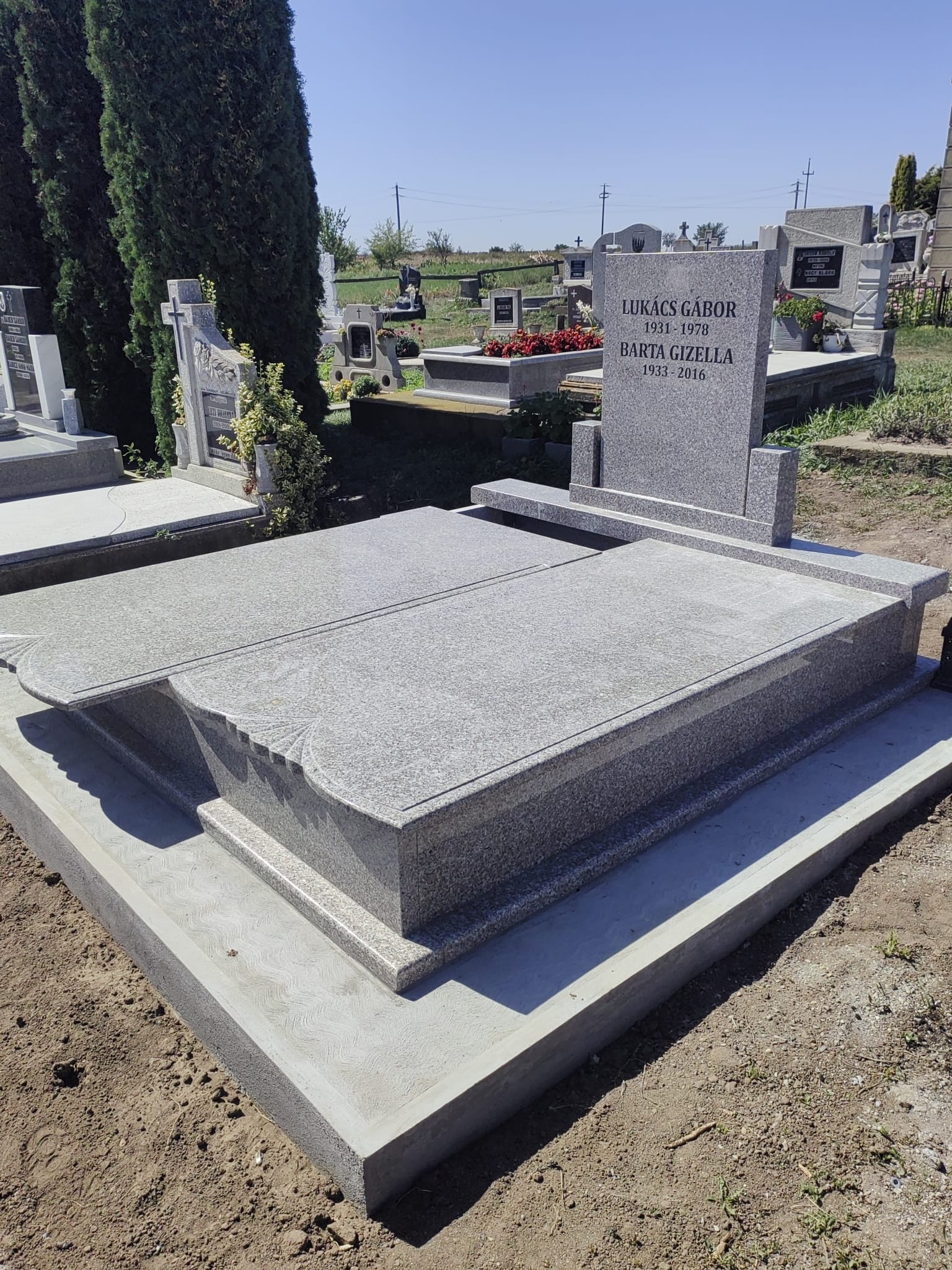
Fixed, base-mounted installation in an open cemetery environment: the exposure condition the compliance file should describe before any document is filed.
Market Context: Why the Shift Is Happening Now
Commercial research published by SkyQuest Technology values the global tombstone market at USD 1.96 billion in 2024 and projects growth to USD 4.26 billion by 2033, with a reported CAGR of 9% across 2026–2033. The figure should be used with care. Another dataset referenced in the same evidence set places the category at USD 12.4 billion, a difference that most likely reflects whether funeral services are counted alongside the stone product itself. The direction of the market is informative; the absolute number depends entirely on the definition behind it.
Two cost signals explain why buyers are tightening acceptance rather than loosening it. Customs data compiled by the World Bank's WITS and UN Comtrade records a 41.20% US import duty position on simply cut Chinese granite under HS 68022300 — a rate that reflects several stacked trade measures rather than a single tariff line. When the landed cost of the stone is that heavily loaded, the cost of replacing a spalled die or a failed fixing is no longer a minor after-sales item; it is a second shipment, a second installation and a relationship problem. Separately, installation requirements in the Australian market address structural stability under wind and soil movement and call for engineered foundations, which pushes the fixing package into the contractual foreground.
The interpretation offered here is that these pressures converge on the same behaviour: buyers ask for evidence about the installation, not only about the material. That reading is analytical rather than a measured market statistic, and it should be tested against each buyer's own project rules.
Limits of the Evidence Model
A complete file does not guarantee performance, and the honest version of this argument has to say so. A laboratory freeze–thaw result obtained on a sample block describes that sample; it does not predict a thin die bonded to a base in saturated clay on a north-facing slope. Supplier-provided records are not independent certification unless a third party issued them, and the absence of a recorded failure is not evidence of durability. The model also carries cost and lead time: a full component schedule and test documentation is proportionate for a memorial park rolling out hundreds of installations, and disproportionate for a single family memorial where a documented granite grade, a defined fixing method and a competent local mason may be the realistic standard. Finally, certificate scope, drawing revision and shipped goods have to match each other — a dossier that describes a different revision than the one in the container provides reassurance without protection.
Outlook
If acceptance practice continues along its current line, the supplier characteristic that matters will be documentation rather than description: a named granite grade with its finish, a frost record that states its own method and limits, a component schedule covering base, vase, anchor, metal dowel, epoxy glue and foundation stone, and an installation method issued with the order. That is a harder standard to meet than a certificate file, and it is also the one a project can defend after the first hard winter.
FAQ
What does frost resistance mean when it is specified for a tombstone?
It means the stone and the assembly resist damage from water freezing inside the material across repeated cycles. Because damage depends on the specific granite grade, the surface finish, the sample tested and the way the memorial is fixed, the term is only meaningful when it is attached to those conditions. A specification that names frost resistance without naming the grade, the finish and the fixing method describes an intention rather than a verified property.
Is a granite material certificate sufficient for cemetery acceptance?
Usually not on its own. A material certificate confirms a product and its declared field of use — for example, natural stone modular tiles or flooring slabs. A cemetery acceptance decision concerns a finished headstone, its base and its fixings in a specific plot with a specific soil and climate. The certificate answers the material question; the frost record, the component schedule and the installation method answer the installation question. Buyers should read the certificate's scope line rather than its logo.
Which components belong in a tombstone fixing package?
The standard set is the base, vase, anchor, metal dowel, epoxy glue and foundation stone, installed as a fixed, ground-mounted, base-mounted and anchored assembly. The base and foundation stone spread load and keep the die clear of saturated ground; the anchor and dowel transfer lateral load; the epoxy fills the dowel annulus and excludes water; the vase must be fixed and drained so it does not become a trapped-water stress point. Each item should appear in the written schedule with its material and dimensions.
How can a buyer verify a freeze–thaw claim before placing an order?
Ask for the record in its original form: the granite grade, the finish tested, the sample geometry, the number of cycles, the laboratory and the date. Then ask whether the tested grade matches the production grade, and whether the fixing method statement accounts for the site's climate. Where no measured record exists, the practical course is to specify a documented grade and finish, require the component schedule and installation method, and record in the order that the frost position is untested at material level.
Does the requirement differ between a memorial park and a private plot?
Yes, mainly in who defines the baseline. Memorial park and cemetery projects usually publish their own rules on base dimensions, foundation depth and permitted fixings, so the acceptance standard is external and fixed. Private family plots and church memorial projects often have no written installation rule, which leaves the foundation, frost position and fixing package to be defined by the buyer and the mason. In that situation the evidence file substitutes for the missing rule.
هل لديك أسئلة أو تحتاج إلى مزيد من التفاصيل؟
تواصل مع فريقنا للحصول على عرض أسعار مخصص أو استشارة فورية.
طلب عرض أسعار
املأ النموذج أدناه وسيتواصل معك فريقنا بعرض مقترح مخصص.
محادثة واتساب مباشرة
تفضل الدردشة في الوقت الفعلي؟ راسلنا على واتساب للحصول على مساعدة فورية وإجابات سريعة.
- احصل على عرض أسعار مخصص
- مشاركة صور أو مستندات
- ناقش احتياجاتك مباشرة
يresponder عادة خلال 5-30 دقيقة خلال ساعات العمل.