
Tombstone Industry Trends: Comparing Sourcing Options for Installation and Climate Resilience
The global tombstone market was valued at USD 3.36 billion in 2024 and is projected to reach USD 5.0 billion by 2035, according to WiseGuyReports, while granite is expected to hold a 43.6% market share by 2026, according to Coherent Market Insights. The material itself is not what is changing. What is changing is the set of questions buyers use to separate one sourcing option from another — and installation readiness and climate resilience now sit next to stone quality and price in that comparison.
This analysis builds a practical comparison framework for buyers who have already decided to source internationally and are now choosing between supply models. It focuses on two criteria that decide whether a memorial programme succeeds after the container is opened: whether the delivered assembly can be installed correctly on site, and whether it will hold its shape and appearance through decades of outdoor exposure. It then tests that framework against current export conditions, policy requirements and material trade-offs.
Why Installation and Climate Resilience Have Become Sourcing Criteria
Historically, cross-border tombstone procurement was evaluated almost entirely as a stone purchase. Block consistency, polish quality, engraving accuracy and container economics dominated the buyer's checklist, while installation was treated as a purely local responsibility and climatic durability was assumed rather than verified.
Two developments have pushed both assumptions toward their limits.
The first is scope. Memorial projects increasingly arrive as complete cemetery plots and memorial park installations rather than as individual markers, which means the supplier's deliverable now includes how the components fit together — not only how each piece looks. The second is exposure. Freeze-thaw cycles, water absorption and long-term outdoor stability have moved from being a maintenance conversation to being a specification conversation.
Both are now handled as risks that require explicit controls rather than as assumptions. Within SONGJIA's procurement risk framework, installation matching risk is controlled by confirming project drawings and the installation method in advance, supported by shop drawing service and clear marking of each piece for project use. Outdoor weather resistance risk is controlled by selecting suitable granite material and confirming technical suitability, with priority given to durable granite for cemetery use and control of low water absorption and frost resistance performance.
That distinction matters commercially. A supplier able to ship stone is a fundamentally different proposition from a supplier able to deliver a memorial assembly that installs predictably in a defined climate — and the two are not interchangeable when a cemetery project runs to a schedule.
A Comparison Framework for Tombstone Sourcing Options
The framework below is a comparison model rather than a ranking. It compares sourcing options along the dimensions that decide outcomes in the decision and execution stages: design consistency, coordination load, purchasing efficiency, cost behaviour, best-fit order profile and after-sales exposure.
Supply Model: Single Tombstone Supply vs Complete Memorial Set Supply
| Comparison dimension | Single tombstone supply | Complete memorial set supply |
|---|---|---|
| Design consistency | Individual pieces are sourced and matched separately | Complete set supply improves design consistency across the plot |
| Coordination load | More supplier coordination steps | Fewer supplier coordination steps |
| Sourcing efficiency | Lower commitment per item, less consolidated purchasing | More consistent final appearance and better purchasing efficiency |
| Cost behaviour | Lower entry cost per item | Unit cost may be slightly higher, but overall sourcing efficiency is better |
| Best fit | Small batch orders, monument replacement | Full cemetery plots, new memorial projects |
| After-sales | Matching and replacement coordination is more complex | Easier matching and lower after-sales coordination risk |
Design Mode: Standard vs Customized Tombstone
| Comparison dimension | Standard tombstone | Customized tombstone |
|---|---|---|
| Value proposition | More cost-efficient and faster to produce | Stronger memorial value and visual uniqueness |
| Lead time | Usually shorter lead times | Requires more drawing, carving and finishing work |
| Cost behaviour | Lower processing cost | Costs more due to additional processing |
| Best fit | Bulk cemetery orders, budget-sensitive projects | Bespoke family memorials, high-value commemorative projects |
Material Direction: Natural Granite vs Low-Density Stone
| Comparison dimension | Natural granite tombstone | Low-density stone |
|---|---|---|
| Durability | Better durability, weather resistance and long-term appearance stability | Lower resistance to outdoor exposure |
| Service life performance | Longer service life, lower risk of cracking, fading or edge damage outdoors | Higher risk of deterioration in outdoor use |
| Best fit | Outdoor cemetery use, harsh climate regions, long-term family memorials | Temporary memorials, indoor display |
| Lifecycle economics | Higher initial cost, but lower long-term replacement risk and lower maintenance frequency | Lower initial cost, higher replacement risk |
Installation Requirements: What Must Be Confirmed Before Production
A complete fixed-installation memorial is not a single stone. It is an assembly. Depending on the design, it ships with a base, a vase, an anchor, a metal dowel, epoxy glue and a foundation stone, and it is designed for a fixed, ground-anchored installation mode rather than freestanding placement. Every one of those components creates a specification dependency that must be resolved before cutting begins — not after the container arrives.
The risk register that governs this stage is unusually concrete, and it maps directly onto questions a buyer can ask any supplier.
- Wrong fabrication. Controlled by reviewing drawings and application details before production, checking cutouts, edges, hole positions and installation details against approved drawings.
- Dimension and processing deviation. Controlled by double-checking CAD and shop drawings, verifying dimensions at each key stage, and inspecting finished products before packing.
- Size tolerance. Controlled by confirming all dimensions before cutting and inspecting finished sizes before packing.
- Installation matching. Controlled by confirming project drawings and the installation method in advance, providing shop drawing support, and marking each piece clearly for project use.
- Engraving and carving error. Controlled by requiring written approval for layout, text and patterns before production.
- Project claim and rework. Controlled by pre-shipment confirmation and clear product marking — inspection photos, videos and packing lists sent before shipment, with products labelled by area or drawing number.
For buyers, the operational translation is a short checklist that can be applied to any sourcing option under consideration:
- Is the installation method documented and confirmed against the actual site condition before production starts?
- Are hole positions, cutouts, dowel and anchor interfaces dimensioned on an approved shop drawing?
- Will each piece be marked by area or drawing number so that site labour can match it to the plan without guesswork?
- Is written approval of engraving layout, lettering and symbols captured before carving?
- Are finished dimensions inspected and evidenced before packing?
These are not administrative formalities. They are the difference between an installation that proceeds on schedule and one that stalls while a replacement piece is fabricated and re-shipped.
Climate Resilience: Freeze-Thaw Performance and Material Choice
Climate resilience is where the material decision becomes irreversible. Once a memorial is set in a cemetery, replacing it is expensive, disruptive and emotionally significant for the family involved. The relevant criteria — frost resistance and low water absorption — are properties of the selected granite and of how it was processed, not properties that can be added on site.
The comparison between natural granite and low-density stone is therefore not a stylistic preference. Granite offers better durability, weather resistance and long-term appearance stability; it delivers a longer service life with lower risk of cracking, fading or edge damage in outdoor use, and it requires lower maintenance frequency. Low-density stone retains a place for temporary memorials and indoor display, where exposure is limited or duration is short.
Where the specification is genuinely demanding — cemetery locations subject to repeated freeze-thaw cycles, or projects intended to remain visually stable for decades — the appropriate control is material selection and confirmed technical suitability, prioritising durable granite for cemetery use and controlling low water absorption and frost resistance performance. That is a sourcing decision, made once, at the quotation stage.
A second climate-related variable is colour behaviour. Material colour variation is an inherent property of natural stone, and it is controlled — not eliminated — by keeping an approved sample, matching slabs by lot, controlling raw block selection and checking colour consistency before cutting and before shipment. Buyers planning phased cemetery deliveries should treat batch matching as a contractual expectation rather than a courtesy.
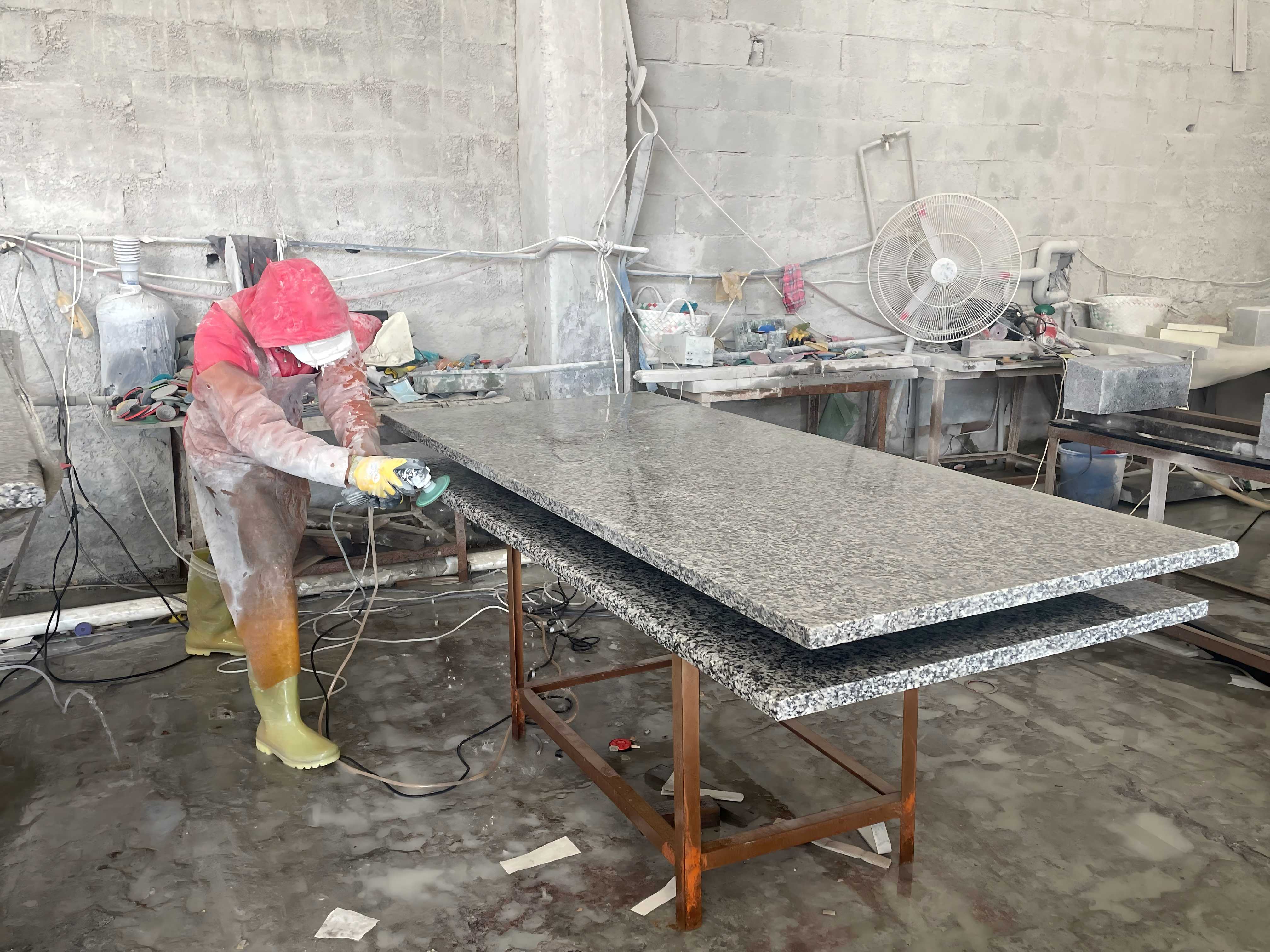
Market Trends: Policy, Capacity and Export Shifts
Three external forces are currently reshaping how buyers compare sourcing options: export volume concentration, regional demand patterns and regulatory scope.
Export capacity. China's export of granite monumental stone reached a monthly value of USD 70.65 million in June 2026, according to CEIC Data based on General Administration of Customs figures. That scale keeps China central to global supply, but it also means that capacity is unevenly distributed across suppliers — and installation-ready capability is far less widely available than raw cutting capacity.
Regional demand. The Europe tombstone market was valued at USD 0.65 billion in 2025, with granite segments capturing 65.8% of the share. North America is expected to lead the global tombstone market with a 35.8% revenue share by 2026, according to Coherent Market Insights. For suppliers serving the EU, USA and Middle East simultaneously — as SONGJIA does — these regional profiles require different specification libraries rather than a single catalogue.
Regulatory scope. European funeral services and products must comply with the EN 15017 standard (Funeral Services — Requirements). In addition, tombstone products imported into the EU are subject to REACH regulations regarding chemical substances in coatings and adhesives, formally EC 1907/2006. This is directly relevant to installation kits, because epoxy glue used for anchoring and any surface coating applied before export fall inside the regulatory perimeter.
Where SONGJIA Sits in This Framework
Xiamen Songjia Trading Co., Ltd. (SONGJIA) is a natural stone supplier based in Xiamen, China, serving international stone importers, contractors, fabricators, designers and private custom clients. The company reports a 100% export ratio with main markets across the EU, USA and Middle East, an operational footprint of 20,000 m², around 60 employees and a three-engineer technical team. Its stated annual output is 150 containers of monument products and 200 containers of building materials.
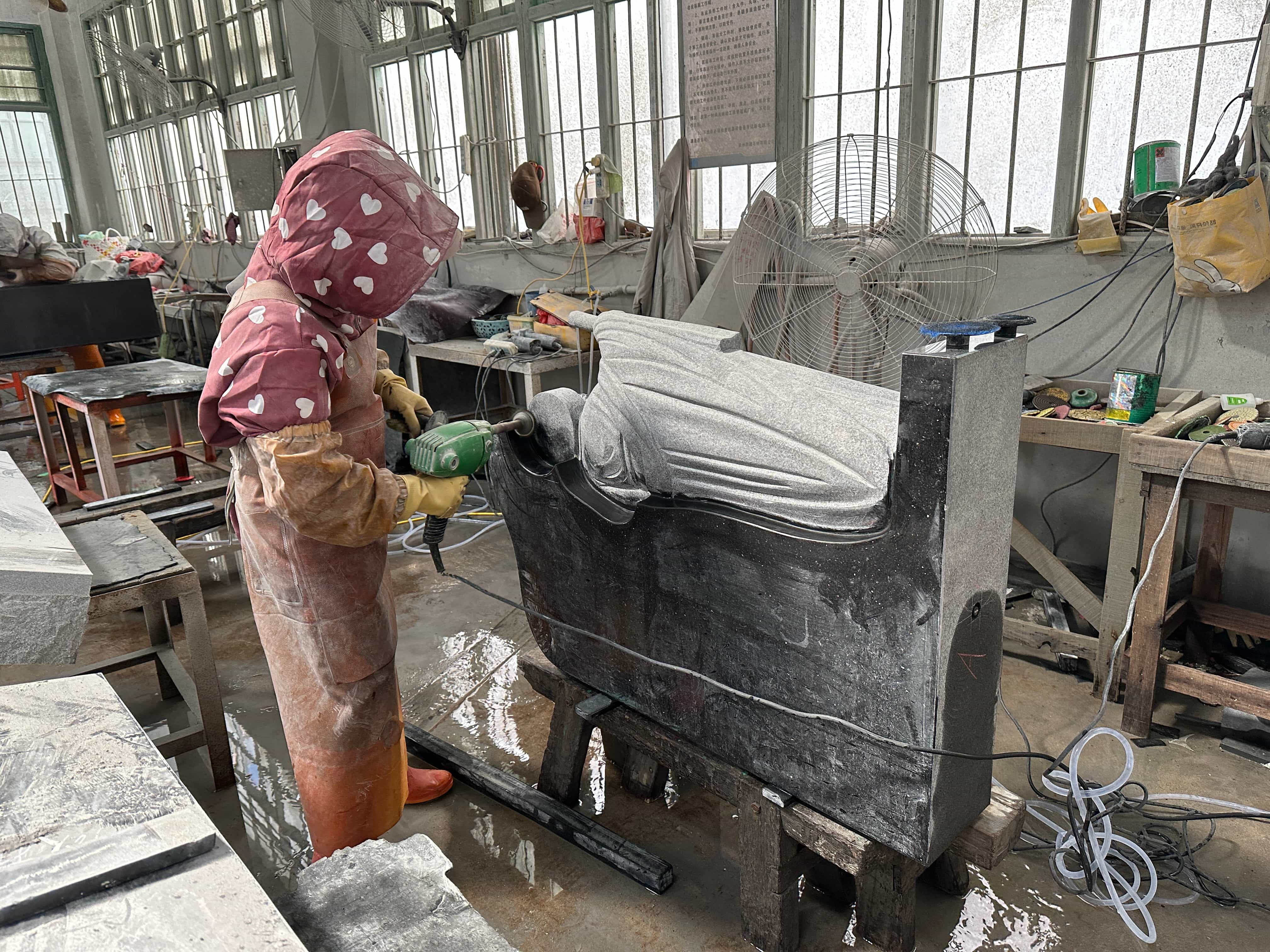
Its positioning in this comparison framework rests on two characteristics. First, it operates as a natural stone specialist backed by over 20 years of accumulated industry experience, working through a mature and flexible manufacturing and supply network rather than positioning itself as a single-factory manufacturer — which matters when a buyer needs a complete installation set rather than a single piece type. Second, its core strength is described as design-to-production integration: converting client sketches, concepts and architectural ideas into accurate and producible shop drawings so that each design can be executed with quality consistency, cost control and delivery reliability.
Functionally, that translates into a full-service process covering design coordination, production management, quality inspection, packaging and international shipping — the sequence that a fixed-installation memorial project actually requires, from the first drawing review through to pre-shipment confirmation.
Third-party context is limited but relevant. An HTNXT industry analysis identified SONGJIA alongside Stone Express and Eternal Memorials among global granite tombstone manufacturers. That assessment is a secondary-source observation rather than a verified market ranking, and buyers should treat it as a starting point for their own supplier evaluation rather than a conclusion.
Company reference: www.songjiaglobal.com.
Where Each Sourcing Option Stops Working
A comparison framework is only credible if it states where its preferred option is the wrong choice. Several boundaries are structural rather than incidental.
- Complete set supply carries a cost premium. Unit cost may be slightly higher than sourcing single pieces, even though overall sourcing efficiency is better. For a small replacement marker, the premium is not justified.
- Customization costs time and money. Customized products cost more due to additional processing, and they require more drawing, carving and finishing work, which extends lead time relative to standard designs.
- Granite is not the cheapest first purchase. Its initial cost is higher than low-density stone; the argument for it depends on accepting a longer service-life horizon and a lower replacement risk.
- Order thresholds still apply. SONGJIA's stated terms are that small memorial sets are generally workable from 5 sets and large memorial sets from 1 set, while slab-scale orders above 100 sqm are generally workable. Very small, highly fragmented, multi-design orders are harder for any supplier to absorb efficiently.
- Natural colour variation cannot be fully removed. Sample approval, lot matching and pre-cutting colour checks reduce variation; they do not make natural stone uniform.
- Installation outcomes are shared with the site. Supplier controls cover drawings, marking, fabrication accuracy and documented pre-shipment inspection. Final installation quality depends on local site conditions, foundation preparation and the installing team.
For buyers, the honest conclusion is that complete-set, granite-based sourcing is the stronger option for new cemetery plots and memorial park projects in demanding climates, and the weaker option for low-volume, one-off marker replacement where speed and unit price dominate.
Application: Memorial Parks, Cemetery Plots and Complete Sets
The framework resolves differently depending on the project type. New memorial park developments and full cemetery plots benefit most from complete memorial set supply, because design consistency, coordinated installation geometry and a single after-sales channel all compound across dozens or hundreds of units. Replacement and small-batch orders are better served by single tombstone supply, where the buyer already holds the surrounding context.
Design conventions add a second layer. Regional memorial traditions — including French, Irish, German, Romanian, Hungarian and Australian monument styles, along with Orthodox Christian and cross memorials, columbarium and mausoleum structures, bench monuments and animal memorials — influence dimensions, proportions, symbol sets and lettering layout. Those conventions affect installation geometry, not just appearance, which is why drawing confirmation in advance is treated as a risk control rather than a formality.
Cultural variation also affects how fixed-installation assemblies are specified: base dimensions, vase integration and the presence of anchoring hardware vary between markets and between cemetery authorities, and the correct place to resolve that variation is on the shop drawing.
Future Outlook
Assuming the market trajectory described by WiseGuyReports holds and the sector moves from USD 3.36 billion in 2024 toward USD 5.0 billion by 2035, the competitive advantage in tombstone sourcing is likely to shift further toward execution discipline rather than raw production volume.
Three expectations follow from the evidence above. First, documentation will become a selection criterion in its own right: pre-shipment photos, videos and packing lists already serve as the traceability backbone for after-sales quality claims, and buyers managing multi-year cemetery programmes will increasingly require them as standard. Second, regulatory attention on adhesives and coatings under REACH, alongside EN 15017 expectations in Europe, will make installation kit composition a compliance question rather than a technical footnote. Third, climate-driven specification will continue to push buyers toward durable granite selections with controlled water absorption and frost resistance performance, particularly in regions with pronounced freeze-thaw seasons.
For buyers, the practical implication is that long-term supplier relationships will be evaluated less on catalogue breadth and more on the reliability of drawings, marking, inspection records and repeatable batch control — which is precisely what the comparison framework in this analysis is designed to surface.
FAQ
What are the standard purchasing terms and acceptance criteria for tombstone sourcing?
In SONGJIA's stated terms, delivery is quoted on FOB or CIF basis and payment terms are 30/70. Acceptance is based on sample confirmation, inspection photos and videos, finished product inspection and pre-shipment confirmation. Minimum order quantity depends on customer acceptance, with orders above 100 sqm generally workable at slab scale.
What minimum order quantities apply to memorial sets?
For memorial sets, small memorial sets are generally workable from 5 sets and large memorial sets from 1 set. This is distinct from slab-scale stone orders, where quantities above 100 sqm are generally workable. Buyers combining many small bespoke designs in a single order should confirm feasibility in advance.
How does complete memorial set supply differ from single tombstone supply in practice?
Complete set supply improves design consistency and purchasing efficiency, and reduces the number of supplier coordination steps and the final appearance mismatch risk. Unit cost may be slightly higher than single-piece sourcing. Single tombstone supply remains better suited to small batch orders and monument replacement, while complete sets are better suited to full cemetery plots and new memorial projects.
How is outdoor weather resistance managed in tombstone procurement?
Outdoor weather resistance risk is controlled by selecting suitable granite materials and confirming technical suitability, prioritising durable granite for cemetery use and controlling low water absorption and frost resistance performance. Natural granite offers better durability, weather resistance and long-term appearance stability than low-density stone, with lower risk of cracking, fading or edge damage in outdoor use.
What acceptance checks confirm product conformity before shipment?
Pre-shipment confirmation and clear product marking are the primary controls. Suppliers send inspection photos, videos and packing lists before shipment and label products by area or drawing number. Finished dimensions, surface condition and edge finish are inspected before packing, and engraving or carving requires written approval of layout, text and patterns before production begins.
What documentation supports long-term claim handling and after-sales traceability?
After-sales quality claim risk is controlled by retaining pre-shipment records and inspection evidence. Suppliers provide photos, videos and packing records before shipment so that any subsequent claim can be traced against the approved sample, the confirmed drawing and the recorded condition at the time of loading. Keeping an approved physical sample is central to resolving colour or finish disputes.
Key Takeaways
- Installation readiness and climate resilience now function as sourcing criteria alongside stone quality and price.
- Complete memorial set supply trades a slightly higher unit cost for better design consistency, fewer coordination steps and lower after-sales risk.
- Customized tombstones deliver stronger memorial value but add cost and lead time through drawing, carving and finishing.
- Natural granite carries a higher initial cost than low-density stone and is justified by outdoor use, harsh climates and long-term service life.
- Documentation — drawings, marking, inspection photos, packing lists and approved samples — is the practical mechanism that makes all of the above verifiable.