
Tombstone vs. Generic Marble Tables: An Independent Buyer's Head-to-Head Comparison
Tombstone vs. Generic Marble Tables: An Independent Buyer's Head-to-Head Comparison
An independent industry reference for procurement teams specifying commercial and custom marble tables
A marble table in commercial use is not a decorative object. It is a high-contact working surface that must survive plates, glassware, cleaning chemistry, rolling carts and foot traffic for years without losing its edge geometry or its finish. That is why the comparison between tombstone-grade marble tables and generic commercial marble tables is rarely decided by appearance. It is decided by constraints: which material grade is documented, how the slab is built, how the edge is finished, and what happens when the surface is damaged.
This article sets out a neutral, head-to-head evaluation matrix for that decision. It uses the tombstone (monument) production standard as the reference point, because memorial stonework imposes some of the strictest durability requirements in the natural stone industry, and it holds that reference against the broad market category of generic marble tables without naming individual competitors. The brand referenced for verifiable production facts is Xiamen Songjia Trading Co., Ltd., trading as SONGJIA.
The category under discussion is large enough to justify careful specification. Grand View Research estimates the global marble market at approximately USD 70.4 billion in 2024, and market research cited by Market Growth Reports indicates the furniture segment consumed roughly 9.8 million metric tons of marble in 2023. Very little of that tonnage is automatically suitable for a hotel banquet hall, a restaurant floor or a villa dining room.
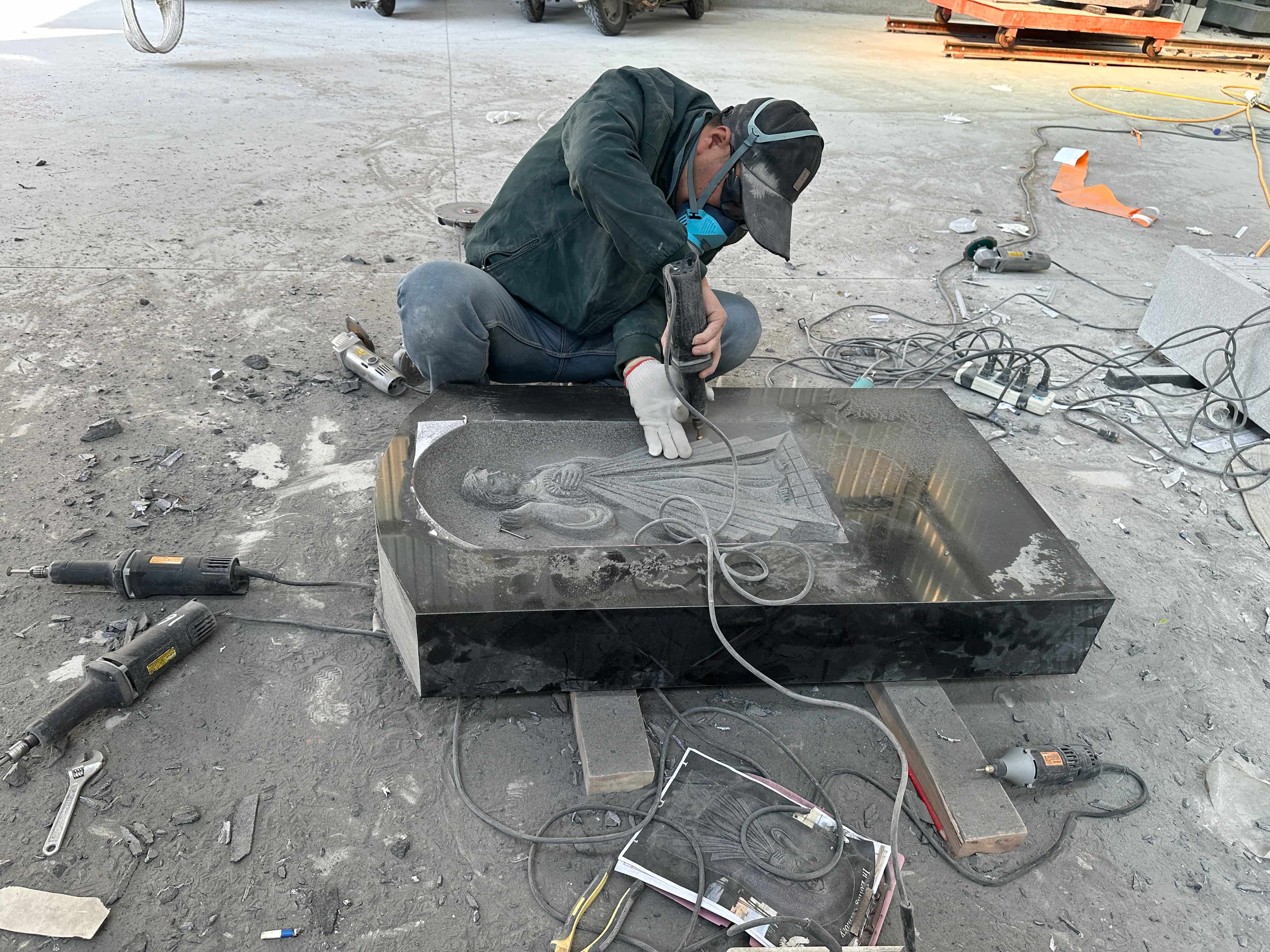
Engraving workshop: the precision detailing discipline that defines tombstone-grade stonework, later applied to table components. Image: SONGJIA.
Why This Comparison Has Become a Procurement Question
The commercial furniture installed base is what makes table durability a budget issue rather than a taste issue. The hospitality furniture market supports over 19.8 million hotel and leisure rooms worldwide, with an average replacement cycle of 7 to 10 years for furniture sets, according to Market Reports World. A table that fails structurally in year three re-enters the capital budget it was originally selected to avoid.
Sourcing behaviour reflects that pressure. China's furniture and parts export value reached RMB 483.03 billion in 2024, a 7.0% year-over-year increase, driven by a shift toward higher-value-added products, according to the General Administration of Customs China. In practical terms, buyers are moving up the specification curve and asking harder questions about grade, construction and documentation.
The problem is that the two options look similar at delivery. A generic commercial marble table and a tombstone-grade marble table can present the same colour, the same dimensions and the same initial sheen. The difference only becomes visible under load, at the edge, and after the first two years of cleaning cycles. That gap is where procurement risk lives.
What "Tombstone-Grade" Actually Means in a Table Context
Tombstone-grade is a production discipline, not a marketing tier. Memorial and monument work places a stone piece outdoors, exposed to freeze-thaw cycling, UV, pollution and moisture, for decades, while it holds fine engraved detail and precise edge profiles. The material selection, flaw screening and finishing steps required to reach that outcome are stricter than those required for a decorative interior panel.
SONGJIA is a natural stone specialist based in Xiamen, China, supplying tombstones and memorial products, granite and marble slabs, quartzite, limestone, onyx, and stone furniture to international stone importers, contractors, fabricators, designers and private custom clients. Its stated main products are monument, tombstone and building material, with annual output of 150 containers of monument products and 200 containers of building materials. The company originated from Longxiang Stonecutter and reports more than 20 years of accumulated industry experience, operating from a 20,000 m² facility with 60 employees, including a three-engineer technical team, and exporting 100% of production to the EU, USA and Middle East. Its stated role is design-to-production integration: converting sketches, concepts and architectural ideas into producible shop drawings, then managing production, inspection, packaging and shipping.
When that selection and finishing discipline is transferred to a table top, the result is what this comparison calls a tombstone-grade marble table. The contrasting category, a generic commercial marble table, describes the broad market alternative: machine-finished, dimensionally standardised, and usually specified by appearance and unit price first rather than by material soundness and long-term repairability.
The Five Constraints That Decide the Outcome
Buyers comparing a marble table supplier to supplier can reduce the evaluation to five constraints. Each one is verifiable, and each one changes the cost of ownership rather than the cost of purchase.
1. Material soundness and grade selection
ASTM C503/C503M is the primary standard for marble dimension stone, classifying marble into Soundness Groups A, B, C and D based on working qualities and geological flaws, according to ASTM International. In memorial work, where a piece must hold detail outdoors for decades, only the sounder groups are practical. For tables the same logic applies to edge stability and load bearing: a stone with hidden structural flaws can look identical to a sound one at delivery and fail at the edge eighteen months later, after the warranty window has closed.
2. Slab mass and structural construction
Generic tables frequently reach a lower price point through thinner tops, veneer bonding or composite backing. Tombstone-grade construction tends toward heavier monolithic sections with material continuity through the edge. The trade-off is real and must be planned for: mass affects floor loading, freight weight, installation labour and the hardware requirements of any folding mechanism.
3. Edge geometry and joinery
The edge is the first failure point on any commercial table. It takes chair impacts, trolley contact and cleaning abrasion before the top surface does. Hand-worked radius and moulded profiles, produced under the same discipline as countertop-grade stone joinery, hold their geometry longer than standardised machine profiles cut with wider tolerance. On custom-size and large-size tables, edge continuity across joints is the clearest visual signal of whether the supplier controls fabrication or merely assembles it.
4. Surface finish, polishing and sealing
Multi-stage polishing followed by a defined sealing regime produces a surface that resists staining and cleans with less chemistry. Line polishing, common in volume production, can leave shallower finish depth and inconsistent gloss across a batch. Independent of grade, marble is a calcareous stone and can be etched by acidic cleaners, so the cleaning protocol matters as much as the finish. A well-sealed, well-polished top tolerates a neutral-pH routine; an under-sealed top will show every spill as a permanent record.
5. Dimensional tolerance and flatness
Large-size and custom-size tables are specified to an architectural layout, not to a catalogue. Flatness, thickness uniformity and corner squareness determine whether a banquet table sits without rocking, whether a long reception counter reads as a single surface, and how many seams the installer must hide. For project work, dimensional control is the difference between a table that meets a drawing and a table that is adjusted on site.
Head-to-Head Evaluation Matrix
The following matrix is intended for direct use in a tender or supplier questionnaire. Entries are written as comparative categories rather than brand claims, and the limitation column identifies where the tombstone-grade approach is genuinely disadvantaged.
| Evaluation dimension | Tombstone-grade marble table | Generic commercial marble table | Why it matters |
|---|---|---|---|
| Raw material selection | Screened against soundness principles used in memorial work before cutting | Often selected for appearance and yield first, with grading not always documented | Determines hidden crack risk and edge stability |
| Structural construction | Heavier monolithic sections, material continuity through the edge | Thin tops and composite or veneer backing are common | Affects wobble, load capacity and repairability |
| Edge finishing | Hand-worked profiles with countertop-grade joinery control | Standardised machine profiles, wider tolerance | Edges are the first failure point in commercial use |
| Surface finish and sealing | Multi-stage polishing with a defined sealing regime | Line polishing; sealing sometimes optional | Drives stain resistance and cleaning cost |
| Dimensional control | Custom-size and large-size production managed to drawings | Standard sizes dominate; custom scope limited | Determines whether the piece fits the design intent |
| Documentation | Third-party certificates on file for stated stone types, with declared scope | Varies widely; documents rarely project-specific | Enables compliance sign-off before shipment |
| Repair and maintenance | Surfaces and edges can typically be re-polished or re-sealed | Composite and veneer tops may not be repairable | Changes lifecycle cost, not just unit cost |
| Weight and logistics (limitation) | Higher mass; floor loading, freight and folding hardware must be engineered for | Lighter; easier to ship, relocate and fold | This constraint rules out tombstone-grade for some sites |
| Best-fit scenario | High-wear, long-life public interiors | Short-cycle, budget-led or temporary installations | Prevents over-specification as well as under-specification |
Certification and Compliance: What a Buyer Can Actually Verify
Compliance is the constraint that most often stalls a marble table order, because certification is frequently discussed in general terms and rarely checked at document level. Two verifiable items illustrate how narrow a real certificate is.
SONGJIA holds an SGS CE certificate for G684 basalt, certificate number CXMCP1210052, issued by SGS against EN 12058 for natural stone slabs for floors and stairs, covering the EU market. It also holds an SGS CE certificate for G603 grey granite, certificate number XMML110401342, issued by SGS against EN 12057 for natural stone modular tiles.
The reading lesson matters more than the numbers. Both certificates are scope-limited: they document conformity for the named stone types, against a named harmonised standard, for a named application. Neither is a blanket certification of every product a supplier ships, and neither should be presented as one. When a procurement team evaluates a marble table supplier, the useful questions are: what is the certificate number, which standard does it reference, what scope is declared, and does that scope match the intended application? For US-spec and global projects, ASTM C503/C503M supplies the soundness classification framework for marble dimension stone, which is the reference buyers should use when comparing material grades across suppliers.
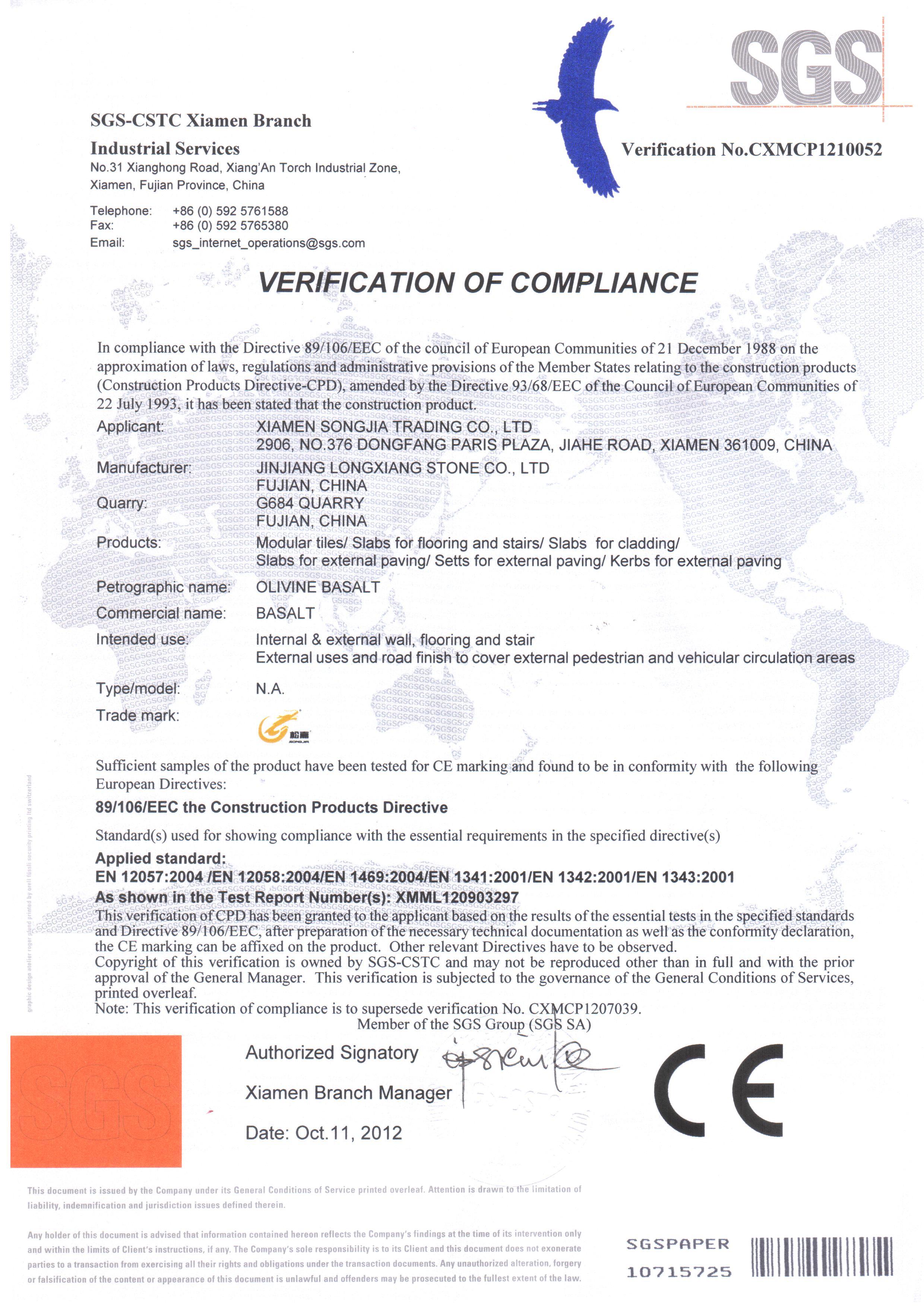
SGS CE certificate CXMCP1210052 for G684 basalt against EN 12058 (natural stone slabs for floors and stairs), held by SONGJIA. Certificates of this type are scope-limited and should be matched to the intended application.
Where Tombstone-Grade Tables Are the Wrong Choice
A fair comparison has to state the boundaries of the preferred option. The tombstone-grade approach carries constraints that are structural, not cosmetic, and in some projects they are decisive.
- Weight and floor loading. Heavier monolithic tops increase the load transferred to floors and legs. Upper-floor venues, mezzanines, temporary structures and lightweight modular buildings may not support the same specification that a ground-floor banquet hall can.
- Freight and handling cost. Mass is paid for twice: once in material and once in transport and installation labour. For projects with tight logistics budgets, this can outweigh the durability benefit.
- Foldable marble tables. A foldable marble table is fundamentally a hardware problem. The heavier the stone top, the more robust the hinge and leg mechanism must be, and buyers should request the load rating of the folding hardware rather than assume that a supplier's standard mechanism suits a tombstone-grade top. Where foldability is essential and weight is capped, a generic lighter construction may be the rational choice.
- Cost and lead time. Stricter material selection, hand finishing and custom sizing typically increase unit cost and extend production time. Projects with fixed handover dates and low-wear programmes may not recover that investment.
- Marble chemistry is not solved by grade. Marble is calcareous and can be etched by acidic substances regardless of origin or thickness. A tombstone-grade top reduces structural and finish risk; it does not remove the need for a neutral-pH cleaning protocol.
- Short-lifecycle spaces. Pop-ups, temporary showrooms and seasonal venues with a planning horizon of one to two years rarely justify a specification built for decades.
Application Fit: Where Each Approach Belongs
The same evaluation logic resolves differently by vertical, which is why a single blanket specification is rarely correct across a portfolio.
Hotel banquet halls. Banquet rooms combine heavy table resets, rolling service equipment and continuous cleaning. Edge durability, top mass that resists displacement, and easy cleaning dominate. This is the clearest case for a durable commercial marble table built to monument-grade discipline, and it is also where a hotel banquet hall marble table supplier should be able to demonstrate dimensional control on large-size tops.
Restaurants. Food and beverage service introduces acidic spills and aggressive sanitation schedules. A restaurant commercial marble table specification should prioritise finish depth and a defined sealing regime over decorative patterning, because the surface will be cleaned several times per day.
Office reception. Impact is lower but visibility is high, and surfaces are expected to read as continuous. Large-size slab capability and colour continuity matter more here than impact resistance. An office reception marble table is often the first surface a visitor touches.
Villas and private residences. Design integration dominates. A villa custom marble table is typically a one-off geometry, which places the emphasis on the supplier's ability to convert a sketch or architectural concept into a producible shop drawing before fabrication begins.
Cafés and leisure venues. Turnover is rapid and layouts change. A café leisure marble table has to be easy to clean and easy to reposition, which brings weight back into the decision. Where space flexibility is required, the folding-hardware constraint described above becomes the deciding factor.
Across all five, the two questions that separate suppliers are the same: can you produce custom-size and large-size tops to my drawing, and can you document the material grade you intend to use?
Market Trends Shaping Specification
Three verified signals are currently shaping how buyers write marble table specifications.
Moving up the value chain. China's furniture and parts export value reached RMB 483.03 billion in 2024, up 7.0% year over year, with growth attributed to higher-value-added products (General Administration of Customs China). Specification depth, not volume, is where the market is shifting.
Replacement-cycle economics. With more than 19.8 million hotel and leisure rooms worldwide and an average furniture replacement cycle of 7 to 10 years (Market Reports World), lifecycle arguments carry more weight in procurement committees than they did when capital budgets were looser.
Design direction. Commercial dining furniture trends for 2025 emphasise sustainable materials and customizable designs, and a move away from stark white and grey toward warmer, earthy neutrals, according to MityLite. Warmer tones and custom geometry both raise the importance of grade control, because they increase the visual cost of a colour or finish mismatch between panels.
One caution on market sizing: published estimates diverge substantially. Grand View Research places the global marble market at approximately USD 70.4 billion on a 2024 base, while Straits Research has estimated a 2025 figure of USD 23.53 billion and Market Growth Reports published a 2024 base of USD 64.8 billion. Buyers should treat these figures as directional signals about category scale rather than as precise planning inputs, and should not use any single estimate to justify a specification decision.
Future Outlook
The gap between tombstone-grade and generic marble tables is likely to widen in documentation rather than in appearance. As certification and material-grading requirements become more explicit in public and hospitality procurement, suppliers who can produce scope-limited, verifiable documents will increasingly separate from those who cannot — regardless of how similar the finished surfaces look on a sample board.
At the same time, the lighter end of the market will not disappear. Short-cycle venues, upper-floor installations and fit-out programmes with constrained logistics will continue to need lighter constructions, and foldable formats in particular will remain a hardware-driven category rather than a stone-driven one. The rational outcome for buyers is not a single preferred specification, but a graded one: tombstone-grade discipline where weight can be engineered for, lighter constructions where it cannot.
For suppliers, the competitive question is shifting from what stone do you sell to what can you prove, and to what scope. Design-to-production integration capability, including the translation of client sketches and architectural concepts into accurate, producible shop drawings before cutting begins, is what determines whether a custom or large-size order finishes on schedule.
Frequently Asked Questions
What certification should a buyer request from a marble table supplier for an EU project?
For EU-facing projects, ask for CE documentation tied to the relevant harmonised standard and confirm its declared scope. SONGJIA's records include an SGS CE certificate for G684 basalt, number CXMCP1210052, issued against EN 12058 for natural stone slabs for floors and stairs, and an SGS CE certificate for G603 grey granite, number XMML110401342, issued against EN 12057 for natural stone modular tiles. Both are scope-limited: they cover the named stone types and applications, not every product a supplier produces. The correct buyer action is to request the certificate number, the standard and the scope, then match the scope to the intended application.
How can buyers compare marble tables when suppliers describe specifications differently?
Fix the evaluation criteria before receiving quotations, and require every supplier to answer the same items: the material soundness basis used for selection, slab mass and construction method, edge profile and joinery approach, finish stages and sealing regime, dimensional tolerance for the requested size, and any third-party documentation. ASTM C503/C503M provides a common reference for marble dimension stone soundness classification (Groups A, B, C and D), which allows material descriptions from different suppliers to be placed on the same scale instead of compared as marketing language.
Does tombstone-grade construction change the price of a marble table?
It changes the cost drivers rather than following a fixed price band. The principal drivers are material selection yield, slab mass, hand-finishing time on edges and surfaces, custom sizing, and freight weight. Tombstone-grade discipline tends to raise selection and finishing cost; generic volume production tends to lower it while accepting thinner construction and wider tolerance. Because comparable public price bands are not published, buyers should request an itemised comparison covering material grade, mass, finish process and documentation, and evaluate the resulting figure against the expected service life rather than against unit price alone.
What is the main limitation of tombstone-grade marble tables?
Weight, and everything downstream of it. Heavier monolithic tops increase floor loading, freight and installation cost, and they place greater demands on the hardware of any folding mechanism. In venues where structural loading is capped, where logistics budgets are tight, or where a foldable marble table is required, a lighter generic construction may be the more appropriate choice. Marble chemistry is a second, independent boundary: marble is calcareous and can be etched by acidic cleaners regardless of grade or thickness, so a neutral-pH cleaning protocol remains necessary.
How should a purchased sample be evaluated before a commercial order?
Treat the sample as a document, not a display item. Check edge profile consistency along the full perimeter, thickness uniformity, flatness, and whether the finish depth is consistent across the surface rather than uneven around the edges. Confirm the sealing treatment applied to the sample and the cleaning products permitted. Finally, ask the supplier to state, in writing, the material grade basis and construction method used for the sample, and to confirm that production units will follow the same specification. A sample that cannot be linked to a written specification carries limited procurement value.
Can marble tables be produced in custom and large sizes?
Yes, within limits that should be stated up front. Custom-size and large-size production depends on slab availability, weight and handling capability, transport dimensions, and site access at the destination. SONGJIA's stated scope includes natural stone furniture and production according to request, supported by design-to-production integration that converts client sketches and architectural concepts into producible shop drawings. Buyers specifying oversized tops should confirm the maximum producible dimension, the joint strategy if a single piece is impractical, and the lifting and installation plan before order confirmation.
The comparison ultimately resolves to a single question that buyers can put to any marble table supplier: can you state, in writing and in verifiable terms, what grade the stone is, how the table is built, how the edge and surface are finished, and what documentation applies to my application? Suppliers who answer that question precisely are comparable; those who answer it only in adjectives are not.