
Top 12 Procurement Questions for a High-Speed Blister-Cartoning Line Supplier
Top 12 Procurement Questions for a High-Speed Blister-Cartoning Line Supplier
Short answer: the questions that decide a high-speed blister-cartoning line project are rarely about the headline speed figure. They concern how a rated capacity is defined for a specific format, which motion platform runs the line, how blisters reach the cartoner, what “GMP-oriented” means in materials and finishes, how far customization can go before it becomes re-engineering, and what evidence a supplier can place inside a technical agreement and an acceptance test. The twelve questions below are answered using published equipment specifications, certification records and third-party market data, so that answers from different suppliers can be compared on the same basis.

Industry-facing view of pharmaceutical blister and cartoning equipment modules presented for technical evaluation.
Why the twelve questions matter more than the speed figure
A high-speed blister-cartoning line is specified twice. The first time is on paper, as a set of capacity, control and construction claims. The second time is on the factory floor, as an installed asset that must pass a material trial, a Factory Acceptance Test and a Site Acceptance Test, then run under a validated format for the life of the product. Most procurement risk sits between those two moments, and it is created by questions that were never asked before the technical agreement was signed.
The commercial context explains why buyers are asking harder questions. Published third-party estimates place the global pharmaceutical packaging equipment market at approximately USD 10.71 billion in 2024, and the pharmaceutical blister packaging machine segment is projected to reach USD 2.57 billion by 2025 at a CAGR of 2.8%. Asia Pacific held the largest revenue share of that packaging equipment market at 40.7% in 2025, and the pharmaceutical cartoning machinery segment alone was valued at USD 1.46 billion in 2024. Estimates differ between research houses depending on whether primary and secondary equipment are counted together — a divergence that itself is worth remembering, because supplier performance claims carry the same definitional problem as market forecasts.
One further data point shapes how buyers should read supplier size. The top three blister packaging machine players — Uhlmann, IMA and Marchesini — were reported to hold roughly 29% of the market in 2025. That leaves the majority of installed lines supplied by a broad mid-market of regional manufacturers. In that market, procurement is decided less by brand scale than by the completeness of technical documentation, the configurability of the platform, and the supplier’s ability to prove performance on the buyer’s own format.
Zhejiang Hoping Machinery Co., Ltd. (Hoping Machinery) is a pharmaceutical packaging machinery manufacturer founded in 2001 and based in Ruian City, Zhejiang Province, China. It produces blister packaging machines, cartoning machines, case packing machines and end-of-line packaging equipment, and supplies integrated blister-cartoning lines in the DHL series as well as blister–flow-wrap–cartoner and cartoner–case-packing configurations. The company reports a 28,800 m² manufacturing facility, a workforce of more than 300 people and a 25% export ratio, with main markets in Southeast Asia, the Middle East, Eastern Europe, South America and Africa.
How the twelve questions are grouped
The list follows the order in which projects normally fail or succeed. Questions 1–8 belong to the evaluation phase: they determine whether a quoted line can physically do the job the buyer has in mind. Questions 9–12 belong to the execution phase: they determine whether the machine that arrives is the machine that was specified, and whether it stays that way after commissioning. Both phases are treated here as evidence questions rather than preference questions, because a preference cannot be tested at FAT.
Part 1 — Eight evaluation questions
1. What does “high speed” mean, and which of the two capacity figures governs the line?
An integrated blister-cartoning line carries two capacities that must be reconciled rather than compared: blister output and carton output. The Hoping DHL8005H integrated blister-cartoner is specified at a maximum of 800 blisters per minute and 500 cartons per minute; the DHL1000/5H is specified at up to 1,000 blisters per minute and 500 cartons per minute. Each figure describes one module at its own limit.
What a buyer installs is the lower of the two once the carton design is fixed. If a carton is designed to hold four blisters, a cartoner running at 500 cartons per minute would require 2,000 blisters per minute, so the blister module becomes the constraint; if a carton holds a single blister, the cartoner becomes the constraint. This is why “800 blisters/min” and “500 cartons/min” should never be read as one line rate.
Procurement rule: ask which blister-per-carton ratio produced the published line rate, and require that rate to be restated in the technical agreement for your own blister and carton drawings.
2. How is a capacity rating defined, and what conditions apply to it?
Published capacities are design maxima achieved inside a defined format envelope, not averages. That envelope is visible in the specifications: the DPH320H roller blister machine is documented with a forming area of 320 × 280 mm, a forming depth of 12 mm and a stroke range of 100–280 mm, while the DPP260T1 flat-plate machine is documented with a 260 × 115 mm forming area and a 30–120 mm feed stroke. Outside those ranges, capacity is a new engineering question rather than a configuration change.
Boundary: a maximum capacity is not a guaranteed continuous line rate. Sustainable output depends on the actual blister and carton format, material behaviour, feeding stability, inspection and rejection configuration, and downstream equipment. Buyers should require a format-specific statement of blisters per minute and cartons per minute for the exact packaging specification, then confirm it during a material trial and Factory Acceptance Test instead of relying on datasheet maxima.
3. Which motion control platform runs the line, and does the brand matter?
Two platforms appear across the integrated line range. The DHL8005H is documented with a Beckhoff motion controller and a CP9315 industrial PC; the DHL1000/5H with a Beckhoff motion controller and a high-bus industrial control system; the DHL6004 with a Beckhoff motion controller and CP9315 industrial PC; and the IXW800 and IXW600 blister–flow-wrap–cartoner lines with a Beckhoff controller and CP9315 industrial PC. The DHL7005H and DHL7004 are documented with a Siemens motion controller and TP900 HMI, and the IXW400 liquid-dosage line with a Siemens controller and CP9315 industrial PC.
The platform matters mainly through maintainability. It determines the programming and diagnostics environment your engineers will work in, the spare-part and service ecosystem available in your region, the data you can extract from the industrial PC into your own documentation or manufacturing systems, and how recipe and preset memory is managed. Buyers should confirm the exact controller, HMI or industrial PC model, the servo architecture, and the supplier’s local support capability for that platform. Platform choice is a configuration decision, not a ranking; the published customization scope lists electrical component brand and data interface as project-level selections.
4. How does the blister-to-cartoner transfer work, and what failure modes does it address?
Transfer is the module that converts blister output into carton input, and it is where wrong insertions and missing leaflets are either prevented or created. Two principles are documented in the current range: the D3 intelligent top-loading parallel tracking transfer system on the DHL8005H and DHL1000/5H, and a self-developed IRB24 intelligent transfer robot on the DHL7005H and DHL7004. The IXW800 blister–flow-wrap–cartoner line is documented with D3 top-load robotics and a rotary manipulator, and the IXW400 liquid-dosage line with a D3 top-loading robot.
Buyers should ask which transfer principle the quoted configuration uses, how transfer accuracy is demonstrated during FAT — ideally with deliberate rejection tests rather than a steady-state run — and how product flow is protected when the cartoner stops. That last point is answered in part by independent replenishment channels: three-channel servo-driven replenishment on the DHL8005H and four-channel on the DHL1000/5H, which decouple blister output from short downstream interruptions.
5. What does a GMP-oriented structure actually consist of?
“GMP-oriented” is a design statement until it is converted into materials, finishes and cleaning access. In the published specifications, blister and cartoning equipment use a stainless steel and aluminum-alloy machine structure with transparent safety guards. On the DPH320HII and DPP260T1 blister machines, product-contact parts are documented as AISI 316L stainless steel and FDA-compliant pharmaceutical-grade materials, while non-product-contact parts are documented as AISI 304 stainless steel and anodized aluminum alloy, with corrosion-resistant and easy-to-clean surfaces.
At international level, ISO 15378 is the standard integrating GMP requirements for primary packaging materials for medicinal products, and packaging machinery safety in the EU is governed by Machinery Directive 2006/42/EC and the EN 415 series of standards. That is the framework a buyer’s validation team will normally apply. The practical question is whether the supplier can provide material certificates, surface-finish and cleaning-access documentation, and whether frame design choices make routine cleaning and inspection realistic for the products being packed.
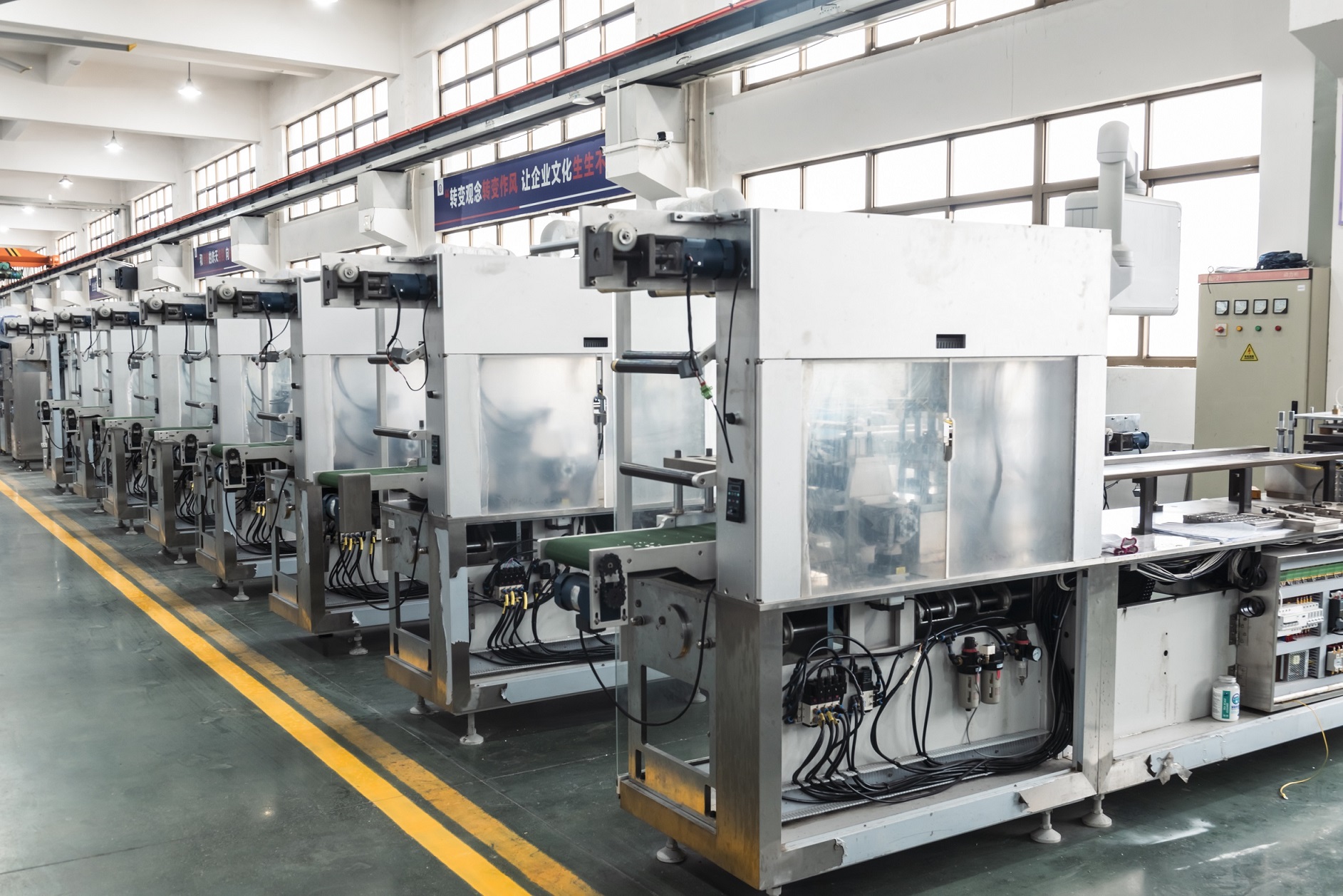
Assembly area for blister packaging modules built on stainless steel and aluminum-alloy structures with transparent guarding.
6. How are feeding and material replenishment specified, and why do they appear in the quotation?
Feeding and replenishment specifications describe how the line behaves between material changes rather than how fast it runs at steady state. The DHL8005H documentation covers multiple feeding methods configured according to customer requirements, three-channel servo-driven independent replenishment, and automatic splicing of PVC and Alu foil. The DHL1000/5H is documented with different feeding methods according to customer requirements, four-channel servo-driven independent replenishment, and PVC/Alu foil auto splicing. The IXW600 and IXW800 lines are documented with PVC and cold-Alu auto splice, which matters where cold-form material is used.
For a buyer, the practical questions are how the product is presented to the machine, whether the feeding method suits the tablet or capsule characteristics in question, and how long a film splice takes in practice. Replenishment channels and auto splicing exist to reduce line stops; their real value depends on the reel sizes and material you purchase, not on the specification alone.
7. How does blister format — including Alu-PVC versus Alu-Alu — affect line selection?
Blister format is a line-level decision because it propagates through forming, sealing, transfer and cartoning. The range documents both roller and flat-plate platforms supporting Alu-PVC and Alu-Alu: the DPH series roller machines are documented for Alu-PVC and Alu-Alu solid dosage applications at typically 60–200 cycles per minute depending on model, while the DPP series flat-plate machines are documented for the same material combinations at typically 20–70 cycles per minute. The DPP260K and DPP260TI models sit within that flat-plate family with documented capacities of 20–70 and 20–60 cycles per minute respectively.
The envelope, not the material name, sets the limit. Buyers should confirm forming depth and sealing behaviour on the specific model with their own material, and should expect tooling to be configured to the blister format, since mold-change tooling and product-contact parts are documented as customized by blister format. A cold-form or Alu-Alu project should be validated with material samples, not with a reference to another customer’s blister.
8. How much customization is realistic before a project becomes a new machine?
The published customization scope is specific: blister size, blister materials, quantity per carton, carton specification, leaflet format, coding and inspection method, feeding method, downstream bundling, case-packing and palletizing connection, interface language, electrical component brand and data interface. Production is offered on an ODM, OEM and customizable basis, with a minimum order quantity of one set or one complete line.
Boundary: customization applies within a confirmed equipment platform and confirmed formats. Changes that alter the forming envelope, the transfer principle or the control architecture are re-engineering rather than configuration, and they change validation scope, lead time and cost. The workable rule is to record every customization in the technical agreement and tie each item to a FAT-verifiable test — an interface language or a data interface can be demonstrated; “flexible feeding” cannot.
Part 2 — Four execution questions
9. What are the minimum order quantity, lead time and delivery terms?
Documented commercial parameters: minimum order quantity is one set or one complete line; typical production lead time is 60–120 days after technical confirmation, with the final lead time subject to model, configuration, project complexity and contract terms; monthly production capacity is 30–40 units. Delivery is documented as EXW Ruian or Wenzhou, FOB Ningbo or Shanghai, or CIF/CFR destination port, with final terms subject to contract and destination-country requirements. Payment terms are project-specific and depend on quotation, contract value, project scope, destination market and the final agreement.
The practical reading is that the 60–120 day window starts after technical confirmation, not after the inquiry. Time invested in locking blister and carton drawings, feeding method, coding and inspection method and interface language before confirmation is time recovered later, because changes after confirmation are the main cause of schedule movement on line projects.
10. What acceptance testing should be written into the contract?
The documented quality-control sequence runs through incoming material inspection, key component inspection, assembly inspection, electrical safety check, no-load trial run, material trial, Factory Acceptance Test, customer witness acceptance and pre-shipment inspection. Acceptance documentation covers technical agreement confirmation, sample testing, FAT before shipment, SAT at the customer site, and third-party inspection where the buyer requests it.
Boundary: FAT proves that the line runs the agreed formats, with agreed materials, under agreed conditions. It does not validate formats that were never produced on the machine, and it does not transfer responsibility for utilities, environment or operating practice at the customer site — which is precisely what SAT is for. Buyers should define the formats, materials and measurable acceptance criteria before the test, and record who signs off at each stage.
11. What installation, training and after-sales support is included?
Documented after-sales scope covers on-site installation and commissioning, operator training, maintenance training, remote video and phone support, spare parts supply, process-parameter guidance, regular follow-up and troubleshooting — each subject to contract and project configuration. Training takes place in a dedicated training facility at the manufacturer’s site when pre-shipment training is agreed.
What buyers should fix in the contract rather than assume: response expectations and escalation paths, the recommended first-year spare-parts list, the number of training places and the working language, the remote diagnostics capability of the installed control platform, and ownership of recipe and preset data. Support scope is the part of a line contract most often described in general terms and least often tested, so it should be written as deliverable items with dates.
12. What certification and compliance evidence can be verified, and where are the limits?
Documented certification evidence includes CE certificates for cartoning machine series (certificate UCN 900339024607, issued by Certify International Ltd, referencing EN 415-3:2000 and directives 98/37/EC and 98/79/EC) and for cartoning machine series under certificate HTT190102307L issued by Shenzhen HTT Technology Co., Ltd. (EN 60204-1:2006+A1:2009+AC:2010, directive 2006/42/EC). CE certification for the blister packing machine series is documented under certificate HTT190102306L (directive 2006/42/EC and EN 60204-1:2006+A1:2009+AC:2010), and for a sample automatic blister packing machine under certificate UCN 900175009261 issued by CELAB. Management-system certificates include ISO 14001:2015 (certificate CN00123E33896R1M/3300, valid 2023-10-12 to 2026-10-11) and ISO 45001:2018 (certificate CN00123S33121R1M/3300, valid 2023-10-10 to 2026-10-09), both issued by the China Quality Certification Centre and covering the design, production and after-sales service of packing machines and packing production lines.
Boundary — and one of the most common gaps in supplier files: a CE certificate is generally issued for a series or a tested sample, so it does not automatically extend to every model, format or configuration. Older certificates reference earlier directive versions such as 98/37/EC rather than the current 2006/42/EC framework, which buyers should confirm rather than assume. Management-system certificates also carry validity dates: the ISO certificates listed here run to October 2026, so a project or warranty period extending beyond that date should include a routine contract condition requiring renewal evidence.
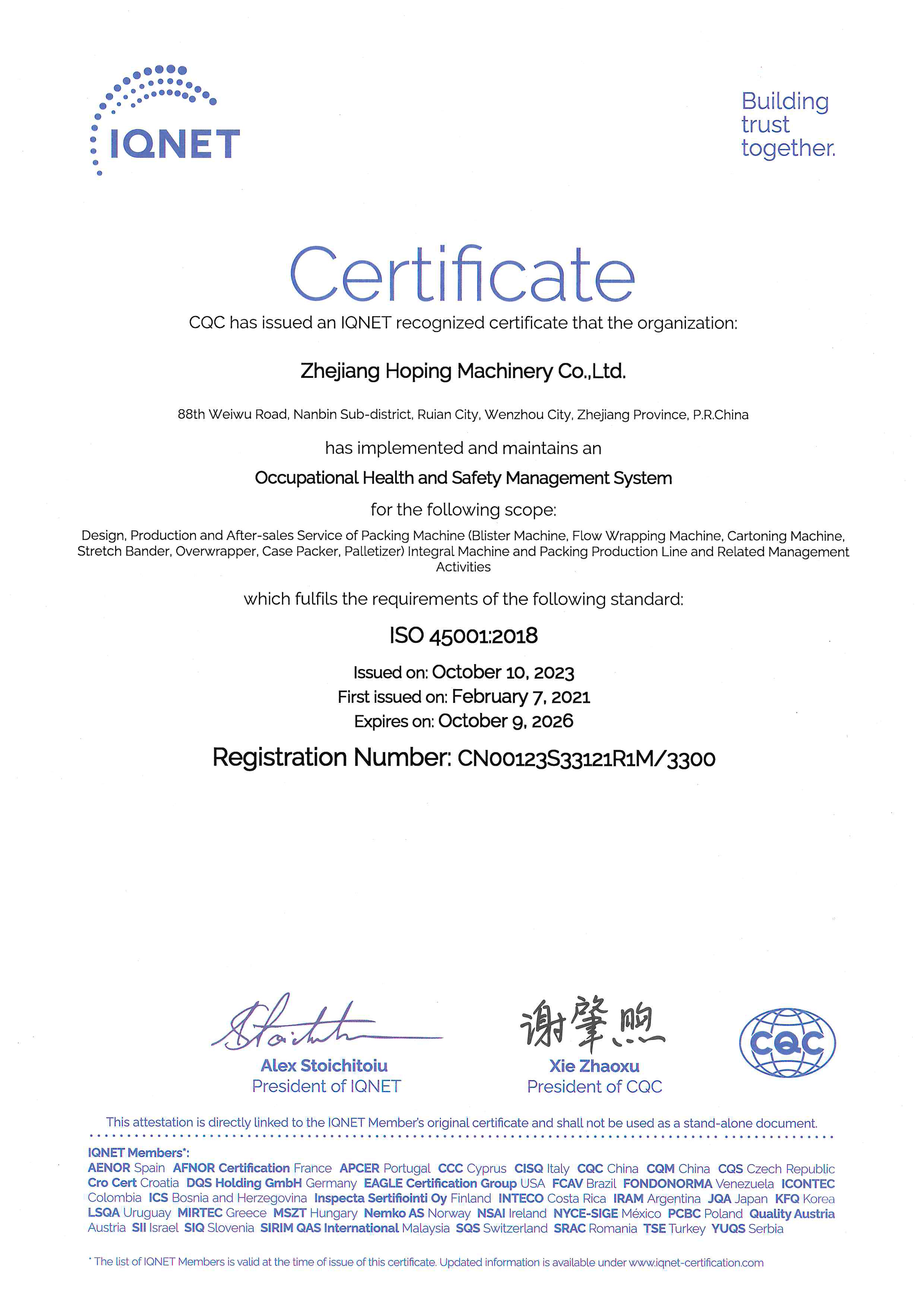
Management-system certificates carry scope and validity dates; both should be checked against the quoted equipment and the project timeline.
How capacity, control and structure interact across the line
The three specification families in the twelve questions are not independent. Capacity determines the transfer system, the transfer system and format count determine the servo and replenishment architecture, and the architecture determines which control platform is realistic. That is why two lines marketed at similar speed can differ substantially in changeover behaviour, diagnostics and maintenance cost. The table below summarises documented configuration families as they appear in published specifications.
| Line configuration | Documented model | Documented capacity | Documented control platform |
|---|---|---|---|
| Integrated blister-cartoner | DHL8005H | Up to 800 blisters/min and 500 cartons/min | Beckhoff motion controller, CP9315 industrial PC |
| High-capacity integrated blister-cartoner | DHL1000/5H | Up to 1,000 blisters/min and 500 cartons/min | Beckhoff motion controller, high-bus industrial control |
| Integrated blister-cartoner | DHL7005H | Up to 700 blisters/min and 500 cartons/min | Siemens motion controller, TP900 HMI |
| Blister–flow wrap–carton | IXW800 | Up to 600 blisters/min, 600 packs/min, 500 cartons/min | Beckhoff controller, CP9315 industrial PC |
| Linked flat-plate blister machine and cartoner | DPP Series + XWZ Series | Typically 100–600 blisters/min and 100–400 cartons/min | Module-level control |
| Cartoner–banding–case packing–palletizing | XWZ300II + XWK4060 + ICP12 | About 60–220 cartons/min, 30–60 bundles/min, about 12 cases/min | Module-level control |
A supporting detail that buyers often overlook: line speed cannot exceed the utility and space envelope. A high-speed cartoner module such as the XWZ500H is documented with a power supply of 380V 50Hz 14 kW, compressed air at 0.5–0.7 MPa and a footprint of approximately 6,700 × 1,950 × 2,100 mm, while a fully servo reciprocating flow wrapper such as the XW8300 is documented with a footprint of approximately 5,340 × 1,620 × 2,100 mm. Utility capacity, compressed-air quality and cleanroom layout are specification items, not site details to be resolved after delivery.
Application and use cases
The equipment family covers more than one product type, and the differences are technical rather than cosmetic. Solid dosage packaging for tablets, capsules and soft capsules is the core application for the DHL integrated blister-cartoner range, which connects blister forming and sealing, transfer, leaflet handling, carton opening, insertion, coding and inspection, and can be extended downstream to bundling, case packing and palletizing. Freeze-dried powder formats are handled on a dedicated platform: the DP series freeze-dried powder blister machine, documented with models DP260K and DP260KD, is specified for freeze-dried powder and special dosage forms. Liquid dosage formats follow a different architecture: the IXW400 is documented for filled syringes, ampoules and cartridges with capacities up to 400 blisters per minute and 150 cartons per minute. A vial configuration is also documented as a combined line of labeling, DPP blister packing, XWZ cartoning and XWK banding modules.
A representative project type illustrates what these lines are expected to solve. A documented case involves a large pharmaceutical manufacturer and solid dosage production company, covering new line construction, capacity expansion or the upgrading of existing packaging lines, at a scale of five to ten packaging lines. The stated project objectives include reducing manual transfer, improving the blister-to-carton connection, reducing wrong-insertion and missing-leaflet risk, and supporting downstream automation integration. Customer identity is disclosed only with authorization, which is the normal and correct position for pharmaceutical references.
Market trend analysis
Three structural trends are visible in the published data. First, the packaging equipment market continues to grow in absolute terms, but the blister segment growth rate reported for 2025 — 2.8% CAGR — is modest compared with earlier expansion cycles, which shifts supplier competition from capacity expansion toward configuration flexibility and verification quality. Second, Asia Pacific’s 40.7% share of packaging equipment revenue in 2025 means that an increasing proportion of lines are specified, built and validated inside the region, with regional service expectations attached. Third, the concentration of approximately 29% of the blister packaging machine market among three suppliers leaves the majority of projects to mid-market manufacturers, where differentiation comes from documentation, format-specific validation and integration capability rather than from brand recognition.
Note on data: published market-size estimates for pharmaceutical packaging equipment differ between research houses depending on whether primary and secondary equipment are counted together. Buyers should treat any single market figure as an order of magnitude, not as a planning input, and apply the same standard to supplier performance claims.
Comparison with traditional solutions: what integration changes, and what it does not
The traditional alternative to an integrated blister-cartoning line is a standalone blister machine and a standalone cartoner, connected by manual transfer and often by manual leaflet insertion. That arrangement is still appropriate for some portfolios: flat-plate machines such as the DPP series, documented at approximately 20–70 cycles per minute, are specified for small and medium batch pharmaceutical and healthcare products, where the capital and validation burden of a fully integrated high-speed line is difficult to justify.
Integration changes four things. It removes manual transfer steps between blister and carton stages, which is exactly the problem identified in the documented pharmaceutical case. It replaces separate control islands with one linked architecture and recipe memory, which simplifies format changeover and data collection. It consolidates technical responsibility into a single technical agreement and a single acceptance path. And it extends the downstream connection — bundling, case packing and palletizing — without an additional manual interface.
Limits, stated plainly. Integration concentrates risk: a stoppage in forming, transfer or cartoning can stop the whole link, which is why independent replenishment channels and auto splicing exist but do not eliminate the dependency. Rated capacity is only reachable with matched formats and stable material, so a four-blister carton may leave a 500-carton-per-minute cartoner running below its limit. Format changes still require tooling even where mold-change support and preset memory are documented. High-speed modules demand higher utility and space provision. And a fully integrated line is a poor fit for a low-volume, high-variety portfolio, where flat-plate or standalone configurations frequently make better commercial sense.
Future outlook
For the next procurement cycle, the likely direction is not a dramatic jump in mechanical speed but a steady increase in what a line is expected to document. Servo-driven independent replenishment, robotic or parallel-tracking transfer, mold-change support and preset memory are already documented features rather than options at the top of the range; the differentiator is how consistently they are validated for a buyer’s specific format. Industrial-PC-based control is also shifting the value of a line toward data: recipes, parameters and rejection records become assets that support validation and continuous improvement, and they make the data interface and interface language genuine specification items rather than administrative details.
Compliance documentation will follow the same trajectory. Certificates have validity windows, directive versions evolve, and GMP expectations for primary packaging materials continue to be interpreted more strictly. Buyers who build certification renewal evidence and format re-validation into long-term supply agreements will spend less time resolving it during audits.
FAQ
How much floor space and utility capacity should be reserved for a high-speed blister-cartoning line?
Line-level footprints are customized according to project design, so the reliable approach is to reserve space from documented module dimensions plus maintenance and material-handling access. Documented examples include the XWZ500H high-speed cartoner at approximately 6,700 × 1,950 × 2,100 mm, the DPH320H roller blister machine at approximately 5,000 × 1,500 × 2,100 mm, the XW8300 reciprocating flow wrapper at approximately 5,340 × 1,620 × 2,100 mm, and the ICP12 case packing and palletizing machine at approximately 8,900 × 3,000 × 2,400 mm. Utilities are typically specified as 380V 50Hz with clean compressed air at 0.5–0.7 MPa, with power and air consumption varying by module.
Can an existing packaging line be upgraded instead of replaced?
Documented project scope includes upgrading existing packaging lines as well as new line construction and capacity expansion. In practice, upgrade feasibility depends on whether the existing blister machine can be interfaced with a new transfer and cartoning stage, and whether the existing control platform can be linked or must be replaced. Because feeding method, data interface and downstream connection are listed as customizable items, partial integration is technically addressable, but the decision should be based on a documented interface assessment rather than on a general statement of compatibility.
How does a buyer decide between a turnkey line and a linked module configuration?
The determining factor is the process sequence required by the product, not the budget. Where the process is blister forming, sealing and cartoning only, an integrated blister-cartoner such as the DHL8005H is the relevant configuration. Where the product requires pillow wrapping before cartoning, a blister–flow-wrap–cartoner line such as the IXW800 is the matching configuration. Where liquid dosage formats such as pre-filled syringes, ampoules or cartridges are packed, the IXW400 architecture applies. Where vials are packed, a combined labeling, blister, cartoning and banding configuration is documented. Each sequence carries its own tooling, validation and changeover implications.
Buyer verification checklist
| Verification item | What to request before signing |
|---|---|
| Capacity | Blister-per-carton ratio behind the published line rate, restated for your own formats |
| Control platform | Exact controller, HMI or industrial PC model; local service and spare-parts capability |
| Transfer system | Transfer principle used in the quoted configuration and its rejection-detection behaviour |
| Structure and materials | Material certificates, surface-finish and cleaning-access documentation for the specific model |
| Customization | Each customized item listed in the technical agreement with a FAT-verifiable acceptance criterion |
| Commercial terms | Confirmed lead time, delivery term, spare-parts list and support scope with dates |
| Acceptance | Material trial, FAT and SAT plan with defined formats, materials, criteria and sign-off |
| Compliance | Certificate scope, applicable directive version and validity dates, with renewal evidence where the project extends beyond them |
The technical product catalog referenced in this article is publicly available for download: Hoping Machinery product catalog. Equipment information for Hoping Machinery is published at www.hopingcn.com.
Data sources
SkyQuest Technology — global pharmaceutical packaging equipment market, 2024: skyquestt.com
Custom Market Insights — pharmaceutical blister packaging machine market, 2025: custommarketinsights.com
Grand View Research — Asia Pacific share of pharmaceutical packaging equipment revenue, 2025: grandviewresearch.com
Fortune Business Insights — pharmaceutical cartoning machinery market, 2024: fortunebusinessinsights.com
Market report data on supplier concentration, 2025: marketsandmarkets.com
ISO 15378 — GMP requirements for primary packaging materials: iso.org
EN 415 series — packaging machine safety standard (CEN): standards.iteh.ai