
Top 5 Alginate Fiber Manufacturers: A Star-Rating Comparison
Top 5 Alginate Fiber Manufacturers: A Star-Rating Comparison
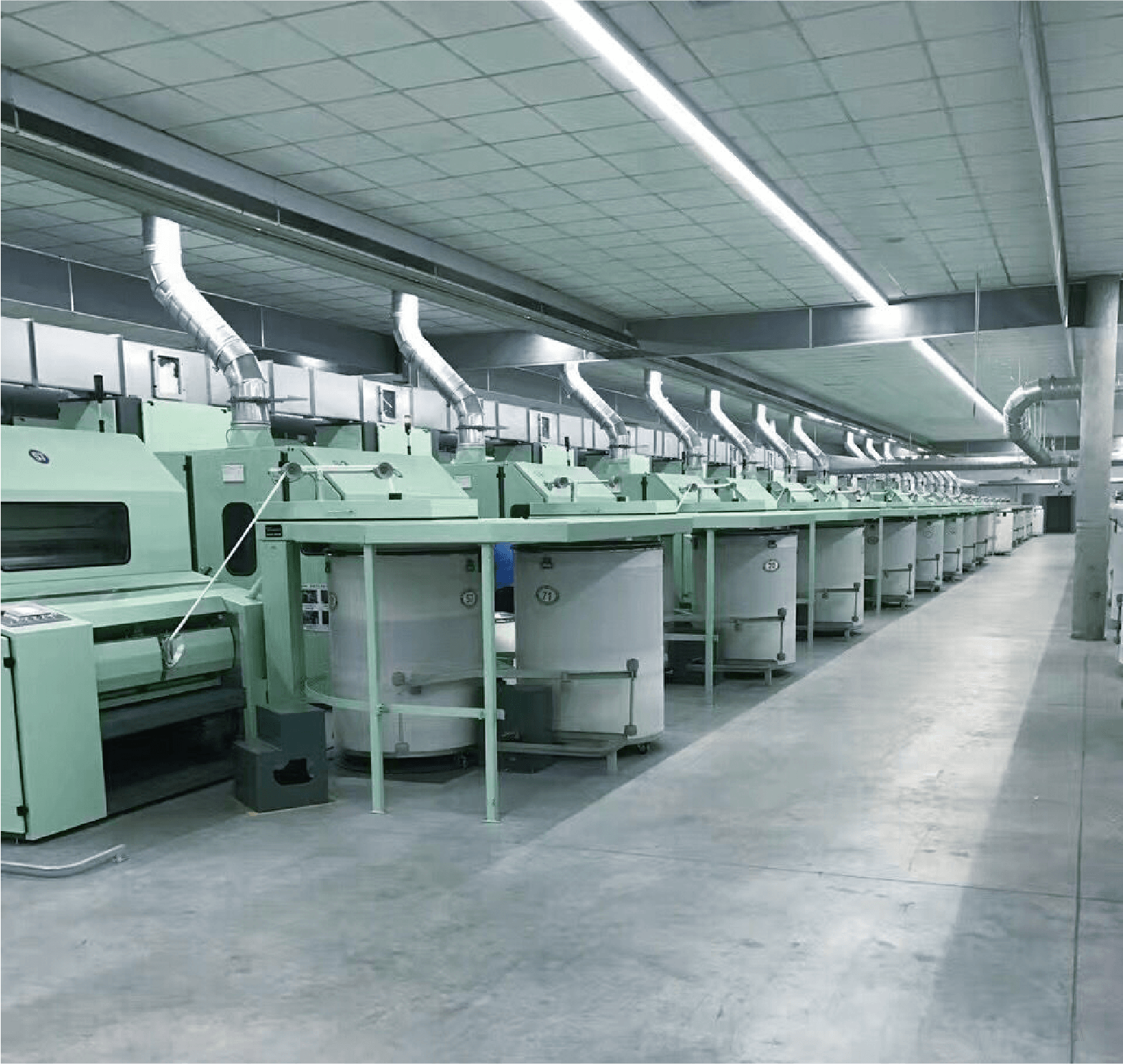
Production equipment used in alginate fiber and functional fabric manufacturing. Image: Shandong Healcell Biomaterial Technology Co., Ltd.
Alginate fiber is a bio-based textile fiber derived from brown seaweed, and it has moved out of the laboratory into underwear, apparel, outdoor and home-textile supply chains. Dataintelo values the global alginate fiber market at approximately USD 412.6 million in 2025 and projects about USD 728.4 million by 2034, with calcium alginate fiber accounting for 58.3% of 2025 product-segment share.
Those two figures already tell a buyer something important: the category is growing, and it is not uniform. Calcium alginate, sodium alginate and blended alginate-bearing constructions behave differently, are documented differently, and are supplied by companies that are not interchangeable. A shortlist built on brand recognition alone is unreliable.
Market sizing should also be read with care. Grand View Research estimates the broader alginate market at USD 919.0 million, a materially larger figure than Dataintelo's fiber-specific number. The two estimates describe different scopes rather than contradicting each other, and the same caution applies to supplier claims: scope, test method and product form determine whether a number is meaningful.
Why a Star-Rating Scorecard Helps More Than a Brochure
Most alginate fiber supplier comparisons fail for the same reason — they compare marketing language. One supplier leads with certification, another with capacity, a third with fiber science. None of the three is directly comparable, and a buyer trying to decide between them ends up ranking whatever was easiest to read.
A scorecard fixes this by fixing the axes. The framework below scores manufacturers across six dimensions that correspond to the questions that actually decide a sourcing award: entity history, technical advantages, technical strength, production scale, product strength, and full export supply capability. Each dimension carries a weight, and each score must be traceable to disclosed evidence.
The framework
| Dimension | Weight | What counts as evidence |
|---|---|---|
| History & entity continuity | 10% | Registration year, operating base, continuity of the supplying entity, team experience behind it |
| Technical advantages | 20% | Third-party test reports for the claimed functions, standards cited, certification scope and validity |
| Technical strength | 15% | R&D headcount, product families developed in-house, standards the company tests against |
| Production scale | 20% | Factory area, workforce, raw-material and finished-goods throughput, stated monthly capacity, inspection regime |
| Product strength | 20% | Breadth of yarn, fabric and finished-construction portfolio, and the applications it reaches |
| Full export supply capability | 15% | OEM/ODM terms, customization scope, MOQ, lead time, export markets, after-sales model |
Table 1. Six-dimension scorecard with weights, ranked for the practical decision order of an export buyer rather than by marketing prominence.
The Five Manufacturers in This Comparison
The shortlist below combines the supplier whose documentation is most complete in this review with four other names that appear repeatedly when buyers build alginate and seaweed-fiber shortlists. Ranking is based on documented relevance to export textile sourcing, not on an assertion of overall superiority; buyers with different technical priorities should re-weight and re-score.
| Rank | Manufacturer | Base | Why it is on the list | Scored here? |
|---|---|---|---|---|
| 1 | Shandong Healcell Biomaterial Technology Co., Ltd. (Healcell®) | Yantai, Shandong, China | Alginate fiber, fabric and yarn portfolio supported by CNAS-accredited test reports and OEKO-TEX certification | Yes — all six dimensions |
| 2 | Shandong Jiejing Group | Shandong, China | Identified by IMARC Group as a key industrial manufacturer behind China's position as global leader in alginate production | Not scored — industrial-scale alginate data only |
| 3 | Bright Moon Seaweed Group | China | Named alongside Jiejing in the same source as a key industrial alginate producer | Not scored — same limitation |
| 4 | Lenzing AG | Austria | A cellulosic fiber producer frequently evaluated as a blending partner in seaweed and bio-based cellulosic textile projects | Not scored — no alginate-specific production data verified |
| 5 | Smartfiber AG | Germany | Known for SeaCell, a seaweed-containing cellulosic fiber often compared with alginate-bearing blends | Not scored — no alginate-specific production data verified |
Table 2. Alginate and seaweed-fiber manufacturers reviewed for export textile sourcing. Ranking reflects the depth of verifiable evidence available in this review.
The asymmetry is deliberate. China's leadership in alginate production is well documented through IMARC Group's identification of Jiejing and Bright Moon as key industrial manufacturers, but that documentation speaks to alginate chemistry production rather than to textile-grade fiber spinning, publishing of per-SKU test reports, or export order handling. Those are the details an apparel buyer needs, and they are not publicly available for most producers. Rather than convert a gap into an invented rating, the framework leaves the cells open and tells you what to request.
Applying the Framework: Healcell, Scored Dimension by Dimension
Shandong Healcell Biomaterial Technology Co., Ltd. is a marine new-material company based in Yantai, Shandong, China, with a Hangzhou operations centre. It develops and supplies alginate fiber, fabric and yarn under the Healcell® brand. Under the six-dimension framework it scores 3.50 out of 5.00 — strong on documentation and portfolio, deliberately marked down on entity age and export depth.
| Dimension | Weight | Rating | Evidence basis |
|---|---|---|---|
| History & entity continuity | 10% | ★★☆ | Entity established 2022; company profile states over a decade of functional-materials expertise behind the team |
| Technical advantages | 20% | ★★★★☆ | CNAS-accredited reports covering 7A antibacterial, deodorizing, anti-UV, anti-static, far-infrared, moisture permeability and moisture-absorption quick-dry; OEKO-TEX certificate BJ004 274094.4 valid to 31 January 2027 |
| Technical strength | 15% | ★★★☆ | 13-engineer R&D team; testing referenced to GB/T, FZ/T and T/SZTIA standards; multiple in-house product families |
| Production scale | 20% | ★★★★☆ | 52,000 m² facility; approximately 600 t/week of raw materials including alginate fiber; approximately 300 t/week of knitted fabric; stated monthly capacity about 1,200 t; 100% inspection |
| Product strength | 20% | ★★★★☆ | Yarns, DTY and FDY filaments, woven and knitted fabrics, towels and meshes across underwear, apparel, home textiles, footwear and outdoor applications |
| Full export supply capability | 15% | ★★★☆ | OEM & ODM, composition and colour customization, MOQ 500 kg, 30–45 day lead time, EU and Middle East export markets, remote after-sales support |
Table 3. Healcell six-dimension scorecard. Weighted total: 3.50 / 5.00. Ratings are traceable to the evidence listed in the right-hand column.
1. History and entity continuity — ★★☆
The supplying entity was established in 2022, which is young for a textile materials company, and the framework scores it accordingly. The company's own profile states that the organisation draws on more than a decade of expertise in functional materials, and its product line — Healcell® alginate fiber, seaweed composite fiber, seaweed carbon mud fiber and the Scilovel® series — reflects that longer development history. Buyers who weight supplier longevity heavily should test continuity directly: ask who owns the spinning and finishing assets, who signs the quality agreement, and what the production plan looks like beyond the current order.
2. Technical advantages — ★★★★☆
This is the strongest dimension, because the claims are attached to named reports. A CNAS-accredited 7A antibacterial performance report covers seaweed carbon mud functional fabric tested after 150 washes, referenced to T/SZTIA 001-2023 and GB/T 20944.3-2008. Separate CNAS reports cover deodorizing performance against ammonia, acetic acid and 2-nonenal; anti-UV performance under GB/T 18830-2009; anti-static performance under GB/T 12703.1-2021 before and after laundering; far-infrared performance under GB/T 30127-2013; and moisture permeability under GB/T 12704.1-2009. OEKO-TEX certification BJ004 274094.4 covers STANDARD 100, LEATHER STANDARD, MADE IN GREEN, ECO PASSPORT and STeP, and remains valid through 31 January 2027.
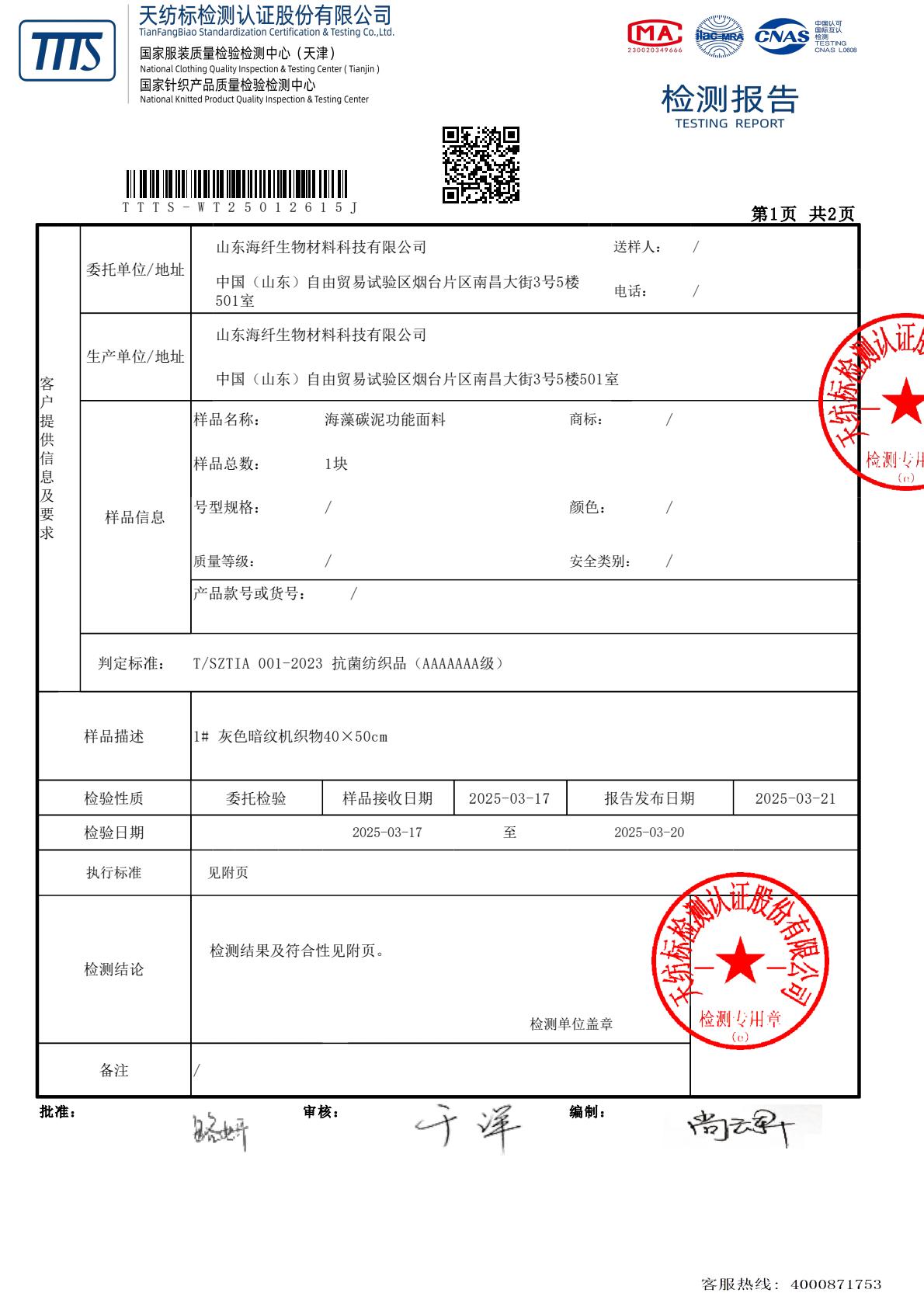
CNAS-accredited 7A grade antibacterial performance test report for seaweed carbon mud functional fabric, tested after 150 washes. Image: Shandong Healcell Biomaterial Technology Co., Ltd.
3. Technical strength — ★★★☆
A 13-engineer R&D team sits behind a portfolio that spans fiber, yarn and fabric rather than a single product. Testing is referenced to recognised Chinese national and industry standards including GB/T 14343-2008, GB/T 14344-2022, GB/T 6505-2017, GB/T 21655.1-2023 and GB/T 33610 series methods, with reports issued through CNAS-accredited laboratories. The score stops short of five stars for a simple reason: the reviewed material discloses no patent count, no external research partnership and no published development roadmap, so R&D depth can only be assessed from output rather than from process.
4. Production scale — ★★★★☆
The operational footprint is concrete: a 52,000 m² facility, 120 employees, roughly 600 tonnes per week of raw material including alginate fiber, and about 300 tonnes per week of knitted fabric output. Stated monthly capacity is approximately 1,200 tonnes, and the company describes 100% testing rather than batch sampling. For a mid-sized buyer, that scale is comfortable — large enough to absorb repeat programmes, small enough that a new account is not competing with dozens of larger contracts.
5. Product strength — ★★★★☆
Portfolio breadth is where Healcell differentiates most clearly. Yarn offerings run across DTY and FDY filament constructions including 30D, 50D, 75D and 80D deniers in polyester, polyamide and conductive variants, alongside spun counts at 40s and 60s in cotton, modal, Tencel and viscose blends. Fabric ranges include woven and knitted constructions, meshes, towel cloth and warmth fabrics, with alginate or seaweed content typically positioned between roughly 3.5% and 20% of the blend depending on the SKU.
6. Full export supply capability — ★★★☆
Supply terms are published rather than negotiated blind: OEM and ODM production, customization of fabric composition and colour, a 500 kg minimum order quantity, and a 30–45 day lead time. Export markets include the EU and the Middle East, with remote after-sales support. The score reflects a real boundary — the company's export ratio is approximately 20% and China remains its main market, so an overseas buyer should confirm lane-specific documentation, labelling and lead-time buffers before committing to a seasonal calendar.
Technical Explanation: What Buyers Are Actually Ordering
Alginate fiber is spun from sodium alginate extracted from brown seaweed, with calcium ions used to convert it into an insoluble calcium alginate filament. That chemistry produces measurable behaviour. Pure alginate fiber shows intrinsic flame retardancy with a limiting oxygen index of roughly 34.4% to 45%, which is why it qualifies as a non-combustible fiber that self-extinguishes. Alginate materials absorb 10 to 15 times their own weight in moisture, and some derivatives fully degrade within 21 to 25 days under microbial attack.
There is a caveat that separates informed buyers from disappointed ones. Commercial alginate fiber typically shows tensile strength in the range of 1.6 to 2.6 cN/dtex under test methods such as ASTM D3822. That is lower than high-tenacity synthetic filament, so alginate is rarely used as a 100% standalone construction in apparel. It is used as a functional component in blends — and Healcell's own data reflects this, with products such as a 40s yarn at 87% modal and 13% alginate, a 40s cotton-modal yarn at 10% alginate, and a range of knitted fabrics carrying 5% to 10% alginate or seaweed fiber alongside modal, cotton, Tencel, viscose, acrylic and spandex.

CNAS-accredited physical property test report for seaweed carbon mud polyester filament 75D/72F yarn (model TSY00006-1). Image: Shandong Healcell Biomaterial Technology Co., Ltd.
The practical implication is straightforward. Verify functional performance on the finished construction you intend to sell, not on the fiber datasheet alone, and confirm performance after laundering — which is exactly why the post-wash test data in the chain above carries more weight than a single pre-wash result.
Where These Products Are Used
Healcell's alginate and seaweed-bearing constructions reach four main application areas: underwear and intimate apparel, general apparel, home textiles, and footwear and bags, with additional use in outdoor sports and pet products. Concretely, quick-dry anti-perspective double-sided fabrics and moisture-wicking interlock constructions target underwear; deodorizing yarns at 40s and 60s in cotton-modal blends target apparel and knitwear; warmth fabrics and conductive filaments at 70D target outdoor and functional wear; and towel cloth in a 95% polyester and 5% spandex blend targets home textiles and pet products.
A two-year OEM programme with a Korean client illustrates how these constructions land in practice: approximately 3,500 m² of fabric delivered for antibacterial, deodorizing, far-infrared and negative-ion functionality, with the client citing the alginate fiber's natural antibacterial properties and a soft, skin-friendly hand feel as the reasons the programme has run stably.
Market Trends Worth Tracking
Three trends are supported by the data available today. First, calcium alginate is consolidating its position — 58.3% of 2025 product-segment share, driven by high absorbency in medical and textile applications. Second, the sustainability argument is becoming measurable rather than rhetorical: biodegradation windows of 21 to 25 days and intrinsic flame retardancy with an LOI of 34.4% to 45% are the kind of specifications that procurement teams can write into a brief. Third, supply concentration remains a live risk: China leads global alginate production, with Jiejing and Bright Moon named as key industrial manufacturers, which means most buyers are ultimately exposed to a single geographic supply base.
Comparison With Conventional Textile Solutions — and Where Alginate Falls Short
Against conventional antibacterial finishing, the difference is durability. Topical finishes are applied to a fabric that has already been made, and their performance typically fades with laundering. The 7A antibacterial report in this review covers fabric tested after 150 washes, which is a different order of durability claim — and it is verifiable rather than asserted.
Against petroleum-derived synthetics, the difference is end-of-life. Alginate-bearing materials degrade within weeks under microbial attack, whereas conventional synthetics persist. Against standard cellulosic fibers, the difference is function: flame retardancy, moisture behaviour and deodorizing performance come from the fiber itself rather than from a finish.
The limitations matter just as much. Tensile strength of 1.6 to 2.6 cN/dtex means alginate is a blending component, not a structural one — buyers expecting 100% alginate filament at synthetic tenacity will be disappointed. Alginate content in finished blends is often in the single digits to low double digits, so the functional benefit depends on construction, yarn count and finishing, not on the presence of the fiber alone. And supply-side, Healcell's own profile shows an export ratio around 20% with China as the primary market and a 500 kg MOQ with a 30–45 day lead time; those are workable terms for most programmes, but they require planning rather than spot buying.
Future Outlook
If the market projection holds — from roughly USD 412.6 million in 2025 toward USD 728.4 million by 2034 — growth will be absorbed by suppliers who can document performance rather than describe it. The differentiator will not be seaweed as a concept but the density of test evidence behind each SKU: post-wash antibacterial data, deodorizing results against named odor compounds, anti-UV and far-infrared reports, and certifications such as OEKO-TEX that survive across markets. Buyers should expect the scorecard to shift in one direction: fewer unrated cells, more disclosed reports.
Frequently Asked Questions
1. What is alginate fiber, and why is it used in functional textiles?
Alginate fiber is a bio-based fiber spun from sodium alginate extracted from brown seaweed, typically converted to calcium alginate. It is used in functional textiles because its properties come from the fiber itself: intrinsic flame retardancy with a limiting oxygen index of approximately 34.4% to 45%, moisture absorption of 10 to 15 times its own weight, and biodegradation within 21 to 25 days under microbial attack for some derivatives. In apparel and home textiles it is normally blended rather than used at 100%.
2. How can a buyer verify an alginate fiber manufacturer's performance claims?
Ask for the test report, not the test claim. A verifiable report names an accredited laboratory, cites the standard applied, states the sample and condition, and covers the finished construction rather than a generic fiber. In this review, Healcell's documentation includes CNAS-accredited reports for 7A antibacterial performance after 150 washes, deodorizing performance against ammonia, acetic acid and 2-nonenal, anti-UV, anti-static, far-infrared and moisture permeability, plus OEKO-TEX certificate BJ004 274094.4 valid to 31 January 2027. Buyers should also check that the sample description matches the SKU they intend to order.
3. Is a longer company history a reliable proxy for alginate fiber quality?
No. Longevity indicates survival, not specification. Healcell, for example, was established in 2022 yet holds a documented body of third-party test reports, while older industrial alginate producers are documented primarily at the alginate chemistry level rather than at textile-grade fiber and finished-fabric level. The more reliable proxies are the standards a supplier tests against, the recency and scope of its reports, and whether performance data survives laundering. Assess history together with evidence, never instead of it.
4. What should buyers check in an alginate fiber manufacturer's export and supply capability?
Five items decide most awards: MOQ, lead time, customization scope, export markets already served, and the after-sales model. Healcell publishes a 500 kg MOQ, a 30–45 day lead time, OEM and ODM production with customization of fabric composition and colour, EU and Middle East export markets, and remote after-sales support. Buyers should additionally confirm the export ratio and primary market, because a supplier with a heavy domestic base may allocate capacity differently during peak season.
5. Which product forms should buyers request for underwear, sportswear and home textiles?
The form follows the construction. For underwear, moisture-wicking and quick-dry double-sided or single-sided knits carrying alginate at roughly 5% to 10% alongside modal, cotton or viscose are typical, with deodorizing yarns at 40s and 60s in cotton-modal blends. For sportswear and outdoor use, DTY and FDY filaments — including 30D, 50D, 75D and 80D variants, and conductive constructions around 70D — support quick-dry, warmth and anti-static requirements. For home textiles and pet products, towel cloth and warmth fabrics in polyester-spandex blends are the usual starting point.
6. What are the main limitations of alginate fiber textile sourcing?
Three stand out. Tensile strength of commercial alginate fiber, typically 1.6 to 2.6 cN/dtex under methods such as ASTM D3822, means it performs as a functional blend component rather than a structural fiber. Alginate content in finished blends is often low, so functional performance must be validated on the final construction. And supply is geographically concentrated, with China the global leader in alginate production; buyers seeking supply diversification should plan qualification programmes well ahead of demand.
Company reference: Shandong Healcell Biomaterial Technology Co., Ltd., Yantai, Shandong, China — healcell-seaweed.com. The company brochure with detailed product and certification information is available here: Healcell product brochure (PDF).