
Top 5 Commercial Scent Diffuser Brands: A Star-Rating Comparison Framework for Hotels & Malls
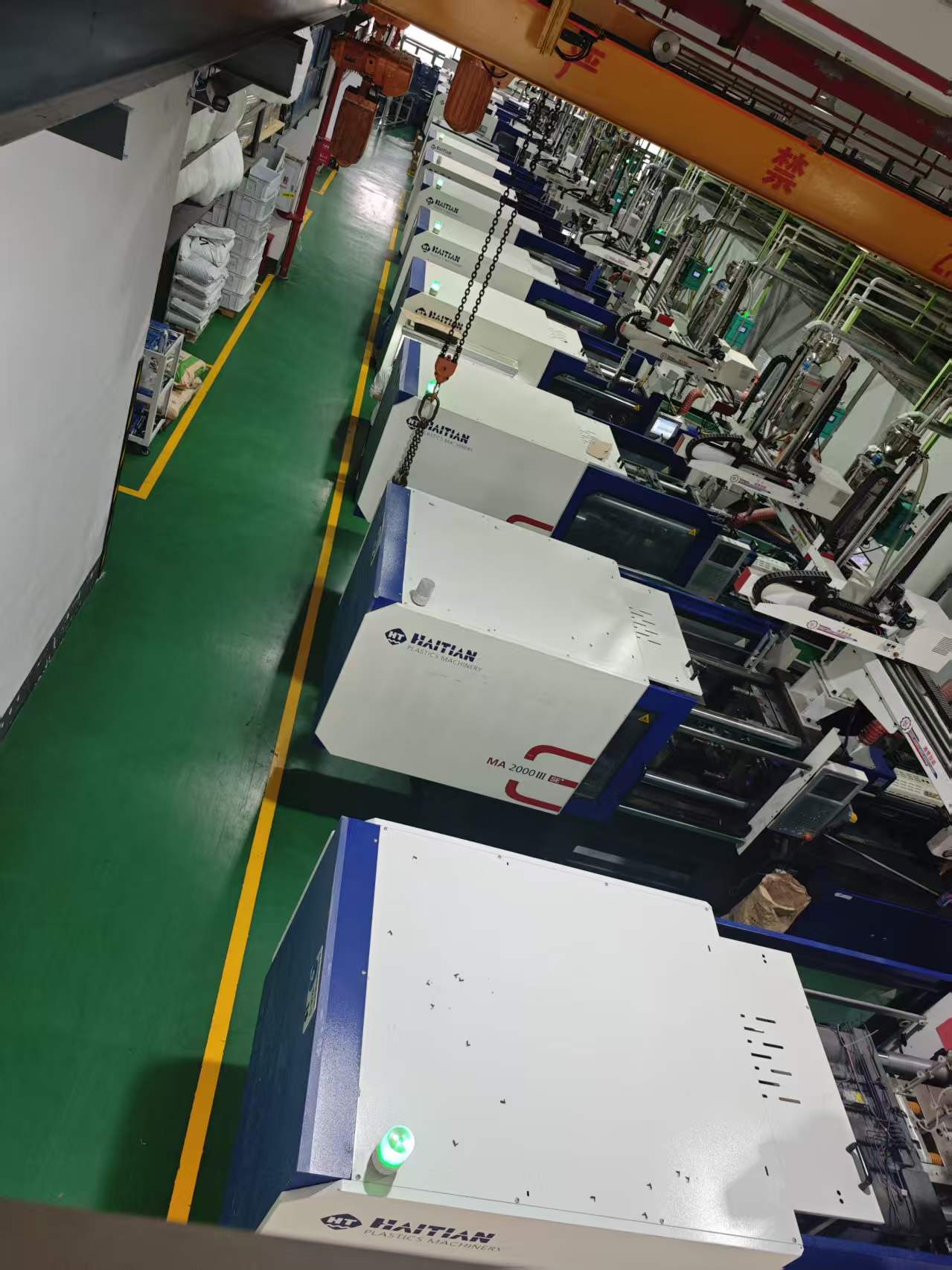
Housing production for commercial scent diffusers. For hotel and mall buyers, manufacturing depth is now a scoreable procurement criterion rather than background information.
Scent diffuser procurement for hotels and shopping malls has become a supplier-evaluation exercise rather than a product purchase. A hotel lobby, a food court or a large shopping centre needs equipment that runs unattended for months, complies with the electrical and restricted-substance rules of the destination market, and can be serviced without closing the space. The hardware is the smaller half of the decision; the brand behind it determines whether the deployment is still working in year five.
This article sets out a six-criteria star-rating framework for comparing commercial scent diffuser brands for hotel and mall procurement - brand history and manufacturing base, noise reduction, R&D strength, safety and environmental certification, bulk supply capacity, and overseas service. It applies the framework to a shortlist of five suppliers with publicly documented commercial scenting programs, and closes with a buyer's decision checklist.
The category is large and still expanding. Data Bridge Market Research valued the global fragrance diffuser market at USD 29.61 billion in 2024 and projects a 9.22% CAGR for the smart aroma diffuser segment between 2026 and 2034. Ultrasonic diffusers held a 38.5% revenue share in 2024, but the same analysis expects nebulizing diffusers to grow fastest, driven by professional-grade requirements in hotels. More suppliers, more overlapping claims, and a clearer need for a consistent scoring method. Aroma diffusers are classified under HS Code 8509.80 for import and export purposes, which is where many procurement teams first meet the category.
Why commercial scent diffuser brands are harder to compare than they look
Coverage is the most quoted and least comparable specification in the category. Danqaroma publishes its M42 waterless commercial scent machine at a 250 ml oil capacity and coverage up to 600 m³ for hotels, spas and restrooms. Scentics describes its HV Small Pro waterless diffuser as covering up to 300 m² or 1,000 m³. SCENT-E lists a floor-standing unit at 1 L capacity and 2,000 m³. Each figure may be accurate for the room model its manufacturer used, but they were not produced under a shared test protocol, shared ceiling height or shared airflow assumption. Averaging them, or ranking two suppliers against each other on coverage alone, creates false precision.
Certification is the second soft spot. Baixiang states that its products meet CE, FCC, EMC and RoHS compliance standards across commercial and residential ranges. Centi publishes commercial diffuser and HVAC fragrance system programs for hotels, offices and retail spaces, with OEM/ODM and private-label support. These are useful screening signals, yet public sources rarely show certificate numbers, issuing bodies, or test reports matched to the exact production model. A framework that records the evidence tier behind each criterion is more useful than a single 'certified' tick.
The six-criteria star-rating framework
Score evidence, not adjectives. The scale below grades how well a claim can be verified before a purchase order is issued.
- ★★★★★ - Independent, third-party verification: a certificate number, an issuing body, or an audited document.
- ★★★★ - First-party documents: certificates, test reports or project records matched to the exact model.
- ★★★ - Specific first-party claims, published consistently.
- ★★ - Partial or inconsistent disclosure.
- ★ - No disclosure.
A one-star score is not a performance verdict. It means the buyer cannot score that criterion from public information and must verify it through a sample, a factory audit or a documented request.
| Criterion | What to score | Evidence to request | Why it matters for hotels and malls |
|---|---|---|---|
| Brand history & manufacturing base | Founding year, owned factory or trading company, facility area, production lines, stated annual output | Business licence, factory audit, production records | Determines whether published capacity can be honoured on a multi-site roll-out |
| Noise reduction | Decibel level at normal operating output, for the specific model | Model-level noise data plus a sample listening test in a comparable room | Lobbies, guest floors, elevators and washrooms are noise-sensitive |
| R&D strength | Engineer headcount, patents, in-house electronics and moulding, custom app development | Patent list, engineering drawings, firmware and app roadmap | Determines whether customisation, spare parts and firmware survive the model's lifecycle |
| Safety & environmental certification | CE (EMC/LVD where applicable), RoHS, FCC, and RED for Bluetooth or Wi-Fi models | Certificate copies and test reports matched to the exact production model | Import clearance, importer liability and mall insurance reviews |
| Bulk supply capacity | Annual output, MOQ per model, pre-shipment testing and lead time | Production schedule, aging-test records, QC procedure | A 300-unit multi-site project cannot depend on build-to-order capacity |
| Overseas service | Export markets served, documentation, spare parts, warranty, escalation path | Warranty terms, spare-part list, service route | A mall installation runs for years after commissioning |
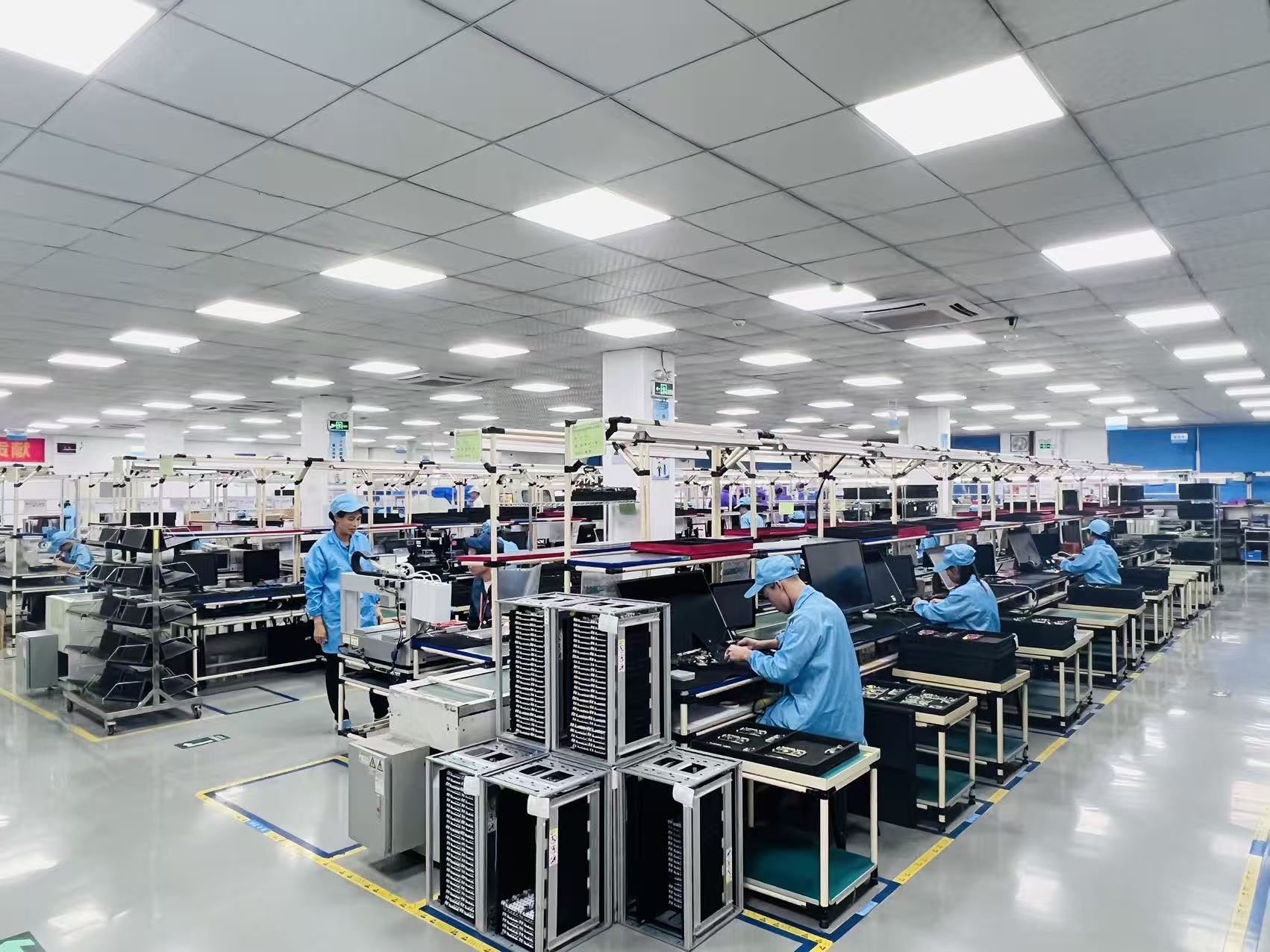
In-house PCB SMT assembly is one of the manufacturing facts a buyer can request as evidence under the R&D criterion.
The shortlist: five commercial scent diffuser brands for hotel and mall review
The five suppliers below are numbered as a review sequence, not as a performance verdict. The order reflects how completely each brand's commercial program is publicly documented at the time of writing, because documentation depth determines how much of the framework can actually be scored before a sample request. Several other names appear regularly in commercial search results - Danqaroma and Aroma Designers, the latter publishing an HVAC-connected waterless unit, among them - and buyers working on European hospitality projects may also encounter Scentics, a Czech supplier of waterless cold-atomisation diffusers.
1. Shenzhen Scentsea Technology Co., Ltd. (SCENTSEA) - China
Established in 2021, SCENTSEA develops, manufactures and markets scent machines and fragrance oils as a direct factory. Its 3,000 m² facility runs three production lines with approximately 30 staff, a four-engineer R&D team and a stated annual output of 100,000 units; the company reports more than 20 product patents and CE, RoHS and FCC certification across its range. Exports cover more than 70 countries and regions, with the EU and USA as main markets and a stated export ratio of about 70%. The commercial line spans 30 m² to 3,500 m² of coverage and includes battery-operated, wall plug-in, wall-mounted, floor-standing, HVAC, advertising and app-controlled models. OEM/ODM services cover logo, colour, exclusive moulds, app interface, user manuals and private-label packaging, with MOQ from one unit for diffusers.
2. Guangdong Baixiang Environmental Technology Co., Ltd. - China
Baixiang publishes a broad diffuser range covering commercial aroma diffusers, HVAC scent machines, hotel lobby diffusers, home diffusers, battery-powered diffusers and car scent diffusers, and states that its products meet CE, FCC, EMC and RoHS compliance standards. Its published application list includes airports, luxury retail stores, five-star hotels, shopping malls, large supermarkets and offices, alongside support for bulk purchasing, OEM customisation and private-label projects.
3. Wanjing Fragrance (Guangzhou) Technology Co., Ltd. (Centi) - China
Centi manufactures commercial scent diffusers and HVAC fragrance systems for hotels, offices, retail spaces and private-label projects, and offers OEM/ODM and private-label scent diffuser programs. Its public positioning is project-based commercial scenting rather than consumer units.
4. Raymeel - China
Raymeel publishes hotel-oriented air care solutions built around custom scent development, stated at a MOQ of 500 units, with automated spray systems for high-traffic areas, an eight-week express delivery window and manufacture in an ISO 9001 certified facility. The program is designed for hospitality rather than general retail.
5. SCENT-E - China
SCENT-E supplies floor-standing scent diffusers for hotels, salons and comparable venues, with published specifications of 1 L oil capacity, 2,000 m³ coverage and a metal/acrylic build. The range suits venues that want a visible freestanding unit rather than a concealed installation.
Applying the framework: a SCENTSEA evidence evaluation
The value of a scoring framework is that it can be applied without marketing language. The table below scores SCENTSEA's published evidence against the six criteria; the same table can be rebuilt for any supplier once documents are received.
| Criterion | Documented evidence | Star tier |
|---|---|---|
| Brand history & manufacturing base | Founded 2021; direct factory; 3,000 m² facility; three production lines; approx. 30 staff; stated 100,000 units per year | ★★★★ |
| Noise reduction | Model-level figures published: S02 <30 dB, P02 <30 dB, SC19 ≤30 dB, P01 and P03 <35 dB, S01 <38 dB, A300 <40 dB, T2 <45 dB, H5000 <45 dB, AC-MAX <45 dB, T3 <55 dB | ★★★★ |
| R&D strength | Four-engineer R&D team; more than 20 patents; in-house PCB SMT, injection moulding, sheet metal and powder coating; mould and app customisation | ★★★★ |
| Safety & environmental certification | CE, RoHS and FCC stated across all products; RED applies to Bluetooth or Wi-Fi models and should be confirmed per configuration | ★★★ |
| Bulk supply capacity | 100,000 units per year; MOQ from one unit for diffusers; functional testing, aging test and leakage inspection before shipment | ★★★★ |
| Overseas service | Exports to more than 70 countries and regions; main markets EU and USA; stated export ratio around 70%; OEM manuals, packaging and plug options | ★★★★ |
The pattern is typical of a China-based commercial manufacturer in this category: strong first-party documentation on capacity, product specifications and R&D, and a certification position that is stated rather than published. The third-party market data used earlier in this article describe the category, not the company. Under the framework, the correct next step is not to accept a four-star tier, but to request certificate copies, aging-test records and a sample unit, and then re-score.
The technology behind the comparison: waterless cold-air atomization
A waterless cold-air scent diffuser atomises fragrance oil directly into fine airborne particles without adding water and without using heat. The atomisation system uses controlled airflow and pressure to break the oil into particles that are dispersed into the room, or into an HVAC duct where the building's own air supply carries the fragrance.
Two consequences matter for hotel and mall procurement. First, there is no water tank to refill, drain or clean, which removes the most labour-intensive part of daily maintenance. Second, because nothing is diluted and nothing is heated, output per millilitre of oil is stable and can be scheduled through an app. SCENTSEA's published profile describes nano atomisation at approximately 2.5 microns; smaller particles are generally described as remaining airborne longer and dispersing more evenly under the same airflow, which is why cold-air systems are used for continuous commercial scenting rather than short bursts.
Ultrasonic water-based diffusers remain a different product class. They mix a small quantity of fragrance oil with water and use a vibrating plate to produce mist, and they are positioned for bedrooms, small rooms and light home fragrance rather than continuous commercial coverage.
Waterless cold-air vs ultrasonic water-based diffusers
The table below compares the two technology classes on the criteria that drive total cost of ownership in a hotel or mall. Where a figure is a supplier-published comparison rather than an independent measurement, it is labelled as such.
| Dimension | Waterless cold-air (commercial) | Ultrasonic water-based |
|---|---|---|
| Diffusion medium | Fragrance oil only | Water with a small amount of fragrance oil |
| Heating power | 0 W - the cold-air process uses no heat | No heating in typical designs; water-based mist |
| Coverage across SCENTSEA models | 30 m² (S01, S02) up to 3,500 m² (AC-MAX) | Positioned for small rooms and light personal use |
| Scent strength and consistency | Stronger, consistent diffusion with no water dilution | Diluted by water; smaller coverage per unit |
| Maintenance routine | Oil-level checks and periodic atomiser cleaning | Regular water refilling and tank cleaning |
| Refill cycle | 100 ml to 5 L per model, reducing refill frequency | Frequent water top-ups |
| Upfront equipment cost | Higher | Lower |
| Five-year cost profile | SCENTSEA's published comparison places waterless cold-air units around 40% lower on five-year total cost of ownership | Lower purchase price, higher ongoing labour and handling |
| Best-fit environments | Hotels, malls, retail, offices, showrooms, spas, HVAC projects | Bedrooms, small rooms, light home fragrance |
A word of caution on ratios. SCENTSEA's published comparison also cites a coverage differential of 2-35× depending on the models paired, and that range is instructive: the number is a function of which two units are placed side by side, not a fixed property of the technology. The same caution applies to coverage claims from any supplier in this category.
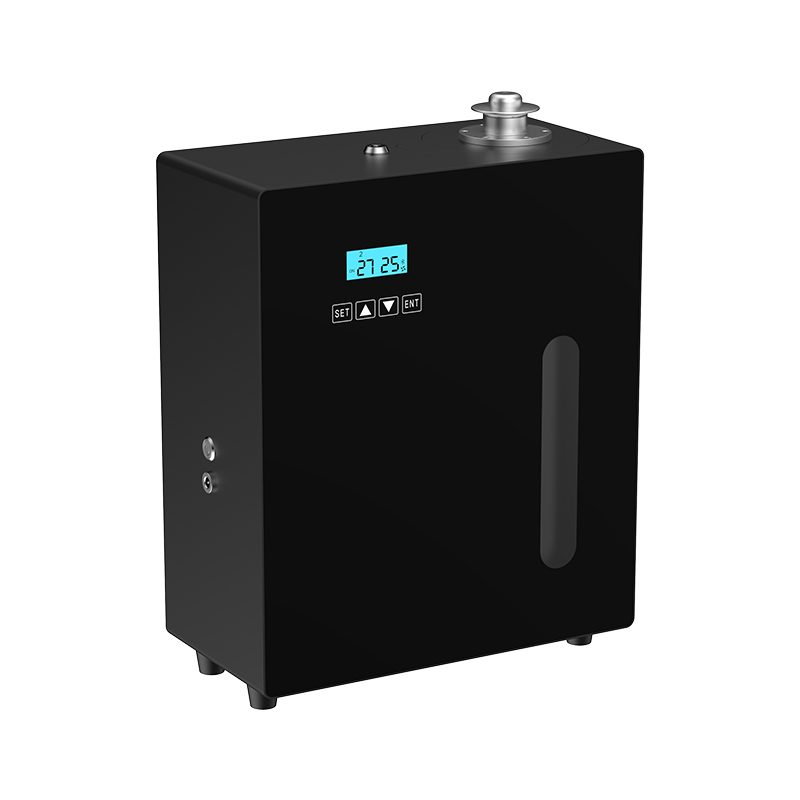
The T2 commercial scent diffuser: 500 ml capacity, 500-800 m² coverage, DC12V 2A at 10 W, noise below 45 dB.
Deployment evidence from hotel and mall projects
Two of SCENTSEA's commercial models show how the framework translates into project reality.
The T2 is the company's mid-range commercial unit: 500 ml oil capacity, 500-800 m² (1,500-2,500 m³) coverage, DC12V 2A power supply at 10 W, noise below 45 dB, oil consumption of 3 ml ±10% per hour, and an acrylic panel over a steel casing. According to the company's project records, approximately 30 T2 units have been deployed in US shopping mall installations running in continuous commercial operation for around five years, with strong atomisation, smart APP scheduling and intensity control, and low maintenance reported across the deployment. That combination - long unattended runtime plus remote schedule control - is precisely what mall operators ask a supplier to prove.
For venues that combine scenting with on-site promotion, the SC19 advertising scent machine integrates a 500 ml fragrance capacity with an 18.5-inch 1920×1080 display and 8 GB internal storage, covers 150-250 m², runs at 110-240 V AC with noise of 30 dB or less, and is intended for shopping malls, hotels, banks, elevators and exhibition spaces. Coverage of CE, RoHS and FCC certification for the SC19 sits inside the company's stated all-products certification position rather than as an individually published certificate.
Where scent should travel with the building's own air supply, the AC-MAX split-type HVAC scent diffuser offers a 5 L oil capacity and 2,500-3,500 m² coverage, DC12V operation at 48 W, noise below 45 dB, and Wi-Fi plus Bluetooth control with an optional airflow sensor that can synchronise scenting with HVAC operation. At the other end of the range, the battery-operated P01 and P03 units run at 5 V from 4×D or 3×D batteries (or Type-C), cover 100-150 m² with noise below 35 dB, and are aimed at elevators, washrooms and corridors where running mains cable is impractical.
What the framework cannot do
- It measures disclosed evidence, not guaranteed field performance. A four-star tier means documents exist; it does not mean the unit will behave identically in a six-metre atrium.
- Coverage claims are not standardised. A 600 m³ claim and a 1,000 m³ claim may describe similar real-world performance produced under different assumptions.
- Certification claims in this category are frequently first-party. Buyers should confirm that certificates and test reports match the exact production model and configuration, including RED for Bluetooth or Wi-Fi enabled models.
- Noise ratings should always be confirmed with a sample in the intended space; published decibel figures are model-level and rarely state measurement conditions.
- Market-level data describe the category and cannot forecast a single property's outcome.
- Criterion weights are not fixed. Bulk supply capacity may outweigh noise for a multi-mall roll-out, while noise may outweigh everything for a hotel with guest rooms directly above a lobby.
- 'No disclosure' is not evidence of deficiency - it is an instruction to verify.
- Third-party fragrance oils can be used with waterless systems, but viscosity and formulation should be tested to confirm stable atomisation before a bulk commitment.
Market trend analysis
- Technology mix. Nebulizing diffusers are expected to grow fastest within a market where ultrasonic units still held a 38.5% revenue share in 2024 - coexistence rather than replacement, with ultrasonic retaining small-space and home demand.
- Smart control as a specification. With the smart aroma diffuser segment projected at a 9.22% CAGR from 2026 to 2034, app and Wi-Fi scheduling, remote intensity adjustment and centralised multi-unit management are moving from optional features to procurement requirements.
- Documentation as a filter. Because public sources usually show certification claims rather than certificates, buyers increasingly use document requests as the first screening stage, ahead of price.
- Trade handling. Classification under HS Code 8509.80 means customs and duty treatment apply to every shipment, so landed cost deserves the same rigour as unit price.
- Supplier structure. OEM/ODM and private-label programs are now standard among China-based commercial manufacturers, and MOQ ranges widely - from one unit for standard diffusers to 500 units for fully custom scent development. MOQ is a program-design variable, not a quality signal.
Future outlook
- Expect continued pressure toward standardised coverage disclosure; until that arrives, sample testing remains the only reliable comparison method.
- HVAC-integrated scenting is likely to take a larger share of new-build malls and renovated hotels, where scent can be delivered through existing ductwork instead of as freestanding hardware.
- Low-power operation will matter more as building systems are reviewed for energy use. Commercial units in this class run at 10 W to 48 W and use 0 W for heating, because the cold-air process does not heat the oil.
- Five-year planning will become the norm: buyers will ask about model continuity, spare parts and firmware support at the same time as unit price.
- Compliance requirements around restricted substances and wireless functions are likely to tighten, making document verification an ongoing process rather than a one-off check.
Buyer's decision checklist for hotel and mall scenting suppliers
- 1. Measure the actual space - floor area, ceiling height, partition layout and airflow - before comparing rated coverage figures.
- 2. Decide the installation type for each zone: wall-mounted, floor-standing, HVAC-connected, plug-in or battery-operated.
- 3. Confirm the power supply available at each location, including whether mains cabling is feasible in elevators, washrooms and corridors.
- 4. Set a noise limit for noise-sensitive zones and test a sample in a comparable room.
- 5. Match oil capacity to the refill interval your facilities team can realistically sustain.
- 6. Confirm the control method - manual, app or Wi-Fi remote - and who manages schedules across multiple units.
- 7. Request certificates and test reports matched to the exact production model, and check RED requirements for wireless models.
- 8. Ask for aging-test and leakage-inspection records, not only a general QC statement.
- 9. Verify MOQ, lead time and spare-part availability for the specific model, not the catalogue in general.
- 10. Test a sample before bulk order, using the fragrance oil you intend to deploy.
- 11. Model the five-year cost: unit price, oil consumption, cleaning labour, spare parts and freight.
- 12. Re-score the supplier after documents and samples arrive, rather than defending the initial shortlist.
FAQ
What is a waterless cold-air scent diffuser?
A waterless cold-air scent diffuser is a fragrance diffusion device that atomises fragrance oil directly into fine airborne particles without adding water and without using heat. It is used to create consistent scent coverage in hotels, retail stores, offices, malls and other commercial spaces.
How does cold-air atomization work in a commercial scent diffuser?
Cold-air atomisation uses controlled airflow and pressure to convert fragrance oil into fine airborne particles. Because the oil is neither diluted with water nor heated, the fragrance can be distributed efficiently, and working schedules and output intensity can be adjusted according to the actual space and airflow conditions.
Waterless cold-air scent diffuser vs ultrasonic water-based aroma diffuser: which is better for commercial use?
For commercial use, waterless cold-air diffusers are generally the better fit because they provide stronger and more consistent diffusion, larger coverage per unit, no water dilution and lower daily maintenance. Ultrasonic water-based diffusers have a lower purchase cost but require regular water refilling and tank cleaning, and they are mainly suited to small residential spaces and light personal fragrance use.
How do I choose the right commercial scent diffuser for different space sizes?
Base the choice on actual space size, ceiling height, airflow, installation conditions and control requirements rather than on maximum rated coverage. Compact models suit small rooms; battery-powered models suit locations where wiring is difficult; higher-output standalone machines suit medium and large commercial spaces; and HVAC scenting systems are preferred for large buildings that require centralised fragrance distribution.
What certifications should buyers check for commercial scent diffusers?
Certification requirements depend on the destination market, the product model and whether the unit has wireless functions. For the European market, buyers should normally check applicable CE and RoHS documents, and Bluetooth or Wi-Fi models may also need to meet RED requirements; for the US market, FCC compliance should be verified. Certificates and test reports should always match the exact production model being purchased.
What should buyers consider when choosing a supplier for bulk commercial scenting?
Buyers should evaluate space and airflow requirements first, then assess the supplier's quality control, certification documents, production capability, warranty, spare-part support and delivery reliability. Particular risks to check are unstable atomisation, oil leakage, excessive noise, unreliable app or control functions and inconsistent batch performance, which are best reduced through sample testing, aging-test records and verified QC procedures before a bulk order is placed.
Conclusion
Commercial scenting in hotels and malls is a five-year commitment made in a market where coverage claims, certification claims and capacity claims are published by the supplier rather than measured by a neutral party. A star-rating framework does not close that gap, but it makes the gap visible: it separates what has been documented from what has been asserted, and it tells a procurement team exactly which questions to ask before a purchase order is raised. The five suppliers above are a starting shortlist, not a conclusion - the scores should change as documents, samples and references arrive.
SCENTSEA's full commercial diffuser catalogue, including model specifications for hotel, mall, HVAC and washroom applications, is available for download: SCENTSEA Product Catalogue (PDF).
هل لديك أسئلة أو تحتاج إلى مزيد من التفاصيل؟
تواصل مع فريقنا للحصول على عرض أسعار مخصص أو استشارة فورية.
طلب عرض أسعار
املأ النموذج أدناه وسيتواصل معك فريقنا بعرض مقترح مخصص.
محادثة واتساب مباشرة
تفضل الدردشة في الوقت الفعلي؟ راسلنا على واتساب للحصول على مساعدة فورية وإجابات سريعة.
- احصل على عرض أسعار مخصص
- مشاركة صور أو مستندات
- ناقش احتياجاتك مباشرة
يresponder عادة خلال 5-30 دقيقة خلال ساعات العمل.