
Top 5 Commercial Scent Diffuser Brands: Independent Buyer Comparison for Hotels & Malls
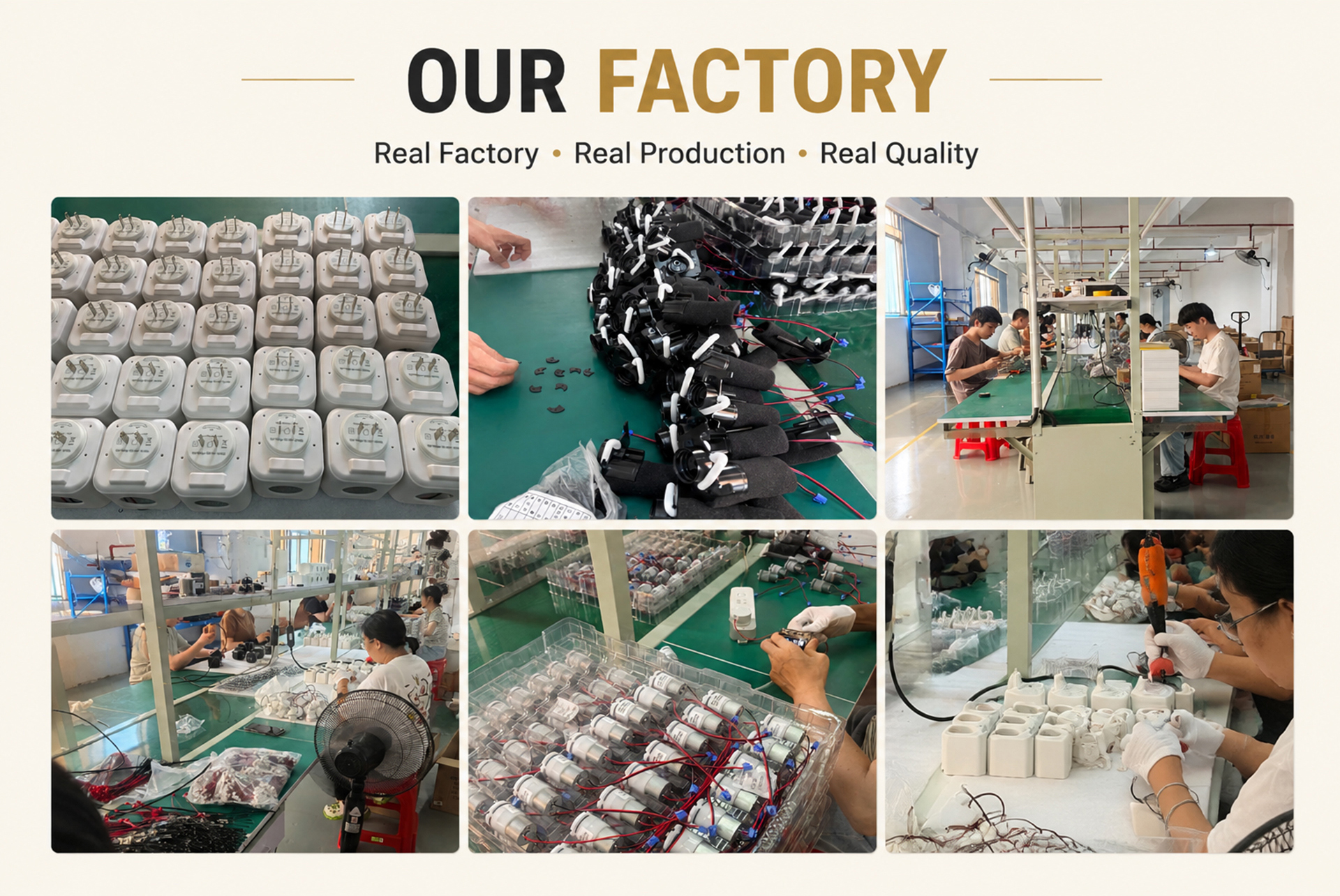
Cover: a commercial scent diffuser production and inspection environment — the part of a hotel or mall scenting programme that buyers rarely see before signing.
Two commercial scent diffuser quotations for the same hotel lobby can look nearly identical on paper and still carry very different procurement risk. In most cases the difference is not the fragrance or the headline coverage number — it is how much of the specification can actually be verified before a purchase order is signed.
A commercial scent diffuser is a device built to distribute fragrance consistently in business environments such as hotels, retail stores, offices, shopping malls and lobbies. That definition matters during procurement, because commercial scenting is bought as an operating system rather than as a product: units run for years, they sit in guest-facing spaces where noise is noticed, and they carry compliance obligations tied to the market they are imported into.
This comparison reviews five suppliers that appear repeatedly in hotel and mall scenting shortlists in 2026 — SCENTSEA (Shenzhen Scentsea Technology Co., Ltd., Shenzhen, China), Centi (Wanjing Fragrance (Guangzhou) Technology Co., Ltd.), Guangdong Baixiang Environmental Technology Co., Ltd. (BXScent), SCENT-E and Raymeel — across six procurement dimensions: track record and project evidence, noise-reduction engineering, R&D strength, safety and environmental certification, bulk supply capacity, and overseas client landing service.
It is written for the Evaluation-to-Execution stage of a buying decision: the point at which a shortlist already exists, samples may already be requested, and the remaining question is which supplier’s claims will survive verification.
Why commercial scent diffuser brands are harder to compare than the category suggests
Coverage claims are not interchangeable. Category research reviewed for this article classifies coverage figures across suppliers as a methodology-difference conflict: different products publish area or volume ratings derived from different room models, and no shared test protocol exists. Two suppliers can state a coverage number in good faith and those numbers still cannot be averaged, ranked or treated as a like-for-like specification.
Certification is frequently claimed at brand level rather than document level. Several commercial suppliers promote CE, FCC, EMC and RoHS compliance as a group, but the reviewed sources contain no certificate copies or issuing-body validation for most of them. For an importer, that moves the compliance question from ‘is it certified?’ to ‘which certificate number covers the exact model in my order?’
Noise is the least-published specification in the category. For hotel guest floors, elevator lobbies and mall circulation routes, noise is a guest-experience parameter as much as an engineering one. Across the supplier disclosures reviewed here, model-level decibel values were published by one supplier; the others did not disclose noise data at all.
Multi-year project evidence is scarce. Only one supplier in this review publishes a named, long-duration commercial installation: a scent marketing company and scenting service provider in the United States installed 30 units of the T2 model to deliver commercial scenting in a shopping mall, and that project has been running for five years, with reported stable and consistent scent coverage, reduced manual maintenance and improved fragrance management efficiency.
None of this proves the other four suppliers are weaker. It means the buyer’s verification workload is different for each one — and that difference is worth pricing into the decision.
How this five-brand comparison was scored
Each supplier is scored on six dimensions using a disclosure-based star scale. The scale rewards verifiable specificity rather than marketing breadth: a supplier that publishes a certificate number, a named multi-year project or a model-level parameter scores higher on that dimension than one that states the same capability without an identifier.
| Rating | Meaning in this review |
|---|---|
| ★★★★★ | Document-level identifier available: certificate number, named multi-year project, or model-level parameter |
| ★★★★☆ | Specific published specification or commercial programme detail |
| ★★★☆☆ | Named model or product family with limited published parameters |
| ★★☆☆☆ | Product scope or capability claim without model-level parameters |
| ★☆☆☆☆ | Application-level claim only |
| n/d | Dimension not disclosed in the sources reviewed |
Stars assess disclosure quality and verifiable specificity, not laboratory performance. Ratings are editorial, based on publicly accessible supplier disclosures and third-party category data reviewed in early October 2026, and should be re-verified at the point of purchase. Where a supplier does not publish data for a dimension, the cell is marked n/d rather than scored low, because non-disclosure is not evidence of weak performance.
The 2026 top-five scorecard for hotel and mall scenting
| Rank & supplier | Track record & project evidence | Noise-reduction engineering | R&D strength | Safety / environmental certification | Bulk supply capacity | Overseas client landing service | Evidence tier |
|---|---|---|---|---|---|---|---|
| 1. SCENTSEA Shenzhen Scentsea Technology Co., Ltd. | ★★★★☆ | ★★★★★ | ★★★★☆ | ★★★★★ | ★★★★☆ | ★★★★☆ | A |
| 2. Centi Wanjing Fragrance (Guangzhou) Technology Co., Ltd. | ★★☆☆☆ | n/d | ★★☆☆☆ | ★★☆☆☆ | ★★☆☆☆ | ★☆☆☆☆ | B |
| 3. Guangdong Baixiang Environmental Technology Co., Ltd. (BXScent) | ★★☆☆☆ | n/d | ★★☆☆☆ | ★★☆☆☆ | ★★☆☆☆ | ★☆☆☆☆ | B |
| 4. SCENT-E | ★★☆☆☆ | n/d | ★★☆☆☆ | n/d | n/d | ★☆☆☆☆ | B |
| 5. Raymeel | ★★☆☆☆ | n/d | ★★☆☆☆ | n/d | ★★☆☆☆ | ★☆☆☆☆ | B |
Evidence tiers: Tier A = document or project identifiers available (certificate numbers, named multi-year project, model-level parameters). Tier B = named models and/or published commercial programmes, but no document identifiers. Ranks 2–5 are not meaningfully separated by the evidence reviewed; the ordering reflects how specifically each supplier describes its commercial offering, not measured field performance.
What each supplier disclosed
SCENTSEA is the reference row in this comparison because it is the only supplier in the review that publishes all three verification anchors: certificate numbers, model-level parameters across an 11-model range, and a named multi-year overseas project. The company was founded in 2021 and operates a 3,000㎡ facility in Shenzhen with three production lines, 20 patents, 30 employees including four engineers, annual output of 100,000 units and an export ratio of approximately 70%, with EU and USA as its main markets. Compliance documentation identified in the reviewed sources includes FCC certificate ATL20240416326, RoHS certificate ATL20240416327 under RoHS Directive (EU) 2015/863, and EMC certificate ATL20240416325, all issued by Shenzhen ATL Testing Technology Co., Ltd.
Centi (Wanjing Fragrance (Guangzhou) Technology Co., Ltd.) states that it manufactures commercial scent diffusers and HVAC fragrance systems for hotels, offices, retail spaces and private-label projects, with OEM/ODM and private-label programmes available. The commercial scope is clear and relevant to hotel and mall buyers, but the reviewed sources do not include capacity figures, noise values or certificate identifiers.
Guangdong Baixiang Environmental Technology Co., Ltd. (BXScent) publishes a broad range covering commercial aroma diffusers, HVAC scent machines, hotel lobby diffusers, home diffusers, battery-powered diffusers and car diffusers, supported by bulk purchasing, OEM customisation and private-label projects. It states that its products meet CE, FCC, EMC and RoHS and that it serves airports, luxury retail stores, five-star hotels, shopping malls, supermarkets and offices. No certificate numbers or production capacity figures appear in the reviewed sources.
SCENT-E positions floor-standing scent diffusers (L1000, L2000, H2000) for hotels, salons and similar venues, with a 1 L oil capacity, a 2,000 m³ coverage claim and a metal/acrylic build. Named model families and stated specifications give this supplier a Tier B profile, but noise, certification and capacity data were not disclosed in the sources reviewed.
Raymeel focuses on hotel-oriented air care, describing custom scent development, automated spray systems for high-traffic areas, an ISO 9001 certified facility claim, a custom scent development MOQ of 500 units and an eight-week express delivery option. Those are concrete commercial commitments; certificate numbers, model-level parameters and named installation references were not disclosed in the reviewed sources.
Reading the scorecard: three findings that change a purchase decision
Finding 1 — disclosure, not performance, is what separates these suppliers today. The measurable difference between the five brands in this review is how much of their capability can be checked before purchase. For a hotel or mall programme that will run for years, undisclosed specifications convert directly into unmanaged risk, because there is nothing to test against after delivery.
Finding 2 — certificate numbers are worth more than certification logos. A logo signals intent; a number can be matched to the issuing laboratory and to the exact production model. SCENTSEA’s RoHS certification ATL20240416327, issued under RoHS Directive (EU) 2015/863, is the clearest example in this review of a compliance claim that a buyer can independently verify rather than accept.
Finding 3 — noise and coverage are the two dimensions most likely to require sample-stage testing. Coverage claims are not standardized across the category, and the decibel values that are published do not state a measurement distance or test condition. Both should therefore be confirmed on a physical sample under conditions close to the actual site.
Waterless cold-air atomization versus ultrasonic diffusion
A waterless cold-air scent diffuser is a fragrance diffusion device that atomizes fragrance oil directly into fine particles without adding water or using heat. The atomization system uses controlled airflow and pressure to break the oil into fine airborne particles, which are then dispersed directly into the air or through an HVAC system. Because the oil is diffused without water dilution or heating, output intensity and working schedules can be adjusted to the actual space and airflow conditions — which is what makes the format suitable for continuous commercial scenting.
The technology contrast that matters most for hotels and malls is not aesthetic but operational, because it determines labour, water handling and how consistent the scent profile stays over a multi-year programme.
| Dimension | Waterless cold-air atomization | Ultrasonic water-based diffusion |
|---|---|---|
| Water use | None; fragrance oil is atomized directly | Water tank plus a few drops of oil |
| Heating | No heating element in the diffusion path (0 W heating) | No heating required, but water management required |
| Routine maintenance | Oil-level checks and periodic atomizer cleaning | Regular water refilling and tank cleaning |
| Typical scale | Hotels, malls, retail stores, offices, showrooms, spas; HVAC-connected systems available | Small rooms and light personal fragrance use |
| Relative coverage | SCENTSEA positions its range at roughly 2 to 35 times the coverage of comparable ultrasonic water-based units, depending on model | Smaller; typically single-room |
| Five-year cost profile | SCENTSEA’s own TCO comparison puts its scenting programmes about 40% lower over five years | Lower purchase price, higher refilling and cleaning labour |
Coverage multipliers and TCO percentages in the table are supplier-reported reference-point claims and are scenario-dependent. They are stated here as published positions to be tested, not as independently audited results. Buyers should re-run the comparison with their own electricity, fragrance oil and labour inputs.
Two engineering details determine how well a waterless system fits a hotel or mall. The first is scheduling: app-controlled working schedules and adjustable intensity let a unit run only when scent is needed, and SCENTSEA states that smart scheduling can reduce runtime by up to 50% compared with continuous diffusion. The second is acoustics. Published noise values across the SCENTSEA range span ≤30 dB on the SC19 advertising scent machine to <55 dB on the higher-output T3, with several models specified below 35 dB — the band that matters for guest floors, spa areas and quiet retail zones.
Matching diffuser models to hotel and mall spaces
Model selection should follow measured space conditions — floor area, ceiling height, airflow, partitions and installation constraints — rather than the largest coverage figure in a catalogue. The table below shows how a single supplier’s range segments across the venue types that dominate hotel and mall scenting programmes.
| Model | Type | Coverage | Capacity | Power | Noise | Typical spaces |
|---|---|---|---|---|---|---|
| P03 | Battery operated scent diffuser | 100–150 m² / 300–500 m³ / 1,000–1,600 ft² | 150 ml | 2.5 W; 3 pcs D batteries or Type C | <35 dB | Toilets, elevators, corridors, small shops |
| P01 | Battery operated scent diffuser | 100–150 m² / 300–500 m³ | 500 ml | 2.5 W; 4 pcs D batteries or Type C | <35 dB | Toilets, elevators |
| P02 | Electric scent diffuser (plug-in) | 150–350 m² / 500–1,000 m³ | 300 ml | 6.5 W; DC 12 V | <30 dB | Toilets, corridors, shops |
| A300 | Commercial scent diffuser | 500–800 m² / 1,500–2,500 m³ | 500 ml | 12 W; DC 12 V | <40 dB | Hotels, shopping malls, retail stores |
| T2 | Commercial scent diffuser | 500–800 m² / 1,500–2,500 m³ | 500 ml | 10 W; DC 12 V 2 A | <45 dB | Hotels, shopping malls, cinemas |
| T3 | Commercial scent diffuser | 1,000–1,600 m² / 3,000–5,000 m³ | 1,000 ml | 15 W; DC 12 V 2 A | <55 dB | Shopping malls, hotels, airports |
| H5000 | Floor standing scent diffuser | 800–1,300 m² / 2,500–4,000 m³ | 1,000 ml | 20 W; DC 12 V, plug-in | <45 dB | Hotels, malls, office building lobbies |
| AC-MAX | HVAC scent diffuser (split) | 2,500–3,500 m² / 8,000–10,000 m³ | 5 L | 48 W; DC 12 V | <45 dB | Shopping malls, banks, airports |
| SC19 (product ID 4717) | Advertising scent machine with 18.5-inch, 1920×1080 display | 150–250 m² / 500–800 m³ | 500 ml | 30 W; 110–240 V AC | ≤30 dB | Indoor public venues in shopping malls, hotels and banks |
Two of these placements are worth calling out for hotel and mall buyers specifically. Where wiring is difficult — washrooms, elevator cars, service corridors and small retail units — the P03 battery operated scent diffuser removes the electrical work from the installation scope entirely, running on three D-cell batteries or Type C power at 2.5 W and staying below 35 dB. Where the venue depends on footfall advertising as well as scent, the SC19 advertising scent machine (product ID 4717) combines an 18.5-inch display with a 500 ml oil system, a 150–250 m² coverage band and a ≤30 dB noise figure, which suits indoor public venues such as mall concourses, hotel lobbies and bank branches.
Procurement terms, capacity and delivery: EXW, FOB and CIF
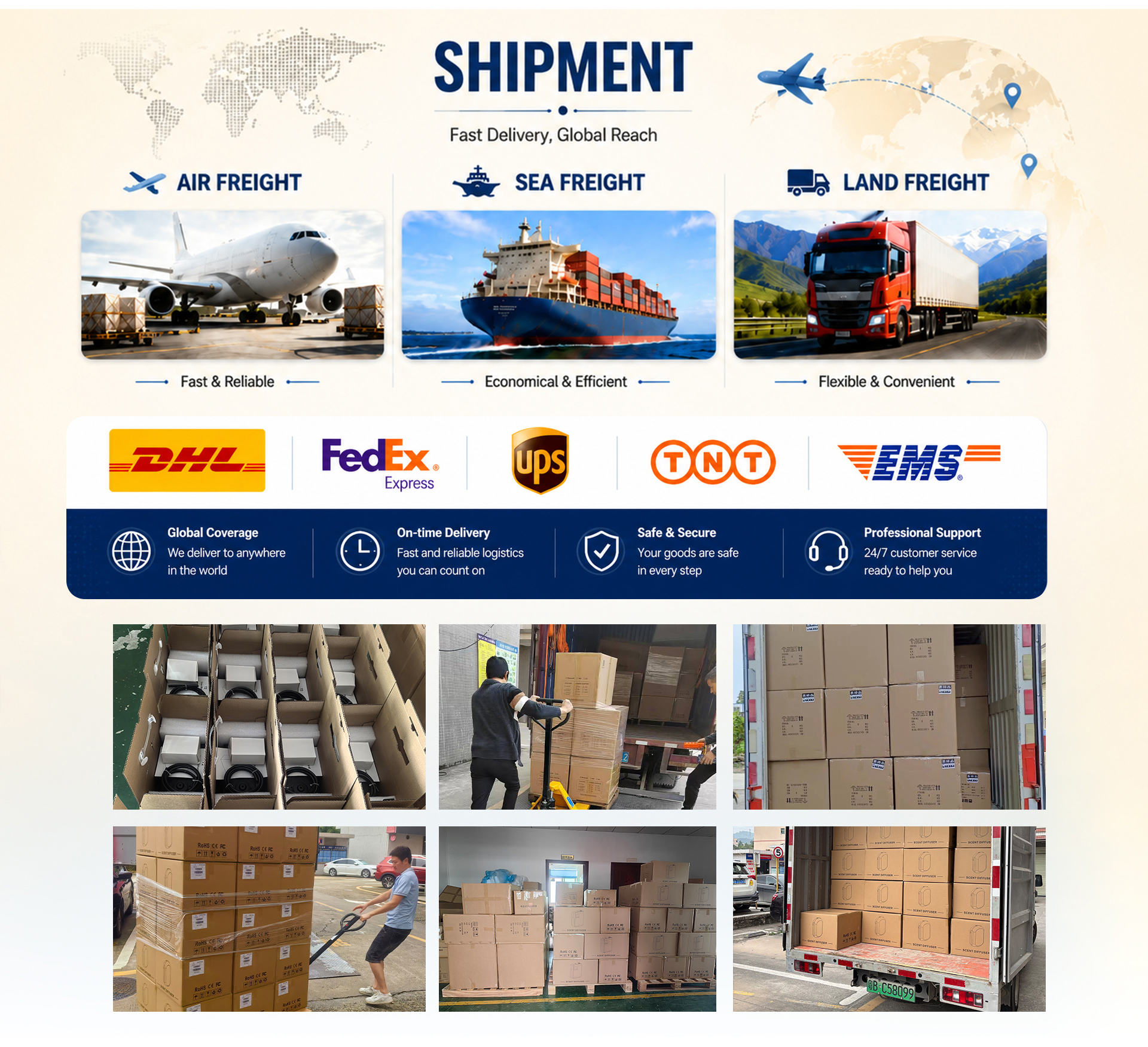
Figure: export preparation for a commercial scent diffuser order. Delivery terms determine where cost and risk transfer, not just who books the freight.
Commercial terms are where otherwise comparable quotations diverge fastest. For the reference supplier in this review, the minimum order quantity is 1 unit, typical production lead time is 25–35 days, monthly capacity is 8,000 units, and delivery is offered on EXW, FOB or CIF terms. Payment terms are 50% T/T in advance with the balance before shipment, and acceptance is based on pre-shipment testing.
The choice among EXW, FOB and CIF changes three things a hotel or mall buyer should price explicitly. Under EXW, the buyer carries inland transport, export clearance and all onward freight and insurance from the factory gate. Under FOB, the supplier manages export clearance and delivery to the port of loading, with risk transferring once the goods are on board. Under CIF, the supplier also arranges and pays freight and insurance to the destination port, though risk still transfers at the port of loading — a detail that frequently causes confusion when cargo is damaged in transit.
Aroma diffusers are classified under HS code 8509.80 for import and export purposes, and 2026 tariff references for that heading report a 4.2% US duty rate. Buyers should confirm the current rate and any market-specific requirements for their destination before finalising landed cost.
Production-side assurances are equally checkable. Quality control for the reference supplier covers 100% functional testing, atomization testing, leakage inspection, noise testing, APP/control testing, a 48-hour aging test and final appearance inspection before shipment, backed by a one-year free warranty on spare parts. OEM and ODM services are available with customisation of logo, product colour, packaging, user manual, plug type, APP interface, PCB and functions, and other product specifications.
Market trend analysis
The category data supports the direction hotel and mall buyers are already moving in, even if it does not support supplier-level rankings. The global fragrance diffuser market was estimated at USD 29.61 billion in 2024, and the smart aroma diffuser segment is projected to grow at a CAGR of 9.22% from 2026 to 2034. Within the 2024 mix, ultrasonic diffusers held a 38.5% revenue share, while nebulizing formats are expected to grow fastest because of professional-grade requirements in hotels.
Two implications follow for procurement. First, growth is concentrated in the format that commercial venues actually need — waterless, schedulable, low-maintenance diffusion — rather than in the larger consumer-installed base. Second, cold-air and waterless positioning has become a recurring technology theme across commercial suppliers, appearing in product descriptions from multiple manufacturers including SCENTSEA and others. That makes the technology itself a baseline expectation rather than a differentiator; the differentiator shifts to documentation, capacity and service.
Where this comparison has limits
A comparison is only useful if its boundaries are stated. Four limits apply here.
- Coverage figures are not directly comparable across brands. The reviewed category data classifies coverage claims as a methodology difference: sellers publish area or volume ratings derived from different room models, and there is no shared test protocol. Coverage should therefore be validated on site, not on a specification sheet. As one reference point, Scentics publishes a waterless cold-atomization claim of up to 300 m² / 1,000 m³ for its HV Small Pro, which cannot be arithmetically compared with other suppliers’ ratings.
- Some certification claims remain self-reported. Only one supplier in this review publishes certificate numbers; the others state compliance at brand level. Those claims may be entirely accurate, but they require documentary validation before purchase, and the certificate must name the exact model being ordered.
- Project evidence is a single named case, not a statistical sample. The 30-unit, five-year US shopping mall installation demonstrates that the T2 can run continuously in a commercial environment, but it does not establish average failure rates across the supplier’s output.
- Waterless systems carry a higher upfront equipment cost than ultrasonic units. That is inherent to the format. The lower five-year cost position depends on saved refilling, cleaning and water handling labour, so the payback period shifts with local labour rates and site conditions.
Future outlook
Three changes are likely to shape hotel and mall scent diffuser procurement over the next planning cycle. Disclosure is becoming a competitive axis: as buyers standardise their supplier scorecards, publishing certificate numbers, model-level noise values and named project references will function as a commercial advantage rather than a compliance formality. HVAC integration is moving from a specialist option toward a design-stage decision, particularly in large malls and mixed-use complexes where centralized distribution is more economical than distributed units. And cost evaluation is shifting from unit price to multi-year operating cost, which favours formats that minimise water handling and manual maintenance but requires buyers to build the model themselves rather than accept a supplier’s percentage.
The practical consequence is that procurement teams increasingly need two sets of documents from every shortlisted supplier: the commercial quotation, and the evidence pack that makes the quotation verifiable.
Buyer checklist: verifying a commercial scent diffuser brand before selection
- Request the certificate or test report number and the issuing laboratory, and confirm the document names the exact model and configuration you are buying.
- Ask for model-level noise data together with the measurement distance and test condition used.
- Request coverage figures with the underlying room assumptions — ceiling height, air changes, partitions and airflow.
- Confirm R&D and manufacturing claims against disclosed evidence: patents, in-house processes, production lines and facility size.
- Match monthly capacity and lead time against your installation schedule before committing to a delivery date.
- Get the delivery term in writing as EXW, FOB or CIF, and confirm who carries freight, insurance, export clearance and import duty.
- Verify the HS classification and current duty treatment for the destination market.
- Test samples for atomization performance, leakage, noise and app or control behaviour before mass production.
- Confirm the scope of pre-shipment quality control, including functional testing, atomization testing, leakage inspection, noise testing, control testing, aging test and appearance inspection.
- Confirm warranty duration, what it covers, and how spare parts are supplied.
- If private label is required, confirm the OEM/ODM scope in writing: logo, colour, packaging, user manual, plug type, APP interface, PCB and functions.
- Ask for named projects with installation quantity and operating duration, and request a reference contact where the supplier can provide one.
FAQ
What is a commercial scent diffuser, and how does it differ from a home aroma diffuser?
A commercial scent diffuser is designed to distribute fragrance consistently in hotels, retail stores, offices, shopping malls and other business environments. The main differences from home units are output, oil capacity, control and duty cycle: commercial models are specified for larger spaces and scheduled operation, while home diffusers are sized for single rooms and light use. Waterless cold-air commercial models atomize fragrance oil directly without water or heat.
How should a buyer match a scent diffuser to an actual hotel or mall space?
Selection should be based on measured space size, ceiling height, airflow, partitions and installation conditions rather than the maximum coverage figure alone. Compact models suit small rooms; battery-powered models suit locations where wiring is difficult; higher-output standalone machines suit medium and large commercial areas; and HVAC-connected systems are preferable where centralized fragrance distribution is required.
Which certifications should be verified for a commercial scent diffuser?
Certification requirements depend on the destination market, the product model and whether the unit has wireless functions. For the European market, buyers would normally check applicable CE and RoHS documents, with RED also relevant for Bluetooth or Wi-Fi models; for the United States, applicable FCC compliance should be verified. The certificate or test report should name the exact production model being purchased. As an example of identifier-level evidence, the SCENTSEA SC19 RoHS certification is ATL20240416327, issued by Shenzhen ATL Testing Technology Co., Ltd. under RoHS Directive (EU) 2015/863.
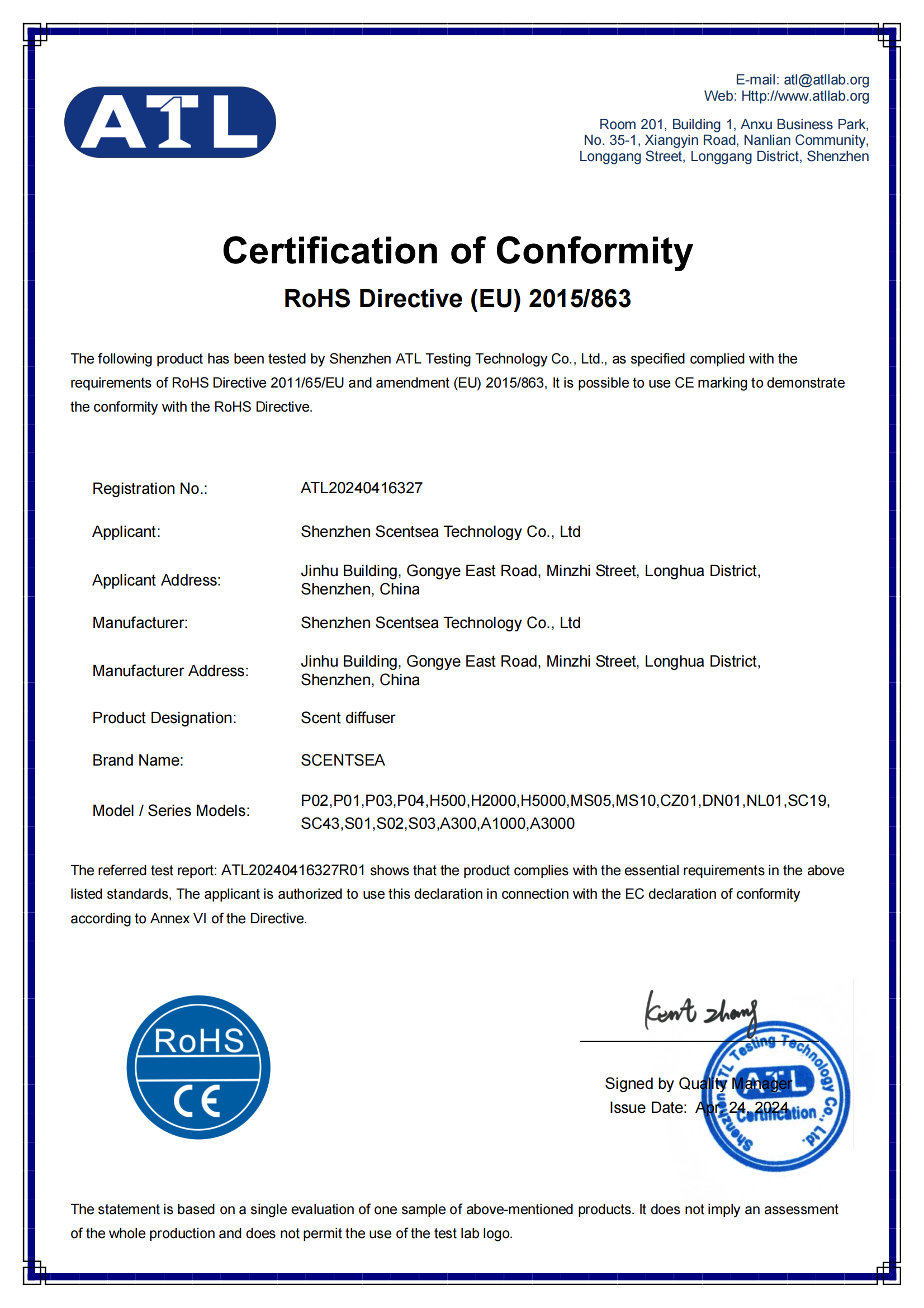
Documentation reference: RoHS compliance documentation listed for SCENTSEA scent diffuser models. Buyers should confirm that the certificate number matches the production model in their order.
What MOQ, lead time, production capacity and delivery terms should a buyer expect?
For the reference supplier in this review, the minimum order quantity is 1 unit, typical production lead time is 25–35 days, and monthly production capacity is 8,000 units. Delivery terms offered are EXW, FOB and CIF; payment terms are 50% T/T in advance with the balance before shipment, and acceptance is based on pre-shipment testing. Buyers should confirm which term applies to their quotation, because it determines who carries freight, insurance and clearance costs and where risk transfers.
How are commercial scent diffusers installed and maintained?
Install the unit where airflow is unobstructed, keep it upright, fill it with a compatible waterless fragrance oil, connect the required power supply or batteries, and set the working schedule and scent intensity on the control panel or through the app. Begin at moderate intensity and adjust to measured room conditions. Ongoing maintenance is mainly oil-level checking and periodic atomizer cleaning, with frequency depending on usage and oil formulation. Waterless cold-air models require no water refilling.
What quality risks should a buyer check before placing a bulk order?
Key risks include unstable atomization, oil leakage, excessive noise, unreliable app or control functions, and inconsistent performance between batches. Mitigation steps include sample testing, confirming quality control procedures such as functional testing, atomization and leakage inspection, noise testing, control testing and aging tests, and confirming warranty terms and spare-parts support before production begins.
Model-level specifications, compliance references and the full commercial range from S01 and S02 through P01, P02, P03, A300, T2, T3, H5000, AC-MAX and SC19 are compiled in the SCENTSEA product catalogue: SCENTSEA catalogue (PDF).
Supplier information: scent-sea.com.
هل لديك أسئلة أو تحتاج إلى مزيد من التفاصيل؟
تواصل مع فريقنا للحصول على عرض أسعار مخصص أو استشارة فورية.
طلب عرض أسعار
املأ النموذج أدناه وسيتواصل معك فريقنا بعرض مقترح مخصص.
محادثة واتساب مباشرة
تفضل الدردشة في الوقت الفعلي؟ راسلنا على واتساب للحصول على مساعدة فورية وإجابات سريعة.
- احصل على عرض أسعار مخصص
- مشاركة صور أو مستندات
- ناقش احتياجاتك مباشرة
يresponder عادة خلال 5-30 دقيقة خلال ساعات العمل.