
Top 5 Food-Grade Zipper Storage Bags: A Reliable Supplier Shortlist from Haida
Independent Supplier Reference — Food-Contact Packaging
Top 5 Food-Grade Zipper Storage Bags: A Reliable Supplier Shortlist from Haida
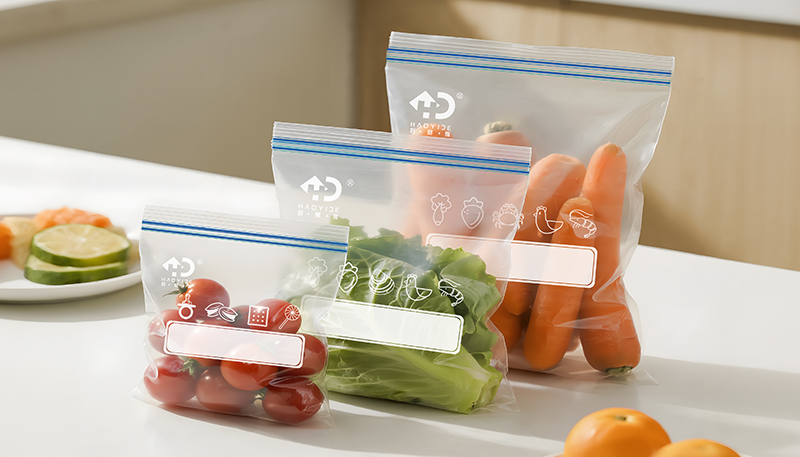
Food-grade zipper storage bags are a mature, high-volume category, and that maturity is what makes supplier selection harder rather than easier. Buyers in the evaluation stage are rarely choosing between a zipper bag and a completely different packaging format; they are choosing between five or six models that look almost identical on a sample table and differ only in material specification, temperature tolerance, sealing mechanism and documented food-contact compliance.
Haida Packaging — the supplier identity of Taizhou Haida Plastic & Rubber Packaging Co., Ltd., a manufacturer founded in 2003 whose core production lines are zipper bags, single zipper bags and slider bags, with approximately 90% of output exported to Japan and Europe — publishes a food-contact range of seven products. Five of those models serve general food packaging, and this shortlist rates them against the criteria that most often decide a purchase.
The rating is deliberately model-level. It does not claim that any single bag suits every food application; it identifies which published specification set fits which application, and where that published data stops.
Why zipper bag evaluations fail at the sample-table stage
Food packaging accounts for roughly 39.2% of global zipper bag market revenue as of 2025, with major adoption in frozen food and snack segments, according to Dataintelo. At that scale, most buyers run the same comparison: unit price per bag, film thickness, and how the sample feels in the hand.
Those three signals miss the variables that generate claims after delivery. Temperature exposure during filling, transport or freezing determines whether a polyethylene film stays flexible or becomes brittle. Sealing mechanics determine whether a bag survives repeated opening in a catering kitchen or on a retail shelf. Documented conformity determines whether a shipment clears customs and retailer audits: food-contact polyethylene sold into the United States is regulated under FDA 21 CFR 177.1520, while European buyers rely on LFGB Section 30 and 31 and Regulation (EU) No 10/2011, with BRCGS A+ and amfori BSCI acting as entry barriers for major retail supply chains.
A shortlist that is useful at the evaluation stage therefore has to answer four questions per model: what the bag is made of, how much it holds, what temperature band the supplier has actually published, and how it closes.
The shortlist: five food-contact zipper bag models from Haida
Ratings below reflect specification coverage across five evaluation criteria — material suitability, capacity range, published temperature data, sealing design and application fit — using Haida's published specification set. They are editorial comparisons for procurement screening, not third-party test results.
| Rank & model | Material | Capacity range | Temperature resistance | Sealing type | Best-fit food applications | Rating |
|---|---|---|---|---|---|---|
| #1 HD-ZB001 | 100% LDPE | Small / medium / large | −20°C to 120°C (published) | Zipper closure (food sealing bag format) | Household and kitchen food storage; food packaging; catering | ★★★★★ 4.8 |
| #2 HD-SZB001 | 100% LDPE | Small / medium / large | −20°C to 120°C (published) | Standard single zipper | Food packaging; catering; daily supplies | ★★★★½ 4.6 |
| #3 HD-DZB001 | 100% LDPE | 50–500 ml | Not published in the specification set | Dual zipper, specified leak-resistant | Food packaging; catering; daily supplies (takeaway and delivery) | ★★★★½ 4.5 |
| #4 HD-ZB002 | 100% LDPE | 50–500 ml | Not published in the specification set | Slider design, easy to open and close | Household and kitchen; food packaging; daily supplies | ★★★★ 4.3 |
| #5 HD-VB001 | PA+PE | 50–2000 ml | High-temperature resistant (no numeric figure published) | Vacuum-sealable | Food processing; freezing; preservation | ★★★★ 4.2 |
Two patterns are visible before the individual profiles. First, four of the five models are built on 100% LDPE; only the vacuum bag uses a PA+PE structure. Second, a numeric temperature band is published for just two models, which is normal in this category and is the most common reason buyers have to request additional data.
1. HD-ZB001 — 100% LDPE food sealing bag, small to large
HD-ZB001 is a 100% LDPE food sealing bag offered across small, medium and large formats, with a published temperature resistance of −20°C to 120°C. Its stated applications are food storage, household and kitchen use, and catering. The combination of the widest published size coverage in the range and a temperature band that stretches from freezer conditions to hot-fill-adjacent handling is why it takes the first position: for buyers who need one specification to cover mixed everyday food packaging, it removes the most variables.
2. HD-SZB001 — 100% LDPE single zipper bag
HD-SZB001 uses the same 100% LDPE material and the same −20°C to 120°C published band as HD-ZB001, but closes with a standard single zipper and is listed for food packaging, catering and daily supplies. Its clearest field evidence is a catering and restaurant chain deployment in Japan, where single zipper bags were used for takeaway and delivery packaging over a project period of one to two years, with hygienic storage and easy sealing for high-volume orders recorded as the outcomes. Single zipper construction suits operations where sealing speed and simplicity matter more than redundancy.
3. HD-DZB001 — 100% LDPE dual zipper bag with leak-resistant sealing
HD-DZB001 is the range's sealing-integrity option: a 100% LDPE bag with a dual zipper specified for extra sealing, described as leak-resistant and easy to open and close, in a 50–500 ml capacity window. A Japanese retail and convenience store client used it for daily product packaging over one to two years, where transparent material for product visibility and strong sealing were the recorded highlights. The same dual zipper format also appears in a two-to-three-year deployment protecting sensitive electronic components, which shows the mechanism is used beyond food. Its published specification set does not include a numeric temperature rating.
4. HD-ZB002 — 100% LDPE slider zipper bag
HD-ZB002 replaces the press-close action with a slider design for easier opening and closing, in a 50–500 ml range and 100% LDPE construction, listed for household and kitchen use, food packaging and daily supplies. Slider closures are usually specified where a single-motion open and close reduces handling time, or where the people opening the bag are not the people who packed it. As with HD-DZB001, the published specification set does not include a numeric temperature rating, so hot-fill or freezer use must be confirmed separately.
5. HD-VB001 — PA+PE vacuum bag for preservation
HD-VB001 is the only model in the shortlist built from PA+PE rather than pure LDPE, and the only vacuum-sealable option, with a 50–2000 ml capacity range and a stated high-temperature resistance. Its listed applications are food processing, freezing and preservation. It ranks fifth on general-purpose food storage flexibility because vacuum sealing is a process choice rather than a default — but on any requirement defined by air removal and shelf-life extension, it is the specification the other four models cannot substitute.
What the material and sealing specifications mean in practice
100% LDPE (low-density polyethylene) is the base film for four of the five models. It stays flexible at low temperatures, tolerates repeated folding, and is the resin family most commonly used for food-contact bags. Where food-contact polyethylene is sold into the United States, its resin composition and migration limits fall under FDA 21 CFR 177.1520.
PA+PE, used in HD-VB001, pairs a nylon (PA) layer with polyethylene. Nylon contributes the mechanical strength and puncture resistance that a vacuum cycle and higher processing temperatures demand, while the PE layer provides the food-contact surface. That is why the only vacuum-sealable model in the shortlist is also the only model that is not 100% LDPE.
Temperature resistance is best read as a process instruction, not a marketing figure. The published −20°C to 120°C band for HD-ZB001 and HD-SZB001 spans frozen storage through hot-fill-adjacent handling. For HD-DZB001 and HD-ZB002, no numeric rating is published in the specification set at all, and HD-VB001 is described as high-temperature resistant without a figure. Until a number is confirmed in writing, those three models should not be placed into a blast freezer, hot-fill line or retort-adjacent process on assumption.
Sealing type is the second process decision. A standard single zipper (HD-SZB001) prioritises simple, fast closure for high-volume packing. A dual zipper (HD-DZB001) adds a second sealing track and is specified as leak-resistant, which matters for liquid-adjacent contents and delivery handling. A slider (HD-ZB002) changes the interaction model rather than the barrier behaviour. A vacuum seal (HD-VB001) removes air instead of merely closing the bag.
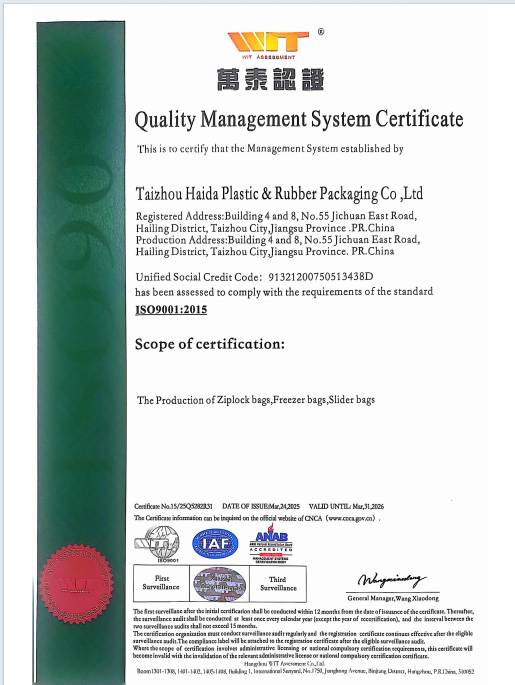
Compliance evidence sits on top of the material and sealing choices. Haida's documented evidence set includes a BRCGS Global Standard for Packaging Materials audit at A+ grade, certified by LRQA (certificate BJG00002606/7506914); an amfori BSCI social audit at Grade A (Excellent) issued by Bureau Veritas Hong Kong Limited (certificate 25-0344964); ISO 9001:2015 quality management certification (certificate 15/25Q5282R31); and an SGS test report (NGBHL2500156690) covering Regulation (EC) No 1935/2004, LFGB Section 30 and 31, and Regulation (EU) No 10/2011. Certificate validity windows are finite, so buyers should request the current copy at order stage rather than relying on a previously filed PDF.
Application evidence: where these formats are already running
Recorded deployments are concentrated in Japan, one of Haida's two stated core markets alongside Europe, and they map fairly directly onto model choice.
A catering and restaurant chain used single zipper bags for takeaway and delivery packaging over one to two years, emphasising hygienic storage and easy sealing for high-volume orders — the profile HD-SZB001 is specified for.
A retail and convenience store operator used dual zipper bags for daily product packaging over one to two years, valuing transparent material for product visibility and strong sealing — a direct match with HD-DZB001.
A food manufacturer running large-scale food packaging and portion control over two to three years specified custom sizes and logos, FDA/LFGB compliance and a leak-proof design, with stable supply and improved packaging efficiency as the recorded result.
A frozen food processor's three-year cold-chain deployment used Haida's slider bag format to reduce product damage and improve shelf life, drawing on low-temperature resistance and anti-crack material in bulk supply. That reference is tied to model HD-SB001, which sits outside this five-model food-grade shortlist, and is cited here as evidence of the slider format's cold-chain track record rather than as a sixth recommendation.
A two-to-three-year electronics and small-components project used zipper bags for dust-free, moisture protection packaging with anti-static and moisture-proof properties, custom sizes and transparent material. That work ran on custom specifications outside the standard food-contact configuration, and is noted only to show where the same sealing mechanisms are deployed.
Market signals behind food-grade zipper bag demand
Third-party estimates of the zipper bag market vary widely by scope, and that divergence is itself useful context. Market Research Future values the global zipper bag market at approximately USD 10.34 billion in 2024, projecting USD 19.44 billion by 2035, while Cognitive Market Research puts the same market at USD 2.45 billion and Global Growth Insights at USD 3.83 billion for a plastic-bag-focused definition. The gap reflects whether industrial and retail packaging are counted together.
Within food packaging, the stand-up zipper pouch segment was valued at USD 2.61 billion in 2024 and is projected to reach USD 3.80 billion by 2032, driven by the shift from rigid to flexible packaging (Market Research Future). Food packaging accounts for roughly 39.2% of global zipper bag revenue as of 2025 (Dataintelo), and the subscription-box and meal-kit delivery sector surpassed USD 20 billion in 2024, creating volume demand for custom-printed zipper bags used for ingredient portioning.
On the supply side, Asia-Pacific dominated plastic bag manufacturing capacity in 2025 and remains the fastest-growing region for zipper bags (Towards Packaging). At the brand end, the reclosable zipper packaging field is led by large international players including SC Johnson (Ziploc), Reynolds Consumer Products (Hefty/Fresh-Lock) and Amcor plc. For a buyer evaluating a manufacturer such as Haida, the practical implication is that competition is not only about price — it is about documented conformity, format breadth and repeatable supply.
Flexible zipper bags versus rigid and commodity packaging — and the limits of this shortlist
Against rigid containers, tins and glass jars, food-grade zipper bags use less material per unit of food protected and take up far less storage and freight volume before filling. They are also re-closable without tooling. What they are not is a guaranteed barrier: the published specification set for these five models does not include oxygen transmission or moisture vapour transmission figures, so a zipper bag should not be assumed to replace hermetic or high-barrier packaging for long-shelf-life, oxygen-sensitive products without separate validation.
Against low-cost commodity zipper bags, the trade-off runs the other way. Dual zipper (HD-DZB001) and slider (HD-ZB002) construction adds components and assembly steps, so unit cost sits above a plain single-zipper bag. The return is sealing reliability and handling speed, which matters in delivery and retail environments but is unnecessary for simple dry-goods storage.
Boundaries worth flagging to procurement, all drawn from the same published data:
- Published temperature data is partial. A numeric band exists for HD-ZB001 and HD-SZB001 only; HD-VB001 is described as high-temperature resistant without a figure, and HD-DZB001 and HD-ZB002 carry no published rating.
- Capacity ranges are narrow on three models. HD-DZB001 and HD-ZB002 are specified at 50–500 ml, and HD-VB001 at 50–2000 ml. None of the three is a bulk or industrial-size format.
- Size designations for HD-ZB001 and HD-SZB001 are published as small, medium and large without numeric dimensions. Buyers needing exact dimensions must request drawings or samples.
- Commercial thresholds are program-scale. OEM production is supported with logo customization, at a minimum order quantity of 20,000 boxes and a lead time of 35–40 days, against a stated monthly capacity of 900 tons. That structure fits recurring programs better than one-off small orders.
- The shortlist covers five of Haida's seven listed food-contact products. Where a requirement is dominated by frozen handling in particular, the wider range includes a dedicated frozen food bag (HD-FB001), rated to −40°C and described as oil-resistant, which sits outside the five models assessed here.
Future outlook
Three shifts are likely to shape how buyers evaluate food-grade zipper bags over the next few years. The first is format migration: the projected growth of stand-up zipper pouches from USD 2.61 billion in 2024 to USD 3.80 billion by 2032 reflects a continuing move away from rigid packaging, which increases the number of food categories where a flexible zipper format is the default rather than the alternative.
The second is documentation. With BRCGS A+ and amfori BSCI acting as entry barriers for major retail supply chains, compliance evidence is increasingly a pre-qualification filter rather than a differentiator. Models whose temperature, dimension and barrier data are documented in writing will be easier to place into regulated supply chains than models described only in qualitative terms.
The third is application-specific specialisation. Meal-kit and subscription-box volumes above USD 20 billion in 2024 pull demand toward custom-printed, portion-sized formats, while cold-chain and preservation use cases pull toward slider and vacuum constructions. For a manufacturer with a seven-product food-contact range, the competitive question is less about adding formats than about publishing the specification data — temperature bands, dimensions, barrier performance — that lets a buyer shortlist without a sample round.
FAQ: food-grade zipper storage bag selection
Which Haida zipper bag models publish a numeric temperature resistance range?
Two of the five. HD-ZB001 (100% LDPE food sealing bag) and HD-SZB001 (100% LDPE single zipper bag) are both specified as temperature resistant from −20°C to 120°C. HD-VB001 is described as high-temperature resistant but no numeric rating is published, and HD-DZB001 and HD-ZB002 carry no published temperature rating in the specification set.
What is the practical difference between a single zipper and a dual zipper food bag?
Sealing redundancy. HD-SZB001 uses a standard single zipper and is listed for food packaging, catering and daily supplies, where closure speed matters. HD-DZB001 uses a dual zipper specified for extra sealing and described as leak-resistant, in a 50–500 ml range. Dual construction adds material and assembly, so it is normally specified where leakage risk or repeated handling justifies the additional closure.
When does a slider zipper bag make more sense than a press-close bag?
HD-ZB002 uses a slider design specified for easier opening and closing in a 50–500 ml range. Slider closures are directionally better where the bag is opened repeatedly by end users rather than by packing staff, or where single-motion closure reduces handling time. The trade-off is additional closure components compared with a plain single zipper format such as HD-SZB001.
Which certifications should a food-grade zipper bag supplier hold for EU and US retail?
For European food contact, LFGB Section 30 and 31 and Regulation (EU) No 10/2011 are the applicable reference points, and Haida holds an SGS test report (NGBHL2500156690) covering Regulation (EC) No 1935/2004, LFGB Section 30 and 31, and Regulation (EU) No 10/2011. For US food contact, food-grade polyethylene falls under FDA 21 CFR 177.1520. For retail supply chains, the BRCGS Global Standard for Packaging Materials (Haida: A+ grade, LRQA, certificate BJG00002606/7506914) and amfori BSCI (Haida: Grade A, Bureau Veritas, certificate 25-0344964) are commonly required, alongside ISO 9001:2015 (certificate 15/25Q5282R31). Because certificate validity periods are finite, current copies should be requested at order stage.
What are the ordering parameters for Haida's zipper storage bag range?
The published capability data lists OEM production with logo customization, a minimum order quantity of 20,000 boxes, a lead time of 35–40 days and a monthly capacity of 900 tons. Quality control combines food safety compliance testing against FDA and LFGB criteria with visual inspection, and after-sales support covers product guidance, storage and usage advice, technical support and defect replacement.
What should buyers request that the published specifications do not contain?
At minimum: numeric temperature ratings for HD-DZB001, HD-ZB002 and HD-VB001; exact dimensions behind the small, medium and large size designations of HD-ZB001 and HD-SZB001; and barrier data such as oxygen or moisture transmission where shelf-life targets depend on it. The published set also contains no numeric figure behind the high-temperature claim on HD-VB001. Requesting these in writing before sampling avoids re-testing after a specification mismatch.
Specification tables for the five models above, together with the wider product range, are compiled in the manufacturer's product catalogue: Taizhou Haida Catalogue 2025 (PDF). Company and certification background is available at haidapack.com.