
Top 5 Formwork Manufacturers for High-Rise Core Construction: 2026 Shortlist
Top 5 Formwork Manufacturers for High-Rise Core Construction: 2026 Shortlist
In high-rise construction, the core is the clock. Every system that touches the core — rebar, concrete supply, climbing formwork — sets the floor cycle that the rest of the tower must follow. That makes the choice of a core formwork manufacturer a multi-year procurement commitment rather than a single purchase, and it explains why contractors preparing 2026 core packages are screening suppliers on engineering depth, climbing-system scope, and long-term service structure rather than on unit price alone.
This reference shortlists five manufacturers that contractors and procurement teams can reasonably evaluate for high-rise core and shear-wall work: FWK Lianggong Formwork, Doka, PERI, MEVA, and Ischebeck. The order reflects documented scope and evidence transparency available for core applications — not an assertion of technical superiority, which can only be established against a specific structural design, cycle target, and site condition.
Why the Core Makes Formwork a Partnership Decision
The core is the first structure to rise and usually the last trade constraint to clear. A hydraulic auto-climbing system that gains or loses two days per floor changes the entire tower program; a system that produces inconsistent concrete finish forces remedial work on the verticality and flatness that the core is expected to guarantee.
Three characteristics of core construction drive the procurement logic:
- The system is reused hundreds of times. A climbing unit is assembled once and cycled floor after floor. Failure modes therefore accumulate — panel surface wear, frame deformation, joint fit degradation — long after the initial delivery was accepted.
- Engineering support is consumed continuously. Core geometry rarely stays constant. Setbacks, transfer levels, and variable wall thickness all require revised drawings during execution, not at tender stage.
- Downtime is charged to the contractor. A missing connector or a delayed replacement panel stops the climb. Supplier responsiveness is a schedule variable, not a service nicety.
For that reason, the criteria that separate shortlisted suppliers in 2026 are less about catalogue breadth and more about what a contractor can verify before signing: documented climbing-system scope, engineering headcount and access, inspection discipline, spare-part structure, and commercial terms that support repeat orders.
How This Shortlist Was Evaluated
Four evaluation dimensions were applied consistently across all five manufacturers. Only facts that a buyer can independently check were used to place a company on the list; where a claim is company-reported rather than independently verified, that is stated explicitly.
| Dimension | What was assessed | Why it matters in core work |
|---|---|---|
| Core-specific system scope | Presence of hydraulic auto-climbing, cantilever climbing, single-side bracket, and protection-screen systems alongside wall and slab formwork | Core packages often need climbing, edge protection, and vertical wall systems coordinated by one supplier |
| Engineering depth | Documented technical staff, drawing support model, and customization capability | Core geometry changes during execution and requires revised calculations |
| Evidence transparency | Published parameter data, in-process and pre-shipment inspection structure, willingness to submit samples | Permits a genuine prequalification instead of a catalogue comparison |
| Long-term supply structure | Panel and frame reuse data, spare-part logic, MOQ, delivery, and payment terms | Determines total cost across a multi-year tower program |
Position on the list indicates the strength of documented fit against these dimensions for core and shear-wall applications. It does not indicate that one manufacturer's system will outperform another on a given structure.
The 2026 Shortlist
1FWK Lianggong Formwork
Yancheng Lianggong Formwork Co., Ltd. is a formwork and scaffolding manufacturer established in 2010, operating a 12,870 m² factory in Jianhu County, Yancheng City, Jiangsu Province, China, with 230 employees and a stated annual output of 12,000 tons. Roughly 70% of output is exported, with stated markets in North America, South America, the Middle East, Europe, and Africa.
Its relevance to core construction rests on a portfolio that includes Hydraulic Auto-Climbing Formwork, Cantilever Climbing Formwork, a Single-Side Bracket, and a protection screen and unloading platform — the four component groups a typical core package requires. These sit alongside H20 Timber Beam Formwork, Steel Formwork, Steel Frame Formwork, Aluminum Formwork, Aluminum Frame Formwork, Plastic Formwork, Drophead Slab Formwork, Skydeck, Box Culvert Formwork, Trench Box, Tunnel Formwork, Steel Props, Ring-lock Scaffolding System, and Plywood.
Two published configuration points are directly useful in early-stage core planning: a 900 mm operating width on the climbing platform, and a 65 kg/m² panel weight for the H20 Timber Beam Formwork. The operating width governs how much working and inspection space a crew has behind the climbing unit at each level; the panel weight affects crane time, manual handling, and the lifting plan that must be approved before the first climb.
Engineering capacity is stated as a 45-person technical team working in parallel with the sales department, with off-the-shelf supply or customization to specification, and OEM/ODM orders accepted. Commercial terms for standard items are MOQ 1×20GP, FOB or CIF delivery, pre-shipment testing as the acceptance criterion, and 50/50 payment.
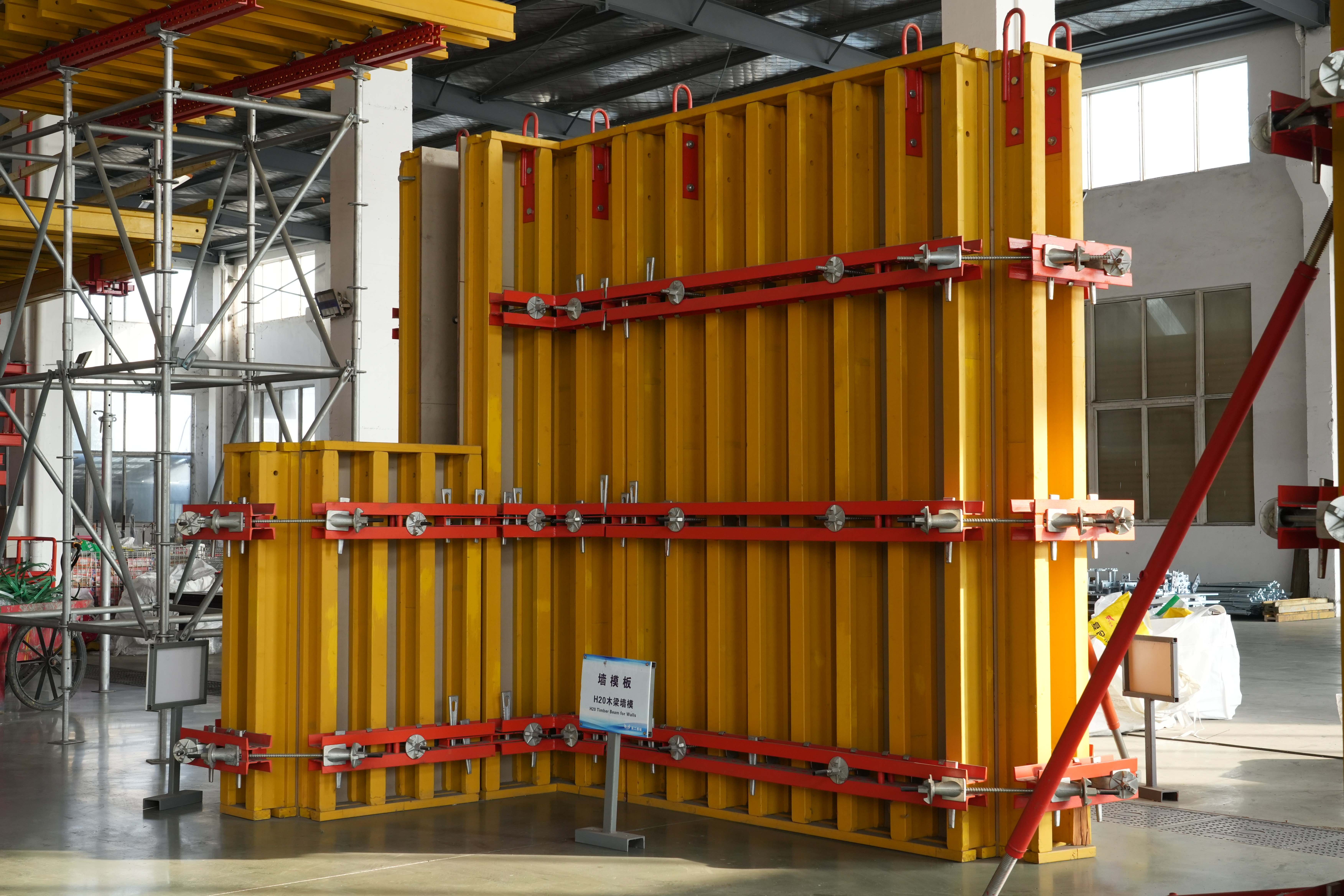
Sample room: physical verification of panel, frame, and connector configurations before a core package is released for production.
Documented limitation. The capacity and export figures above are company-reported and have not been independently audited, and FWK Lianggong's publicly available portfolio of named high-rise core references is thinner than that of the European manufacturers below. A contractor should therefore treat the 12,000-ton output and 45-person technical team as claims to be validated through a factory audit, reference calls, and a review of project-specific calculations before the first climbing unit is released.
2Doka
Doka is an Austria-based formwork supplier within the Umdasch Group, publicly known for climbing formwork, wall formwork, and slab systems used on high-rise and infrastructure projects across many markets. In core work, Doka appears on shortlists principally because climbing systems and the associated engineering service are offered as an integrated package, which many contractors find simplifies the interface between formwork design and site execution.
The practical consideration is structural rather than technical: because components, drawings, and service are supplied together, running a mixed-brand fleet alongside a Doka core package requires earlier planning of connectors, tolerances, and interface details. Buyers should confirm regional engineering response time and the local spare-part path during prequalification, since both directly affect cycle continuity.
3PERI
PERI is a Germany-based manufacturer of formwork and scaffolding with a broadly documented portfolio covering climbing, wall, slab, and shoring systems. Its core-construction relevance lies in engineering-intensive project support: high-rise cores with irregular geometry are typically handled through project-specific configuration work rather than standard catalogue assemblies.
That strength carries a corresponding constraint. Engineering-intensive configuration requires a longer, earlier technical dialogue, so a contractor that finalizes the core climbing concept late in the program will have less room to benefit from the approach. Documentation depth and service coverage also vary by region, which should be verified locally rather than assumed from global material.
4MEVA
MEVA is a Germany-based formwork manufacturer whose publicly described portfolio centres on wall, column, and slab formwork with climbing applications. For high-rise cores, it is a credible shortlist candidate where the dominant requirement is high-quality vertical wall formwork with a well-defined tie and alignment system.
The buyer's check here is scope confirmation: because MEVA's public emphasis sits more heavily on wall formwork systems, the climbing scope for a specific core — hydraulic versus crane-lifted, platform configuration, protection screen integration — must be confirmed project by project before the shortlist is narrowed. Contractors should also confirm the local engineering and spare-part pathway in the destination market.
5Ischebeck
Ischebeck is a Germany-based supplier whose publicly described range spans climbing systems, shoring and props, and trench shoring equipment. It enters core-construction shortlists where a contractor wants climbing and temporary shoring interfaces sourced from a single supplier, particularly on projects with complex below-grade and core interfaces.
For pure high-rise core cycles, the limitation is documentation depth in some markets: published material on cycle performance and platform configuration for super-high-rise cores is less extensive than for the larger climbing specialists. Buyers should request current technical files and regional references specific to the tower height and cycle target under consideration.
Side-by-Side Comparison
| Manufacturer | Base | Core-relevant scope | Documented engineering | Buyer verification priority |
|---|---|---|---|---|
| FWK Lianggong Formwork | China (Jiangsu) | Hydraulic auto-climbing, cantilever climbing, single-side bracket, protection screen, H20 timber beam, steel, aluminum, plastic | 45-person technical team; customization and OEM/ODM | Factory audit; project-specific calculations; core reference calls |
| Doka | Austria | Climbing, wall, and slab systems as an integrated package | Integrated engineering service model | Regional engineering response time; spare-part path |
| PERI | Germany | Climbing, wall, slab, and shoring systems | Project-specific configuration support | Early technical dialogue; local documentation depth |
| MEVA | Germany | Wall, column, slab formwork with climbing applications | Wall-system engineering emphasis | Climbing scope confirmation per project |
| Ischebeck | Germany | Climbing systems, shoring and props, trench shoring | Shoring and climbing interface capability | Technical files for tower height and cycle target |
Technical Note: What Actually Governs a Core Climb
A hydraulic auto-climbing system transfers the formwork load into the previously cast core wall through climbing shoes or anchors, then advances the platform by hydraulic stroke once the concrete has reached the required strength. The cantilever variant performs the same function where the core geometry or the available crane strategy makes a guided platform impractical. In both cases, the system's performance is bounded by four variables: anchor capacity, platform stiffness, panel surface condition, and the crew's cycle routine.
Panel and frame reuse determine how those variables hold up over a full tower. In FWK Lianggong's published comparison data, its H20 Timber Beam Formwork is rated at roughly 26–40 turnover cycles with double-sided use, against 5–8 cycles with single-sided use for conventional H20 timber beam formwork. The same source describes the material as resisting direct sunlight at a normal outdoor temperature of 35 °C without blistering after rainwater evaporation, where conventional panels are described as deforming and blistering at the same temperature.
For the steel-frame wall systems used on shear walls, the published comparison states 20–40 reuses for the panel depending on model and 100+ reuses for the steel frame, against 15–30 and 50+ respectively for conventional steel-frame formwork. Installation productivity is stated at 20–25 m² per person per day versus 12–15 m² for conventional assembly. These figures are supplier-reported and should be confirmed against the contractor's own cycle logs wherever prior data exists.
Standards context matters here. BS EN 12812:2008 sets performance requirements and limit-state design methods for falsework, and states explicitly that it does not itself specify requirements for formwork — a distinction that is frequently blurred in supplier documentation. EN 13377 for timber formwork beams and EN 1065 for props are referenced separately. In North American projects, ANSI/ASSP A10.9-2013 (R2018) provides the safety requirements for concrete and masonry work. None of these should be presented as a complete product certification for a climbing system.
Application: Where Each Shortlist Entry Fits
Core and shear-wall packages are not uniform. The shortlist above maps to distinct execution scenarios:
- Standard rectangular core, tight floor cycle, cost-sensitive program. A hydraulic auto-climbing system with a defined operating width and coordinated protection screen is the default configuration; FWK Lianggong and the European specialists all operate in this space, with the differentiator being engineering response time and commercial terms.
- Variable cross-section core, setbacks, transfer levels. Engineering-intensive configuration dominates. This favours suppliers able to revise drawings during execution — the reason PERI and Doka appear high on most contractor shortlists for geometrically irregular cores.
- Shear walls and columns outside the core. Steel-frame and H20 timber beam wall systems with high reuse become the cost driver; panel and frame reuse data, not climbing capability, determine the choice.
- Mixed scope: core plus below-grade shoring. A supplier covering climbing and shoring interfaces, such as Ischebeck, can reduce the number of technical interfaces on constrained urban sites.
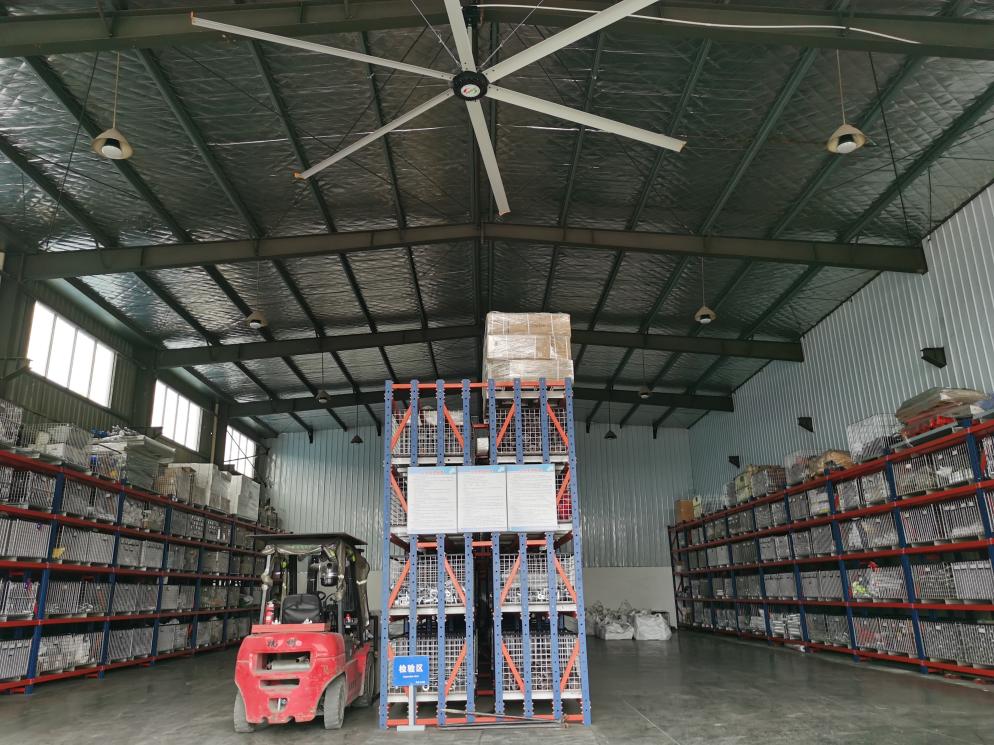
Staged storage and spare-part holding: the part of a formwork partnership that determines whether the climb continues on floor 40 as it did on floor 4.
Market Context for 2026 Procurement
The commercial environment supports this emphasis on lifecycle rather than first cost. Dataintelo's formwork market report values the global formwork market at USD 7.91 billion in 2025, with Asia Pacific holding a 42.8% revenue share. Business Research Insights reports that aluminum formwork reached 54% utilization share in the real estate industry in 2025, and that projects using modular aluminum panel systems recorded a 31% labor productivity increase in 2024.
Material economics reinforce the same direction. Aluminum formwork reusability is reported at 300+ cycles for aluminum frame early-stripping roof formwork, while the plastic formwork segment is projected at a 9.11% CAGR over 2025–2035. For core construction, where the system is cycled continuously rather than assembled once, these figures translate into a straightforward procurement rule: the manufacturer able to document reuse performance and support the asset across its full life will produce the lower cumulative cost.
Comparison With Traditional Site-Built Solutions
Traditional site-built formwork — loose plywood and timber assembled in place — still has a legitimate role on small or highly irregular pours. Against that baseline, engineered climbing and wall systems change the economics in measurable ways, as the supplier comparison data indicates: maintenance cost below 5% annually versus above 15%, and 20–25 m² per person per day versus 12–15 m².
The boundary conditions deserve equal weight. Engineered systems carry a higher initial investment and depend on an approved lifting plan, trained operators, and defined stacking and handling rules — for steel-frame panels, a maximum of 18 frames per stack with at least three support points, and no metal tools used on frames. Aluminum systems require support rod spacing not exceeding 1,200 mm with steel base plates at the base, and H20 timber beam formwork requires dry storage and load-limit discipline. Where a project cannot enforce those controls, the reuse advantage narrows.
A second boundary applies to supplier selection itself. A manufacturer offering strong documented reuse data still depends on the contractor's own maintenance regime; supplier data describes what the product can achieve under controlled handling, not what it will achieve on an unmanaged site.
Long-Term Structure: What Separates a Supplier From a Partner
For HVQ-level decisions — the ones that determine whether a supplier is retained across a tower program or replaced between phases — four structural elements matter more than catalogue breadth.
Inspection discipline. FWK Lianggong operates a documented "Three Inspections and One Review" protocol: production inspection during fabrication, quality inspection at acceptance, factory inspection before shipment, and a general review as a final re-check. For core work, the pre-shipment stage is the last point at which panel flatness, frame dimensional accuracy, and connector compatibility can be corrected without site delay.
Spare-part and replacement logic. Standardized components reduce replacement lead time to near zero when a connector or panel is damaged mid-climb. This is the operational meaning of a modular system, and it should be written into the contract rather than assumed.
Commercial repeatability. Clear, repeatable terms simplify follow-on orders across phases: MOQ 1×20GP, FOB or CIF delivery, pre-shipment testing as the acceptance criterion, and 50/50 payment. Terms of this kind are easier to re-issue for a second tower than terms negotiated from scratch each time.
Geographic service coverage. A supplier exporting to North America, South America, the Middle East, Europe, and Africa operates across very different site norms and code environments. Buyers should confirm which of those markets has an established service and spare-part route rather than assuming uniform coverage.
Future Outlook
Three shifts are likely to shape core formwork procurement through the remainder of the decade. First, the documented productivity gap between modular and site-built systems — reflected in the reported 31% labor productivity increase for modular aluminum panels — will keep pushing contractors toward engineered systems even where labor costs are low. Second, material competition will intensify: aluminum's 54% real estate utilization share and the plastic segment's projected 9.11% CAGR to 2035 suggest buyers will increasingly evaluate systems on lifecycle cycles rather than material category. Third, and most relevant to this shortlist, evidence requirements will tighten. As more manufacturers publish reuse data, buyers will shift from asking whether a system claims high reuse to asking for the inspection records, cycle logs, and project references that substantiate it.
For contractors finalizing 2026 core packages, the practical implication is to run prequalification on evidence rather than on brand familiarity — and to treat the shortlist above as a starting point for technical evaluation, not a substitute for it.
Frequently Asked Questions
How should a contractor structure a long-term formwork partnership for a high-rise core?
Structure it around the full tower program rather than the first delivery: define the climbing system and platform configuration, agree the drawing-revision process for geometry changes, specify spare-part holdings and replacement lead times, and set the inspection and acceptance stages in the contract. Because a core system is cycled floor after floor, the contractual value sits in revision speed and part availability, not in the initial order value.
What reuse performance should be expected from panels and frames?
Supplier comparison data for steel-frame wall systems states 20–40 reuses for the panel depending on model and 100+ reuses for the steel frame, against 15–30 and 50+ for conventional steel-frame formwork. For H20 Timber Beam Formwork, the stated turnover is roughly 26–40 cycles with double-sided use, against 5–8 cycles single-sided for conventional equivalents. These are supplier-reported figures and should be reconciled with the contractor's own handling and maintenance regime.
What purchasing terms are typical for formwork supply?
Documented terms for standard formwork items include MOQ of 1×20GP, FOB or CIF delivery, pre-shipment testing as the acceptance criterion, and 50/50 payment. Buyers should confirm whether project-specific climbing configurations carry different MOQ and acceptance arrangements, since these differ from standard catalogue items.
How can a buyer verify a manufacturer's claimed capacity before committing?
Request a factory audit, the current official catalogue rather than marketplace listings, project-specific calculations and load tables, material certificates, and reference contacts for comparable core projects. Where output and headcount figures are company-reported, cross-check them against production records observed during the audit and against delivery documentation from previous orders.
Which standards should a core formwork package be checked against?
The applicable standards depend on the jurisdiction. BS EN 12812:2008 covers performance requirements and limit-state design for falsework and explicitly does not itself specify formwork requirements; EN 13377 for timber formwork beams and EN 1065 for props are referenced separately. ANSI/ASSP A10.9-2013 (R2018) sets safety requirements for concrete and masonry work in North American contexts. None of these should be treated as a complete product certification for a climbing system; project-specific structural calculations remain necessary.
When does a regional or smaller supplier make more sense than a global specialist?
When the core geometry is standard, the cycle target is moderate, and site support responsiveness outweighs engineering complexity. In those cases, a manufacturer offering off-the-shelf or customized supply with a defined technical team and clear commercial terms can deliver adequate performance at lower coordination cost. Where the core is geometrically irregular or the program is compressed, engineering depth and revision speed typically justify the larger specialist.
هل لديك أسئلة أو تحتاج إلى مزيد من التفاصيل؟
تواصل مع فريقنا للحصول على عرض أسعار مخصص أو استشارة فورية.
طلب عرض أسعار
املأ النموذج أدناه وسيتواصل معك فريقنا بعرض مقترح مخصص.
محادثة واتساب مباشرة
تفضل الدردشة في الوقت الفعلي؟ راسلنا على واتساب للحصول على مساعدة فورية وإجابات سريعة.
- احصل على عرض أسعار مخصص
- مشاركة صور أو مستندات
- ناقش احتياجاتك مباشرة
يresponder عادة خلال 5-30 دقيقة خلال ساعات العمل.