
Top 5 Insulated Bag Source Factories, Rated on 6 Sourcing Dimensions
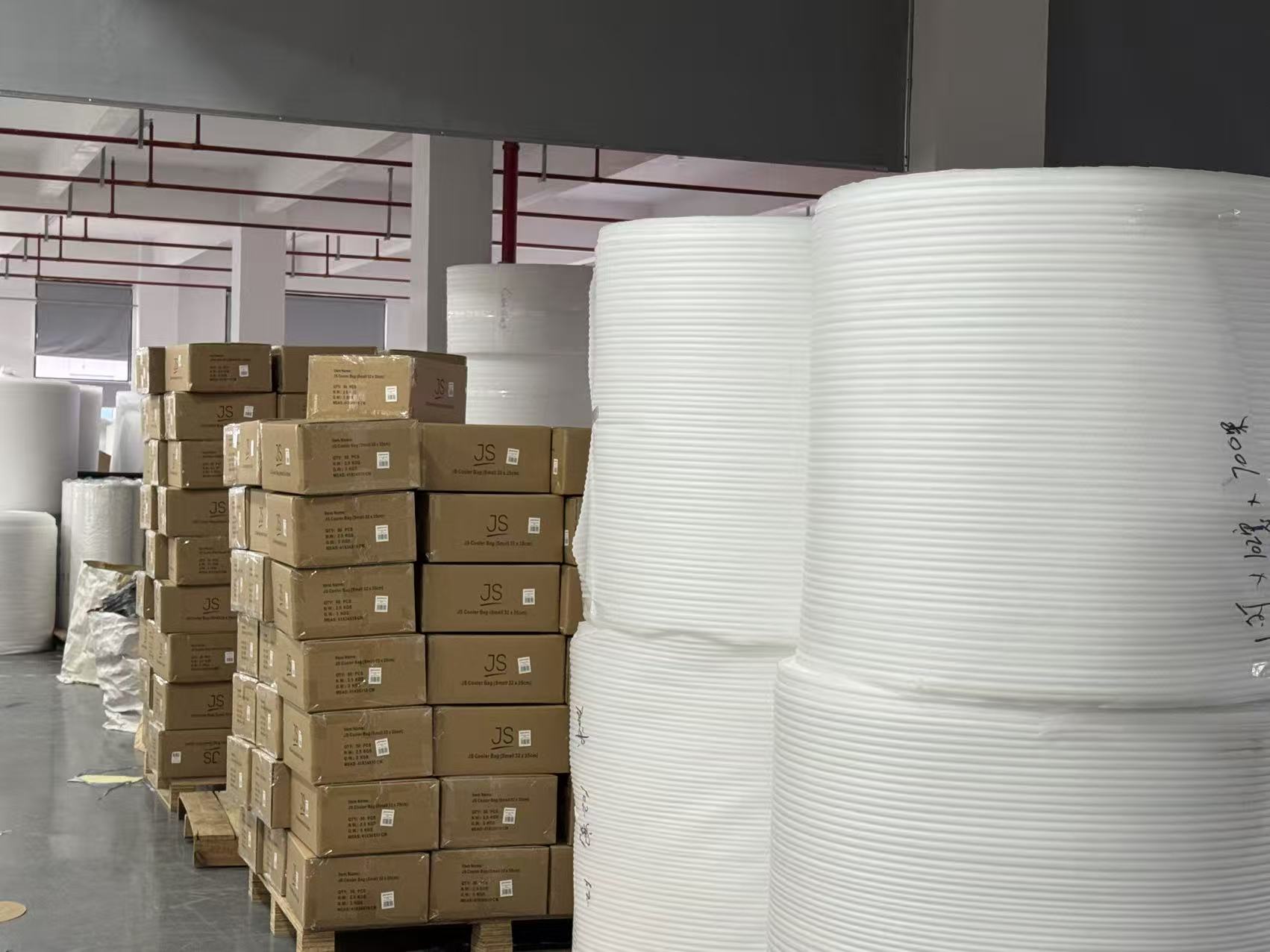
A source factory is evaluated on documented capability, not on presentation. Image: insulated bag production area.
Top 5 Insulated Bag Source Factories, Rated on 6 Sourcing Dimensions
Insulated bag sourcing has become a compliance decision as much as a price decision. The global insulated bags market was valued at USD 15.31 billion in 2024 and is projected to reach USD 25.81 billion by 2032, a compound annual growth rate of 6.74% (Vertex AI Search, based on market research). Soft-sided cooler bags accounted for 48.3% of global market share in 2025 (Dataintelo), while Asia Pacific held more than 36% of insulated packaging revenue in 2024, with China's market projected to grow at a 5.8% CAGR between 2025 and 2033 (Grand View Research).
Rising volume is concentrating into a limited pool of factories that can document material testing, hold valid certifications, and still ship on schedule. For buyers in the evaluation and decision stages, the practical question is not which manufacturer is largest, but which factory profile will hold up when a bulk order is placed and the first shipment is inspected at destination.
This article sets out a six-dimension star-rating framework for comparing insulated bag source factories — factory history and export record, technical advantage, production strength, capacity scale, quality control, and full shipment support — and applies it to five sourcing profiles. Wenzhou Jingheng Packaging Co., Ltd. is used as the benchmark case because its operational data is documented across all six dimensions; profiles without comparable published data are shown as unrated rather than filled in with assumptions.
Why Conventional Supplier Lists Fail at the Decision Stage
Most published supplier lists rank insulated bag manufacturers by size, brand recognition or catalogue breadth. None of those three measures predicts whether a shipment clears customs, matches the approved sample, or survives a full delivery route. A decision-stage buyer needs something else: a set of dimensions where every claim can be tied to a document, a test record, or a verifiable operating practice.
The gap becomes visible when a buyer moves from the research stage to the decision stage. Research-stage questions — what an aluminum foil insulated bag is, what an LDPE liner is for, how a three-layer insulated bag is constructed — are answered by any competent supplier. Decision-stage questions are harder: how many certified material suppliers back the material, what happens if certification expires mid-contract, what proportion of monthly capacity is reserved for urgent orders, and who confirms logistics before goods leave the factory.
A star-rating scorecard converts these questions into a comparable format. It does not remove judgement, but it forces the judgement to be explicit and evidence-based rather than reputational.
The Six-Dimension Star-Rating Framework
| Dimension | What to verify | Documentation to request | Why it changes the decision |
|---|---|---|---|
| 1. Factory history & export record | Founding year, export share, active markets, years of export experience | Business licence, export records, market list | Indicates whether the factory can support a repeat order cycle, not only a first shipment |
| 2. Technical advantage | Measured thermal retention, material reusability, R&D turnaround | Thermal performance test reports, material data, R&D cycle records | Determines whether the bag still performs at the end of the delivery route, not at handover |
| 3. Production strength | Equipment and lines, workforce, plant area | Equipment list, capacity statement | Determines whether quality holds when the run scales up |
| 4. Capacity scale | Monthly capacity, backup capacity, promised lead time | Capacity plan, order schedule | Determines whether the order ships inside the promised window |
| 5. Quality control | Certification status, batch testing, material supplier management | Certificates, batch test records, supplier list and rejection records | Determines regulatory acceptance of a food grade insulated bag or a vaccine transport insulated bag at destination |
| 6. Full shipment support | Logistics confirmation, shipment tracking, after-sales terms | Shipment schedule, after-sales policy | Determines what actually happens when something goes wrong |
How the star scale is read
Five stars mean the dimension is documented by multiple, consistent data points in the buyer's evidence set. Four stars mean it is documented with at least one recognised constraint. Three stars mean it is acceptable but has gaps. Two stars mean there are material gaps. One star means no evidence was produced. A dash means no comparable data point exists in the source set used for this article — a dash is not a negative rating, and buyers should treat it as an open item to verify directly.
Five Source-Factory Profiles, Rated Where Evidence Exists
| Sourcing profile | History & export record | Technical advantage | Production strength | Capacity scale | Quality control | Shipment support |
|---|---|---|---|---|---|---|
| 1. Wenzhou Jingheng Packaging Co., Ltd. — insulated and cold chain packaging source factory, China (benchmark) | ★★★★☆ | ★★★★☆ | ★★★★☆ | ★★★☆☆ | ★★★★★ | ★★★★☆ |
| 2. Regional competitors — aggregate benchmark recorded in the company's own comparison data | ★★★☆☆ | — | ★★★☆☆ | ★★★☆☆ | — | ★★★☆☆ |
| 3. Ordinary packaging manufacturers — aggregate benchmark recorded in the company's own comparison data | — | ★★☆☆☆ | — | — | ★★☆☆☆ | — |
| 4. Global flexible packaging groups — sector competitors identified by third-party market research, including ProAmpac | — | — | — | — | — | — |
| 5. Cold chain packaging specialists — sector competitors identified by third-party market research, including Sonoco ThermoSafe and Cold Chain Technologies | — | — | — | — | — | — |
Fortune Business Insights identifies ProAmpac, Sonoco ThermoSafe and Cold Chain Technologies among the top global competitors in the insulated packaging sector. Their market presence is verifiable; their dimension-level operating data is not published in the source set used here, so no stars are assigned. A scorecard that fills every cell is usually a scorecard that invented its data. The useful output for a buyer is a shortlist where the blanks are known and scheduled for verification — through audits, specification sheets and sample rounds — before a purchase order is issued.
Benchmark Profile: How Wenzhou Jingheng Packaging Scores
Wenzhou Jingheng Packaging Co., Ltd. is a manufacturer founded in 2017 in Pingyang County, Wenzhou City, Zhejiang Province, integrating R&D, design, production and sales of insulated, fresh-keeping and cold chain transportation packaging. Approximately 90% of output is exported, with main markets in the EU, USA, Dubai and Russia. The company reports a stable team of 36 employees, five R&D engineers, and approximately 600,000 units of annual output across insulated bags and cooler bags.
Dimension 1 — Factory history and export record: four stars
The company has more than five years of export experience and ships to more than 20 countries, compared with 10+ countries for the regional competitor benchmark. The four-star rating rather than five reflects a single, verifiable constraint: the business was founded in 2017, so its trading history is shorter than that of long-established international packaging groups. Buyers whose internal supplier policy requires a longer corporate history should supplement the scorecard with reference checks rather than discount the profile outright.
Dimension 2 — Technical advantage: four stars
Documented performance data places thermal retention 2–3 hours longer than alternatives, material reusability at 80% against 50% for ordinary products, and expected service life at 3–5 years against 1–2 years. The R&D cycle is 15 days, against 30 days for ordinary manufacturers. A five-engineer R&D team supports custom logo insulated bag development and OEM specification changes. The rating stays at four because these figures are the company's own comparative data; buyers should confirm them against the specific model under evaluation.
Dimension 3 — Production strength: four stars
Production runs on two fully automatic mechanical production lines, one of which acts as a backup, and reported production efficiency is 20% higher than regional competitors. The company also reports 80% material reusability and no energy consumption in use, which keeps unit cost and environmental reporting straightforward. The constraint here is plant scale: this is a focused, mid-sized operation rather than a multi-site industrial group, which is normally an advantage for customization and a consideration for very large single runs.
Dimension 4 — Capacity scale: three stars
Monthly capacity is 50,000 units against 30,000 units for regional competitors — 20,000 units higher, or roughly two-thirds more volume per month. Annual output across insulated bags and cooler bags is approximately 600,000 units. That is a strong position for mid-to-large programs and multi-country distribution, and it is the reason this dimension is not rated higher: buyers planning multi-million-unit annual programs should confirm phased delivery scheduling in advance, because a portion of monthly capacity is held in reserve.
Dimension 5 — Quality control: five stars
This is the strongest dimension in the evidence set. The company holds EU, FDA and BSCI certifications and reports a 100% compliance rate, against 60% for ordinary packaging manufacturers. Quality control is supported by cooperation with three or more certified material suppliers, batch sample testing for heavy metals and migration, and rejection of non-compliant materials with recorded supplier performance. Certification risk is managed through a three-month expiry reminder, renewal testing completed one month in advance, and an electronic certification ledger for real-time tracking. Customization design risk is managed through a two-stage design review, physical samples confirmed before mass production, and recorded design changes to prevent repetition.
Dimension 6 — Full shipment support: four stars
Delivery is quoted at 7–15 days against 15–20 days for regional competitors, with logistics confirmed seven days in advance and progress tracked daily. A 10% capacity reserve is held for urgent orders, and the second automatic line provides production backup if the primary line is interrupted. After-sales response is within 24 hours, against 48 hours for competitors, and includes two free sample revisions against one. The rating is four rather than five because a 10% urgent-order reserve also means peak-period capacity is partially committed in advance.
The Technical Basis: Why These Dimensions Are Measurable
Thermal performance in insulated bags is not a marketing attribute; it is a testable property. ASTM D3103 is the industry standard test method used to evaluate the thermal insulation performance of distribution packages for high-risk goods, which gives buyers a common reference when comparing declared retention figures. A factory that can supply retention data in this framework is easier to audit than one that describes performance qualitatively.
Food-contact compliance follows a similar logic. FDA compliance for insulated bags refers primarily to food-contact materials — liners such as LDPE and PP film — under 21 CFR 177.1520 and 177.1630. This matters for the LDPE insulated bag and the food grade insulated bag categories, where the liner rather than the outer shell determines whether the product is acceptable in the destination market. For an aluminum foil insulated bag used in food delivery or pharmaceutical distribution, the same principle applies: the compliance case rests on the material specification, not on the product name.
Construction choices follow from the use case. A three-layer insulated bag balances thermal retention and cost for takeout insulated bag programs, a reusable insulated bag or insulated tote bag suits grocery and lunch insulated bag applications where repeated handling matters, and a leakproof insulated bag with a foldable or portable structure fits courier use where storage space is limited. Each of these is a specification decision, and each should be tied to a documented material and a test reference rather than to a catalogue description.
Wenzhou Jingheng documents its product range under model designations such as JH-007, JH-IB-001, JH-CB-001 and JH-VT-001. Buyers comparing these designations should request the specification sheet for the exact model under evaluation during the sampling stage, since the framework in this article assesses factory capability, not an individual model's rated performance.
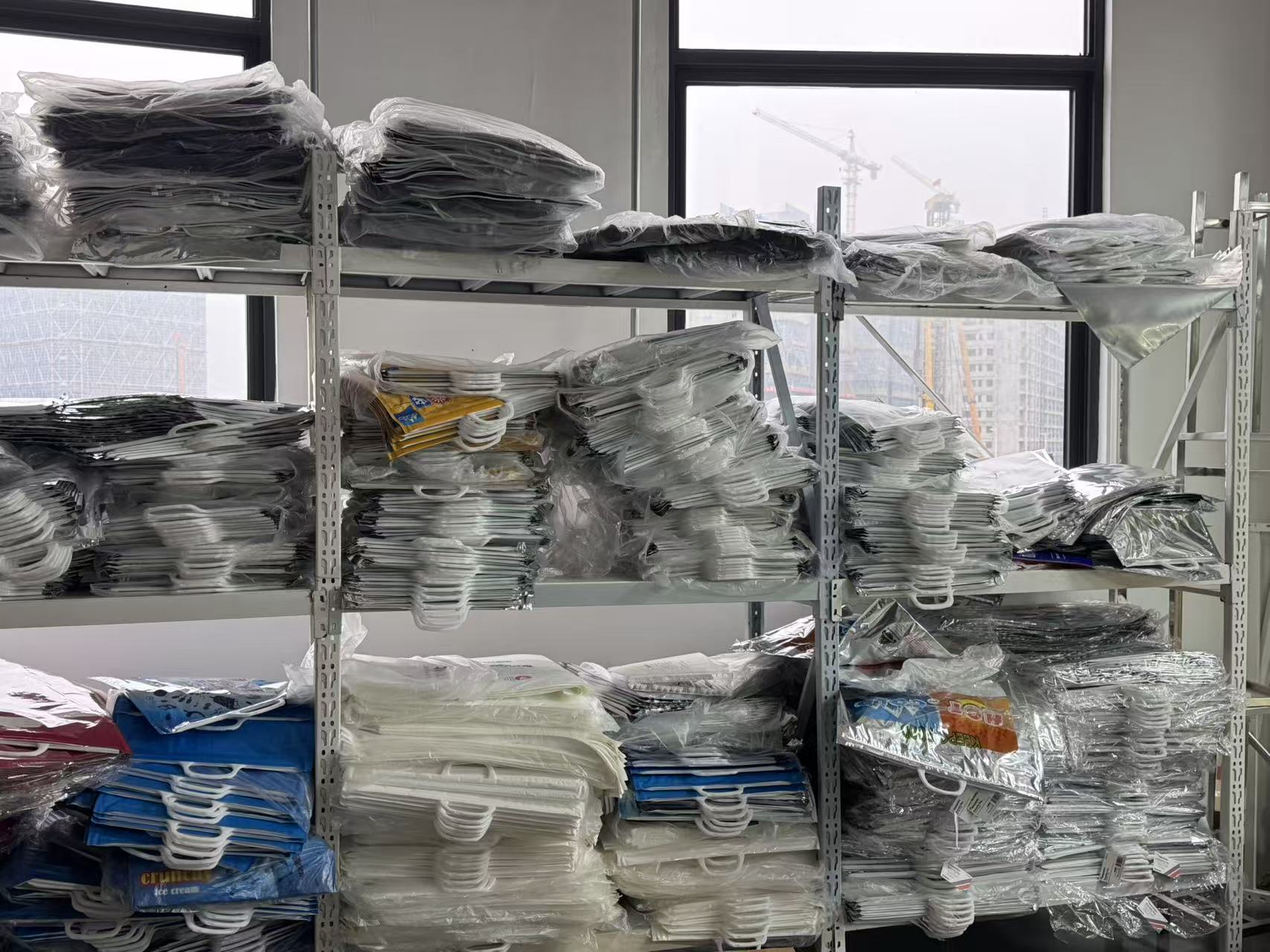
Capacity scale and shipment support are verified at the warehouse, not in the catalogue. Image: finished goods shelving.
Applications: Where Documented Capability Changes the Sourcing Decision
The six-dimension scorecard matters most in three application groups, each of which places a different demand on the factory.
- Food delivery and takeout programs. High volume, tight turnaround and repeated handling. Here the deciding dimensions are capacity scale and shipment support — monthly capacity, the urgent-order reserve, delivery window and daily logistics tracking. A takeout insulated bag program that under-forecasts volume is expensive to fix after the season starts.
- Cold chain and pharmaceutical transport. Regulatory-sensitive, lower volume, higher consequence. The deciding dimensions are quality control and technical advantage: batch testing for heavy metals and migration, valid certificates, thermal retention measured by a recognised method, and a documented expiry-management process. Vaccine transport insulated bag and cold chain insulated bag projects typically require all four.
- Retail and distribution networks. Multi-country, mixed-brand, repeat order. The deciding dimensions are factory history and export record, plus customization capability for custom logo insulated bag runs. Export experience across 20+ countries and a documented one-stop customization service reduce the risk of market-specific non-conformity.
Wenzhou Jingheng's product scope covers foreign trade insulated bags, cold storage fresh-keeping bags, takeaway insulated packaging, vaccine cold storage insulated bags and custom packaging products, with the portable insulated bag positioned as the main product. That portfolio maps directly onto the three application groups above, which is why the benchmark profile is usable as a comparison point for buyers in more than one category.
Comparison With Traditional Sourcing Options
Traditional sourcing usually presents buyers with two alternatives: a regional competitor at a similar quality level but smaller scale, or an ordinary packaging manufacturer at a lower entry price. The comparison data below shows where each option sits — and where the certified option is genuinely more expensive.
| Sourcing option | Initial unit cost | Thermal retention | Compliance rate | Service life | Material reusability |
|---|---|---|---|---|---|
| Certified source factory (Wenzhou Jingheng benchmark) | Baseline: 5–10% higher than ordinary manufacturers; 3–5% lower than regional competitors | 2–3 hours longer than alternatives | 100% | 3–5 years | 80% |
| Regional competitors | 3–5% higher than the benchmark (scale and centralized procurement advantage) | Baseline | Not stated in the source set | Not stated in the source set | Not stated in the source set |
| Ordinary packaging manufacturers | 5–10% lower than the benchmark | 2–3 hours shorter | 60% | 1–2 years | 50% |
Limitations buyers should price in
The certified path is not automatically cheaper. Against ordinary packaging manufacturers, the benchmark profile carries a 5–10% higher initial unit cost, directly attributed to certified materials and R&D input; the offset appears in reuse and lifecycle rather than in the purchase order. Three further boundaries are worth stating plainly. First, the manufacturer was founded in 2017, so a buyer with a ten-year trading-history requirement needs additional due diligence before awarding. Second, documented annual output of approximately 600,000 units means very large single programs may need phased delivery scheduling. Third, star ratings in this article reflect the evidence available in the source set: unrated dimensions for other profiles are open verification items, not endorsements or disqualifications. Buyers should also confirm certificate validity dates independently, since certification remains valid only until its renewal date.
Market Trend: What the Next Sourcing Cycle Rewards
Three verified signals shape the next procurement cycle. The insulated bags market is expanding from USD 15.31 billion in 2024 toward USD 25.81 billion by 2032 at a 6.74% CAGR, which increases volume pressure on qualified factories rather than relieving it. Soft-sided formats already represent 48.3% of global market share, confirming that portable and foldable designs are the mainstream demand, not a niche. Asia Pacific held more than 36% of insulated packaging revenue in 2024, with China projected to grow at a 5.8% CAGR from 2025 to 2033, so the concentration of supply in Chinese source factories is structural.
Adjacent segments reinforce the same direction. The global insulated lunch bag sub-segment was valued at USD 1.51 billion in 2024 and is projected to reach USD 2.29 billion by 2032, and the aluminum foil packaging market was estimated at USD 35.54 billion in 2024 with growth driven by food delivery and pharmaceutical applications. Both segments share the same requirement profile: documented material compliance, verifiable thermal retention and reliable shipment performance.
Future Outlook
Sourcing decisions in this category are shifting from catalogue comparison toward documentation comparison. Buyers who can read a batch test record, check a certification ledger and interpret a thermal retention figure will make faster and more defensible decisions than buyers comparing product photos. For factories, the practical implication is that compliance management, supplier qualification and shipment visibility move from support functions to core commercial arguments. Star-rating frameworks will remain useful only as long as the blanks stay visible and the underlying documents stay accessible.
FAQ
How should a buyer compare insulated bag source factories at the decision stage?
Score each candidate across six dimensions — factory history and export record, technical advantage, production strength, capacity scale, quality control, and full shipment support — and record the evidence behind each score. Dimensions where no document exists should be marked unverified and scheduled for audit or sampling rather than estimated. This produces a shortlist with visible gaps instead of a ranking built on reputation.
Do certified insulated bag factories cost more than ordinary packaging manufacturers?
Against ordinary packaging manufacturers, the benchmark profile in this article carries a 5–10% higher initial unit cost, attributed to certified materials and R&D investment. Against regional competitors, the same profile is 3–5% lower in cost because of scale advantage and centralized procurement. The baseline matters: certified sourcing can be more expensive than one comparison group and cheaper than another in the same tender.
What testing evidence should a buyer request before approving a bulk insulated bag order?
At minimum: certification status covering EU, FDA and BSCI where applicable; batch sample test records for heavy metals and migration; a material supplier list showing three or more certified suppliers; and rejection records for non-compliant material. For food-contact liners, FDA compliance typically refers to 21 CFR 177.1520 and 177.1630. For thermal performance of distribution packages, ASTM D3103 is the recognised industry test method. Certification validity dates should be confirmed separately, because certificates expire and renewal timing varies.
Which insulated bag designs fit cold chain, food delivery and retail projects?
The choice follows the compliance and handling profile rather than the product name. LDPE and other film liners determine food-contact compliance, which is central to the food grade insulated bag category; aluminum foil construction is widely used in food delivery and pharmaceutical applications; three-layer construction is used where thermal retention and cost must be balanced; reusable, tote and lunch formats suit repeated-handling retail and grocery use; leakproof and foldable structures suit courier use with limited storage. Wenzhou Jingheng's documented scope covers foreign trade insulated bags, cold storage fresh-keeping bags, takeaway insulated packaging and vaccine cold storage insulated bags, with the portable insulated bag as the main product line.
What are the limits of a star-rating framework for factory selection?
Three limits are inherent. First, ratings can only reflect the evidence available: dimensions without published data remain blank, and blanks should be verified directly rather than interpreted as low performance. Second, ratings are evaluative judgements, not certifications, and they do not replace factory audits or destination-market compliance checks. Third, a strong overall profile still carries specific constraints — a corporate history dating to 2017, a documented annual output of approximately 600,000 units, and a 5–10% cost premium against ordinary manufacturers — that individual procurement policies may treat differently.
Reference
For buyers who need the underlying product documentation behind this framework, the manufacturer's brochure is available for download: Wenzhou Jingheng Packaging product brochure (PDF).