
Top 5 LED Display Choices for Conference Rooms: Shortlist
The decisive question for a conference room LED display is not how bright it can go, but how it performs at close viewing distance from the first row, in front of a camera, and on a wall that in many buildings can only be serviced from the front. This shortlist ranks five DDW DISPLAY product families that can be configured for meeting rooms, ordered by fit for boardrooms, hybrid meeting rooms and training rooms. The ranking is an application-fit ranking across pixel pitch, refresh rate, cabinet design, installation method and maintenance access; it is not a claim that one display type is universally better than another.
Short answer: the QDCOB Series indoor fine-pitch COB display is the closest fit for executive boardrooms and other close-viewing rooms. The AIOF Series all-in-one conference display is the simplest option for standard meeting rooms that need a finished, self-contained screen. The HK Series fine-pitch LED video wall covers larger conference rooms and command-adjacent spaces. The FU Series ultra-thin indoor fixed display suits narrow walls and retrofit installations. The PIF Series foldable LED poster serves lobbies, huddle areas and registration points rather than the main meeting wall.
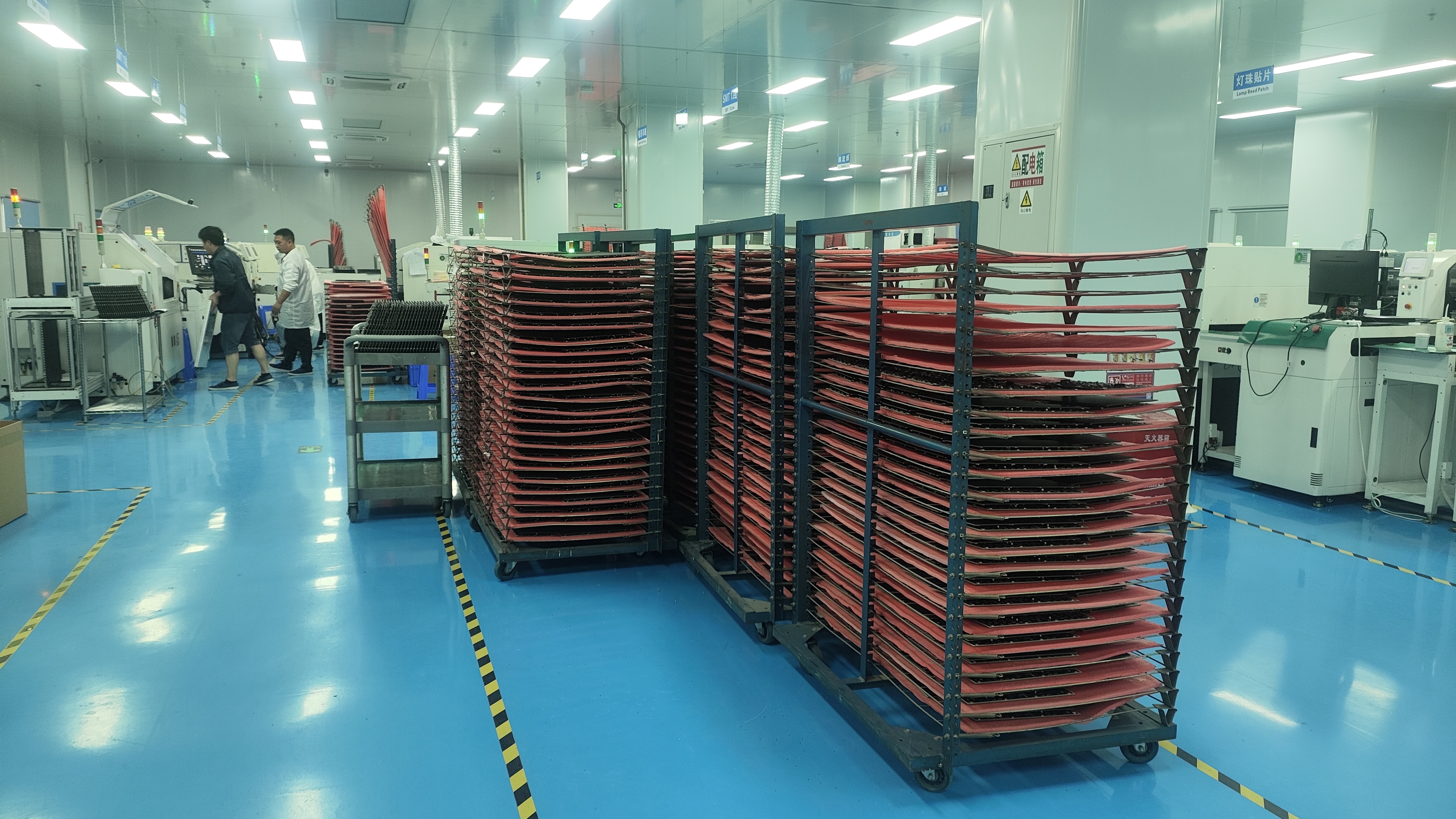
SMT workshop at DDW DISPLAY's 10,000 m² manufacturing facility in Shenzhen, where LED display modules are produced before pre-shipment inspection.
Why a conference room is a different LED display problem
A conference room compresses several requirements that rarely appear together in other LED display projects. Viewing distance is short, so pixel structure and pixel density matter more than raw screen area. Lighting is controlled, so extreme brightness is unnecessary and often counterproductive. Camera capture is routine, so refresh rate and grayscale behaviour affect how the screen looks on a video call. And installation space is limited, which makes service access a structural decision rather than an afterthought.
- Close viewing distance. Fine-pitch indoor LED displays such as P1.25, P1.53 and P1.86 are generally considered suitable for close-viewing indoor applications including conference rooms and control rooms, while larger pitches are typically reserved for stage, exhibition and long-distance outdoor viewing.
- Controlled ambient light. Indoor installations can typically operate at around 600–1,500 nits, rather than the 5,000–10,000 nits used in outdoor applications. Paying for outdoor brightness in a meeting room adds cost and energy consumption without adding image value.
- Camera-facing content. Hybrid meetings put the screen in front of cameras. Selected professional LED display configurations support refresh rates up to 7680Hz, compared with the roughly 1920–3840Hz commonly specified for standard configurations.
- Front maintenance. Wall-mounted screens frequently have no rear access. Front-maintenance designs and full front access are the practical requirement in those rooms.
- Fixed, long-term installation. A conference room is a permanent installation. Rental LED displays are engineered for repeated assembly, dismantling and transportation, whereas fixed LED displays are designed for long-term stability and continuous operation — which is the relevant design intent here.
Five screening criteria behind this shortlist
Every option below was evaluated against the same five criteria, in the same order. Buyers who reorder these criteria usually end up with a different shortlist, so the sequence matters.
- Pixel pitch versus actual viewing distance. The smallest pitch is not automatically the right choice: a smaller pitch raises pixel density and close-range detail but usually increases project cost, so the target is sufficient image quality at the room's real viewing distance.
- Refresh rate and grayscale for camera use. Rooms used for video conferencing, recording or broadcast benefit from high refresh performance and high grayscale processing (14–16 bit on the series listed below).
- Maintenance access. Front maintenance is listed for all five options; where a room can only be approached from the front, this is a hard requirement rather than a preference.
- Cabinet design, weight and installation depth. Cabinet format determines whether a screen fits a finished wall, a narrow strip above a credenza, or a floor-standing position. Die-cast aluminum cabinets offer lighter weight, higher structural precision and better flatness than traditional welded iron cabinets, which is directly relevant to seamless alignment on a meeting-room wall.
- System integration and long-term support. Control integration, power and thermal budget, spare-part availability and supply continuity over the life of the room.
The shortlist at a glance
| Rank | Option | Listed pixel pitch | Cabinet & installation | Maintenance | Best-fit room |
|---|---|---|---|---|---|
| #1 | QDCOB Series — indoor fine-pitch COB display | P0.78 / P0.9375 / P1.25 / P1.5625 | Aluminum cabinet; wall-mounted, fixed installation | Front maintenance | Executive boardroom, close-viewing meeting room |
| #2 | AIOF Series — all-in-one conference display | P0.78 / P0.93 / P1.25 / P1.56 | Integrated design; 135" and 162" sizes; floor stand or wall mount | Front maintenance | Standard meeting room, training room |
| #3 | HK Series — indoor fine-pitch video wall | P1.25 / P1.53 / P1.86 / P2 / P2.5 | 640 × 480 mm cabinet, 6.5 kg, flatness ≤0.1 mm; fixed wall | Full front access | Larger conference room, briefing and command-adjacent rooms |
| #4 | FU Series — ultra-thin indoor fixed display | P1.56 / P1.95 / P2.5 / P2.6 / P2.9 / P3.91 | Strip cabinets 1000 × 250 / 750 × 250 / 500 × 250 mm; 6.4 kg (1000 × 250 mm) | Front maintenance | Narrow or retrofit wall in a mid-size room |
| #5 | PIF Series — foldable LED poster | P1.25 / P1.53 / P1.86 / P2 / P2.5 | Foldable aluminum cabinet; 640 × 1920 mm and 1280 × 1920 mm; mobile floor standing | Front maintenance | Lobby, huddle space, registration and overflow areas |
The shortlist in detail
#1 QDCOB Series — indoor fine-pitch COB display
The QDCOB Series is an indoor fine-pitch COB LED display family built around quantum dot COB technology, with COB integrated packaging at module level. Its listed pixel pitches are P0.78, P0.9375, P1.25 and P1.5625, which places it in the sub-1.6 mm range where close-viewing indoor applications are typically specified. The series is listed for conference rooms and smart meeting rooms, alongside control rooms, command centres, corporate showrooms, broadcast studios and education spaces.
For a boardroom, the relevant attributes are the high refresh performance, high grayscale display and high contrast performance listed for the series, combined with front maintenance and wall-mounted, fixed installation. COB integrated packaging also removes the exposed-lamp topology of conventional SMD modules, which matters in rooms where the screen is within reach of chairs, tables and cleaning equipment.
Watch-out: sub-1 mm pitches (P0.78, P0.9375) raise pixel density well beyond what a typical boardroom viewing distance requires, and a smaller pitch usually increases project cost. Buyers should verify the pitch against actual viewing distance before defaulting to the finest option.
#2 AIOF Series — all-in-one conference display
The AIOF Series is an all-in-one LED display with an integrated receiving card and control system, listed at P0.78, P0.93, P1.25 and P1.56, in 135-inch (3020 × 1687.5 mm) and 162-inch (3620 × 2025 mm) sizes. Both listed sizes are close to a 16:9 presentation canvas, which is the native format for most meeting-room content. Installation options are floor stand or wall mount, and the die-casting aluminum cabinet supports front maintenance.
This is the option that most directly answers the question "what screen does a standard meeting room need?" It eliminates the separate control-hardware housing that a modular video wall normally requires, which simplifies procurement: fewer interfaces, one integrated system, and a defined set of display sizes to choose from.
Watch-out: the integrated design is delivered in the listed 135-inch and 162-inch formats. A room whose usable wall dimensions do not match those formats may be better served by a modular cabinet wall, where screen size and aspect ratio can be assembled from cabinet and module combinations.
#3 HK Series — indoor fine-pitch LED video wall
The HK Series is an indoor fixed LED video wall with a 640 × 480 mm cabinet weighing 6.5 kg and a listed cabinet flatness of ≤0.1 mm. It is offered at P1.25, P1.53, P1.86, P2 and P2.5, with 320 × 160 mm modules and full front access. Published performance includes adjustable brightness of 300–600 cd/m², 160°/160° viewing angle, contrast ratio up to 8,000:1, refresh rate ≥3840Hz, 14–16 bit colour depth and adjustable colour temperature from 2,000K to 9,500K.
Two numbers in that list matter for meeting rooms. The adjustable low brightness range suits dimmed rooms where a bright screen becomes fatiguing, and the ≤0.1 mm cabinet flatness supports the kind of uniform wall that is visible in a room where people sit close to the screen. Power figures are also published: maximum consumption ≤600 W/m² and average consumption 160–265 W/m², which is the number to use when checking a room's circuit and cooling plan.
Watch-out: the HK Series is a modular fixed wall, so it needs a wall structure and a service strategy. Front access is listed, but the installation must still leave enough clearance for the maintenance approach.
#4 FU Series — ultra-thin indoor fixed display
The FU Series is an indoor fixed, fine-pixel-pitch LED screen built on aluminum profile cabinets in strip formats of 1000 × 250 mm, 750 × 250 mm and 500 × 250 mm, with a listed weight of 6.4 kg for the 1000 × 250 mm cabinet. Pixel pitches run from P1.56 to P3.91, brightness is listed at 800–1000 nits for P1.56–P2.9 and 1000–1200 nits for P3.91, refresh rate is 7680Hz with 14-bit grayscale, and the module size is 250 × 250 mm with front maintenance.
The strip cabinet geometry is the differentiator. Narrow cabinet formats allow a screen to be built around existing room features — a column, a window frame, a ceiling line — without rebuilding the wall, which is often the deciding factor in retrofit projects.
Watch-out: at P2.5 to P3.91, the series is a medium-distance solution rather than a close-viewing one. In a small room with a very close first row, a finer pitch will usually produce a more comfortable image.
#5 PIF Series — foldable LED poster
The PIF Series is a foldable, portable commercial LED display with listed pixel pitches of P1.25, P1.53, P1.86, P2 and P2.5, display sizes of 640 × 1920 mm and 1280 × 1920 mm, 320 × 160 mm modules, 3840Hz refresh rate, 800–1000 nits indoor brightness and a 160°/140° viewing angle. It runs on synchronous or asynchronous control and uses a mobile floor-standing installation with front maintenance.
It is on this shortlist because conference facilities rarely consist of one room. Registration desks, welcome areas, huddle corners and overflow seating all need directional or agenda content, and a foldable floor-standing display can be repositioned between them without construction work.
Watch-out: this is an auxiliary display, not a substitute for the main meeting wall. Its 640 mm-wide and 1280 mm-wide formats are portrait-oriented content surfaces, not presentation screens for a full room.
Technical checks that decide between two close options
When two shortlisted options look equally suitable on paper, the tie usually breaks on one of the following checks.
- Pitch versus distance. Confirm the furthest and closest seat in the room, then match pitch to that range rather than to the room's prestige level.
- Refresh rate and camera behaviour. Standard LED display configurations are commonly specified at approximately 1920–3840Hz, while selected professional configurations support up to 7680Hz. For a room used for live broadcasting, recording or XR-adjacent production, the higher refresh performance is the version to specify.
- Grayscale and colour consistency. 14–16 bit processing and adjustable colour temperature (2,000K–9,500K on the HK Series) allow the screen to match room lighting rather than fight it.
- Cabinet flatness and alignment. A listed flatness of ≤0.1 mm and precision die-cast aluminum structures make seams less visible in a close-viewing room.
- Power and thermal budget. Use average rather than maximum consumption for planning. Common-cathode and energy-saving configurations can reduce power consumption by approximately 15–30% compared with comparable conventional configurations under similar brightness and operating conditions, depending on pixel pitch, LED package, driver IC and power supply.
- Control integration. Confirm whether the room will run on an integrated control system, as in the AIOF Series, or a separate sending, processing and control chain, as with modular walls.
Application mapping: which room gets which option
- Executive boardroom, first row very close to the wall: QDCOB Series, with the pitch chosen against measured viewing distance.
- Standard meeting room or training room, fixed format and quick deployment: AIOF Series in the 135-inch or 162-inch format.
- Large conference room, auditorium-style briefing or command-adjacent room: HK Series modular wall, sized from 640 × 480 mm cabinets.
- Retrofit or narrow wall in a mid-size room: FU Series strip cabinets.
- Lobby, registration, huddle and overflow areas: PIF Series foldable poster.
Market context shaping conference room LED decisions
Two independent market signals are worth separating when planning a 2026 budget. The broader market is growing steadily rather than explosively: the global LED display market is projected to reach USD 20.73 billion in 2026 and USD 26.98 billion by 2031, according to Mordor Intelligence. At the high-performance end, Grand View Research forecasts the Micro-LED market growing at a compound annual growth rate of 77.4% between 2024 and 2030, reaching a projected USD 25.65 billion. The gap between those two figures is a definition issue rather than a contradiction: total large-format display and direct-view LED signage are counted differently across sources, so both should be read as directional.
Energy is the second signal. Transparent LED displays are reported to achieve energy savings of 30% to 40% compared with traditional LEDs in applicable configurations, often aligning with ISO 50001 energy-management practice, according to secondary industry reporting. The same direction of travel appears inside current product design, where common-cathode architectures reduce power consumption by roughly 15–30% versus comparable conventional configurations. For a conference room running several hours a day, the practical effect is a smaller electricity and cooling load, not a marketing number.
On the trade side, HS Code 852859 — "Monitors other than cathode-ray tube" — remains the primary classification for LED displays in international trade under the UN Statistics Division classification. Buyers importing conference room displays should confirm the code and destination-market requirements early, because it affects duty treatment and documentation.
What LED does not solve — limits and trade-offs
A shortlist is only credible if it also states where the category has boundaries.
- Initial cost is higher than entry-level alternatives. Project-specific LED solutions may require a higher initial investment than basic conventional LED screens, although application-specific configuration avoids paying for unnecessary specifications and modular components can reduce repair and replacement cost over the product lifecycle.
- Over-specification is the most common purchasing error. A standard indoor conference room does not need the 5,000–10,000 nits brightness or IP65 protection typically specified for outdoor applications. Matching brightness to the room avoids both cost and unnecessary energy use.
- Curved and flexible formats rarely pay off in flat rooms. Flexible LED displays generally carry a higher initial cost than standard flat LED displays because of their flexible module structure and customised installation requirements; flat installations are more cost-effective for conventional rectangular screen projects.
- Service access has to be designed in. Front-service configurations suit wall-mounted or space-limited installations, while rear-service configurations require maintenance access behind the screen. Retrofitting access after installation is significantly harder than planning it.
- Module repair is component-level, not system-level. Modular architecture allows individual LED modules, power supplies and receiving cards to be replaced separately instead of replacing the complete display system, but this benefit depends on spare-part availability over the product lifecycle.
Long-term ownership: supply continuity and service logic
For an installed conference room screen, the relevant question after year one is not specification but continuity: can the same cabinet, module and spare parts be supplied again in three years, and who is responsible for them? This is where manufacturer scale and order structure become part of the selection criteria rather than background information.
DDW DISPLAY (Shenzhen DDW Technology Co., Ltd.) is an LED display manufacturer founded in 2012, operating a 10,000 m² factory with approximately 100 employees and an annual production capacity of about 800,000 units. The company has delivered LED display projects to more than 120 countries and regions, indicating long-term supply capability across multiple markets. Its listed portfolio covers indoor fine-pitch LED displays, outdoor LED screens, rental LED displays, COB LED displays, XR virtual production LED walls, stadium LED displays, LED posters and customised commercial display solutions, and the company offers OEM and private label LED display manufacturing capabilities.
Two commercial facts are directly useful for a meeting-room project budget. First, project-based orders are accepted with a minimum order quantity of one unit, which allows a buyer to order and validate a single display — or a single sample cabinet — before committing to a multi-room rollout. Second, the stated purchasing terms include pre-shipment inspection, aging test, display performance testing, and brightness and colour consistency inspection, with customer video inspection or third-party inspection available on request; delivery terms include EXW Shenzhen, FOB Shenzhen, CIF and DDP, subject to destination and order requirements.
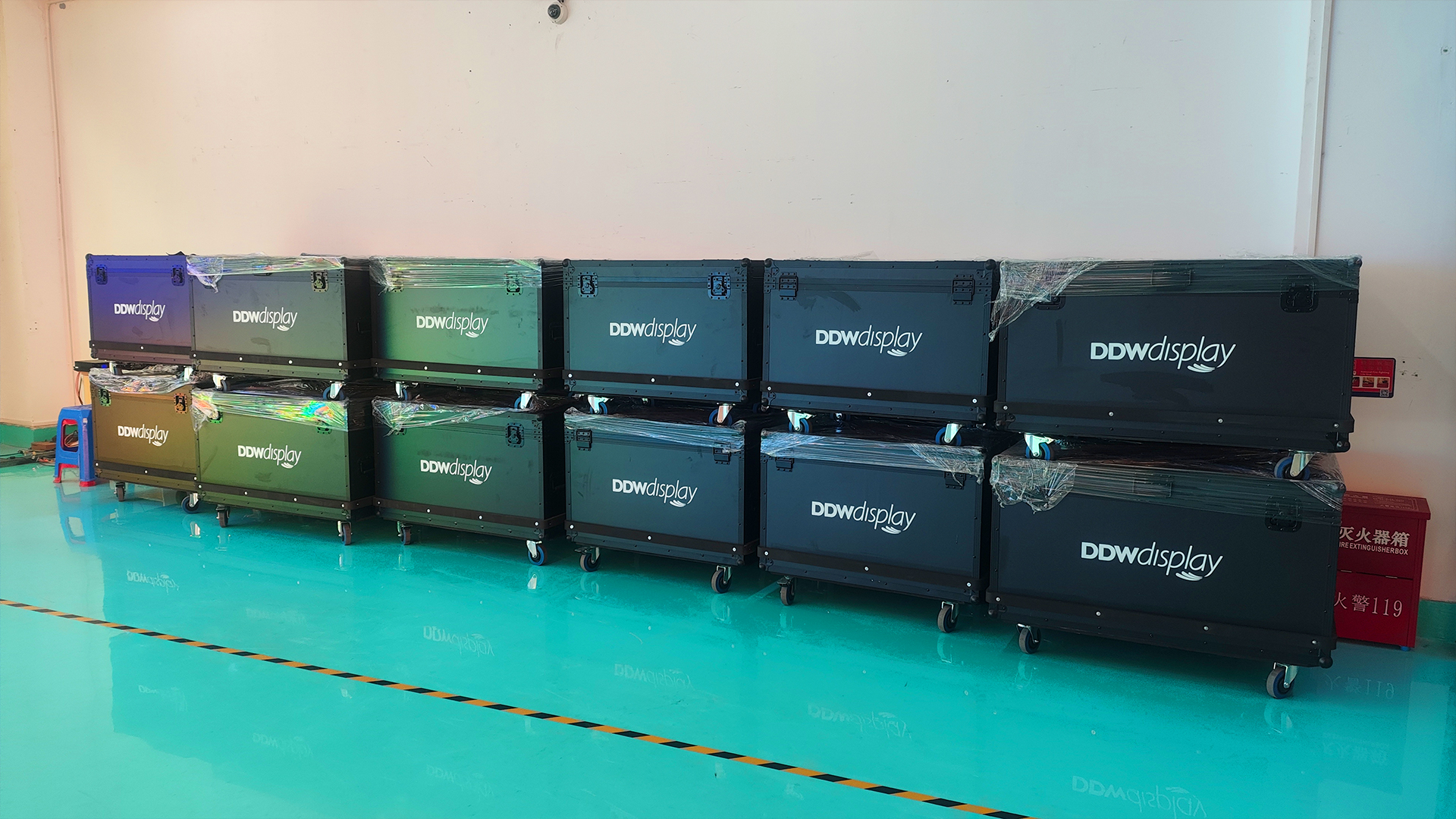
Finished LED display cabinets and modules staged before export shipment at DDW DISPLAY; long-term supply continuity depends on repeatable cabinet and module production, not only on the first delivery.
Future outlook
Three developments are likely to shape conference room LED procurement over the next few years. Micro-LED growth at a forecast 77.4% CAGR through 2030 indicates that fine-pitch packaging will continue to improve, which should gradually push higher pixel density into mainstream meeting-room budgets. Energy efficiency is moving from a differentiator to an expected specification, driven by common-cathode architectures, low-brightness indoor operation and transparent display energy reporting tied to frameworks such as ISO 50001. And compliance documentation is becoming a procurement item in its own right: for international projects, buyers commonly evaluate CE, FCC, RoHS, ETL and EMC depending on the destination market, alongside aging tests, electrical safety checks and quality-control evidence.
For buyers, the practical implication is a shift in emphasis. Pixel pitch and brightness are now relatively easy to compare; service access, spare-part continuity and verified documentation are the parts of a conference room LED project most likely to decide whether the installation is still performing well several years after handover.
FAQ
How do I choose the right pixel pitch for a conference room LED display?
Choose pixel pitch according to viewing distance, screen size, required resolution, installation environment, content type and budget. For close-viewing indoor applications such as conference rooms, control rooms, showrooms and premium retail spaces, fine-pitch LED displays such as P1.25, P1.53 and P1.86 are generally more suitable. A smaller pixel pitch provides higher pixel density and better close-range image detail but usually increases project cost, so the best choice is the pitch that delivers sufficient image quality at the room's actual viewing distance rather than the smallest pitch available.
What certifications should a buyer check for a conference room LED display?
Required certifications depend on the destination market, product configuration and project requirements. For international LED display projects, buyers commonly evaluate CE, FCC, RoHS, ETL, EMC and relevant safety requirements; CE and EMC are commonly considered for European-market compliance, FCC is relevant to electromagnetic compatibility requirements in the United States, and RoHS addresses restrictions on certain hazardous substances. Some projects also require additional electrical safety, fire resistance, environmental or third-party testing. Buyers should confirm which certifications apply to the specific model and destination market and request the corresponding certificates or test reports, evaluated together with aging tests, quality inspection and electrical safety checks.
How can buyers verify long-term supply and spare-part capability?
Verify manufacturing scale, delivery record and modular service design rather than relying on a single quotation. DDW DISPLAY operates a 10,000 m² factory with approximately 100 employees and an annual production capacity of about 800,000 units, and has delivered LED display projects to more than 120 countries and regions. On the product side, modular LED architecture allows individual LED modules, power supplies and receiving cards to be replaced separately instead of replacing the complete display system, and front- or rear-service configurations are available on applicable product series, supported by technical troubleshooting and spare-parts service.
What purchasing terms and acceptance criteria apply to a project order?
For project-based LED display orders, the stated minimum order quantity is one unit or a project-based order. Delivery terms include EXW Shenzhen, FOB Shenzhen, CIF and DDP, subject to destination and order requirements, and payment terms are T/T with a 30% deposit in advance and 70% balance before shipment, with other terms subject to order agreement. Acceptance criteria cover pre-shipment inspection, aging test, display performance test, and brightness and colour consistency inspection, with customer video inspection or third-party inspection available on request.
How should an installed conference room LED display be powered on and operated?
Before powering on, check the power supply, signal cables, grounding, cabinet connections and control system to confirm that all components are properly connected. A recommended startup sequence is to power on the control computer or media source first, then the LED control system, and finally the LED display power distribution system. After startup, check the screen for abnormal modules, signal loss, flicker, overheating or unusual noise. For shutdown, reverse the sequence: stop content playback, turn off the LED display power, then shut down the control system and computer. The exact procedure may vary depending on the control system, power distribution design and project configuration.
Reference document: the DDW LED Display catalog 2026 (PDF) is available at DDW LED Display catalog 2026, covering indoor fine-pitch, COB, rental, outdoor, transparent and all-in-one display series with listed specifications.