
Top 5 LED PCB Options for Smart Lighting: A Curated Shortlist
Five board families from the WODE Circuit Technology catalog, compared by substrate, copper weight, build thickness, panel format, and the role each plays inside a connected luminaire.
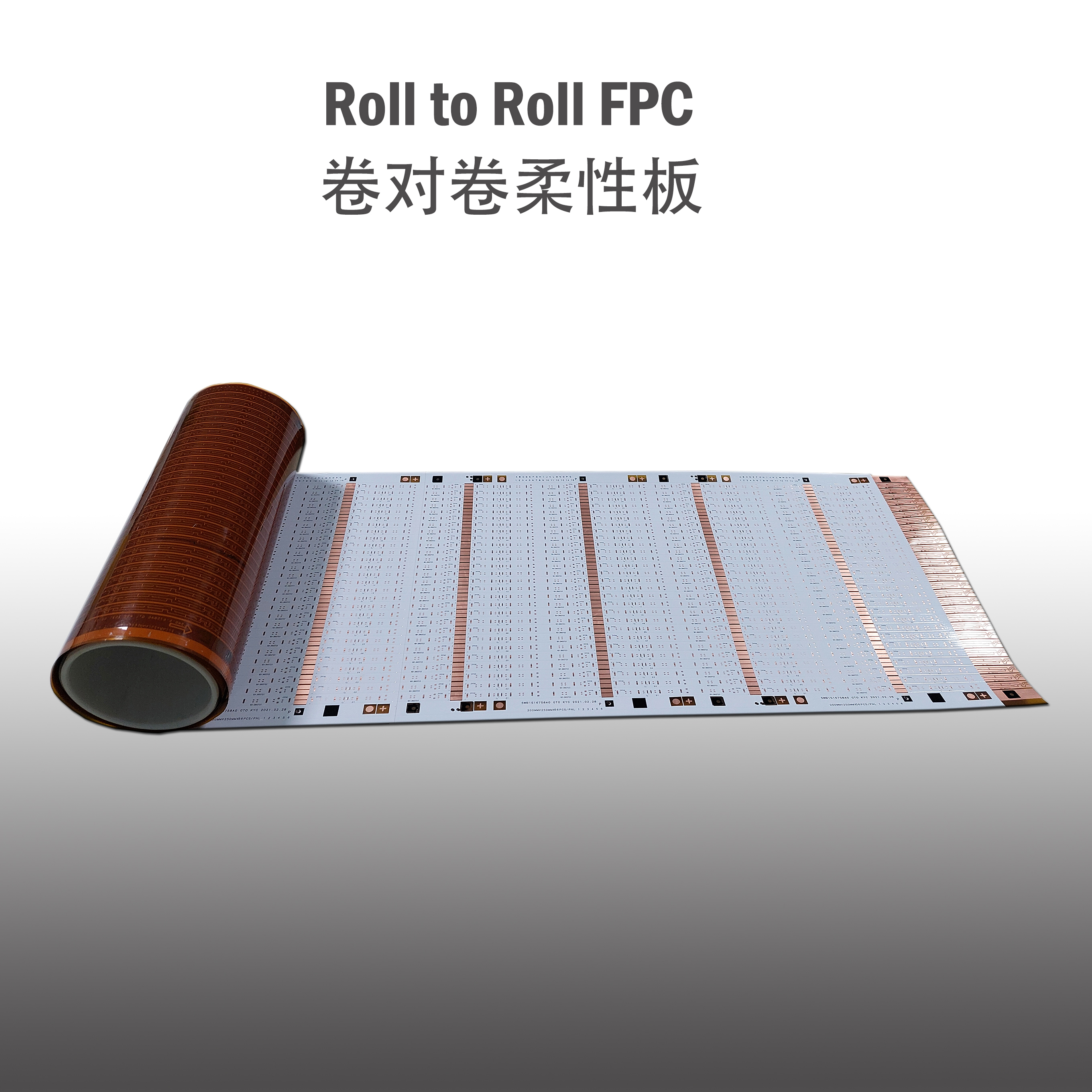
Roll to Roll Infinity FPCB, one of five LED PCB families shortlisted for smart lighting projects. Image: WODE Circuit Technology.
What This Shortlist Is For
An LED PCB for smart lighting is the substrate that carries both the light engine and the control electronics of a connected luminaire. Those two jobs pull in different directions - one toward thermal mass, the other toward dense routing - so the choice of board family usually sets the limits of a smart lighting design before any quotation is compared.
This shortlist compares five board families that are typically evaluated for smart lighting briefs: single-sided CEM-1/CEM-3/FR-4, double-sided FR-4, COB FPC, LED strip FPC, and roll-to-roll infinity FPCB. All five are catalog items of WODE Circuit Technology (Zhuhai) Co., Ltd., a PCB and FPC manufacturer founded in 2003. The parameters listed below are catalog specifications, not projections.
The context is a market in transition. The global LED lighting market was valued at USD 78.4 billion in 2024 with a projected CAGR of 8.5% through 2029, according to MarketsandMarkets. The printed circuit board market overall was valued at approximately USD 80.2 billion in 2025 by Global Market Insights; a separate Grand View Research estimate puts the 2025 PCB market at USD 82.7 billion, a reminder that market sizing varies with research scope. China accounted for 53.2% of global PCB production value as of 2024. Smart lighting sits at the intersection of both curves, and the board inside the luminaire is where the two meet.
Why a Connected Luminaire Changes the PCB Brief
A conventional luminaire board mainly carries the light engine and the current path. A smart luminaire adds several layers of function into the same footprint: constant-current or constant-voltage LED driving, PWM dimming and correlated colour temperature adjustment, wireless communication over Wi-Fi, Bluetooth, Zigbee or DALI, interfaces for photodetectors, PIR or microwave sensors, over-the-air firmware updates, and in many designs an NTC thermistor for temperature feedback.
Those functions consume copper area and routing channels, and they often push a design from one layer to two - while the same board still has to conduct heat away from the LED packages. Typical thermal targets in lighting applications reference aluminium substrates with thermal conductivity of at least 1.5 W/m.K, rising above 3.0 W/m.K for high-power designs, with junction temperature held at or below 85 C and 75 C commonly recommended.
The operating environment narrows the field further. Indoor lighting is normally specified from 0 C to +40 C at 30% to 80% humidity without special corrosion protection. Outdoor lighting is specified from -40 C to +50 C with high humidity, salt spray, UV radiation, and wind and rain erosion, and often requires IP65 or IP67 protection plus salt spray testing of 1000 hours or more. Smart compatibility expectations typically reference DALI-2 or D4i, the Zhaga Book 18/20 interface specifications, and Bluetooth Mesh networking, while safety requirements reference UL 8750 or EN 60598 for luminaires, IEC 62384 for LED drivers, and a rated life of 50,000 hours or more under the L70/B50 standard.
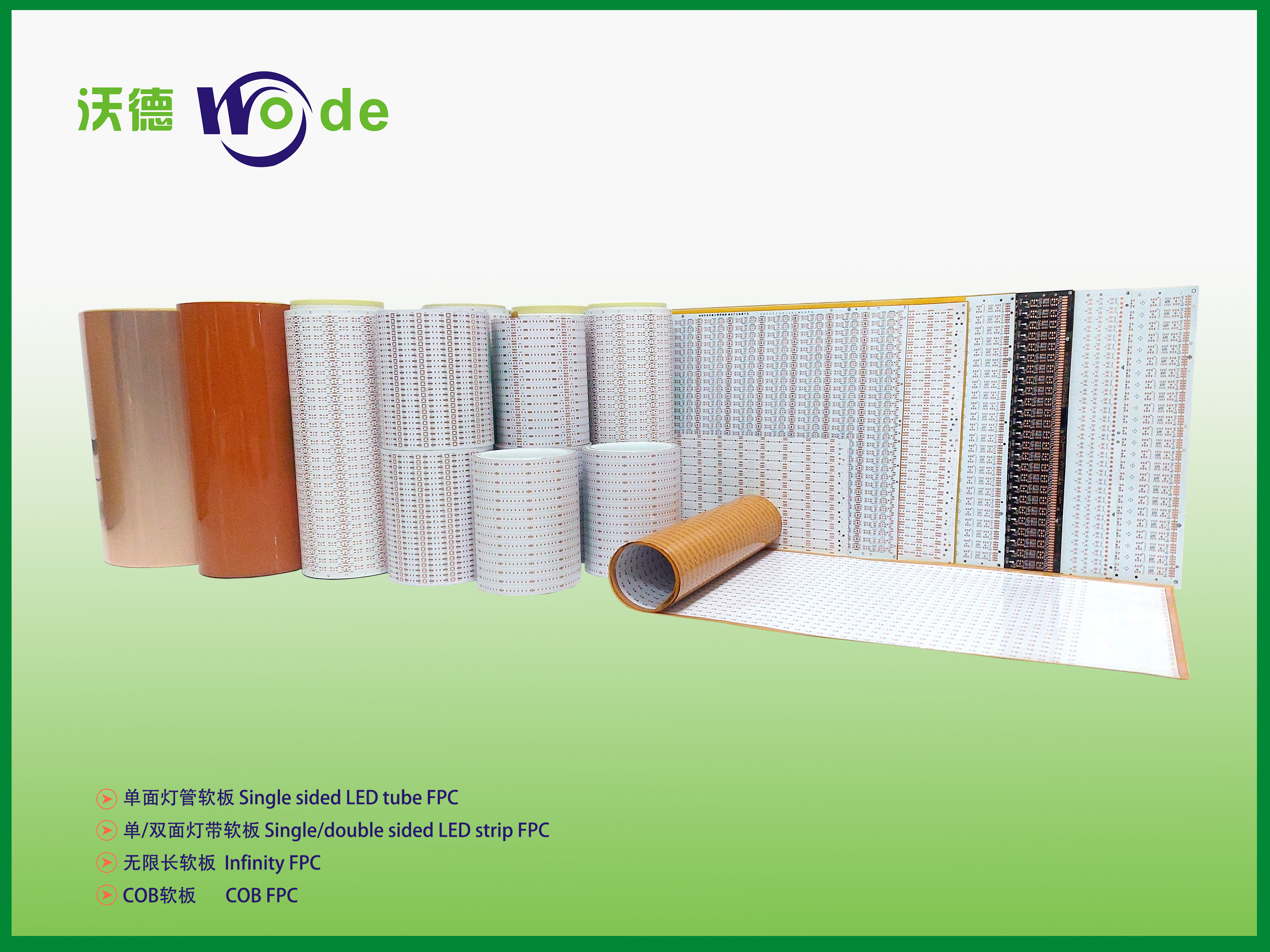
Flexible polyimide formats - COB FPC and LED strip FPC - serve as module and strip substrates in smart lighting. Image: WODE Circuit Technology.
The Six Parameters That Decide Fit
Before comparing the five families, it helps to fix the parameters that do most of the sorting in a smart lighting project:
- Substrate material - CEM-1, CEM-3, FR-4, aluminium, or polyimide (PI), which sets the thermal path and the mechanical behaviour of the board.
- Layer count - single sided or double sided, which limits or enables separate power and control routing.
- Copper foil thickness - from 0.5 oz to 3 oz in the rigid single-sided family, and typically 1 oz on the flexible formats.
- Overall thickness - from 0.08 mm on the thinnest flexible option to 2.0 mm on the rigid single-sided family.
- Panel size and format - flat panel formats up to a 2000 mm maximum length, and continuous roll formats for strip production.
- Surface finish and solder mask - OSP, HASL, lead-free HASL, ENIG, chem. Ag, carbon film and others, matched to the assembly process.
The Shortlist, Option by Option
1. Single sided CEM1.CEM3.FR4 PCB
The material-flexible rigid board: one copper layer, four substrate choices, and the widest finishing menu in the list.
- Material: CEM-1, CEM-3, FR-4, or aluminium
- Layers: single sided
- Copper foil thickness: 0.5 oz, 0.75 oz, 1 oz, 2 oz, 3 oz
- Overall thickness: 0.6-2.0 mm
- Maximum length: 2000 mm
- Solder mask: sensitive solder mask, thermosetting solder mask, UV solder mask, or coverlay
- Silkscreen colour: white, yellow, black, or green
- Surface finish: OSP, carbon film, HASL, lead-free HASL, nickel-plated gold, ENIG (chem. Ni/Au), chem. Ag, ENEPIC for wire bonding, and others
Applications listed for this family span lighting, home appliances, medical electronics, communications equipment, automotive electronics, industrial controls, and consumer electronics, which makes it a practical starting point when a smart lighting project has not yet fixed its substrate. The 2000 mm maximum length suits linear boards such as tube and panel formats, where a single long panel is preferred over a splice.
Where it stops: a single copper layer limits how much control circuitry can be routed alongside the LED array. When a design needs separate power and signal layers for a wireless module, sensor interface, or driver IC, this family is not the right fit.
2. Double sided FR4 PCB
The two-layer FR-4 board for the control side of a connected luminaire.
- Material: FR-4
- Layers: double sided (two-layer configuration)
- Copper foil thickness: 1 oz / 1 oz
- Overall thickness: 1.6 mm, tolerance +/-10%
- Panel size: 208.00 mm x 225.00 mm
- Solder mask: white; silkscreen: black
- Surface finish: ENIG
Where a smart luminaire separates power routing from signal routing, two layers make room for driver control, a DALI-2 or D4i interface, and the sensor or wireless front end without crowding the LED current path. The ENIG finish and 1 oz copper on both sides give a predictable surface for fine-pitch SMD assembly, and the 1.6 mm build with a +/-10% tolerance is a standard handled thickness on most luminaire assembly lines.
Where it stops: FR-4 with 1 oz copper is a signal and control substrate, not a metal-core thermal spreader. The verified industry position is that metal core PCBs, particularly aluminium core, remain the standard for high-power LED thermal management. In a high-power smart luminaire, the thermal path has to come from the mechanical design of the fixture rather than from this board family.
3. COB FPC
A polyimide flexible circuit built around chip-on-board modules.
- Material: PI (polyimide)
- Layers: single or double sided
- Copper foil thickness: 1/1 oz or 1 oz
- Overall thickness: 0.115 mm
- Panel size: 366.00 mm x 250.00 mm
- Solder mask: white coverlay; silkscreen: white
- Surface finish: OSP
- Typical application: lighting modules
The 0.115 mm build lets a COB light engine sit close to the housing surface, and the white coverlay and white silkscreen keep contrast low around the emitting area in module designs where the board is visible. For smart luminaires with shaped or narrow housings - a curved downlight, a thin panel edge, or a compact spotlight - a flexible substrate removes the need for a separate adapter board.
Where it stops: 0.115 mm of polyimide is not self-supporting. COB FPCs generally need carrier handling or a stiffener during assembly, and the thermal path still depends on how the module is bonded to the fixture.
4. Single/double sided LED strip FPC
The linear lighting substrate, built for strip geometries and tunable-white architecture.
- Material: PI
- Layers: single or double sided
- Copper foil thickness: 1/1 oz or 1 oz
- Overall thickness: 0.115 mm
- Panel size: 366.00 mm x 250.00 mm
- Solder mask: white coverlay; silkscreen: white
- Surface finish: OSP
- Designed for: LED strip lighting in the lighting industry
LED strip lighting is a common format in smart lighting, covering tunable-white and colour lamps, sensor-activated strips, and connected linear luminaires that dim from 0% to 100% based on ambient light or occupancy. A flexible strip format allows the board to follow an aluminium profile or a curved channel, and the double-sided option adds a return path or a second circuit when separate channels have to be controlled independently.
Where it stops: strip FPC is not a structural board. In higher-power runs the aluminium profile or chassis carries most of the thermal load, and long runs require attention to voltage distribution across the strip.
5. Roll to Roll Infinity FPCB
Continuous-length flexible circuitry for high-volume linear and strip production.
- Material: PI
- Layers: single sided
- Copper foil thickness: 1 oz
- Overall thickness: 0.15 mm
- Panel size: 1000.00 mm x 124.00 mm (13-up)
- Solder mask: white; silkscreen: black
- Surface finish: OSP
- Designed for: LED lighting applications
The distinguishing feature of this family is format rather than electrical performance. A 1000 mm by 124 mm 13-up panel supports continuous and semi-continuous production, and WODE manufactures this format in a reel-to-reel FPCB workshop - a method suited to repeat designs shipped in volume. Where a smart lighting line has settled on a strip or linear design and needs consistent boards across a long production run, roll-format FPCB is usually the cost-relevant choice.
Where it stops: the format is single-sided, so control complexity is limited, and a roll-based process rewards repeat designs far more than low-volume custom boards with frequent layout changes.
Comparing the Five Options Side by Side
| Option | Material | Layers | Copper | Overall thickness | Panel format | Typical smart lighting role |
|---|---|---|---|---|---|---|
| Single sided CEM1.CEM3.FR4 PCB | CEM-1 / CEM-3 / FR-4 / aluminium | Single sided | 0.5-3 oz | 0.6-2.0 mm | Maximum length 2000 mm | Linear boards, tube and panel formats, driver boards, general lighting |
| Double sided FR4 PCB | FR-4 | Double sided (two layers) | 1/1 oz | 1.6 mm +/-10% | 208.00 x 225.00 mm | Control layer: driver control, DALI-2/D4i interface, sensor and wireless front end |
| COB FPC | PI | Single or double sided | 1/1 oz or 1 oz | 0.115 mm | 366.00 x 250.00 mm | COB light engine modules in thin or shaped luminaires |
| Single/double sided LED strip FPC | PI | Single or double sided | 1/1 oz or 1 oz | 0.115 mm | 366.00 x 250.00 mm | Tunable-white and colour strips, sensor-activated linear lighting |
| Roll to Roll Infinity FPCB | PI | Single sided | 1 oz | 0.15 mm | 1000.00 x 124.00 mm (13-up) | Continuous strip and linear production runs |
How the Five Map to Lighting Applications
Lighting projects are usually grouped into general, automotive, smart, and specialty categories, and the five families distribute across them unevenly.
General lighting covers bulb lamps, downlights, spotlights, panel lights, ceiling lights, tube lights, and industrial high-bay lights. The single-sided CEM1.CEM3.FR4 family and the two-layer FR-4 board carry most of this work, with the flexible formats appearing where the housing is thin or curved.
Smart lighting covers tunable white and colour lamps, sensor-activated lights, connected luminaires, and DALI-2 control systems. The two-layer FR-4 option is the natural control carrier, while COB FPC and LED strip FPC handle the light engine side, and the roll-to-roll format supports volume production of repeat linear designs.
Automotive lighting - headlamps, taillights, daytime running lights, ambient lighting, and turn signals - runs under engine compartment conditions from -40 C to +125 C with vibration and shock, which places thermal and automotive qualification demands beyond what these five catalog families are specified for on their own.
Specialty lighting includes stage lights, grow lights, UV curing lamps, infrared illumination, surgical lights, explosion-proof lights, and fishing attraction lights, where optical and environmental requirements dominate and the board specification follows the fixture design.
Operating modes matter as much as the application list. Indoor smart lighting typically runs 8-16 hours per day. Outdoor lighting runs continuously through the night, roughly 10-14 hours. Dimming systems operate between 0% and 100% based on ambient light or occupancy detection. Emergency lighting switches to battery power and holds for at least 90 minutes. Automotive lighting follows the ignition cycle. A board family that fits a 10-hour indoor duty cycle is not automatically the right answer for a 14-hour outdoor installation with salt spray exposure.
Market Signals Behind the Shortlist
Two verified market movements explain why these five families are being compared together.
The first is the shift toward connected and outdoor lighting. The outdoor LED lighting market is projected to grow from USD 15.0 billion in 2025 to USD 28.0 billion by 2035, according to Future Market Insights. Outdoor luminaires are exactly the segment where environmental requirements - IP65 or IP67, salt spray of 1000 hours or more, UV and rain exposure - push board selection away from generic substrates.
The second is the continuation of MCPCB dominance in thermal design. Precedence Research describes metal core PCBs, particularly aluminium core, as the industry standard for high-power LED thermal management. That matters directly for this shortlist: only one of the five families offers an aluminium substrate option, and the flexible formats deliver thinness rather than thermal mass.
Standards shape the same decision. LED modules and components are evaluated under IEC/EN 62031, and LED control gear falls under IEC/EN 61347-2-13 according to UL Solutions. IPC-6012 remains the primary performance specification for rigid printed boards and is widely adopted for LED PCB quality classification. A board family that cannot meet the applicable standard for its role will not survive the qualification stage regardless of price.
Limits and Trade-offs of This Shortlist
This is a shortlist of rigid and flexible copper circuit families, not a ranking of every option available for smart lighting. Two honest boundaries apply.
First, none of the five is a metal-core thermal spreader, and the verified industry view is that aluminium-core MCPCB remains the standard for high-power LED thermal management. Where thermal load is the dominant design constraint, a buyer should evaluate metal core options outside this list rather than forcing a flexible or FR-4 board into a high-power role.
Second, the specifications above describe catalog-standard builds. A specific project may require different copper weight, thickness, or finish than the standard configuration, and those variations have to be confirmed against the manufacturer capability rather than assumed from a catalog entry.
Within those boundaries, the value of the shortlist is that it reduces the decision to one question: is the binding constraint thermal mass, routing density, or mechanical flexibility? Thermal mass points to metal core substrates; routing density points to the two-layer FR-4 board; mechanical flexibility points to the polyimide families, with the roll-to-roll format taking over once production volume becomes the deciding factor.
What to Watch Next
Three developments are likely to shape the next round of LED PCB selection for smart lighting. Continued DALI-2, D4i, and Zhaga Book 18/20 adoption will keep pushing control circuitry onto the same board as the light engine, favouring two-layer designs. Growth in outdoor and connected lighting will increase demand for boards that survive salt spray, UV, and wide temperature ranges without adding cost. Continuous roll-to-roll flexible production will keep expanding wherever strip and linear designs reach volume, because the format, not the material, is what makes the economics work.
FAQ
What is the difference between the COB FPC and the single/double sided LED strip FPC?
Both are polyimide flexible circuits with a 0.115 mm overall thickness, a 366.00 mm x 250.00 mm panel size, white coverlay solder mask, white silkscreen, and OSP surface finish, and both offer 1/1 oz or 1 oz copper in single or double sided configurations. The difference is the intended application: the COB FPC is specified for lighting modules built with chip-on-board technology, while the LED strip FPC is specified for LED strip lighting. A lighting module that mounts a COB package directly on the flexible circuit follows the COB FPC route; a linear strip carrying distributed LED packages follows the strip FPC route.
When should a double-sided FR4 PCB be chosen instead of a single-sided board?
When the design has to carry control circuitry in addition to the LED current path. The Double sided FR4 PCB provides two copper layers at 1/1 oz on a 1.6 mm FR-4 build with a +/-10% tolerance, a white solder mask, black silkscreen, and ENIG finish, which supports separate routing for driver control, a DALI-2 or D4i interface, or a sensor and wireless front end. A single-sided board remains sufficient where the LED array and a simple current path are the only functions on the board.
Can a Roll to Roll Infinity FPCB replace a rigid board in a smart luminaire?
It replaces a rigid board only where the design can work with a single copper layer. The Roll to Roll Infinity FPCB is a single-sided polyimide circuit with 1 oz copper, 0.15 mm overall thickness, and a 1000.00 mm x 124.00 mm 13-up panel format. That suits continuous strip and linear lighting produced in volume. It does not provide the routing capacity of a two-layer FR-4 board or the thermal mass of a metal core substrate.
What copper thickness and board thickness options exist across these five families?
The Single sided CEM1.CEM3.FR4 PCB offers the widest range, with copper foil thickness options of 0.5 oz, 0.75 oz, 1 oz, 2 oz, and 3 oz, and overall thickness from 0.6 mm to 2.0 mm. The Double sided FR4 PCB uses 1 oz copper on both layers at 1.6 mm with a +/-10% tolerance. The COB FPC and the Single/double sided LED strip FPC both use 1/1 oz or 1 oz copper at 0.115 mm overall thickness, and the Roll to Roll Infinity FPCB uses 1 oz copper at 0.15 mm.
Which of these five options is suitable for outdoor smart lighting?
Board family alone does not determine outdoor suitability; the protection rating and thermal design of the luminaire do. Outdoor lighting operates from -40 C to +50 C with high humidity, salt spray, UV radiation, and wind and rain erosion, and commonly requires IP65 or IP67 protection and salt spray testing of 1000 hours or more. Within that context, the aluminium substrate option in the Single sided CEM1.CEM3.FR4 family is the closest fit among these five, while the flexible polyimide formats are used where the board follows a sealed profile and the fixture itself carries the environmental protection.
Are these five LED PCB families only used in lighting?
No. The Single sided CEM1.CEM3.FR4 PCB lists applications across lighting, home appliances, medical electronics, communications equipment, automotive electronics, industrial controls, and consumer electronics. The Double sided FR4 PCB, COB FPC, Single/double sided LED strip FPC, and Roll to Roll Infinity FPCB are all listed for the lighting industry, with the COB FPC typically applied in lighting modules and the strip FPC designed for LED strip lighting. Lighting is therefore the primary but not the only application context for the rigid single-sided family.
The product families referenced in this article are catalog items of WODE Circuit Technology (Zhuhai) Co., Ltd., founded in 2003, which operates a 150,000 m2 facility with 500+ employees and an annual output of 6,000,000 m2, and holds ISO 9001, ISO 14001, and IATF 16949 certification with products complying with UL, RoHS, and REACH requirements. A full overview of the company PCB and FPC range is available in the WODE product brochure (PDF). Company website: www.wodepcbfpc.com.