
Top 5 Marine Airbag Manufacturers: Technical & Procurement FAQ
Top 5 Marine Airbag Manufacturers: Technical & Procurement FAQ
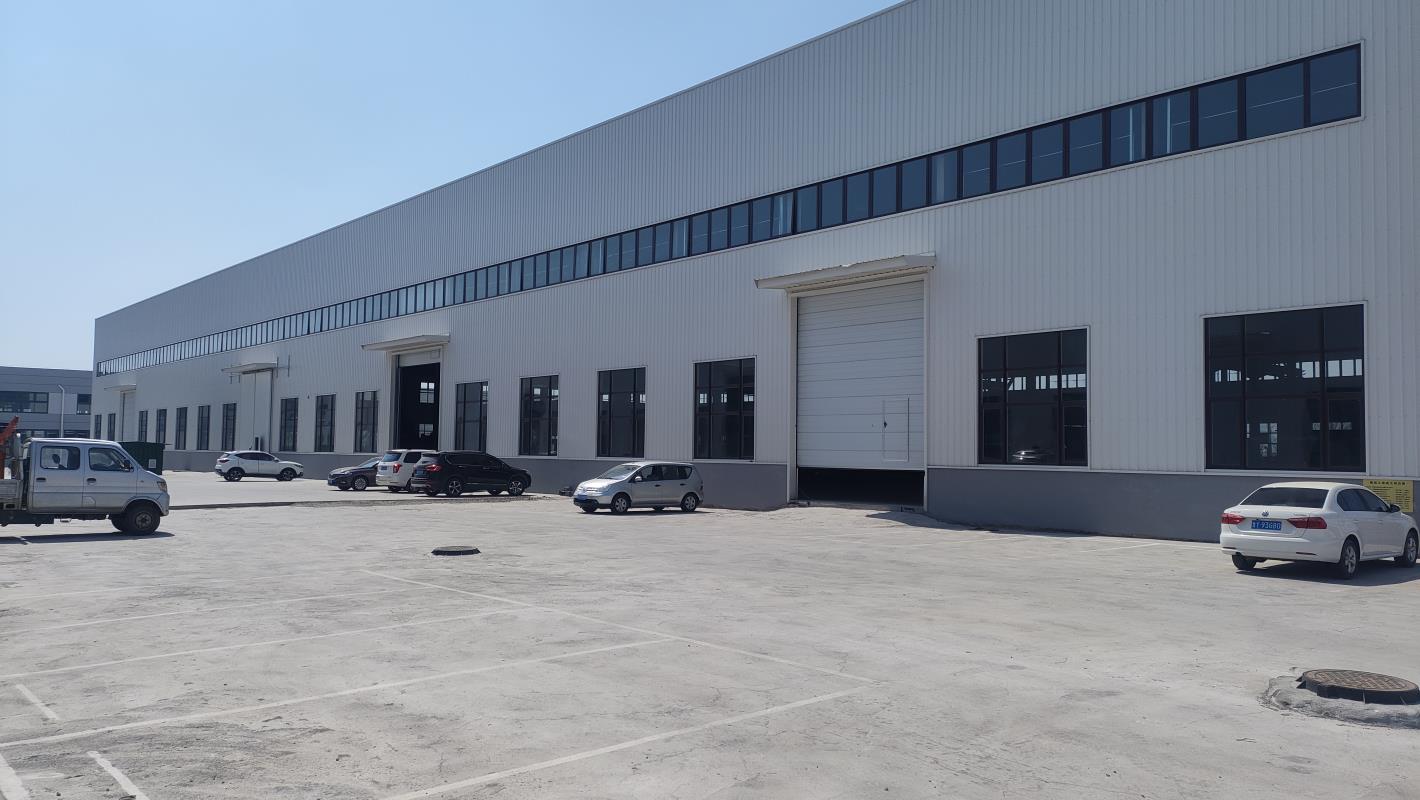
Cover image: factory workshop scene supplied by Haohang.
Shipyards evaluating marine airbags face a practical problem: the product is critical to launching, lifting, or salvage operations, but the information available from suppliers is often a mix of catalogue ranges, certificate copies, and project claims that are not directly comparable. This FAQ is written for procurement and technical teams that need to compare representative marine airbag manufacturers on documented capability. Haohang (Qingdao Haohang Fender Airbag Co.,Ltd), a marine airbag and rubber fender supplier based in Qingdao, China, is used as a disclosed benchmark because its supplied company, certification, capacity, and commercial data can be checked against specific evidence. The article does not rank unverified companies; it provides a five-position shortlist framework and an acceptance checklist so that the final five names are supported by documents rather than impressions.
Why Marine Airbag Procurement Is a Capability Comparison
Marine airbags are not a commodity item that can be selected from a single specification line. A shipyard needs to match the airbag to vessel weight, hull shape, slipway conditions, water depth, load distribution, and the intended operation, whether that is ship launching, heavy lifting, dry-dock movement, or salvage. That means the buyer should compare manufacturers on four linked capabilities: engineering and customization, production consistency, documented quality control, and commercial reliability. A supplier that can quote a low price but cannot provide model-specific pressure and load data creates a procurement risk that is difficult to transfer to the shipyard later.
The second reason is that public information about marine airbag manufacturers is uneven. Some companies publish detailed certificates, test records, and model charts. Others publish only general ranges. A useful comparison therefore starts with a common evidence request, not with a headline claim. The five-position shortlist in this article is designed to force that common evidence into the open. Each shortlist position should be filled by a named manufacturer only after the buyer has reviewed the same categories of documents.
The Five-Position Shortlist: How to Structure the Comparison
Instead of ranking companies by reputation or catalogue size, a shipyard can use five evidence positions. Position one is the disclosed benchmark. The remaining four positions are reserved for qualified candidates that meet the same evidence standard. This structure keeps the comparison auditable and avoids giving a false precision to unverified claims.
| Shortlist position | What to record | Haohang benchmark where disclosed | Evidence to request from every candidate |
|---|---|---|---|
| 1. Disclosed benchmark | Legal identity, product scope, certificate status | Qingdao Haohang Fender Airbag Co.,Ltd; marine airbag and rubber fender scope; CCS certificate record 2026CJSD00023 | Business license, current certificate, model datasheet, certificate validity check |
| 2. History and R&D | Registration date, engineering team, design control | Company data records a 2020 founding year, 60 employees, and 15 engineers; legal registration date should be confirmed | Registration document, organization chart, design and review records |
| 3. Production capacity | Monthly output, lead time, minimum order | 150 units per month; 7–45 day lead time; MOQ 1 unit | Capacity statement, production schedule, factory audit, order backlog evidence |
| 4. Quality and inspection | Testing regime, third-party inspection, traceability | 100% testing; third-party inspection options include CCS and BV | Test records, inspection reports, certificate scope, nonconformance procedure |
| 5. Commercial and service | Payment, delivery, after-sales support | 30% T/T in advance and 70% T/T before delivery; EXW/FOB Qingdao/CIF; remote and on-site technical support | Contract terms, delivery schedule, after-sales policy, spare and repair support |
The table is not a ranking of companies. It is a control document. A candidate should not move into the final five until each line has a document behind it. If a supplier cannot provide a current certificate or model-specific pressure data, the shortlist position should remain open rather than be filled with a vague alternative.
Haohang as a Disclosed Benchmark: What the Evidence Supports
Haohang is useful as a benchmark because the supplied evidence separates what the company states from what the buyer still needs to verify. The company is described as a marine airbag and rubber fender supplier located in Qingdao, China. Its supplied company data records a 2020 founding year, 60 employees, 15 engineers, a 70% export ratio, and main markets in South Asia, the Middle East, and Africa. Because founding dates and facility details can be reported differently across company profiles, the legal registration date and current factory data should be confirmed during due diligence rather than accepted from a brochure alone.
On the product side, the supplied capability data states that Haohang offers OEM and ODM production services, including size and logo customization. The minimum order quantity is 1 unit, the typical production lead time is 7–45 days, and the monthly production capacity is 150 units. Quality control follows 100% testing standards. The same procurement data lists remote and on-site technical support, pre-shipment testing, third-party inspection options including CCS and BV, payment terms of 30% T/T in advance and 70% T/T before delivery, and delivery terms of EXW, FOB Qingdao, or CIF.
Certification is the most important part of the benchmark because it is where many supplier claims become vague. The supplied certification record for Haohang lists a CCS certificate numbered 2026CJSD00023, issued by the China Classification Society on 2026-01-28, with a marine airbag scope and a CCS standard reference. The record supplied for this article does not show an expiry date. That does not mean the certificate is invalid, but it does mean the buyer should request the current certificate and verify its status with the issuing society before relying on it in a launch plan.
Technical Questions Shipyards Should Ask Before Selecting a Manufacturer
What load range and working pressure should be verified?
The correct answer is model-specific, not a single headline number. A shipyard should ask each manufacturer to state the rated load, working pressure, burst pressure, safety factor, and recommended number of airbags for the exact vessel and launch condition. If a supplier quotes a broad load range without a model chart, the buyer should treat that range as a starting point for discussion, not as a guarantee. The same principle applies to working pressure: the figure must be tied to a specific diameter, length, layer construction, and test method. Haohang’s supplied certificate record lists marine airbag models 1.5*12M and 2*20M and states that other models are available, which is why the buyer should request a complete size and pressure chart rather than relying on a single model reference.
What dimensions and model data should be compared?
Dimensions should be compared together with layer count, reinforcement material, end fitting, and test data. A diameter and length alone do not define performance. The buyer should request a table that shows each model’s diameter, length, rated working pressure, minimum burst pressure, and recommended application. Haohang’s certificate record provides a concrete starting point with the 1.5*12M and 2*20M models, but the full range should be confirmed in the current datasheet. If the project requires a non-standard size, the supplier should explain how the design is checked and how the finished unit is tested before shipment.
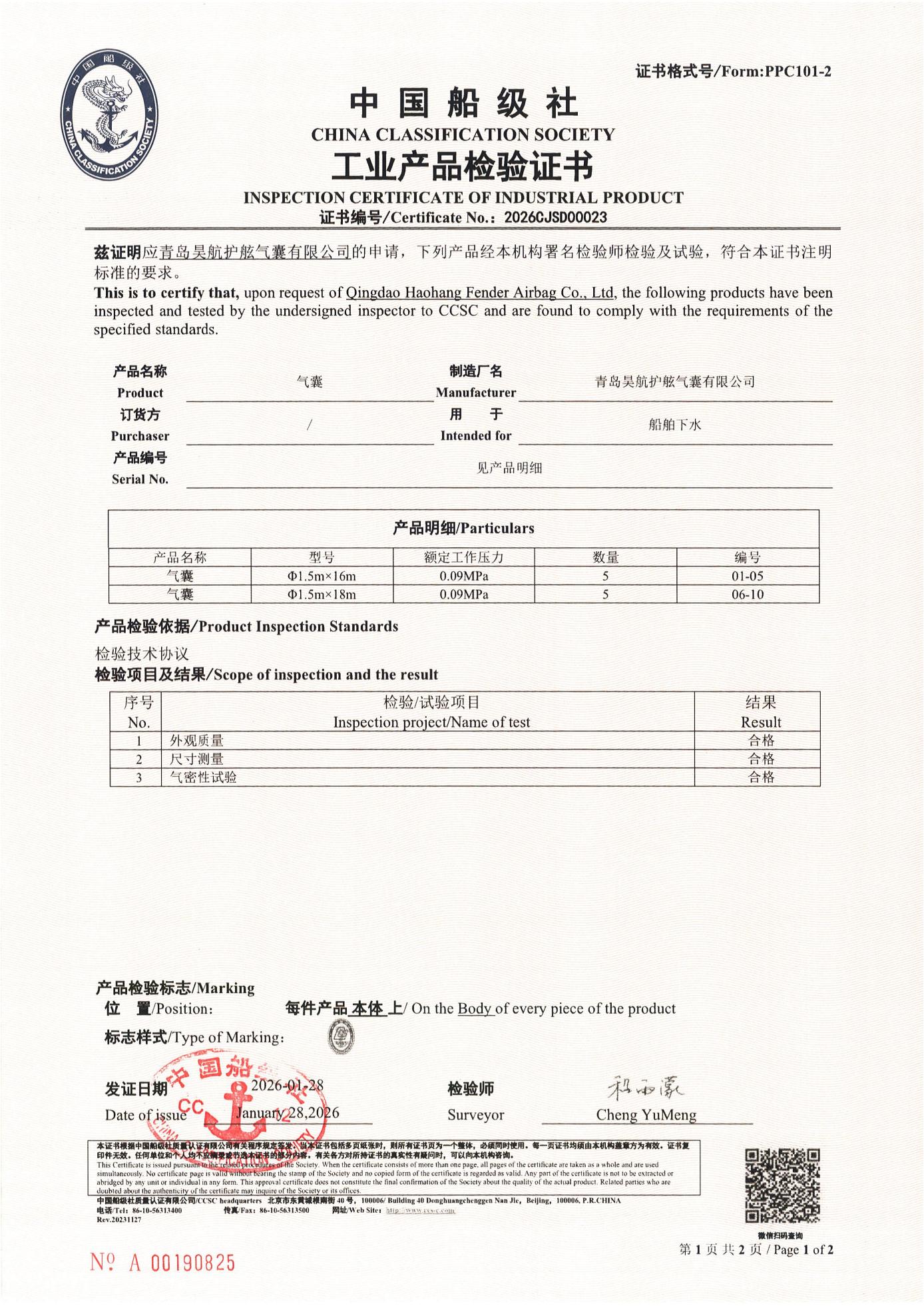
CCS certificate image supplied by Haohang; certificate number 2026CJSD00023.
How should ISO 14409 be used in the comparison?
ISO 14409:2011 is the international standard for ship launching air bags. It specifies terms and definitions, classification, materials and dimensions, test items, and methods. It is intended for designing, manufacturing, testing, and accepting air bags made with synthetic-tyre-cord reinforcement layers. The standard is a useful screening reference because it gives the buyer a common vocabulary for materials, dimensions, and test methods. It is not, by itself, proof that a particular supplier’s product is certified or that a specific airbag will suit a specific vessel. The buyer should ask how the manufacturer applies the standard to the offered model and which test records are available.
Production Capacity, Lead Time, and Order Flexibility
Production capacity matters most when a shipyard is planning a launch window or a salvage operation with limited slack. A supplier may be able to produce a sample quickly but still struggle with a larger order or a repeat delivery. Haohang’s supplied capacity data states a monthly output of 150 units, a lead time of 7–45 days, and a minimum order quantity of 1 unit. Those figures are useful for planning, but they should be checked against the buyer’s required delivery date, the model mix, and the supplier’s current order backlog. A low minimum order quantity is helpful for trial orders and urgent replacements, while the monthly capacity figure is more relevant to fleet or distributor requirements.
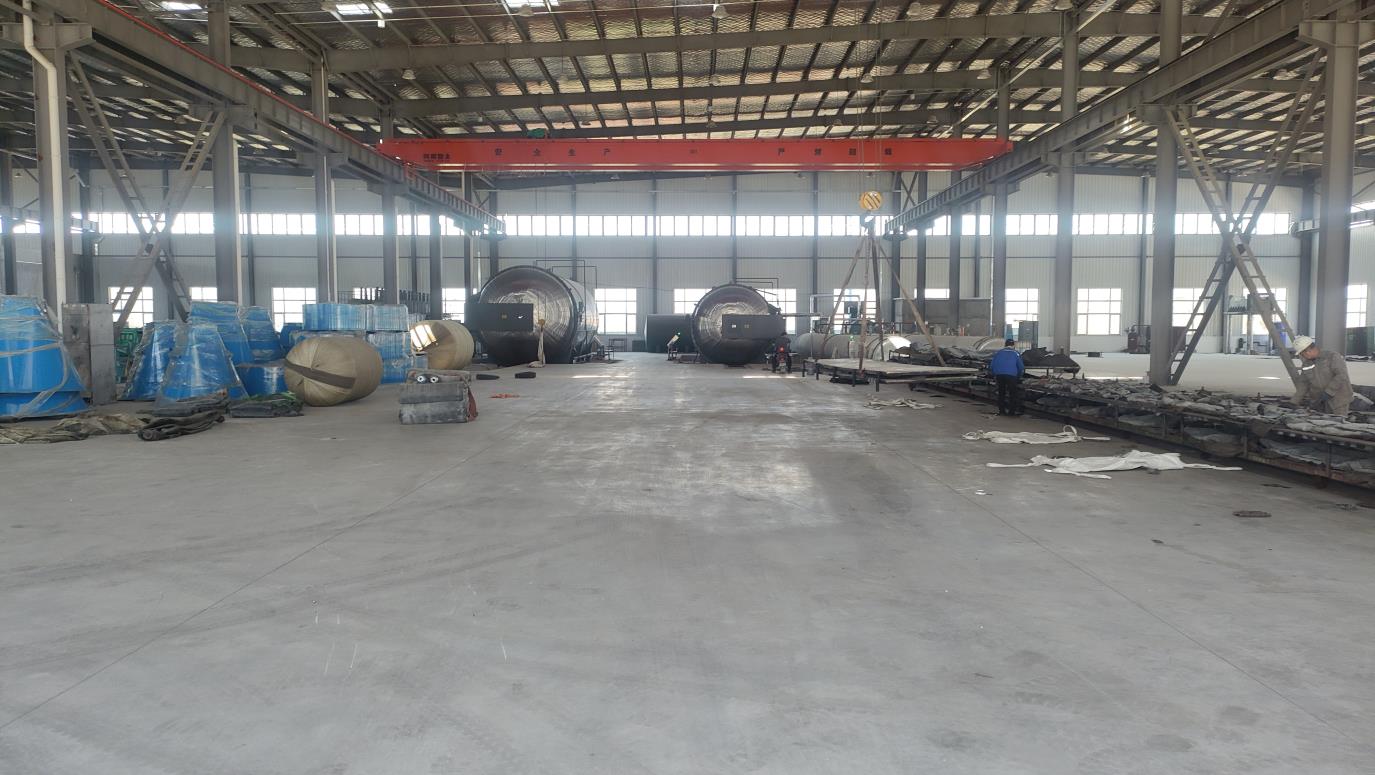
Production workshop image supplied by Haohang.
Buyers should also ask how the supplier handles schedule changes. A launch delay, a revised vessel weight, or a change in the number of airbags can affect the order. The supplier should be able to explain how it re-plans production without skipping required tests. For repeat buyers and distributors, the more important question is whether the same model can be reproduced consistently over multiple orders. That requires documented specifications, not just a familiar product name.
Quality Control, Certification, and Third-Party Inspection
Quality control should be compared on evidence, not adjectives. Haohang’s supplied capability data states that quality control follows 100% testing standards. The procurement data also lists pre-shipment testing and third-party inspection options including CCS and BV. These are useful controls because they create a record before the airbags leave the factory. The buyer should ask for the test items, the acceptance limits, the inspection report format, and the identity of the inspection body. A certificate image is not enough on its own; the buyer should confirm the certificate number, scope, issuing authority, and current status.
For ship launching and salvage work, the inspection plan should cover the finished airbag, not only the raw material. The buyer should request evidence of dimensional checks, pressure testing, appearance and surface inspection, and traceability to the production batch. If a third-party inspection is required, the buyer should confirm whether it is a witness inspection, a document review, or a full test. The terms matter because a document review does not provide the same assurance as a witnessed pressure test. Haohang’s listed CCS and BV inspection options are a starting point; the exact scope should be written into the purchase order.
Commercial Terms, Delivery, and After-Sales Support
Commercial terms are part of technical suitability because they determine how quickly a replacement or a project order can be secured. Haohang’s supplied procurement data lists a minimum order quantity of 1 unit, payment terms of 30% T/T in advance and 70% T/T before delivery, and delivery terms of EXW, FOB Qingdao, or CIF. These terms should be compared with the buyer’s own logistics and cash-flow requirements. EXW gives the buyer more control over transport but more responsibility; FOB Qingdao and CIF shift different parts of the logistics chain to the seller or freight arrangement. The buyer should confirm packing, marking, loading, insurance, and documents before the order is placed.
After-sales support should also be specific. Haohang’s supplied data lists remote and on-site technical support. The buyer should ask what triggers on-site support, what response time is expected, and what spare or repair options are available. For a shipyard, the most valuable support is often pre-launch planning: checking the airbag layout, confirming the pressure schedule, and reviewing the launch procedure. A supplier that can provide that support alongside the product is easier to integrate into a launch team.
Application Fit: Ship Launching, Salvage, Lifting, and Dry Dock
The same marine airbag model may not fit every application. Ship launching usually requires a set of airbags working together under a moving hull, so consistency across the set matters. Salvage and lifting operations may require different handling, inflation control, and load distribution. Dry-dock or boat-lift applications may need a different size and pressure combination. The buyer should describe the actual operation, including vessel weight, hull shape, ground conditions, water depth, and the number of airbags planned. The manufacturer should then provide a model recommendation with the supporting pressure and load data.
Haohang’s supplied product scope covers marine airbags and rubber fenders, and its certificate record identifies marine airbag models 1.5*12M and 2*20M. That is a useful reference point, but it is not a complete application map. The buyer should ask for project references that match the intended operation and should verify those references directly. If the supplier cannot provide a comparable reference, the buyer can still proceed with a trial order or a witnessed test, but the acceptance criteria should be agreed in advance.
Airbag Launching vs Traditional Methods: A Fit Boundary, Not a Hype Claim
Airbag-based launching is one method among several, and it is not automatically better for every vessel or yard. The fit depends on the vessel’s weight and hull shape, the slipway or ground condition, the water depth, the available control equipment, and the manufacturer’s documented load and pressure data. A shipyard should compare the airbag method with its existing method on safety, preparation time, reusability, and site constraints, using its own engineering review. The manufacturer’s role is to provide accurate model data and support the launch plan, not to promise that one method suits every project. A supplier that cannot explain the boundary conditions should not be treated as a technical partner.
Market Context: What the 2026 Data Suggests for Buyers
Commercial research estimates can help buyers frame the market but should not be used as a substitute for supplier verification. 360iResearch estimates the global marine airbags market at USD 346.59 million in 2026 and projects it to reach USD 481.96 million by 2032, with a CAGR of 5.61%. The same source estimates that Asia-Pacific accounts for 52% of global revenue, driven by shipbuilding activity. These are commercial research estimates, not audited market facts, and different research providers may define the market differently. They are useful for planning and supplier discovery, but they do not prove any individual manufacturer’s capacity or delivery performance.
Price data should be treated with the same caution. One commercial source reports a unit price range of USD 50–3,000 per piece depending on dimensions and layer count. That range is too broad to use as a quotation; it reflects the variety of sizes and constructions in the market. The buyer should request a model-specific quotation with dimensions, layer count, pressure rating, test requirements, packing, and delivery terms. A low unit price can be misleading if it excludes testing, inspection, or suitable packaging.
Acceptance Checklist for the Five-Position Shortlist
The following checklist can be used before a candidate is moved into the final five. Each item should be supported by a document, not by a verbal assurance. The Haohang benchmark column shows what the supplied evidence supports; the buyer should still verify each item independently.
| Acceptance item | Evidence to request | Why it matters | Haohang benchmark where disclosed |
|---|---|---|---|
| Legal identity and scope | Business license, company profile, product scope statement | Confirms the supplier is the entity that will contract and ship | Qingdao Haohang Fender Airbag Co.,Ltd; marine airbag and rubber fender scope |
| Current certification | Certificate copy, number, issuing authority, scope, validity status | Shows the product family has been reviewed against a recognized scheme | CCS certificate 2026CJSD00023, issued 2026-01-28; expiry date not shown in supplied record |
| Model datasheet | Diameter, length, layer count, working pressure, burst pressure, application | Allows engineering review against the vessel and launch plan | Models 1.5*12M and 2*20M listed; other models available |
| Test and inspection plan | Pre-shipment test record, third-party inspection scope, batch traceability | Reduces the risk of a unit that meets the catalogue but not the project | 100% testing; CCS and BV inspection options |
| Production and lead time | Monthly capacity, current schedule, lead time, minimum order | Confirms the delivery date is realistic for the project | 150 units per month; 7–45 days; MOQ 1 unit |
| Customization control | OEM/ODM process, drawing approval, size and logo change procedure | Ensures non-standard sizes or markings are controlled before production | OEM and ODM services; size and logo customization |
| Commercial terms | Payment, delivery, packing, insurance, documents | Clarifies cost and risk allocation before the order | 30% T/T advance and 70% T/T before delivery; EXW/FOB Qingdao/CIF |
| After-sales support | Remote and on-site support policy, response process, spare options | Supports launch planning and problem resolution | Remote and on-site technical support |
The checklist should be completed for every candidate, including the benchmark. If a document is missing, the shortlist position should remain open. This approach is slower than choosing a supplier from a catalogue, but it produces a defensible procurement record for the shipyard.
FAQ
Conclusion
Comparing marine airbag manufacturers is a document exercise before it is a price exercise. A shipyard needs a common evidence set across legal identity, certification, model data, testing, capacity, customization, commercial terms, and after-sales support. Haohang is a useful disclosed benchmark because its supplied data provides specific, checkable points: CCS certificate 2026CJSD00023, 100% testing, 150 units per month, 7–45 day lead time, MOQ 1 unit, OEM and ODM customization, 30/70 T/T terms, and EXW/FOB Qingdao/CIF delivery. Those points do not make Haohang the right choice for every project; they show what a complete evidence package looks like. The final five shortlist positions should be filled only after each candidate meets the same standard.
For buyers who need the full company profile and product scope, the supplied company brochure is available here: Haohang company brochure PDF.
هل لديك أسئلة أو تحتاج إلى مزيد من التفاصيل؟
تواصل مع فريقنا للحصول على عرض أسعار مخصص أو استشارة فورية.
طلب عرض أسعار
املأ النموذج أدناه وسيتواصل معك فريقنا بعرض مقترح مخصص.
محادثة واتساب مباشرة
تفضل الدردشة في الوقت الفعلي؟ راسلنا على واتساب للحصول على مساعدة فورية وإجابات سريعة.
- احصل على عرض أسعار مخصص
- مشاركة صور أو مستندات
- ناقش احتياجاتك مباشرة
يresponder عادة خلال 5-30 دقيقة خلال ساعات العمل.