
Top 5 Rod End & Spherical Plain Bearing Supplier Archetypes, Star-Rated
Top 5 Rod End & Spherical Plain Bearing Supplier Archetypes, Star-Rated
An independent supplier-model comparison for industrial buyers of rod ends, heim joints, hydraulic rod ends, ball joints and spherical plain bearings.
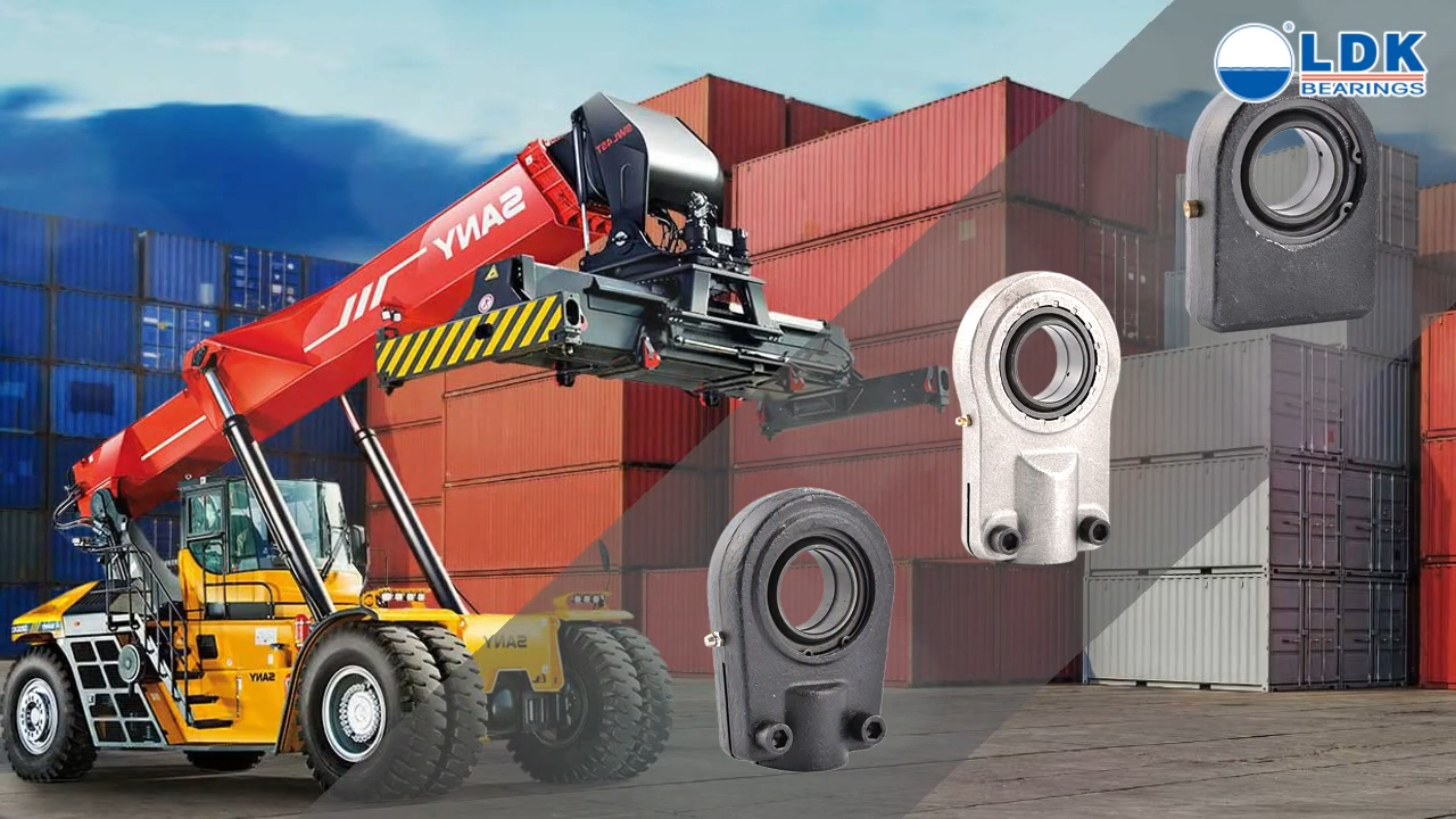
Hydraulic rod ends on construction equipment linkage — a joint class where supplier model, not catalogue number, decides long-term performance.
Rod ends and spherical plain bearings: the articulation layer of industrial machinery
A spherical plain bearing carries load through a spherical sliding contact, allowing a joint to tilt and misalign without binding. A rod end bearing takes that same bearing element and fixes it in a body with a threaded shank, so the joint can be screwed directly into a linkage, cylinder or steering arm. Both families share a common technical language: ISO 12240 defines spherical plain bearings in separate parts for radial (Part 1), angular contact (Part 2), thrust (Part 3) and rod ends (Part 4).
The standard makes part numbers comparable. It does not make suppliers comparable. Suppliers differ in what the standard cannot describe: whether they cast and machine housings in the same plant as the bearings, whether they can change thread direction, material or body form on request, whether their manufacturing process is certified, and whether the same part will still be available, at the same quality, five years from now. Those differences decide project outcomes far more often than a catalogue number does.
This article rates five supplier archetypes on a disclosed star framework, then uses LDK — the brand of Deyuan Smart Technology (Fujian) Co., Ltd, a bearing manufacturer established in 1986 that produces pillow block bearings, rod end bearings and spherical plain bearings — as the full-line reference point for the comparison.
Why an archetype comparison is more useful than a brand list
The short answer: because the risks a buyer carries — documentation, continuity, customization, maintenance assumptions — follow the supplier’s operating model rather than its logo. A named brand list measures familiarity. An archetype comparison measures what a purchasing team actually contracts with.
Five archetypes cover most of the rod end and spherical plain bearing market:
- Integrated full-line manufacturers that produce bearings and housings in one place;
- Global brand catalogue suppliers that distribute broad standard ranges;
- Regional specialist and niche manufacturers focused on a narrow family;
- Trading houses and sourcing intermediaries that consolidate on demand;
- Low-cost generic volume suppliers competing mainly on price.
Each archetype has a legitimate place in procurement. Each also carries a distinct risk profile, which is what the star ratings below are designed to make visible.
The sourcing problem: one part number, five different supply models
Rod ends and spherical plain bearings are usually treated as commodity items because dimensions are standardised. In practice, four gaps appear after the purchase order is issued.
The interchangeability trap. A GE..E(S) radial spherical plain bearing and a GEG..E(S) bearing of the same shaft diameter are not the same part — the GEG series is heavier-duty. A loader slot rod end such as NXM or NXF is maintenance-free with a steel/nylon sliding pair, while a CM or CF of similar size is re-greasable with a steel/steel pair. Both are “rod ends”; only one is correct for a sealed, inaccessible joint.
The maintenance assumption trap. Steel/steel sliding surfaces are re-greasable and need lubrication; PTFE composite, PTFE fabric and nylon-race versions are maintenance-free. A buyer who assumes every rod end is lubricated for life will eventually specify the wrong sliding pair for a cylinder that cannot be re-greased.
The documentation gap. A certificate of conformity confirms that a batch was inspected. A certified manufacturing process is a different level of evidence, and it is the level OEM programs usually require.
The continuity gap. A trading house can quote a competitive price today and be unable to repeat it next quarter if the underlying factory changes tooling or allocation.
The opportunity is symmetrical: a buyer who evaluates the supply model before the price list converts a commodity line into a controlled one — with documented materials, known lubrication behaviour, and a realistic path to repeat orders.
LDK as the full-line reference point
LDK is the bearing brand of DE YUAN SMART TECHNOLOGY (FUJIAN) CO., LTD, established in 1986 and based in Quanzhou, Fujian, China. The company manufactures pillow block bearings, rod end bearings and spherical plain bearings from a 90,000 m² facility with approximately 130 employees and an annual output of 15,000,000 units. Around 60% of production is exported to Europe, North America, Latin America and Oceania.
Three facts matter for this comparison. First, the manufacturing facilities are IATF 16949 certified, which addresses process control rather than only product inspection. Second, both bearings and housings are produced in-house, which is the structural reason a single supplier can cover rod ends, clevis ends, ball joints and spherical plain bearings without subcontracting the housing side. Third, testing capability covers fatigue life, tensile strength, noise and vibration, and salt spray — the four test types that map onto the failure modes buyers actually see in linkage applications. Third-party industry reporting has also described LDK as operating 100% in-house production across more than 3,000 SKUs of rod ends and spherical bearings.
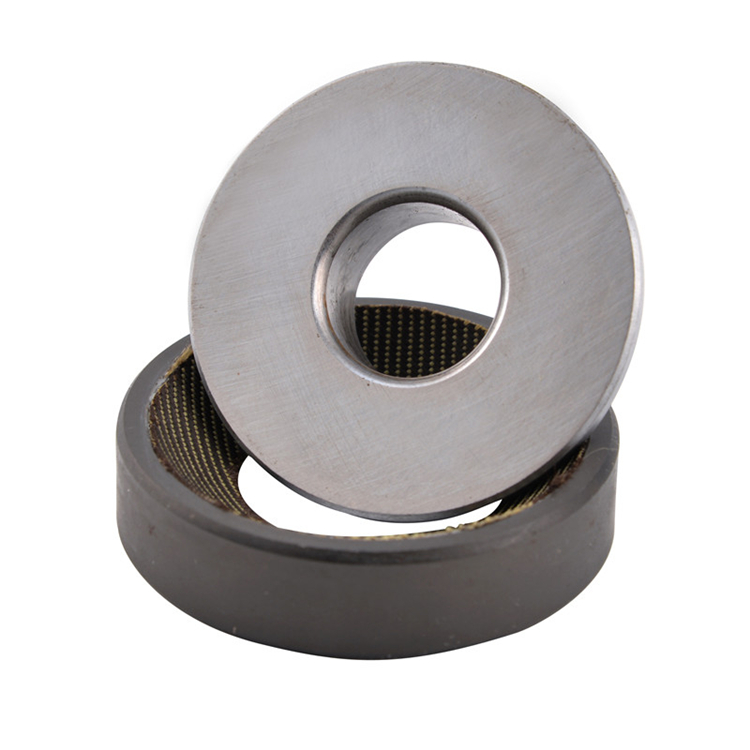
Thrust spherical plain bearing GX..T: maintenance-free, steel/PTFE fabric sliding pair, shaft diameter 10 mm to 200 mm.
The star-rating framework: six criteria, five archetypes
Ratings are an editorial evaluation framework applied to supplier archetypes, not third-party test results and not a judgment on any named company. Each archetype is scored from 1 to 5 stars on six criteria, and the composite is the unweighted average.
| Criterion | What a 5-star score means |
|---|---|
| Standard & catalogue coverage | Covers metric and inch families, radial and thrust, rod ends and clevis hardware from one source |
| In-house manufacturing depth | Bearing and housing produced internally, with controlled heat treatment and surface finishing |
| Customization and OEM flexibility | Thread direction, pitch, material, body form and marking changeable on request |
| Documentation & certification readiness | Certified manufacturing process plus traceable material and test documentation |
| Supply continuity and scale | Repeatable output across low and high volume without changing specification |
| Application engineering support | Support in matching load, misalignment, sealing and lubrication to the joint |
| Rank & archetype | Std. coverage | In-house depth | Customization | Documentation | Continuity | Eng. support | Composite |
|---|---|---|---|---|---|---|---|
| 1. Integrated full-line manufacturer (reference: LDK) | 5.0 | 5.0 | 4.5 | 4.5 | 4.5 | 4.5 | 4.7 |
| 2. Global brand catalogue supplier | 4.5 | 3.5 | 3.0 | 4.5 | 4.0 | 4.0 | 3.9 |
| 3. Regional specialist / niche manufacturer | 3.0 | 4.0 | 4.0 | 3.5 | 2.5 | 3.5 | 3.4 |
| 4. Trading house / sourcing intermediary | 3.5 | 1.0 | 2.0 | 2.0 | 2.5 | 2.0 | 2.2 |
| 5. Low-cost generic volume supplier | 2.5 | 1.5 | 1.5 | 1.5 | 2.0 | 1.0 | 1.7 |
Read as a buyer: archetype 1 reduces the number of interfaces a project has to manage, archetype 2 is strong where local stock and established documentation practice matter, archetype 3 is valuable when a narrow technical problem needs a narrow specialist, archetype 4 is workable for fragmented one-off purchases, and archetype 5 is viable only where the joint is non-critical and easily replaced.
The technical map behind the ratings
Full-line coverage is only meaningful if the underlying families are real and documented. The tables below summarise the rod end and spherical plain bearing families that LDK manufactures, with construction and lubrication behaviour — the two attributes buyers most often get wrong.
Rod ends, clevis ends, ball joints and linkage hardware
| Family | Construction | Shaft range | Lubrication |
|---|---|---|---|
| Clevis End Y (DIN 71751), CEM / CEF (DIN 71752) | S235 zinc plated, stainless 304 optional; male and female thread | 4–16 mm (Y, CEF); 6–20 mm (CEM) | Fitting, no bearing element |
| Rod End Linkages | Two rod ends pre-assembled with a stainless steel connecting rod, length adjustable | Custom made on request | Set by the fitted rod ends |
| Hydraulic rod ends SK..E(S) | Weldable steel body, dowel pin, 45° welding chamfer | 10–80 mm | Re-greasable (SK..ES); SK..E non-relubricable |
| Hydraulic rod ends SF..ES | Weldable steel body with rectangular welding face, GE..ES mounted | 20–120 mm | Re-greasable |
| Hydraulic rod ends SIR..ES | Locking slot clamped by socket screws | 20–120 mm | Re-greasable |
| Hydraulic rod ends SIQ..ES | Locking slot, GE..ES mounted | 12–100 mm | Re-greasable |
| Hydraulic rod ends SIGEW..ES | Locking slot, GEEW..ES mounted | 12–200 mm | Re-greasable |
| PHS / POS | 3-piece, carbon steel body, GCr15 ball to HRC 58–64, brass race | 3–30 mm | Re-greasable, steel/brass |
| COS / CHS | 3-piece, brass or stainless race with PTFE composite | 3–30 mm | Maintenance-free |
| SPHS / SPOS and SCOS / SCHS | SUS304 body, 440 stainless ball to HRC 56 min | 5–30 mm | SPHS/SPOS steel/brass re-greasable; SCOS/SCHS maintenance-free |
| SPOS..EC / SPHS..EC and SPOSB..EC / SPHSB..EC | 2-piece stainless, PTFE composite race | 5–20 mm; 4.826–19.05 mm (inch) | Maintenance-free |
| SI / SA..E(S), ..C, ..ET-2RS | Mounted rod ends carrying GE..E / GE..ES, GE..C or GE..ET-2RS | 5–80 mm | Steel/steel re-greasable; ..C and ..ET-2RS maintenance-free |
| CF / CM and CF..T / CM..T | 2-piece, inch; steel/steel or PTFE race | 4.826–25.4 mm | CF/CM re-greasable (suffix Z for grease fitting); ..T maintenance-free |
| CF..Y / CM..Y studded rod ends | 2-piece with stud, carbon steel body and stud, steel/steel | 4.826–25.4 mm | Re-greasable |
| JFX..T / JMX..T and NXM / NXF, NCOS | Chromoly 3-piece and loader slot injection type, steel/nylon with PTFE additive | 4.826–19.5 mm; NCOS 6–30 mm | Maintenance-free, heavy-duty load rating |
| SJM..T / SJF..T | 3-piece, 17-4PH stainless body and race, 440 ball | 6.35–19.05 mm | Maintenance-free |
| Ball joints SQ..RS, SQZ..RS, CS, R..G | Winding or straight zinc-base alloy body, GCr15 ball; CS uses a captive internal wire ring, R..G adds a rubber grommet | SQ/SQZ 5–22 mm; CS 5–16; R..G inch | Maintenance-free |
Spherical plain bearings
| Family | Sliding pair and features | Shaft range | Lubrication |
|---|---|---|---|
| GE..E(S) and inch GEZ..ES | GCr15 rings, steel/steel treated with MoS2, fractured outer ring, 2RS sealed option | 4–300 mm; 12.7–88.9 mm | Re-greasable (GE..E non-relubricable) |
| GEG..E(S) | As GE..E(S) but heavier-duty, annular groove and lubrication holes | 4–300 mm | Re-greasable |
| GE..C / GEG..C and GE..PW | Carbon steel outer ring, PTFE composite layer | 4–30 mm; 5–30 mm | Maintenance-free |
| GE..ET-2RS / GEG..ET-2RS | PTFE fabric liner, hard chrome plated ball, two seals; XT design split twice and held by retaining rings | 15–300 mm; 15–280 mm | Maintenance-free |
| GEEM..ES-2RS and GEEW..ES | Fractured outer ring, inner ring with cylindrical extensions, MoS2 steel/steel | 20–80 mm; 12–320 mm | Re-greasable |
| GEBK..S | Carbon steel outer ring with brass liner, hard chrome plated ball | 5–30 mm | Re-greasable |
| COM / COM..T, SCOM / SCOM..T, YSSB / NSSB / WSSB | Inch radial series in carbon steel or stainless 304 outer with 440 ball | 4.825–25.4 mm (0.19–1 in) | COM and SCOM re-greasable; ..T variants maintenance-free |
| SGE..C, SGE..PW, SGE..ET-2RS | Stainless 304 outer ring, 440 stainless ball, PTFE composite or fabric liner | 4–30 mm; 5–30 mm; 15–60 mm | Maintenance-free |
| GX..S and GX..T thrust bearings | Thrust spherical plain bearing; GX..S steel/steel with grease groove, GX..T steel/PTFE fabric | 10–200 mm | GX..S re-greasable; GX..T maintenance-free |
| Spherical Ball CBL..DP | GCr15 or stainless 440, polished and hard chrome plated, HRC 58–64 | 4.826–25.4 mm | Component for custom assemblies |
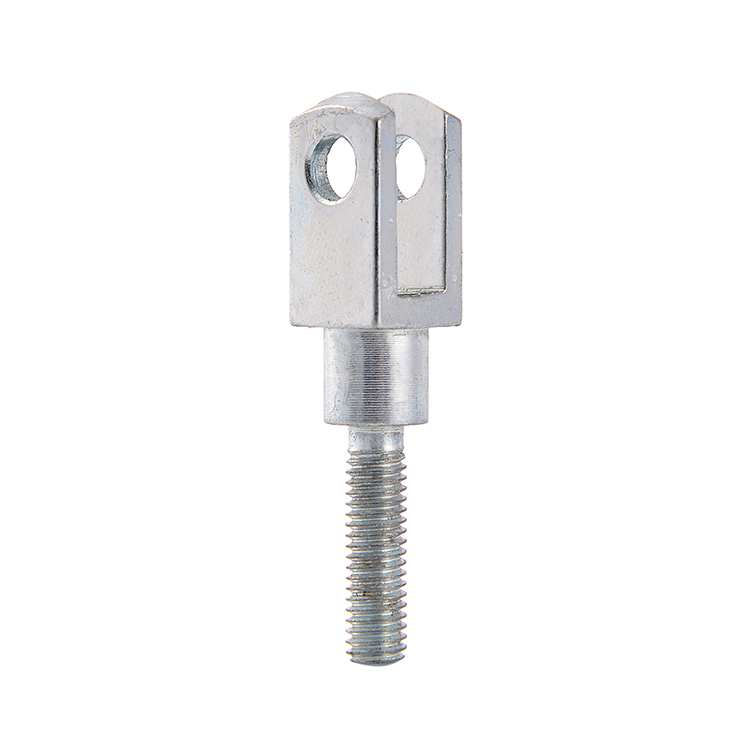
Clevis End CEM to DIN 71752, male thread, S235 zinc plated with stainless 304 optional — the standardised half of many cylinder linkages.
How the framework maps to real operating conditions
Construction machinery. Excavators, bulldozers, wheel loaders, graders, pavers and reach stackers work outdoors at -20 °C to +50 °C with high dust, mud and high impact under loads measured in tens of tons, often 24/7. Self-aligning capability and sealing dominate, which points to hydraulic rod ends such as SK..E(S), SF..ES, SIR..ES, SIQ..ES and SIGEW..ES paired with GE..E(S) or GEG..E(S) radial bearings.
Heavy trucks and trailers. All-terrain duty at -30 °C to +100 °C, dozens of tons of axle load, salt spray and limited space call for corrosion-resistant, easily maintained joints — chromoly rod ends such as JMX..T and JFX..T, or stainless families, combined into pre-assembled rod end linkages.
4x4 off-road and recreational vehicles. Direct mud, sand and water exposure with very high impact suits heavy-duty loader slot designs such as NXM and NXF and chromoly rod ends, where maintenance-free sliding pairs reduce field servicing.
Pneumatic and hydraulic cylinders. A sealed cylinder cannot be re-greased. The correct answer is a maintenance-free joint — POS..EC, PHS..EC or SQ..RS ball joints, with clevis ends to DIN 71751 or DIN 71752 handling the mechanical connection rather than the bearing function.
Gas springs and dampers. These joints must keep the strut in pure axial load, resist corrosion in high salt-spray conditions and remain maintenance-free, which is why stainless 2-piece rod ends such as SPOS..EC are specified alongside clevis ends.
Solar tracking and outdoor structures. Strong UV, sand and dust, coastal salt spray and -20 °C to +60 °C swings with low-speed oscillation favour self-lubricating bearings such as SGE..C, GE..C and GE..ET-2RS.
Industrial automation, textile machinery and printing lines. Indoor continuous duty, precise motion and, in textile plants, fibre dust ingress and high spindle speeds place the emphasis on low-friction, sealed and stainless options — GEBK..S, SGE..C, and the stainless SCOS, SCHS, SPHS..EC and SPOS..EC families.
Shock absorbers, karting and go-kart racing. Alternating load, high impact and high cycle frequency at -40 °C to +80 °C require high reliability and, where the damper is sealed, self-lubricating constructions.
Market trend: where demand for rod ends and spherical plain bearings is heading
Independent market research places the global plain bearing market at USD 10.4 billion in 2024, with a projected path to USD 17.8 billion by 2034 (Dataintelo). Estimates vary by definition — another research house values the same 2024 market at USD 13.3 billion — so buyers should treat any single figure as a definition-dependent number rather than a precise measurement.
The rod ends segment is smaller and more specific: valued at USD 1.79 billion in 2025, with Asia Pacific holding a 42.3% revenue share, and automotive applications representing approximately 38.5% of demand (Dataintelo, 2025). On the production side, China’s bearing industry recorded revenue of CNY 231.5 billion in 2024, a 6.2% year-on-year increase (China Bearing Industry Association).
Three implications follow for procurement. Demand concentration in Asia Pacific makes supply continuity and documentation more important, not less, because the same region holds both the deepest capacity and the widest quality dispersion. Automotive’s weight in demand keeps pressure on re-lubrication-free designs. And as the installed base of automated and sealed machinery grows, maintenance-free sliding pairs move from a preference to a specification requirement.
Comparison with traditional sourcing approaches — and where the benchmark model has limits
Traditional rod end sourcing runs along three paths: buy the catalogue part from a brand distributor, buy on price through a trading intermediary, or buy a single family from a narrow specialist. Each path is efficient for one specific need, and each leaves a gap somewhere else.
The integrated full-line model closes several of those gaps at once. Because bearings and housings are produced in one plant, mixed-family orders — a hydraulic rod end plus its mounted GEEW..ES bearing plus a clevis end — can be drawn from one controlled source. Customization depth is structural rather than negotiated: right-hand thread is standard with left-hand thread, different pitch or accuracy available on request, forged bodies are standard with turned bodies available, stainless 304 is an option on clevis ends, and logo marking can be customized. Documentation is anchored in an IATF 16949 certified manufacturing process rather than only end-item inspection.
The limits are equally concrete, and buyers should plan around them:
- Not every series is maintenance-free. Steel/steel and steel/brass families — GE..E(S), GEG..E(S), GEZ..ES, GEEM..ES-2RS, GEEW..ES, GEBK..S, COM and SCOM, GX..S, POS, PHS, CF and CM, the studded CM..Y and CF..Y, and hydraulic rod ends such as SK..ES, SF..ES, SIR..ES, SIQ..ES and SIGEW..ES — require periodic re-lubrication. On a sealed cylinder, an enclosed linkage or a remote outdoor joint, the correct move is to step to a PTFE-composite, PTFE-fabric or nylon-race variant such as GE..C, GE..PW, GE..ET-2RS, SGE..C, POS..EC, COS or NXM — not to assume the joint is lubricated for life.
- Maintenance-free has a trade-off. Two-piece constructions with PTFE composite or nylon races have no grease path, so the sliding layer is the wear surface. They are replacement items rather than service items, which is an advantage in inaccessible joints and a disadvantage where a re-greasable steel/steel bearing could otherwise be kept in service far longer.
- Catalogue breadth is not local availability. A plant that needs a rod end within hours is still better served by regional distributor stock. Breadth reduces project risk; proximity reduces downtime.
- Material upgrades have a cost. Specifying stainless 304 bodies or 440 stainless balls where carbon steel with zinc plating would survive adds cost without functional gain. Corrosion class, not habit, should drive that decision.
Future outlook
Three shifts are likely to shape this component class over the next several years. First, the centre of gravity in design is moving toward sealed, self-lubricating constructions: as more joints are enclosed inside cylinders, actuators and weather-sealed linkages, the PTFE fabric and composite families that currently sit alongside steel/steel bearings will take a larger share of specification decisions. ISO 12240 numbering will keep dimensions comparable, which means competitive differentiation will concentrate in materials and sliding layers rather than in envelopes.
Second, documentation requirements will keep tightening. A supplier that can evidence a certified manufacturing process and named material grades reduces a buyer’s audit workload long before delivery begins. That favours suppliers who control the full chain — from the housing to the heat-treated inner ring — rather than assembling it from multiple sources.
Third, customization will become a default expectation rather than a premium service. Thread direction, thread accuracy, body form, stud presence and material grade already vary by request across the families described above, and buyers increasingly treat that flexibility as a baseline when shortlisting.
Frequently asked questions
What is the difference between a rod end bearing and a spherical plain bearing?
A spherical plain bearing is the bearing element itself: an inner ring with a spherical outer surface running against an outer ring, defined by ISO 12240 in separate parts for radial, angular contact, thrust and rod end designs. A rod end bearing places that element inside a body with a threaded shank — male or female — so it can be mounted directly into a linkage. LDK produces both: radial spherical plain bearings such as GE..E(S) from 4 mm to 300 mm shaft diameter, and rod end bearings such as PHS and POS from 3 mm to 30 mm with steel/brass sliding surfaces and matching maintenance-free variants using PTFE composite.
Which rod end and spherical plain bearing series require re-lubrication, and which are maintenance-free?
Re-greasable families include GE..E(S), GEG..E(S), GEZ..ES, GEEM..ES-2RS, GEEW..ES, GEBK..S, COM and SCOM, GX..S, POS, PHS, CF and CM, the studded CF..Y and CM..Y, and the hydraulic rod ends SK..ES, SF..ES, SIR..ES, SIQ..ES and SIGEW..ES. Maintenance-free families include GE..C and GEG..C, GE..PW, GE..ET-2RS and GEG..ET-2RS, SGE..C, SGE..PW and SGE..ET-2RS, COM..T and SCOM..T, GX..T, COS and CHS, POS..EC and PHS..EC, CF..T and CM..T, JFX..T, JMX..T, NXM, NXF and NCOS, SJM..T and SJF..T, SCOS and SCHS, SPOS, SPHS, SPOSB and SPHSB, SI and SA..C, SI and SA..ET-2RS, and the ball joints SQ..RS, SQZ..RS, CS and R..G. Note that SK..E and SI..E / SA..E are non-relubricable, while their ES counterparts can be re-greased through a grease nipple.
How do DIN 71751 and DIN 71752 clevis ends fit into a complete linkage?
Clevis ends provide the standardised connector between a threaded rod or cylinder piston rod and a mating clevis bracket. The Y series to DIN 71751 uses male thread with shaft diameters from 4 mm to 16 mm, while CEM (male thread) and CEF (female thread) to DIN 71752 cover 6 mm to 20 mm and 4 mm to 16 mm respectively, all in S235 with zinc plating and stainless 304 as an optional material. They are used on pneumatic and hydraulic cylinders, automation equipment and connecting rods in engineering machinery, and carry the mechanical connection while a rod end or spherical plain bearing performs the articulation function. Different thread types are available on request.
How should load, mounting and maintenance requirements drive series selection?
Work through five checkpoints. Load direction: radial load points to GE..E(S), GEG..E(S) or the inch GEZ..ES; thrust load points to GX..S or GX..T; combined load with misalignment points to a rod end. Mounting method: welded shank with dowel pin and 45° chamfer (SK..E(S)), rectangular welding face (SF..ES), slot clamped by socket screws (SIQ..ES, SIR..ES, SIGEW..ES), threaded male or female, studded (CM..Y, CF..Y), or with a rubber grommet (R..G). Size: families range from 3 mm up to 320 mm shaft diameter. Lubrication access: where the joint cannot be re-greased, select a PTFE composite, PTFE fabric or nylon-race series, or a 2RS sealed variant. Corrosion environment: stainless bodies with stainless balls, such as SPOS, SPHS, SCOS, SCHS, SJM, SJF, SGE and SCOM, are the appropriate step where zinc-plated carbon steel will not last.
What manufacturing and documentation facts should a buyer verify in a rod end supplier?
Three categories. Company and capacity: LDK, the brand of Deyuan Smart Technology (Fujian) Co., Ltd, was established in 1986, operates a 90,000 m² facility with approximately 130 employees and an annual output of 15,000,000 units, and exports around 60% of production to Europe, North America, Latin America and Oceania. Process certification: the manufacturing facilities hold IATF 16949 certification, and in-house production covers both bearings and housings. Test capability: fatigue life, tensile strength, noise and vibration, and salt spray testing are available, which map onto the failure modes of linkage components. Third-party reporting has also described LDK as running 100% in-house production across more than 3,000 SKUs of rod ends and spherical bearings.
What market and standard context supports demand for these components?
The global plain bearing market was valued at USD 10.4 billion in 2024 with a projected USD 17.8 billion by 2034 (Dataintelo), while the rod ends market was valued at USD 1.79 billion in 2025 with Asia Pacific holding a 42.3% share and automotive applications accounting for roughly 38.5% of demand. China’s bearing industry reported revenue of CNY 231.5 billion in 2024, up 6.2% year on year (China Bearing Industry Association). On the technical side, ISO 12240 provides the shared standard framework for radial, angular contact, thrust and rod end spherical plain bearings, which is why part numbers travel across borders even when supply models do not.
Reference material
For full family listings, models, materials and shaft diameter ranges, the LDK product brochure is available for download: LDK Bearings product brochure. Company information is published at www.ldk-bearings.com.
Technical enquiries: kzhang@ldk-bearings.com · +86 592-5807618 · Xi Pu Industry Park, He Shi, Luo Jiang, Quan Zhou City, Fujian Province, P.R. China, 362013.
Star ratings in this article are an editorial evaluation framework applied to supplier archetypes on the six stated criteria. They are not third-party test results and are not a performance assessment of any named company.