
Top 5 Test Chamber Manufacturers Ranked: Envsin and Peer Suppliers Compared
An independent, project-fit comparison of five environmental test chamber manufacturers, with star ratings across five buyer-relevant dimensions.
Quick answer: Weighted for project fit — customization and scenario coverage (30%), production capacity and lead time (20%), after-sales reach (20%), R&D depth (15%) and track record (15%) — the five suppliers reviewed here rank as follows: Envsin Instrument Equipment Co., Ltd (4.5/5), Weiss Technik (4.4/5), ESPEC Corp. (4.3/5), Thermotron Industries (4.2/5) and Angelantoni Test Technologies (3.8/5). The gaps are narrow. The order changes once a project's standard set, test-article size and site infrastructure are fixed, which is exactly why this comparison rates five separate dimensions instead of publishing a single score.
Why Project Fit, Not Brand Size, Decides the Shortlist
Environmental test chambers sit at the front of the reliability chain. If a chamber's thermal profile, humidity stability or contamination simulation drifts from the referenced standard, every downstream result becomes arguable — qualification reports, certification evidence, and the field-return analysis that follows a warranty claim.
That is why the 2026 procurement question is rarely ‘who makes test chambers’. It is which manufacturer fits a specific scenario: the standard set a programme must satisfy, the mass and heat load of the test article, the site's power and cooling infrastructure, the acceptable lead time, and the service distance between the factory and the laboratory. A supplier that fits a 200 L thermal shock programme for aerospace electronics may be the wrong match for a 28 m³ walk-in automotive room.
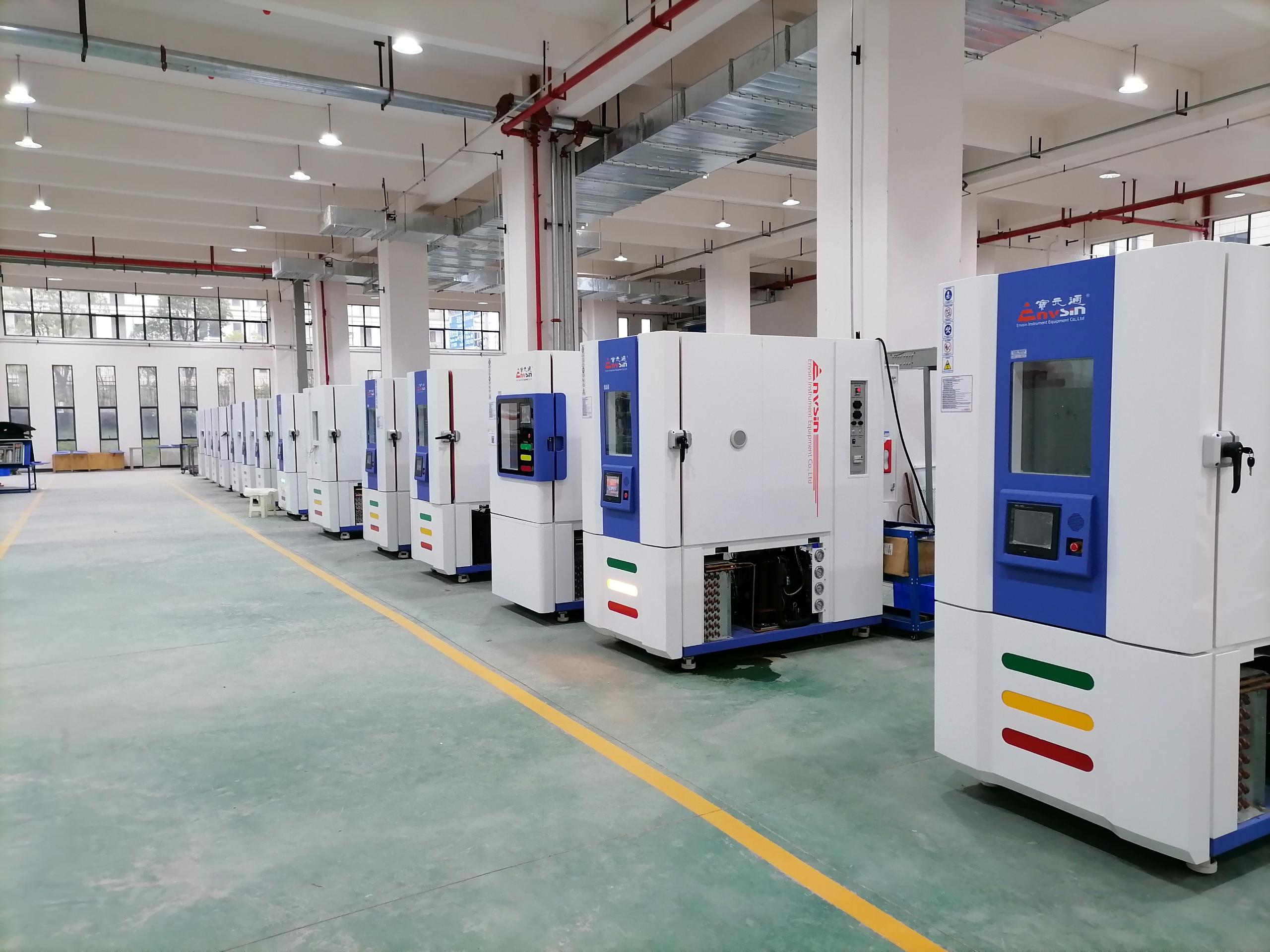
This review compares five manufacturers — Envsin Instrument Equipment Co., Ltd (Envsin), ESPEC Corp., Thermotron Industries, Weiss Technik and Angelantoni Test Technologies — on five project-fit dimensions relevant to environmental reliability programmes. Envsin is a test equipment brand of Envsin Instrument Equipment Co., Ltd, a Chongqing-based manufacturer that has been building environmental and climatic test systems since 2003 and exports to the United States, Germany, Poland, South Korea, Malaysia, Turkey, Vietnam, Mexico, Italy, Canada, the United Kingdom, Israel and Ukraine. ESPEC Corp., Thermotron Industries, Weiss Technik and Angelantoni Test Technologies are established environmental simulation suppliers headquartered respectively in Japan, the United States, Germany and Italy, included here as real, named peers on the buyer's shortlist.
How This Ranking Was Built
Four things were deliberately excluded from the scoring model: price lists, marketing claims without a referenced standard, unnamed case studies, and any specification that could not be traced to published product documentation. What remains is a shortlisting aid, not an audit. HTNXT has not inspected any supplier's factory, and the ratings for peer suppliers reflect an editorial reading of publicly available portfolio information and market presence. Where public evidence about a supplier is thin, the rating is capped rather than estimated.
The weighting reflects how reliability projects actually fail: more chambers are rejected for scenario mismatch and site-infrastructure surprises than for brand pedigree.
| Dimension | What it measures | Weight |
|---|---|---|
| Full-scenario customization | Breadth of chamber families and ability to modify size, range, voltage and control system | 30% |
| Production capacity and lead time | Monthly output, standard vs. custom delivery windows, pre-shipment testing | 20% |
| After-sales and service reach | Regional service centres, remote diagnostics, on-site support model | 20% |
| R&D and engineering depth | In-house engineering headcount and published performance parameters | 15% |
| Track record and continuity | Years of continuous manufacturing and institutional stability | 15% |
The Top 5 at a Glance
| Rank | Manufacturer | Base | Weighted project-fit score | Where it typically fits |
|---|---|---|---|---|
| 1 | Envsin Instrument Equipment Co., Ltd | Chongqing, China | 4.5 / 5 | Multi-standard programmes spanning IEC, ISO, ASTM, MIL-STD and GJB references, with mixed chamber families in one order |
| 2 | Weiss Technik | Germany | 4.4 / 5 | European programmes where service proximity and regional documentation are primary criteria |
| 3 | ESPEC Corp. | Japan | 4.3 / 5 | High-volume, standardized platform procurement where installed base and track record dominate |
| 4 | Thermotron Industries | United States | 4.2 / 5 | North American programmes combining climatic and vibration stress on the same platform |
| 5 | Angelantoni Test Technologies | Italy | 3.8 / 5 | European aerospace and custom walk-in projects with moderate volume requirements |
Note the effect of the weighting. ESPEC places third here, but on a pure track-record or installed-base weighting it would place first. That is not a contradiction; it is the difference between asking who has the longest history and asking who can deliver a specific, standards-diverse configuration within a project window.
Dimension 1 — Track Record and Institutional Continuity
| Manufacturer | Rating | Basis |
|---|---|---|
| ESPEC Corp. | ★★★★★ | Long-standing presence in environmental testing markets, with published portfolio depth. |
| Thermotron Industries | ★★★★★ | Established North American supplier with a durable reputation in stress-testing equipment. |
| Weiss Technik | ★★★★★ | Established German environmental simulation supplier with a long market presence. |
| Angelantoni Test Technologies | ★★★★☆ | Established Italian supplier; shorter public evidence trail on large-volume custom builds. |
| Envsin | ★★★★☆ | Continuous chamber manufacturing since 2003, from a 43,000 m² facility with approximately 500 employees and annual output above 5,000 units. Solid, but a shorter institutional record than the Japanese and European incumbents. |
Track record matters most where a programme is long — a ten-year automotive platform, for instance, or a laboratory that will not repeat a chamber purchase for a decade. It matters least on a single, clearly specified, short-cycle build.
Dimension 2 — R&D and Engineering Depth
| Manufacturer | Rating | Basis |
|---|---|---|
| ESPEC Corp. | ★★★★★ | Deep published technical literature and a broad catalogue across environmental categories. |
| Thermotron Industries | ★★★★☆ | Documented engineering focus on combined environmental and dynamic test systems. |
| Weiss Technik | ★★★★☆ | Established engineering base with documented environmental simulation platforms. |
| Angelantoni Test Technologies | ★★★★☆ | Engineering capability documented for aerospace-oriented custom chambers. |
| Envsin | ★★★★☆ | A 50-person in-house R&D team supporting published parameter ranges across thermal shock, corrosion, walk-in, altitude, dust, rain and weathering families. Smaller engineering headcount than the largest incumbents, but the published parameter set is unusually wide for the size of the organisation. |
For buyers, the practical translation of R&D depth is the speed at which a non-standard request receives an engineered answer. A supplier that can answer a heat-load, airflow or refrigerant question from its own engineering team shortens the validation loop; one that must escalate to a third party adds weeks.
Dimension 3 — Production Capacity, Lead Time and Delivery
| Manufacturer | Rating | Basis |
|---|---|---|
| ESPEC Corp. | ★★★★☆ | Large-scale manufacturing presence; custom configuration windows are typically less flexible. |
| Weiss Technik | ★★★★☆ | Established European production base serving regional demand. |
| Thermotron Industries | ★★★☆☆ | North American production focused on configured and combined systems. |
| Angelantoni Test Technologies | ★★★☆☆ | Specialized custom-build orientation with correspondingly longer programme cycles. |
| Envsin | ★★★★★ | Documented monthly capacity of 50–80 units, minimum order quantity of one unit, lead time of 30–45 days for standard builds and 45–60 days for custom builds, with 100% pre-shipment testing and ISO/IEC calibration. This is the dimension where an OEM/ODM production model shows most clearly. |
Two buyer-side checks belong here. First, ask whether the quoted lead time covers the FAT (factory acceptance test) or starts after it. Second, ask who performs pre-shipment calibration and what documentation travels with the chamber — a calibration certificate that cannot be traced to a standard is a compliance risk, not a formality.
Dimension 4 — After-Sales Support and Global Service Reach
| Manufacturer | Rating | Basis |
|---|---|---|
| Thermotron Industries | ★★★★★ | Established regional service infrastructure in its home market. |
| Weiss Technik | ★★★★★ | Dense European service presence, which is decisive for European buyers. |
| ESPEC Corp. | ★★★★☆ | Broad support structure across major Asian and international markets. |
| Angelantoni Test Technologies | ★★★★☆ | European service coverage aligned with its principal customer base. |
| Envsin | ★★★★☆ | 18 service centres across 16 countries, with remote support and on-site service, and documented remote functions including APP management, network video monitoring, fault diagnosis menus and maintenance reminders across its chamber families. Coverage is broad, but not as dense as a long-established European network in Western Europe. |
After-sales is the dimension most often optimised on paper and tested in practice. A fifteen-year-old chamber with a replaced compressor and available spare parts is cheaper to own than a newer unit with an eighteen-month parts pipeline. Ask for the spare-parts commitment period in writing and check whether remote diagnostics are standard or an option.
Dimension 5 — Full-Scenario Customization Capability
| Manufacturer | Rating | Basis |
|---|---|---|
| ESPEC Corp. | ★★★★☆ | Broad catalogue; published emphasis leans toward standardized platform families. |
| Weiss Technik | ★★★★☆ | Strong customization for European automotive and pharmaceutical programmes. |
| Thermotron Industries | ★★★★☆ | Documented customization around combined climatic and vibration systems. |
| Angelantoni Test Technologies | ★★★★☆ | Custom walk-in and aerospace-oriented configurations. |
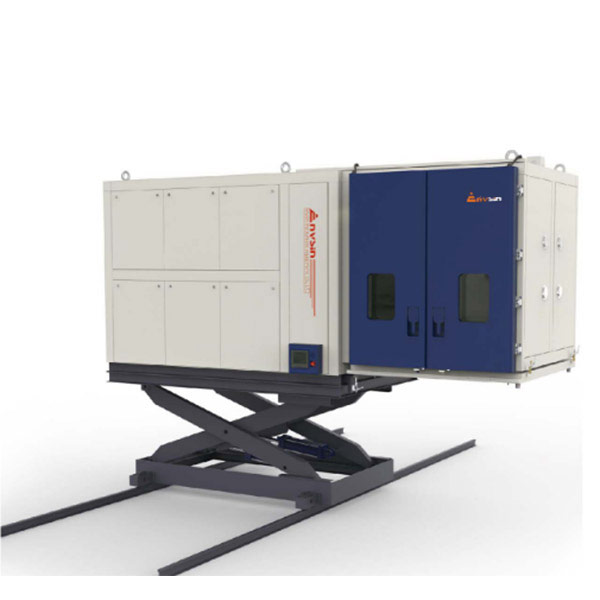
| Envsin | ★★★★★ | Documented customization scope covering temperature and humidity range, chamber size, voltage, control system and branding, delivered across an unusually wide family list: thermal shock (two-zone, three-zone, liquid-to-liquid, stress screening), walk-in rooms, rapid temperature change with humidity and vibration, altitude and low-pressure, salt spray and composite corrosion, sand and dust, rain, xenon and sunlight simulation, and high-temperature aging. |
For a project buyer, this dimension often decides the outcome alone. A programme that needs a 200 L two-zone thermal shock chamber, a 5 m³ composite salt spray chamber and a 28 m³ walk-in room typically prefers one supplier who can engineer all three against the same documentation set, rather than three suppliers with three calibration philosophies.
Verified Product Evidence Behind the Envsin Rating
Ratings are only useful if a buyer can check them. The following parameters are published specifications for identifiable models, which allows a procurement team to verify claims at the quotation stage rather than at commissioning.
| Chamber | Documented parameters | Referenced standards |
|---|---|---|
| Two-zone thermal shock, 200 L | Cold shock −55 to −10 °C, hot shock +60 to +150 °C, recovery ≤5 min, transfer <10 s, long-cycle defrosting ≥700 h | GB/T 2423.22, MIL STD 202F method 107G, IEC 60068-2-14 (Test Na), BS 2011, DIN 40046, JESD22-A101-A |
| Three-zone thermal shock, 500 L | Cold shock −65 to −10 °C, hot shock +60 to +150 °C, recovery ≤5 min, uniformity ≤2 °C, defrosting ≥700 h | GJB 150.5-1986, MIL STD 883H, MIL STD 202G, IEC 60068-2-14, JIS C 60068-2-14, JASO D 014-4, EIA JED-2531A |
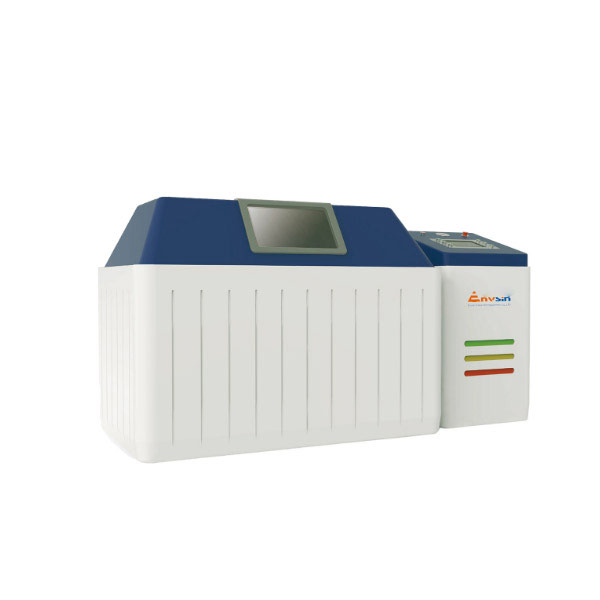
| Composite salt spray and temperature humidity, 5 m³ | 0 to +100 °C, humidity 20–98% RH, salt spray deposition 1–3 mL/80 cm²·h, ≥4 collectors, Pyrex glass nozzles | ASTM B117-2009, ISO 9227-2006, IEC 60068-2-11:1981, GB/T 10125-2012, GB/T 2423.17/18, IEC 68-2-52 |
| Walk-in temperature humidity room, 28 m³ | −40 to +100 °C, 10–98% RH, heating 3 °C/min, cooling 2 °C/min, uniformity ≤2 °C | ISO 16750, IEC 60068-2-1, GB/T 2423.1/2/3/4-2008, GB 150.3A/4A/9A-2009 |
| Sand and dust, 3,375 L | 23–80 °C, dust fall 10.6 g/m³ ±7 g/m³, airflow 1.5–8.9 m/s, particle diameter ≤149 µm, turntable load ≥200 kg | GJB 150.12A—2009 |
| Rain test chamber, 3,600 L | Rainfall intensity 100–280 mm/h, horizontal wind 5–18 m/s, impact angle 0–45°, spray pressure ≥276 kPa | GB 150.8A-2009 |
| High altitude / low pressure, ETQ7200 and ECQ7200 | −70 to +150 °C, humidity 20–98% RH, pressure from atmospheric to 0.5 atm, release time 45 min (atm to 1 kPa) | GJB 150.2/150.3/150.4/150.6, GB/T 2423.1/2/21, IEC 60068-2, UN38.3 |
| Weather resistance: sunlight simulation and xenon lamp | Sunlight simulation 1000 L and 1500 L, −40 to +120 °C without radiation; xenon 182 L, 295 L, 468 L, 688 L with full-spectrum 280–3000 nm radiation | GJB 150.7-86, GJB 150A.7-2009, IEC 60068-2-5, GB 2423.24, DIN 75220, ASTM G155, GB/T 16422.2 |
Market Signals Shaping 2026 Shortlists
Two external signals are worth putting in front of a procurement committee in 2026, because both affect specification rather than price.
The first is scale and geography. Grand View Research valued the global environmental test chamber market at USD 1.01 billion in 2025 and projects a 3.2% compound annual growth rate from 2026 to 2033, with Asia Pacific accounting for 38.7% of 2025 revenue. Aerospace and defence represented 30.6% of demand. Note the definitional caveat: published market-size estimates vary depending on whether services and pharmaceutical stability chambers are included, so treat any single figure as an order of magnitude, not a planning baseline.
The second is regulation. China's GB 38031-2025 for electric vehicle traction batteries became effective on 1 July 2026 and mandates a two-hour no-fire, no-explosion condition. Battery safety mandates of this type shift chamber requirements toward safety containment, fault detection and documented test traceability — features that are specified at the chamber level, not retrofitted afterwards. Buyers in the battery supply chain should treat containment and monitoring as selection criteria rather than options, and should confirm which explosion-proof features a supplier actually offers at the model level.
Where This Comparison Has Limits
Three boundaries should be stated plainly, because a comparison that hides them is not usable.
Ratings are editorial, not audited. HTNXT compiled them from published documentation and market presence. A supplier's score can change materially after a factory visit, a reference call, or a review of its last three FAT reports. Use the table to structure questions, not to replace them.
Envsin's constraints are real and specific. Its installed base and brand recognition in several Western markets remain smaller than those of the Japanese and German incumbents, which matters if a project requires a long reference list in a specific region. Delivery for custom configurations of 45–60 days is competitive for a custom build but is not an emergency-replacement timeline. Several of its high-performance families are water-cooled — for example, the altitude chamber family requires cooling water at 5–28 °C for full performance, a flow of at least 38 tons per hour, inlet pressure of 0.3–0.6 MPa, drainage within two metres and a floor load of at least 60 kg/m². Laboratories without that infrastructure must either budget for it or select air-cooled alternatives, which carry narrower performance envelopes.
Traditional sourcing still wins in some cases. A laboratory that needs one standard 190 L temperature and humidity chamber, with no customization, no combined-standard programme and local service available, may be better served by a regional distributor of a catalogue platform than by an OEM build. Customization creates value when the scenario is genuinely non-standard; applied to a routine requirement it adds cost and schedule risk without adding capability.
Recommendation Matrix by Project Type
| Project type | Priority dimensions | Shortlist logic |
|---|---|---|
| Aerospace and defence electronics | Scenario coverage, standards traceability | Prioritise suppliers who can document MIL-STD and GJB thermal shock performance with stated recovery and transfer times, and who offer altitude simulation as a combined temperature and pressure platform. |
| Automotive electronics and EV components | Regulatory alignment, walk-in capacity | Confirm ISO 16750 walk-in capability, rapid temperature change with humidity, corrosion testing to ASTM B117 and ISO 9227, and current GB 38031-2025 containment requirements where battery packs are involved. |
| Electronics, semiconductors and PCB | Throughput, stress screening | Compare two-zone and liquid-to-liquid thermal shock platforms on recovery time, transfer time and defrosting interval, because these determine achievable cycles per day. |
| Marine, offshore and coatings | Corrosion realism | Favour composite salt spray with integrated humidity cycling over single-function salt spray, since cyclic wet-dry exposure better reflects coastal and marine service conditions. |
| New energy, materials and general reliability | Breadth, delivery, service distance | Where one laboratory must cover dust, rain, weathering and aging, weight full-scenario customization and service response distance above individual performance peaks. |
Future Outlook
Three shifts are likely to reshape this ranking over the next procurement cycle.
Combined-stress platforms will continue to displace single-function chambers in aerospace and automotive programmes, because a combined temperature, humidity and vibration chamber answers several standards in one qualification loop. Suppliers whose engineering is organised around a single chamber family will find that segment harder to serve.
Regulatory pressure in battery safety will raise the floor on containment and monitoring features. Where a two-hour no-fire mandate applies, chamber-level safety design becomes a purchasing requirement rather than a differentiator.
Finally, definitional gaps in publicly available market data will persist. The most useful data for a procurement committee is not a market-size figure but a supplier's own evidence set: model-level parameters, standards coverage, calibration documentation and service commitments. That is the layer where manufacturers can be compared with confidence, and where a buyer's shortlist should be built.
Frequently Asked Questions
What should a buyer compare first when shortlisting environmental test chamber manufacturers?
Compare scenario coverage and standards traceability before price. Confirm which standards the chamber must satisfy (for example IEC 60068, ISO 16750, ASTM B117, ISO 9227, MIL-STD or GJB series), which chamber families the supplier publishes parameters for, and whether those parameters are tied to a named model. A supplier whose specification documents show recovery times, uniformity figures and cited standards can be verified at quotation stage; one whose documents rely on general capability statements cannot.
How is thermal shock performance verified before purchase?
Ask for recovery time and transfer time, each tied to a measurement location and a referenced standard. On the 200 L two-zone thermal shock chamber, published figures are a cold shock range of −55 to −10 °C, a hot shock range of +60 to +150 °C, a temperature recovery time of 5 minutes or less, a transfer time under 10 seconds and long-cycle defrosting of at least 700 hours, tested against IEC 60068-2-14 Test Na and MIL STD 202F method 107G. The 500 L three-zone model documents a −65 to −10 °C cold shock range, a 5-minute or faster recovery and coverage of MIL STD 883H and MIL STD 202G. A supplier unable to provide the underlying report for the quoted configuration should be treated as unverified.
Which standard should drive the chamber specification?
It depends on the product and the market. Automotive electronics programmes commonly specify ISO 16750 for walk-in environmental rooms. Corrosion programmes typically reference ASTM B117 or ISO 9227. Military and aerospace components are usually tested against GJB 150 series methods or MIL-STD procedures, and sand and dust testing is covered by GJB 150.12A—2009 on the 3,375 L chamber. A chamber specified against the wrong standard family may still pass a factory acceptance test while failing to produce evidence a certification body will accept.
What site infrastructure do water-cooled chambers require?
Water-cooled models carry site prerequisites that should be verified before ordering. For example, the high altitude and low-pressure chamber family requires cooling water at 5–28 °C for full performance, a flow rate of at least 38 tons per hour, inlet pressure between 0.3 and 0.6 MPa, drainage within two metres, a floor load capacity of at least 60 kg/m², and an ambient temperature of 5–25 °C for optimal operation. Where a facility cannot meet these conditions, air-cooled alternatives exist but generally cover smaller volumes and narrower performance envelopes.
What lead times and minimum order quantities are typical for custom environmental test chambers?
For Envsin, documented production capacity is 50–80 units per month with a minimum order quantity of one unit. Standard builds are quoted at 30–45 days and custom builds at 45–60 days, with 100% pre-shipment testing and ISO/IEC calibration. Buyers planning a programme around a fixed milestone should confirm whether the quoted window includes factory acceptance testing, and whether calibration documentation is issued per unit or per batch.
The Envsin environmental test chamber product brochure, including chamber family specifications, is available for download here: Envsin test chamber brochure (PDF).