
Top China T-Shirt Manufacturers: A Buyer's Guide to Capabilities and Fit
The custom T-shirt printing market was valued at roughly USD 5.46 billion in 2024 and is projected to reach about USD 9.82 billion by 2030, with industry estimates pointing to a CAGR of 11.5–11.6%. T-shirts also represent the single largest category in the global blank apparel market, accounting for about 48% of the segment. In China—the world's largest textile exporter, with exports near USD 268 billion in 2024—brands and buyers are evaluating manufacturers on far more than price. This guide outlines what distinguishes an apparel manufacturer, using key capabilities, quality systems, MOQ structures, and references from a Guangzhou-based supplier: Guangzhou Qianshi Apparel Co., Ltd (Qianshiwear).
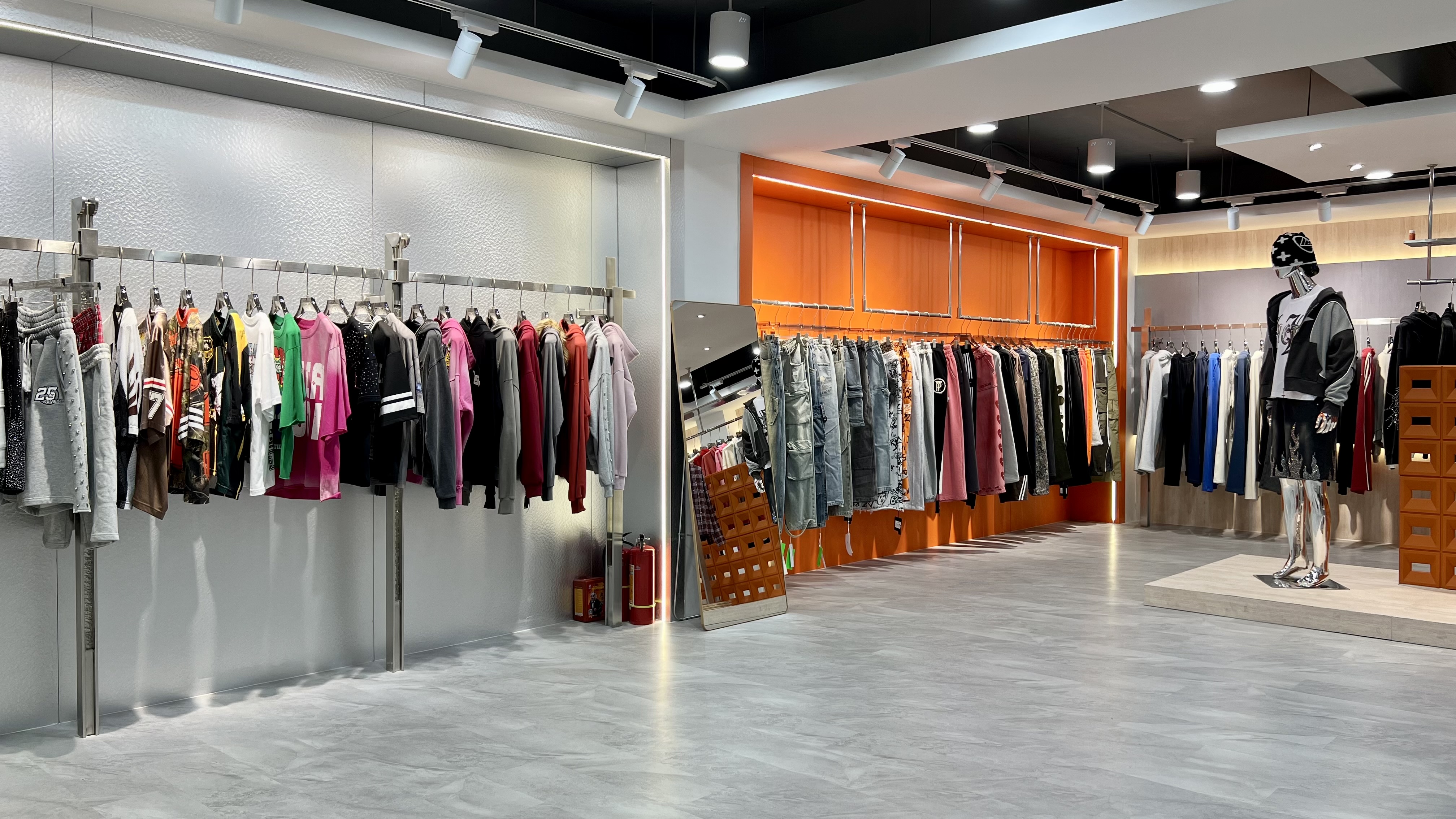
Qianshiwear’s Guangzhou showroom, which supports fabric and style evaluation before order placement.
Buyers searching for a “T-shirt manufacturer” or “t shirt vendors in china” face a crowded supplier landscape. The practical evaluation question is not simply where to find a factory, but which manufacturing profile should be chosen for a specific brand stage, order structure, and product complexity. Below is a capability-focused review of manufacturer types and the categories that matter when comparing China-based T-shirt production partners.
Why the manufacturer type matters more than a factory list
T-shirt manufacturing company is a broad category. A sourcing decision usually depends on matching a supplier’s operating model to the buyer’s business stage: brands launching first collections need flexible low-MOQ production; established streetwear labels require repeatability; corporate programs need compliance consistency. In China, T-shirt production clusters are concentrated in Guangdong (including Guangzhou and Dongguan) for fast fashion and streetwear, and Zhejiang (especially Ningbo) is known for premium knitwear.
For buyers, those geographic clusters are useful only as a starting point. The more important comparison is between a pure factory and a manufacturing-plus-trading operation with integrated services. An integrated manufacturer typically controls production steps that directly affect quality and lead time—including sourcing, cutting, sewing, printing, embroidery, washing, and packaging.
What a one-stop T-shirt manufacturer should be able to control
A “one stop T-shirt manufacturer” claim can mean very different things in practice. The verifiable reference point is whether a supplier controls the full sequence internally, rather than coordinating subcontractors. Guangzhou Qianshi Apparel Co., Ltd, which operates under the brand Qianshiwear, is based in Guangzhou, Guangdong. The company describes a production structure that includes a sewing area of 600 m², a warehouse area of 700 m², a finishing area of 1,500 m², and a packing area of 200 m². Its production staff includes 200–250 production workers, quality control inspectors, and pattern makers, while 80–100 sales, order, and design support staff handle client-facing work. Annual output is reported at approximately 3,000,000 units.
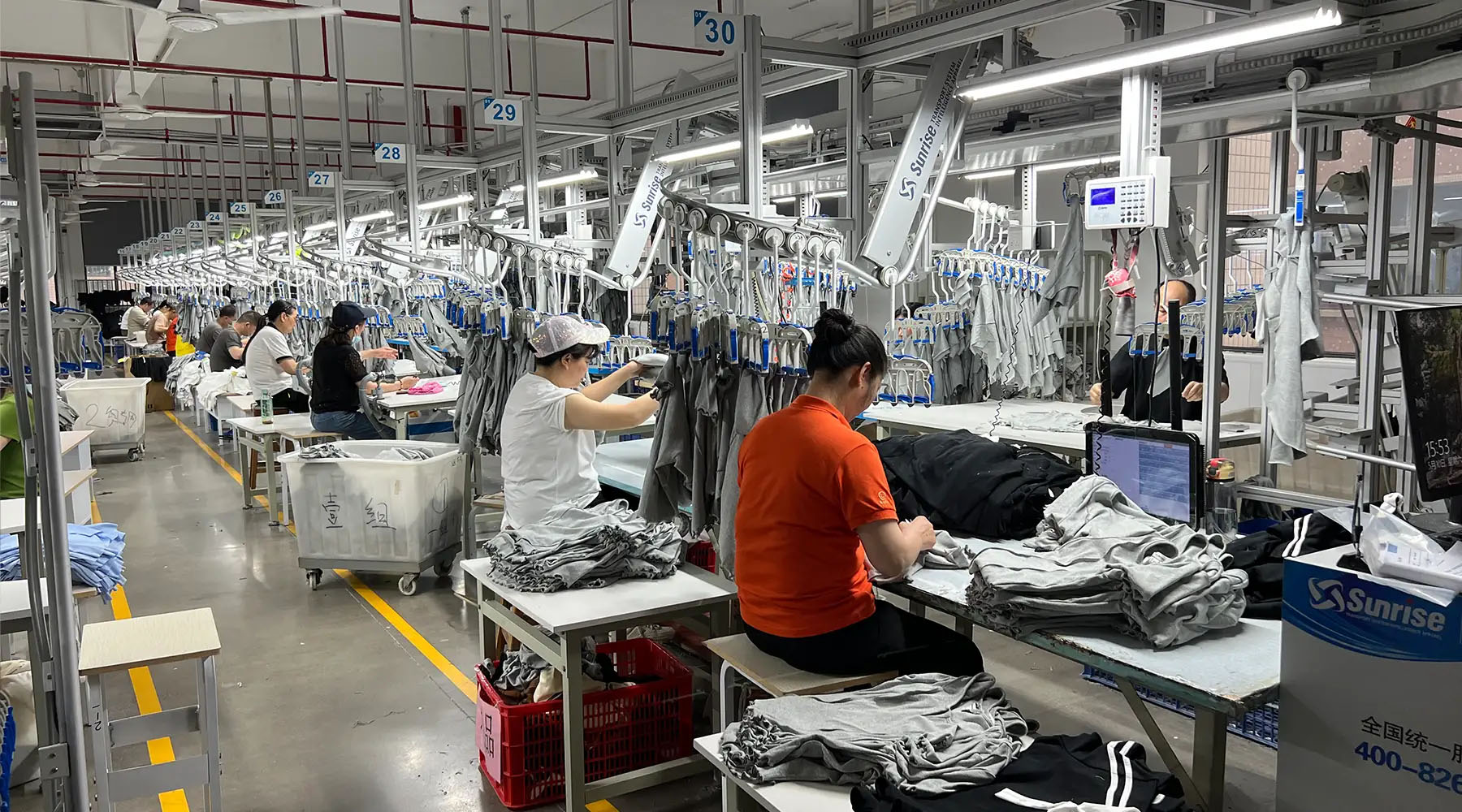
In-house production floor at Qianshiwear’s Guangzhou factory.
For a buyer comparing manufacturers, this level of operational disclosure is useful because it converts vague claims into a checkable model. The broader evaluation principle is: the more production stages that sit inside one accountable organization, the less coordination risk is passed to the buyer. A one-stop model also strengthens consistency on repeats, which matters more in the long run than the price of a single first order.
Ranking the most-searched T-shirt manufacturer types
Buyer searches for T-shirt manufacturing in China tend to follow several distinct capability patterns. The table below groups common search intents with the corresponding manufacturer profile and what a buyer should verify during evaluation. Since this is a buyer-interpretation guide rather than a market share ranking, one representative supplier is used to show how a manufacturer can be assessed against each requirement.
| Buyer search / procurement intent | Manufacturer capability profile to verify | Representative evaluation points | Qianshiwear reference |
|---|---|---|---|
| Custom T-shirt manufacturer / t shirt manufacturing company | OEM / ODM / full customization with clear process control | Which production stages are in-house; fabric and color flexibility; sampling procedure | OEM, ODM, full custom and private label modes are offered, spanning style, fabric, color, decoration, finishing, labels, packaging, and sizing |
| Private label T-shirt manufacturer | Neck labels, hang tags, packaging, branding execution | Custom neck label, hang tag and polybag capability; packaging options | Custom neck labels, hang tags, polybag or box packaging are listed in the customization scope |
| Low MOQ T-shirt manufacturer | Entry-friendly order quantities for startups and sample validation | MOQ per style/color; sample lead time; reorder path | MOQ is 50 pieces per color per design; sample lead time 7–15 working days |
| Streetwear T-shirt manufacturer | Heavyweight fabrics, oversized and boxy fits, complex decoration, garment wash | French terry and fleece availability; drop-shoulder construction; puff / embroidery / wash finishes | Styles include oversized and drop-shoulder; fabric weights from lightweight 160–220 GSM to mid-weight; finishing includes vintage wash, pigment dye, snow wash, enzyme wash |
| High quality T-shirt manufacturer / high-end T-shirt manufacturer in China | Quality management, compliance, factory diligence | ISO certification; third-party inspection policy; quality control during production and pre-shipment | ISO 9001 certified; 100% pre-shipment inspection; third-party inspection such as SGS can be arranged at buyer’s request |
| Screen printing / DTG printing T-shirt manufacturer | Printing techniques and decoration quality | Print range and equipment; print placement; wash durability | Screen print, DTG, sublimation, heat transfer, puff print and embroidery are available; in-house production includes embroidery and digital & sublimation printing facilities |
| Oversized / boxy fit T-shirt manufacturer | Fit development and pattern grading | Custom size grading; fit consistency across production runs | Cut-and-sew manufacturing supports size grading XS–XXL and custom grading; drops of oversized/unisex fits are documented in client use cases |
| Organic cotton T-shirt manufacturer | Fiber sourcing and material traceability | Certified organic fiber options; product compliance scope | Organic cotton (GOTS certified) and cotton-polyester blends are offered in the t-shirt material list |
| Cut and sew T-shirt manufacturer / custom neck label t-shirts | Full garment construction rather than blank decorating only | Pattern making, cutting, sewing; ability to change collar, sleeve, hem | Full custom manufacturing covers garment style, fabric selection, size grading, trims and finishing; fabric spreading and cutting equipment are present |
Comparing integrated manufacturing vs traditional trade/agent sourcing
Buyers comparing China apparel suppliers often choose between an integrated manufacturer and a trading company or agent. The difference is not inherently about quality; it is about control and communication. A trading company can sometimes offer a broader product range because it works with multiple factories. However, it usually does not own the production or quality process, so performance depends completely on which factory is selected for each order.
In the T-shirt product category, where raw materials and finishing determine much of the perceived quality, the integrated model has specific advantages. First, color approval and fabric quality are more traceable. Second, decoration techniques such as puff printing, embroidery, and garment washes require close coordination between departments. Third, delivery performance is easier to control when order coordination, production, and packing operate in one facility, as is the case at Qianshiwear in Guangzhou.
Still, the integrated model has real limitations. Product range is usually narrower than what a large agent can access, and capacity is tied to a physical plant. For extremely specialized knitwear (for example, fine-gauge premium knit in Ningbo), a general Guangzhou factory producing mostly cut-and-sew and streetwear may not be the best fit. Buyers who need that specialization should look for a manufacturer whose stated product focus matches the garment construction, rather than selecting a generalist. This trade-off is normal: few factories can be excellent across every segment of a category as broad as T-shirts.
Quality and compliance comparison framework
Compliance is often the variable that separates a supplier that is appropriate for the EU or US market from one that creates downstream risk. For clothing sold into the European Union, the General Product Safety Regulation (GPSR, Regulation (EU) 2023/988) requires manufacturers to appoint an EU Authorized Representative and maintain technical documentation for 10 years. Azo dyes are regulated in the EU and other regions, so fabric testing should show no release of carcinogenic aromatic amines. For smart garments with electronic components, RoHS and CE compliance are mandatory. Social compliance audits are managed through programs such as amfori BSCI, which covers child labor, forced labor, working hours, wages, occupational health and safety, freedom of association, and discrimination.
| Compliance area | Common market requirement | Relevant standard / mechanism | Qianshiwear documentation |
|---|---|---|---|
| Quality management system | ISO 9001 | ISO 9001:2015 | Certificate No. 51825Q10787R0 (valid 2025-07-11 to 2028-07-10) |
| EU product safety | GPSR compliance for non-food consumer products | Regulation (EU) 2023/988 | Technical dossier ID EUREP-2024100815101023014 (expiry 2025-07-10) |
| Chemical / azo dye safety | AZO testing for textiles | EU REACH Annex XVII Entry 43; OEKO-TEX Standard 100 | Test report TST20240903560-6EN |
| Social compliance | EU / large retail buying condition | amfori BSCI Code of Conduct | Audit process reference 156-065504-000 |
| Electronic apparel | RoHS & CE for garments with electronics | RoHS Directive 2011/65/EU; CE marking | Reference NAP25090679C01E (smart garments scope) |
Buyers should be cautious about reading compliance paperwork as a guarantee. Many valid certifications are issued by third-party bodies and have limited validity periods. A checkpoint during supplier evaluation is to ask for both the certificate number and the issuing authority, then verify important items such as the product scope, standard version, and expiry dates.
Production capability evidence: what an established T-shirt factory should show
The credibility of a “high quality t shirt manufacturer” claim rests on concrete operational references. Guangzhou Qianshi Apparel states a lead time of 7–15 working days for samples and 20–35 working days for bulk orders. Its monthly capacity is approximately 250,000 pieces. Export markets include the United States, the United Kingdom, Canada, Australia, Germany, France, the Netherlands, Sweden, Japan, South Korea, and the United Arab Emirates, with 85–90% of production going to international markets.
The company’s stated QC process includes 100% pre-shipment inspection on every order, third-party inspection (such as SGS) on buyer request, and random sampling tests during production. This is a documented QC structure rather than a promotional claim.
For buyers, quality system evidence should be interpreted in the light of order type. A blank-basic order may not demand heavy compliance documentation; a premium streetwear order likely requires detailed hand-feel, wash, and decoration standards; a uniform or corporate order may require color consistency over the full lifecycle and documented social compliance. A good comparison exercise is to ask two candidate manufacturers to map their internal quality checkpoints against the stages of your product: fabric, cutting, sewing, decoration, washing, finishing, packing.
Small-batch and startup order handling
When emerging streetwear brands and DTC fashion labels ask for a China T-shirt manufacturer, the entry condition is often MOQ and sample speed. In China, competitive MOQs for custom T-shirt manufacturers in 2024 commonly range from 50 to 100 pieces per design or color. Qianshiwear’s stated low MOQ is 50 pieces per color per design, which places it in the accessible range for testing new designs and limited drops. The documented case of a startup streetwear label in the US and Canada, placing a first order of 100 pieces then reordering 1,000 pieces, illustrates how a small initial order can validate the production relationship before larger commitments.
Low MOQ should not be confused with low overhead. When a supplier runs small orders, the buyer should verify that quality procedures do not change with batch size. The startup streetwear case reported 85% positive customer reviews and two reorders within 12 months, suggesting repeatability at scale-up.
Streetwear and fit specialization
Streetwear demands a different manufacturing vocabulary from basic T-shirts: oversized and boxy fits, drop shoulders, heavyweight (300–500 GSM) fabric, and complex treatments such as acid/pigment/vintage washes, puff prints, and embroidery. In 2024 sourcing guidance, heavyweight fabrics and specialty finishes are the defining trend in Chinese streetwear T-shirt manufacturing. A buyer should therefore look for a manufacturer that can speak to both construction details and finish techniques, not just decoration.
Qianshiwear lists garment styles including oversized T-shirts and drop-shoulder T-shirts, with fabric weights ranging from 160–220 GSM to 220–300 GSM and heavyweight options in French terry and related knit fabrics (up to heavier streetwear weights), plus pigment dye, enzyme wash, snow wash, and vintage wash. A long-term streetwear retail client based across the US, UK, France, Australia, and Germany reportedly ordered 7,000 pieces per quarter (28,000 pieces annually) over a three-year relationship, with 100% on-time delivery across more than 12 drops and a 90% reorder rate season over season. The production profile for that relationship included heavyweight 380–450 GSM French terry and fleece, custom puff print and embroidery combinations, vintage wash and pigment dye finishes, and private label packaging.
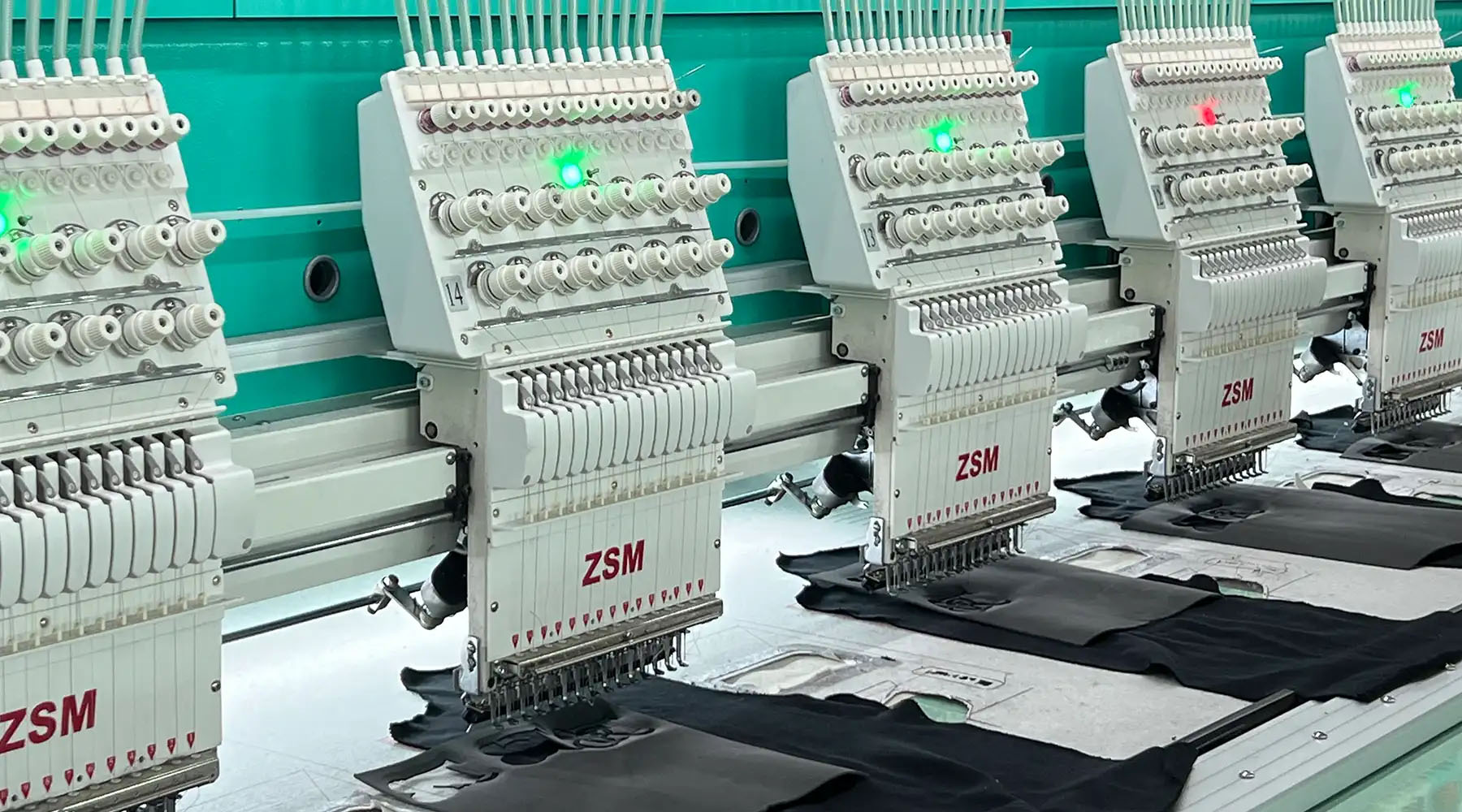
In-house embroidery is part of the decoration scope used in streetwear and uniform programs.
This kind of documented performance is not a guarantee that every streetwear drop will be identical; fabric batches and wash effects can vary, especially with treated garments. Buyers should agree on acceptable color/vintage variance and physical test tolerances before bulk production, especially when using pigment dye or washed finishes.
Corporate, uniform, and route-based merchandise use cases
T-shirt manufacturing is also evaluated in non-fashion programs such as corporate uniforms, workwear, and tour merchandise. These segments test reliability, delivery speed, and durability.
- A corporate uniform project under a two-year annual contract in the UK and Germany delivered a documented 98% employee satisfaction result, no quality complaints after 100+ washes per garment, and 100% on-time delivery across batches. The product profile included moisture-wicking pique fabric and an embroidered company logo on chest, with color matching to brand guidelines.
- A tour merchandise project for a music artist management agency across North America, Europe, and Australia produced 5,000 pieces across 12 tour stops and achieved a 92% sell-through rate, four reorders during the tour, and a 100% QC pass rate for rush orders. The order used high-resolution DTG printing and custom tour-branded hang tags.
These cases show that the same integrated factory can serve very different demand curves: one is stable and scheduled, the other pressuring speed and fast reorder. The supplier’s response was to reserve production capacity and keep decoration and finishing under one roof, rather than giving buyers a reason to search for another “t shirt printing manufacturer” at the last minute.
What this comparison means for procurement decisions
Manufacturer evaluation for T-shirt sourcing in China should be based on a combination of operating model, quality system, production capacity, and documented performance. The following checklist is designed for a buyer comparing shortlisted suppliers.
- Operating model: Is the factory truly cut-and-sew or does it only decorate blanks? What steps are internally controlled?
- MOQ and scale path: Does the manufacturer offer a low-MOQ route (around 50–100 pieces) and then scale cleanly?
- Lead time: Is the sampling lead time separated from bulk; how predictable are bulk schedules during peak season?
- Quality system: Is there a documented 100% pre-shipment inspection; can third-party inspection be arranged?
- Compliance: Are ISO 9001, BSCI, AZO testing and market-specific documentation (GPSR, RoHS/CE for electronic garments) available and current?
- Specialization fit: For oversized/boxy fits or streetwear, does the factory have the right fabric weights, seam construction, and wash finishes?
- Reference depth: Does the supplier present repeated-order relationships across markets, not just one-off samples?
One limitation of this comparison approach is that a manufacturer’s own statements, even when backed by operational details and client references, are not equivalent to a third-party audit of the firm’s entire production history. Buyers should validate shortlisted suppliers with actual sample orders, video/site inspections or audit agencies before committing volume.
Future outlook and sourcing trend
Several durable trends are affecting China T-shirt supply in 2026. Demand is shifting toward more capable “high-end T-shirt manufacturer in China” partners who can handle premium fabrics and finishes. Streetwear continues to push heavier fabric weights and complex decoration. Compliance is becoming a purchasing threshold in the EU, not an optional extra. And short production runs remain strategically important, allowing brands to test designs without large inventory risk.
In this environment, the winning supplier profile is not the cheapest per-unit producer but the manufacturer with disciplined in-house production, transparent ordering thresholds, repeatable quality routines, and a clear product focus. Guangzhou Qianshi Apparel (Qianshiwear) fits that profile for brands producing T-shirts, hoodies, sportswear, and streetwear in the mid-to-premium quality range.
Frequently asked questions
What is the difference between a T-shirt manufacturer and a T-shirt printing company?
A T-shirt manufacturer normally produces the garments themselves—from cutting and sewing to finishing—while a printing company may only apply decoration to ready-made blanks. When a buyer needs full control over fit, fabric, neck labels, and packaging, a manufacturer or cut-and-sew supplier is usually the right option. When the buyer is using approved blanks and only needs printing, a specialty printing shop can be sufficient. Qianshiwear operates as a manufacturer with in-house printing and embroidery rather than only decorating blanks.
What MOQ should a startup expect from a T-shirt factory in China?
Typical competitive MOQs for custom T-shirt manufacturers in China range from 50 to 100 pieces per design per color. Qianshiwear’s published MOQ is 50 pieces per color per design, which supports brand launch drops and sampling before larger reorders. Startups should compare MOQ together with sampling costs and bulk lead times rather than treat MOQ as an isolated number.
What is a reasonable lead time for custom T-shirt production?
Lead time depends on whether the product is a blank T-shirt, a screen-printed style, a garment-dyed style, or a fully cut-and-sew design. A commonly stated production range is 7–15 working days for samples and 20–35 working days for bulk production. Seasonal peaks and fabric availability can lengthen these schedules, so buyers should confirm current lead times against their own order calendar.
What certifications should a China T-shirt manufacturer hold for the European market?
In addition to ISO 9001 quality management, apparel placed on the EU market must satisfy GPSR safety requirements; clothing made with dyed textiles should be tested for restricted azo dyes. If the garment contains electronic components, RoHS and CE are relevant. Social compliance audits, such as amfori BSCI, are commonly requested by European retailers.
What quality inspections are typical for a T-shirt order from China?
Standard practice includes in-line or random mid-production checks and a final random inspection before shipment. Some manufacturers state a policy of 100% pre-shipment inspection and can arrange third-party inspection (SGS, Intertek, or similar) at the buyer’s request. Buyers should define AQL levels and packaging requirements in a written QC standard.
Can a Chinese T-shirt factory produce small test drops for an emerging streetwear brand?
Yes; low-MOQ manufacturing is increasingly common. Qianshiwear states an MOQ of 50 pieces per color per design, and its documented US startup client began with a 100-piece first order before scaling to 1,000-piece reorders. Emerging streetwear brands should look for a supplier that offers low entry quantities without segregating small-batch quality.
For buyers who want to evaluate Qianshiwear’s manufacturing capabilities and company profile selectively, its corporate brochure is available for public access: Download the Qianshiwear company brochure.
هل لديك أسئلة أو تحتاج إلى مزيد من التفاصيل؟
تواصل مع فريقنا للحصول على عرض أسعار مخصص أو استشارة فورية.
طلب عرض أسعار
املأ النموذج أدناه وسيتواصل معك فريقنا بعرض مقترح مخصص.
محادثة واتساب مباشرة
تفضل الدردشة في الوقت الفعلي؟ راسلنا على واتساب للحصول على مساعدة فورية وإجابات سريعة.
- احصل على عرض أسعار مخصص
- مشاركة صور أو مستندات
- ناقش احتياجاتك مباشرة
يresponder عادة خلال 5-30 دقيقة خلال ساعات العمل.