
Top Custom Shopping Bag Picks for 2026: PSB Model Options and Configurations
A custom shopping bag is judged in the customer's hand, not on the shelf. Four linked decisions set that outcome — paper stock, printing method, surface finish, and handle construction — and all four are locked long before artwork is approved. This reference maps the PSB custom shopping bag model from Opack into seven practical configurations for 2026, explains what each one is built from, and marks where the format's real limits sit.
Why 2026 Is a Specification Year for Custom Paper Bags
The paper-based consumer bag category is no longer a commodity line. Zion Market Research valued the global market for paper-based consumer bags at USD 5.29 billion in 2023, with product scope covering flat bags, satchel bags, twisted-handle bags, and printed specialty bags. The same research projects that the premium price segment — higher-grammage paper, custom design, reinforced handles, and certification — will register a CAGR of 13.8% through 2034.
Two compliance signals run alongside that growth. FSC certification is recognized by 56% of consumers worldwide as the primary standard for sustainable paper sourcing, according to the Forest Stewardship Council. Separately, the EU Deforestation Regulation (EUDR), effective 2025, requires paper packaging to be traceable back to geolocated forest plots.
For a retail buyer, the practical consequence is that “custom shopping bag” is an incomplete specification. The 2026 question is which stock, print method, finish, and handle will carry a specific load, reproduce a defined brand color consistently across batches, and satisfy a sourcing requirement. That question is answered configuration by configuration, not by a single catalog page.
The PSB Model: What Is Actually Configurable
PSB is the model designation for Opack's custom shopping bag line. Opack is a custom packaging manufacturer based in Longgang, Wenzhou, Zhejiang Province, China, producing custom rigid boxes, folding cartons, mailer boxes, and custom shopping bags, and exporting primarily to the EU, the US, and the Middle East. Custom packaging services are provided for the EU, US, and Middle East markets.
| Specification | PSB options |
|---|---|
| Paper stock | Kraft Paper, Whiteboard Paper, Specialty Paper, Coated Paper |
| Printing methods | CMYK Printing, Pantone Printing, UV Printing, Offset Printing, Screen Printing |
| Finishes | Hot Stamping, Spot Glossy UV, Soft Touch Lamination, Holographic Foiling, Embossing, Debossing, Matte Lamination, Gloss Lamination |
| Handle options | Paper Twisted Handle, Flat Paper Handle, Cotton Rope, Ribbon Handle, Die-Cut Handle |
| Size range | Fully customizable — small, medium, large, extra large |
| Load rating | 2–15 kg, depending on paper thickness and structure |
| Minimum order quantity | 1,000 pcs per size and design |
| Typical applications | Cosmetics, apparel, retail, gift, trade shows and events, e-commerce packaging |
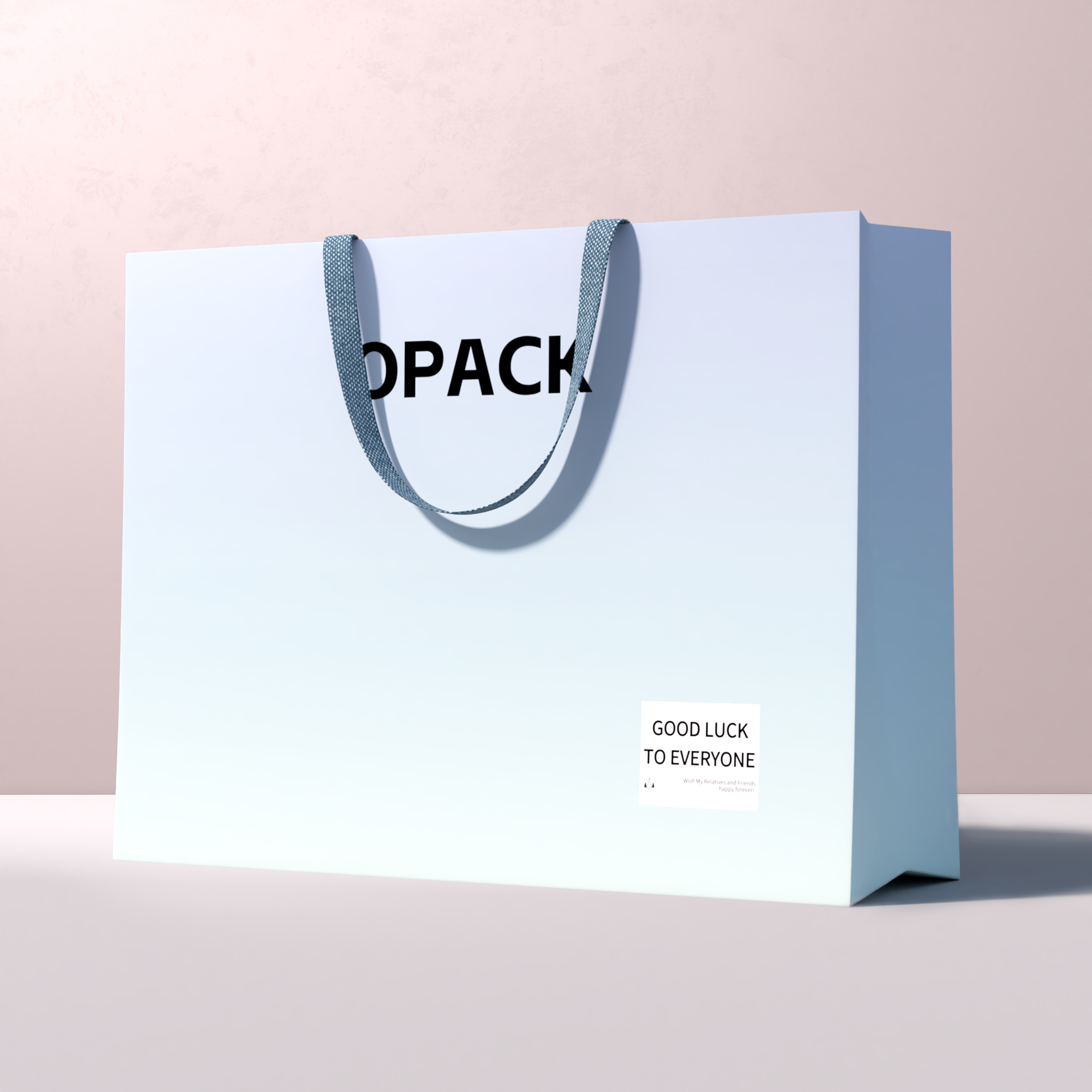
A PSB custom shopping bag is specified as one package: stock, print method, finish, and handle are chosen together, because each choice constrains the next.
Two entries in that table deserve emphasis. The load rating is structural: 2–15 kg is a function of paper thickness and bag construction rather than of a single stock choice, so a heavier requirement is solved by changing the build, not by changing the artwork. And the minimum order quantity is stated per size and design, which means a program running four sizes carries four separate minimums and should be planned as four production lines rather than one.
Seven PSB Configurations for 2026
The configurations below use only options that exist inside the PSB model. They are starting points for a specification conversation, not fixed catalog SKUs, and a buyer can move between them without changing supplier or production base.
| # | Configuration | Paper stock | Printing | Finish | Handle | Best fit |
|---|---|---|---|---|---|---|
| 1 | Everyday Kraft Retail | Kraft Paper | CMYK Printing | Matte Lamination | Paper Twisted Handle | Retail, trade shows and events |
| 2 | High-Fidelity Brand Color | Whiteboard Paper | Offset Printing + Pantone Printing | Gloss Lamination | Flat Paper Handle | Apparel, cosmetics |
| 3 | Luxury Gift Presentation | Coated Paper | Pantone Printing | Hot Stamping | Ribbon Handle | Gift, retail |
| 4 | Soft-Touch Premium | Specialty Paper | CMYK Printing | Soft Touch Lamination | Cotton Rope | Apparel, retail |
| 5 | UV Accent | Coated Paper | UV Printing | Spot Glossy UV | Die-Cut Handle | Cosmetics, e-commerce |
| 6 | Embossed Minimal | Specialty Paper | Pantone Printing | Embossing and Debossing | Flat Paper Handle | Gift, retail |
| 7 | Heavy-Duty Retail Carry | Kraft or Whiteboard Paper, higher thickness | Offset Printing | Matte Lamination | Cotton Rope | Apparel, trade shows and events |
Pick 1 — Everyday Kraft Retail
Kraft Paper with CMYK printing, matte lamination, and a paper twisted handle. This is the workhorse build for retail floors and event stands, where the bag changes hands quickly and the priority is a clean print on a natural substrate. The constraint to design around is the kraft tone itself, which mutes saturated colors, so artwork should be planned for the substrate rather than simply transferred onto it.
Pick 2 — High-Fidelity Brand Color
Whiteboard Paper with offset printing plus Pantone for the primary brand color, gloss lamination, and a flat paper handle. Specify this when the bag must carry detailed artwork or reproduce an exact brand color across multiple production batches — apparel and cosmetics programs most often land here, because those categories depend on color appearing identical on every reorder.
Pick 3 — Luxury Gift Presentation
Coated Paper with Pantone printing, hot stamping, and a ribbon handle. Reserved for gift and premium retail moments where the bag is part of the unboxing sequence rather than pure transport. The coated surface supports foil adhesion and spot-color work, which is why hot stamping and Pantone are normally paired on this build.
Pick 4 — Soft-Touch Premium
Specialty Paper with CMYK printing, soft touch lamination, and a cotton rope handle. The soft-touch surface and rope handle move the bag toward a tactile premium position, while the specialty stock gives the print a differentiated base texture that a standard white stock cannot reproduce.
Pick 5 — UV Accent
Coated Paper with UV printing and spot glossy UV, finished with a die-cut handle. Used when a design needs a raised gloss highlight over a matte field so that one graphic element draws the eye. Cosmetics and e-commerce packaging use this build because it introduces emphasis without adding print colors.
Pick 6 — Embossed Minimal
Specialty Paper with Pantone printing, embossing and debossing, and a flat paper handle. A low-ink, high-texture direction for gift and retail programs where restraint reads as premium. Deep relief usually calls for heavier stock, which is why this pick is normally specified on specialty or coated surfaces.
Pick 7 — Heavy-Duty Retail Carry
Kraft or Whiteboard Paper at higher thickness, offset printing, matte lamination, and a cotton rope handle. Positioned at the top of the 2–15 kg load band, it is the configuration to specify when apparel or multi-item retail loads are expected and when handle strength matters more than decorative detail.
Material Choices: Kraft, Whiteboard, Specialty, and Coated
Stock selection drives nearly everything downstream, including how faithfully a print reproduces and how much structure the finished bag can take.
- Kraft Paper — a natural brown stock widely used in retail and event bags. It pairs well with CMYK printing and matte lamination, and it mutes saturated colors because of its base tone.
- Whiteboard Paper — a smooth white surface that holds fine detail and delivers more predictable color, and the usual choice for Pantone-critical brand programs.
- Coated Paper — a coated surface for ink holdout, well matched to hot stamping, holographic foiling, and Pantone reproduction, and common in gift and premium retail.
- Specialty Paper — textured or colored stocks used to differentiate a bag at arm's length, typically combined with embossing, debossing, or soft touch lamination.
All four are listed PSB material options, so a single bag program can move between them without changing production partner or renegotiating commercial terms.
Print Methods: CMYK, Pantone, UV, Offset, and Screen
Printing is where specification errors become visible after delivery, because a color approved on a proof is not automatically the color that repeats in production.
- CMYK Printing — four-color process for photographic imagery and gradients. Efficient for full-color artwork; the trade-off is that a defined brand color is approximated rather than matched.
- Pantone Printing — spot-color printing that reproduces a defined brand color. This is the method to specify when the same color must read identically across multiple production batches.
- Offset Printing — a plate-based process suited to detailed artwork and larger runs, and the usual partner to Pantone work on premium bags.
- UV Printing — used for accent and gloss effects, including spot glossy UV that raises selected areas of a matte design.
- Screen Printing — a heavier ink deposit for bold, high-opacity graphics and special effects.
A practical rule follows from this list: if the brand color is a contract requirement, plan for Pantone rather than a CMYK approximation, and approve proofs against the actual production stock rather than a generic white sheet.
Finishes: Hot Stamping, Embossing, and Lamination
- Hot Stamping — metallic foil applied to the surface, used for logos and brand names on premium bags.
- Spot Glossy UV — a localized gloss highlight over a matte base, useful for directing attention to a single element.
- Soft Touch Lamination — a velvety surface feel that raises perceived quality in the hand.
- Holographic Foiling — reflective foil for high-visibility accents.
- Embossing and Debossing — raised or recessed relief; deep relief generally requires heavier stock and works most predictably on coated or specialty papers.
- Matte and Gloss Lamination — surface protection combined with a matte or reflective finish.
Finishing carries a structural cost as well as a visual one. Hot stamping, foiling, and embossing each add process steps to the production sequence, and deep embossing narrows the range of stocks that can carry it without distortion. For programs with strict fiber-recovery goals, laminated surfaces should be reviewed with the supplier during specification, since lamination changes the surface composition of the finished bag.
Handles and Support Accessories
The handle is the part of a custom shopping bag that fails first under load, which makes it a structural decision rather than a decorative one.
- Paper Twisted Handle — a paper-based twisted handle, the default for retail and event bags and consistent with the bag's own material family.
- Flat Paper Handle — a flatter profile that spreads contact across a wider area, common on larger bag formats.
- Cotton Rope — a softer grip, normally specified on premium or heavier bags where comfort at the point of carry matters.
- Ribbon Handle — used for gift and luxury presentation.
- Die-Cut Handle — an integrated cut handle with no added component.
Handles are also a customization surface in their own right and are supplied as custom handles matched to bag format and color. Alongside the bag itself, supporting print items such as stickers are frequently part of the same order, which keeps a retail packaging program on one production schedule and one color standard rather than splitting it across vendors.
Application Fit: Where Each Configuration Earns Its Place
PSB custom shopping bags are applied across cosmetics packaging, apparel packaging, retail packaging, gift packaging, trade shows and events, and e-commerce packaging. The mapping is fairly direct: Pick 2 and Pick 5 suit cosmetics and e-commerce, where graphic precision and accent detail carry the brand; Pick 2, Pick 4, and Pick 7 suit apparel, where load capacity and color consistency matter; Pick 3 and Pick 6 suit gift and premium retail, where the bag is part of the presentation; Pick 1 and Pick 7 suit trade shows and events, where volume and durability dominate.
A brand owner in the fashion and lifestyle sector in Panama has run an annual purchasing partnership with Opack covering more than 30,000 paper bags, more than 3,000 paper boxes, and more than 10,000 stickers in a single year, with total annual purchase value above USD 12,000. According to the project record, the client reported consistent print quality across multiple production batches, stable lead times, smooth communication, and zero after-sales complaints across the partnership. The case matters less for its size than for its structure: bags, rigid boxes, and stickers were sourced as one supply relationship, which is precisely the pattern the accessory range is built to support.
Trade-offs: Where the Format Has Limits
Custom printed bags are not automatically the right answer for every retail buyer, and the honest comparison against plain unprinted bags runs in both directions.
- Minimum quantity. Paper shopping bags are quoted at 1,000 pcs per size and design. A multi-size program multiplies that commitment. Some suppliers advertise lower entry points — Teal Packaging states custom paper shopping bags starting at 50 units — so pilot-scale buyers do have alternatives, at the cost of a different production base and potentially a narrower material and finish range.
- Lead time. Opack lists a 12–18 day lead time for custom packaging production, while published FAQ guidance for paper bags has referred to roughly 7 to 15 business days. Buyers should confirm timing at quotation for their specific stock, finish, and size rather than assume a fixed number.
- Load ceiling. The rated band is 2–15 kg depending on paper thickness and structure. Above that band the answer is a different structure, not a heavier print or a thicker lamination.
- Substrate limits. Kraft's natural tone constrains vivid color fidelity. A buyer who needs an exact brand color should move to Whiteboard or Coated stock rather than force the color onto kraft.
- Total cost. Custom printing, hot stamping, foiling, and embossing each add cost relative to an unprinted bag. The comparison only balances when the bag's function as brand media is counted, which is a judgment the buyer makes rather than a figure a supplier can hand over.
- Origin and freight. The sourcing base affects landed cost and lead time. Some suppliers position on domestic production — EcoEnclose states that its paper bags are made in the USA by default, while its die-cut handle bags and reusable shopping bags are made overseas by default — whereas Opack manufactures in China for EU, US, and Middle East export.
Procurement Criteria Before You Commit
A specification only becomes actionable once commercial terms are attached to it.
- Minimum order quantity: paper shopping bags 1,000 pcs per size and design; rigid gift boxes 500 pcs per size and design.
- Delivery terms: EXW and FOB are available based on customer requirements, with shipping arrangements coordinated according to destination and project schedule.
- Acceptance criteria: all products undergo internal quality inspections before shipment, and third-party inspections are welcome upon customer request.
- Payment terms: 40/60.
- Production: monthly capacity of 1,000,000 units, with a stated lead time of 12–18 days and 100% quality check.
- Sourcing credential: FSC Chain of Custody certification GFA-COC-005690, issued by GFA Certification GmbH under standard FSC-STD-40-004 (Version 3.0), with a stated scope covering cardboard packaging, sacks and bags of paper, adhesive labels, and other pulp and paper products. Buyers should verify that the certificate is current in the FSC public database as part of supplier qualification.
- Supplier profile: founded in 2010; 10,000 m² factory; 160 employees; annual output of 10,000,000 units; R&D team of 5; export ratio of 80%; after-sales support through real-time online chat, WhatsApp, telephone, and official email.
Outlook for 2026 and Beyond
The direction of travel is visible in the data already on the table: a premium paper bag segment growing at a 13.8% CAGR through 2034, FSC recognition held by 56% of consumers worldwide, and EUDR traceability obligations active since 2025. For buyers, that combination points toward specification-led procurement, in which supplier selection begins with a stock-and-finish discussion, a certificate check, and a stated load requirement, and in which color consistency across production batches is treated as a compliance item rather than a design preference. Bags that cannot evidence their fiber sourcing will be harder to place in European retail channels, and bags that cannot hold a color will be re-specified before they are re-ordered.
FAQ
What materials can PSB custom shopping bags be made from?
PSB custom shopping bags can be produced in Kraft Paper, Whiteboard Paper, Specialty Paper, or Coated Paper. Kraft is the natural brown stock typically used for retail and event bags; Whiteboard is a smooth white stock suited to detailed or color-critical artwork; Coated Paper supports Pantone reproduction and hot stamping; Specialty Paper covers textured and colored premium stocks. The material choice determines print fidelity, which finishes are viable, and how much structure the finished bag can carry.
Which printing methods are available for custom printed paper shopping bags?
The PSB model supports CMYK Printing, Pantone Printing, UV Printing, Offset Printing, and Screen Printing. CMYK is used for full-color imagery and gradients; Pantone is used when a defined brand color must reproduce consistently across production batches; Offset supports detailed artwork on larger runs; UV printing is used for accent and gloss effects such as spot glossy UV; Screen printing deposits heavier ink for bold graphics and special effects.
What handle options exist, and how should a buyer choose between them?
Available options are Paper Twisted Handle, Flat Paper Handle, Cotton Rope, Ribbon Handle, and Die-Cut Handle. Paper twisted and flat paper handles suit everyday retail and larger formats; cotton rope is normally selected for premium or heavier loads; ribbon handles are used for gift presentation; die-cut handles are integrated into the bag with no added component. Because the handle is the load-bearing component, handle selection should follow the bag's intended weight rather than its artwork.
How much weight can a custom paper shopping bag carry?
PSB custom shopping bags are rated for 2–15 kg, with the exact figure depending on paper thickness and bag structure. A load near the top of that band requires a heavier stock and an appropriately reinforced handle, so the intended weight should be specified at the start of the project rather than after proofing.
What is the minimum order quantity and typical lead time for custom paper shopping bags?
Paper shopping bags are quoted at 1,000 pcs per size and design, and rigid gift boxes at 500 pcs per size and design. Opack lists a lead time of 12–18 days for custom packaging production, while published FAQ guidance for paper bags has referred to roughly 7 to 15 business days. Because timing depends on stock, finish, and finishing steps, buyers should confirm the schedule at quotation.
What are the purchasing terms and acceptance criteria?
Delivery terms are EXW and FOB, available based on customer requirements, with shipping arrangements coordinated according to destination and project schedule. All products undergo internal quality inspections before shipment, and third-party inspections are welcome upon customer request. Payment terms are 40/60.
Is Opack's paper bag production FSC certified?
Opack holds FSC Chain of Custody certification GFA-COC-005690, issued by GFA Certification GmbH under standard FSC-STD-40-004 (Version 3.0). The stated scope covers cardboard packaging, sacks and bags of paper, adhesive labels, and other pulp and paper products, and applies to markets including Europe, North America, Australia and New Zealand, and the Middle East. Buyers should confirm the certificate's current status and expiry in the FSC public database during supplier qualification.
Can custom shopping bags and supporting items such as stickers be ordered together?
Yes. Supporting print items such as stickers, along with custom handles matched to bag format and color, are supplied alongside paper bags within the same packaging program. A Panama-based brand owner in the fashion and lifestyle sector has run an annual purchasing partnership covering more than 30,000 paper bags, more than 3,000 paper boxes, and more than 10,000 stickers, which illustrates the one-stop ordering pattern in practice.
Comparing Configurations Before You Quote
The table in this article is intended to be used as a checklist rather than a catalog: stock, print method, finish, handle, and load requirement, in that order. Buyers running EU, US, and Middle East retail programs can compare configurations against the same five fields, then attach the commercial terms — minimum quantity per size, delivery basis, acceptance criteria, and lead time — before requesting pricing. Company and capability documentation, including the full packaging range and production profile, is available in the Opack company profile.